* Dept. of Education, Professor
On Introducing CLIL into Foreign Language
Activities in Elementary Schools in Japan
AOTANI, Noriko*
11. Introduction
The reform of English education in Japan throughout elementary, junior high and high schools will be carried out from 2018 in order to respond to ongoing rapid globalization. One of the major changes is the early introduction of English to the curriculum at elementary schools. The Ministry of Education, Culture, Sports, Science and Technology (MEXT) intends that “students build a foundation for communication skills and raise their interest in English as they become familiar with the sounds of the language by starting foreign English activities from the middle grades of elementary school.” For upper graders, they intend “students to develop basic communication skills including the skills such as listening to and speaking about daily topics using basic phrases, while also obtaining the mindset for reading and writing.”
Since the last reform in 2008 when they first introduced Foreign Language Activities into elementary schools, however, the problem of who-teaches-what-and-how has been left unsolved. Although the government has been developing new educational materials such as “Hi, friends! Story Books” and “Hi, friends! Plus” to enhance English lessons, developing teaching methods is another crucial issue to be
considered.
This study explored the possibility of introducing Content and Language Integrated Learning (CLIL) activities into English lessons in elementary schools, and discussed some educational implications.
2. The aim of CLIL
Content and Language Integrated Learning (CLIL) is a dual-focused educational approach in which both the content of a subject and language are taught together. Content and language are interwoven with each other (Mehisto, Marsh, & Frigols, 2008; Coyle, Hood, & Marsh, 2010).
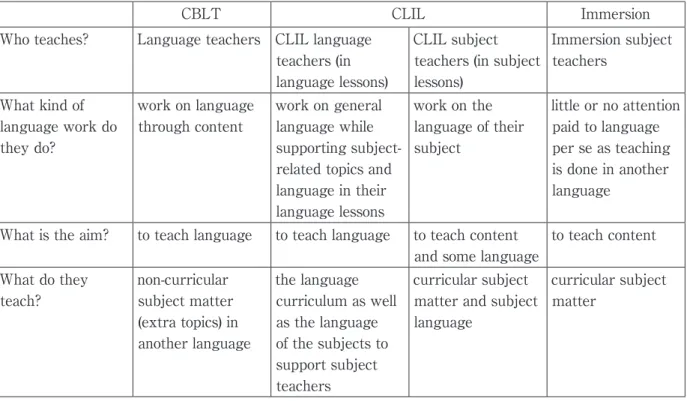
CLIL has been flourishing in Europe since mid-1990s because achievement of plurilingualism is crucial in order to maintain both the economic and political power of Europe in the world. Although the method of CLIL is included in the Communicative Approach of language teaching, it has different aims from other methods in the same approach such as content-based language teaching (CBLT) and immersion. Table 1 partially adapted from Dale & Tanner (2012) shows the differences between CBLT, CLIL, and immersion.
Comparing these methods can help us understand the basic idea of what CLIL is and its benefits. CLIL is basically conducted by two kinds of teachers, that is, CLIL language teachers and CLIL subject teachers. Thinking about the situation in Japanese elementary schools where all subjects including Foreign Language Activities are taught by one teacher, it might be possible for the class teacher to play
both roles, if proper training is provided, which is discussed more in the later part of this paper.
Coyle (2008) claims there are four important elements regarding CLIL; Content (growth of knowledge and understanding without explicit focus on structure), Communication (learning by doing or improving language communication by using it), Cognition (developing abstract and concrete thinking skills), and Culture2 (exploring new to you perspectives which deepen awareness). It is significant to point
out how much these elements can get into line with the target of English education including Foreign Language Activities in Japan.
3. CLIL practices in Japan
A pioneer case of CLIL practice in Japan is the one at Sophia University, which is called the Sophia Academic English Program. It intends to improve students’ proficiency in English for academic purposes (Watanabe, Ikeda, & Izumi, 2011a; 2011b). In this course, students learn academic skills such as note-taking, critical reading, discussion, and essay writing. Since students might be required to read and write papers in English in the future, the interweaving of content and language might be reasonably accepted by students. Lafaye (2017) reported CLIL practice for University students who are majoring in Humanities Studies. In the course, students combined reading, writing and discussion study/skill study in a course which culminated in the production of a class newspaper.
CLIL practices in junior and high schools are also reported (Sasajima ed., 2011), but their introduction seems experimental rather than systematic. Systematic introduction of CLIL to junior and high schools has a significant hurdle to overcome: the fundamental reform of English education in Japan.
In contrast to junior and high school curricular, Foreign Language Activities curriculum has more flexibility, so chances of introducing CLIL activities might be high. Sasajima ed. (2011) reported a
Table 1 The differences between CBLT, CLIL, and immersion
CBLT CLIL Immersion
Who teaches? Language teachers CLIL language teachers (in language lessons)
CLIL subject teachers (in subject lessons) Immersion subject teachers What kind of language work do they do? work on language through content work on general language while supporting subject-related topics and language in their language lessons work on the language of their subject little or no attention paid to language per se as teaching is done in another language
What is the aim? to teach language to teach language to teach content and some language
to teach content What do they teach? non-curricular subject matter (extra topics) in another language the language curriculum as well as the language of the subjects to support subject teachers curricular subject matter and subject language
curricular subject matter
CLIL practice at Morimura Gakuen, which is a private elementary school in Yokohama, Japan. A home economics teacher at the school and a CLIL teacher sent by the British Council taught a CLIL class named “How to make welshcakes”. The targets of the class were to learn to say (1) ingredients, (2) quantities of ingredients, and (3) cooking procedures in English, as well as learn how to make the cake. This class seemed to be a successful CLIL case in Japan; however, Sasajima pointed out the biggest issue that prevents CLIL from spreading is a shortage of trained teachers.
Yamano (2014) also reported her CLIL practices at a public elementary school in Saitama, Japan. She practiced CLIL in PE, art, and science classes by using English vocabularies and expressions used in Hi, Friends!. Following up on her practice, she pointed out some issues of concern: difficulty creating lesson plans and teaching/learning materials, and teachers’ attitudes to CLIL activities.
4. Possible elementary school CLIL activities
The existing teaching guidelines of Foreign Language Activities limit the contents to oral communication, and spelling, grammar, reading, and writing are outside the scope of the course. The new guidelines are basically following the same direction. With such a restriction, CLIL activities should be planned very carefully. Moreover, materials and teaching methods should be simple and easy enough to encourage teachers to use them without hesitance. The following are examples of simple and possible CLIL activities which could be applied to many subjects.
Odd one out3
Outline: Learners discuss which picture is the odd one out. Thinking skills: Comparing and contrasting, reasoning
Language Focus: Vocabulary Language skills: Speaking
Preparation: Each learner (group of learners) selects a group of four pictures. There should not be an obvious odd one out in one’s group of four.
Procedures: Put four pictures on the board. Discuss with the class which word could be the odd one out and why. Encourage the learners to use knowledge they have leant from other subjects.
Reasoning can be provided in either English or Japanese, depending on the learners’ proficiency level.
Subject examples: Science → beetle, dragonfly, spider, ant Math → two, six, eleven, thirty
Japanese → book, desk, pillow, paper
Social Studies → Singapore, Korea, Austria, Paris
Describe and draw4
Outline: Learners describe a picture to a partner who draws it. Thinking skills: Ordering
Language skills: Speaking
Preparation: Collect photographs, pictures or illustrations which are simple to draw. Each learner (group of learners) will need a blank sheet of paper, a pencil and an eraser. Brainstorm with the class some useful language for explaining the position of objects in their picture, e.g. on the right-hand side, in the left corner, below, above next to, in the middle.
Procedures: Divide the class into pairs (A and B), and position each pair opposite each other so that they can’t see each other’s pictures. A describes one’s picture to B, who must draw it carefully. Swap a role so that B describe one’s picture to A.
Subject examples: Geography → map symbols
Math → a series of diagram showing the relationship between height and tangent point
Music → drawing of a musical instrument
PE → a series of stick figure drawing explaining a physical exercise
In both cases above, while the procedure is quite simple, CLIL teachers are expected to provide proper scaffolding to help learners understand the input, and encourage them to achieve output (Mehisto, Marsh, & Frigols, 2008). Scaffolding should be provided very carefully especially for novice leaners in order not to discourage and frustrate them, and, instead, to give them confidence in express their ideas using English. The thought of giving scaffolding might scare some teachers without high English proficiency and it might cause them to step back from CLIL teaching. However, it should be emphasized that the matter is not the English proficiency level, but the methodology and skill of teaching. In fact, in the case of the science version of “odd one out” above, reasoning can be presented by using easy sentences like “beetles, dragonflies and ants have four legs, but spiders have eight legs”.
5. Conclusion
According to the recent announcement from MEXT, the number of classes of the Period for Integrated Studies (Sogo-teki Gakushu no Jikan) will decrease due to the introduction and increase of Foreign Language Activities in elementary school classes, which would be controversial. The overall objectives of the Period for Integrated Studies are:
To enable pupils to think in their own way about life through cross-synthetic studies and inquiry studies, while fostering the qualities and abilities needed to find their own tasks, to learn and think on their own, to make proactive decisions, and to solve problems better. At the same time, enable pupils to acquire the habits of studying and thinking, cultivating their commitment to problem solving and inquiry activities in a proactive, creative and cooperative manner (adapted from MEXT HP).
Also, in the teaching guidelines of Foreign Language Activities, the importance of the linkage with other subjects is mentioned. In order not to detract the values of the objectives of the Period for Integrated Studies, and, at the same time, in order to attach importance of relatedness with other subjects, the introduction of CLIL activities has great significance. In CLIL activities, students work on the integration
of subject contents they’ve already learnt and the language, which could channel them into “the proactive and interactive deep learning”, which is one of the keywords of the coming Course of Study from MEXT.
As mentioned above, the great advantage of the introduction of CLIL in elementary schools is the fact that the class teacher can play a role as both CLIL subject teacher and CLIL language teacher. In order to make this ideal situation real, elementary school teacher training courses at university should provide CLIL methodology workshops or courses to let the students develop their CLIL skills.
Footnotes
2 Community sometimes replaces Culture (Mehisto, Marsh, & Frigols, 2008).
3 This activity is adapted from Dale & Tanner (2012, p155), and revised by the authors. 4 This activity is adapted from Dale & Tanner (2012, p174), and revised by the authors.
References
Coyle, D. (2008). CLIL – a pedagogical approach. In N. Van Deusen-Scholl, & N. Hornberger (eds). Encyclopedia of Language and Education, 2nd edition, Volume 4: Second and Foreign Language Education, 97-111. Springer Science + Business Media LLC.
Coyle, D., Hood, P., & Marsh, D. (2010). CLIL: Content and Language Integrated Learning. Cambridge University Press.
Dale, L., & Tanner, R. (2012). CLIL Activities: A resource for subject and language teachers. Cambridge University Press.
Lafaye, E. B. (2017). The Media English Course: Making space for content in the language classroom. Kyoiku-Kenkyu-Kiyo, 2, 13-22. Tokai Gakuen University.
Mehisto, P., Marsh, D., & Frigols, M. J. (2008). Uncovering CLIL: Content and Language Integrated Learning in Bilingual and Multilingual Education. Macmillan Books for Teachers.
Sasajima, S. ed. (2011). CLIL: Atarashii Hassouno Jugyou. Sanshusha.
Watanabe, Y., Ikeda, M., & Izumi, S. (2011a). CLIL: New Challenges in Foreign Language Education at Sophia University, Volume 1: Principles and Methodologies. Sophia University Press.
Watanabe, Y., Ikeda, M., & Izumi, S. (2011b). CLIL: New Challenges in Foreign Language Education at Sophia University, Volume 2: Practices and Applications. Sophia University Press.
Yamano, Y. (2014). Shogakkou Gaikokugokatudou to CLIL. In S. Matsumoto, M. Ikeda, & S. Sasajika (eds). Nihon deno CLIL no Shinten (Japan CLIL Development), volume 1, 84-92. CLIL Japan.