K Industrial Use
Computational Study for Electrical and Optical Properties of Organic
Semiconducting Polymers
高分子有機半導体材料の電気的光学的特性の計算科学的研究
Masaya Ishida1, Shinya Nishino1, Yukiya Abe2, Takeo Hoshi2
石田雅也1, 西野信也1, 安部友樹也2, 星健夫2 1Sumitomo Chemical Co., Ltd., 2Tottori University
1住友化学株式会社, 2鳥取大学
Abstract
The electrical and optical properties of organic semiconducting polymers were investigated on the K computer by the two novel quantum material simulators of RSRT and ELSES. Organic polymer is a foundation of flexible devices. The present paper focuses on isolated polymers and aggregated polymer structures for poly-fluorene, which is a typical organic polymer. We found that the research with the two programs gave fruitful knowledges, since the optical spectrum by RSRT can be analyzed with the orbital wavefunctions by ELSES and we can obtain the physical origin of the spectrum. In addition, the wavepacket dynamics simulation by ELSES enables us to simulate the charge propagation between polymers. These researches will play crucial roles in computational material design of next-generation industrial devices.
Keywords: organic semiconducting polymer, fluorene, optical spectrum, time-dependent density functional theory, large-scale electronic state calculation, wavepacket dynamics, RSRT, ELSES
要旨 2 種の革新的量子物質シミュレータ、RSRT および ELSES、を「京」上で用いて、高分子有機半 導体材料の光電子的性質を研究した。有機高分子はフレキシブルデバイスの基盤である。本論文 では、典型的有機ポリマーであるポリフルオレンに着目した。2 種プログラムを用いた研究は有 意義であることが分かった。RSRT による光学スペクトルを ELSES の軌道波動関数を用いて解析 することができ、スペクトルの物理的起源を知る事ができるためである。さらに、ELSES の波束 ダイナミクス計算では、高分子間の電荷伝搬が可能となった。これら研究は、次世代工業デバイ スに対する計算物質設計において、必須の役割を担う。 キーワード:高分子有機半導体、フルオレン、光学スペクトル、時間依存密度汎関数理論、 大規模電子状態計算、波束ダイナミクス、RSRT、ELSES
techniques for calculating polymer structures and electronic states taking into account structural conformation of polymer chain and to reveal optical and electrical properties of organic semiconducting polymers from the viewpoint of polymer structures and the electronic states.
2. Calculation Model
We studied poly-fluorene (FL), which is a typical organic polymer, in single-chain structural models and aggregated models. See Sec. 4 for details.
3. Method and Performance of Parallel Computing
The organic polymers were investigated by two novel quantum material simulators. One is the first-principles optical spectra calculated by real-space and real-time (RSRT) program [1,2] with the time-dependent density functional theory (TDDFT) [3,4]. The other is the extra large scale electronic structure (ELSES) program [5-8] with a first-principle-based modeled (tight-binding-form) theory. The two programs enable efficient parallel computations on the K computer [2,7].
4. Research Results 4-1. Single polymer chain
Single chain structures were investigated for linear and bended structures with different number of the monomer units 𝑛, so as to investigate how these structural features affects the electronic states. We focused on poly-fluorenes of FL2, FL10, FL20, FL40 and FL80, in which the ninth position is simplified to a methyl group. Figure 1(a) shows an example of the linear chain structures with the monomer units of 𝑛=2 (FL2), 𝑛=20 (FL20) and 𝑛=40 (FL40), and Fig. 1(b) shows the bended chain structure with the monomer units of 𝑛=40 (FL40). The bended structure was prepared in the two stages: First, a classical molecular dynamics simulation in the temperature of 598 K was carried out leading to the resultant structure with significantly large deformations. Then the thermal relaxation was carried out by ELSES in the temperature of 298 K.
Figure 1 (a) Example of the linear chain polymer structures. (b) The bended chain structure of FL40.
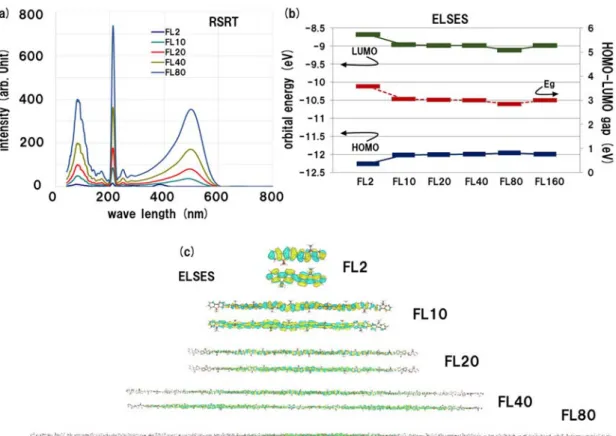
Figure 2 (a) Absorption spectrum by RSRT for the linear chains. (b) The HOMO and LUMO orbital energies and the HOMO-LUMO gap by ELSES among the linear chains. (c) The HOMO and LUMO orbital wave functions among the linear chains by ELSES.
Figure 2(a) shows the absorption spectrum by RSRT for the linear chains of FL2, FL10, FL20, FL40 and FL80. The peak position at the shorter wave length shifts into longer wave length from FL2 to FL10 but the position is almost unchanged among FL10, FL20, FL40 and FL80. Figure 2(b) plots the HOMO and LUMO orbital energies and the HOMO-LUMO gap by ELSES. Here one can find the results of Figs. 2(a) and 2(b) are consistent, because the HOMO-LUMO gap is significantly different between FL2 and FL10 but is almost the same among FL10, FL20, FL40 and FL80. In addition, we found that the tendency stems from the HOMO and LUMO orbital wavefunctions, because the spatial extension of these
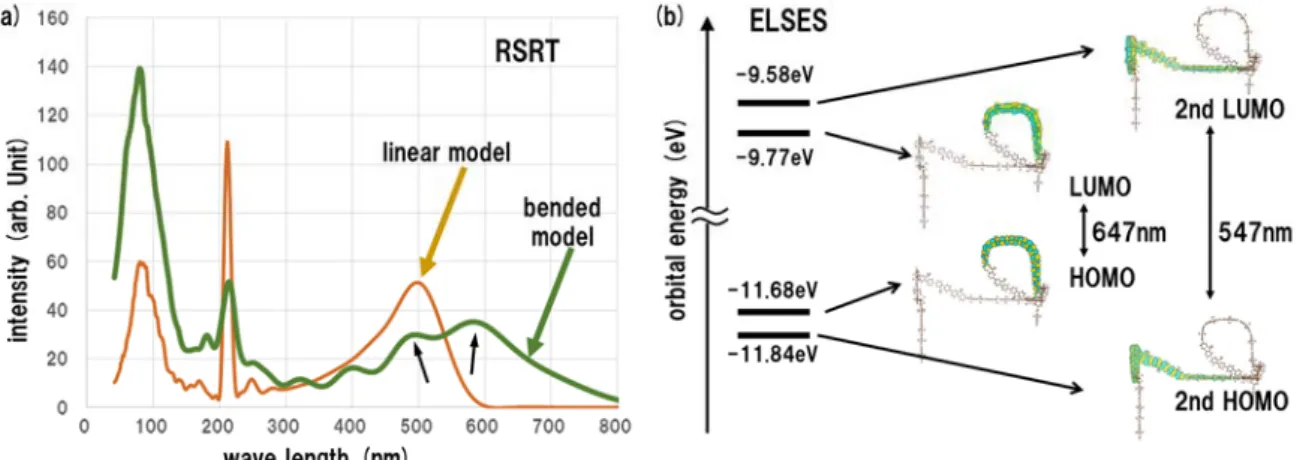
Figure 3 (a) Absorption spectrum by RSRT for the linear and bended chains of FL40. (b) The orbital energies near the HOMO and LUMO levels by ELSES for the bended chain of FL40.
The comparison in the absorption spectrum by RSRT between the linear and bended chains of FL40 is given in Fig. 3(a). The peak at a short wavelength is observed in the linear model and the peak is split, in the bended model, into the two peaks, indicated by black arrows in Fig. 3(a). Figure 3(b) shows the orbital energy in the HOMO, second HOMO, LUMO and second LUMO levels. The similarity in the localization region is found between the HOMO and LUMO wavefunctions and between the second HOMO and second LUMO wavefunctions, which implies that the two pairs should give the peaks in the absorption spectrum. The gap between the HOMO and LUMO levels and that between the second HOMO and second LUMO levels are estimated to be 467 nm and 547 nm, respectively. Therefore the presence of the two gaps in Fig. 3(b) elucidates the two split peaks in Fig. 3(a).
4-2. Aggregated polymers
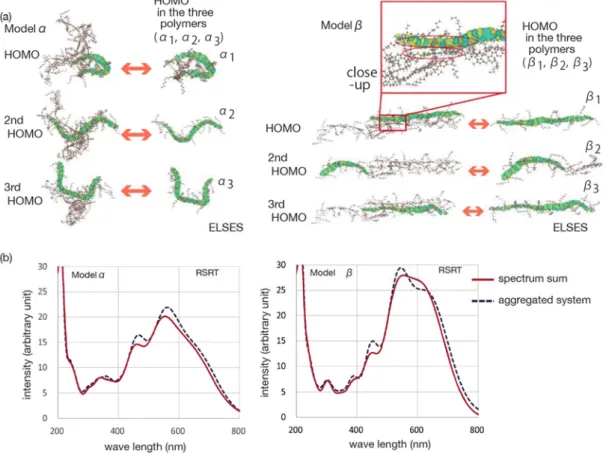
Two aggregated chain models 𝛼 and 𝛽 were prepared from the three chains of poly-((9,9) dioctyl-fluorene) and are shown in Fig. 4(a), in which the HOMO, second HOMO and third HOMO wavefunctions by ELSES are drawn on the structures. The model 𝛼 or 𝛽 is a random or oriented structure, respectively. The three wavefunctions are contributed mainly from the HOMO wavefunctions in the three individual polymers, as is seen in Fig. 4(a). Here the individual polymers of the model 𝛼 or 𝛽 are denoted as 𝛼 , or 𝛽 , , respectively. The above observation indicates that the three polymers
are weekly bound with each other. For example, the HOMO wavefunction of the model 𝛽 shows a small spatial spread over two polymers in the close-up picture in Fig.4(a). Figure 4(b) shows the absorption spectrum by RSRT for the aggregated models 𝛼 and 𝛽. The spectrum is calculated also for the sum of those in the three individual polymers and the aggregation effect appears in the difference of the two lines.
Figure 4 (a) The aggregated polymer models 𝛼 (left) and 𝛽 (right) with several eigen wavefunctions by ELSES. The three polymers of the model 𝛼 or 𝛽 are denoted as 𝛼 , or 𝛽 , , respectively.
(b) Absorption spectrum by RSRT of the model 𝛼 (left) and 𝛽 (right). See the text for details.
Figure 5 Wavepacket dynamics simulation by ELSES for the aggregated polymer models of 𝛼 and 𝛽. (a)-(c): The snapshots for the model 𝛼 at t=0, 3, 5 ps. (d)-(e): The snapshots for the model 𝛽 at t=0, 5 ps. (f)-(g): The hole charge on each polymer during the simulation for 𝛼 and 𝛽, respectively.
other two polymers. Figures 5(d) and (e) show the result for the model 𝛽, in which the initial wavepacket is localized on the polymer 𝛽 and then propagates into the polymer 𝛽 but not into the polymer 𝛽 , because the polymer 𝛽 is well separated from the other two. For a quantitative discussion, the hole charge on each polymer is plotted in Figs. 5(f) and 5(g) for the models of 𝛼 and 𝛽, respectively. In Fig. 5(g), an oscillatory behavior appears between the two polymers, which can be explained by the simple two-level model with the Hamiltonian of 𝐻 ≡ ∑ |𝛽 ⟩, ℎ 𝛽 | (𝑖 1 or 3, 𝑗 1 or 3). Here |𝛽 ⟩ is the HOMO of the polymer 𝛽 (𝑖 1 or 3). An oscillatory behavior appears in a nearly resonant situation (|ℎ ℎ | |ℎ |), as seen in elementary textbooks. We should recall that, in general, the inter-molecular hopping (|ℎ |) is much smaller than the intra-molecular one. The nearly resonant situation appears in the model 𝛽, since the polymers 𝛽 and 𝛽 show similar structures and their HOMO levels are nearly equal (ℎ ℎ ). In the model 𝛼, on the other hand, the three polymers show very different structures and no oscillatory behavior appears in Fig. 5(f).
5. Summary and Future Subjects
The present paper shows that the research with the two novel quantum material simulators, RSRT and ELSES, gives fruitful knowledges on the opt-electronic properties of (i) single organic polymers and (ii) aggregated polymer models. The optical spectrum by RSRT can be analyzed with the orbital wavefunctions by ELSES and we can obtain the physical origin of the spectrum. In addition, the wavepacket dynamics simulation by ELSES enables us to simulate the charge propagation between polymers. The systematic research on large disordered aggregated structures requires a large resource of the K computer and will play a crucial role in computational material design of next-generation industrial devices.
References
[1] Y Zempo, et al., J. Phys.: Condens. Matter 20, 064231 (2008). [2] Y. Zempo, et al., J. Phys: Conf. Seri. 640, 012066 (2015). [3] E. Runge, and E. K. Gross, Phys. Rev. Lett. 52, 997 (1984). [4] K. Yabana, and G. G. Bertsch, Phys. Rev. B54, 4484 (1996). [5] T. Hoshi, et al., Phys.: Condens. Matter 24, 165502, 5pp. (2012). [6] H. Imachi, et al., AIP Conf. Proc. 1790, 020010, 4pp. (2016). [7] T. Hoshi, et al., Proc. ScalA16 in SC16, pp.33-40 (2016). [8] H. Imachi, D. Thesis, Tottori University, Mar. 2017.