A22
Relations of Fish and Bivalve Species Diversity to Historical Changes in Habitat Conditions of
Floodplain Pools in the Kizu River
〇Mikyoung CHOI, Yasuhiro TAKEMON, Kinko IKEDA, Kazuhiro NISHII, Tetsuya SUMI
This paper aims to clarify the time lag between habitat changes and its influence on species diversity. In addition, we attempted to figure out habitat parameters having a dominant role on species diversity. Floodplain pools and their habitat were selected as materials for that study. The database consisted of the fish and bivalve species diversity in 2011 as well as the historical data of pool conditions from 2007 to 2011. A total number of 49 observed pools along the lower reach of the Kizu River were classified into three typical types: bar-tail wando (TW), active pond (AP) and terrace pond (TP). Condition of pool as habitat structure is the function of following parameters: degree of disturbance (e.g. year, flooding frequency), physical parameters (e.g. relative height, water level, depth of mud, water surface area and ratio of vegetation) and water quality. The main criteria to assess the diversity of fish and bivalve species are: diversity index (H’), richness index (R) and dominance index (D). To demonstrate the relations of fish and bivalve species diversity to historical changes in habitat conditions, a one-way ANOVA, the correlation analysis and the linear regression analysis were used.
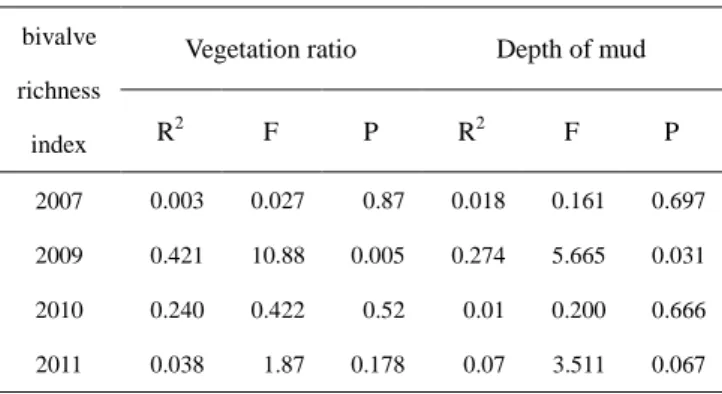
Table 1 and 2 tabulate the relationship between richness index and pool conditions respectively for fish and bivalves using a simple regression analysis. It was found that the fish richness index has a strong correlation with both water surface area and low relative height in 2011 (Table 1). The bivalve richness index was significantly correlated with the vegetation ratio and depth of mud in 2009 rather than in 2011
(Table 2). These results indicated that the species diversity was influenced not only by current habitat conditions but also by the past conditions in the Kizu River. Therefore, to maintain a healthy and sustainable habitat for bittering, both the current habitat condition and the historical changes should be considered because they required bivalves for spawning.
Table 1. Results of a simple linear regression analysis examining the relationship between the fish richness index and habitat conditions (water surface area and low relative height).
fish richness
index
Water surface area Low relative height
R2 F P R2 F P
2007 0.002 0.017 0.9 0.006 0.051 0.82 2009 0.003 0.043 0.83 0.001 0.017 0.9 2010 0.016 0.27 0.61 0.147 2.936 0.10 2011 0.252 15.807 <0.001 0.137 7.431 0.009
Table 2. Results of a simple linear regression analysis examining the relationship between the bivalve richness index and habitat conditions (vegetation ratio and depth of mud).
bivalve richness index
Vegetation ratio Depth of mud
R2 F P R2 F P
2007 0.003 0.027 0.87 0.018 0.161 0.697 2009 0.421 10.88 0.005 0.274 5.665 0.031 2010 0.240 0.422 0.52 0.01 0.200 0.666 2011 0.038 1.87 0.178 0.07 3.511 0.067