
文字列ごとの情報フロー追跡手法のPHPへの実装と評価
11
0
0
全文
(2) Vol.2010-OS-115 No.4 2010/8/3. 情報処理学会研究報告 IPSJ SIG Technical Report. operations from common memory access, and propagates taint through string operations from load. dummy’; UPDATE prod SET price=0 WHERE name=’ruby. string to store string. Since SWIFT only concentrates on address traces of a target program, it can. Then following SQL query will be produced.. be implemented both on interpreters of script languages and on processors. Li et al. proposed. $cmd = SELECT price FROM prod WHERE name=’dummy’; UPDATE prod SET price=0 WHERE name=’ruby’. SWIFT on processors, but it is hard for SWIFT to be familiarized. In this paper, We implemented SWIFT to PHP and executed typical string operations. PHP is widely used in the world as scripting language that is designed for server-side web development.. As a result, the database will be updated against the programmer’s intention by the attacker.. By implementing SWIFT to PHP, coverage is limited for PHP, but the highly accurate DTP can. As seen in this example, a script injection attack is performed by making the victim server in-. be made in the range of taint-support PHP. And it is easy for SWIFT to be familiarized.. terpret the string including attack code written in script language. As for binary injection attack,. The rest of the paper is organized as follows. Section 2 reviews background knowledge for. even if an attack binary is successfully injected, execution of injected binary can be easily prohib-. script injection attacks. Section 3, 4 and 5 summarizes current DTP/DIFTs and taint propagation. ited, e.g., by NX bit. As for script injection attack, however, interpretation of injected scripts itself. algorithms. Then, section 6 explains SWIFT in detail. Section 7 and 8 explains how to SWIFT to. cannot be prohibited, because it is the main benefit in using scripts. This is the main difficulty of. PHP and evaluation. Section 9 states the conclusion.. script injection attack detections.. 2. Script injection attacks. 3. DTP and DIFT. From Cross-Site Scripting to SQL injection, hackers have various techniques at their disposal. The original inspiration of this area was given by the taint mode of Perl. The main purpose was to prevent script injection attacks especially to web applications1) .. to attack Web applications. This section takes SQL injection as an example to explain how script injection attacks occur.. Since then, this kind of techniques have been supported by various programming language systems, such as PHP, Ruby, Java, C and its decendants5)–9),12) . These language-level supports are. SQL injection is a most popular attacks. It allows an attacker to access sensitive information from a Web server’s database. Next we explain the mechanism of SQL injection by using the fol-. often referred to as DTP (Dynamic Taint Propagation).. lowing example. A web page shows the price of a product asking the user the name of it through. On the other hand, Suh et al. applied Perl taint mode to a processor in order to detect injection attacks to binary code, and named it DIFT (Dynamic Information Flow Tracking)11) . Nowadays,. a text box. The below code shows a PHP statement in the page $cmd = SELECT price FROM prod WHERE name=’$name’. the name of DIFT is often used to refer to all such techniques on processors2) . Although the purpose of DIFT was to detect binary injection attacks, DIFT can also be used to. The string the user entered in the text box has been stored in the variable $name. Concatenating. detect script injection attacks4) . In this paper, we discuss DTPs and DIFTs in a unified viewpoint.. $name and the constant strings, the statement produces the SQL command $cmd to send to the. 3.1 Advantage and disadvantage of DIFT. SQL server.. The key advantage of DIFT in script injection attack detection is the comprehensiveness. DTP. In a usual case, for example, the user entered just ruby for $name, the following code is pro-. systems are implemented on language-level, so they are language-specific. For example, Perl. duced as:. taint mode cannot be used for other languages such as PHP. But DIFT systems are not language-. $cmd = SELECT price FROM prod WHERE name=’ruby’. specific. Therefore, DIFT provides a more comprehensive platform than DTP. And obviously. Then the database will return the price of ruby to client. If an attacker injects the string into. DIFT is preferable script injection attack detection than DTP if its accuracy is as high as DTP.. $name by using the code like:. However, until now, for the present DIFT systems, the detection accuracy is considered as a. 2. c 2010 Information Processing Society of Japan °.
(3) Vol.2010-OS-115 No.4 2010/8/3. 情報処理学会研究報告 IPSJ SIG Technical Report. lower one than that of DTPs. Because DIFT could not utilize information of script or high-level. (1). 3 uncoded bytes (8*3=24bits) are converted into 4 numbers (6*4=24bits). languages as a support on detection. In addition, not only the mass of instructions which are ex-. (2). 4 numbers are converted to their corresponding values by using a conversion table. ecuted during interpreting the script provides no helps in information flow tracking, but also it. Base64 decoding procedure is the reverse. The point is that Base64 uses table reference as con-. behave as noise.. version. In general, table reference is like this:. The two facts are supposed as the main reasons which degrade the accuracy to detect attacks.. $ostr = $table[$istr];. But, evaluation results show that DIFT could provide a accuracy class which is just the same as DTP4) . The reason is that the propagation algorithms of DTP/DIFT make more influence on. We can regard table reference as safe in usual cases, but if it is used as conversion, it is unsafe.. their accuracies than above factors and by using proper propagation algorithms DIFT could get a. When thinking from the point of taint propagation, table reference falls into a trade-off. If we. good enough detection accuracy. In next section, we will explain this point of view by discussing. regard table reference as safe, taint isn’t propagated from $istr to $ostr, and it produces security. information flows in program execution and taint propagation algorithms in detail.. hole. On the contrary, if we regard table reference as unsafe, taint is propagated from $istr to $ostr, and it results in mass of false positives. Most existing DTP/DIFTs select the former, so they don’t. 4. Current problem. propagate taint through Base64.. Some Web applications use Base64 to obfuscate sensitive input. In Cubecart3.0.3, we could. 5. Taint propagation algorithms. find the code as below: This section summarizes the algorithms of taint propagation. Firstly we summarize types of. $redir = base64 decode($ GET[¨redir¨]);. information flow and their taint propagations. Next, subsection 5.2 describes non-propagation. After this base64 decode(), $redir is not sanitized, and this can lead to a remote Cross-site script-. policy, which is one of the most important factors of propagation algorithms.. ing attack. For example, if a user creates and inputs a specially crafted URL like:. 5.1 Types of information flow and taint propagation Information flow can be divided into data, address, and control flows.. http://[victim]cc3/index.php?act=login&redir=L3NpdGUvZ GVtby9jYzMvaW5kZXgucGhwP2FjdD12aWV3RG9jJmFtcDtkb2NJZD0x. Data flow is associated with direct data dependence. In the following sample code, there are direct data dependences from the right to the left hand objects.. And the base64encoded part of variable redir is. $o = $i; $o = $i + $j;. L3NpdGUvZGVtby9jYzMvaW5kZXgucGhwP2FjdD12aWV3RG9jJmFtcDtkb2NJZD0x. // $o depends on $i // $o depends on $i and $j. In this case, taintedness can simply be propagated from the right to the left hand objects. After base64 decode function, it will generate a code like this:. Address flow is associated with indirect reference through addresses. In the following sample, $o is dependent on $i (and $table):. /site/demo/cc3/index.php?act=viewDoc&docId=1. $o = $table[$i];. And when the code is executed, it will cause a remote Cross-site scripting.. // $o depends on $i. Control flow is associated with if-statement in high-level languages or conditional branches in. Existing DTP/DIFTs don’t propagate taint through Base64, so they can’t detect the Cross-site. binary codes. In the following sample, $o is dependent on $i:. scripting mentioned above. In the rest of this section, we will explain why existing DTP/DIFTs. if ($i == ’ ’) $o = ’+’;. don’t propagate taint through Base64.. // $o depends on $i. As described before, control flow is more difficult to track than data and address flows. DTPs. Base64 encoding procedure is as follows:. 3. c 2010 Information Processing Society of Japan °.
(4) Vol.2010-OS-115 No.4 2010/8/3. 情報処理学会研究報告 IPSJ SIG Technical Report. can find the dependent range of the variables appeared in the condition of if statement because it. eralize the policy to string-to-scalar conversion, which hash functions perform8),9) . These DTPs. can see the block structure of the statement, which is explicitly specified in the source code.. regard all scalars as safe even if they are produced from tainted strings, because script injection at-. On the other hand, it is very difficult for DIFTs to find that of a conditional branch. In order to. tacks are performed finally by strings. And most DIFTs do not propagate taint along with address. do so, DIFTs must find the join point of the conditional branch, which is not explicitly specified. flows by default4) , which prevents to propagate taint from the index to the values in hash table or. in usual instruction-set architectures.. array accesses.. As far as we know, no DIFT can track control flows, and only a few DTP can track and propa-. 6. SWIFT. gate taint along with control flows. 5.2 Non-propagation policies. This section presents the proposal of SWIFT. The goal of SWIFT proposal is to provide a high. The output of a realistic application program is always a response to user input. Thus, a perfect. accuracy on detecting script injection attacks.. DTP/DIFT, which can perfectly track all the kind of information flow described above, would. First of all, subsection 6.1 and 6.2 describes two key observations for introducing our proposal.. mark all the output as tainted. Such DTP/DIFT is useless. Therefore, the non-propagation policy,. Then, we describe the detection of string access in subsection 6.3. Finally, we present the taint. is as important as how to propagate taint in particular in control flows. But as far as we know, all. information propagation technique of SWIFT in detail.. the current DTP/DIFTs define non-propagation policy on heuristics, such as about sanitization or. 6.1 Command parsing. table reference.. Su et al. show that SQL injection can always be perfectly detected as long as the SQL syntax is known and the substrings are correctly detected trusted or untrusted10) .. 5.2.1 Sanitization Most DTPs regard sanitized string as safe. Since sanitization is often performed by regular. As the example of SQL injection we describes in section 2. The command parser of the SQL. expression match and replace in script languages, most DTPs untaint strings which experience it.. server knows which substring must be trusted and which substring may be untrusted. Specifically,. Some DTP untaint strings tested for the presence of particular (unsafe) characters. However, this. keywords, such as UPDATE or SET, or field and table names, such as price or prod, must be. is a well-known security hole.. trusted; while arguments such as ruby could be untrusted. If the parser knows that the substring. 5.2.2 Table reference. of $cmd corresponding to $name, underlined data in SQL injection example, is untrusted, the. Most DTPs regard the values obtained from hash tables or arrays as safe, and do not propagate. parser can easily distinguish $cmd is an attack or not.. taint from the input to the output. Most script languages support hash table or array in such a form. This command parsing can also be applied to any commands raised from web applications. as follows:. other than SQL such as system calls. In general, data from untrusted source should not specify the. $ostr = $table[$istr];. names of the system resources, but may specify their contents. The names of the system resources. Hash table retrieving is performed in the following manner:. include file names, command names, or field and table names of databases.. (1). The input string is converted to a scalar index by a hash function.. (2). The chain indicated by the index is selected.. version to$name only because all the name of the products in the database is stored in lower-cases.. (3). Following the selected chain, the key string of one tuple in the chain is compared with the. If the programmer write lower-case conversion like figure 1(d), almost all the current DTPs untaint. input string after another. If a key string matches the input string, the tuple is selected.. $name because it uses a translation table. In this case, however, such an attack is still possible. Finally, the value string of the selected tuple is copied to the output string.. even though $name is converted to lower-case (note that the SQL keywords are case-insensitive).. (4). In the example of section 2, it is very possible that the programmer may apply lower-case con-. Most DTPs do not propagate taint through hash tables or arrays. In addition, some DTPs gen-. Then, the current DTPs result in a false negative. So the substring corresponds to $name should. 4. c 2010 Information Processing Society of Japan °.
(5) Vol.2010-OS-115 No.4 2010/8/3. 情報処理学会研究報告 IPSJ SIG Technical Report. be always tainted even in non-attack cases. In the example of section 2, even if ruby is left tainted,. /* ... */ switch ($i) { case ’A’: $ostr = ”alpha”; break; case ’B’: $ostr = ”beta”; break; /* ... */ }. the parser can distinguish it is not an attack. The next subsection describes appropriate non-propagation rules when used with command parsing. 6.2 Radio-button and text-box operations. $table[’A’] = ”alpha”; $table[’B’] = ”beta”; /* ... */ $ostr = $table[$i];. A radio button and a text box are two representative user interfaces on web pages. Radio buttons are used to choose one from some options. On the other hand, text boxes are used to get arbitrary. (a) Sample code of radio-button operation. (b) Sample code of radio-button operation. strings, often with string conversions, such as case conversion or coding conversion. for ($i = 0; $i < strlen($istr); $i++) switch ($istr[$i]) { case ’A’: $ostr[$i] = ’a’; break; case ’B’: $ostr[$i] = ’b’; break; /* ... */ }. As described in section 2, text boxes are unsafe to injection attacks. The programmer must carefully check the string entered through text boxes. Whereas radio buttons are considerably safe. Since the options of a radio button are provided by the programmer, the string that the user choose is necessarily under control of the programmer. It is practically impossible for attackers to attack through radio buttons.. $table[’A’] = ’a’; $table[’B’] = ’b’; /* ... */ for ($i = 0; $i <strlen($istr); $i++) $ostr[$i] = $table[$istr[$i]];. The string operations in web applications can also be divided into radio-button and text-box. 6.2.1 Radio-button operations figure 1(a) is a sample code of radio-button. As is the case of radio buttons, the value of the. (c) Sample code of text-box operation. (d) Sample code of text-box operation. output $ostr is chosen from the strings given by the programmer according to the input $i. The programmer cannot predict the exact value of $ostr, but can completely predict the range of the value that $ostr will take. It can be said that the programmer has control on the output. figure 1(b) is another implementation of figure 1(a). This is the same as hash tables described in section 5.2. In this case, the programmer also has control on the output. It is, however, not because hash tables are considered safe as described in section 5.2, but because the contents of the (e) Address trace of radio-button operations of (a) and (b). table has been given by the programmer. 6.2.2 Text-box operations figure 1(c) is a sample code of text-box operation. Though the switch statement in the block of the for statement looks like the code in figure 1(a), it is actually of text-box. This is an inefficient implementation of lower-case conversion. As described in the previous subsection, the user can control the value of $ostr except that it is converted in lower-case, and it is still possible to attack through this operation. It cannot be said the programmer has control on the output.. . (f) Address trace of text-box operations of (c) and (d). Text-box operations include string copy and all kinds of string conversions such as case conFigure1 Radio-button and text-box operations and their address trace. versions explained above, or coding conversions. URL encode/decode and character code conver-. 5. c 2010 Information Processing Society of Japan °.
(6) Vol.2010-OS-115 No.4 2010/8/3. 情報処理学会研究報告 IPSJ SIG Technical Report. sions are the most frequently used in web applications. figure 1(d) looks like the radio-button operation of figure 1(b). In addition, the contents of the $table is also provided by the programmer. However, in fact it is just another implementation for figure 1(c) and of text-box. 6.2.3 Command parsing and string operations In an application, strings travel on the route from the input to the output, experiencing one or more radio-button and/or text-box operations. Substring of the string can be considered under control of the programmer if it experiences at least one radio-button operation on the route. Therefore, what we should do is to detect whether the operation that a substring experiences is radio-button or text-box, and propagate the taintedness of input string to output string if and only Figure2 Address trace of string concatenation of SQL injection. if the operation is detected as text-box. Notice that this will propagate taintedness to the output even if it is not an attack. This is acceptable, since SWIFT is assumed to be used with command parsing described in the previous subsection. The parser will detect it is an attack or not correctly. 6.3 Algorithm of SWIFT 6.3.1 Address trace As described in the previous subsection, the switch statements in figure 1(a) and 1(c) are almost the same except that the latter is included in the for statement. In order to distinguish the operation in figure 1(c) is of text-box, DTP has to know the switch statement is in the for statement and. Figure3 Address trace of multi-byte string operation. repeatedly executed producing a single string. It is difficult for conventional DTPs, which focus on each statement or instruction being executed as it did not grasp the overall situation. SWIFT focus on memory access during program execution, and make use of address traces on. The first tainted load indicates the load to input variable $i. In this case, the value of $i is ’B’, then. the string operations. Figure 1(e) and 1(f) show two examples of address traces of these string. the constant string ”beta” is copied to the output variable $ostr.. operations. In these figures, the x-axis indicates the address, and the y-axis indicates the time.. Figure 1(f) corresponds to the sample code of the text-box operation shown in figure 1(c). The. There are four types of triangles. Upward triangles 4 and N indicate load instructions to untaint. taint input string ”UPDATE” is converted to ”update”.. and taint data, respectively. Downward triangles O and H indicate store instructions whose store. In the both figures, the load instructions read strings and the store instructions write strings, the. value should be untainted and tainted, respectively. A group of triangles connected with a line. actions appear in an interleaved pattern. The obvious difference is that the loads are untainted in. indicates a string access. The load/store instructions that does not related to DTP are not drawn in. radio-button while tainted in text-box.. these figures.. The sample code in figure 1(b)/1(d) are semantically the same as 1(a)/1(c), and their address. 6.3.1.1 Basic address traces. traces also looks like 1(e)/1(f), respectively.. Figure 1(e) corresponds to the sample code of the radio-button operation shown in figure 1(a).. Figure 1(b) is of a hash table access. As shown in section 5.2.2, the hash table access starts with. 6. c 2010 Information Processing Society of Japan °.
(7) Vol.2010-OS-115 No.4 2010/8/3. 情報処理学会研究報告 IPSJ SIG Technical Report. hashing the input, and ends with copying the value of the selected tuple to the output. Figure 1(e). pair is referred to as an interleaving-stream read/write.. only shows the first taint load to the input to hash it, and the following string copy from the value base64encoding. string of the tuple to $ostr. The values of the tuples are untainted, since it has been copied from. 56940. the untaint constant strings just in the reverse direction of figure 1(e).. untainted_load tainted_load untainted_store tainted_store. 56950. Figure 1(d) uses a translation table. In the $i-th iteration, the $i-th character of $istr is loaded,. 56960. then the value in the $table corresponding to the loaded character is loaded, and finally the value 56970 time. is stored to $i-th character of $ostr. Figure 1(f) only shows the first taint loads to $istr, and the last stores to $ostr, omitting intermediate untaint loads to $table. As shown in figure 1(f), it can. 56980. 56990. be detected of text-box focusing on the taint loads to $istr, and the stores to $ostr. So for script injection attacks detection, we should trace interleaving string reads and writes,. 57000. and the taintedness of the read string should be propagated to the write string. And as the result,. 57010. we can get the output of radio-button operations be untained, and the output of text-box operations. 57020 150. 200. 250. 300. 350. 400. 450. 500. address. be tainted.. Figure4 Example of interleaving pair (base64 encode). 6.3.1.2 Other examples Figure 2 shows the address trace of SQL injection. In this case, the constant strings and user input $name are concatenated to produce $cmd. As shown in figure 3, the three substrings of. 6.3.2.2 Tables. $cmd should be tainted or untainted depending on the source strings are taint or untaint. And. Two tables are used to detect read and write streams. Each of the entries of the read/write stream. here, the string ”ruby” could be tainted because the parser will detect it is not an attack.. tables is allocated to a stream.. Figure 3 shows a copy processing of multi-byte string operation. Web applications often deal. The entry of the tables has the following fields: • start The start address of the stream.. with multi-byte characters, such as URL coding or non-ASCII character sets. 6.3.2 String access detection. • next The predicted next address of the stream.. 6.3.2.1 Streams and Interleaving Pair. • n access The current number of accesses in the stream. • n substrm The current number of substreams in the stream.. A read stream is a sequence of read accesses to a string, and a read access in a read stream is referred to as a stream read. Likewise, a write stream is a sequence of write accesses to a string,. • switched A flag to calculate n substrm.. and a write access in a write stream is referred to as a stream write.. 6.3.2.3 Stream Read/Write Detection On a read access to addr, next of all the entries of the read table is compared to addr. If there. The purpose of the algorithm is to detect an interleaving pair of a read stream and a write stream. Figure4 shows an example of an interleaving pair. This figure shows a address trace of. is no match, a new entry is created, start, next, n access are initialized to addr, the address next. base64 encode. The x and y axis show memory addresses and time. In an interleaving pair, the. to add, and one. If there is a match, n access is incremented and next is advanced for the future. stream reads and writes appear in turn. The read stream is divided into plural read substreams by. access. An entry with n access greater than a threshold is recognized to represent a read stream.. occurrences of the stream writes, and vice versa. Each of the read/write substreams contains one. In other words, if addr matches the next and n access is greater than a threshold, the read access. or more stream reads/writes. And, a read/write access in the read/write stream of an interleaving. is detected as a stream read. And, the same holds true for the write table and write accesses.. 7. c 2010 Information Processing Society of Japan °.
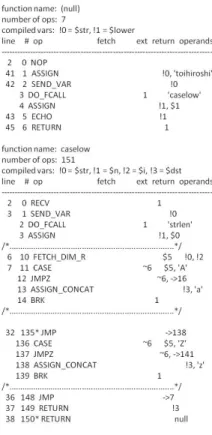
(8) Vol.2010-OS-115 No.4 2010/8/3. 情報処理学会研究報告 IPSJ SIG Technical Report. tions. We refer functions that execute each PHP built-in functionas Zif functions.. 6.3.2.4 Interleaving Stream Read/Write Detection When a stream write is detected, the switched flags of all the entries of the read (not write). All variables in a PHP script are stored in the structure named zval after they are compiled.. table are set. After that, a read access of a stream is detected as the first access to a new substream. Zval is Figure 7 Zvalue value in the zval is Figure 8 When a string in a script is stored in zval,. because switched is set. Then, n substrm is incremented, and switched is reset for the possible. a pointer to the string is acquired by using macros, such as Z STRVAL(), Z STRVAL P() and. second access in the same substream. An entry with n substrm greater than a threshold is detected. Z STRVAL PP(), in the Opcode functions. The argument of Z STRVAL is zval, and the rest of. as the read stream of an interleaving pair. In other words, if addr matches the next and n substrm. the macros take the pointer to zval as their arguments.. is greater than a threshold, the read access is detected as an interleaving stream read. Likewise, the same holds true for the write table and write accesses. 6.3.2.5 Propagation and Backtracking Every time a stream read is detected, the taintedness of the read is stored in the taintedness. Then, when an interleaving stream write is detected, the taintedness of the written word is set to the value of taintedness. When the detector detects streams, the same number of accesses as the threshold have already been performed. Thus, backtracking is needed, that is, these written characters should also be tainted. The start field of the entry is mainly used to locate the start address of the stream.. 7. Implementation of SWIFT to PHP This section explains how to implement SWIFT to PHP. Since SWIFT only focuses on address traces of a program execution, it can be implemented both on script interpreters and on proces-. Figure5 Sample PHP script. sors. PHP is widely used in the world as scripting language that is designed for server-side web development. By implementing SWIFT to PHP, coverage is limited for PHP, but a highly accurate DTP can be made in the range of taint-support PHP. And it is easy for SWIFT to be familiarized.. 7.2 Acquisition of memory addresses. 7.1 PHP interpreter. We explain the acquisition of memory addresses. Because we can utilize information of the. We describe the interpreter of PHP.. interpreter’s source code, there is no influence of interpreting noise, namely we can acquire only. Figure 5 shows a sample PHP script. We refer functions users defines as PHP user-defined. memory addresses of strings. We acquire memory addresses on the source code of Opcode func-. functions. In this script, caselow() is a PHP user-defined function. Strlen() in caselow() is a PHP. tions and Zif functions.. built-in function.. 7.2.1 Opecode functions. A script of PHP is compiled to the intermediate language named opcode by a runtime compiler. String access is done by using the macros mentioned above in Opcode functions, so we can. and is executed. Figure 6 shows a dump of opcode. PHP user-defined functionsand PHP built-in. recognize string access. However, we don’t get memory addresses from all macros, because the. functionsare called by opcode named DO FCALL.. macros only return the pointer to the string. We get memory addresses only when a memory area. PHP interpreter is written in C. We refer functions that execute each opcode as Opcode func-. where string is stored moves to another memory area. There are two actual cases.. 8. c 2010 Information Processing Society of Japan °.
(9) Vol.2010-OS-115 No.4 2010/8/3. 情報処理学会研究報告 IPSJ SIG Technical Report. Figure7 Zval Figure8 Zvalue value. In this case we should get addresses of Z STRVAL P(result) and Z STRVAL P(op1). Z STRVAL P(op1) corresponds to read string, while Z STRVAL P(result) corresponds to write string. Another case is that the macros access an element of the string by using subscript. For example, we can find source code as below: Z STRVAL P(T->str offset.str)[T->str offset.offset] = Z STRVAL(tmp)[0];. In this case we should get the addresses of right and left operands. 7.2.2 Zif functions There are about a hundred Zif functions from which we have to get memory addresses. For example, zif urlencode(), zif base64 encode(), zif ereg replace(). Because only pointers to char are passed to Zif functions, we must read the source code and get memory addresses.. 8. Evaluation Figure6 Dump of opcode. 8.1 Environment We implemented SWIFT to PHP-5.3.1. As for taint-support PHP, we used PHP-taint 20080622 package.. One case is that functions that manage the memory of the interpreter take the macros as thier arguments. The function to which we should pay attention is five of the following: estrdup(), es-. We set the environment as below: Ubuntu 9.04, Apache 2.2.14, Mysql 5.1.37.. trndup(), estrndup rel(), erealloc(), memcpy(). Memcpy() is C built-in library function. The e*()s. 8.2 String operations Table 1 summarizes the result of basic string operations. The string operations include string. are defined on the interpreter, and they use memcpy() internaly. For example, we can find source. copies, case and code conversions, which are commonly used in web applications. (2) to (7) are. code as below:. PHP built-in functions, thus they are written in C.. memcpy(Z STRVAL P(result), Z STRVAL P(op1), Z STRLEN P(op1));. (1)concatenation, (2)substr(), and (3)ereg replace() execute string copies in the ends of opera-. 9. c 2010 Information Processing Society of Japan °.
(10) Vol.2010-OS-115 No.4 2010/8/3. 情報処理学会研究報告 IPSJ SIG Technical Report. operation (1) (2) (3) (4) (5) (6) (7) (8) (9) (10). PHP-SWIFT FP FN. concatenation substr() ereg replace() ereg() strtoupper/tolower() urlencdoe/decode() base64 encode/decode() untaint table taint table tolower (switch-statement) FN : false negative. PHP-taint FP FN √. √ √ √ √ FP : false positive. Table1 Results of string operation. program. attack. phpSysInfo 2.3 Qwikiwiki 1.4.1 phpBB 2.0.8 PHP-Nuke 7.5 CubuCart 3.0.3 PHP-Nuke 7.1 PHP-Nuke 7.1. Cross-site scripting Directory traversal Cross-site scripting SQL injection Cross-site scripting Cross-site scripting SQL injection. PHP-SWIFT FN FP. PHP-taint FN FP. √ √ √ √ √ √. FN: false negative FP: false positive Table2 Results of web applications. tions, and all the models can propagate taint correctly. (4)ereg() is regular expression match, and all the model untaint the scalar result. (5)strtoupper/strtolower() are case conversions.. directory traversal, and SQL injection according to the exploit code. As summarized in Table 2,. (6)urlencode/urldecode() and (7)base64 encode/base64 decode() do encode and decode oper-. SWIFT caused no false positives or negatives. But PHP-taint produced false negatives.. ations. As a result, PHP-taint untaints the outputs of all these functions.. 8.4 Accelerator. (8)untaint table and (9)taint table retrieve values from tables with taint keys.(8)untaint and. we evaluated PHP-SWIFT with a PHP accelerator. A PHP accelerator is an extension designed. (9)taint table have been stored untaint and taint values, respectively. Since PHP-taint regards. to speed up execution time of software applications written using PHP. Most PHP accelerators. the values from tables as safe, it results in false negative in (9)taint table. On the other hand,. use opcode caches. Opcode caches work by caching compiled codes of a PHP script (opcode). PHP-SWIFT can track the flow between the input and the output values through a table.. in shared memory to avoid the overhead of parsing and compiling source code on each request.. (10) is a lowercase conversions code, shown in figure 1(c). Though the function is the same as. Some users and enterprises introduce accelerators in order to increase a speed of PHP code. We used an eAccelerator?) as an accelerator. The eAccelerator is one of free accelerators. We. (5)strtolower(), it is written in PHP. (10) is written with a switch statement construction. PHPSWIFT produce no false positives or negatives, because PHP-SWIFT can correctly propagate. confirmed PHP-SWIFT worked correctly with the eAccelerator.. taint for all the operations. So, even if programmers use operations such as these to be the input. 9. Conclusion. arguments of applications, PHP-SWIFT could also provide high precision.. In this paper, we implemented String-Wise Information Flow Tracking, SWIFT, to PHP.. 8.3 Real-world web applications We executed eight web applications with known vulnerabilities written in PHP. The applications. SWIFTis a completely different approach from conventional DTP/DIFTs. In order to detect script. are phpSysInfo 2.3, QwikiWiki 1.4.1, phpBB 2.0.8, PHP-Nuke 7.5, Cubecart 3.0.3 and PHP-Nuke. injection attacks precisely, SWIFT observes memory accesses of a target programs, detects text-. 7.1. These applications use some input variables as an argument without validation or even any. box string operations and propagates taint through them. Since SWIFT only uses address traces. string operations to them. We made Script injection attacks such as Cross Site Scripting (XSS),. of a program, it can be implemented both on script language interpreters and on processors.. 10. c 2010 Information Processing Society of Japan °.
(11) Vol.2010-OS-115 No.4 2010/8/3. 情報処理学会研究報告 IPSJ SIG Technical Report. We implemented SWIFT to PHP and compared the accuracy with taint-support PHP. PHPSWIFT can correctly propagate taint for typical string operations and real-world web applications with known vulnerabilities, while PHP-taint don’t. Additionally, we confirmed PHP-SWIFT worked correctly with the eAccelerator. We are going to implement SWIFT to all PHP built-in functions. We plan to distribute PHPSWIFT.. References 1) Allen, J.: Perl Version 5.8.8 Documentation - Perlsec, http://perldoc.perl.org/perlsec.pdf (2006). 2) Chen, H., Wu, X., Yuan, L., Zang, B., chung Yew, P. and Chong, F.T.: From Speculation to Security: Practical and Efficient Information Flow Tracking Using Speculative Hardware, Int’l Symp. on Computer Architecture, pp.401–412 (2008). 3) Christey, S. and Martin, R.A.: Vulnerability Type Distributions in CVE, http://cve.mitre.org/ docs/vuln-trends/ (2007). 4) Dalton, M., Kannan, H. and Kozyrakis, C.: Raksha: A Flexible Information Flow Architecture for Software Security, 34th Int’l Symp. on Computer Architecture, pp.482–493 (2007). 5) Haldar, V., Chandra, D. and Franz, M.: Dynamic Taint Propagation for Java, 21st Annual Computer Security Applications Conf., pp.303–311 (2005). 6) Livshits, B., Martin, M. and Lam, M.S.: SecuriFly: Runtime Protection and Recovery from Web Application Vulnerabilities, Tech. Rep., Stanford Univ. (2006). 7) Nanda, S., Lam, L.-C. and cker Chiueh, T.: Dynamic Multi-Process Information Flow Tracking for Web Application Security, 8th Int’l Middleware Conf. (2007). 8) Nguyen-Tuong, A., Guarnieri, S., Greene, D., Shirley, J. and Evans, D.: Automatically Hardening Web Applications using Precise Tainting, 20th Int’l Information Security Conf., pp. 295–307 (2005). 9) Pietraszek, T. and Berghe, C.: Defending against Injection Attacks through ContextSensitive String Evaluation, 8th Int’l Symp. on Recent Advances in Intrusion Detection, pp. 124–145 (2005). 10) Su, Z. and Wassermann, G.: The Essence of Command Injection Attacks in Web Applications, 33rd Symp. on Principles of Programming Languages (2006). 11) Suh, G.E., Lee, J.W., Zhang, D. and Devadas, S.: Secure Program Execution via Dynamic Information Flow Tracking, 11th Int’l Conf. on Architectural Support for Programming Languages and Operating System, pp.85–96 (2004). 12) Xu, W., Bhatkar, S. and Sekar, R.: Taint-Enhanced Policy Enforcement: A Practical Approach to Defeat a Wide Range of Attacks, 15th USENIX Security Conf., pp.121–136 (2006).. 11. c 2010 Information Processing Society of Japan °.
(12)
図


関連したドキュメント
転倒評価の研究として,堀川らは高齢者の易転倒性の評価 (17) を,今本らは高 齢者の身体的転倒リスクの評価 (18)
現在入手可能な情報から得られたソニーの経営者の判断にもとづいています。実
A linear piecewise approximation of expected cost-to-go functions of stochastic dynamic programming approach to the long-term hydrothermal operation planning using Convex
Instead, to obtain the existence of weak solutions to Problem (1.1), we will employ the L ∞ estimate method and get the solution through a limit process to the approximate
Figure 2: Time-history results at points A and B taking into account FEM-BEM coupling procedures and di ff erent temporal discretizations for each subdomain: a explicit direct
Touchdown Total may be applied as a spot spray in peppermint and spearmint. Apply spray-to-wet with hand-held equipment, such as backpack and knapsack sprayers, pump-up
【原因】 自装置の手動鍵送信用 IPsec 情報のセキュリティプロトコルと相手装置の手動鍵受信用 IPsec
学期 指導計画(学習内容) 小学校との連携 評価の観点 評価基準 主な評価方法 主な判定基準. (おおむね満足できる
