1. INTRODUCTION
Recently, proton magnetic resonance spectroscopy (1H - MRS) has been used to examine brain metabolism in patients. The main metabolites that can be assessed using this technique are N acety laspartate (NAA), creatine/phosphocreatine (Cr), and choline -containing compounds (Cho). The NAA signal, the most prominent 1H spectral peak, is present at high concentrations in neurons, and might be related to mitochondrial function. Therefore, NAA is often used to assess neuronal density (1). The intensity of the Cho signal, which might indicate glial cell density (1, 2), increases with an increase in membrane synthesis and turnover (3). The Cr signal might reflect glial or overall (neurons plus glia) cell density (1, 2) ; phosphocreatine represents a key component of high- energy phos-phate metabolism (4).1H- MRS studies often use Cr as an internal reference for other peaks, on the assumption that its concentration is relatively constant.
Brothers (5) proposed a network of neural regions that comprise the “social brain”, which includes the amygdala!the center of limbic system!, the orbito-frontal cortex (OFC), and the superior temporal sulcus and gyrus (STG). Since the psychiatric condition of autism spectrum disorders (ASD) involves deficits in “social intelligence”, it is plausible that ASD may be caused by an abnor-mality of these regions. We used1H- MRS to investigate metabo-lism in the amygdala and OFC of subjects with ASD and healthy control subjects, and compared the amounts of chemical metabolites
(6). We also examined the association between these metabolic findings and intellectual and social abilities in subjects with ASD (6).
It has recently been proposed that dysfunction of the mirror neuron system (MNS) early in development could give rise to the cascade of impairments that are characteristic of ADS (7), including deficits in imitation, theory of mind and social communication. First discovered in the ventral premotor cortex (area F5) of the macaque, mirror neurons fire both while a monkey performs goal -directed actions and while it observes the same actions performed by others. This observation - execution matching system is thought to provide a neural mechanism by which others’ actions and in-tentions can be automatically understood (8). The existence of an analogous MNS in humans has been demonstrated by a number of independent investigations (8) : MNS activity in human homolog of area F5!the pars opercularis in the inferior frontal gyrus!has been consistently reported during imitation, action observation and intention understanding (9, 10). In concert with activity in limbic centers, the MNS is considered to mediate our understanding of the emotional states of others (11, 12). Dapretto et al. used an event- related functional magnetic resonance imaging (fMRI) design to investigate neural activity during the imitation and observation of facial emotional expressions, in high- functioning children with ASD and typically developing children, and reported that activity in bilateral pars opercularis of the inferior frontal gyrus was seen in the typically developing group but not in the ADS group (13). We performed a near - infrared spectroscopy (NIRS) study to evalu-ate MNS in children with ASD (14).
REVIEW
Neuroimaging in autism spectrum disorders :
1H-MRS and NIRS
study
Kenji Moria, Yoshihiro Todab, Hiromichi Itob, Tatsuo Morib, Keiko Moric, Aya Gojib, Hiroko Hashimotoa, Hiroe Tania, Masahito Miyazakib, Masafumi Haradad, and Shoji Kagamib
aDepartment of Child Health & Nursing, Institute of Health Biosciences, Tokushima University Graduate School, Tokushima, Japan,b De-partment of Pediatrics, Institute of Health Biosciences, Tokushima University Graduate School, Tokushima, Japan,cThe Joint Graduate School in Science of School Education, Hyogo University of Teacher Education, Hyogo, Japan,dDepartment of Radiology, Institute of Health Biosciences, Tokushima University Graduate School, Tokushima, Japan
Abstract : Using proton magnetic resonance spectroscopy (1H -MRS), we measured chemical metabolites in the
left amygdala and the bilateral orbito -frontal cortex (OFC) in children with autism spectrum disorders (ASD). The concentrations of N -acetylaspartate (NAA) in these regions of ASD were significantly decreased compared to those in the control group. In the autistic patients, the NAA concentrations in these regions correlated with their social quotient. These findings suggest the presence of neuronal dysfunction in the amygdala and OFC in ASD. Dysfunction in the amygdala and OFC may contribute to the pathogenesis of ASD. We performed a near -infrared spectroscopy (NIRS) study to evaluate the mirror neuron system in children with ASD. The concentra-tions of oxygenated hemoglobin (oxy -Hb) were measured with frontal probes using a 34-channel NIRS machine while the subjects imitated emotional facial expressions. The increments in the concentration of oxy -Hb in the pars opercularis of the inferior frontal gyrus in autistic subjects were significantly lower than those in the con-trols. However, the concentrations of oxy -Hb in this area were significantly elevated in autistic subjects after they were trained to imitate emotional facial expressions. The results suggest that mirror neurons could be ac-tivated by repeated imitation in children with ASD. J. Med. Invest. 62 : 29-36, February, 2015
Keywords :autism, proton magnetic resonance spectroscopy (1H-MRS), amygdala, near-infrared spectroscopy (NIRS), mirror neuron
Received for publication December 8, 2014 ; accepted January 27, 2015. Address correspondence and reprint requests to Kenji Mori, Department of Child Health & Nursing, Institute of Health Biosciences, Tokushima University Graduate School, 3 - 18 - 15 Kuramoto - cho, Tokushima City, Tokushima 770 - 8503, Japan and Fax : +81 - 88 - 633 - 9082.
1
H-MRS study
2. MATERIALS AND METHODS
2.1. Subjects
The study group included 77 autistic patients (3 to 6 years old ; mean age 4.1 ; 57 boys and 20 girls). These individuals were re-cruited from among outpatients at the Department of Pediatrics of Tokushima University. All subjects in this group were diagnosed with autistic disorder by two experienced pediatric neurologists according to the criteria of DSM-!"-TR. The intelligence quotient (IQ) was determined by the Tanaka- Binet intelligence scale; mean IQ"SD= 61"20 (24#110). Social ability of the autistic patients was evaluated with a social maturity scale (Nihon Bunka Kagakusha) ; (S - M scale). The mean social quotient (SQ)"SD= 60"17 (20# 100).
The control subjects were 31 children underwent an MRI ex-amination because of a non - specific temporal symptom such as headache or vertigo, but showed no neurological findings and were confirmed by experienced pediatricians to have no autistic traits. Ages and genders (3 to 6 years old ; mean age 4.0 ; 23 boys and 8 girls) were matched with those of autistic patients.
A routine MRI examination was conducted for all subjects to con-firm the absence of organic disease, and the MRS measurement was conducted immediately afterwards. None of the nominated control subjects showed any abnormalities or symptoms during observation for more than one month and thus data from all con-trol subjects were used as normal concon-trol data. Most of the subjects were sedated with triclofos sodium (Tricloryl, 0.5 mL/kg body weight) 30 min before the MR measurement, following the guide-lines for monitoring and management of pediatric patients dur-ing and after sedation published by the American Academy of Pediatrics (15).
This study was approved by the Institutional Review Board (No. 207) and informed consent for additional MRS measurements and
data analysis were obtained from the parents of all subjects, fol-lowing the approved procedures. Informed consent was also ob-tained from the subjects who could understand the content and purpose of this study.
2.2.1
H-MRS measurement
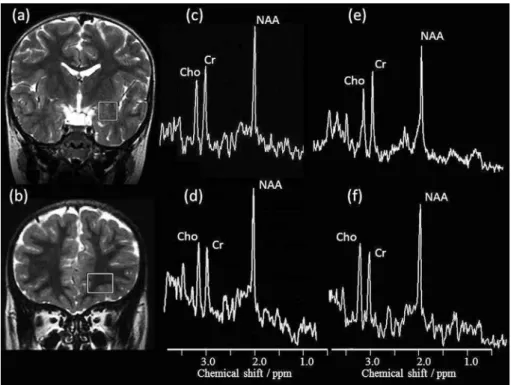
All1H- MRS studies were performed with a 1.5 - tesla clinical MRI system (Signa Horizon, GE, Milwaukee, WI) with a standard head coil for both of MRI and MRS measurements. Conventional proton MR spectra were obtained using the STEAM (Stimulated Echo Acquisition Mode) sequence with parameters of TR= 5 sec, TE= 15 msec and sum of signals= 48 to diminish the influence of the longitudinal and transverse relaxation (16). We analyzed NAA, Cr, and Cho concentrations using the external standard calibration method in LCModel (Ver. 6.1). We acquired T1 and T2 MRI im-ages in axial and coronal views before the1H- MRS examination, and placed a single 3.4 ml (1.5
!
1.5!
1.5 cm) volume of interest (VOI) in the left amygdala (Fig. 1). Furthermore, we also placed a single 4.5 ml (2.0!
1.5!
1.5 cm) VOI in each OFC (Fig. 1). The criteria for maintaining reliable metabolite concentrations were based on the %SD of the fit for each metabolite reflecting the Cramer -Rao lower bounds (CRLB) ; only results with S.D. below 20% were included in the analysis.2.3. Statistical analysis
We compared autistic patients with control individuals with re-spect to the concentrations of NAA, Cho, and Cr. We used Stu-dent’s t-test to determine statistically significant differences between autistic patients and the control group. Paired t- test was used to determine statistically significant differences between the concen-trations of metabolites in the left OFC and those in the right OFC. A value of p below 0.05 was considered statistically significant. Fur-thermore, we examined the correlation between the concentration of NAA and IQ and SQ in autistic patients using Pearson’s corre-lation coefficient.
Fig. 1. Location of the measurement voxel in the left amygdala (a) and the left orbito - frontal cortex (OFC) (b) and representative spectra obtained. (c), MR spectrum from the left amygdala in a control subject ; (d), MR spectrum from the left OFC in a control subject ; (e), MR spectrum from the left amygdala in an autistic patient ; (f), MR spectrum from the left OFC in an autistic patient.
The peaks of NAA from both regions in an autistic patient were slightly low compared to those in a control subject. NAA, N - acetylaspartate ; Cr, creatine/phosphocreatine ; Cho, choline - containing compounds.
3. RESULTS
The baseline MRI was evaluated individually by two experienced pediatric neurologists and one neuroradiologist. No abnormal sig-nal or distinct atrophy was detected in the brain of autistic patients or control individuals at the time when1H- MRS studies were per-formed.
The concentrations of NAA for the left amygdala and the bilat-eral OFC in autistic patients were significantly decreased compared to those in the control group (Table 1, Fig. 2).
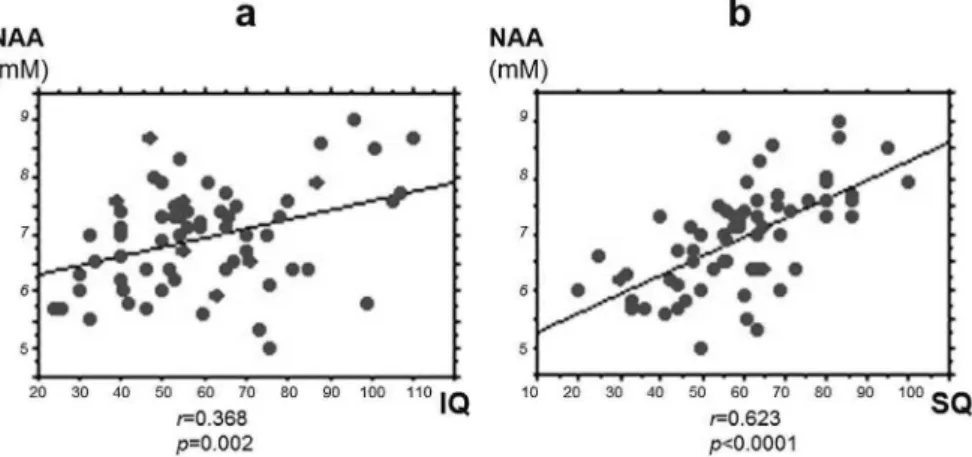
We investigated the relationship between IQ and NAA concen-tration in autistic patients. NAA concenconcen-tration for the left amygdala and the left and right OFC in autism was correlated with IQ. The correlation coefficient was 0.368 (p = 0.002), 0.415 (p = 0.001), 0.530 (p!0.0001), respectively (Figs. 3-5).
We also investigated the relationship between SQ and NAA concentration in autistic patients. NAA concentration for the left amygdala and the left and right OFC in autism was correlated with SQ. The correlation coefficient was 0.623 (p!0.0001), 0.601 (p!0.0001), 0.522 (p!0.0001), respectively (Figs. 3-5). The cor-relation coefficient between SQ and NAA concentration was higher
than that between IQ and NAA concentration in the left amygdala and the left OFC.
There was no significant difference in the concentration of any metabolite between the left and right OFC in autism and control groups. There was no significant difference in the concentration of Cho and Cr for any region between autism and control groups (Table 1).
Fig. 2. NAA concentrations for the left amygdala and the bilateral orbito - frontal cortex (OFC) in control subjects and autistic patients. (a), the left amygdala ; (b), the left OFC ; (c), the right OFC.
The concentrations of NAA for the left amygdala and bilateral OFC in autistic patients were significantly decreased compared to those in the control subjects.
C, control subjects ; A, autistic patients.
Fig. 3. Correlation between IQ, SQ, and NAA concentration of the left amygdala in autistic patients.
(a) : A significant correlation was confirmed between intelligence quotient (IQ) and NAA concentration. (b) : A significant correlation was also con-firmed between social quotient (SQ) and NAA concentration.
Table 1 The summarized results for the quantitative values of each metabolite.
Left amygdala Left OFC Right OFC
autism control autism control autism control NAA 6.9!0.9** 7.5!1.0 7.4!1.1** 8.1!1.2 7.4!1.2** 8.3!1.3
Cr 5.9!0.9 5.9!0.8 5.5!1.2 5.5!0.8 5.6!1.0 5.8!1.0 Cho 2.1!0.3 2.2!0.4 2.1!0.4 2.0!0.4 2.1!0.5 2.1!0.5
Data are presented as mean!standard deviation. OFC, orbito - frontal cortex ; **, p!0.01
NIRS study
4. MATERIALS AND METHODS
4.1. Subjects
The subjects consisted of ten high- functioning boys with autis-tic disorder (9 to 14 years old ; mean age 11.5) and ten normally developing boys (9 to 14 years old ; mean age 11.8). The high-functioning boys with autistic disorder were recruited from among outpatients at the Department of Pediatrics of Tokushima Univer-sity. All subjects in this group were diagnosed with autistic disor-der by two experienced pediatric neurologists according to the criteria of DSM-!"-TR. The intelligence quotient (IQ) was deter-mined by the Wechsler Intelligence Scale for Children third edi-tion ; mean full - scale IQ"SD= 82.5"9.1 (70#95). The control sub-jects were confirmed by experienced pediatricians to have no autistic traits. This study was approved by the Institutional Review Board (No. 1617) and informed consent for NIRS measurements and data analysis were obtained from the parents of all subjects. Informed consent was also obtained from the subjects who could understand the content and purpose of this study.
4.2. NIRS measurement
The NIRS measurement was performed using a 34 - channel NIRS system (Shimazu NIRStation OMM- 3000 - 12 ; Kyoto, Japan). Twelve probes (3
!
4) were set on the left and right frontal region, respectively, with an inter - probe distance of 3.0 cm. The lowest probes were positioned along the Fp1 - Fp2 line in accordance with the international 10/20 Electrode Placement System for electroen-cephalography. The distance from the midline to the most medial probe was 3.0 cm. The position of each channel was shown on 3D-MRI by the analysis software of NIRStation+Fusion (Fig. 6).The experiment consisted of a 30 - s pre - task baseline, a 60 - s imitation of emotional facial expression task, and a 30 - s post- task baseline. This procedure was repeated five times. During the pre -task and post- -task baseline periods, an asterisk was presented on the screen, and the subjects were instructed to stare the mark. The emotional facial expressions of Japanese were selected from Japanese and Caucasian Facial Expressions of Emotion and Neu-tral Faces (17). These stimuli consisted of six kinds of emotional facial expressions (happiness, sadness, surprise, anger, disgust and fear). During the task periods, the emotional facial expressions were presented on the screen in a random order at 5 - s intervals, and the subjects were instructed to imitate the emotional facial Fig. 4. Correlation between IQ, SQ, and NAA concentration of the left orbito - frontal cortex in autistic patients.
(a) : A significant correlation was confirmed between intelligence quotient (IQ) and NAA concentration. (b) : A significant correlation was also con-firmed between social quotient (SQ) and NAA concentration.
Fig. 5. Correlation between IQ, SQ, and NAA concentration of the right orbito - frontal cortex in autistic patients.
(a) : A significant correlation was confirmed between intelligence quotient (IQ) and NAA concentration. (b) : A significant correlation was also con-firmed between social quotient (SQ) and NAA concentration.
expressions. The obtained data were analyzed in the integral mode, which calculates average waveform. Pre - task baseline was deter-mined by the last 10 s of the baseline just before the imitation task period.
After the first NIRS measurement, autistic patients were trained to imitate emotional facial expressions used in this NIRS experi-ment. The duration of the training was 30 minutes, and the training was done twice a week. The second NIRS measurement was per-formed after the trainings were carried out five times.
4.3. Statistical analysis
We compared autistic patients with control individuals with re-spect to the increments in the concentration of oxygenated he-moglobin (oxy - Hb) during the imitation task of emotional facial expressions. We used Student’s t test to determine statistically significant differences between autistic patients and the control group. A value of p below 0.05 was considered statistically sig-nificant.
5. RESULTS
Representative hemoglobin concentration changes during the imitation task of emotional facial expressions in the subjects with autistic disorder and control are shown in Fig. 7. The increments in the concentration of oxy - Hb in the pars opercularis of the inferior frontal gyrus in autistic subjects were significantly lower than those in the controls (Fig. 8). However, the concentrations of oxy - Hb in this area were significantly elevated in autistic subjects after they were trained to imitate emotional facial expressions (Fig. 8).
6. DISCUSSION
The present1H- MRS study has two major findings : 1) decreased concentrations of NAA in the left amygdala and bilateral OFC in subjects with ASD ; and 2) a positive correlation between the con-centrations of NAA in these regions and the SQ as determined by the S - M scale. NAA is present at high concentrations in neurons and is often used as a chemical marker of neuronal integrity (1). A decreased NAA concentration suggests abnormal neurodevelop-ment in this region. Therefore, our findings suggest that subjects
with ASD might have a neurodevelopmental abnormality in the left amygdala and bilateral OFC.
Unfortunately, we could only measure three regions (the left amygdala and bilateral OFC) by1H- MRS, since it was difficult to scan the subjects over a 30 - min period. Although we chose the left amygdala in this study, the side of the amygdala that plays a greater role in individuals with autism is not yet clear. Schumann and Amaral reported significantly fewer neurons in the bilateral amygdalae of the postmortem autistic brain (18).
The amygdala has been implicated in the mediation of social behavior (19), face processing (20), and recognition of emotions (21) in healthy individuals and is considered to be a part of the social brain. Previous fMRI studies of ASD have reported reduced activation in the amygdala when subjects make judgments regard-ing the emotion expressed by the eyes (22) or when they perform a facial perception task (23). We found a positive correlation be-tween the concentration of NAA in the amygdala and the SQ by the S - M scale. These findings suggest that the amygdala might be the primary structure that is responsible for autistic symptoms such as emotional and social impairments.
The amygdala is thought to play a central role in associating sensory cues with their motivational and emotional significance (24). Schoenbaum et al. (25) proposed models of amygdala- frontal interaction in which motivational and emotional significance, coded by the amygdala, is conveyed to the OFC for the control of action. Patients with OFC lesions show impairments in social and moral behaviors (26). Furthermore, the OFC contributes to “Theory of mind”, which is impaired in ASD (27). In this study, the concen-trations of NAA in the bilateral OFC were significantly decreased in subjects with ASD, and a positive correlation was observed between the concentrations of NAA in these regions and the SQ by the S - M scale. These findings suggest that abnormal neurode-velopment of the OFC may also contribute to the social impair-ments in ASD.
Using fMRI, Carr et al. (11) have described a neural network in which the insula acts as an interface between the frontal compo-nent of the MNS!the pars opercularis of the inferior frontal gyrus! and the limbic system, thus enabling the translation of an ob-served or imitated facial emotional expression into its internally felt emotional significance. Furthermore, Dapretto et al. (13) used an event- related fMRI design to investigate neural activity during the imitation and observation of facial emotional expressions, in Fig. 6. Optic probe position of a 34 - channel NIRS system.
Twelve probes (3
"
4) were set on the left and right frontal region, respectively. The red and blue numbers indicate the position of sources and de-tectors, respectively. The arrow shows Ch27 on the left pars opercularis of the inferior frontal gyrus.Fig. 7. Hemoglobin concentration changes during the imitation task of emotional facial expressions.
a : 9 - year - old typically developing boy, b : 9 - year - old boy with autistic disorder, before training of the imitation task, c : 9 - year - old boy with autis-tic disorder, after training of the imitation task.
The upper row of each graph shows hemoglobin concentration changes in the right frontal region. The lower row of each graph shows hemoglobin concentration changes in the left frontal region. Red, oxygenated hemoglobin (oxy - Hb) ; blue, deoxygenated hemoglobin (deoxy - Hb) ; green, total Hb. The arrows show Ch8 on the right pars opercularis of the inferior frontal gyrus and Ch27 on the left pars opercularis of the inferior frontal gyrus.
high- functioning children with ASD and typically developing chil-dren, and reported that activity in bilateral pars opercularis of the inferior frontal gyrus and periamygdaloid regions was significantly lower in the ADS group than that in the controls.
We performed a NIRS study to evaluate MNS in children with ASD. The increments in the concentration of oxy - Hb in the pars opercularis of the inferior frontal gyrus in autistic subjects were significantly lower than those in the controls. However, the con-centrations of oxy - Hb in this area were significantly elevated in autistic subjects after they were trained to imitate emotional facial expressions. These findings suggest that mirror neurons could be activated by repeated imitation in children with ASD. The lower activation in the pars opercularis of the inferior frontal gyrus in autistic subjects might be caused secondarily by human beings avoidance tendency that is brought about by neurodevelopmental abnormality of the amygdala in ASD. Individuals with ASD avoid the eye region of human beings because it heightens amygdala activation and is perceived as socially threatening (28).
The present study has some limitations. First, IQ of autistic patients was slightly low in this study. Because the difference of intellectual level between autistic patients and control individuals might influence the results of1H- MRS and NIRS study, further research with IQ matched subjects is needed. Second, we should compare the concentrations of oxy - Hb in autistic patients with those in control individuals after both of them were trained to imitate emotional facial expressions. However, the consent for the training was not obtained from the parents of control group in this NIRS study. Third, since NIRS has a comparatively low spacial resolution, we should be careful when we judge a specific anatomical region. We suppose that further research using fMRI will resolve the problem. Finally, there is some data to suggest that there might be brain changes with age (29). Because NAA concentration tends to increase with age in children (29), the age of the subjects was limited to 3 to 6 years old in1H- MRS study. Since the evolutional change in the concentration of oxy - Hb during the imitation task is unknown, additional longitudinal study with a larger sample size is needed.
CONFLICT OF INTEREST STATEMENT
None of the authors has any conflict of interest to disclose.
REFERENCES
1. Urenjak J, Williams SR, Gardian DG, Noble M : Proton nuclear
magnetic resonance spectroscopy unambiguously identifies different neural cell types. J Neurosci 13 : 981 - 989, 1993 2. Brand A, Richter - Landsberg C, Leibfritz D : Multinuclear NMR
studies on the energy metabolism of glial and neural cells. Dev Neurosci 15 : 289 - 298, 1993
3. Gill SS, Thomas DG, Van Bruggen N, Gadian DG, Peden CJ, Bell JD, Cox IJ, Menon DK, Iles RA Bryant DJ : Proton MR spectroscopy of intracranial tumors : In vivo and in vitro studies. J Comp Assist Tomogr 14 : 497 - 504, 1990
4. Tedeschi G, Bertolino A, Righini A, Campbell G, Raman R, Duyn JH, Moonen CT, Alqer JR, Di Chiro G : Brain regional distribution pattern of metabolite signal intensities in young adults by proton magnetic resonance spectroscopic imaging. Neurology 45 : 1384 - 1391, 1995
5. Brothers L : The social brain : a project for integrating primate behavior and neurophysiology in a new domain. Concepts in Neuroscience 1 : 27 - 51, 1990
6. Mori K, Toda Y, Ito H, Mori T, Goji A, Fujii E, Miyazaki M, Harada M, Kagami S : A proton magnetic resonance spectro-scopic study in autism spectrum disorders : amygdala and orbito - frontal cortex. Brain Dev 35 : 139 - 145, 2013
7. Williams JH, Whiten A, Suddendorf T, Perrett DI : Imitation, mirror neurons and autism. Neurosci Biobehav Rev 25 : 287 -295, 2001
8. Rizzolatti G, Craighero L : The mirror - neuron system. Annu Rev Neurosci 27 : 169 - 192, 2004
9. Iacoboni M, Woods RP, Brass M, Bekkering H, Mazziotta JC, Rizzolatti G : Cortical mechanisms of human imitation. Science 286 : 2526 - 2528, 1999
10. Johnson - Frey SH, Maloof FR, Newman - Norlund R, Farrer C, Inati S, Grafton ST : Actions or hand - object interactions? Human inferior frontal cortex and action observation. Neuron 39 : 1053 - 1058, 2003
11. Carr L, Iacoboni M, Dubeau MC, Mazziotta JC, Lenzi GL : Neural mechanisms of empathy in humans : a relay from neural systems for imitation to limbic areas. Proc Natl Acad Sci USA 100 : 5497 - 5502, 2003
12. Leslie KR, Johnson-Frey SH, Grafton ST : Functional imaging of face and hand imitation : towards a motor theory of empathy. Neuroimage 21 : 601 - 607, 2004
13. Dapretto M, Davies MS, Pfeifer JH, Scott AA, Sigman M, Bookheimer SY, Iacoboni M : Understanding emotions in others : mirror neuron dysfunction in children with autism spectrum disorders. Nat Neurosci 9 : 28 - 30, 2006
14. Mori K, Mori T, Goji A, Ito H, Toda Y, Fujii E, Miyazaki M, Harada M, Kagami S : Hemodynamic activities in children with autism while imitating emotional facial expressions : a Fig. 8. Oxygenated hemoglobin (oxy - Hb) changes of Ch27 and Ch8 during the imitation task of emotional facial expressions.
a : Ch27 on the left pars opercularis of the inferior frontal gyrus. b : Ch8 on the right pars opercularis of the inferior frontal gyrus.
near infrared spectroscopy study. No To Hattatsu 46 : 281 -286, 2014
15. Cote CJ, Wilson S : Guidelines for monitoring and manage-ment of pediatric patients during and after sedation for diag-nostic and therapeutic procedures : An update. Pediatrics 118 : 2587 - 2602, 2006
16. Harada M, Miyoshi H, Uno M, Okada T, Hisaoka S, Hori A, Nishitani H : Neuronal impairment of adult moyamoya disease detected by quantified proton MRS and comparison with cere-bral perfusion by SPECT with Tc- 99m HM- PAO : A trial of clinical quantification of metabolites. J Magn Reson Imaging 10 : 124 - 129, 1999
17. Matsumoto D, Ekman P : Japanese and Caucasian Facial Ex-pressions of Emotion (JACFEE) and Neutral Faces (JACNeuF). (CD Rom). Oakland, CA
18. Schumann CM, Amaral DG : Stereological analysis of amygdala neuron number in autism. J Neuroscience 26 : 7674 - 7679, 2006
19. Brothers L, Ring B, Kling A : Response of neurons in the ma-caque amygdala to complex social stimuli. Behav Brain Res 41 : 199 - 213, 1990
20. Haxby JV, Hoffman EA, Gobbini MI : Human neural systems for face recognition and social communication. Biol Psychia-try 51 : 59 - 67, 2002
21. Adolphs R, Tranel D, Damasio AR : Dissociable neural systems
for recognizing emotions. Brain Cogn 52 : 61 - 69, 2003 22. Baron - Cohen S, Ring HA, Wheelwright S, Bullmore ET,
Brammer MJ, Simmons A, Williams SC : Social intelligence in the normal and autistic brain : An fMRI study. Eur J Neurosci 11 : 1891 - 1898, 1999
23. Pierce K, Muller RA, Ambrose J, Allen G, Courchesne E : Face processing occurs outside the fusiform ‘face area’ in autism : Evidence from functional MRI. Brain 124 : 2059 - 2073, 2001 24. LeDoux JE : Emotion : clues from the brain. Annu Rev Psychol
46 : 209 - 235, 1995
25. Schoenbaum G, Chiba AA, Gallagher M : Neural encoding in orbitofrontal cortex and basolateral amygdala during olfactory discrimination learning. J Neurosci 19 : 1876 - 1884, 1999 26. Anderson SW, Bechara A, Damasio H, Tranel D, Damasio
AR : Impairment of social and moral behavior related to early damage in human prefrontal cortex. Nat Neurosci 2 : 1032 -1037, 1999
27. Stone VE, Baron - Cohen S, Knight RT : Frontal lobe contribu-tions to theory of mind. J Cogn Neurosci 10 : 640 - 656, 1998 28. Tanaka JW, Sung A : The “eye avoidance” hypothesis of autism
face processing. J Autism Dev Disord 2013 [Epub ahead of print]
29. Hisaoka S, Harada M, Nishitani H, Mori K : Regional magnetic resonance spectroscopy of the brain in autistic individuals. Neuroradiology. 43 : 496 - 498, 2001