A Short
Primer
on
the
Primal-Dual
Method
for
Approximation
Algorithms
David
P.WILLIAMSON
IBM Almaden Research Center 650 Harry Rd., San Jose, $\mathrm{C}\mathrm{A}$, 95120, USA
Abstract: In this primer, we give an overview of a technique used to design and analyze algorithms that provide approximate solutions to $NP$-hard problems in combinatorial
opti-mization. Because of parallels with the primal-dual method commonly used in combinatorial optimization, we call it the primal-dual method for approximation algorithms. We give a general overview of this technique and show how it can be used to derive approximation algorithms for a number of different problems, including a network design problem and a
feedback vertex set problem.
Keywords: approximation algorithms, primal-dual method, Steiner trees, feedback vertex
sets
1
Introduction
Many problems of interest in combinatorial
op-timization are considered unlikely to have
effi-cient algorithms;most of these problems are
NP-hard, and unless $P=NP$ they do not have
polynomial-time algorithms to find an optimal
solution. Researchers in combinatorial optimiza-tion have considered several approaches to deal with $NP$-hard problems. One approach that has
received considerable attentionrecently isthat of approximation algorithms. An $\alpha$-approximation
algorithm for an optimization problem is an
al-gorithm that runs in polynomial time and pro-duces a solution whose value is within a factor
of $\alpha$ of the value of an optimal solution. The
parameter $\alpha$ is called the performance guarantee
or the approximation ratio of the algorithm. We will follow the convention that $\alpha\geq 1$ for
mini-mization problems and $\alpha\leq 1$ for maximization
problems, so that a 2-approximation algorithm for a minimization problem produces a solution of value no more than twice the optimal value,
and$\mathrm{a}\frac{1}{2}$-approximationalgorithm fora maximiza-tion problem produces a solumaximiza-tion of valueat least half the optimal value. The reciprocal $1/\alpha$ is
sometimes usedin the literature formaximization
problems, so that the examples above would both
be referred to as 2-approximationalgorithms.
In the past dozen years there have been a number of exciting developments in the area
of approximation algorithms. For more details about the area of approximation algorithms, the reader is invited to consult the excellent survey
of Shmoys [26], the book of surveys edited by
Hochbaum [19], or the forthcoming monograph of Vazirani [29]. In this primer we will focus on one very useful algorithmic technique, called the primal-dual method for approximation
algo-rithms, that has been developed and applied to
several different
proble.ms
in combinatorialopti-miza.tion.
In order to discuss this method, it is necessary to have some familiarity with the theory of inte-ger and linear programming. Good introductions
can
be found in Chv\’atal [6] or Strang [27, Ch. 8]. We give a very basic introduction here. Ina linear program $(\mathrm{L}\mathrm{P})$, we try to minimize (or
maximize) alinear objective
function
in variables$x_{1},$$\ldots,$$x_{n}$ subject to linear constraintsonthe$x_{i}$
.
For example, consider the linear program
${\rm Min}$ $\sum_{i=1}^{n}c_{i}x_{i}$
subject to:
$(P)$ $\sum_{i=1}^{n}a_{ij}..x_{i}\geq b_{j}$ $j=1,$$\ldots,$$m$
A particular setting ofthe $x_{i}$ which obeys allthe sible for the relaxation, and will have the same
linear const$r$aints is saidto be a
feasible
solution. objective function value.A settingof the$x_{i}$ which minimizes the objective The name “the primal-dual me,thod” has been
function is called an optimal solution. Associated borrowed from a standard tool used in designing
with every linear program is a dual linear pro- algorithms forpolynomial-time solvable problems
gram. For instance, the dual of the line$a\mathrm{r}$ pro- in combinatorial optimization. A good overview
gram $(P)$ above is $\mathrm{c}$
.an
be found in the textbook of Papadimitriouand Steiglitz $[23]$
’
(see also the survey of
Goe-${\rm Max}$ $\sum_{j=1}^{m}b_{j}y_{j}$ mans and Williamson [16]
$)$. The primal-dual
method for approximation algorithms is a
sim-subject to: ple modification of the standard method. Given
$.(D)$ $\sum_{j=1}^{m}a_{i}jy_{j}.\leq c_{i}$
. $\dot{i}=1.’\ldots,$$n$ be $\mathrm{f}_{\mathrm{o}\mathrm{r}\mathrm{m}\mathrm{u}}1\mathrm{a}\mathrm{t}\mathrm{e}\dot{\mathrm{d}}$
as an integer programming
prob-a combinprob-atori$a1$ optimization problem that can
$\mathrm{l}\mathrm{e}\mathrm{m}$, the primal-dual method for approximation
$y_{j}\geq 0$ $j=1,$$\ldots,$$m$.
algorithmsconsiders this primal
int.eger
programThis linear program $(D)$ is the dual of$(P)$, which and a dual ofalinear programming relaxation of is sometimes called $\mathrm{t}$he primal$\mathrm{L}\mathrm{P}$. The dual has the integer program. We start with a dual
fea-many important properties, one of which is the sible solution $y$, and attempt to find a feasible
following: the value of the dual objective func- integer primal solution $x$ that obeys the primal
tion for any feasible dual $y$ is a lower bound on complementary slackness conditions with respect
the value of an optimal solution to the primal to $y$. If one exists, we stop, otherwise we can
$\mathrm{L}\mathrm{P}$. Notice that there is a dual constraint $\dot{i}$ for show that we can modify $y$ so as to increase the each primal variable $x_{i}$ and a primal const$r$aint dual objective function value. In the standard $j$ for each dual variable $y_{j}$
.
Given a primal fea- primal-dual method, we would have wanted$x$and
sible solution $x$ and a dual feasible
soiution
$y$,$y$that obeyed both primal and dual
complemen-the solution $x$ is said to obey the primal com- tary slackness conditions, implying that both $x$
plementary slackness conditions with respect to and $y$ are optimal. However, in general we can’t $y$ifwh\‘enever$x_{i}>0\mathrm{t}$he corresponding dual con- expect that there exists an optimal integral
so-straint is met with equality by $y$. Similarly, $y$ is lution to the linear programming relaxation, so
said
to.obey
the dual complementary slackness we drop the dual complementary slacknesscon-ditions. conditions with respect to $x$ if whenever $y_{j}>0$
the corresponding primal constraint is met with As we will seebelow, relaxing.the dual comple-equality by $x$. If$x$ and $y$ obey both primal and mentary slackness condition in appropriate ways
dual complementary slackness conditions, it can leads to provably good algorit$h\mathrm{m}\mathrm{s}$ for NP-hard
be shown that they are optimal primal and dual problems in combinatorialoptimization by yield-solutions.
S.ometim.
es we add constraintstolinear ing solutions to the primal integer problem that programs asking that $x_{i}$ be a nonnegative integer cost no more than$\alpha$ times the value of a
feasi-or restricted to some bounded range of integers ble solution to the dual, which implies that $\mathrm{t}$he
(e.g. $x_{i}\in\{0,1\}$). A linear program withthistype solution is within a factor of $\alpha$ of optimal. The
of$\mathrm{c}.0,\mathrm{n}$str
$’$
.aint
is usually called anintegerprogram. value of the dual solution is always within some
Given an integer program, it is often useful to factor of$\alpha$ of optimal, but may from instance to
consider its linear programming relaxation; that instance be much closer; sincewegenerate a dual is, the LP obtained by dropping the condition each time we can know when we are closer $\mathrm{t}h$an
thatthe variable$x_{i}$ bea nonnegative integer, and factor of
$\alpha$ from the optimum.
replacing it with the condition that $x_{i}\geq 0$. Ob- In the next section, we develop the basic ideas
servethat the value of an optimal solution for the given above into a primal-dual algorithm for a
linear programmingrelaxation will be nogreater generic problem, and give theorems for its
analy-than the value of the integer program (in which $\mathrm{s}\mathrm{i}\mathrm{s}$
.
We conclude in Section 3.we minimize the objective function) since any $x$ Other surveys onthe primal-dual method have
Bertsimas and Teo [4] (see also the thesis ofTeo
[28]$)$. Our central exposition is taken from a
forthcomingsurvey of Williamson [31] andclosely
follows that of [16].
2
The primal-dual method for
approximation
algorithms
2.1 The hitting
set
$\mathrm{p}_{\Gamma \mathrm{o}\mathrm{b}}1\mathrm{e}\dot{\mathrm{m}}$Wenow show how the primal-dual method can be
used to give approximation algorithms for
NP-hard problems in combinatorial optimization. In
order to do this, it will be useful to consider the
hitting set problem: given a ground set of
ele-ments $E$, nonnegative costs $c_{e}$ for all elements
$e\in E$, and subsets $T_{1},$
$\ldots,$$T_{p}\subseteq E$, we want to
find aminimum-cost subset $A\subseteq E$ so that $A$has
a nonemptyintersectionwith each subset $T_{i}$. We
say that A hits each subset $T_{i}$.
$\cdot$
The hitting set problem can be used to model
a number of$NP$-hard problems, and we will
con-sider several in this section. In $\mathrm{t}$he minimum-weightvertexcover problem, we
are.given
a graph$G=(V, E)$ with weights $w_{i}\geq 0$ for all vertices $i\in V$, and wemustselect $a$minimum-weight
sub-setofverticessuchthat eachedgeis covered (that
is, atleast one of its endpoints ischosen). Wecan
formulate theminimum-weightvertexcover
prob-lemas ahitting set problem in which theground
set elements are vertices, and we have a subset $T_{i}=\{u, v\}$ for each edge $(u, v)$ in $\dot{\mathrm{t}}\dot{h}e$
graph. In the minimum-weight
feedback
vertex set problemin undirected graphs, we are given as input an undirected graph $G=(V, E)$ and nonnegative weights $w_{i}\geq 0$ on the vertices $\dot{i}\in V$, and the
goal is to remove a minimum-weight set of ver-tices from $G$ so as to make $\mathrm{t}$he remaining graph acyclic. Wecan viewthisas ahittingset problem in which the ground set elements are the vertices of the graph, and we must hit every cycle in $\mathrm{t}$he
gr$a\mathrm{p}\mathrm{h}$; that is,$T_{i}=C_{i}$, where$C_{i}$isthe$\dot{i}\mathrm{t}h$cycle of
$G$. In the shortest s-t path problem, we are given
an undirected graph with nonnegative edge costs
$c_{e}$ for all $e\in E$, and two distinguis
$h\mathrm{e}\mathrm{d}$ vertices $s$
and $t$, and we must find the minimum-cost path
from $s$ to $t$
.
We can formulate this as a hittingset problem in which$\mathrm{t}$he edgesarethe ground set elements and wemust hit every cut in the graph separating $s$ from $t$; that is, for all $S_{i}\subseteq V$ with
$s\in S_{i}$ and $t\not\in S_{i}$, we must select an edge from
$T_{i}=\delta(S_{i})$, where $\delta(S)$ is the set of edges with
exactlyoneendpointin$S$
.
By the$\max- \mathrm{f}\mathrm{l}\mathrm{o}\mathrm{W}/\min-$$c$ut theorem of Ford and Fulkerson [12], we have
selected anedge in every cut separating $s$ from$t$
iff there is a path from $s$ to $t$
.
In theminimum-cost branching problem we are $\mathrm{g}\mathrm{i}^{C}\mathrm{v}$
en a directed graph $G=(V, A)$, nonnegative costs $c_{a}$ for all
arcs$a\in A$, and a root vertex$r\in V$, and the goal
istofind a minimum-cost branching (a set ofarcs suchthat for everyvertex,thereisa path from the
root tothevertex). Byusinga$\max- \mathrm{f}\mathrm{l}_{0}\mathrm{w}/\min$-cut
argument, one $c$an see that the following hitting
set problem models the minimum-cost branching
problem: the groundset of elements are the arcs,
and for every set ofvertices $S_{i}\subseteq V-r$, we must
hit the set $\delta^{-}(S_{i})$ of arcs, where $\delta^{-}(S_{i})$ is the set
of arcs whose headsare in $S_{i}$ and tails are not in $S_{i}$. Finally, in $\mathrm{t}$he generalized Steiner tree prob-lem we aregivenan undirected gr$a\mathrm{p}hG=(V, E)$,
nonnegative costs $c_{e}\geq 0$ on alledges $e\in E$, and
$k$pairs of vertices
$s_{j},$$t_{j}\in V$. The goal isto finda
minimum-cost set ofedges $F$, such that for each
$j=1,$$\ldots,$$k,$ $s_{j}$ and$t_{j}$
are
connectedin the graph(V,$F$). Again, a$\max- \mathrm{f}\mathrm{l}\mathrm{o}\mathrm{W}/\min$-cutargument will
show that the problem can be modelled by the
h.i.tting
set problem in which the ground setel-emen.ts
arethe.
edges and we must hit every cut$\mathrm{t}\dot{\mathrm{h}}$
at separates some$s_{j^{-}}t_{j}\backslash$ pair; in other
$\mathrm{w}\mathrm{o}\dot{\mathrm{r}}\mathrm{d}\mathrm{s}$ , for each $S_{i}$ such that for some$j,$ $|S_{i}.\cap\{s_{j},.t_{j},\}|=\grave{1}$,
we must hit $T_{i}=\delta(S_{i})$.
Except for$\mathrm{t}$he minimum-cost s-t path problem and the minimum-cost branching problem, all of the problems above are $NP$-hard. For many of
them, the size of the hitting set formulation is
exponentialin the size of the input. For example, in the feedback vertexsetproblem, $\mathrm{t}$he number of cyclescan be exponential in$\mathrm{t}$he size of the graph. We willsee later that the primal-dual method can often be used in this case and still $\mathrm{r}e$sult in a polynomial-time algorithm.
We can model the hitting set problem by the following integer program:
${\rm Min}$ $\sum_{e\in E}C_{e}x_{e}$ subject to: $\sum_{e\in Ti}x_{e}\geq 1$ $\forall\dot{i}$ $x_{e}\in\{\mathrm{o}, 1\}$.
Ifwe relax the integrality constraint $x_{e}\in\{0,1\}$
to$x_{\mathrm{e}}\geq 0$and take$\mathrm{t}$he dual of the resulting linear
program, we obt$a\mathrm{i}\mathrm{n}$the following:
${\rm Max}$ $\sum_{1}$
. $y_{i}$
subject to:
$i. \cdot e\in T\sum_{i}yi\leq ce$
$\forall e\in E$
$y_{i}\geq 0$ $\forall i$.
Our goal is to construct a feasible solution $\overline{x}$ to the primal integer program and a feasi-ble solution $y$ the dual linear program such that $\sum_{e\in Ee}c_{e}\overline{x}\leq\alpha\cdot\sum_{i=1}^{p}y_{i}$forsome value of$\alpha$
.
Thisimplies that the cost ofour primal solution is no
more than $\alpha$ times the cost of an optimal
solu-tion to the integerprogram. If we can construct
our solutions in polynomial time, then we have
an $\alpha$-approximation algorithm. We will $\mathrm{s}o\mathrm{m}e_{-}$
times giveourprimal solutionas$\overline{x}$ or as a subset $A\subseteq E$, which implies the solution $\overline{x}_{e}=1$ for
$e\in A$ and $\overline{x}_{e}=0$otherwise.
2.2
The
basicalgorithm
Let’s consider how to developaprimal-dual
algo-rit$h\mathrm{m}$
f..or
the hitting set problem bas$e\mathrm{d}$ on whatwe have said so far. Suppose we are given a dual
so.lution
$y$.
We maintain the primalcomplemen-tary slackness $\dot{\mathrm{c}}\mathrm{o}\mathrm{n}\mathrm{d}\mathrm{i}\mathrm{t}\mathrm{i}_{0}\mathrm{n}\mathrm{s}$;
that is, we include $e$
in our solution only if the corresponding dual in-equalityis tight(thatis,met withequality). Thus
$e\in A$ implies $\sum_{i:e\in^{\tau_{i}}}yi=c_{e}$. Suppose that we
simply set $A$ to contain all elements $e$ for which
the corresponding dual inequality is tight; thatis,
$A= \{e\in E:\sum_{i:e}\in\tau_{i}y_{i}=c_{e}\}$. According to the
primal-dual method, if$A$is not a feasible solution
to the hitting set problem forourcurrent dual so-$\mathrm{l}\mathrm{u}\mathrm{t}\dot{\mathrm{i}}\mathrm{o}\mathrm{n}y$, then there must be a way to modify
$y$
that increases the dual objective function value. In $\mathrm{t}\mathrm{h}\dot{\mathrm{e}}$
case $0\dot{\mathrm{f}}\mathrm{t}\mathrm{h}\dot{\mathrm{e}}\mathrm{h}\mathrm{i}\mathrm{t}t\dot{\mathrm{i}}\mathrm{n}\mathrm{g}$ set problem, if$A$ is not feasible,then there must besomeset$T_{k^{\mathrm{S}}}$uchthat
$A\cap T_{k}=\emptyset$
.
We $c$all $s$uch a$s$et $T_{k}$ a violated set.If $T_{k}$ is violated, then for all $e\in T_{k}$, their
cor-responding dual inequalities must not be tight; that is, $\sum_{i:e\in\tau}.\cdot y_{i}<c_{e}$
.
However, since thesein-equalities arethe only ones in which $y_{k}$ appears,
wecan increase $y_{k}$until some dualconstraint
be-comes tight for some $e\in T_{k}$, and obtain another
dualfeasible solution which
now
has a largerob-jective function value. Furthermore, since a new
constraint became tight for some $e\in T_{k}$, we can
add this elementto $A$, and now $A\cap T_{k}\neq\emptyset$
.
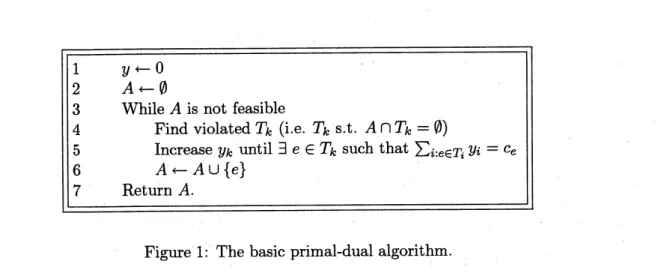
Thisleads to the basic primal-dual algorit$h\mathrm{m}$, which
is shown in Figure 1. This algorithm is due to
Bar-Yehuda and Even [2].
Wenowanalyze the$\mathrm{c}o$st of the feasible solution
$A$returned by the algorithm. The cost of $A$ is $\sum_{e\in A}c_{e}$
$=$
$\sum_{e\in A}.\sum_{i.e\in\tau_{i}}y_{i}$ (1) $=$ $\sum_{i=1}^{p}yi|A\cap T_{i}|$, (2)
where (1) follows since the complementary
slack-ness conditions are obeyed for the primal vari-ables, and (2) follows by reversing the double sum. If we let $f= \max_{i}|T_{i}|$, then certainly
$|A\cap T_{i}|\leq f$for all $\dot{i}$, sothat
$\sum_{e\in A}C_{e}\leq f\cdot i\sum_{=1}yip$
.
We $\mathrm{t}h\mathrm{u}\mathrm{s}$ have an $f$-approximation algorithm for the hitting set problem, since the dual objective function value is a lower bound on the cost of an optimal solution to the hitting set probl$e\mathrm{m}$. As an example of what can be proved in this case, recall that for the minimum-weight vertex cover problem each subset $T_{i}$ contained the two
end-points of an edge in a $\mathrm{g}r\mathrm{a}\mathrm{p}\mathrm{h}$, so that $|T_{i}|=2$
for each $\dot{i}$ in thi
$s$ case. Thus $\mathrm{t}$he algorit$h\mathrm{m}$ gives
a 2-approximation algorit$h\mathrm{m}$ for the
minimum-weight vertex cover problem.
2.3
Feedbackvertex sets
Wenowturn toa slightlymore complicated
appli-cation of the primal-dual algorithm: the feedback vertex set problem for undirected graphs. Let $A$
and$y$be the primal and dual solution created by
the algorithm. Recall from equations (1) and (2)
if for any $y_{i}>0$ it is the case that $|A\cap T_{i}|\leq\alpha$,
then the algorithm is an $\alpha$-approximation
algo-rit$h\mathrm{m}$
.
Recall nowthat for the hitting setprob-lem modelling this probprob-lem, each ground eprob-lement
$e$is avertex$j$, the cost $c_{e}$ is thevertexweight $w_{j}$,
and$\mathrm{t}$he sets$T_{i}$are$\mathrm{t}$he cycles in the graph. In this case, Bar-Yehuda, Naor, Geiger, and Roth [3] ob-tain a performance guarantee of $4\log_{2}n$ (where
$n=|V|)$ by carefully choosing the cycle in line
Figure 1: The basic primal-dual algorithm.
succesfullyignoresome vertices since their
corre-sponding dual inequalities willalwaysbe satisfied. In orderto choose$\mathrm{t}$he violatedcycle, Bar-Yehuda
et al. invoke the following lemma of $\mathrm{E}\mathrm{r}\mathrm{d}6\mathrm{s}$ and
P\’osa [10].
Lemma 1 ($\mathrm{E}\mathrm{r}\mathrm{d}’\text{\’{o}}_{\mathrm{S}}$ and P\’osa [10]) Given
a graph $G’=(V’, E’)$ with no degree 1 vertices
and with every vertex
of
degree 2 adjacent to twovertices
of
higher degree, there exists a cycleof
length no longer than $4\log_{2}|V’|$, and it can be
found
in polynomial time.Of course, $\mathrm{t}$he given input graph might not meet the conditions of the lemma. Thus we show that we can ignore some vertices; the remain-ing vertices we call special vertices. We map the graph onto a graph $G’$ that contains exactly the
specialvertices, such that there is abijective map-ping between cycles of $G$ and of $G’$. Then by
applying the lemma we can find in $G$ a violated
cycleofatmost 4$\log_{2}n$specialvertices,and since
we only add special verticesto $A$, we get that for
any $y_{i}>0$ (corresponding to some violatedcycle $T_{i}$ chosen in line 4), $|A\cap T_{i}|\leq 4\log_{2}n$, implying
the desired performance guarantee.
Now we need to specify which vertices we can
ignore, and why their dual inequalities will
re-main feasible. Suppose that as weadd a vertex$j$
to $A$in line 6 ofthe algorithm, we remove$j$ and
its incident $\mathrm{e}d$ges from the graph. Certainly we
can ignore any vertex in the remaining graph that is nolonger in acycle; sinceweonly add vertices from the chosen violatedset (line 5), weonlyadd vertices thatarein somecycle. Now consider any
pat$h$ofverticesthat all have degree 2. Since any
cycle that goes through one of these vertices must go through all ofthem, it must be the case that
when the reduced cost $\tilde{w}_{j}=w_{j}-\sum_{i:j\in T}iy_{i}$ ofa
vertex$j$ on this path decreases by $\epsilon$, the reduced
costofall vertices on this path also decreases by$\epsilon$. Thus we cansafely ignore all vertices in this path except for one special vertex$j$ with the smallest
reducedcost,since no dual inequality for any ver-tex on the pat$h$willbecome tightunless the dual
inequality for $j$ becomes tight. Furthermore, if
$j$ is added to $A$, then all cycles containing $\mathrm{t}$he vertices on this pathwill be hit, and so no other
vertex from the path need by added to $A$
.
Since we $c$an ignore any vertex not on a
cy-cle, and ignore all but one vertex on a path of vertices of degree 2, weobtain the desired graph
$G’$ from $G$ by removing all vertices currently in
$A$, recursively removing alldegree 1 vertices, and
replacing any pat$h$ of degree 2 vertices with the
special vertex for that path. This yields a graph
$G’$obeyingthe properties of$\mathrm{t}$helemma, such that
any cycle in $G’$ has a one-to-one mapping to a
cycleof $G$. Thus we $c$an find a cycle of at most
$4\log_{2}n$ special vertices in $G$.
This
argu-ment yields a $(4\log_{2}n)$-approximation algorithm
for the minimum-weight feedbackvertex set prob-lem in undirected graphs. In fact, one canobtain
a2-approximationalgorithm for $t$his problem
us-ing the primal-dual method, but one must use a different integerprogramming formulation of the problem; see Chudak et al. [5] and Fujito [13] for
details.
.,
2.4
Reverse delete
Wenowturntomodifications of$\mathrm{t}$he basic primal-dual algorithm of Bar-Yehuda and Even. The first is a relatively simple idea: once a feasible solution $A$ has been obtained, we should
exam-ine the elements of$A$and delete any that arenot
needed for a feasible solution. This idea was first introduced by Goeman$s$andWilliamson [15], but
we will present here a refinement discovered in-dependently by Klein and Ravi [21] and Saran,
Vazirani, and Young [25]. They showed that it
is useful for the analysis of the algorithm to ex-amine $\mathrm{t}$he elements of $A$ for possible deletion in a certain order; in particular, in the reverse of $\mathrm{t}$he order in which the elements of$A$ were
added. This part of thealgorithmis sometimes called the
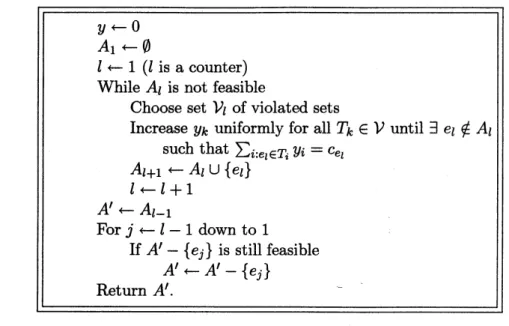
reverse delete. Wepresentthe modified algorithm
in Figure 2.
To see why$\mathrm{t}$he reversedelete step is useful for $\mathrm{t}$he analysis, con
$s$ider the set $T_{i_{1}}$ chosen in the$l\mathrm{t}h$
iterationofthe algorithm. Let $A_{l}$ betheset of
el-ements in $A$at the beginning of the $lt\mathrm{h}$iteration,
let $e_{l}$ be $\mathrm{t}$he element added in the $l\mathrm{t}h$ iteration,
and let $A’$ be the final set returned by $t$he
algo-rithm. By the analysis at the beginning of the section (Equations (1) and (2)), if we can $\mathrm{s}h\mathrm{o}w$
that $|A’\cap T_{i_{l}}|\leq\alpha$ for all iterations $l$, we have
an $\alpha$-approximation algorithm. Not$e$ that since
$T_{i_{1}}$ is chosen as a violated set, it is the case that
$T_{i_{l}}\cap A_{l}=\emptyset$, so if$B=A’-A_{l}$, then weonlyneed
prove that $|B\cap T_{i_{l}}|\leq\alpha$. Furthermore, when $e_{l}$
is considered for deletion, no element $e_{j}$ for$j<l$
has been considered for deletion, so the contents of $A$ at that point in time in $t$he reverse delete
step must be precisely $A_{l}\cup B$. Finally, because
each element in $B$ was added after the $l\mathrm{t}h$
itera-tion, it must be the case that each of them was already considered by the
reverse
delet$e$stepandisnecessary for the feasibility of$A_{l}\cup B$. Thus for
any $e\in B,$ $A_{l}\cup B-e$ is not a feasible solution. We call any set ofelements$D$ such that $A_{l}\cup D$ is
feasiblean augmentationof$A_{l}$, and any
augmen-tation $D$ such that for any $e\in D,$ $A_{l}\cup D-e$ is not feasible, a minimal augmentation. We have shown above that $B$ is a minimal augmentation
of $A_{l}$. We are trying to bound $|B\cap T_{i_{1}}|$, and
certainly this is dominated by the maximum of
$|D\cap T_{i}\iota|$ overall minimal augmentations $D$ of$A_{l}$.
Thus wehave shown $\mathrm{t}$he following theorem. Theorem 2
If
for
all iterations $l$of
thealgo-rithm in Figure 2,
$\max$ $|D\cap Til|\leq\alpha$, $D: \min$
.
aug.of
$A_{1}$the algorithm is an $\alpha$-approximation algorithm.
To illustrate the use of this analysis, we con-sider the shortest s-t path problem and the minimum-cost branching problem. Recall that for the minimum-cost s-t path problem, we need
to hit the sets $T_{i}=\delta(S_{i})$ for all sets $S_{i}$ with
$s\in S_{i},$ $t\not\in S_{i}$, where $\delta(S_{i})$ is the set of edges
with exactly one endpoint in $S_{i}$. To apply the
primal-dual algorithm of Figure 2, we need to
specifywhich violat$e\mathrm{d}$set
$T_{i_{l}}$ is chosen for agiven
infeasible solution $A_{l}$. Here we invoke a
princi-ple that turns out to be useful for a number of problems of this sort: we choose the minimal vio-latedset $T_{i}=\delta(S_{i})$, where by this wemean a set $S_{i}s\mathrm{u}c\mathrm{h}$ that there is no other set $S_{j}\subset S_{i}$ with $T_{j}=\delta(S_{j})$ also violated. For the minimum-cost
s-t path problem, this principle implies that for
an infeasible solution $A_{l}$, we find the connected
component $S_{i_{l}}$ containing $s$ in $\mathrm{t}$he graph (V,$A_{l}$),
and choose the violated set $T_{i_{l}}=\delta(S_{i_{l}})$. It is not
difficultto$\mathrm{s}e\mathrm{e}$that forany augmentation$D$of$A_{l}$,
if $|D\mathrm{n}\delta(s_{i_{\iota}})|>1$, then an edge of$D\mathrm{n}\delta(S_{i})\iota$ can
be removed with the remaining edges still con-taining an s-t path. Thus for any minimal aug-mentation $D$, it is the case that $|D\cap\delta(S_{i},)|=1$,
which implies by $\mathrm{t}$he analysis of the preceding
paragraph that the primal-dual method gives a
1-approximation algorithm, $or$ an optimal
algo-rithm, for the shortest s-t path probl$e\mathrm{m}$. $1n$ fact,
one$\dot{c}$
an show that thisalgorithmisjustDijsktra’s
algorithm $[8, 30]$.
For the minimum-cost branching problem, we needtohit thesets$T_{i}=\delta^{-}(S_{i})$ for all$S_{i}\subseteq V-r$.
Recall that $\delta^{-}(S_{i})$ is the set of arcs with thei$r$
heads in$S_{i}$ andtheirtails not in $S_{i}$
.
Given anin-feasibleset $A_{l}$, we find astrongly connected
com-ponent $S_{i_{l}}$ not containing the root $r$ for which
$A\cap\delta^{-}(S_{i})=\emptyset$ and choose as our violated set
$T_{i_{l}}=\delta^{-}(S_{i_{l}})$
.
It is not hard to $s$how that sucha stronglyconnect$e\mathrm{d}$ component must exist if
$A_{l}$
is infeasibl$e$. Then again it is easy to $\mathrm{s}e\mathrm{e}$ that for any augmentation $D$ of $A_{l}$, only one arc in
$D\cap\delta-(S_{i_{l}})$ is necess$a\mathrm{r}\mathrm{y}$, since the strong connec-tivity of $S_{i_{l}}$ implies all the vertices of $S_{i_{\iota}}$ can be
reached through that arc. Hence for any minimal
augmentation $D$of$A_{l},$ $|D\mathrm{n}\delta^{-}(Si_{t})|=1$, and we
again have an optimal algorithm. One can show that this algorithm is the same as Edmonds’ al-gorithm for$\mathrm{t}$heminimum-costbranching problem
Figure 2: The primal-du$a1$ algorithmwith reverse delete stepadded.
2.5 Increasing multiple duals
We now introduce another modification to our primal-dual algorithm. To motivate $\mathrm{t}$he
modifi-cation, we consider the $\mathrm{g}\mathrm{e}\mathrm{n}\mathrm{e}\mathrm{r}\mathrm{a}\mathrm{l}\dot{\mathrm{i}}$zed Stei
$n$er tree
problem. Recall that $\mathrm{t}\dot{h}\mathrm{i}\mathrm{s}$
can be modelled by
a hitting set problem in $\mathrm{w}h$ich we must hit all
$T_{i}=\delta(S_{i})$ such$\mathrm{t}h$at $|S_{i}\cap\{s_{j}, tj\}|=1$ forsome
$s_{j^{-}}$ $t_{j}$ pair that must be connected. Suppose we try
to apply the algorithmin Figure 2 and the an
al-ysis above to this problem. As with the
short-est s-t pat$h$ problem, $we$ will invoke the
princi-ple of finding a minimal violated set and choose
some connected component $S_{i_{l}}$ of (V,$A_{l}$) such
that $|S_{i_{1}}\cap\{s_{j}, t_{j}\}|=1$, and choose as our
vi-olat$e\mathrm{d}$ set $T_{i_{1}}=\delta(S_{i\iota})$. However, consider the
problem in which $s=s_{1}=s_{2}=\cdots--s_{k}$, and
$t_{1},$
$\ldots,$$t_{k}$ are distinct vertices. Then for $A_{1}=\emptyset$,
the vertex $s$ and each $t_{j}$ is a possible minimal
violated set. Without loss of generality, $\sup-$
pose we choose $t$he violated set $T=\delta(\{s\})$
.
Then one possible minimal augmentation is $D=$
$\{(s, t_{1}), (s, t_{2}), \ldots, (s, t_{k})\}$, and $|D\cap T|=k$. Thus
the algorithm and analysis wehave developed so far wouldonlygive a $k$-approximation algorithm.
However, if we consider the number of times this augmentation hits these minimal violated $\mathrm{s}e\mathrm{t}\mathrm{s}$ averaged over $\mathrm{t}$he number of minimal vio-lated sets,weget something better: $|D\cap\delta(\{s\})|=$
$k$, but $|D\cap\delta(\{t_{j}\})|=1$, with $k+1$ minimal
vio-lated$\mathrm{s}e\mathrm{t}\mathrm{s}$, leadingtoan averageof$2k/(k+1)\approx 2$
.
This leads to the following idea: suppose wechoose multiple violated sets and increase their
dual variables simultaneously and uniformly. It
turns out that this gives good approximation
al-gorithms for a number of problems, including
a 2-approximation algorithm for $\mathrm{t}$he generalized Steiner tree probl$e\mathrm{m}$. We give the modified
algo-rithm in Figure 3. The idea of increasing
multi-ple duals was introduced implicitly by Agrawal, Klei$n$, and Ravi [1] (whodid not refer to LP
du-ality), and was made explicit by Goemans and
Williamson [15].
We now show how we can analyze the
algo-rit$h\mathrm{m}$in Figure 3 via the followi
$n\mathrm{g}$theorem.
No-tice that this algorithm and its $an$alysisgeneralize
$t$he algorithmof Figure 2, in which onlyone
vio-lat$e\mathrm{d}$set is chosen in eachiteration.
Theorem 3
If for
every iteration $l$of
thealgo-rithm in $F_{\dot{i}}gure\mathit{3}$,
$D:m\dot{i}n.aug\mathrm{m}\mathrm{a}\mathrm{x}.$
of
$A_{1}Tk \sum_{\in \mathcal{V}\iota}|D\mathrm{n}T_{k}|\leq\alpha|v_{l}|$,the algorithm is an$\alpha$-approximation algorithm.
Proof: Let $A’$be the final solution returned by $\mathrm{t}$he algorithm. Wewish to prove that
$\sum_{e\in A^{\prime c_{e}}}\leq$
$\alpha\sum_{i=1}^{p}y_{i}$. As before, we have $\mathrm{t}h$at
Figure 3: The general prim$a1$-dual algorithm.
So weneed toprove that
$\sum_{i=1}^{p}|A’\cap\tau_{i}|yi\leq\alpha\sum_{i=1}^{p}yi$
.
Let $\epsilon_{l}$ be the amount by which the duals are increased in iteration $l$ of the algorithm. Then
clearly, for $\mathrm{t}$he solution
$y$ at $\mathrm{t}$he end of the algo-rit$h\mathrm{m}$,
$\sum_{i=1}^{p}y_{i}=\sum_{l}|\mathcal{V}_{l}|\epsilon\iota$
.
Similarly,
$\sum_{i=1}^{p}|A’\cap T_{i}|y_{i}$ $=$ $\sum_{i=1}^{p}|A’\cap\tau i|\sum\epsilon_{l}l:T_{i\in}\mathcal{V}\iota$
$=$ $\sum_{l}(\sum_{T_{k\in}v_{\iota}}|A\prime \mathrm{n}T_{k}|\mathrm{I}^{\epsilon}l\cdot$
Thus certainly$\mathrm{t}$he
ineq..u
ality follows if for all it-erations $l$,$\sum|A’\cap T_{k}|\leq\alpha|\mathcal{V}f|$
.
$\tau_{k\in}v_{l}$As in$\mathrm{t}$he proof of Theorem 2,
$\sum_{T_{k}\in v_{\iota}}|A’\cap T_{k}|$ is
dominated by $\max_{D:\min}$
.
aug. of$A_{\mathrm{t}^{\sum_{T_{k}\in \mathcal{V}_{l}}1}}D\cap$$T_{k}|$
.
Thus the theorem follows. $\square$ To illustrate $\mathrm{t}$he use of the algorit$h\mathrm{m}$ andthe theorem, we show how we can obtain a 2-approximation algorithm for the generalized
Steiner tree problem. As suggested above, in
each iteration $l$ we choose all the minimal $v\mathrm{i}_{0-}$
lated sets; that is, we choose $\mathrm{t}$he sets $T_{i}=\delta(S_{i})$ for all connected components $S_{i}$ in (V,$A_{l}$) such
that for some$j,$ $S_{i}$ contains exactly one of $s_{j}$ or
$t_{j}$. Thus $\mathcal{V}_{l}$ is $\mathrm{t}$he set of all such sets
$T_{i}$.
Theorem 4 Using the algorithm in Figure 3 with the choice
of
$\mathcal{V}_{l}$ as given above yields a 2-approximation algorithmfor
the generalized Steiner tree problem.Proof: To prove this,we show that$\mathrm{t}$he state-ment of Theorem 3 holds for $\alpha=2$
.
To do this,we consider the graph in which each connected
component of (V,$A_{l}$) has been shrunk to a
sin-gle node; let $V’$ be this set ofvertices. Let $D$ be
any minimal augmentation of $A_{l}$, and consider
$\mathrm{t}$he gr$a\mathrm{p}hH=$ (V’,$D$). Note first that $H$ is a forest, otherwise $D$ is not minimal. Observe
also that some of the vertices in $V’$ correspond
to connected components $S_{i}$ that are in $\mathcal{V}_{l}$ and
some do not. Let $R\subseteq V’$ be the first type of
vertex, which we will call red, and
$B=V’-R$
be the second type, which we will call blue.
Ob-serve$\mathrm{t}h$at
$|R|=|\mathcal{V}_{l}|$
.
Also, if$deg(v)$ is the degreeof $v\in V’$ in the graph $H$, and $v$ corresponds
to $t$he connected component $S_{i}$ in (V,$A_{l}$), then $|D\cap\tau_{i}|=|D\cap\delta(s_{i})|=deg(v)$
.
Thus$t$hedesiredinequality
$\sum|D\cap T_{k}|\leq 2|v_{l}|$
$\tau_{k\in \mathcal{V}\iota}$
reduces to proving that $\sum_{v\in R}deg(v)\leq 2|R|$. If
we can show that no blue vertex $h$as degree 1,
then the statement would follow, $\sin$ce (ignoring
blue vertices ofdegree $0$),
$\sum_{v\in R}deg(v)$ $=$ $v \in R\cup\sum_{B}deg(v)-\sum dv\in Beg(v)$
$\leq$ $2(|R|+|B|)-2|B|$ $\leq$ $2|R|$.
The inequalities follow since$t$hesum ofdegreesof
the vertices in$t$he forest$H$is nomorethan twice
$t$he number of vertices, and every blue vertex in
the sum has degree at least 2. To show that no
blue vertex has degree 1, assume the opposite: let
$v$ be a blue vertex of degree 1, let $e\in D$ be the
adjacent edge in $H$, and let $S$ be the connected
component correspondi$n\mathrm{g}$to$v$in(V, $A_{l}$). Because $D$ is a minimal augmentation, $e$ is necessary for
feasibility. Since $e$ is the only edge in $D\cap\delta(S)$
there must be some $j$ such that either $s_{j}$ or $t_{j}$ is
in $S$and the other is not in$S$
.
But then$T–\delta(s)$would be in $\mathcal{V}_{l}$, and $v$ would be red, which is a
contradiction. $\square$
Thu.s.
the algorithm in Figure 3 gives a $2_{- a}\mathrm{p}\mathrm{p}\mathrm{r}\mathrm{o}\mathrm{x}\mathrm{i}\mathrm{m}\dot{\mathrm{a}}$tion algorit$h\mathrm{m}$ for the generalized$\mathrm{S}t$einer tree problem. The first 2-approximation
algorithmfor this problem was givenbyAgrawal,
Klein, and Ravi [1]. Its use of the
primal-dual method was made explicit by Goemans and Williamson [15].
3
Conclusions
Approximation algorithms for many NP-hard problems can be derived from the framework above: for example, network design problems
($\mathrm{s}e\mathrm{e}$the survey of Goemans and Williamson [16]), feedback vertex set problems [17, 5, 13], prize-collecting problems [15], multicut problems in trees [14], and others.
However, it is important to remember that$\mathrm{t}$he algorithm and analysis given above is only one
potential way of applying the primal-dual tech-nique, the one that developed historically from
papers in the$80\mathrm{s}$ andearly $90\mathrm{s}$. A fewrecent
pa-pers have usedtheirown variationsofthe
primal-dual method. Forinstance, thepaper ofJain and
Vazirani [20] uses $\mathrm{t}$he same ideas for$\mathrm{t}$he
uncapac-itated facility location problem, but constructs
a primal solution in a somewhat different way.
Rajagopalan and Vazirani [24] use local search
on top of a primal-dual algori$th\mathrm{m}$ to get an
im-proved algorithm for $\mathrm{t}$he St$e\mathrm{i}n\mathrm{e}\mathrm{r}$ tree problem in
some cases. Thus it is important to see that al-thoughmanyresult$s$can be deriveddirectlyfrom
the algorithm in the preceeding section, it should
be viewed as $a$ starting point from which further
modifications can be madeto suit the problemat
hand.
Acknowledgements
This primeris extracted from a much longer
sur-vey submitt$e\mathrm{d}$ to Mathematical Programming as
part ofthe issue for the 17th International Sym-posiumon
Mathem.atica.l
Programming. Theau-$t$hor is $\dot{\mathrm{g}}\mathrm{r}\mathrm{a}\mathrm{t}\mathrm{e}\dot{\mathrm{f}}\mathrm{u}\mathrm{l}$ to the editors of Mathematical Programming for
allowing.
him to make thisex-tract available.
References
[1] A. Agrawal, P. Klein, and R. Ravi. When trees colide: An approximation algorithmforthe gen-eralized Steiner problem on networks.
.SIAM
Journal on Computing, 24:440-456, 1995.[2] R. Bar-Yehuda and S. Even. A linear time ap-proximation algorithm for the weighted vertex
cover
prob.lem.
$J_{our}nal$.
of
Algori\prime thmS,
2:198-203,1981.
[3] R. Bar-Yehuda, D. Geiger, J. Naor, and R. M. Roth. Approximation algorithms for the feed-backvertex set problem with applicationsto
con-straint satisfaction andBayesian inference. SIAM
Journal on $Comput_{\dot{i}}ng$, 27:942-959, 1998.
[4] D. Bertsimas and C.-P. Teo. Fromvalid
inequal-ities to heuristics: Aunified view of primal-dual approximation algorithms in covering problems. Operations Research, 46:503-514, 1998.
[5] F. A. Chudak, M. X. Goemans, D. S.Hochbaum,
and D. P. Williamson. A primal-dual
interpre-tationoftwo 2-approximation algorithmsfor the
feedbackvertexset problem in undirectedgraphs.
[6] V. Chv\’atal. LinearProgramming. W.H. Freeman and Company, New York, NY, 1983.
[7] G. B. Dantzig, L. R. Ford, and D. R. Fulkerson.
Aprimal-dual algorithm for linearprograms. In
H. W. Kuhn and A. W. Tucker, editors, Linear
Inequalities andRelatedSystems,pages 171-181.
PrincetonUniversity Press, Princeton, NJ, 1956.
[8] E. W. Dijkstra. A note ontwo problems in
con-nexion with graphs. Numerische Mathematik,
1:269-271,1959.
[9] J. Edmonds. Optimum branchings. Journal
of
Research
of
theNational Bureauof
Standards B,71B:233-240, 1967.
[10] P.Erd’\’osand L. P6sa.Onthe maximalnumber of disjointcircuitsofagraph. Publ. MathDebrecen,
9:3-12, 1962.
[11] G. Even, J. S. Naor, B. Schieber, and L. Zosin.
Approximating minimumsubset feedbacksets in
undirected graphs with applications.SIAM
Jour-nal on Discrete Mathematics, 13:255-267,2000.
[12] L. R. Ford and D. R. Fulkerson. Maximal flow
through a network. Canadian Journal
of
Mathe-matics, 8:399-404, 1956.
[13] T.Fujito. Approximatingnodedeletionproblems
for matroidal properties. Joumal
of
Algorithms,31:211-227, 1999.
[14] N. Garg, V. Vazirani, and M. Yannakakis.
Primal-dual approximation algorithms for
inte-gral flow and multicut in trees. Algorithmica,
18:3-20, 1997.
[15] M. X. Goemans and D. P.Williamson. Ageneral
approximation technique for constrained forest
problems. SIAM Journal on Computing,
24:296-317, 1995.
[16] M. X. Goemans and D. P. Williamson. The
primal-dual method for approximation
algo-rithms and its application to network design
problems. In D. S. Hochbaum, editor,
Approx-imation algorithms
for
$NP$-hard problems. PWSPublishing Company, 1997.
[17] M. X. Goemans and D. P. Williamson. Primal-dual approximation algorithms for feedback
problems in planar graphs. Combinatorica,
18:37-59, 1998.
[18] D. S. Hochbaum. Approximation algorithms for
the setcoveringand vertexcoverproblems. SIAM
Joumal on Computing, 11:555-556, 1982.
[19] D. S. Hochbaum, editor. Appronimation
algo-rithms
for
$NP$-hard problems. PWS PublishingCompany, 1997.
[20] K. Jain and V. V. Vazirani. Primal-dual
ap-proximation algorithms for metric facility
loca-tion and $k$-median problems. In Proceedings
of
the
40th
Annual IEEE Symposium onFounda-tions
of
Computer Science, pages2-13, 1999.[21] P. Klein and R. Ravi. When cycles collapse: A
general approximation technique for constrained twoconnectivity problems. InProceedings
of
theThird MPS
Conference
on Integer Programmingand Combinatorial Optimization, pages 39-55,
1993. Also appears as Brown University
Tech-nical Report CS-92-30.
[22] H. W. Kuhn. The Hungarian method for the
assignment problem. Naval Research Logistics Quarterly, 2:83-97, 1955.
[23] C. H. Papadimitriouand K. Steiglitz.
Combina-torialOptimization: Algorithms and Complexity.
Prentice-Hall, Englewood Cliffs, NJ, 1982.
[24] S. Rajagopalan and V. V. Vazirani. On the
bidirected cut relaxation for the metric Steiner
tree problem. In Proceedings
of
the 10thAnnual$ACM$-SIAMSymposium on DiscreteAlgorithms,
pages 742-751, 1999.
[25] H. Saran, V. Vazirani, and N. Young. A primal-dual approach to approximation algorithms for network Steiner problems. In Proceedings
of
Indo-US workshop on Cooperative Research in
Computer Science, pages 166-168, 1992.
[26] D. B. Shmoys. Computing near-optimal
solu-tionsto combinatorial optimizationproblems. In
W. Cook, L. Lova’sz, and P. D. Seymour,
ed-itors, Combinatorial Optimization, pages
355-397. American Mathematical Society, 1995.
[27] G. Strang. Linear Algebra and its Applica-tions. Harcourt Brace Jovanovich, San Diego,
CA, Thirdedition, 1988.
[28] C.-P. Teo. Constmcting approximation
algo-rithms via linear programming relaxations:
pri-mal dual and $rand_{om\dot{i}}zed$ rounding techniques.
PhD thesis, MIT, 1996.
[29] V. V. Vazirani. $Appro\dot{m}mat_{\dot{i}on}$ algorithms.
Springer, 2000.
[30] D. P. Williamson. On the design
of
approx-imation algorithms
for
a dassof
graph prob-lems. PhD thesis, MIT, Cambridge, MA, September 1993. Also appears as Tech Report MIT/LCS/TR-584.[31] D. P. Williamson. The primal-dual method for
approximationalgorithms. Submitted to