The Manner/Result Complementarity in Chinese
Motion Constructions: Synchronic and
Diachronic Perspectives
著者
邱 磊
学位授与機関
Tohoku University
学位授与番号
国博第192号
Doctoral Dissertation Abstract
The Manner/Result Complementarity in
Chinese Motion Constructions:
Synchronic and
Diachronic Perspectives
(
中国語の移動動詞における様態・結果の相補性
-共時的および通時的観点から-)
Tohoku University
Graduate School of International Cultural Studies
Division of Intercultural Relations
Qiu Lei
Supervisor: Professor Naoyuki Ono
Sub-supervisor: Professor Daiko Takahashi
Chapter 1: Introduction
This dissertation looks at the lexical hypothesis proposed by Rappapport Hovav and Levin (1998, 2010) that manner and result meaning components lexicalized in verbs are in complementarity distribution (MRC), and checks its viability in Chinese motion constructions from both synchronic and diachronic perspectives. Based on their observation of the meaning components lexicalized in ontologically different types of verbs and their distinct grammatical behaviors, Rappaport Hovav and Levin (1998, 2010) suggest this systematic lexical gap in verbal meaning and claim that it is cross-linguistically relevant.As the classification and the typological status of lexicalization patterns of Chinese motion verbs are controversial among researchers, a close look at Chinese motion verbs will provide direct empirical evidence for or against the MRC hypothesis on one hand, and further reveal the properties of lexicalization patterns of Chinese motion verbs on the other.
As to motion events encoding in Chinese, some scholars (Zlatev and Yangklang 2004, Hsiao 2009, among others) suggest that besides manner and path verbs, there is a third type of motion verbs encoding both manner and path in Modern Chinese (e.g. 掉 diào ‘fall’). Old Chinese, a typologically distinct language from Modern Chinese with respect to motion events encoding, is also claimed to have a type of “semantically synthetic” motion verbs, (e.g. 涉 shè ‘sail across’) which may lexicalize manner and path information at a time (Ma 2008, Shi and Wu 2014). Moreover, some motion verbs are observed to show inconsistent grammatical behaviors and exhibit dual ways of ontological categorization (e.g. 走 zǒu ‘walk’ 跑 pǎo ‘run’ and 飞 fēi ‘fly’). Along with the development of Chinese language from Old to Modern Chinese, their lexical semantics and grammatical behaviors in different synchronic periods also show contrastive properties. With regarding to these data in Chinese and in light of the MRC hypothesis, a series of research questions are put forward:
i. Do the lexicalized meaning components in Modern and Old Chinese motion verbs conform to the MRC hypothesis?
ii. Concerning their lexical semantics and grammatical behaviors, what evolution processes do motion verbs undergo along with the development of Chinese language from Old to Modern Chinese?
Chinese motion verbs?
iv. From a diachronic perspective, what is the possible relation between lexical semantics of Chinese motion verbs and the syntactic structures they may appear in?
To answer these questions, I will first review the lexicalist approaches to the lexicon and syntax interface, explicate the theoretical motivation for the MRC hypothesis and discuss relevant arguments against the MRC based on the data in English in Chapter 2. Chapter 3 looks at the lexicalization patterns of motion verbs in Modern Chinese. Since Old Chinese is claimed to have distinct lexicalization patterns of motion events, Chapter 4 explores the motion verbs in Old Chinese. Focusing on polysemous motion verbs, Chapter 5 delves a diachronic investigation of the evolution of lexical semantics and grammatical behaviors of Chinese motion verbs. Chapter 6 concludes the whole dissertation.
The significance of this study is threefold. First, it will promote a better understanding of possible constraints on verbal meaning complexity and how a verb contributes to the encoding of motion events. Second, it will further reveal the property of lexicalization patterns of Chinese motion verbs. Third, it can enhance a better understanding of the nature of the interface between the lexicon and syntax in motion domain.
Chapter 2: Previous Studies and the MRC Hypothesis
The lexicalist approach to lexicon and syntax interface consider the grammatical behaviors of a verb to be determined by its lexical meaning. Proposing an independent level of predicate decomposition, Rappaport Hovav and Levin’s (1998, 2010) approach not only enables the encoding of predicates’ lexical meaning but also induces restriction on possible types of verbal meaning. Based on the association between event schemas and verb roots, Rappaport Hovav and Levin (1998, 2010) propose each root has only one position in a event schema, and manner and result roots occupy distinct positions in event schemas: manner roots are modifiers of the primitive predicate ACT and result roots are arguments of BECOME, as shown in (1), so the MRC follows.
(1) a. [x ACT<MANNER>]
b. [[x ACT] CAUSE [y BECOME <RESULT>]]
verbs as involving non-scalar and scalar changes. In both change-of-state and motion domains result verbs involve scalar changes, as they lexicalize change in the value of some scalar attribute, while manner verbs lexicalize non-scalar changes which are complex and cannot be characterized by an ordered set of values of a single attribute.
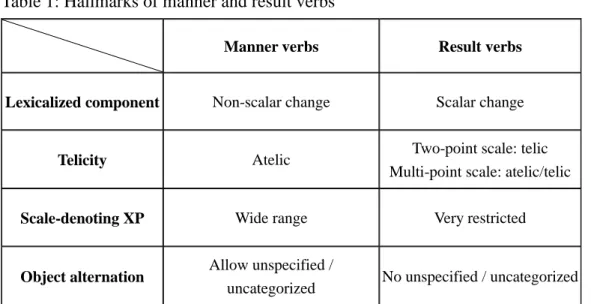
The MRC is claimed to be grammatically relevant as manner and result verbs show distinct argument realization patterns and aspectual features. For example, manner rather than result verbs allow unspecified or unsubcategorized objects. While manner verbs are generally atelic activity verbs, result verbs associated with two-point scales are necessarily punctual and telic. Even result verbs involving multiple-point scales can be interpreted telically without supporting context. With different grammatical properties, the hallmarks of manner and result verbs are identified to determine the ontological category of Chinese motion verbs, as illustrated in Table 1.
Table 1: Hallmarks of manner and result verbs
Manner verbs Result verbs
Lexicalized component Non-scalar change Scalar change
Telicity Atelic Two-point scale: telic
Multi-point scale: atelic/telic
Scale-denoting XP Wide range Very restricted
Object alternation Allow unspecified /
uncategorized No unspecified / uncategorized
Concerning the arguments against the MRC, I reanalyze the counterexamples to the MRC proposed by researchers. For example, based on a detailed analysis and grammatical tests of the manner of death verbs in English, I reveal that these verbs are in fact result verbs without lexicalized manner meaning component and thus are not counterexamples. As to researchers’ proposals that the MRC should not be regarded as a principle operating in the lexicon, I argue that the hypothesis can not be reduced to different syntactic configurations a verb is freely used in or differences in aspectual focus of verbs; rather it is well motivated principle operating in the lexicon.
Chapter 3: The Manner/Result Complementarity in Modern Chinese
As to the notions of manner and result in motion events in Modern Chinese, though varied conceptual properties related to manner or path verbs are proposed by scholars, not all conceptual properties are relevant to the ontological categorization of motion verbs in Chinese. For example, the conceptual properties concerning the force of gravity, the medium of motion are not regarded as a separate manner sense of the verb, since they do not encode independent change and are encyclopedic knowledge of the conceptualization of motion events in the language. A reexamination of motion verbs collected by Guo and Chen (2009) reveals that to some degree the controversies over the classification of some less prototypical motion verbs are related to the misunderstanding of the concept of manner or unclear criteria for testing manner or path meaning components. The purported counterexample verbs are also examined and shown not challenging the validity of the MRC. Some of these verbs (e.g., 落 luò fall) actually lexicalize only one type of meaning component, either manner or result, with the reading of the other meaning component determined by the contexts; the other verbs may lexicalize the two meaning components, but they are polysemous lexicalizing only one sense at a time and dropping the other sense meanwhile. Inconsistent grammatical behaviors of three motion verbs 走zǒu ‘walk’, 跑pǎo ‘run’ and 飞fēi ‘fly’, which are neglected in previous studies, are in particular looked at in detail. When these verbs are used following another verb expressing distinct manner or in subject inversion construction, they only encode a direction of motion as ‘depart from a reference object’ dropping the manner sense. Thus these verbs are polysemous motion verbs encoding the two senses separately conforming to the MRC hypothesis.
Chapter 4: The Manner/Result Complementarity in Old Chinese
Since Old Chinese is reported to have distinct lexicalization patterns from Modern Chinese and scholars have also suggested a variety of counterexamples from Old Chinese, it is worth independent investigation. Though Old Chinese has distinct lexicalization patterns of motion events, motion verbs in Old Chinese can also be categorized by their ontological type as manner or result. Through the compatibility test for the motion verbs used in serial verb constructions in representative Old Chinese texts, it is shown that manner and path verbs in Old Chinese show different compatibilities with other verbs expressing manner or path
information. In a single integral motion event, whereas Old Chinese manner verbs are compatible with verbs expressing varied path information, path verbs can co-occur with verbs indicating a wide range of manner information. Detailed analysis of counterexample verbs to the MRC in Old Chinese proposed by researchers (Ma 2008, Shi and Wu 2014, 2015) demonstrates that these verbs encode only one type of meaning at a time. To be specific, these verbs are either polysemous verbs encoding the two meaning components separately or lexicalize only one meaning component deriving the other from the contexts. Verbs like 走zǒu ‘run’, 趋 qū ‘hurry up’ and 奔 bēn ‘rush’ belong to the former type. These verbs in their basic uses are manner verbs, but when they are followed by locative nouns which indicate the goal of motion they always undergo ontological shift from manner to path verbs through tone alternation, as shown in (2).
(2) a. 荀跞 掩 耳 而 走
xún lì yǎn ěr ér zǒu (ctso1) Xun Li cover ears CONJ run
‘Xun Li ran with his hand covering his ears.’
(左传 昭公 31 年 Zuǒzhuàn Zhāo Gōng 31st Year: 1399) b. 赵旃 弃 车 而 走 林…
zhào zhān qì chē ér zǒu (tsoɔ) lín
Zhao Zhan abandon cart CONJ run forest ‘Zhao Zhan abandoned his cart and ran to the forest.’
(左传 宣公 12 年Zuǒzhuàn Xuān Gōng 12th year: 543) It can be seen in (2a), the verb 走zǒu ‘run’ only specifies the manner of motion and is read in rising tone reconstructed as ctso in International Phonetic Alphabet, but in (2b) it specifies the
goal direction of motion and it is read in departing tone represented as tsoɔ. As the tone change in the manner verb always goes along with the change in its lexical semantics and grammatical behaviors, the tone alternation of the verb 走zǒu ‘run’ marks its ontological shift from a manner to a result verb.
Verbs like 逃 táo ‘flee’, 亡 wáng ‘flee’, 遁 dùn ‘flee’, 涉 shè ‘sail across’ and 渡 dù
1 Following Sun (1997) the four tones of Old Chinese verbs are transcribed as half circles on four sides of the word: c平
‘sail across’ belong to the latter type. 逃 táo ‘flee’, 亡 wáng ‘flee’ and 遁 dùn ‘flee’ are in fact manner verbs deriving the direction of motion from the contexts. 渡 dù ‘sail across’ and 涉 shè ‘sail’ are path verbs with more elaborated path information. Their lexicalization patterns reflect the typological properties of verb-framed languages, which tend to have larger path lexicon including path verbs with both relatively abstract and more elaborated path information. Though they encode more elaborate path information, their ontological category is still that of path verbs.
Therefore, though Old Chinese is a typologically distinct language from Modern Chinese, its lexicalization patterns of motion verbs also conform to the general lexical principle. They only differ as to how different morphosyntactic devices are used to distinguish the two types of motion verbs.
Chapter 5: The Diachronic Evolution of Polysemous Motion Verbs
In Modern Chinese, manner of motion verbs 走zǒu ‘run/walk’, 跑 pǎo ‘run’ and 飞 fēi ‘fly’ are different from other manner verbs because they are polysemous and exhibit dual ways of ontological categorization. The diachronic investigation of the evolution of their lexical meaning and grammatical behaviors shows that a verb’s ontological category as manner or result and their relevant grammatical behaviors are not only determined by the concepts they are associated with but also affected by available morphosyntactic structures of the language. The verb 走zǒu ‘run/walk’ may encode both manner and direction of motion in Old and Modern Chinese, but along with the language’s evolution from Old to Modern Chinese its lexical meaning and grammatical behaviors have also changed. In Old Chinese besides used as a manner verb, it may also be directly followed by locative nouns encoding goal-oriented direction of motion, but in Modern Chinese it cannot be used in this way and correspondingly its lexicalized direction has changed into source-oriented path. The verb 飞
fēi also enters Chinese lexicon before Old Chinese period, but different from 走zǒu ‘run’ it
can not be used to indicate the direction of motion till Pre-modern Chinese period. 跑 pǎo ‘run’ enters Chinese lexicon much later, i.e., in Pre-modern Chinese period. Though it encodes the similar manner as the Old Chinese verb 走zǒu ‘run’, it does not develop a goal-direction sense either. Their evolution processes are represented in Table 2.
Table 2: The evolution processes of 走zǒu ‘run/walk’, 跑 pǎo ‘run’ and 飞 fēi ‘fly’
The possible factors affecting the evolution processes of the three verbs are analyzed. The pragmatic inference of displacement associated with nature of manner encoded in these verbs and the cognitive preference for goal-oriented path in the conceptualization of motion events provide conceptual basis for the lexicalization of directed motion sense in these verbs. In addition, available morphosyntactic structures in specific developmental stages of Chinese language facilitate or prohibit the actual lexicalization of either goal- or source-oriented path sense. The factors affecting the evolution process of 走zǒu ‘run/walk’ is illustrated in Figure 1.
Figure 1: The factors affecting the lexical evolution of 走zǒu ‘run/walk’2
In Old Chinese, more complicated phonological and morphological system provides beneficiary morphosyntactic devices (e.g., derivation by tone alternation) for the verb to
2 The small dotted square represents the evolution of the manner sense. The whole big dotted square represents the evolution
of its directed motion sense and relevant factors affecting the lexicalization of the specific sense. The plain arrows indicate the process of the actual lexicalization of certain sense. The arrows with dotted tail illustrate the relevant factors which are assumed to affect the lexicalization of certain sense.
derive a new sense without changing its written form. The verb-framed language property that prototypically renders the goal-oriented path into verbs also promotes the lexicalization of goal direction in the manner verb. In contrast, from Middle to Modern Chinese period, gradually simplified phonological system, disyllabification tendency of Chinese and its typological shift from verb-framed to satellite-framed language make the encoding of goal-direction in verbs unfavorable on the one hand. On the other hand the interaction between the inferred displacement from the manner verb and the newly emerged directional verbal compound construction consolidates the source-oriented sense to be lexicalized.
Though the verb 跑 pǎo ‘run’ and 飞 fēi ‘fly’ have undergone different evolution processes from Old to Modern Chinese, their distinct lexicalization patterns can also be explained by relevant factors affecting the evolution process of 走zǒu ‘run/walk’. The Figure 3 illustrates the factors affecting the lexical evolution of 飞 fēi ‘fly’.
Figure 2: The factors affecting the lexical evolution of 飞 fēi ‘fly’
The manners encoded in the three verbs are all likely to obtain a displacement inference, but in Old Chinese distinct from the verb 走zǒu ‘run’ which is prototypically used to encode motion events carried out by human beings often with an obvious intention of reaching a goal, 飞 fēi ‘fly’ is only used to encode motion events related to animals which cannot possibly have an intention of reaching a goal. Thus, without a favorable pragmatic concept associated with a goal direction, even with proper morphosyntactic devices 飞 fēi ‘fly’ does not develop a
lexicalized goal direction in Old Chinese. The effect of pragmatic inference on the lexicalization patterns of 飞 fēi ‘fly’ is further supported by the cases when used to describe intentional motions in Middle and Modern Chinese, it gains goal direction meaning, though it is better to be regarded as the pragmatic rather than lexicalized meaning of the verb, since it is only used in very restricted contexts.
Though the verb 跑 pǎo ‘run’ encodes similar manner of motion as 走zǒu ‘run’, it enters Chinese lexicon much later, i.e. in Pre-modern Chinese period when along with the typological change of Chinese from verb-framed to satellite-framed language there is no favorable morphosyntactic structures for the verb to develop a goal direction, so it does not have a separate goal-oriented path sense throughout its evolution process, as can be seen in Figure 3.
Figure 3: The factors affecting the lexical evolution of 跑 pǎo ‘run’
However, the same as 走zǒu ‘walk’, since Pre-modern Chinese period both 飞 fēi ‘fly’ and 跑
pǎo ‘run’ have benefited from the interaction between their inferred displacement concept
related to the nature of manner they encode and the property of directional verbal compound construction, their source-oriented direction sense has been developed and consolidated. The evolution of the lexicalization patterns of the three verbs demonstrates that the notions of manner and result reveal the two-way interaction between the lexicon and the syntactic structures.
Chapter 6: Conclusion
The major findings of the whole dissertation are summarized in this chapter. Relevant issues concerning motion verbs and motion events at the interface between lexicon and syntax are
also discussed. The distinct lexicalization patterns of the polysemous manner verbs in Chinese result from both the specificity of morphosyntactic structures and the diachronic evolution of Chinese language. Ontological categorization of verbs and their grammatical behaviors could not be attributed to either conceptual components or construction meaning alone; rather they result from the dynamic interaction of lexical semantics and syntactic construction. The diachronic change of the lexicalization patterns of motion verbs is regulated by general lexical principles operating in semantic structure of verbs on the one hand, and on the other hand it is also affected by other factors such as the conventional pragmatic inference from the contexts and morphosyntactic resources of the language at certain developmental stage. As the present study is mainly based on Chinese motion verbs, future work concerning the lexicalization patterns of change of state verbs and their diachronic evolution is suggested.
References
Ma, Y. X. (2008) Hanyu Lujing Dongci de Yanbian yu Weiyi Shijian de Biaoda [The
Development of Chinese Path Verbs and Motion Event Expressions]. Beijing: Zhongyang
Minzu Daxue Press.
Rappaport Hovav, M. and B. Levin. (1998) Building verb meanings. In M. Butt and W. Heuder (eds.), 97-134. The Projection of Arguments: Lexical and Compositional factors, Stanford, CA: CSLI Publications.
Rappaport Hovav, M. and B. Levin. (2010) Reflections on manner/result complementarity. In E. Doron, M. Rappaport Hovav and I. Sichel (eds.), In Syntax, Lexical Semantics, and
Event structure, 21–38. Oxford: Oxford University Press.
Sun, Y. W. (1997) Hanyu Biandiao Gouci Yanjiu [Word formation through Tone
Alternation in Classical Chinese]. Ph. D Dissertation. Peking University.
Shi, W. L. and Y. C. Wu. (2014) Which way to move: The evolution of motion expressions in Chinese. Linguistics. 52, (5): 1237–1292
Zlatev, J. and P. Yangklang (2004) A third way to travel: The place of Thai in motion-event typology. In S. Strömqvist and L. Verhoeven (eds.), Relating Events in Narrative:
別 記 様 式 博在-Ⅶ-2-②-A
論 文 審 査 の 結 果 の 要 旨
学 位 の 種 類 博 士 ( 国 際 文 化 ) 氏 名 Qiu Lei (キュウ ライ)
学 位 論 文 の 題 名
The Manner/Result Complementarity in Chinese Motion Constructions: Synchronic and Diachronic Perspectives ( 中 国 語 の 移 動 動 詞 に お け る 様 態 ・結 果 の 相 補 性 ― 共 時 的 お よ び 通 時 的 観 点 か ら ― ) 論 文 審 査 担 当 者 氏 名 ( 主 査 ) 小 野 尚 之 , 高 橋 大 厚 , 中 本 武 志 , 望 月 圭 子 論 文 審 査 の 結 果 の 要 旨 ( 1,000 字 内 外 ) 本 研 究 は 、 中 国 語 の 移 動 動 詞 を 分 析 対 象 に し て 、 動 詞 の 語 彙 的 な 意 味 の 形 成 に 関 わ る 様 態 ・ 結 果 の 相 補 性 仮 説 の 有 効 性 を 論 じ た も の で あ る 。 様 態 ・ 結 果 の 相 補 性 仮 説 と は 、 近 年 、 動 詞 の 意 味 論 に お い て 多 く の 研 究 者 の 関 心 を 集 め て い る 仮 説 で あ る が 、 移 動 や 状 態 変 化 を 表 す 動 詞 が 基 本 的 に 様 態 動 詞 と 結 果 動 詞 の い ず れ か に 分 類 さ れ 、 単 一 の 語 彙 素 が 様 態 と 結 果 を 同 時 に 表 す こ と は な い と す る も の で あ る 。 本 研 究 は 、 現 代 中 国 語 の 動 詞 を 対 象 と し た 共 時 的 研 究 、 及 び 古 代 中 国 語 か ら 現 代 中 国 語 へ 至 る 動 詞 用 法 の 変 遷 を 追 っ た 通 時 的 研 究 の 両 方 の 視 点 か ら こ の 仮 説 を 検 証 し た 。 第 1 章は、中国語の動詞における結果と様態の相補性を論じながら、研究課題をあげて い る 。 第 2 章では、特に意味論的な観点から様態と結果の相補性を論じた先行研究を分析 し 、 問 題 点 を 指 摘 し て い る 。 第 3 章は、現代中国語の移動動詞の分析によって仮説の論証 を 試 み て い る 。 特 に 、 先 行 研 究 に お い て 例 外 的 な 振 る 舞 い を す る と 指 摘 さ れ て い る zǒu ( 歩 く )、pǎo(走る)、fēi(飛ぶ)の3つ動詞について詳細な議論を展開している。多く の 研 究 で 仮 説 の 例 外 と さ れ て い る こ れ ら の 動 詞 に つ い て 適 切 な 説 明 を 加 え て い る 。 さ ら に 第 4 章では、これら3つの動詞が古代中国語ではどのような様態、結果のいずれに用いら れ た か を コ ー パ ス デ ー タ を 元 に 論 じ て い る 。 第 5 章は、3つの動詞が古代中国語から現代 中 国 語 へ ど の よ う な 変 遷 を 遂 げ た か を 明 ら か に し て い る 。 本 研 究 の 独 自 性 は 、 中 国 語 の 詳 細 な 分 析 に よ っ て 動 詞 の 意 味 研 究 に 新 た な 知 見 を 加 え た こ と 、 ま た 、 共 時 的 な 分 析 に 加 え 、 通 時 的 な 観 点 か ら の 分 析 を 行 う こ と で 、 こ れ ま で 議 論 さ れ て こ な か っ た 歴 史 的 変 化 を 明 ら か に し た こ と で あ る 。 こ の 2 点において、語彙意味論 研 究 へ の 学 術 的 貢 献 は 大 き い と 言 え る 。 審 査 会 で は 、 論 文 中 の 用 語 の 定 義 や 中 国 語 の 史 的 展 開 に お け る 複 合 動 詞 の 形 成 過 程 と の 関 連 性 な ど に 議 論 不 足 が 指 摘 さ れ た が 、 最 終 試 験 に お い て 十 分 な 説 明 が 行 わ れ た と 判 断 し た 。 な お 、 本 研 究 は 、 現 代 中 国 語 の み な ら ず 古 代 中 国 語 も 対 象 と す る 研 究 で あ っ た た め 、 論 文 審 査 会 に 外 部 審 査 員 と し て 東 京 外 国 語 大 学 の 望 月 圭 子 教 授 を 加 え 、 中 国 語 デ ー タ の 判 断 及 び 中 国 語 学 の 観 点 か ら の 専 門 的 ご 意 見 を い た だ い た 。 望 月 教 授 か ら は 、 古 代 及 び 現 代 中 国 語 の デ ー タ は 適 切 な も の で あ り 、 中 国 語 の 分 析 も 妥 当 で あ る と の 判 断 を い た だ い て い る 。
別 記 様 式 博在-Ⅶ-2-②-B
以 上 の こ と か ら 、 本 審 査 会 は 、 本 論 文 が 、 執 筆 者 が 自 立 的 に 研 究 を 遂 行 す る に 足 る 学 識 と 能 力 を 十 分 身 に つ け た こ と を 示 す も の で あ る と 判 断 す る 。 よ っ て 、 本 論 文 は 、 博 士 ( 国 際 文 化 ) の 学 位 論 文 と し て 合 格 と 認 め る 。