Mediating Effect of Affective Commitment on Organizational
Factors and Customer Satisfaction
Yutaka Ueda* Yoshiki Matsui** Atsuko Ebine***
Abstract
The purpose of this paper is to assess the impact of organizational structure and process factors on customer satisfaction, and to examine the mediating role of organizational commitment (affective commitment) on these relationships. The Round 3 data from the High Performance Manufacturing (HPM) project were used for this study. The data includes 266 plants from 9 industrialized countries. A simple Sobel test demonstrated the partial mediating effect of affective commitment. Structural equation modeling (SEM) revealed that when two structural factors and one process factor are considered, affective commitment partially mediates the effect of the flatness of organizational structure and supervisory interaction facilitation, but does not mediate the effect of the centralization of authority. Some limitations of this study are highlighted and future expectations provided.
Keywords: affective commitment, customer satisfaction, centralization, flatness
I. IMPORTANCE OF ORGANIZATIONAL COMMITMENT
Organizational commitment is “a strong belief in and acceptance of the organization’s goal and values, a willingness to exert considerable effort on behalf of the organization, and a strong desire to maintain membership in an organization” (Fields, 2002, p. 43). Furthermore, it is an important attitudinal factor in research on organizational behavior (Meyer, Jackson, & Maltin, 2008). Organizational commitment comprises various components, and a number of models have been used to describe the concept. Among these, Meyer and Allen (1991) proposed that organizational commitment is comprised of affective, continuance, and normative commitment. Affective commitment is related to identification with and involvement in the organization. Employees with high affective commitment remain in the organization because they like it and want to stay. Continuance and normative commitments are related to a different motive. Continuance commitment stems from awareness of the cost associated with leaving the organization.
* Faculty of Economics, Seikei University [email protected]
** Graduate School of International Social Sciences, Yokohama National University [email protected]
*** Faculty of Economics and Management, Surugadai University [email protected]
Some employees remain in the organization, even if they do not like it, because they find it difficult to obtain employment with another attractive organization. In other words, they remain because they need to stay. Normative commitment is associated with employees’ feelings of obligation to continue their employment. They remain with the organization because they think they ought to do so.
Among the three components of organizational commitment, affective commitment has received considerable attention from researchers in the field of organizational behavior. These researchers investigated it as an individual attitudinal factor that influences, or is influenced by, other individual or organizational factors (Meyer et al., 2008). Recent studies confirm the mediating effect of affective commitment. Mediating effects were found for the following relationships: career growth–voice behavior (Wang, Weng, McElroy, Ashkanasy, & Lievens, 2014), strategic compensation practice–knowledge-sharing (Anvari, Abdul Mansor, Abdul Rahman, Abdull Rahman, & Chermahini, 2014), organizational culture–innovation behavior (Taghipour & Dezfuli, 2014), training process–organizational performance (Ko & Ko, 2012), feedback environment–organizational citizenship behavior (OCB) (Norris-Watts & Levy, 2004), perceived organizational support (POS)–employee wellbeing (Panaccio & Vandenberghe, 2009), psychological contract breach–turnover intention (Lapointe, Vandenberghe, & Boudrias, 2013), organizational inclusion–turnover intention (Hwang & Hopkins, 2012), and the corporate entrepreneurship–OCB relationship (Zehir, Muceldili, & Zehir, 2012). All these studies stimulate a more persuasive discussion by considering that organizational policy or culture initially influences employees’ affective commitment, which impacts employees’ behavior and other attitudinal variables, instead of linking organizational variables to employee variables directly.
In this study, we focused on the effect of two organizational structural factors and one organizational process factor on a performance measure, and examined whether affective commitment mediated this effect. The structural factors considered were centralization of authority and flatness of organizational structure, and the process factor was supervisory interaction facilitation. Customer satisfaction was selected as the organizational performance measure in this study.
There are two possible effects of the two structural factors on customer satisfaction. One is a direct effect and the other an indirect effect through attitudinal factors. First, to enhance customer satisfaction, those who can understand customers’ needs should be given the necessary authority to respond promptly to those needs. This implies that centralization of authority is not appropriate for prompt responses to customers; thus, this factor will negatively impact customer satisfaction. Another way to understand customers’ needs and respond to them promptly is to have a flat hierarchical structure in the organization. Even if authority is centralized, prompt decision making in response to customers’ needs is possible in a flat structure. In such cases, the flat organizational structure has a positive effect on customer satisfaction.
In addition to these informational effects, structural factors are also associated with employees’ attitudes to work. Decentralization of authority and flat structures facilitate
job enrichment and enlargement. Employees enjoy these work environments, and have a high commitment to the organization. Employees with high affective commitment tend to consider their organization empathically, work hard, and as a result, enhance customer satisfaction.
Although organizational structure factors strongly impact the attitudes of employees and customers, similar effects have been found for other factors. Even if the authority of decision-making is not delegated to the lower level of the organization, or if there is a delay or error in communication between upper and lower levels in highly hierarchical organizations, it is expected that management can enhance employees’ affective commitment and customer satisfaction by approaching and communicating sincerely with frontline subordinates.
Furthermore, we selected supervisory interaction facilitation as the organizational process factor. Supervisory interaction facilitation means the degree to which supervisors consider their subordinates as a team. It also relates to the degree to which supervisors consider opinions and ideas from their subordinates.
Supervisors who frequently interact with frontline subordinates can acquire important information about customer needs, and increase customer satisfaction by responding to those needs. Furthermore, this process factor relates to employees’ attitudes to the organization. When supervisory interaction facilitation is high, workers have high affective commitment, which influences organizational performance.
II. HYPOTHESES
As described above, organizational factors influence performance measures such as customer satisfaction. Thus, we propose several hypotheses about the way in which affective commitment partially mediates this relationship. First, organizational structure is one important antecedent of affective commitment (Morris & Steers, 1980). For example, Katsikea, Theodosiou, Perdikis, and Kehagias (2011) determined that centralization and formalization have a negative effect on job satisfaction, which influences affective commitment. Decentralization and a flat organizational structure facilitate employees’ autonomy and empowerment. In this regard, De Ruyter, Wetzels, and Feinberg (2001) identified the positive effect of empowerment on affective commitment through greater job satisfaction. Furthermore, Prince (2003) emphasized the importance of task autonomy on affective commitment. Based on these previous studies, the effect of organizational structural factors on affective commitment can be assumed.
Second, we did not find any study dealing directly with the effects of supervisory interaction facilitation, because this concept is relatively unique to the HPM project. However, this factor is associated with the way in which a leader has contact with his/ her subordinates on the shop floor; therefore, it is a dimension of leadership. Some studies examined the effect of this dimension on affective commitment (de Ruyter et
al., 2001; Morris & Sherman, 1981; Tatlah, Ali, & Saeed, 2011). By surveying previous research, Lease (1998) concluded that supervisory and co-worker support positively affects affective commitment. O’Neill, Harrison, Cleveland, Almeida, Stawski, and Crouter (2009) positively associated supportive lower-level managers with affective commitment. Peng, Ngo, Shi, and Wong (2009) added that leader-member exchange positively impacted affective commitment. These findings contribute to our hypotheses. Furthermore, the process factor we focus on relates to an inclusive leadership style. According to Hollander (2009) and Carmeli (2010), a leader with this leadership style tries to build an open relationship with subordinates by listening to them and paying attention to their needs. Choi, Tran, and Park (2015) found that this type of leadership had a positive effect on affective commitment. The effect of this process factor on affective commitment can be inferred based on earlier research.
Finally, employees’ affective commitment affects their behavior and performance. Although few studies deal directly with the effect of affective commitment on customer satisfaction, many focus on the relationship between affective commitment and task and/ or non-task performance (Akoto, 2014; Chen & Francesco, 2003; Chong & Eggleron, 2007; Cohen, 2006; Ng, 2015; Neininger, Lehmann-Willenbrock, Kauffeld, & Henschel, 2010; Norris-Watts & Levy, 2004; Vandenberghe, Bentein, & Stinglhamber, 2004). Employees with high commitment and performance naturally expect their customers to have a high level of satisfaction with their high performance. Therefore, we assume that affective commitment will have a positive effect on perceived customer satisfaction. Considering together the elements discussed above, we propose the following hypotheses regarding the partial mediating effect of organization commitment on organizational factors and customer satisfaction. In these hypotheses, we assume a partial, not full mediating effect of affective commitment, because there is more than one way to relate such organizational factors to performance.
H1. Affective commitment partially mediates the relationship between centralization of authority and perceived customer satisfaction.
H2. Affective commitment partially mediates the relationship between the flatness of the organizational structure and perceived customer satisfaction.
H3. Affective commitment partially mediates the relationship between supervisory interaction facilitation and perceived customer satisfaction.
III. RESEARCH METHOD
1. SampleAs noted, we utilized the High Performance Manufacturing (HPM) data (Round 3). These data were collected from 2005 to 2007 by an international team of researchers from nine countries. Survey instruments were provided to plant managers who distributed them to appropriate people in their organizations. The plants are in the electronics, machinery, or transportation industries.
Each plant was counted as one sample, but there were multiple respondents in each plant. The total sample size was 266 (Australia: 21, Finland: 30, Germany: 40, Italy: 27, Japan: 35, South Korea: 31, Spain: 28, Sweden: 24, and the United States: 29).
2. Independent and Dependent Variables
Three independent variables were used in the analysis. Centralization of authority was measured using three seven-point scale items. Although the original HPM data had four items, one was omitted, because of the initial exploratory factor analysis (EFA). An example of one item is, “even small matters have to be referred to someone higher up for a final answer.” The flatness of the organizational structure was measured through five seven-point scale items, as was the original HPM data. An example of one item is, “our organization structure is relatively flat.”
Supervisory interaction facilitation was measured using four seven-point scale items. This is also the same as the original HPM data. “Our supervisors encourage the people who work for them to work as a team” is an example of an item. The HPM project collected four items for supervisory interaction facilitation.
Perceived customer satisfaction was introduced as a dependent variable. This was measured using six seven-point scale items. This type of data was not collected from customers directly in the HPM project, but from plants that provide customers with products. Therefore, it is more appropriate to label this variable as “perceived customer satisfaction” than simply “customer satisfaction.” An example of this variable is, “our customers are pleased with the products and services we provide for them.”
Affective commitment is expected to function as a mediating factor. This is measured using six seven-point scale items. An example of one item is, “I find that my values and the values of this organization are very similar.”
IV. RESULTS
1. Basic Statistics and Correlation of Variables
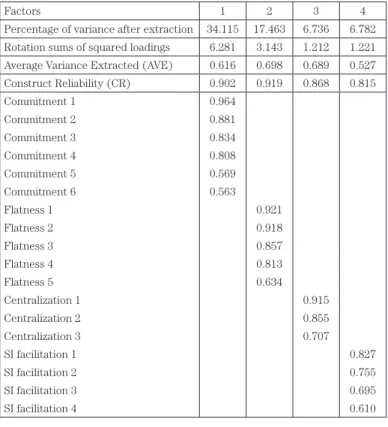
Table 1 provides the results of the EFA (maximum likelihood, Promax rotation) of all items. This demonstrates that the loading for all items was as expected. All average variance extracted (AVE) values exceed 0.5, and all construct reliability (CR) values exceed 0.7, confirming the reliability of all constructs (Hair, Black, Babin, & Anderson, 2010). We also conducted a CFA to assess the adequacy of the model comprising four factors, with the following results: CMIN/DF = 3.016, CFI = 0.915, and RMSEA = 0.087. Although RMSEA is slightly high, we consider the validity of this model confirmed.
Table 1 Pattern Matrix of EFA with 18 Items
Factors 1 2 3 4
Percentage of variance after extraction 34.115 17.463 6.736 6.782 Rotation sums of squared loadings 6.281 3.143 1.212 1.221 Average Variance Extracted (AVE) 0.616 0.698 0.689 0.527 Construct Reliability (CR) 0.902 0.919 0.868 0.815 Commitment 1 0.964 Commitment 2 0.881 Commitment 3 0.834 Commitment 4 0.808 Commitment 5 0.569 Commitment 6 0.563 Flatness 1 0.921 Flatness 2 0.918 Flatness 3 0.857 Flatness 4 0.813 Flatness 5 0.634 Centralization 1 0.915 Centralization 2 0.855 Centralization 3 0.707 SI facilitation 1 0.827 SI facilitation 2 0.755 SI facilitation 3 0.695 SI facilitation 4 0.610 Notes: N = 266
Extraction method: maximum likelihood
Rotation Method: Promax with Kaiser normalization
Simple arithmetic averages of responses were calculated by employing variables for the correlation analysis and a simple Sobel test, which is discussed later. Table 2 displays the basic statistics and correlations between two variables. The alpha values are all above 0.7. All the correlations of perceived customer satisfaction with the other variables are significant, and their directions are as expected by our hypotheses.
Table 2 Correlations of Variables
Mean DeviationStd. alpha 1 2 3 4
1. centralization 3.338 0.863 0.866 2. flatness 4.515 0.972 0.919 -0.522* 3. supervisory interaction 5.225 0.632 0.808 -0.228* 0.224* 4. commitment 5.219 0.555 0.908 -0.250* 0.295* 0.518* 5. customer satisfaction 5.337 0.527 0.856 -0.339* 0.335* 0.395* 0.489* N = 265-266, *: p < 0.01
2. Testing Hypotheses
Two methods were adopted to examine the mediating effect of affective commitment. One method was a simple Sobel test, and the other was structural equation modeling (SEM). The former has the advantage of easy application to a simple mediating model, and the latter is appropriate for examining the “fit” of a more complicated model to examine the effect of all independent variables simultaneously.
First, a simple mediation model was formulated for the Sobel test. According to Figure 1, the mediating effect of a variable is assessed by estimating the following three equations:
Yˆ = i1+ cX
Mˆ =i2+ aX
Yˆ = i3+ c' X + bM
In these equations, i is an intercept coefficient. When the effect of X on Y decreases to zero statistically through the inclusion of M, M has a full mediating effect on the Y – X relationship. When the effect of X on Y decreases, but not to zero statistically, M has a partial mediating effect on the Y – X relationship. Baron and Kenny (1986) asserted that the following Aroian test statistic (z), which is an Aroian version of the Sobel test, can be compared with the critical value of the standard normal distribution appropriate for a given significance level.
z = a × b b2 s
a2+ a2 sb2+ sa2 sb2
Table 3 Results of Regression Analysis of Structural and Process Variables Dependent variables Independent variables Commitment adj r2 F
Centralization Flatness Supervisory Interaction
Perceived Customer Satisfaction -0.207* 0.111 34.184* (0.035) -0.136* 0.410* 0.28 52.309* (0.033) (0.051) 0.181* 0.109 33.288* (0.031) 0.108* 0.407* 0.269 49.590* (0.030) (0.052) 0.328* 0.153 48.515* (0.047) 0.161* 0.368* 0.266 47.526* (0.051) (0.059) 0.462* 0.236 82.504* (0.051) Commitment -0.161* 0.059 17.478* (0.039) 0.170* 0.084 25.059* (0.034) 0.455* 0.268 96.265* (0.046) N = 266, *: p < 0.01
As shown in Table 3, both coefficients c’ remain significant after including affective commitment in the equations. The Aroian test statistic is –3.650 for centralization (p < 0.01), 4.189 for flatness (p < 0.01), and 5.257 for supervisory interaction (p < 0.01). All VIFs (variance inflation factors) are lower than 1.50, suggesting that multicollinearity is not a problem. Thus, we conclude that affective commitment partially mediates the relationship between the two structural factors or one process factor and customer satisfaction. As such, H1, H2, and H3 are supported.
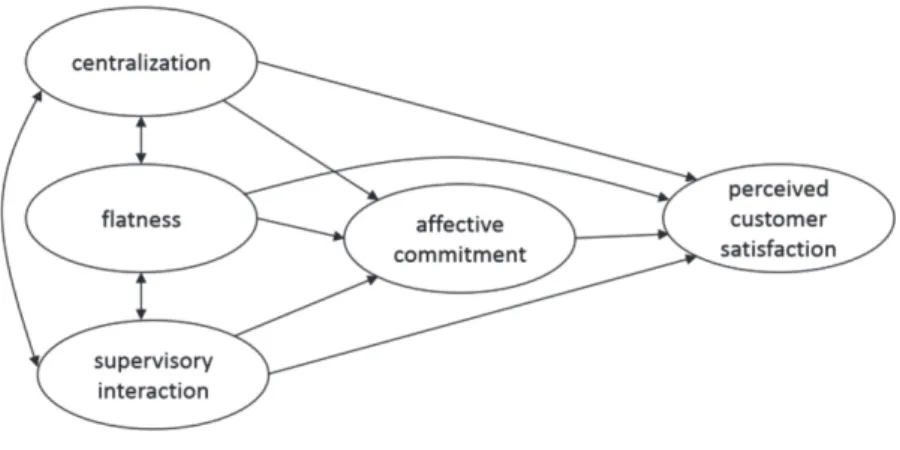
While the Sobel test is appropriate for examining whether the effect of each independent variable on perceived satisfaction is mediated by affective commitment, the SEM model provides effective information about more complicated relationships that simultaneously include the two structural variables and one process variable. We adopted the basic model to explore the best model to explain the relationships among variables (Figure 2). In Figure 2, the basic model depicts six paths (arrows), which show the causal relationship between each of the three independent variables and either perceived customer satisfaction or affective commitment. If the existence or non-existence of each of these six paths is considered, we can deal with 64 (= 26) different models, and
2016). We considered this specification search process necessary because it is not enough just to analyze only one model according to the hypotheses, and to examine whether all the paths are significant just as the hypotheses. Rather, it is desirable to extract the best model, and to figure out how this best model is related to the hypotheses (the basic model).
Figure 2 The Basic Model
The results of the comparison of the 64 models by BCC0 as a criterion (Burnham & Anderson, 1998) indicate that the best one is as depicted in Figure 3. Here, all the paths demonstrate significance at the 5% level, and the relationships between observed variables and latent variables are omitted. As shown in Figure 3, although centralization had a significantly negative impact on perceived customer satisfaction, the effect of centralization is not mediated by affective commitment. Thus, the mediating effect of affective commitment on the centralization–satisfaction relationship is negated, and H1 is not supported. In contrast, both the direct effect and mediated effect of flatness and supervisory interaction on perceived customer satisfaction are significantly positive. This means the effect of these two factors is partially mediated by affective commitment. As such, H2 and H3 are supported.
Figure 3 The Best Model
V. DISCUSSION AND CONCLUSION
This study examined the mediating role of affective commitment on structural and process variables and the relationship with perceived customer satisfaction. As discussed in the previous section, the simple Aroian test demonstrated a partial mediating effect of affective commitment, although the SEM provided a test for more complicated relationships.
One interesting finding is that centralization is not mediated by affective commitment. Primarily centralization has a negative correlation with affective commitment, and the Sobel test reveals that the effect of centralization is significantly mediated by affective commitment. However, as shown in Figure 3, centralization only has a direct effect on perceived customer satisfaction. SEM considers the effect of three independent variables concurrently, and in that case, it is considered that the effect of supervisory interaction on affective commitment is relatively strong. Because of this large effect, the weaker effect of centralization is cancelled.
These empirical results elicit an important implication for the practical management of the organization. Employees’ affective commitment must be increased to enhance customer satisfaction. In terms of organizational structural factors, the organization should be decentralized. However, organizational structure cannot be determined simply by considering its effect on employees’ attitudes, and it should sustain an accommodative relationship with its environment and context. The organization often has little choice but to adopt a centralized structure in the full knowledge of the negative impact of centralization on employees’ attitudes.
The results of this empirical research indicate that management behavior has a stronger effect on affective commitment than organizational structure. Specifically, regardless of the degree of centralization of the organization, if management has regular
contact with their subordinates and enough respect and care, subordinates have higher affective commitment. Furthermore, customers are also more satisfied.
Affective commitment is only one of the attitudinal factors that mediate organizational structure/process and performance, and the HPM data include other perceptual/ attitudinal factors that should be considered.
Although this study demonstrates that one important attitudinal factor acts as a mediator, there are some limitations to this study. First, our model was preliminary and simple, because of the limited number of samples. There were less than 300 samples, and more complicated SEM models require a greater number. Second, there is the possibility of an inverse causal relationship between commitment and customer satisfaction. Although we assumed that employees with high affective commitment work hard and consider their customers empathetically, and thereby enhance customer satisfaction, it is possible that high customer satisfaction increases employees’ pride as organizational members and heightens their affective commitment. Future research is needed to examine this inverse relationship.
Finally, it is true that organizational factors take time to obtain good results through attitudinal factors. Although this paper adopted a cross-sectional approach to examine the mediating effect of affective commitment, a longitudinal approach might be necessary in a future study. Adopting a longitudinal approach will make it possible to conclude about the causal relationship described above.
Much empirical research has dealt with affective commitment, or organizational commitment as an antecedent or consequent variable of other individual or organizational factors. Focusing on it as a mediator can provide important implications for both academic research and practical management. We hope this paper arouses future research that more widely considers organizational commitment.
*We thank two anonymous reviewers for their helpful comments on earlier drafts of the manuscript. This study was supported by Grant-in-Aid for Scientific Research (A), Grant Number 25245050, sponsored by the Japan Society for the Promotion of Science (JSPS).
REFERENCES
Akoto, E. O. 2014. “Contexts of the commitment–citizenship link: A test of economic volatility in a dual organization setting,” Journal of Vocational Behavior, Vol.84, No.3: 332-344.
Anvari, R., Abu Mansor, N. N., Abdul Rahman, S. A. P., Abdull Rahman, R. H. B., & Chermahini, S. H. 2014. “Mediating effects of affective organizational commitment and psychological contract in the relationship between strategic compensation practices and knowledge sharing,” Procedia-Social and Behavioral Sciences, Vol.129: 111-118.
Arbuckle, J. L. 2016. IBM SPSS Amos 24 User’s Guide, Amos Development Corporation. Baron, R. M. & Kenny, D. A. 1986. “The moderator-mediator variable distinction in social
psychological research: Conceptual, strategic, and statistical considerations,” Journal of Personality and Social Psychology, Vol.51, No.6: 1173-1182.
Burnham, K. P. & Anderson, D. R. 1998. Model Selection and Inference: A Practical Information: Theoretical Approach, New York: Springer-Verlag.
Chen, Z. X. & Francesco, A. M. 2003. “The relationship between the three components of commitment and employee performance in China,” Journal of Vocational Behavior, Vol.62, No.3: 490-510.
Choi, S. B., Tran, T. B. H., & Park, B. I. 2015. “Inclusive leadership and work engagement: Mediating roles of affective organizational commitment and creativity,” Social Behavior and Personality, Vol.43, No.6: 931-944.
Chong, V. K. & Eggleton, I. R. C. 2007. “The impact of reliance on incentive-based compensation schemes, information asymmetry and organisational commitment on managerial performance,” Management Accounting Research, Vol.18, No.3: 312-342. Cohen, A. 2006. “The relationship between multiple commitments and organizational
citizenship behavior in Arab and Jewish culture,” Journal of Vocational Behavior, Vol.69, No.1: 105-118.
De Ruyter, K., Wetzels, M., & Feinberg, R. 2001. “Role stress in call centers: Its effects on employee performance and satisfaction,” Journal of Interactive Marketing, Vol.15, No.2: 23-35.
Fields, D. L. 2002. Taking the Measure of Work: A Guide to Validate Scales for Organizational Research and Diagnosis, Thousand Oaks, CA: Sage Publications. Hair, J. F., Black, W. C., Babin, B. J., and Anderson. R. E. (2010). Multivariate Data
Analysis (7th ed.), Englewood Cliff, NJ: Prentice-Hall.
Hwang, J. & Hopkins, K. 2012. “Organizational inclusion, commitment, and turnover among child welfare workers: A multilevel mediation analysis,” Administration in Social Work, Vol.36, No.1: 23-39.
Katsikea, E., Theodosiou, M., Perdikis, N., & Kehagias, J. 2011. “The effects of organizational structure and job characteristics on export sales managers’ job satisfaction and organizational commitment,” Journal of World Business, Vol.46, No.2: 221-233.
Ko, C-P., & Ko, C-C. 2012. “The relationship of training quality in e-learning and organizational commitment to organizational performance in the Taiwan service industry,” IERI Procedia, Vol.2: 821-827.
Lapointe, E., Vandenberghe, C., & Boudrias, J. S. 2013. “Psychological contract breach, affective commitment to organization and supervisor, and newcomer adjustment: A three-wave moderated mediation model,” Journal of Vocational Behavior, Vol.83, No.3: 528-538.
Lease, S. L. 1998. “Annual review, 1993-1997: Work attitudes and outcomes,” Journal of Vocational Behavior, Vol.53, No.2: 154-183.
Meyer, J. P., and Allen, N. J. 1991. “A three-component conceptualization of organizational commitment,” Human Resource Management Review, Vol.1, No.1: 61-89.
Meyer, J. P., Jackson, T. A., and Maltin, E. R. 2008. “Commitment in the workplace: Past, present, and future,” in Barling, J., and Cooper, C. L., eds., The Sage Handbook of Organizational Behavior, Sage.
Morris, J. H. & Sherman, J. D. 1981. “Generalizability of an organizational commitment model,” Academy of Management Journal, Vol.24, No.3: 512-526.
Morris, J. H. & Steers, R. M. 1980. “Structural influences on organizational commitment,” Journal of Vocational Behavior, Vol.17, No.1: 50-57.
Neininger, A., Lehmann-Willenbrock, N., Kauffeld, S., & Henschel, A. 2010. “Effects of team and organizational commitment – A longitudinal study,” Journal of Vocational Behavior, Vol.76, No.3: 567-579.
Ng, T. W. H. 2015. “The incremental validity of organizational commitment, organizational trust, and organizational identification,” Journal of Vocational Behavior, Vol.88: 154-163.
Norris-Watts, C. & Levy, P. E. 2004. “The mediating role of affective commitment in the relation of the feedback environment to work outcomes,” Journal of Vocational Behavior, Vol.65, No.3: 351-365.
O’Neill, J. W., Harrison, M. M., Cleveland, J., Almeida, D., Stawski, R., & Crouter, A. C. 2009. “Work–family climate, organizational commitment, and turnover: Multilevel contagion effects of leaders,” Journal of Vocational Behavior, Vol.74, No.1: 18-29. Panaccio, A. & Vandenberghe, C. 2009. “Perceived organizational support, organizational
commitment and psychological well-being: A longitudinal study,” Journal of Vocational Behavior, Vol.75, No.2: 224-236.
Peng, K. Z., Ngo, H. Y., Shi, J., & Wong, C. S. 2009. “Gender differences in the work commitment of Chinese workers: An investigation of two alternative explanations,” Journal of World Business, Vol.44, No.3: 323-335.
Prince, J. B. 2003. “Career opportunity and organizational attachment in a blue-collar unionized environment,” Journal of Vocational Behavior, Vol.63, No.1: 136-150. Taghipour, A. & Dezfuli, Z. K. 2014. “Innovative behaviors: Mediate mechanism of job
attitudes, “ Procedia-Social and Behavioral Sciences,” Vol.84, No.9: 1617-1621. Tatlah, I. A., Ali, Z., & Saeed, M. 2011. “Leadership behavior and organizational
commitment: An empirical study of educational professionals,” International Journal of Academic Research, Vol.3, No.2: 1293-1298.
Vandenberghe, C., Bentein, K., & Stinglhamber, F. 2004. “Affective commitment to the organization, supervisor, and work group: Antecedents and outcomes,” Journal of Vocational Behavior, Vol.64, No.1: 47-71.
Wang, Q., Weng, Q., McElroy, J. C., Ashkanasy, N. M., & Lievens, F. 2014. “Organizational career growth and subsequent voice behavior: The role of affective commitment and gender,” Journal of Vocational Behavior, Vol.84, No.3: 431-441.
Zehir, C., Muceldili, B., & Zehir, S. 2012. “The impact of corporate entrepreneurship on organizational citizenship behavior and organizational commitment: Evidence from Turkey SMEs,” Procedia-Social and Behavioral Sciences, Vol.58, No.12: 924-933.
Appendix (Question Items)
[Centralization of Authority]
1 Any decision I make has to have my boss’s approval.
2 Even small matters have to be referred to someone higher up for a final answer. 3 There can be little action taken here until a supervisor approves a decision. [Flatness of Organizational Structure]
1 There are many levels between the lowest level in the organization and top management.
2 There are few levels in our organizational hierarchy. 3 Our organizational chart has many levels.
4 Our organization structure is relatively flat. 5 Our organization is very hierarchical. [Supervisory Interaction Facilitation]
1 Our supervisors encourage the people who work for them to exchange opinions and ideas.
2 Our supervisors encourage the people who work for them to work as a team.
3 Our supervisors frequently hold group meetings where the people who work for them can really discuss things together.
4 Our supervisors rarely encourage us to get together to solve problems (R). [Commitment]
1 I am proud to tell others that I am part of this organization.
2 I am extremely glad that I chose this organization to work for over others I was considering at the time I joined.
4 I find that my values and this organization’s values of this organization are very similar.
5 For me, this is the best of all organizations for which to work.
6 This organization really inspires the best in me in the way of job performance. [Perceived Customer Satisfaction]
1 Our customers are pleased with the products and services we provide for them. 2 Our customers seem happy with our responsiveness to their problems.
3 We have a large number of repeat customers. 4 Customer standards are always met by our plant.
5 Our customers have been well satisfied with the quality of our products over the past three years.
6 In general, our plant’s level of quality performance over the past three years has been low relative to industry norms.