Academia arena2010;2(6)
10
DOES ENERGY AND IMPULSE ARE INTER CONVERTABLE Manjunath. R(Reader in physics).
#16,8th Main road, Shivanagar, Rajajinagar,
Bangalore-560010 Karnataka, India [email protected]
Abstract : The new mathemathematical model allows us to calculate energy stored in particle as the function of impulse applied on it.It is shown that the impulse and energy are interconvertable.The paper also describes impulse is indirect measure of energy and relativistic variation of mass with position.th mathematical expressions was developed based on wave theory, classical mechanics, atomic physics and mathematical concepts [Academia Arena, 2010;2(6):10-13] (ISSN 1553-992X).
Key words : Energy, Impulse, Photon,Wave theory...
Consider a photon of relativistic mass ‘m’ moving with speed ‘c’ is associated with the wavelength ‘λ’ is given by the relation λ=h/mc, Where h=planck’s constant (6.625*10^-34 JS).
According to wave theory, speed of the photon wave is given by c = λ /T, where T= time period.
By substitution of value of ‘c’ in the equation λ = h/mc, we get the expression m λ^2 = hT.
According to wave theory, as frequency of photon wave is given by f=1/T.
Then the equation m λ^ 2 = hT becomes f=h/mλ^2
De Broglie wavelength associated with the photon is given by λ= h/p, thus the equation f=h/mλ^2 becomes f=p/mλ.
Angular frequency associated with the photon is given by ω= 2 πf.
By putting the value of f=p/mλ. in the above equation we get ω= 2 πp/mλ.
The above equation ω= 2 πp/mλ. can be applied to both photons and material particles like electron in motion.
Debroglie wavelength associated with the electron is given by λ=h/mv Where v=velocity of electron in motion
Then the equation ω= 2 πp/mλ becomes ω= 2 πpmv/mh i.e ω= 2 πpv/h.
Part : 2
Consider a electron of mass “me”at rest, total energy associated with the electron is given by “me c^2”. Suppose radiation of energy hf is incident on this electron at rest. Part of energy hf” is absorbed by electron and part of
Academia arena2010;2(6)
11
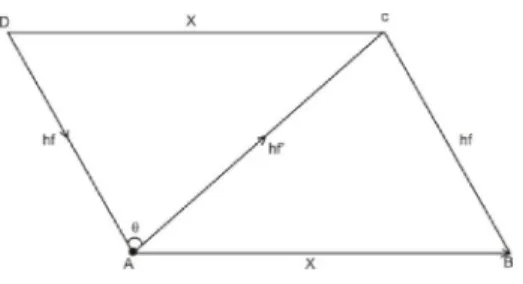
energy hf’ is scattered by electron . Absorbed energy hf” is converted to motion of electron, hence electron travels a distance ‘x’ in time ‘t’. let θ is the scattering angle.
Figure :1 –schematic diagram of scattering of energy of photon by electron x= Linear displacement of electron
hf = Energy of incident radiation hf’ = Energy of scattered radiation θ = scattering angle
Consider a parallelogram ABCD constructed as shown in the figure 1.
Let AB=CD=x, AD=BC=hf, AC=hf’(opposite sides in parallelogram are equal)
Law of cosine is given by a^2=b^2+c^2-2bc cos θ. Let a = x, b=hf, c=hf’, cos A = cosθ.
By applying the law of cosine to the triangle ADC, we get X^2=(hf)^2+(hf’)2-2(hf)(hf’) cos θ = 1
By law of conservation of momentum of photon.
We get
→
→
→= +
'
" y
y y
p p
p where
→
→
→ '
"
, ,
y y y
p p
p be the momentum of incident, absorbed and scattered photon respectively.
Let us assume absorbed momentum of photon = momentem of electron
i.e.
→
→p= p
y"
Thus
→
→
→= +
' y y
p p
p where
→
p = momentum of electron
→
→
→= −
' y y
p p
p Squaring on the both sides we get
Academia arena2010;2(6)
12
P^2=
−→ →
y' y
p
p ^2, as (a-b)^2=a^2+b^2-2ab
Thus the above equation becomes p ^2=py ^2+py’ ^2-2 |
→
py
.
→py’|According to dot product rule |
→
→•b
a |= |a||b|cosθ Then we get p^2= py ^2+ py’ ^ 2-2| py | | py’ | cos θ Let us multiply the above equation by c ^ 2we get Where c = speed of light in vaccum (3* 10 ^ 8 m/s) P ^2 c ^2 = py ^ 2c ^2 +py’ c^2-2| py | | py’ |c^2 cos θ
As we know frequency of photon is directly proportional to it’s momentum i.e hf = pc thus the below equation is obtained
p ^2 c ^ 2= =(hf)^2+(hf’)2-2(hf)(hf’)cos θ = 2 By comparison of 1 and 2 we get x ^ 2 = p ^2 c^ 2
i.e x = pc (position of electron is defined as the function of it’s momentum) As told earlier position of electron is defined as a function of it’s momentum i.e x = pc
Small change in momentum of electron causes small change in it’s position i.e. dx = dpc hence, dp = dx/c
Newton second law of motion is mathematically represented by equation F=dp/dt Where F = force exerted by photon
dp = Small change in momentum of electron with respect to time As dp = dx/c then the above equation becomes F= dx/dtc.
as velocity of electron is defined as v = dx/dt.
Then F =v/c is obtained
Force exerted by photon is defined as function of velocity of electron As impulse exerted by photon is mathematically given by I = F dt.
then the equation F= dx/dtc becomes Fdt = dx/c i.e I =dx/c
Impulse exerted by photon is defined as function of change in position of electron At point A and B mass of electron is mei.e total energy assosiated with electron is mec^2. (as electron is at rest at
Academia arena2010;2(6)
13
point Aand B) But in between point A and B mass of electron is mc^2 (since electron is in motion in between point A and B ) Hence total energy of electron in motion is mathematically given by E= mec^2+hf’
(As absorbed energy adds up to rest mass energy ) where E= total energy of electron in motion hf’=absorbed energy of photon
mec^2=rest mass energy of electron As absorbed momentum of photon equals the momentum of electron i.e py’’= p
As x=pc (position of electron is defined as the function of it’s momentum) then x= py’c py’c=hf’then x=hf’ then the equation E= mec^2+hf’ becomes equation E= mec^2+x=3 According to Einstein equation E= mec^2+Ek=4 By camparison of 3and 4 we get Ek = x i.e kinetic energy of electron = position of electron Small change in kinetic energy of electron causes small change in it’s position i.e d Ek = dx i.e I =dx/c
i.e I= d Ek/c i.e d Ek=Ic According to workenergy theorm
Work done on particle equals change in kinetic energyof particle i.e W= d Ek i.e W= Ic Work done on particle involves storage of energy in particle i.e W=Ea where Ea= Energystored in particle.
Ea =Ic ,energy stored in particle is defined as a function of impulse applied Thus Ea a I (as c is constant ) i.e impulse and energy are interconvertable.
2) Proof for Einstein predicted formula E=tc
As x = pc (position of electron is defined as the function of it’s momentum)
As momentum of electron can be given by p=mv then the equation x = pc becomes x=mvc i.e x/v=mc
According to newton v=x/t i.e equation x/v=mc becomes t=mc According to Einstein E=mc^2 hence E=mcc becomes E=tc
References :
• Matter wave (From Wikipedia, the free encyclopedia)
• Classical mechanics (From Wikipedia,the free encyclopedia)
• Compton effect (From Wikipedia, the free encyclopedia)
• Law of cosines (From Wikipedia, the free encyclopedia)
• Fundamental equation of unified theory.6 of R.W. Kuhne, Modern Physics letters A, 14 (1999)1917-1922
• Frequency ((From Wikipedia, the free encyclopedia)
• Angular frequency, Angular velocity (From Wikipedia, the free encyclopedia)
• Momentum (From Wikipedia, the free encyclopedia)
• Mass –energy equivalence, www.worsleyschool.net/science/files/emc2.html catched pages
• Parallelogram, Vector (mathematics and physics) (From Wikipedia,the free encyclopedia)
4/1/2010