原 著
学校心臓検診全国アンケート調査
高橋 良明1),小川 實2),松下 享3),上田 憲4)
太田 文夫5),佐藤 雄一6),澤田 陽子7),奈良井 栄8)
矢嶋 茂裕9),渡部 誠一10)
たかはし小児科循環器科医院1),小川クリニック2),
松下こどもクリニック3),うえだ小児科医院4),おおた小児科循環器科5), 佐藤小児科医院6),育愛こども医院7),鳥取県立厚生病院小児科8), 矢嶋小児科小児循環器クリニック9),土浦協同病院小児科10)
School Heart Examination in Japan: A Nationwide Questionnaire Survey
Yoshiaki Takahashi
1), Minoru Ogawa
2), Tohru Matsushita
3), Ken Ueda
4), Fumio Ohta
5), Yuichi Sato
6), Yoko Sawada
7), Sakae Narai
8), Shigehiro Yajima
9), Seiichi Watanabe
10)1)
Takahashi Pediatric Clinic, Shiga, Japan,
2)Ogawa Pediatric Clinic, Osaka, Japan,
3)Matsushita Kids Clinic, Osaka, Japan,
4)
Ueda Pediatric Clinic, Shizuoka, Japan,
5)Ohta Pediatric Clinic, Chiba, Japan,
6)Sato Pediatric Clinic, Miyazaki, Japan,
7)
Ikuai Pediatric Clinic, Hokkaido, Japan,
8)Department of Pediatrics, Tottori Prefectural Kousei Hospital, Tottori, Japan,
9)
Yajima Children s Clinic, Gifu, Japan,
10)Department of Pediatrics, Tsuchiura Kyodo General Hospital, Ibaraki, Japan
Background and Methods: To clarify the actual status of the school heart examination in Japan, we sent questionnaires to 1,825 prefectural and municipal Boards of Education and 708 branches of the Japan Medical Association in Japan. We classified the answers into two groups from prefecture and municipality, and received answers from 23 prefectures and 810 municipalities.
Results: In 92% of municipalities, a school heart examination was performed in the first year of primary, junior high, and high school. The screening was also performed in the fourth grade of primary school in 33%. Most students, more than 98.5%, received the school heart examination. Incidents of students who were asked to receive further detailed examinations were 3% to 4% in the first year of primary school, 4% to 5% in the junior high school, and 6% in high school.
After the second and third examinations, 1.3% of primary school students, 1.5% to 1.6% of junior high school students, and 1.5% of high school students were judged to be under control regarding exercise strength at school and sports clubs. As the first examination, an electrocardiogram (ECG) was solely used in 66% and a combination of ECG and phonocardiogram in 30%. The judgment was checked by responsible doctors or committees of school screenings in 17% to 39% of municipalities.
Conclusions: In advance of school heart examinations, the following should be necessary: first, improving the guidelines for examinations; second, improving the accuracy of automatic analysis system in ECG; and third, accumulating and reviewing all data including the proper management of daily activity in children under control.
要 旨
背景と目的:学校心臓検診の全国各地域の方法はいまだ調査されたことがなく,今回アンケート調査を行った.
方法:708都道府県市町村医師会,1,825都道府県市町村教育委員会にアンケートを郵送した.アンケートの回答 が重複した地域を整理し,810市町村と
23
都道府県の回答を対象とした.結果:市町村からの回答では検診施行は
92%が市町村単位であった.心電図は 33%の市町村で小学校 4
年生時 も行っていた.心電図受診率は98.5%以上であった.このうち要精密検査とした生徒は,小学校 1
年生3
〜4%,
中学校
1
年生4
〜5%,高校 1
年生6%であり,管理されている生徒は小学校 1
年生1.3%,中学校 1
年生1.5
〜1.6%,
高校
1
年生1.5%であった.1
次検診の検査項目は学校医診察・問診票以外に,心電図のみが66%,心電図+心
Key words:
school heart examination, ECG, whole country questionnaire survey
2010
年3
月23
日受付2011
年6
月3
日受理別刷請求先:〒
520-0241 滋賀県大津市今堅田 2-8-21
たかはし小児科循環器科医院 高橋 良明背 景
学校において生徒の心電図を記録することによる学 校心臓検診は昭和
30
年頃より大阪,滋賀,東京1-3)で 始められ,昭和53
年頃より全国的に広がった.平成7
年に学校保健法が改正され,小学校1
年生,中学校1
年生,高校1
年生全員に心電図記録が義務付けられ た.しかし,心臓検診は各市町村が主体で行われてお り,学校心臓検診の実施様式には不明の点が多い.そ こで各地で行われている学校心臓検診の様式を明らか にすることを目的としてアンケート調査を行った.方 法
アンケート内容は以下のごとくである.質問事項の 作成には文献
4
〜13
を参考にした.1)
心臓検診の施行単位はどのような単位でしょうか ①市町村単位②都道府県単位 ③その他
2)
心臓検診の実施主体あるいは委託先はどこでしょ うか(複数回答可能)①都道府県医師会 ②地区医師会 ③民間検査センター ④病院
⑤その他
3) 1
次検診の集計結果は ①都道府県で集計 ②市町村で集計③集計されているか不明 ④その他
4) 3
次検診の集計結果は① 都道府県市町村に報告され,集計しチェックされ る
②集計のみ
③集計されているか不明 ④その他
5) 1
次検診で心電図を施行しているのは(複数回答可 能)①小学校
1
年 ②小学校4
年 ③中学校1
年 ④高校1
年⑤運動クラブ参加全員 ⑥その他
6)
心電図検診受診率はおおよそ何%ですか(心電図受 診生徒/在籍生徒×100,都道府県市町村など単
位はいずれでもよい)①小学校
1
年 ②中学校1
年 ③高校1
年7)
そのうち要精密検査とされた生徒は何%ですか(要 精密検査生徒/心電図受診生徒×100,都道府県
市町村など単位はいずれでもよい)①小学校
1
年 ②中学校1
年 ③高校1
年8)
生活管理指導(管理)を受けたのは何人ですか(都道 府県市町村など単位はいずれでもよい)①小学校
1
年 ②中学校1
年 ③高校1
年9)
都道府県市町村など単位の母集団(1学年のおおよ その在籍生徒数)①小学校
1
年 ②中学校1
年 ③高校1
年10) 1
次検診の心電図や心音図はだれが検査していま すか①検診業者 ②医師会など ③その他
11) 1
次検診の心電図判定医はどなたですか(複数回答 可能)①小児循環器専門医 ②循環器内科専門医 ③一般小児科医
音図が
30%であった.1
〜3
次検診は各自独自の方式で行われており,検診精度の検証を行っている率は17
〜39%であった.
結論:今後の学校心臓検診の改善には,①さらなるガイドラインの充実,②心電図解析診断ソフトの精度の向上,
③有所見者の管理方法も含めたデータの集積と再検討が望まれる.
20) 3
次検診は①
1
箇所にまとめて精密検査している② どこでもいいから精密検査医療機関を受診させて いる
③特定の病院に行くことを指導している ④その他
21) 3
次検診で精密検査医療機関が生徒にわたす管理 表は,①
3
〜4
枚綴りで生徒の親,学校,医師会あるいは 教育委員会に提出されている② 厚紙でつくり毎年同じものをもたせ,過去の歴史 がわかるようにしている
③その他
22) 3
次検診で出された管理表は,心電図判定責任者 あるいは心電図判定委員会などで①異常な管理があるか点検している ②点検していない
③その他
23)
点検していると答えられた方に,異常な管理表を 提出した医療機関に①管理表の診断根拠を質問している ②何もしていない
③その他
24)管理表の問診表(学校心臓検診調査票)について
① 平成2
年度学校保健会作成の調査票(1:心臓の異常,2:川崎病,3:リウマチ熱などの病気,4:
動悸,けいれんなどの有無,5:突然死,6:運動 など)を使用している
②
2004
年に日本小児循環器学会学校心臓検診研究委員会(馬場國蔵委員長)の調査票の改訂(日小循 誌
2004; 20: 50-51)を使用している
③その他
25) QT
延長の判定基準について① 日本小児循環器学会の基準(Bazettで
HR75
以上0.5
以上,それ以下0.45
以上A
判定)を使用して いる②
Bazett
以外を使用している③その他
26) Brugada
様心電図について①診断基準(Consensus Report)で行っている
② 日本小児循環器学会の
Brugada
委員会の診断基準 で行っている③特に行っていない ④その他
27)管理についてお聞きします(複数回答可)
①
2002
年基礎心疾患を認めない不整脈の管理基準④一般内科医 ⑤その他
12) 1
次検診の検査項目は ①心電図のみ②心電図+心音図
③心電図+心断層エコー図 ④その他
13) 1
次検診の心電図は①
6
チャネル同時記録(胸部誘導V
1〜V
6が同時に 検査できる)12
誘導②
3
チャネル同時記録(V1〜V
3が同時に検査でき る)12
誘導③省略
4
誘導 ④その他14)
上記13)の質問で心電計が学年ごとに違う場合お
答えください(13)の①②③を入れてください)
1:小学校
1
年 2:中学校1
年 3:高校1
年15)心電図の判定につきお聞きします
①自動解析装置の心電計を利用している ②自動解析装置のない心電計を利用している ③その他16)
自動解析装置の心電計を利用している場合,判定 は①解析装置の判定のみで判断し生徒を指導している ②医師のオーバーリードがある
③その他
17) 1
次検診での生徒の負担は ①無料②
1,000
円以下 ③1,000
〜2,000
円 ③2,000
〜3,000
円 ④3,000
円以上18) 1
次検診の心電図での結果は①都道府県市町村の心電図判定基準で決めている ②日本小児循環器学会の基準で判定している ③特に判定基準は決めていない
④その他
19) 2
次検診を行っている地区の方にお聞きします.2 次検診の検査は①聴診のみ ②聴診+胸部
X
線 ③聴診+運動負荷心電図 ④聴診+心断層エコー図 ⑤その他聴診,心電図で異常を指摘された生徒を専門医が学校 に出向いたり,あるいは生徒を学校や公民館などの施 設に集めて検査することを指す.3次検診とは医療機 関を生徒が受診し,精密検査される場合をいう.たと えば,2次がなく学校の心電図検査で異常を指摘され て直接医療機関で精査を受けた場合は
3
次検診とし た.結 果 1.アンケート結果
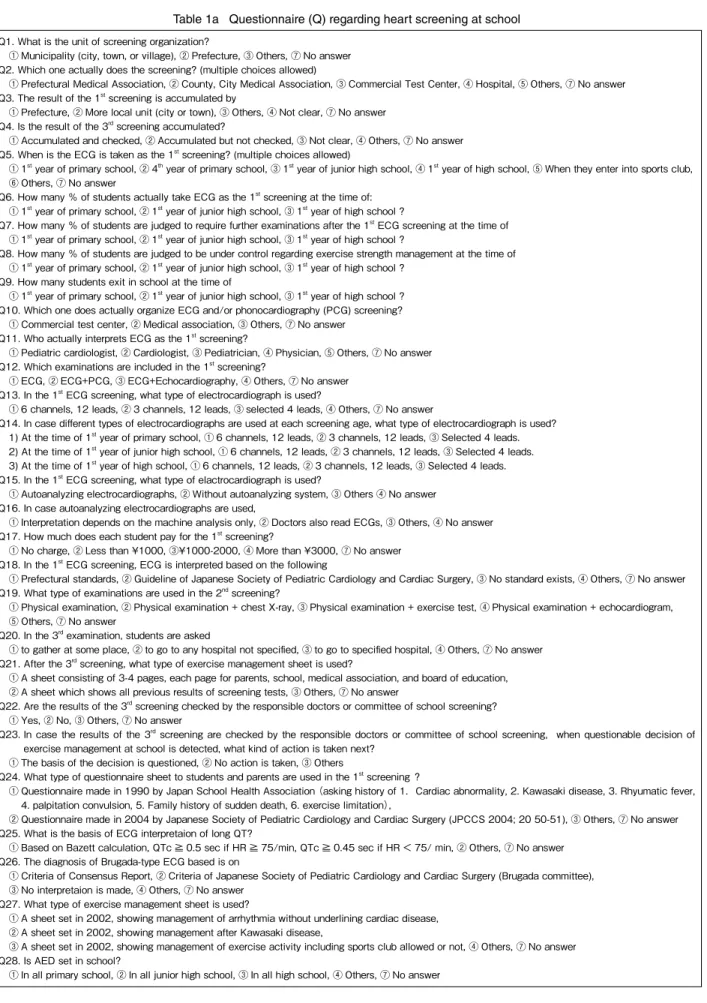
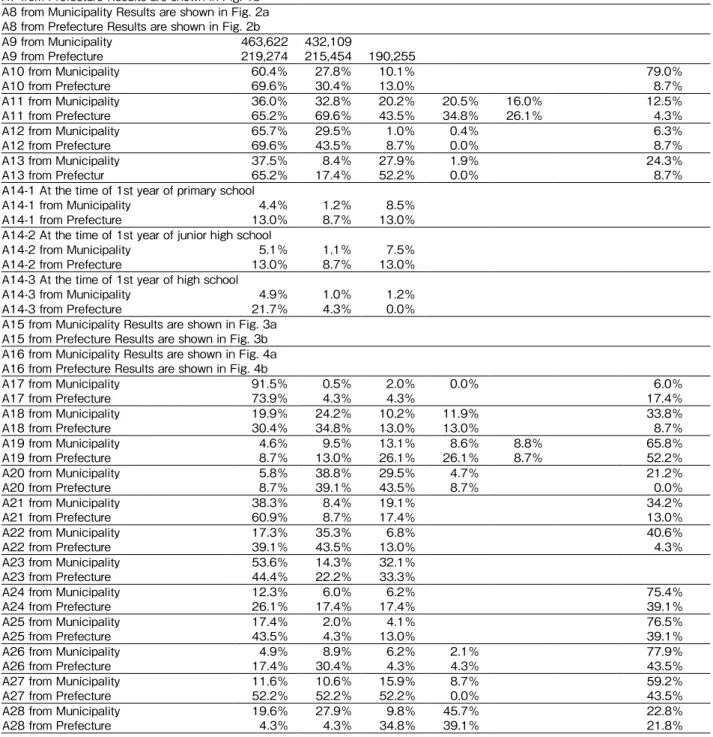
アンケートの質問とそれに対する回答を
Table 1a, b
及びFig. 1, 2, 3, 4
に示す.810市町村と
23
都道府県からの回答の中で複数回 答されたものや無回答の場合もあり,結果の合計は100%になっていない場合がある.
2. 今回の調査で学校心臓検診に独自の工夫を加えて いた地域を紹介する
1)鳥取県
鳥取県では平成
18
年度の小学校1
年生,4年生,中学校
1
年生,高校1
年生が1
次心臓検診対象であっ た(24,412名)が,まず学校医検診と心電図判読で至急 精査が必要な生徒を見出し精密検査医療機関に直接受 診 さ せ(46名 ), そ の ほ か は2
次 検 診 対 象 と な り,735/24,412
名(3%)が2
次検診を受診した.そこで安静時,運動負荷心電図や心断層エコー図を行い,81 名が
3
次検診を受診した.その結果結局46
+81
=127
名(0.5%)が3
次検診に回り,精密検査されたあと,結果的に要管理は
83
名(0.3%)となった.ちなみに2
次検診の費用は昭和46
年から鳥取県の予算化により,自己負担なしであった.
2)岩手県
1次検診で心電図記録,問診,専門医による心電図 判読があり,それらを,①異常なし,②処置不要,③ 要
2
次検診,④要経過観察,⑤要3
次検診に分けられ る方法がとられていた.要3
次検診は直接,精密検査 医療機関に回り,2次検診では,専門医による聴診,標準
12
誘導心電図,簡易運動負荷試験,心断層エコー 図を行い,①異常なし,②処置不要,③要経過観察,④要
3
次検診に分けられていた.平成18
年度,岩手 県では小学校1
年生14,347
名,2次検診受診者648
名(4.52%),3次検診対象者
71
名(0.49%)の結果であっ た.これらの
2
県が県全体で2
次検診において心断層エ コー図を行っていた.2次検診費用はやはり自己負担 を用いている②
2002
年川崎病管理基準を用いている③
2002
年運動部活動,可と禁の判定の目安を用いている ④その他
28)
所属する都道府県市町村単位でAED
は学校にあ りますか(複数回答可能)①全小学校にある ②全中学校にある ③全高校にある ④その他
平成
19
年2
月にアンケートを郵送し,平成19
年7
月31
日を回答期限とした.アンケート先の決定方法 は,http://www.med.or.jp/とhttp://www.kyoi-ren.gr.jp/
を 参照し,インターネットで調べられた都道府県47
医 師会と661
市町村医師会の合計708
医師会,47都道 府県教育委員会と1,778
市町村教育委員会の合計1,825
教育委員会に郵送した.主要なメーリングリストのJPMLC
( 会 員1,500
人 ),FTML( 会 員1,200
人 ),MEDPRACT
(会員350
人),小児心電図研究ML
(会員802
人),東京女子医科大学循環器小児科いもん会ML
(会員
150
人)に協力を依頼した.回収率は都道府県医師会
17 / 47
(36%),市町村医師 会290 / 661
(44%),都道府県教育委員会11 / 47
(23%),市町村教育委員会
654 / 1,778
(37%)であった.なおML
からの返信は医師会や教育委員会からの返事とし て取り扱った.同じ地域の医師会と教育委員会から同 じ回答が得られた地域の回答は,1つの地域として統 計処理を行った.また,同じ地域の医師会と教育委員 会からの回答で,医師会から回答がない質問で教育委 員会からあった場合は,それを加えて1
つの地域の回 答とした.以上のように返事が重複した地域を調整し,全国
810
市町村の結果と23
都道府県の全県結果とを 対象とした.高校検診に関する回答は,810市町村は 市立高校の結果であり,23都道府県の結果はすべて の都道府県立高校の結果であった.また質問6
〜9
に おいては母集団が関係するので,質問9
で母集団が明 確な地域のみ,すなわち259
市町村と14
都道府県の みを対象とした(259市町村の高校の回答は市立高校 のみの結果が多くあり計算から除外した).また,鳥取県と岩手県では,突然死の数の推移を調 査した.
アンケートの
1
次検診・2次検診・3次検診の定義 として,1次検診とは最初に学校で行う問診,聴診,心電図検診を指し,
2
次検診とは1
次検診により問診,Table 1a Questionnaire (Q) regarding heart screening at school
Q1. What is the unit of screening organization?
① Municipality (city, town, or village), ② Prefecture, ③ Others, ⑦ No answer Q2. Which one actually does the screening? (multiple choices allowed)
① Prefectural Medical Association, ② County, City Medical Association, ③ Commercial Test Center, ④ Hospital, ⑤ Others, ⑦ No answer Q3. The result of the 1st screening is accumulated by
① Prefecture, ② More local unit (city or town), ③ Others, ④ Not clear, ⑦ No answer Q4. Is the result of the 3rd screening accumulated?
① Accumulated and checked, ② Accumulated but not checked, ③ Not clear, ④ Others, ⑦ No answer Q5. When is the ECG is taken as the 1st screening? (multiple choices allowed)
① 1st year of primary school, ② 4th year of primary school, ③ 1st year of junior high school, ④ 1st year of high school, ⑤ When they enter into sports club,
⑥ Others, ⑦ No answer
Q6. How many % of students actually take ECG as the 1st screening at the time of:
① 1st year of primary school, ② 1st year of junior high school, ③ 1st year of high school ?
Q7. How many % of students are judged to require further examinations after the 1st ECG screening at the time of
① 1st year of primary school, ② 1st year of junior high school, ③ 1st year of high school ?
Q8. How many % of students are judged to be under control regarding exercise strength management at the time of
① 1st year of primary school, ② 1st year of junior high school, ③ 1st year of high school ? Q9. How many students exit in school at the time of
① 1st year of primary school, ② 1st year of junior high school, ③ 1st year of high school ? Q10. Which one does actually organize ECG and/or phonocardiography (PCG) screening?
① Commercial test center, ② Medical association, ③ Others, ⑦ No answer Q11. Who actually interprets ECG as the 1st screening?
① Pediatric cardiologist, ② Cardiologist, ③ Pediatrician, ④ Physician, ⑤ Others, ⑦ No answer Q12. Which examinations are included in the 1st screening?
① ECG, ② ECG+PCG, ③ ECG+Echocardiography, ④ Others, ⑦ No answer Q13. In the 1st ECG screening, what type of electrocardiograph is used?
① 6 channels, 12 leads, ② 3 channels, 12 leads, ③ selected 4 leads, ④ Others, ⑦ No answer
Q14. In case different types of electrocardiographs are used at each screening age, what type of electrocardiograph is used?
1) At the time of 1st year of primary school, ① 6 channels, 12 leads, ② 3 channels, 12 leads, ③ Selected 4 leads.
2) At the time of 1st year of junior high school, ① 6 channels, 12 leads, ② 3 channels, 12 leads, ③ Selected 4 leads.
3) At the time of 1st year of high school, ① 6 channels, 12 leads, ② 3 channels, 12 leads, ③ Selected 4 leads.
Q15. In the 1st ECG screening, what type of elactrocardiograph is used?
① Autoanalyzing electrocardiographs, ② Without autoanalyzing system, ③ Others ④ No answer Q16. In case autoanalyzing electrocardiographs are used,
① Interpretation depends on the machine analysis only, ② Doctors also read ECGs, ③ Others, ④ No answer Q17. How much does each student pay for the 1st screening?
① No charge, ② Less than ¥1000, ③¥1000-2000, ④ More than ¥3000, ⑦ No answer Q18. In the 1st ECG screening, ECG is interpreted based on the following
① Prefectural standards, ② Guideline of Japanese Society of Pediatric Cardiology and Cardiac Surgery, ③ No standard exists, ④ Others, ⑦ No answer Q19. What type of examinations are used in the 2nd screening?
① Physical examination, ② Physical examination + chest X-ray, ③ Physical examination + exercise test, ④ Physical examination + echocardiogram,
⑤ Others, ⑦ No answer
Q20. In the 3rd examination, students are asked
① to gather at some place, ② to go to any hospital not specified, ③ to go to specified hospital, ④ Others, ⑦ No answer Q21. After the 3rd screening, what type of exercise management sheet is used?
① A sheet consisting of 3-4 pages, each page for parents, school, medical association, and board of education,
② A sheet which shows all previous results of screening tests, ③ Others, ⑦ No answer
Q22. Are the results of the 3rd screening checked by the responsible doctors or committee of school screening?
① Yes, ② No, ③ Others, ⑦ No answer
Q23. In case the results of the 3rd screening are checked by the responsible doctors or committee of school screening, when questionable decision of exercise management at school is detected, what kind of action is taken next?
① The basis of the decision is questioned, ② No action is taken, ③ Others
Q24. What type of questionnaire sheet to students and parents are used in the 1st screening ?
① Questionnaire made in 1990 by Japan School Health Association (asking history of 1.Cardiac abnormality, 2. Kawasaki disease, 3. Rhyumatic fever, 4. palpitation convulsion, 5. Family history of sudden death, 6. exercise limitation),
② Questionnaire made in 2004 by Japanese Society of Pediatric Cardiology and Cardiac Surgery (JPCCS 2004; 20 50-51), ③ Others, ⑦ No answer Q25. What is the basis of ECG interpretaion of long QT?
① Based on Bazett calculation, QTc ≧ 0.5 sec if HR ≧ 75/min, QTc ≧ 0.45 sec if HR < 75/ min, ② Others, ⑦ No answer Q26. The diagnosis of Brugada-type ECG based is on
① Criteria of Consensus Report, ② Criteria of Japanese Society of Pediatric Cardiology and Cardiac Surgery (Brugada committee),
③ No interpretaion is made, ④ Others, ⑦ No answer Q27. What type of exercise management sheet is used?
① A sheet set in 2002, showing management of arrhythmia without underlining cardiac disease,
② A sheet set in 2002, showing management after Kawasaki disease,
③ A sheet set in 2002, showing management of exercise activity including sports club allowed or not, ④ Others, ⑦ No answer Q28. Is AED set in school?
① In all primary school, ② In all junior high school, ③ In all high school, ④ Others, ⑦ No answer
Table 1b Answer (A) regarding heart screening at school
① ② ③ ④ ⑤ ⑥ ⑦ No answer
A1 from Municipality 92.0% 4.9% 3.2% 1.0%
A1 from Prefecture 56.5% 47.8% 13.0% 8.7%
A2 from Municipality 9.5% 32.7% 48.6% 11.1% 11.0% 0.5%
A2 from Prefecture 26.1% 52.2% 47.8% 8.7% 30.4% 8.7%
A3 from Municipality 17.3% 64.9% 5.6% 14.3% 1.2%
A3 from Prefecture 60.9% 30.4% 4.3% 26.1% 8.7%
A4 from Municipality 38.6% 13.6% 17.3% 15.4% 15.1%
A4 from Prefecture 43.5% 21.7% 8.7% 17.4% 8.7%
A5 from Municipality 97.2% 33.3% 95.7% 24.6% 1.0% 6.5% 1.7%
A5 from Prefecture 91.3% 43.5% 87.0% 91.3% 13.0% 8.7% 8.7%
A6 from Municipality 99.2% 99.0%
A6 from Prefecture 99.6% 99.4% 98.5%
A7 from Municipality Results are shown in Fig. 1a A7 from Prefecture Results are shown in Fig. 1b A8 from Municipality Results are shown in Fig. 2a A8 from Prefecture Results are shown in Fig. 2b
A9 from Municipality 463,622 432,109
A9 from Prefecture 219,274 215,454 190,255
A10 from Municipality 60.4% 27.8% 10.1% 79.0%
A10 from Prefecture 69.6% 30.4% 13.0% 8.7%
A11 from Municipality 36.0% 32.8% 20.2% 20.5% 16.0% 12.5%
A11 from Prefecture 65.2% 69.6% 43.5% 34.8% 26.1% 4.3%
A12 from Municipality 65.7% 29.5% 1.0% 0.4% 6.3%
A12 from Prefecture 69.6% 43.5% 8.7% 0.0% 8.7%
A13 from Municipality 37.5% 8.4% 27.9% 1.9% 24.3%
A13 from Prefectur 65.2% 17.4% 52.2% 0.0% 8.7%
A14-1 At the time of 1st year of primary school
A14-1 from Municipality 4.4% 1.2% 8.5%
A14-1 from Prefecture 13.0% 8.7% 13.0%
A14-2 At the time of 1st year of junior high school
A14-2 from Municipality 5.1% 1.1% 7.5%
A14-2 from Prefecture 13.0% 8.7% 13.0%
A14-3 At the time of 1st year of high school
A14-3 from Municipality 4.9% 1.0% 1.2%
A14-3 from Prefecture 21.7% 4.3% 0.0%
A15 from Municipality Results are shown in Fig. 3a A15 from Prefecture Results are shown in Fig. 3b A16 from Municipality Results are shown in Fig. 4a A16 from Prefecture Results are shown in Fig. 4b
A17 from Municipality 91.5% 0.5% 2.0% 0.0% 6.0%
A17 from Prefecture 73.9% 4.3% 4.3% 17.4%
A18 from Municipality 19.9% 24.2% 10.2% 11.9% 33.8%
A18 from Prefecture 30.4% 34.8% 13.0% 13.0% 8.7%
A19 from Municipality 4.6% 9.5% 13.1% 8.6% 8.8% 65.8%
A19 from Prefecture 8.7% 13.0% 26.1% 26.1% 8.7% 52.2%
A20 from Municipality 5.8% 38.8% 29.5% 4.7% 21.2%
A20 from Prefecture 8.7% 39.1% 43.5% 8.7% 0.0%
A21 from Municipality 38.3% 8.4% 19.1% 34.2%
A21 from Prefecture 60.9% 8.7% 17.4% 13.0%
A22 from Municipality 17.3% 35.3% 6.8% 40.6%
A22 from Prefecture 39.1% 43.5% 13.0% 4.3%
A23 from Municipality 53.6% 14.3% 32.1%
A23 from Prefecture 44.4% 22.2% 33.3%
A24 from Municipality 12.3% 6.0% 6.2% 75.4%
A24 from Prefecture 26.1% 17.4% 17.4% 39.1%
A25 from Municipality 17.4% 2.0% 4.1% 76.5%
A25 from Prefecture 43.5% 4.3% 13.0% 39.1%
A26 from Municipality 4.9% 8.9% 6.2% 2.1% 77.9%
A26 from Prefecture 17.4% 30.4% 4.3% 4.3% 43.5%
A27 from Municipality 11.6% 10.6% 15.9% 8.7% 59.2%
A27 from Prefecture 52.2% 52.2% 52.2% 0.0% 43.5%
A28 from Municipality 19.6% 27.9% 9.8% 45.7% 22.8%
A28 from Prefecture 4.3% 4.3% 34.8% 39.1% 21.8%
の問いに,市町村の回答は
92%が市町村単位,5%が
県単位であるのに対し,都道府県の回答は57%が市
町村単位,48%が県単位と答えて市町村と都道府県の 結果が異なっていた.市町村の心臓検診の結果を都道 府県が集計し統計を取っている都道府県が心臓検診の 施行単位を県単位と回答していた.そのために市町村 と都道府県の結果が異なっていた.心電図検診受診率は高率であった.心電図検診後に 要精密検査とされた生徒の抽出率は,地域や学年で多 少の差はあるものの
3
〜6%前後であった(Fig. 1).
これは
2
次検診を含んだ値であり,鳥取県や岩手県な ど全県の2
次検診に心断層エコー図を取り入れている県では
1%未満となっており,心断層エコー図は要精
密検査の率を下げると考えられた.
A〜
E
以上の管理を必要とした生徒は,1〜2%で
あった(Fig. 2).1次検診の判定医は小児循環器専門医がまったく関 与していない地域もあったが,およそ
3
割の地域で判 定に関与していた.今後,学校心臓検診に熟練した小 児循環器専門医の増加が待たれる.1次検診の心電図は,高校生では
6
チャネル12
誘 導心電図が多く用いられ,小学生は省略4
誘導心電図 が多かった.催不整脈性右室異形成(arrthythmogenicright ventricular dysplasia: ARVD)や Brugada
症 候 群,QT
延長症候群や心筋症などの診断には省略4
誘導心 電図では不十分で,高校生ではこれらの疾患が多いこ とから,高校生が6
チャネル同時12
誘導心電計を使 用する地域が多いと考えられた.また自動解析の心電 計を用いている地域のうち,半数以上が医師のオー バーリードがあると答えていた(Fig. 3)が,3〜4%は
自動解析の判定のまま心電図を判定している地域が あった(Fig. 4).検診の精度の向上には自動解析の判 定だけでは不十分と考えられた.質問
24,質問 25,質問 26,質問 27
は,専門的な質問であり,アンケートは,都道府県市町村医師会と,
都道府県市町村教育委員会に郵送したが,質問が難し く,都道府県市町村医師会は多く回答をいただいたが,
都道府県市町村教育委員会はほとんど回答がなかっ た.AEDは平成
19
年7
月の時点ではあまり普及して いなかった.今後全学校に配備されることが望まれる.心臓検診の突然死に対する有用性を示した論文は多
く22-24),また,学校心臓検診が突然死の減少に有効で
あるという大規模調査研究も
JAMA
23)に報告されてい る.これは若年の運動選手に対して競技の前に心電図 スクリーニングを行ったもので,突然死の減少に有効 と結論している.全米心臓学会も同様に心電図検診の なしであった.また鳥取県と岩手県において心断層エコーを学校心 臓検診に取り入れて学校心臓検診を充実させた前後の 小児期心臓突然死の発生頻度を調査したところ,平成
12
年度より鳥取県全県で心断層エコーを学校心臓検 診に取り入れ,学校管理下での平成6
〜12
年度(7年 間)は突然死例11
例,心断層エコーを学校心臓検診に 取り入れた後の平成13
〜19
年度(7年間)は突然死例7
例であった.岩手県は平成13
年度に心断層エコー を学校心臓検診に取り入れ,平成6
〜13
年度(8年間)の突然死
8
例と心断層エコーを学校心臓検診に取り入 れた後の平成14
〜21
年度(8年間)の突然死5
例と,両県とも期待が持てる結果であるが,統計学的には有 意の減少はなかった.
3)岐阜県
県全体ではないが,岐阜市を中心に小学校
1
年生に2
次検診で心断層エコー図を用いていた.この地域の2
次検診から3
次検診受診者は,平成17
年度が48
名 /8,354
名であり,他の地域で2
次検診はするが,12誘導心電図と専門医聴診のみを行い,心断層エコー図を しない.こうした地域では,156名/12,584名と,3 次検診に進む対象者は岐阜市の
2
倍以上になってい た14, 15).4)滋賀県
心臓検診関係者全員のレベルアップを目的とし,管 理表の点検を行い異常な管理表による生徒の指導を是 正している.異常な管理表は
1
年間で231
あったもの が現在1/3
〜1/5
(231→49)以下に減少している
16-19).考 察
学校での心臓検診は平成
7
年度より小学校1
年生,中学校
1
年生,高校1
年生に心電図記録が義務付けら れた.それ以前には神奈川県における就学前幼稚園児 の心臓検診の詳細な結果がある20, 21).今回著者らは全国アンケートを行い,全国の学校心 臓検診の実態動向を調査した.心臓検診の施行単位は ほとんどが市町村単位であった.複数の市町村が合同 に行っている地域もみられたが,これは医師会の活動 範囲と一致しているからであった.10カ所以上の市 町村が合同で行っている地域が熊本県,富山県でみら れた.
学校心臓検診の実施主体は市町村教育委員会であ り,地区医師会が協力のうえ,民間検査センターに委 託していた.
質問
1
の心臓検診の施行単位はどのような単位かとFig. 1a Incidence of requirement for further examination (Question 7)
Fig. 1b Incidence of requirement for further examination (Question 7)
Fig. 2a Incidence of students needing medical care by cardiologists (Question 8)
Fig. 2b Incidence of students needing medical care by cardiologists (Question 8)
Fig. 3a Does the electrocardiograph is autoanalized?
(Question 15)
Fig. 3b Does the electrocardiograph is autoanalized?
(Question 15)
Fig. 4a In the case when autoanalizer is used, who judges the ECG? (Question 16)
Fig. 4b In the case when autoanalizer is used, who judges the ECG? (Question 16)
259 cities 9.0%
7.0%
5.0%
3.0%
1.0%
−1.0%
−3.0%
3.0± 3.0%
at first grade at 7th grade 3.6± 6.0%
810 cities
①Yes(59.3%)
④No answer(33.7%)
③Others(0.6%)
②No(6.4%)
23 prefectures
①Yes(69.6%)
④No answer(17.4%)
③Others(4.3%)
②No(8.7%)
810 cities
①Autoanalizer only(2.6%)
④No answer(40.8%)
③Others(1.7%)
②Doctor(54.9%)
23 prefectures
①Autoanalizer only(4.3%)
④No answer(17.4%)
③Others(0%)
②Doctor(78.3%)
14 prefectures
3.7± 1.6%
at first grade at 7th grade at high school 5.4± 2.3% 6.3± 2.7%
10.0%
5.0%
0.0%
259 cities
1.3± 1.4% 1.5± 1.4%
at first grade at 7th grade 3.0%
2.0%
1.0%
0.0%
−1.0%
14 prefectures
1.3± 0.8% 1.6± 1.1% 1.5± 1.0%
at first grade at 7th grade at high school 3.0%
2.0%
1.0%
0.0%
らされたときに,学校心臓検診が突然死の減少により いっそう効果を表すのではないかと考える.今回の調 査でその課題が判明したと考える.今回の調査と結果 分析が,日本小児科学会や日本小児循環器学会におけ る学校心臓検診基準全国統一化に向けての一助になれ ば幸いである.
最後に,アンケート調査に回答いただいた医師会および 教育委員会各位に感謝の意を表します.この論文の一部は,
第
17
回日本外来小児科学会年次集会(熊本県),第12
回日 本小児心電学研究会(吹田市),第111
回日本小児科学会学 術集会(東京都),第44
回日本小児循環器学会総会(郡山市),第
3
回アジア−太平洋小児循環器学会総会(千葉市)におい て発表した.【参 考 文 献】 ̶̶̶̶̶̶̶̶̶̶̶̶̶̶̶̶̶̶̶̶
1)小川 實:大阪における学校心臓検診実態調査からみた
今後の学校医の役割.若年者心疾患対策協議会誌2001; 29: 43-45
2)大津市医師会:児童生徒の心臓検診 大津市医師会 120
年史.大津市医師会編,滋賀;大津市医師会 1993,
pp266-283
3)津田淳一,中沢秀雄,島信幸他:学齢期心臓病検診方式
の問題点について(511984例集検成績).小児科診療1974; 37: 1435-1445
4)日本小児循環器学会学術委員会:学校検診研究委員会;
学校心臓検診二次検診対象者抽出のガイドライン(2006 年改訂):一次検診の心電図所見から.日児誌 2006;
22: 503-513
5)日本学校保健会:学校生活管理指導表の活用 新学校心
臓検診の実際.東京;日本学校保健会.2003, PP90-1016)日本小児循環器学会学校心臓検診研究委員会:学校心臓
検診調査表の改訂.日小循誌 2004; 20: 50-51
7)高橋良明,小西 眞,奥野昌彦,他:滋賀県学校心臓検
診におけるQT
延長判定基準.外来小児科 2007; 10(3):228-235
8) Wilde AM, Antzelevitch C, Borggrefe M,et al: Proposed diagnostic criteria for the Brugada syndrome: consensus report. Circulation 2002; 106: 2514-2519
9) Antzelevitch C, Brugada P, Borggrefe M, et al: Brugada syndrome: report of the second consensus conference:
endorsed by the Heart Rhythm Society and the European Heart Rhythm Association. Circulation 2005; 111: 659-670
10)小児 Brugada
様心電図例の生活管理基準作成に関する研究委員会:小児
Brugada
様心電図例の生活管理基準作成 に関する研究委員会・最終報告書.日小循誌 2006; 22;687-696
11)日本小児循環器学会学校心臓検診研究委員会:基礎心疾
有用性を認めている26).今回,鳥取県と岩手県で学校心臓検診に心断層エコー図を導入していた.学校心臓 検診の精度を上げれば突然死を減少できるかというこ とも今後の課題である.今回の検討では,統計学的に 有意差をもって突然死は減少していなかった.しかし,
さらに長期間継続して心断層エコーの検診を進めてい くことが小児の突然死の減少に寄与する可能性があ る.2次検診に心断層エコー図を行えば
3
次検診に進 む率は減少するが,それが不可能な時は,滋賀県のよ うに全管理表の再点検も,2次検診の精度を上げる一 法であろう.心臓検診の充実を図るために,①さらなるガイドラ インの充実.②
1
次心臓検診用のコンピューター解析 診断ソフトの精度の向上.③1
次あるいは3
次の心臓 検診の集計をさらに綿密に行うことにより現在のシス テムでも価値あるものとする.以上3
点の改善が必要 である.①のガイドラインの充実には,日本小児循環 器学会による学校心臓検診二次検診対象者抽出のガイ ドライン(2006年改訂)4)に掲載されているQT
延長判 定基準はQT
時間の異常(BazettやFridericia)によるも
ののみであるが,これに加えて新しく遺伝子検索の結 果を含めたガイドラインやLQT1,LQT2,LQT3
のT
波の波形の相違も含めたガイドラインが必要と考え る.また突然死の恐れのあるQT
短縮のガイドライン の新設や文献10
も取り入れたBrugada
のガイドライ ンが必要と考える.②の1
次心臓検診用のコンピュー ターソフトの精度の向上については,QT延長におい て頻脈時での計測にも有効なFridericia
法や,また文献
10
にあるBrugada
の自動診断を取り入れた心臓検診用のコンピューター解析診断ソフトが必要となる が,やはり県全体でそろえるには,費用が問題となる であろう.③の
1
次あるいは3
次の心臓検診の集計を さらに綿密に行い,滋賀県方式による管理表の点検を 行うことは,コストはかからず,不必要な管理を減少 させる効果がある24, 26).今回の調査では,3次検診で出された管理表点検を 行っている率は
17
〜39%であった.また,管理表点
検を行っていると回答した140
市町村および9
都道府 県において,診断根拠を医療機関に質問している率は 回答された中の44
〜53%であった.管理表の点検は
検診精度を上げるうえで重要である.現在の日本の学 校心臓検診は,心電図受診率は99
〜100%と満足の
いくものであるが,精密検査受診率は各地で大きく異 なる.また,2次検診の方法は地域の情況により大き く異なる.3
次検診は各地独自の方法で行われている.これが,統一され,全国に同じような検診精度がもた
20)新村一郎,柴田利満:神奈川県下における就学前児童(5
歳児)の集団心臓検診の成績と心臓検診の今後の展望に ついて.循環器専門医 2003; 11: 305-31121)神奈川県児童医療福祉財団:神奈川県における(5
歳児)の心臓集団検診について.神奈川県児童医療福祉財団 編,神奈川;神奈川県児童医療福祉財団 1997, pp3-181
22)吉永正夫:心臓性突然死予防のための学校心臓検診.日
小循誌 2002; 18: 562-564
23) Niwa K, Warita N, Sunami Y, et al: Prevalence of arrhythmias and conduction disturbances in large population-based samples of children. Cardiol Young 2004; 14: 68-74
24) Tanaka Y, Yoshinaga M, Anan R, et al: Usefulness and cost effectiveness of cardiovascular screening of young adolescents. Med Sci Sports Exerc 2006; 38: 2-6
25) Corrado D, Baasso C, Pavei A, et al: Trends in sudden caridiovascular death in young competitive athletes after implementation of a preparticipation screening program.
JAMA 2006; 296: 1593-1601
2 6
)M a r o n B J , To m p s o n P D , A c k e r m a n M J , e t a l : R e c o m m e n d a t i o n s a n d c o n s i d e r a t i o n s r e l a t e d t o preparticipation screening for cardiovascular abnormalities in competiive athletes: 2007 update: a scientific statement from the American Heart Association Council on Nutrition, Physical Activity, and Metabolism: endorsed by the American College of Cardiology Foundation. Circulation 2007; 115:
1643-1655
患を認めない不整脈の管理基準−2002
年改訂.日小循誌 2002; 18: 608-609
12)日本川崎病研究会運営委員会:川崎病管理基準− 2002
年改訂−.日児誌 2003; 107: 166-167
13)日本小児循環器学会学校心臓検診研究委員会:心臓病に
対する「学校生活管理指導表」の活用,運動部(クラブ)活 動可と禁の判定のめやす.日小循誌 2002; 18: 610-61114)矢嶋茂裕,久野保夫,河合直樹,ほか:超音波診断装置
を用いた医師による学校心臓
2
次検診.日本医事新報2008; 4383: 69-74
15)岐阜県医師会:岐阜県下児童生徒集団心電図解析システ
ムのまとめ岐阜県方式(29版平成18
年度版).岐阜県医 師会編,岐阜;岐阜県医師会 200716)高橋良明,奥野昌彦,近藤雅典,ほか:滋賀県の学校心
臓検診の2
(3)次精密検査医療機関における学校生活管 理指導表のチェック第一報.日小循誌 2005: 21: 28-3117)高橋良明,西岡研哉,奥野昌彦,ほか:滋賀県心臓検診
の
2
(3)次精密検査医療機関における学校生活管理指導 表のチェック第2
報.日小循誌2009; 25: 794-799 18)高橋良明,奥野昌彦,近藤雅典,ほか:滋賀県心臓検診
における