奈良教育大学学術リポジトリNEAR
A Basic Study on the Behavior of Ions in
Solutions by means of Solvent Extraction 1 The halogeno‑and nitro‑complexes of Eu (?) by
means of TTA‑benzene extraction.
著者 MITSUJI Toshikazu, SAKURADA Matsujiro, NOMURA Kazuo
journal or
publication title
奈良教育大学紀要. 自然科学
volume 22
number 2
page range 31‑42
year 1973‑11‑15
URL http://hdl.handle.net/10105/2777
A Basic Study on the Behavior of Ions in Solutions by means of Solvent Extraction
1 The halogeno-and nitro-complexes of Eu (I) by means of TTA-benzene extraction.
( With ll Text-figures)
Toshikazu Mitsuji, Matsujiro Sakurada and Kazuo Nomura
(Laboratory of Inorganic and Physical Chemistry, Nara University of Education, Nara, Japan. )
(Received April 27, 1973)
Summary
1) The complex formation between Eu (I) and the inorganic ligands such as CI~, F~ and NO^ was investigated by means of TTA-benzene extraction.
2) Eu(H20)g+ was the most probable ionic species in the perchlorate solution, and the extraction reaction was expressed as;
Eu (H2O)*+ + 3HT = EuT3 + 6H2O + 3H+
3) [^Eu(H2O)g+^1•E£NO^ was the most probable ionic species in the nitrate solution. The extraction reaction from the nitrate solution was inferred to be:
CEu(H2O)g+>CNO3] + 3HT = EuT3 + 6H2O + NO" + 3H+
CEu(H2O)^f>C(NO3)23 + 3HT = EuT3 + 6H2O + 2NO3 + 3H+
and the stability constants of the complexes were measured.
Introduction
A number of metal chelating complexes in aqueous solutions have been charac- terized by stability constant measurements. However reports on ion-pair formations have been sparse. Particularly, we are interested in the question of whether or not the formation of hydrated ion pairs is a general phenomenon for lanthanide cations and inorganic ligands. Choppin et al. used the liquid cation exchanger dinonyl naph- thalene sulphonic acid to study several ion-pair complexes of lanthanides a)> 2)> 3).
Solvent extraction is also a promising method to measure the stability constants;
one of the authors has reported the stability constants of sulfato-complex of Pa(V>
31
;32 Toshikazu MlTSUjl, Matsujiro Sakurada and Kazuo NOMURA
and Pa(IV) ">•E 5».
In this paper, we studied some ion-pair complexes of Eu(III) at an ionic strength of 0. 5 M by means of TTA-benzene extraction method. Since TTA (thenoyl trifluoroacetone) is a valuable chelating agent for many metal ions, especially lanthanide and actinide cations, it often has been used to determine the stability constants of several metal complexes 6> -n>.
Experimental Materials
TTA of the highest purity was purchased from Dojindo Co. LTD. Research Laboratory. The nuclide, 152 Eu was obtained from the Radiochemical Center, Amersham, England, as the europium chloride. The other reagents were of the analytical grade.
Apparatus
A Toa Denpa Kogyo pH meter, Model HM-5A, was used for the pH measure- ment. A Shimazu recording spectrophotometer, Double-40R, was used for the measurement of absorption spectra. The solvent extraction was carried out on an Iwaki universal mechanical shaker, Model V-S. The radioactivity was measured with a Metro-Denki Nal (Tl) well-type scintillation counter.
Procedure
The chemical purity of Eu 3+ and the radiochemical purity of 152 Eu were certified by absorption spectra and 7-ray spectra, respectively. Concentrated perchloric acid was added to the solution containing Eu 3+ and 152 Eu. This solution was evaporated repeatedly on a hot plate. Finally, Eu and 152 Eu were dissolved in 10~s M perchloric acid solution, being stored in a glass bottle. The total ionic strength of the aqueous phase was adjusted at 0. 5 M with 1. 0 M sodium perchlorate solution. The pH of the solution was controlled with 10~3 M perchloric acid solution and 10~8 M sodium hydroxide solution. The concentration of TTA in benzene was either 0.05 M or 0.50 M in various runs. Both organic and aqueous phases were pre-equilibrated by contact with its opposite to use. Solvent extraction was conducted in a separatory funnel. The volumes of both the organic and the aqueous phases were 20 ml. The concentration of europium in aqueous phases was always less than 10~9 M throughout the extraction experiment. After allowing 20 min for the both phases to separate, aliquats of both organic and aqueous phases were withdrawn for r-counting. The distribution ratio, D, was calculated by means of the following equation.
P_ T - activity per lml of the organic phase T - activity per lml of the aqueous phase
Absorption spectra of hydrated europium and of the various europium complexes -were observed in a quartz cell with a recording spectrophotometer.
Results 1. Preliminary experiments
In order to assess the extraction condition for our purpose, the preliminary experiments were carried out on both the equilibrium of solvent extraction and the
0r
,Q
60
O -1
-2 0
tr
10 20 30
X
Extraction Equilibrium Time (min) Fig. 1 Extaction Equilibrium
TTA conentration; 0.05 M pH; 3.45
100h
50
0.5M TTA 0.05M TTA
PH
Fig. 2 Extraction Curve of Eu3+
34 Toshikazu MITSUJI, Matsujiro SAKUEADA and Kazuo NOMURA
extraction curve of europium using 0.05 M and 0.50 M TTA-benzene solutions.
As shown in Figs. 1, and 2, the equilibrium is reached in about 10 min, and the necessary range of pH is from 2.7 to 3.0 in the extraction using 0.5 M TTA- benzene solution.
2. Solvent extraction from perchlorate solutions
Extractions first were conducted in perchlorate solutions as a non-complexing solvent. On the assumption that Eu(OH0á"~")+ is the only one kind of europium species in the perchlorate solution, the extraction reaction of the europium ion by TTA can be described by the following equation;
1.0
TTA
O
-1.
-2.0
05M TTA
slope- 3
2.0 3.0 4.0
pH
Fig. 3 Relationship between log D and log CTTA} at pH=3.41
Eu(OH)i3-*)+ + tn(HT) = EuTm + n(H2O) + (m-n)H+ (1)
where HT and T denote the TTA molecurle and the enolate ion of TTA, respectively.
When the activity coefficients of all the species are assumed to be equal to one, the equilibrium constant of the solvent extraction, K, can be expressed as follows;
K = CEu(OH)<f-")+] CHTDá" (2)
where square brankets represent the concentration of the relevant species.
Supposing only one kind of europium specium exists predominantly in aqueous solution, the distribution ratio also can be expressed as;
EuT,,
D=^-Eu(OH) r (3)
If the solvent extraction is performed at a constant temperature and with a constant
1.0
O
-1.0
slope- 3
-1.0 0
log CTTA)
Fig. 4 Relationship between log D and log CTTA} at pH=3.41
36 Toshikazu MITSUJI, Matsujiro SAKUEADA and Kazuo NOMURA
concentration of TTA, the following equation can be obtained by substituting Eq. (2) into Eq. (3), and then by taking logarithm.
log D = (m-n)pH + const. (4)
The effect of pH on the extraction was examined by using 0. 50 M and 0. 05 M TTA- benzene solution. As shown in Fig. 3, the relationship between log D and pH is linear and the slope indicates that (m-n) of Eq. (4) is equal to 3.
If the extraction is carried out at a constant temperature and at a constant pH, the following equation can be obtained from Eqs. (2) and (3).
log D = m-log CTTA] + const. (5)
Fig.4 shows the relationship between log D and log CTTA3 at a constant pH of 3.4.
The slope of the line gave a value for mof3. This result also indicates that EuT3 is the extracted species.
3. Solvent extraction from aqueous solutions containing inorganic ligands
When the extraction is conucted at a constant pH and with a constant concentra- tion of TTA, the stability constants for the europium complexes can be determined
from measurements of D values, changing the concentration of the ligand as follows;
D9/D=1+kiCX] +k!k2CXD2+ .... (6)
2.00
18± 1°C
i
Q
å O
1.00
(en cm)
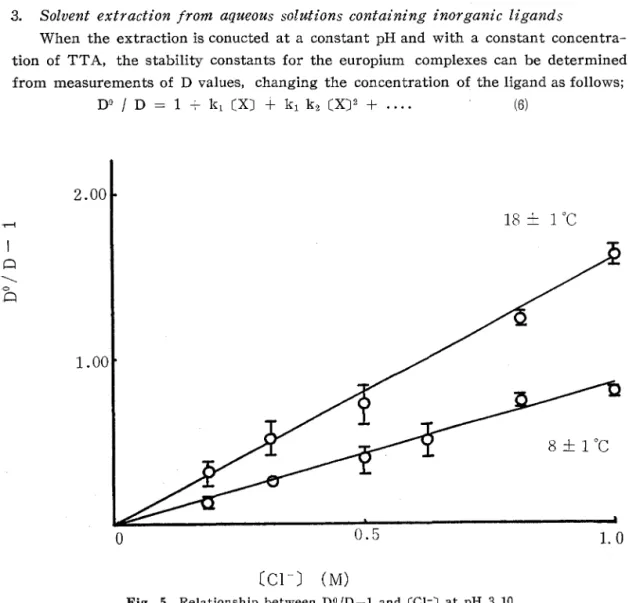
Fig. 5 Relationship between D°/D-l and CC1") at pH 3.10
where CX] is the concentration of ligand, k,, k2 , kn are the step-wise stability- constants for the formation of the complexes such as MXi, MX2, MX3 MXn, respectively, and D9 and D the distribution ratio in the absence and presence of the complexing ligand, respectively. If only the first complex is formed, a plot of C(D° / D) - ll vs. CX3 will give a straight line with the slope equal to kx. If the second complex as well is formed, a plot of C (D° / D) -1] / CX] vs. (X) will give a straight line, the slope being equal to kx k2 and the intercept equal to ki. The data for Eu (III) and Cl" are plotted in this manner in Fig. 5. Only EuCl2+ probably exists predominantly in the concentration of the chloride ion less than 1 M. Fig. 6
6.0
CBr-) (M)
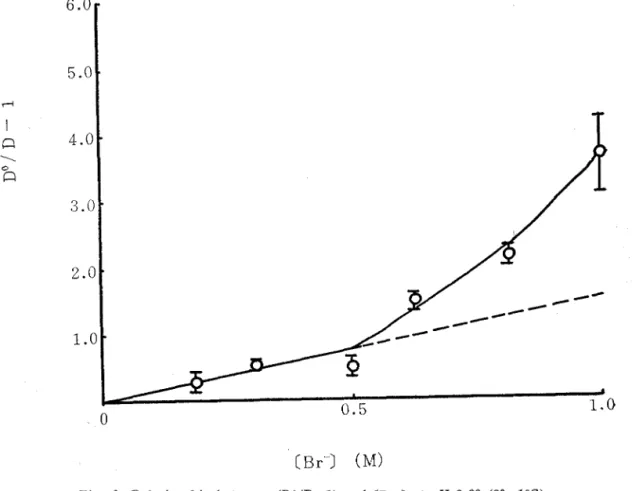
Fig. 6 Relationship between (D«/D-l) and CBr-3 at pH 2.80 (20±l°C)
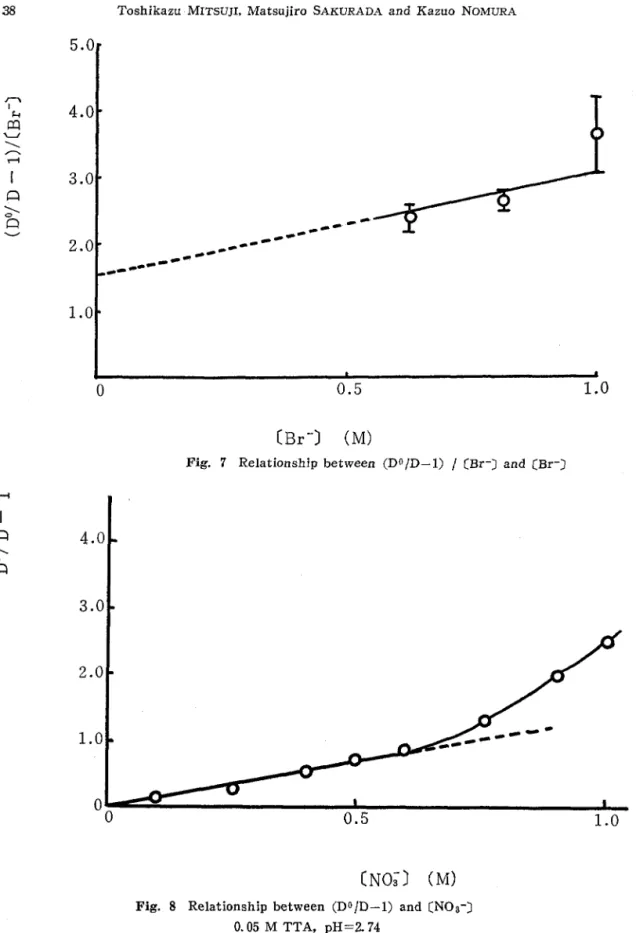
shows the relationship between C(D° / D) - ID and CBr"D- The plot of C(D° / D) -1] vs. CBrO departs from a linear relationship when the complexing anion exceeds a concentration of 0. 5 M. This departure from linear relationship is considered to be due to the formation of the second complex, EuBr2+. As expected, Fig. 7 shows that C(D0 / D) - V) I [Br~3 vs. CBr~] gives a linear relationship at higher concentrations of Br~ than 0. 5 M. The fact supports that the second complex is formed. Similarly,
38 Toshikazu MITSUJI, Matsujiro Sakoeada and Kazuo NOMURA 5.Of
CQ 4.0
q
oQ
I
Q
3.0
2.0
1.0
0.5 CBr'D (M)
Fig. 7 Relationship between (D«/D-l) / CBr~: and CBr-}
1.0
1.0
CNOs~) (M) Fig. 8 Relationship between (D°/D-l) and CNO3-3
0.05 M TTA, pH=2.74
bM
Q
oQ
3.0
2.0
1.0
0.5 1.0
(NOs^ (M)
Fig 9 Relationship between (D°/D-l) /CNO-SD and CNO-3]
0.05 M TTA, pH=2.74
the data on the nitro-complex are shown in Figs. 8 and 9. The stability constants determined for these complexes are summarized in Table 1.
Discussion
In general, the mononuclear wall is believed to be in the range between 10"4 M and 10~5 M for many metal ions12'. As the concentration of the europium ion did not exceed the mononuclear wall throughout this extraction experiment, the europium species might be considered to exist as a monomer. Supposing Eu (III) possesses a co-ordination number of 6, Eu(H2O)a8+ is the europium species in the perchlorate solution (Figs. 3 and 4). We can, therefore, describe the extraction reaction from the perchlorate solution as;
Eu(H2o)e3+ + 3HT = EuT3 + 3H+ + 6H2O
Chopin et al had measured the stability constants of the chloro-and bromo- complexes at an ionic strength of 1. 0 M by a liquid cation exchanger extraction method
«å 2). In this work, we measured the stability constants of EuCl2+, EuBr2+, EuBr2+, Eu(NO3)2+ and Eu(NO3)2+ at an ionic strength of 0.5 M, which [are shown in Table 1, compared with those of chopin et al1''. The differences in the two sets of data is explained by the differences in the ionic strength. The stability constants of nitro-
40 Toshikazu MlTSUjl, Matsujiro SAKURADA and kazuo NOMURA Table I stability constants for the various complexes
of Eu at an ionic strength of 0.5
I n o r g a n i c
L ig a n d s K i K 2
c i ‑ B r ‑ N O ‑ 3
1 . 6 ( 0 . 8 ) i >
1 . 5 ( 0 . 6 ) 1 ' 1 . 4 ( )
1 . 0 ( 0 . 4 1 ' 1 . 1 ( ‑ )
o
boo
l.Oi
0.0
-l.Oi
-2.0|
slope - 3
3.0 4.0
pH
Fig. 10 Relationship between log D and pH for EuNO32+ (0.05 M TTA)
1.0
0.5:
<
394
361 375 384
J
379 V
50 300 350J_ 400
Wave Length (m/S)
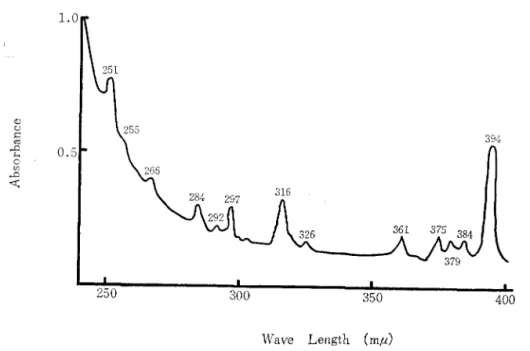
Fig. ll Absorption Spectra of CEu(H2O)6s+'NO-3D, Referenace : distilled water complexes first have been described in this paper. It is seen that the nitro-complexes as well as the chloro-and the bromo-complexes are low in view of their stability constants. Chopin et al determined the thremodynamic functions for the formation of the complex, EuCl2+, to study the type of this complex ])i 2> ; the free energy change,, AG, was calculated directly from the stability constant; The enthalpy change, /7H, was determined by the temperature differential method; And the entropy change,, AS, was obtained from the values of ^G and JH at 25°C. They concluded that EuCl2+ was ionic and possibly of the outer sphere type, written as CEu(H2O)6s+>CCl~D.
If this conclusion is true, the absorption spectra of CEu(H2O)63+> CCr] is expected to be nearly identical with that of CEu(H2O)63+]. As the extraction reaction from the chloride solution may be regarded as follows;
CEu(H2O)63+>CCl-D + 3HT = EuT3 + 6H2O + Cl" + 3H+,
the relationship between log D and pH is inferred to be linear with a slope of 3.
According to the above consideretion, solvant extractions from the nitrate solutions were made changing pH. The dependence of log D on pH is shown in Fig.
10. The slope of the straight line is equal to 3, as expected. Therefore, one can express the extraction reaction from the nitrate solution as follows;
CEu(H2O)63+>CNOn + 3HT = EuT3 + 6H2O + NO-3 + 3H+
CEu(H2O)63+>C(NO-3)2D + 3HT = EuT3 + 6H2O + 2NO-3 + 3H+
The evidence is provided that the nitro-complex is also probably ionic and of the outer sphere type. The absorption spectra in the nitrate solution is shown in Fig. ll.
42 Toshikazu MITSUJI, Matsujiro SAKURADA and Kazuo NOMURA This is nearly identical with the absorption spectra of Eu (H2O)88+.
The authors wish to thank Prof. Taichiro Fujinaga, Kyoto University, for his valuable advice and support throughout this study.
References
1) G. R. Choppin and P. J. Unrein, J. Inorg. Nucl. Chem., 25, 387 (1963) 2) G. R. Choppin and J. Ketels, ibid., 2z, 1335 (1965)
3) G. R. Choppin. and J. K. Schneider, ibid., 32, 3283 (1970) 4) T. Mitsuji and S. Suzuki, Bull. Chem. Soc, Japan, 40, 821 (1967)
5) T. Mitsuji, ibid., 41, 115 (1968)
6) R. E. Connie and W. H. Mcvey, J. Am. Chem. soc., 71, 3183 (1949) 7) R. A. Day and R. W. Stronghton, ibid., 72, 5662 (1950)
8) E. L. Zabroski, W. H. Alter and F. K. Heuman, ibid., 73, 5646 (1951) 9) R. A. Dayand R. M. Powers, ibid., 76, 3985 (1954)
10) D. L. Heising and F. E. Hicls, UCRL-1664 (1952)
ll) A. S. ChoshMazumdarand C. K. Sivarakrishnan, J. Inorg. Nucl. Chem., 27, 2423 (1965) 12) A. Ringbom, "Complexation in Analytical Chemistry", John Wiley and Sons Inc., New
York (1968)


![Fig 9 Relationship between (D°/D-l) /CNO-SD and CNO-3]](https://thumb-ap.123doks.com/thumbv2/123deta/6452258.2147608/10.772.66.713.124.703/fig-relationship-between-d-cno-sd-and-cno.webp)