• 検索結果がありません。

Mandibular Jaw Movement and Masticatory Muscle Activity during Trunk Exercise. (体幹運動時の下顎運動と咀嚼筋筋活動)

N/A
N/A
Protected

Academic year: 2021

シェア "Mandibular Jaw Movement and Masticatory Muscle Activity during Trunk Exercise. (体幹運動時の下顎運動と咀嚼筋筋活動)"

Copied!
20
0
0

読み込み中.... (全文を見る)

全文

(1)

1

Mandibular Jaw Movement and Masticatory Muscle Activity during Trunk Exercise.

(体幹運動時の下顎運動と咀嚼筋筋活動)

Daisuke Sugihara

Nihon University Graduate School of Dentistry at Matsudo Oral Function and Rehabilitation

(Director: Prof. Osamu Komiyama)

日本大学大学院松戸歯学研究科 顎口腔機能治療学専攻 杉原 大介

(指導:小見山 道 教授)

(2)

2 I. Abstract

II. Introduction

III. Materials and Methods

Research 1: Effect of Neck Muscle Strength Training with Manual Therapy on Masticatory and Neck Muscles

Research 2: Mandibular Jaw Movement and Masticatory Muscle Activity during Dynamic Trunk Exercise

IV. Results

Research 1: Effect of Neck Muscle Strength Training with Manual Therapy on Masticatory and Neck Muscles

1. Muscle activity of the temporalis, masseter, digastric, and trapezius muscles in three different types of isometric training exercises

Research 2: Mandibular Jaw Movement and Masticatory Muscle Activity during Dynamic Trunk Exercise

1. Maximum incisal point displacements in the anterior-posterior and superior- inferior directions of the sagittal plane during the three steps of the deadlift exercise

2. Activities of the temporalis, masseter, and digastric muscles during the three steps of the deadlift exercise

V. Discussion

Research 1: Effect of Neck Muscle Strength Training with Manual Therapy on Masticatory and Neck Muscles

Research 2: Mandibular Jaw Movement and Masticatory Muscle Activity during Dynamic Trunk Exercise

VI. Conclusion VII. References

VIII. Tables and Figures

(3)

3 I. Abstract

[Objective]

The examination of jaw movement during exercise is essential for an improved understanding of jaw function. Currently, there is no unified view of the mechanism by which the mandible is fixed during physical exercise. We hypothesized that during intense skeletal muscle exertion in dynamic exercises, the mandible is displaced to a position other than the maximal intercuspal position, and that mouth- opening and mouth-closing muscles simultaneously contract to fix the displaced mandible.

[Materials and Methods]

Research 1: We recruited 12 healthy adult male subjects with normal occlusion and no subjective or objective abnormalities in the muscles of the head and neck or in the stomatognathic system. We conducted four short isometric exercises; the exercises included resistance to anterior inclination, resistance to posterior inclination, mouth-opening resistance, and maximum voluntary clenching.

Muscle activity of the masseter, temporalis, digastric, and trapezius muscles was measured using electromyography.

Research 2: Mandibular jaw movements and masticatory muscle activities during dynamic trunk muscle exertion (deadlift exercise) were recorded in 23 healthy adult males. The deadlift was divided into three steps: Ready (baseline), Pull, and Down.

[Results]

Research 1: The activities of the masseter and temporalis muscles were highest for maximum voluntary clenching and increased significantly more than other muscle activities (p = 0.002 and p = 0.001). Meanwhile, the digastric muscle activity was highest during mouth-opening resistance and increased significantly more than other activities (p = 0.013) but was lowest during resistance to posterior inclination of the head. The trapezius muscle was highest during resistance to posterior inclination and increased significantly more than the other activities (p = 0.044).

Research 2: During

Pull (incisal distance from Ready to Pull) and

Down (incisal distance from Ready to Down), the mandibular incisal points of many subjects moved posteriorly and inferiorly from the maximal intercuspal position. Additionally, the masseter, temporal and digastric muscles were activated simultaneously and significantly during the pull phase (19.1 ± 15.8%, 17.9 ± 17.2 and 21.1

± 20.1% of the maximum voluntary contraction, respectively), with maintained activities during the

(4)

4 down phase (p<0.001).

[Conclusion]

The results suggested that during the exercise, the mandibular incisal point in almost all subjects

moves to an inferior position (an open-mouth position). Simultaneously, the activities of the digastric

muscles and the temporal and masseter muscles lead to mandibular fixation.

(5)

5 II. Introduction

The mandible moves in accordance with the function required, such as mastication, swallowing, and phonation. Mandible and head movements are known to occur simultaneously during full-body exercise. For example, during walking and running, the head oscillates vertically and may undergo rotational yaw and pitch. The velocity and frequency of head movements during such activities [1,2], and the mechanisms for stabilizing head movements to maintain the constancy of gaze and posture have been described [3–5]. The vertical positional relationship of the mandible relative to the maxilla remains constant when such movements are not being performed; this condition is known as the mandibular rest position [6]. When examining mandibular dynamics during physical exercise using this scheme, it is difficult to consider the mandible as placed in the mandibular rest position or in other relaxed positions. During physical exercise, the mandible should be fixed in a position that is optimal for the exercise. However, there is no unified view of the mechanism by which the mandible is fixed, and a search of the literature did not reveal any reports of natural jaw movements during exercise. The examination of jaw movement during exercise is important for improved understanding of jaw function and prevention of oral injuries.

When humans (including top athletes and amateur sportspeople) exert whole-body muscle force

during physical exercise, the mandible is frequently fixed in a position other than the maximal

intercuspal position, including the open-mouth, protruded, and lateral positions [7]. This phenomenon

is considered to occur because postural reflexes and a strong bite in the maximal intercuspal position

reduce the reciprocal innervation involved in skeletal muscle contractions [8–10]. Therefore, a strong

bite is considered to be effective during static exercise (i.e., during performance of an exercise with

almost no movement, typified by grip strength exertion [11–13]) but has a negative effect during

dynamic exercise [14–17]. Additionally, in terms of the mandibular position during exercise, the

condylar point has a tendency to be displaced in the posterior and inferior directions of the sagittal

plane during strong force exertion by the back muscles, with the digastric muscles (Dm) contracting

simultaneously and forcefully [18–20]. Thus, masticatory muscle activities under muscle exertion

during exercise while maintaining the trunk position can cause various changes in other muscle

activities. However, although many previous investigations of mandibular dynamics have focused on

muscle force exertion during exercise with the mandible clenched in the maximal intercuspal position

[11,12], or on masticatory muscle activities under muscle exertion during exercise [19,20], the natural

mandibular dynamics during muscle force exertion in humans have not yet been clarified; this

(6)

6

knowledge gap should be addressed. Therefore, we hypothesized that in the course of intense skeletal muscle exertion during dynamic exercise, the mandible is displaced to a position other than the maximal intercuspal position, and that mouth-opening and mouth-closing muscles simultaneously contract to fix the displaced mandible.

The aim of the present study was twofold: first, to investigate the effect of isometric exercises that

were carried out by manually supporting the forehead, occipital region, or mental region on the

masticatory and neck muscles, and second, to simultaneously record and examine mandibular jaw

movements and masticatory muscle activities during dynamic trunk muscle exertion.

(7)

7 III. Materials and Methods

Research 1: Effect of Neck Muscle Strength Training with Manual Therapy on Masticatory and Neck Muscles

This part was conducted in 12 healthy adult male subjects (mean age: 26.3 ± 2.7 years) with normal occlusion and no subjective or objective abnormalities in the muscles of the head and neck or in the stomatognathic system. The procedure was approved by the Ethical Review Committee of Nihon University School of Dentistry at Matsudo (EC16-013:28/07/2016), and the study was performed according to the principles stated in the Declaration of Helsinki. The participants were well informed about the purpose of the study and consented to participate.

We conducted three different isometric training exercises: the first exercise consisted of resistance against an anterior inclination of the head through exertion of full-force by placing the palm of a hand on the forehead (resistance to anterior inclination). The second exercise consisted of resistance against the posterior inclination of the head through exertion of a full-force by placing a hand against the occipital region (resistance to posterior inclination), and the third exercise consisted of resistance to mouth-opening through exertion of maximum effort by placing the thumb in the submental space (mouth-opening resistance). All the above-mentioned exercises were carried out without tooth contact.

In addition, as a control, maximum voluntary clenching were also performed. The participants performed each exercise at maximum effort for 3 s.

Polymate Mini AP108 (Miyuki Giken Co., Ltd, Tokyo, Japan) was used as the electromyogram measuring device. The muscles tested were as follows: superficial masseter muscle (Mm) and the anterior temporal muscle (Tm) (which are considered jaw-closing muscles on the habitual chewing side), the anterior belly of the Dm and neck muscles (which are considered jaw-opening muscles), and the superior trapezius muscle (TrM). The electrodes were placed on the skin after they were cleansed with alcohol; the surface electrodes were attached to the belly of each muscle, with a distance of 10 mm between the electrodes. In this study, the tested motions were performed three times for 3 s each;

the maximum voluntary contraction of each muscle was measured, and the mean was calculated.

To analyze the relationship between the motion and muscles tested, a one-way analysis of variance

was performed, and multiple comparisons were carried out using Fisher's LSD method. Analyses were

performed using SPSS version 24 software (IBM SPSS Japan Inc., Tokyo, Japan), and the statistical

significance was set at 5%.

(8)

8

Research 2: Mandibular Jaw Movement and Masticatory Muscle Activity during Dynamic Trunk Exercise

Twenty-three healthy adult males (age, 27.1 ± 2.5 years) who enjoyed sports in their everyday life and had a stable maximal intercuspal position, without malocclusion, toothache, orofacial myalgia, or temporomandibular joint arthralgia, were selected as participants. The selected participants also had a favorable general health status, without a medical history of injury. Each participant was preliminarily provided with an adequate explanation of the objectives and methods of this study. Verbal and written informed consent was obtained from all participants prior to starting the experiment. This part of the study was approved by the Ethics Committee of the Nihon University School of Dentistry at Matsudo (EC16-013, 28/07/2016).

The deadlift was selected as the test exercise in this study. The deadlift, a powerlifting performance exercise in which the back is straightened, with the trunk posture maintained, was selected as the test exercise for dynamic trunk muscle exertion. In this experiment, the course of the deadlift was divided into three steps. The first step consisted of the movements involved in the process of getting ready to lift the weight. In this step, the participants stood with their feet shoulder-width apart behind a barbell, bent their knees, and grabbed the bar (Ready). The second step comprised the movements for lifting the barbell along the front of the body, with force, while raising the body (Pull). The third step comprised the movements for putting the lifted barbell back into place (Down). This sequence of movements was defined as one attempt. During each attempt, the participants faced forward, with the bite plane parallel to the floor, according to the basic posture of the deadlift, and were instructed to maintain this posture.

Prior to the assessments, the participants performed adequate stretching and warm-up exercises for barbell lifting. After adequate rest, the participants completed three attempts. For safety reasons, the barbell weight during the attempts was approximately 80% of the maximum weight the participant could lift.

Jaw movements were recorded using a three-dimensional six-degree-of-freedom jaw movement measuring device (ARCUS digma2, KaVo, Biberach, Germany). The maxillary attachment (face- bow) of the ARCUS digma2 device was affixed using the Frankfort horizontal plane as a reference plane. A mandibular attachment (clutch) was made using a quick-cure resin (UNIFAST III, GC, Tokyo, Japan) and was fixed/bonded with a cyanoacrylate instant adhesive (Aron Alpha, Toagosei Co., Ltd.;

Tokyo, Japan) while adjusting its position to prevent the maxillary teeth from touching the bilateral

(9)

9

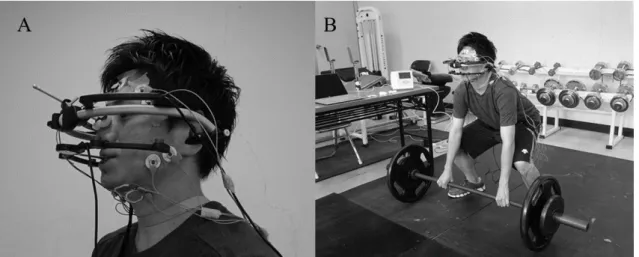
first molar teeth with the mandible in the maximal intercuspal position [21]. The ARCUS digma2 device was then affixed parallel to the Camper's plane by marking the middle and posterior ear canals and the subnasale (Figure 1).

Initially, the maxillary tooth alignment position with respect to the maxillary sensor, and subsequently, the position of the mandible tooth alignment with respect to the maxillary tooth alignment position in the maximal intercuspal position were recorded using the ARCUS digma2 transmitter (bite-fork).

Anterior and right/left lateral movements were recorded using the 'articulator mode' of the device.

Subsequently, incisal point movements in the sagittal plane during the test exercise were measured using the ‘analyze mode’ of the device. At the start of each assessment, the mandible was placed in the maximal intercuspal position with a minimal bite force; this position was defined as the measurement origin. The participants then moved their jaw at their discretion, without any instructions.

The maximum incisal point displacements in the anterior-posterior and superior/inferior directions of the sagittal plane were assessed during the Ready, Pull, and Down phases.

The assessment of masticatory muscle activities was focused on the right and left center of the superficial layer of the Mm and the anterior bundles of the Tm (i.e., mouth-closing muscles), as well as on the suprahyoid muscles, mainly the Dm (i.e., mouth-opening muscles). The electrodes were affixed along the muscle fibers 10 mm posterior and parallel to the anterior margin of the Tm, at the center of and parallel to the anterior margin of the Mm, and 20 mm away from the chin and on the bisector of the angle between the line connecting the chin with the mandibular angle and the sagittal line of the chin (Dm) (Figure 1).

Masticatory contractions were measured using a multi-telemeter system (Polymate Mini AP108, Miyuki Giken Co., Ltd.; Tokyo, Japan) with an Ag-AgCl bipolar surface electrode (5-mm diameter).

The derived electromyographic signals were scanned by the wave-analyzing software, BIMUTAS-

Video (KISSEI COMTEC Co., Ltd.; Matsumoto, Japan), and recorded on a personal computer with a

sampling frequency of 1 kHz. The measurements were performed with the following settings: the

treble cut-off frequency turned off, a time constant of 0.03 s, and a sensitivity of 0.5 mV/diV. In

addition, the contractions of the Mm and Tm during maximum voluntary bite force exertion in the

maximal intercuspal position, and that of the Dm under maximum voluntary resistance against mouth

opening (achieved by placing the thumb on the lower margin of the mandibular midline to prevent the

head from bending backward) were measured to define the maximum voluntary contractions (MVCs)

of those muscles.

(10)

10

In the analysis of electromyographic data, the mean contraction in 1 second of stable electromyographic waveforms out of 3 second of electromyographic waveforms obtained at the time of the maximum voluntary clenching (Mm and Tm) or the maximum voluntary resistance against mouth-opening (Dm) was taken as the MVC. For each step of the deadlift (Ready, Pull, Down), 0.2 seconds of stable EMG waveforms were selected, and the percentages of the Mm, Tm, and Dm relative to the corresponding MVC (root mean square) were calculated. Additionally, jaw movement measurements and electromyography were performed simultaneously. Further, for all analyses, the barbell position was confirmed using a video camera.

For the analysis, the maximum amount of movement of the incisor point from Ready to Pull was calculated as

Pull, and the maximum amount of movement of the incisor point from Ready to Down during the deadlift exercise was calculated as

Down. A scatter plot was then created for the amount and direction of movement, and the percentage of locations in the four directions (antero-superior, antero-inferior, postero-superiorly, postero-inferior) was calculated. The activities of Mm, Tm, and Dm during the three steps of the deadlift (Ready, Pull, Down) were also examined using a repeated- measures ANOVA with step as a factor. For both analyses, the least significant difference method was used in subsequent multiple comparisons. The analyses were performed using SPSS software version 24 (IBM SPSS Japan Inc., Tokyo, Japan), and the statistical significance was set at 5%.

IV. Results

Research 1: Effect of Neck Muscle Strength Training with Manual Therapy on Masticatory and Neck Muscles

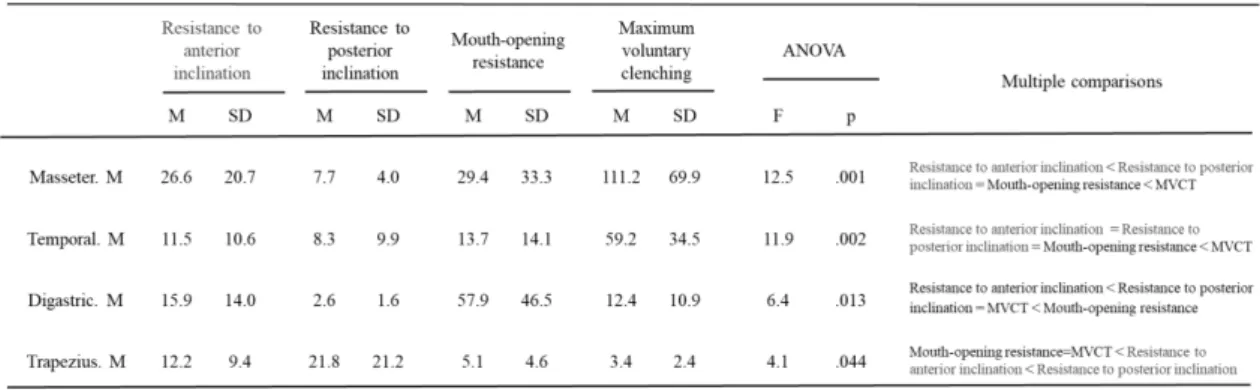
The Mm activity was highest for maximum voluntary clenching and increased significantly more

than other muscle activities (p = 0.01). Resistance to posterior inclination was the lowest and was

significantly lower than the other muscle activities. There was no significant difference in the

resistance to anterior inclination and mouth-opening resistance. There was no significant difference

between the activity for resistance to anterior inclination and mouth-opening resistance. Tm activity

was highest during maximum voluntary clenching and increased significantly more than other muscle

activities (p = 0.002). There was no significant difference in the resistance to anterior inclination,

resistance to posterior inclination, or mouth-opening resistance. Dm activity was highest during

mouth-opening resistance and increased significantly more than other activities (p = 0.013). The

activity of the Dm was lowest during resistance to posterior inclination and was significantly lower

(11)

11

than the other activities. There was no significant difference in the resistance to anterior inclination and mouth-opening resistance. The TrM showed the highest activity during resistance to posterior inclination and increased significantly more than the other activities (p = 0.044). The TrM showed the lowest activation during mouth-opening resistance and was significantly lower than other activities.

There was no significant difference in the activity between the resistance to anterior inclination and mouth-opening resistance (Tables 1 and 2).

Research 2: Mandibular Jaw Movement and Masticatory Muscle Activity during Dynamic Trunk Exercise

1. Mandibular incisal point displacements

In

Pull, the mandibular incisor point moved antero-superiorly in 8.7% of the subjects, antero- inferiorly in 21.7%, postero-superiorly in 13.1%, and postero-inferiorly in 56.5% of the subjects. On the other hand, in

Down, the mandibular incisor point moved antero-superiorly in 4.4% of the subjects, antero-inferiorly in 21.7%, postero-superiorly in 21.7%, and postero-inferiorly in 52.2% of the subjects. In

Pull and

Down, the percentage of postero-inferior displacement was the highest.

(Figure 2, Table 3).

2. Masticatory muscle activities

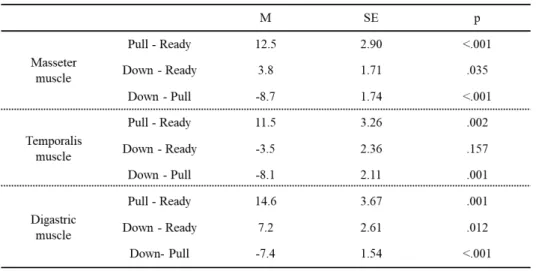
The Mm contraction increased in the Pull phase and then decreased in the Down phase to the same value as that at the Ready phase. The Mm contraction was 6.5 ± 4.4% of the MVC at the Ready phase, 19.1 ± 15.8% at Pull, and 10.4 ± 10.0% at the Down phase. Repeated measures ANOVA revealed that the step factor was significant (F (2, 21) = 7.67, p = 0.003), and the post hoc test revealed significant differences in the mean between Ready and Pull and between Pull and Down (both p < 0.001).

Specifically, Mm contraction increased at the Pull phase, and then decreased at the Down phase. The Tm contraction was 6.5 ± 3.7% of the MVC at the Ready phase, 17.9 ± 17.2% at the Pull phase, and 9.9 ± 12.1% during the Down phase. Repeated measures ANOVA revealed that the step factor was significant (F (2, 21) = 11.09, p < 0.001), and post hoc tests using LSD revealed significant differences in the means between Ready and Pull (p = 0.002) and between Pull and Down (p < 0.001). The Dm contraction was 6.5 ± 3.6% of the MVC at Ready, 21.1 ± 20.1% at Pull, and 13.7 ± 14.7% at Down.

Repeated measures ANOVA revealed that the step factor was significant (F (2, 21) = 11.87, p < 0.001),

and post hoc tests revealed significant differences among all steps (all p < 0.05). Specifically, Dm

contraction increased at the Pull phase, and then decreased at the Down phase (Tables 4 and 5).

(12)

12 V. Discussion

Research 1: Effect of Neck Muscle Strength Training with Manual Therapy on Masticatory and Neck Muscles

The Dm plays various roles, and one of its important roles is to raise the hyoid bone during swallowing. Therefore, performing exercises that involve the suprahyoid muscles, including the Dm, might be an effective treatment for patients with dysphagia. Thus far, the Shaker exercise (head-raising exercise) [22] and the chin push-pull maneuver [23], or the exercise consisting of swallowing while pushing the forehead up with the palm of the hand [24], have been considered effective for strengthening the suprahyoid and infrahyoid muscles, and these methods are still practiced today, as they are effective for most patients, including the elderly; however, for participants who perform these exercises for preventive purposes, a certain amount of weight should be used for muscle training, and establishing a simple technique that can be performed by the subjects as a part of the activities of daily living may greatly improve their quality of life and prevent the development of disorders.

The method described in this study can also be considered as a head-raising exercise supplemented with isometric resistance, or more specifically, a modified version of an exercise consisting of swallowing while pushing up the forehead with the palm of the hand. However, thus far, no report has provided a clear description of the activity phases of the suprahyoid muscles. Our study yielded meaningful findings by exploring the underlying mechanism of neck strength training with manual therapy and examining the activities of important muscles during isometric exercises of the head and neck. The maximal load during resistance to anterior inclination of the head and resistance to mouth opening could strengthen the Dm. Our findings suggest that this could contribute to preventing the deterioration of swallowing function. The optimal weight for performing the exercises, and the subsequent continuity of the exercises is up to the discretion of the individual; therefore, further studies are needed. Thus, the best methods for objective evaluation and measurements should also be determined.

Furthermore, our study compared the activities of the masticatory and neck muscles during the tested motions. The findings revealed that, for the first time, during resistance to anterior inclinations of the head, the Mm was active despite the absence of contact between the upper and lower teeth.

Fixing and stabilizing the mandible by activating the Mm without using teeth contact is similar to

bracing, a non-functional movement occurring unconsciously in sleep bruxism [25], which is

particularly interesting.

(13)

13

Research 2: Mandibular Jaw Movement and Masticatory Muscle Activity during Dynamic Trunk Exercise

Motion dynamics research of occlusal and physical movement functions [26,27] has provided limb muscle output values during occlusal function exertion; studies analyzing the occlusal status (i.e., the mandibular position during muscle exertion in detail) are lacking. Thus, in the current study, masticatory muscle activities and mandibular jaw movements during dynamic trunk muscle exertion were simultaneously recorded and examined to address this knowledge gap in natural mandibular dynamics in humans. The results showed that the mandibular incisal point during dynamic trunk muscle exertion was displaced from the maximal intercuspal position to a posteroinferior position, causing an open-mouth posture. Additionally, in terms of masticatory muscle activities, the simultaneous activities of not only the Dm (responsible for mouth opening) but also the Tm and Mm (responsible for mouth closure) led to mandibular fixation.

While performing the deadlift, which requires dynamic trunk muscle strength, the mandibular

incisal point was displaced posteriorly and inferiorly from the maximal intercuspal position of the

sagittal plane to an open-mouth position during the Pull and Down phases, as shown in Figure 2. In

the current study, mandibular jaw movements were observed as incisal point movements in the sagittal

plane. As mandibular jaw movements are considered to reflect concerted movements based on

Bonwill’s triangle (consisting of the incisal point and both condylar points), incisal point movements

can be regarded as mandibular movements synchronized with condylar point movements [28]. It has

been reported that displacements from the maximal intercuspal position to a posterior position may

cause jaw dysfunction, a phenomenon that has been explored from the viewpoint of abnormal

stomatognathic function [29]. However, Sicher [30] reported that the working-side condyle during the

Bennett movement not only rotates but also moves side-to-side, up-and-down, or inward, and that the

non-working-side condyle moves downward and forward. Additionally, some studies have reported

that there is a space (0.5 to 1 mm) on the side at the rear of the joint cavity, in which the working-side

condyle can rotate during lateral movements and while backing away [31

33]. Moreover, in a report

on condylar point displacements during spontaneous backward movements Posselt stated that, when

the condylar point was placed posterior to the maximal intercuspal position, with tooth contact, the

condylar point was displaced 0.3 mm posteriorly and 0.2 mm superiorly [28], which is on the same

order of magnitude as the changes observed in the current study. Thus, the condyles can be displaced

posteriorly because of the articular structure. In the current study, under trunk muscle force exertion,

(14)

14

this space may enable fixation of the mandible, not in the maximal intercuspal position, but in a posteroinferior position. Therefore, the hypothesis that the mandible is spontaneously displaced during strong muscle force exertion in dynamic movement is supported by the results of the current study.

The outcomes of this study are novel in that the contractions of the Mm, Tm, and Dm were approximately three times higher during the Pull phase (when the maximum muscle force was exerted) than during the Ready phase, even though the jaw was not placed in the maximal intercuspal position.

In other words, Mm activity was not observed without strong occlusal contact. Only a few studies have investigated human jaw movements and masticatory muscle activities during low-intensity muscle exertion. In recent years, the concept of 'bracing' has been introduced to firmly fix the mandible in a position under no occlusal contact [34]. Bracing is currently defined as forcefully maintaining a certain mandibular position/activity without the necessary presence of tooth contact or as an increased level of masticatory muscle activity without tooth contact [35]. Sugihara et al. reported that during a head-raising exercise, the Mm is activated even though the maxillary and mandibular teeth are not in contact with each other, which was considered to reflect bracing [36]. Bracing is considered to occur even during dynamic exercise [35], and the results of the current study suggest fixation of the mandible by bracing.

The current study has several limitations. As mandibular jaw movements were observed two- dimensionally using incisal point displacements in the sagittal plane, it is necessary to examine mandibular jaw movements three-dimensionally, including condylar point displacements. Moreover, future studies should examine the muscles involved in mouth closure, such as the Mm and Tm, and the muscles involved in mouth opening, (which are suprahyoid muscles) such as the Dm, along with the infrahyoid and neck muscles, including the sternocleidomastoid and TrM. Further research should also investigate jaw movements during muscle exertion in greater detail.

VI. Conclusion

During exercise, the mandibular incisal point is displaced from the maximal intercuspal position to the inferior position (an open-mouth position). Additionally, in terms of masticatory muscle activities, the activities of not only the muscles involved in mouth opening, such as the Dm, but also those of the muscles involved in mouth closure, such as the Tm and Mm, are responsible for mandibular fixation.

VII. References

(15)

15

1. Grossman, G.E.; Leigh, R.J.; Abel, L.A.; Lanska, D.J. Frequency and velocity of rotational head perturbations during locomotion. Exp. Brain Res. 1998, 70, 470–476.

2. Grossman, G.E.; Leigh, R.J.; Bruce, E.N.; Huebner, W.P.; Lanska, D.J. Performance of the human vestibule ocular reflex during locomotion. J. Neurophysiol. 1989, 62, 264–272.

3. Hirasaki, E.; Moore, S.T.; Raphan, T.; Cohen, B. Effects of walking velocity on vertical head and body movements during locomotion. Exp. Brain Res. 1999, 127, 117–130.

4. Pozzo, T.; Berthoz, A.; Lefort, L. Head kinematics during various motor tasks in humans. Prog.

Brain Res. 1989, 80, 377–383.

5. Pozzo, T.; Berthoz, A.; Lefort, L. Head stabilization during various locomotor tasks in humans. I.

Normal subjects. Exp. Brain Res. 1990, 82, 97–106.

6. Michelotti, A.; Farella, M.; Vollaro, S.; Martina, R. Mandibular rest position and electrical activity of the masticatory muscles. J. Prosthet. Dent. 1997, 78, 48–53.

7. Cuccia, A.; Caradonna, C. The relationship between the stomatognathic system and body posture.

Clinics 2009, 64, 61–66.

8. Takada, Y.; Miyahara, T.; Tanaka, T.; Ohyama, T.; Nakamura, Y. Modulation of H reflex of pretibial muscles and reciprocal Ia inhibition of soleus muscle during voluntary teeth clenching in humans. J. Neurophysiol. 2000, 83, 2063–2070.

9. Baratta, R.; Solomonow, M.; Zhou, B.H.; Letson, D.; Chuinard, R.; D'Ambrosia, R. Muscular coactivation. the role of the antagonist musculature in maintaining knee stability. Am. J. Sports Med. 1988, 16, 113–122.

10. Ebben, W.P.; Leigh, D.H.; Geiser, C.F. The effect of remote voluntary contractions on knee extensor torque. Med. Sci. Sports Exerc. 2008, 40, 1805–1809.

11. Ringhof, S.; Leibold, T.; Hellmann, D.; Stein, T. Postural stability and the influence of concurrent muscle activation--beneficial effects of jaw and fist clenching. Gait Posture 2015, 42, 598–600.

12. Fujino, S.; Takahashi, T.; Ueno, T. Influence of voluntary teeth clenching on the stabilization of postural stance disturbed by electrical stimulation of unilateral lower limb. Gait Posture 2010, 31, 122–125.

13. Wang, K.; Ueno, T.; Taniguchi, H.; Ohyama, T. Influence on isometric muscle contraction during shoulder abduction by changing occlusal situation. Bull. Tokyo Med. Dent. Univ. 1996, 43, 1–12.

14. Hellmann, D.; Giannakopoulos, N.N.; Blaser, R.; Eberhard, L.; Schindler, H.J. The effect of

various jaw motor tasks on body sway. J. Oral Rehabil. 2011, 38, 729–736.

(16)

16

15. Ringhof, S.; Hellmann, D.; Meier, F.; Etz, E.; Schindler, H. J.; Stein, T. The effect of oral motor activity on the athletic performance of professional golfers. Front Psychol. 2015, 6, 750.

16. Hislop, H.J. Quantitative changes in human muscular strength during isometric exercise. J. Am.

Phys. Ther. Assoc. 1963, 43, 21–38.

17. Schubert, M.M.; Guttu, R.L.; Hunter, L.H.; Hall, R.; Thomas, R. Changes in shoulder and leg strength in athletes wearing mandibular orthopedic repositioning appliance. J. Am. Dent. Assoc.

1984, 108, 334

337

18. Asano, T.; Kawara, M.; Iida, T.; Komiyama, O.; Suzuki, H.; Kuroki, T.; Kono, C. Movement of the condyle point and incisal point during exercise. Prosthodont. Res. Pract. 2008, 7, 210–212.

19. Asano, T.; Kawara, M.; Suzuki, H.; Komiyama, O.; Iida, T.; Aono, H.; Nanba, K.; Okamoto, H.;

Kuroki, T. Masticatory muscle activity during snatch weightlifting. Int. J. Sports Dent. 2009, 2, 33–40.

20. Kawara, M.; Asano, T.; Suzuki, H.; Watanabe, A.; Obara, R.; Iida, T.; Komiyama, O.; Kuroki, T.

Influence of mouthguard on masticatory muscles activities and physical performance during exercise. Int. J. Sports Dent. 2012, 5, 28–34.

21. Okawa, T.; Abe, S.; Nakano, M.; Oka, K.; Horikawa, E.; Kawano, F. Relationship between frontal/lateral mandibular translations and masticatory movement based on evaluation of occlusal surface motion. J. Oral Health Biosci. 2018, 31, 39–48.

22. Shaker R, Easterling C, Kern M, Nitschke T, Massey B, Daniels S, Grande B, Kazandjian M, Dikeman K.: Rehabilitation of swallowing by exercise in tubefed patients with pharyngeal dysphagia secondary to abnormal UES opening. Gastroenterology. 2002, 122, 1314-1321.

23. Sze W.P., Yoon W.L., Escoffier N, Liow S.J.R.: Evaluating the training effects of two swallowing rehabilitation therapies using surface electromyography—chin tuck against resistance (CTAR) exercise and the Shaker exercise. Dysphagia. 2016, 31: 195-205.

24. Nanba, Y., Okamoto, T., Nakajima, Y., Matsuo, T., Nakagoshi T.: An electromyographic analysis of deglutition muscle activity during four swallowing exercises. Kobe International University Journal of the Institute for Rehabilitation Studies. 2018, 9: 19-25.

25. Sateia, M.J.: International Classification of Sleep Disorders – Third Edition (ICSD-3). American Academy of Sleep Medicine. 2014, 303-311.

26. Miyahara, T.; Hagiya, N.; Ohyama, T.; Nakamura, Y. Modulation of human soleus H reflex in

association with voluntary clenching of the teeth. J. Neurophysiol. 1996, 76, 2033

2041

(17)

17

27. Boroojerdi, B.; Battaglia, F.; Muellbacher, W.; Cohen, L.G. Voluntary teeth clenching facilitates human motor system excitability. Clin. Neurophysiol. 2000, 111, 988

993

28. Posselt, U. Movement areas of the mandible. J. Prosth. Dent. 1957, 7, 375–385.

29. Mahan, P.E.; Wilkinson, T.M.; Gibbs, C.H. Superior and inferior Bellies of the lateral pterygoid muscle EMG activity at basic jaw posterior. J. Prosthet. Dent. 1983, 50, 716

718.

30. Sicher, H. Positions and movements of the mandible. J. Am. Dent. Assoc. 1954, 48, 620–625.

31. Gibbs, C.H.; Messerman, T.; Reswick, J.B.; Derda, H.J. Functional movements of the mandible.

J. Prosthet. Dent. 1971, 26, 604–620.

32. McKay, G.S.; Yemm, R.; Cadden, S.W. The structure and function of the temporomandibular joint. Br. Dent. J. 1992, 173, 127–132.

33. Atwood, D.A. A critique of research of the posterior limit of the mandibular position. J. Prosthet.

Dent. 1968, 20, 21–36.

34. Lobbezoo, F.; Ahlberg, J.; Glaros, A.G.; Kato, T.; Koyano, K.; Lavigne, G.J.; de Leeuw, R.;

Manfredini, D.; Svensson, P.; Winocur, E. Bruxism defined and graded: an international consensus. J. Oral Rehabil. 2013, 40, 2–4.

35. Lobbezoo, F.; Ahlberg, J.; Raphael, K.G.; Wetselaar, P.; Glaros, A.G.; Kato, T.; Santiago, V.;

Winocur, E.; De Laat, A.; De Leeuw, R.; Koyano, K.; Lavigne, G.J.; Svensson, P.; Manfredini, D. International consensus on the assessment of bruxism: Report of a work in progress. J. Oral Rehabil. 2018, 45, 837–844.

36. Sugihara, D.; Suzuki, H.; Yasuda, A.; Asano, T.; Iwata, Y.; Takeuchi, H.; Ebato, A.; Yagi, T.;

Kawara, M.; Komiyama, O. Effect of manual neck muscle strength training on masticatory and

neck muscles. Int. J. Sports Dent. 2020, 13, 2–7.

(18)

18 VIII. Tables and Figures

Table 1 Effect of manual neck muscle strength training on masticatory and neck muscles

Table 2 LSD test for manual neck muscle strength training on masticatory and neck muscles.

(19)

19

Table 3 The ratio of the jaw movement direction during

Pull and

Down in the deadlift

Table 4 Muscle activities during the steps of the deadlift (Ready, Pull, Down)

Table 5. LSD test for muscle activity during the steps of the deadlift

(20)

20

Fig.1 Measurement of the mandibular jaw movement (A) and EMG measurement of masticatory muscles activity (B) during the deadlift.

Fig. 2 Scatter plot of

Pull and

Down in the mandibular jaw movement during the deadlift.

Figure legends

Fig.1 Measurement of the mandibular jaw movement (A) and EMG measurement of masticatory muscles activity (B) during the deadlift.

Fig. 2 Scatter plot of

Pull and

Down in the mandibular jaw movement during the deadlift.

Table 1 Effect of manual neck muscle strength training on masticatory and neck muscles
Table 5. LSD test for muscle activity during the steps of the deadlift
Fig. 2 Scatter plot of  ⊿ Pull and  ⊿ Down in the mandibular jaw movement during the deadlift

参照

関連したドキュメント

自動運転ユニット リーダー:菅沼 直樹  准教授 市 街 地での自動 運 転が可 能な,高度な運転知能を持 つ自動 運 転自動 車を開 発

The activity of the gluteus maximus is said to change with exercise, the hip joint position, and muscle fiber. Therefore, it is important for physical therapy to deepen the

Second, the main parameters of the algorithm are extended and studied in this continuous framework: the study of particular trajectories is replaced by the study of

Greenberg and G.Stevens, p-adic L-functions and p-adic periods of modular forms, Invent.. Greenberg and G.Stevens, On the conjecture of Mazur, Tate and

The proof uses a set up of Seiberg Witten theory that replaces generic metrics by the construction of a localised Euler class of an infinite dimensional bundle with a Fredholm

Using the batch Markovian arrival process, the formulas for the average number of losses in a finite time interval and the stationary loss ratio are shown.. In addition,

Is it possible to obtain similar results as in [COP] and in the present paper concerning John disks that are not necessarily

: Associations betwwen spectral repre sentation of the surface electromyo gram and fibre type distribution and size in human masseter muscle.. : Motor unit activity and