Studies on Data‑Driven Controller Tuning for Cascade Control Systems
著者 グエン クアン フィ
著者別表示 Nguyen Quang Huy journal or
publication title
博士論文要旨Abstract 学位授与番号 13301甲第4623号
学位名 博士(工学)
学位授与年月日 2017‑09‑26
URL http://hdl.handle.net/2297/00049547
Creative Commons : 表示 ‑ 非営利 ‑ 改変禁止 http://creativecommons.org/licenses/by‑nc‑nd/3.0/deed.ja
Studies on Data-Driven Controller Tuning for Cascade Control Systems
Division of Electrical and Computer Engineering
Author: Nguyen Quang Huy
Abstract
Data-driven approach is an effective solution to achieve the optimal controllers in the control process. In this approach, a mathematical model of a plant is not required, only a set of data directly collected from the plant to be controller is required for designing the controller. It means that we do not have to implement the identification to know the dynamics of the plant, this is an advantage in compare with the conventional method. In addition, since the data obtained from the practical system includes the dynamics of the plant more explicitly and directly than mathematical models which is described in the form of the compressed formula, data-driven approach is expected to bring more desired controllers. Cascade control systems are developed and used for practical multiple-loop control systems, and are applied to many industrial processes such that, temperature, humidity control, pressure, level of fluids control, oil-gas industry and adjustment of DC motor speed e.g.,.
In this dissertation, data-driven approach to the cascade control system is presented. Here, I treat two representative methods on this issue, one is virtual reference feedback tuning (VRFT), the other is fictitious reference iterative tuning (FRIT). Main feature to be pointed out for these two methods is that only one-shot experimental data is required for obtaining the desired con- trollers. I apply these two methods (VRFT and FRIT methods) of data-driven approaches to cascade control systems to obtain the optimal parameters for both inner and outer controllers . Particularly, I focus on VRFT method and clarify the meaning of the cost function. Fur- thermore, the prefilter is originally derived for cascade control systems to assign the inner and the outer loop property independently. This is also effective strategy to overcome non-proper problem in the VRFT method to cascade system.
Finding out the original prefilter for cascade control systems is extremely important point, it enable us to have a new method of applying VRFT approach to achieve the optimal parameters for both inner and outer controllers in the cascade scheme. Also this point is a big difference from study of the previous results. The simulation results of illustrated examples demonstrate the effectiveness and the validity of my proposal results.
1 Introduction
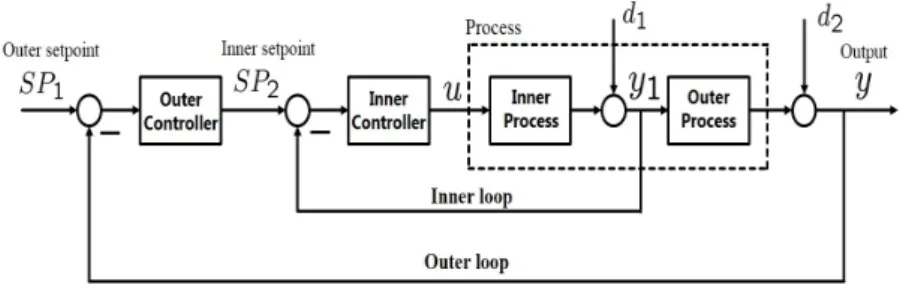
A cascade control system (see Fig. 1) is a multiple-loop system where the output of the controller in the outer loop (the “primary” or “master”) is the set point of a controller in the inner loop (the “secondary” or “slave”). The inner process is an intermediate process variable that can be used to obtain more effective control of the outer process variable.
In the configuration of the cascade control system the process is divided into two parts (the inner process and the outer process) and therefore two controllers are used, but only one signal generated from inner controller is manipulated. These two processes can be affected by disturbancesd1 and d2, respectively.
The case where the cascade control system is not affected by disturbances then the config- uration of cascade control system can be shown in the Fig. 2.
As shown in Fig.2, the cascade control system consists of an inner loop where an inner
Figure 1: Block diagram of a cascade control system
Figure 2: Cascade Control System
controller C2 operates as a feedback controller for plant P1 and an outer loop where an outer controllerC1 performs the same function for inner closed loop 1+PP1C2
1C2, which is serially connected to a plant P2. The outer controller C1 generates the set point signal for the inner loop, which includes the inner controllerC2. The controlled variable of the inner loopy1 affects on the outer loopy.
In the structure of cascade control system, we want to design desired controllersC1 and C2, then the first important step is to obtain a mathematical model of plantsP1 andP2as exactly as possible. Controllers are designed by using conventional methods to meet a given specification based on mathematical models. Nevertheless, there are cases in where a desirable experiment to achieve mathematical model of the plants is too hard to be done. And it is also very difficult to take much time and cost to execute efficient experiments for identification P1 and P2. To overcome this problem, an effective solution should be used is to apply data-driven approaches to cascade control system.
As another approach of application of VRFT to cascade control system, in my proposed method, I applied and developed VRFT methods to cascade control systems in the cases in where plants are minimum and non-minimum phase systems. Here, I construct the original cost function for cascade control system, and simultaneously obtain optimal parameters for both inner and outer controllers by only minimizing this cost function. The most important point and different points compared with the Previdi’s work, I clarified the meaning of the cost function in VRFT without the prefilter. As a result, it is clarified that the cost function of VRFT aims to optimize the open loop transfer function. Moreover, I also derived the original prefilter for cascade control system not only to avoid the problem of non-properness appearing in the cost function but also to obtain the matching between optimal parameters achieved from model reference criterion of VRFT and one yielded from original cost function. The above two points are major important different points compared with previous studies.
Besides, I also developed FRIT method for cascade control systems. In the previous study
, the authors have just applied FRIT method to cascade control system to deal with the case plants are minimum phases . FRIT for cascade control systems with non-minimum phase systems will be also implemented in this dissertation.
2 Virtual Reference Feedback Tuning for Cascade Con- trol Systems
I propose a direct tuning method for controllers in cascade control system to simultaneously obtain optimal parameters for both the inner and outer controllers by performing one-shot experiment for collecting one set of initial data from the cascade. Using a parameter vectorθini, assume that the current or initial closed loop is stable. The desired tracking closed loop transfer function from r toy is given as M.
Initial output yini := y(θini) differs from desired output yd := M r. Here, the purpose of tuning parameters is to find optimal parameter vector θ∗ such that the output of cascade control system with these optimal parameters can be approximated well with the desired output yd := M r. To find the optimal parameters for both inner and outer controllers we have to minimize ∥y(θ∗)−M r∥2N and use the initial data uini =u(θini), yini, and y1ini :=y1(θini). The performance indexJV(θ) of cascade control system is shown as
JV(θ) =
uini+C2(θ)y1ini−C1(θ)C2(θ) ( 1
M −1 )
yini 2
N
(1) The meaning of the cost function (1) is also shown as follows:
JV(θ) =
(1 +P1C2(θ)) (
1− HT(θ) HM
) uini
2
N
(2) Above equation in (2) shows that the minimization of JV(θ) in (1) corresponds to that of the relative error between open loop transfer functionHT(θ) and HM under the influence of the inverse sensitivity function of the inner loop and initial input datauini. Unknown plants of cas- cade control system are described as follows: P1 = s2+3s+2s+8 and P2 = s2+7s+5s+9 . We use structure of the controllers for both inner and outer controllers asC1(θ) = θθ1s2+θ2s+θ3
4s2+θ5s+θ6 and C2(θ) = θθ7s+θ8
9s+θ10
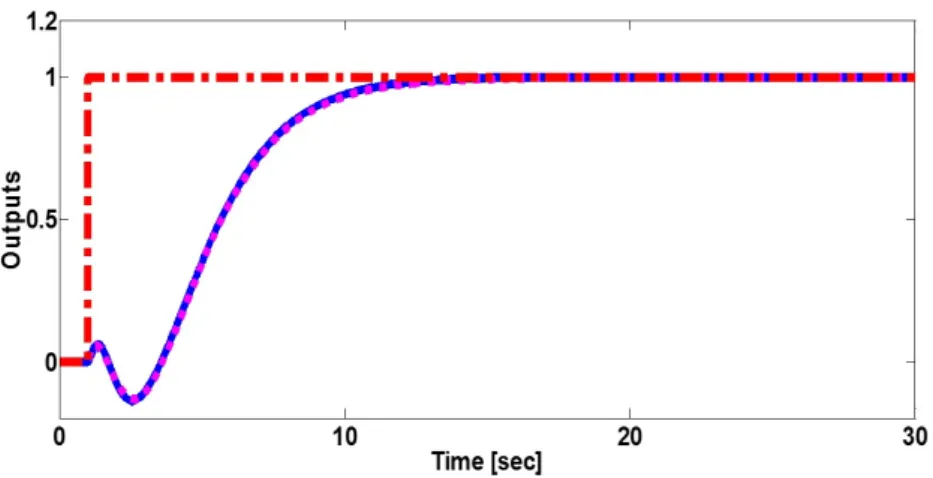
withθ := [θ1 θ2 θ3 θ4 θ5 θ6 θ7 θ8 θ9 θ10]T. Desired reference modelM is given byM = s+11 .Initial parameter vectors are set as θini = [0.0 1.0 1.0 0.0 1.0 0.0 1.0 1.0 1.0 0.0]T. The optimal parameter vectors is obtained asθ∗ = [0.4664 1.7533 1.3209 0.0283 1.2162 − 0.0010 0.8008 0.2504 0.0494 1.0844]T. Results in Fig. 4 show that actual output y(θ∗) and desired output yd are almost the same, implying that we can achieve the desired output of the cascade control system by using optimal parameter vectors θ∗.
3 Prefilter Approach to Virtual Reference Feedback Tun- ing for Cascade Control Systems
In this section,I developed work in the previous section by providing an effective data-driven method for direction design of cascade control system. It is based on finding out an original
Figure 3: Initial cascade control system output yini (solid line), reference signal r (dot-dash line), and desired output yd (dotted line).
Figure 4: Cascade control system output with optimal parametersy(θ∗) (solid line), the reference signalr (dot-dash line), and desired output yd (dotted line)
prefilter for Virtual Reference Feedback Tuning (VRFT) method to cascade control system. This is a very important point, it not only overcomes the problem of non-properness existed in the cost function of VRFT method but also ensures the whether the optimal parameters obtained from model reference criterion in VRFT method is closed to the optimal parameters achieved from original cost function of VRFT method. It enables us to have new VRFT approach to cascade control systems. Also, this is a new important point in comparing with previous study of authors.
The criterion index of cascade control systemJV RK (θ) can be described as JV RK (θ) = 1
K
∑K t=1
[(
1 +C2(θ)P1−C1(θ)C2(θ)P1P2 ( 1
M −1 ))
u(t) ]2
(3) By using a suitable prefilter Lc for the signals, then signals u(t), y1(t) and y(t) are filtered such as Lcu(t), Lcy1(t) and Lcy(t), respectively.
When the number of data increase (K → ∞) and using the discrete Parseval theorem, then the criterionJV RK (θ) is rewritten in the frequency domain as
JV R(θ) = 1 2π
∫ π
−π
Lc [
1 +C2(θ)P1−C1(θ)C2(θ)P1P2 ( 1
M −1)]
2Φudω (4) Where Φu is the power spectrum density ofu(t). The purpose of control in VRFT approach to cascade control system scheme is to achieve the optimal parametersθ∗ by minimizing of the following model reference criterion
JM R(θ) =∥Gry(θ)−M∥2N =
P1P2C1(θ)C2(θ)
1 +P1C2(θ) +P1P2C1(θ)C2(θ)−M 2
N
(5) We introduce two ideal controllersC1d and C2d such that
P1P2C1dC2d
1 +P2C2d+P1P2C1dC2d =M (6) In the scheme of cascade control system, C1d, C2d are chosen to satisfy the problem model- matching such that the output of closed loop cascade control system is equaled to the desired outputM r. By substituting the desired reference model of the cascade control system M into (6) to equation (5), using Parseval theorem and after some manipulations, the model reference criterion JM R(θ) is rewritten as
JM R(θ) = 1 2π
∫ π
−π
|P1P2|2|C1C2(1 +P1C2d)−C1dC2d(1 +P1C2)|2
|1 +P1C2+P1P2C1C2|2|1 +P1C2d+P1P2C1dC2d|2Φrdω (7) By comparing equation (7) with equation (4), the prefilterLc is chosen as
|Lc|2 =|M|2|1−M|2 1
|1 +P1C2|2 Φr
Φu (8)
If above condition is held, then the sensitivity function of the inner loop Si is rewritten as Si = 1+P1
1C2 = 1−M1. With M1 is the desired reference model of inner loop. Finally, we obtain the prefilterLc of the cascade control system |Lc|2 =|M|2|1−M|2|1−M1|2 ΦΦur.
Thus, the cost function of the outer loop cascade control system using original prefilter Lc is described by
JV Rout(θI) =
Lcu0 +LcC2(θ∗II)y10−LcC1(θI)C2(θII∗ ) ( 1
M −1 )
y0 2
N
(9) We consider an example, two unknown plants of cascade control system are described as fol- lows: P1 = s2+5s+6s+1 and P2 = s2+2.5s+1.5s+5 . First, we turn the inner closed- loop of cascade control system to obtain a purpose that the sensitivity function inner loop is equal the de- sired reference model of the inner loop M1 = 2s+11 , obtained optimal controller of inner loop C2∗(θ∗II) = 0.338s2+1.3079s+1.5522
0.5180s2+0.5176s . Next, we turn the outer loop with desired outer reference model M = s+11 , obtained optimal controller of outer loop C1∗(θI∗) = 1.4036s3+3.5248s2+3.2346s+0.8723
0.0082s3+0.4025s2+2.9443s−0.0011. Ob- tained results are shown in Fig.5 and Fig.6 . The original prefilterLc of cascade control system can be identified as Lc= 0.9939s1.5998s3+7.0649s2+0.2602s2+3.5228s+1.9913−0.0100 .
Figure 5: Initial outer loop cascade control system output y0 (solid line), reference signal r (dot-dash line), and desired output yd (dotted line).
Figure 6: Cascade control system output with optimal parameters y(θI∗) (solid line), reference signalr (dot-dash line), and desired output yd (dotted line).
4 Prefilter of FRIT approach to cascade control systems
Similarly, I shown a FRIT approach to derivate an exactly prefilter of cascade control structure.
Using this prefilter allows achieving optimal parameters for both controllers in cascade control systems. By using same way, the prefilter LF in FRIT approach to cascade control systems is given as
|LF|2 = |P1P2|2|C1dC2d|2
|1 +P1C2d+P1P2C1dC2d|2 Φr
Φy0 =|Td|2 Φr
Φy0 (10)
The cost function is shown as
JF(ρ) =∥(1−Td)LFy0−TdC1(ρ)−1C2(ρ)−1LFu0−TdC1(ρ)−1LFy01∥2N (11) Finding out the above prefilter LF enables us to have an effective strategy in applying FRIT approach to cascade control system for obtaining optimal parameters of both inner and outer controllers.
5 Extension of VRFT Approach to Cascade Control Sys- tem for Non-Minimum Phase Systems
In this part, I extend VRFT approach to cascade control system in the case the plants are non- minimum phases to estimate the unstable zeros of plants and obtain the optimal parameters of both inner controller and outer controller such that the output of cascade control system can follow a given desired output by using directly the data collected from the cascade system. We address P1(s) and P2(s) in the cascade control system are linear, time-invariant, single-input single-output, strictly proper, stable, and non-minimum phase plants. P1(s) and P2(s) can be described as follow: P1(s) = P1m(s)P1n(s) = N1m(s)N1n∗ (s)
D1(s)
| {z }
P1m(s)
N1n(s) N1n∗ (s)
| {z }
P1n(s)
, P2(s) = P2m(s)P2n(s) = N2m(s)N2n∗ (s)
D2(s)
| {z }
P2m(s)
N2n(s) N2n∗ (s)
| {z }
P2n(s)
. In whereP1m, P2m are minimum phase parts,P1n, P2nare non-minimum phase parts. The reference model should be given asMd(θn, s) = Mdm(s)P1n(θ1n, s)P2n(θ2n, s).
The cost function is shown as:
JVcas(θ) =
uini+C2(θC2)y1ini−C1(θC1)C2(θC2) ( 1
Md −1 )
yini 2
N
(12) The unknown non-minimum phase plants of cascade control system are described as P1 =
s−1
s2+6s+8.75 , P2 = s2+3.7s+3.4s−1.5 . We give the desired reference model which includes the unknown non-minimum phase parts Md(θn) = 2s+11 P1n(θ1n)P2n(θ2n). With the above setting, we set the initial parameterθCini = [1.0 2.0 4.0 1.0 1.0 3.0 17.0 0.0 2.0 0.0]T and θnini = [0.6 0.7]T. Optimal parameter vector is achieved as
θC∗ = [0.4023 2.4377 2.3755 0.4633 1.6874 3.3192 16.8500 0.1822 1.9234 0.0209]T and θn∗ = [1.0073 1.4885]T. The obtained results are shown as in Fig.7 and Fig.8.
Figure 7: The initial output of cascade control systemyini (the solid line), the reference signal r (the dot-dash line), and desired outputyd (the dotted line)
Figure 8: Cascade control system outputs with optimal parameters y(θ∗) (the solid line), the reference signalr (the dot-dash line), and the desired output yd (the dotted line)
6 Fictitious Reference Iterative Tuning of Cascade Con- trol Systems for Non-minimum Phase Systems
I expanded FRIT method to cascade control system in the case the plants are non-minimum phases to obtain the optimal parameters of both inner controller and outer controller such that the output of cascade control system can follow a given desired output by using directly the data collected from the cascade system . Similarly, the plants of cascade control system can be parameterized asP1(s) =P1m(s)P1n(s),P2(s) = P2m(s)P2n(s). In whereP1m, P2m are minimum phase parts, P1n, P2n are non-minimum phase parts. The reference model should be given as Td(θn, s) =Tdm(s)P1n(θ1n, s)P2n(θ2n, s). The cost function is shown as:
JFcas(ρ) =∥(1−Td)yini−TdC1(ρ1)−1C2(ρ2)−1uini−TdC1(ρ1)−1y1ini∥2N (13) The meaning of the cost function is shown as follow
JFcas = (
1− Td Gry(ρ)
) yini
2
N
(14) In where : Transfer function fromr →y, Gry(ρ) = 1+P P1C2(ρ2)P2C1(ρ1)
1C2(ρ2)+P1C2(ρ2)P2C1(ρ1).
7 Conclusions
In this dissertation, I presented two methods ( FRIT and VRFT ) of data-driven approaches to cascade control systems. In these studies, the mathematical models of the plants are not required, only a set of initial data directly collected a closed cascade control system loop by one-shot experiment is required to achieve the optimal parameters for both inner and outer controllers. I have presented VRFT method for the class of minimum phase plants of cascade control systems. Also I constructed the original cost function for VRFT method to cascade systems and shown that using VRFT method simultaneously yields both optimal controllers in the cascade systems. In addition, I analyzed clearly the meaning of the cost function in two cases to show the great effect of my proposed method.
Moreover, I derived original prefilters of VRFT and FRIT methods for cascade control systems, using these original prefilters not only avoids the problem of non-properness appearing in the cost function of VRFT case but also obtains the matching problem between optimal parameters achieved from model reference criteria and one yielded from original cost functions . It also ensures the optimality of the cost functions in two methods. These are very important different points when comparing with previous studies of authors.
Deriving original prefilters for cascade control systems in case the controllers are linearly parameterized enables us to have a new strategy in applying VRFT and FRIT methods to cascade control systems.
In addition, I have extended VRFT and FRIT methods to the cascade control systems in the case the plants are non-minimum phases systems. The results show that using these methods yields the optimal parameters for both inner and outer controllers of cascade control systems.
The optimal controllers guarantee that the output of cascade system is approximate with the desired output.
Consequently, above achieved results imply that data-driven approach is a very effective method to design optimal controllers for not only cascade control systems but also other kind of control systems.