Acta Med. Nagasaki 25 : 8-15
Clinical Evaluation of Immune Response in Patients with Lung Cancer
Masao TOMITA, Yasunori KOGA, Koichiro SHIBATA, Kazuhisa MATSUMOTO, Toshio ONITSUKA,
Koichiro SAKODA, Takami MAEDA, Shigehito HAMASUNA,
Toshiro KARIYA, Yasunori MATSUZAKI,
Tsutomu YONEZAWA, Makoto YOSHIOKA
The Second Department of Surgery Miyazaki Medical College
Received for publication, March 15, 1980
ABSTRACT
In patients with lung cancer, the immune response was observed with an analysis of various factors which mostly related to its prognosis.
Its response was extremly depressed in the course of following surgery in advanced cases of stage III and IVas well as in unresectable cases for lung cancer, compared with those of stage I and II .
Furthermore, it showed that the high levels of immune response were seen in those of long term survivors given OK-432 during follow-up period. It was obvious from this study that the use of OK-432 was suitable for activation of the immune reaction against host as one of the immunopotentiators.
Meanwhile, from the immunological mechanism of view, the hyperactivity of immune response enable the patient to be free from recurrence of cancer for a long term following surgery, in contrast the low level of the immune response showed to be poor prognosis owing to early appearance of recurrence.
Furthermore, the effectiveness in use of OK-432 was clinically presented in patients with malignant pleural effusion, which showed direct cytocidal action of OK-432 given intrapleurally with a 10 or 14 days interval.
INTRODUCTION
Cell mediated immunity is generally accepted to be playing an important role of inhibition of tumor growth for tumorbearing host and the contribution of lymphocyte
富 田 正雄,古 賀 保 範,柴 田紘 一 郎,松 本 和 久,鬼 塚 敏 男,迫 田耕 一 郎,前 田 隆 美, 浜 砂 重 仁,仮 屋 敏 郎,松 崎 泰 憲,米 沢 勤,吉 岡 誠
from the aspects of immunological mechanism was become apparent in a role of subpo- pulation of lymphocyte.
On advancing immunological research, immunological aspect for prohibition of tumor growth has been utilized cancer therapy combined with surgery, radiation or chemotherapy as well.
However, it was not yet resolved to detect the best method to promote immunolog ical preventive effects against tumor growth clinically. Recently it was noted that various bacteria have been found to induce inhibitory effects for tumor growth and a preparations of various bacteria such as streptococcus hemolyticus, mycobacterium bovis and cory'ne- bacterium parvum developed in clinical application for cancer therapy.
As cited by many investigator"')", OK-432, a lyophilized preparation of atten- uated strain of streptococcus haemolyticus, has an antitumor activity which is demonstrated
experimentally as well as clinically.
OK-432 was used in patients with cancer undergoing surgery to identify the inhibitory effects against cancer and to define some immunological benefits as a host defence.
The aim of this study was to document the immunological effectiveness of OK- 432 for patients with cancer.
MATERIAL AND METHOD
The patients with lung cancer who admitted in our clinics were classified by disease staging and histological finding. The majority of patients were advanced cases who were shown as stage I and IV. According to histological finding, nearly half patients were squamous cell carcinoma and adenocarcinoma. The former consisted of 11 cases and the latter of 13 cases, including 5 cases of anaplastic carcinoma. Three of them were non-operative cases, which were one of adenocarcinoma and two of anaplastic carcinoma respectively.
The immune response of tumor-bearing host was testified by skin test against phytohemagglutinin-p (PHA) provided from Difco Laboratories and by lymphoblast- genesis against PHA. Positive response by skin test was decided in those of more than 10 mm in size of skin reaction.
Blastogenic response of lymphocyte to PHA was testified as follows. Lyphocyte in 6 ml of venous blood was separated by conray 400-Ficoll method and the suspension of lymphocyte was obtain in 20 % Eagle MEM. Thereafter, the concentration of lym- phocyte was adjusted in 106/ml and added PHA-P at the concentration of 15/pg/mg and incubated in 5% cot at 37°C, after 48 hours of incubation 250 ,ic thimidin was added and was continuted to incubate in a 24 hours duration. After total 72 hours of incubation, it was filtrated by cell Harvest. And radioactivity of thymidin was countered in addition
of 7 ml scintilation liquid.
Stimulation index (SI) was calculated by following
formula SI= radioactivity of added PHA radioactivity of lymphocyte only
The changes in these response were evaluated in regard to an influence of surgery, advancing disease and administration of OK-432.
Furthermore, OK-432 was given into the intrapleural space directly in patients with malignant pleural effusion arising from lung cancer to identify the direct cytocidal action against tumor cell. This clinical course was reported to justify tumor inhibitory effects of OK-432 clinically.
RESULT
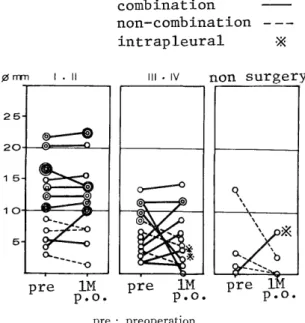
As shown Fig. 1, the response against PHA-P by skin tests were evaluated in patients with lung cancer according to stage of disease classification prior to surgery and the first one month following surgery respectively.
In stage I and I , positive response for skin test were seen in 7 cases out of 12 cases preoperatively as well as in 8 cases at the first one month after surgery.
Meanwhile, preoperative skin reaction against PHA-P was very weak and only 2 cases out of 11 cases showed positive reaction in stage I and IV of advanced cases.
These response had no correlation between preoperative and postoperative states.
From the observation of changes in skin test during pre and postoperative periods, an attitude of immune response by administration of OK-432 was compared according to stage of disease. In stage I and ff , its
responses were almost the same despite of demonstrating a somewhat decreased response on postoperative period.
In general, weak response was observed following surgery, suggesting the depressed defensive reaction of the host by surgical stress in spite of removal of cancer tumor.
In stage iJ and IV, a remarkable reduction of skin reaction was seen
compared with in stage I and ff despite of OK-432 administration.
Two cases with O K - 432 in stage II and IV revealed negative reaction, which was converted from positive rea- ction in preoperative period.
The effects of OK-432, however, was appearently warranted to ensue the stimulation of immune system in advan-
Fig 1. The Effects of OK-432 on Response of Skin Test (Lung Cancer)
ced cases of stage I and IV after surgery in which 4 out of 6 cases with preoperative negative response showed a promotion of skin test by use of OK-432 following surgery.
In three cases without surgery, the response of skin reaction had become weak during 1 month period administrated in a dose of 20 KE or more of OK-432. Never- theless, in a case with direct use of OK-432 into intrapleural speace, immune response become to be strong, suggesting that tumor regression by direct action of OK-432 also contributes to stimulation of immune system for the host.
The changes of immune response by skin test were observed until at least one year after surgery, compared with the efficacy of OK-432 as shown Fig. 2.
As a matter of fact, immune response by skin test against PHA seems to be depressed wth surgical trauma in spite of excision of cancer tumor. However, the use of OK-432 was beneficial to prevent from depression for immune response, which showed in 3 among 9 cases with surgery.
At the time of the third month following surgery, however, skin reaction was still depressed regardless of use of OK-432 except one case with the accelerated reaction of skin test. Two cases who survived beyond one year after operation showed positive reaction of skin test.
It is suggesting that immune response of skin test reflects its prognosis. All cases but one with negative reaction at the third month following surgery were unable to survive until more than 1 year.
Therefore, skin reaction at third month after operation seems to be valuable to anticipate its prognosis grossly.
Fig. 2 Changes of response against skin test between pre-and postoperative state
Fig. 3 Changes of Stimulation Index against PHA between Pre-and Postoperative State
According to operative mode in either curative or non-curative operation, the patients undergoing curative operation had positive reaction by skin test against PHA, in contrast, the response of those who underwent non-curative operation was markedly depressed at the time of third month following surgery including non-operated cases as shown in Fig. 2.
By lymphoblastogenesis against PHA in vitro, the changes of stimulation index (SI) showed a depression of its response following surgery until at least one month after operation as shown in Fig. 3.
In those who underwent curative operation, however, a high level of SI was provoked by use of OK-432 postoperatively and its tendency remained still until at
least subsequent three months following surgery.
Meanwhile, unless OK-432 was used for those who underwent surgery, the immune response was definitively depressed as is observed in Fig. 3.
In a case of advanced lung cancer with malignant pleural effusion, OK-432 was attempted to use directly into pleural space.
An indicated in Fig. 4, clinical improvement of approximetely 7 months duration after delivery of 2450 g body weight boy (Ss 36w) by induced labor was obvious. OK- 432 was given intrapleurally in a dosis of 5 to 20KE followed by every 2 or 4 weeks of interval and total dosis reached 141 KE. The finding of chest xp showed a transient aeration of the left lung field which revealed diminution and remission of malignant pleural effusion as shown in Fig. 5 and Fig. 6. It must be assumed that OK-432 exert on not only activation of immune response by means of cell mediation but also direct cytocide against tumor cell.
Host reaction by skin test presented an activation of immune response and also it was warranted by SI of lymphocyte blastogenesis against PHA, accompanying with
Fig. 4 Clinical course treated by Ok-432 for patient with malignant pleural effusion arising from lung cancer.
Fig. 5 Chest xp, prior took-432 therapy, showing malignant pleural effusion in left side with mediastinal shift contra laterally.
Fig 6. Chest xp, following 2 months of ok-432 therapy given intrapleurally,
showing the reduction of malignant pleural effusion with reexpansion of ipsilateral lung.
lymphocytosis followed by OK-432 administration.
From above clinical experience, it is of note that the effects of OK-432 contri- butes to the enhancement of immune response for tumor-bearing host as well as exert directly on tumor cell as a cytocidal action.
DISCUSSION
Based on advanced immunological research, it is defined that the application of immunological aspect is of value to cure a various kinds of cancer. As a treatment of cancer, some of immunopotentiators were discovered and utilized in treatment of cancer clinically. OK-432, one of immunopotentiator, was recognized by Okamoto and coworkers" to provide antitumor activity for tumor-bearing host and inhibitory effect.
The patients with lung cancer were treated by use of OK-432 and the effecti- veness of OK-432 were evaluated in the course of an attitude of the immune response by skin test and lyphoblastogenesis against PHA, compared with pre-and postoperative period from the first month to at least first one year after surgery.
In general, it has revealed that the immune response was depressed during a period after urgery within at least 1 month, especially its tendency was prominent in
advanced cases of stage IQ and IV.
A decrease of immune reaction, however, was also seen in patients who did not undergo any surgical intervention.
From above results, it was documented that the degree of the immune response was in accordance with that of advanced cancer and it was slightly depressed in patients with surgery, suggesting that immune response was temporarily compromised after
surgical treatment.
Therefore, it seems that the improvement of its prognosis after surgery is antici- pated in prevention of immunological depression against host. In stage f and IV of advanced cases, the level of postoperative immune is one of the most important parameter to determine its prognosis.
By using OK -432 after surgery, the levels of the immune response by skin test or lymphoblastogenesis were maintained in the range of at least a little high rather than preoperative level in patients with stage I and fl of lung cancer, whereas it was mainly depressed in the majority of patients with stage J and IV of advanced cases regardless of use of OK-432.
In those who did not receive any of OK-432, the further depression of the immune response was shown, reflecting the influence of surgical stress in spite of excision of cancer tumor.
From the view of surgical radicality the assessment of skin test against PHA showed apparently different behavior in either curative or non-curative operation.
In patients who underwent curative operation, the level of the immune response against PHA was still high. From these results, it was of note that interestingly enough,
both factors of curative operation and use of OK-432 are necessary for maintainance of high level of immue response after surgery. Unless OK-432 is given even in patients undergoing curative operation, immune response results in low level of it.
It has been assumed, however, that this level also demonstrate its prognosis in the clinical course.
Unless the immune response by lyphblastogenesis against PHA is continue to be a considerably high level at the time of three months following surgery, it may irnply that its prognosis will be poor.
It was worthy to note that a trial of further enhancing the cure rate is to be in effective activation of immune reaction for host. Postoperative application of OK-432, therefore, might be available for this purpose.
In patients with malignant pleural effusion, the clinical course was improved by intrapleural admistration of OK-432. This experience provides an evidence related to clinical benefit of direct cytocidal action against tumor cell.
REFERENCES
1) OKAMOTO, H., SHORIN, S., KOSHIMURA, S. and SHIMIZU, R.: Studies on the anti- cancer and Streptolysin S-forming abilities of hemolytic streptococci, JPA. J. Microbiol. ,
11 : 323, 1967.
2) SAKURAI, Y., TSUKAGOSHI, S., SATOH, H., AKIBA, T., SUZUKII, S. and TAKEGAKI, Y.: Tumor inhibitory effect of a streptococal preparation Cancer Chemother. Rep., 56,
9. 1972.
3) KIMURA, I.: Immunochemotherapy of human cancer using OK-432 Cancer Chemother.
2 : 21, 1975.