著者名(英) Siwon Park, Yasuhi Sekiya, Masaki Kobayashi, Yasuko Ito
journal or
publication title
神田外語大学紀要
volume 24
page range 137‑155
year 2012‑03
URL http://id.nii.ac.jp/1092/00000607/
137
Group Oral Tests
Siwon Park Yasushi Sekiya Masaki Kobayashi Yasuko Ito Introduction
The primary purpose of the current study is to examine the extent to which raters’
scores were affected by the quantity and quality of examinees’ foreign language speech in group oral tests. Prior studies have suggested that the group oral test be a reliable testing technique. Those studies, however, mostly concerned test validation using rating scores without fully addressing how the quantity and quality of the speech produced by examinees may affect raters’ judgments. Researchers, such as Hildon (1991) and Fulcher (1996), were active advocates of the group oral tests.
However, a few recent validation studies (Kobayashi, Johnson, & Van Moere, 2005;
Nakatsuhara, 2010; Park, 2008; Van Moere, 2006; Van Moere, 2010) have expressed reservations about the use of the test especially for high-stakes testing.
Among the researchers who have explored group oral tests, Hildon (1991) appears
Hildon points to several advantages of the test while justifying its use in Zambia as part
of school exams. He argues that group tests are economical relative to conventional
interviews since large numbers of candidates can be heard in a short time. Also, the test
would suggest several advantages for testing children’s oral ability, especially for the
shyer or more nervous ones. In his trial of the group oral exam in Zambia, however, Hildon noticed a couple of problems in administrating and scoring the exam which included the issue of content and questions of cultural appropriateness in addition to the reliability in rating and standardization of the task itself.
Kobayashi, Johnson, and Van Moere (2005) studied the relationship between the amount of students’ output amounts and their scores in group oral tests administered yearly at a university in Japan. Their study, similar to the current one in its purpose, raters. They found that there was a systematic relationship between the amount of speech and the scores: the more the learners spoke, the higher scores they received.
Van Moere (2006) took a more extensive look at the validity of group oral tests.
He conducted a G-study to locate the sources of variation in test scores and found that person-by-occasion was the greatest source of variance, while topic was not a ! performances themselves were more responsible for the differences in test scores from one occasion to the other.
Nakatsuhara’s (2010) study on group oral tests concerns more practical aspects of the test and provides more pertinent suggestions to the administration of the tests.
She argues that in order to control the extroversion levels of examinees, a test group must involve no more than three examinees. She notes in her study that the number "
participants sat the exam, the discussion turned into a presentation event, in which
each participant, without exchanging turns, presented his/her opinion and passed
the turn to the next participant. In addition to limiting the number of participants,
Nakatsuhara recommends using more closed, goal-oriented tasks in a group oral test,
139
such as information gap or picture difference tasks. This is to force all participants to attend to the oral performance equally contributing to the completion of the task(s).
Such use of more goal-oriented tasks in group oral tests was strongly advocated also by Van Moere (2010) and Park (2008) as the tasks facilitate more negotiation of meaning among participants, which is closer to authentic conversations.
Concerned with the increasing popularity of group oral tests in language education, more validation studies on the tests are called for. The current study aims to add a piece of validity evidence to prior studies for the use of the tests. For such a research purpose, the following research questions were to be addressed in the study:
#$ % '
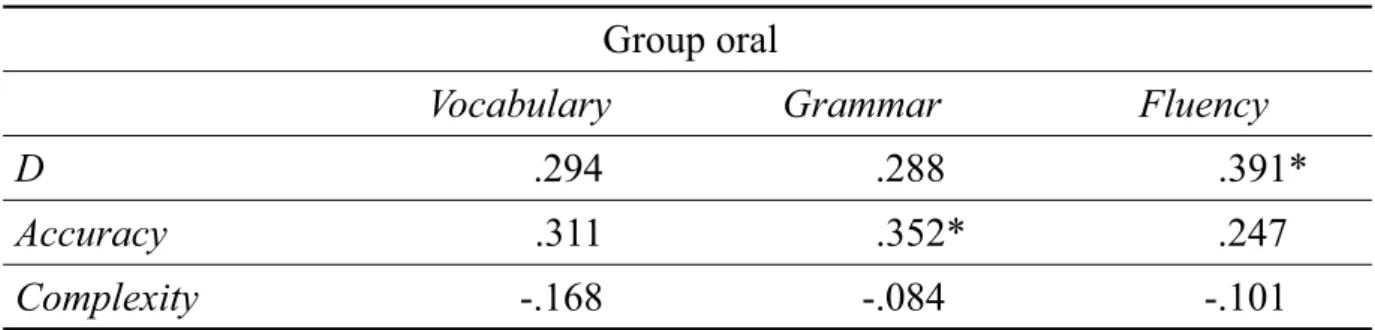
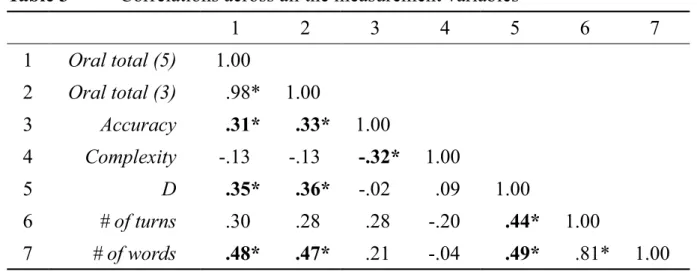
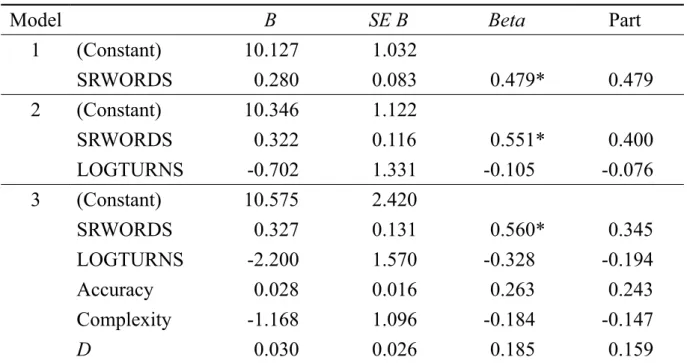
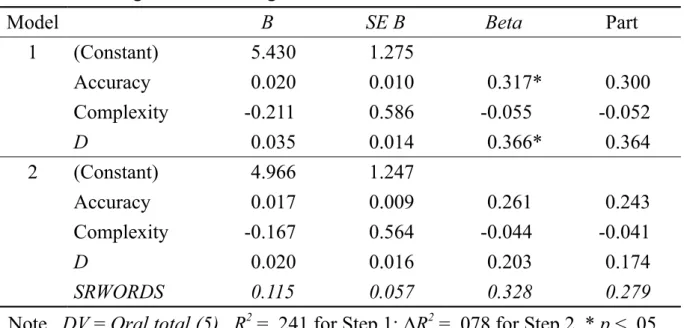
*$% ' If so, what aspect(s) is particularly influential – accuracy, complexity, and/or '
+" 4 < = '
By addressing the three research questions, we will be able to examine the extent to which the linguistic quantity and quality of L2 examinees’ English speech affect raters’ score assignment in group oral tests.
Methodology
1. Participants and speech sample data
The speech samples used for the current study come from 11 group oral tests of an
!> ?@>D OQ@>DOU
11