JAPANESE SUPPLIERS SYSTEM AND THE FOREIGN DIRECT INVESTMENT BY SMALL
AND MEDIUM SIZE ENTERPRISES:
The case of automobile parts suppliers
学生番号
: 200771
氏名
: Ngido Melkiory Philemon
指導教員名: 穴沢 眞平成2
0
年度提出Key Words: Foreign Direct Investment, Industrial system
networks, Japanese suppliers system
ABSTRACT
It is noted that inquiry on importance of specific advantages in determining not only how MNEs engage in FDI, but also in explaining why MNEs establish production in specific locations have been studied extensively. However, inquiry into what determines the FDI by SMEs, which face shortage in the management and financial resources, has not received much attention despite the increasing overseas production operations by SMEs. Therefore, this study attempts to explore the Japanese auto industry suppliers system in order to identify the reason for SMEs to engage in overseas production operation.
On the surface, the activities of SMEs and those of MNEs seem highly divergent.
Until recently, they have operated in largely separate realms, each in its own competitive space with markedly different characteristics; SMEs largely considered to be operating on the domestic market place. However, globalization has dismantled the barriers that traditionally segmented local business opportunities and firms from international counterparts. Evidence indicate that SMEs which were considered passive victim of globalization, in the last few decades have become active players by setting up activities beyond their home market and their role is increasingly crucial in contributing to the growth of the industry. This is particularly observed in the Japanese automobile industry, where a large share of SMEs parent companies have their subsidiaries involved in the value chain of overseas subsidiaries of major Japanese automobile manufacturers.
Although it is well known that the fundamental objective of firms is growth and development, the fact that SMEs increasingly engage in FDI brings crucial questions.
The questions come because it has been studied that, as firms internationalize their
operations they face a number of challenges such as liability of foreignness or
disadvantages faced by firms to compete with local firms in their markets (Hymer,
1976). Other problems faced by firms when investing outside home country include
geographical distance, which increases both the costs of communication and travel
and the complexities of managing geographically dispersed assets. In addition, firms
face the problem of psychic distance, because they must compete with local firms
that have greater knowledge of the local culture and language, as well as of local
legal, regulatory and marketing practices. These challenges bring up the concern
about what offer SMEs the prospects to compete on a par with other global
manufacturers. Considering that SMEs face the shortage of both management and
financial resources to run overseas subsidiaries as compared to large-scale MNEs,
this argument implies that, firm-specific advantages alone are much less in
explaining the FDI by SMEs but need to consider the environments surrounding business relations among firms.
To examine the FDI behavior by SMEs this paper develops an approach to explain the FDI by SMEs with the aid of the investment in the inter-firms relations.
The model of this paper builds its logic upon the basic insights developed in network approach to industrial system and firm’s internationalization (Johanson and Mattsson, 1987, 1988) to identify the determinants for SMEs to engage in FDI. And in contrast to the most existing frameworks on FDI, the benchmark of this study is based on the assumption that there exists a coordination of activities between firms that can not achieved through a central plan or on organizational hierarchy, nor does it take place through the traditional market model (price mechanism). This coordination is achieved through continuous cooperative transactions and mutual orientation to each other (Richardson G., 1972; Asanuma B., 1987; and Itoh, M. et al., 1993). In this light, firms in the industrial systems are considered as embedded actors in the business relationships.
By examining the distinctive features of the Japanese suppliers system (customer-supplier relationship) in automobile industry, it is evident there is a symbiotic relationship between major automobile manufacturers and suppliers of auto parts (about 96% of which are SMEs) that explains the determinants of FDI by SMEs suppliers. The symbiotic relationship between firms makes it difficult to change the existing relation specific investment to orient to another customer. This can be described as due to the switching, monitoring and competitive cost as result of cumulative nature of activities to develop the relationship. And because the symbiotic relationships involve adaptations in a number of dimensions such as technically, logistically, administratively, knowledge development or specific capital investment there are costs involved in shifting the production lines to fit a new customer (SMEs lack enough resources for this transition). In light of the interpretation of the engagement of Japanese SMEs in the FDI it is indicated that since Japanese companies are mutually related to each other through keiretsu or subcontracting system, SMEs are feeling pressure to implement overseas production to meet the requirements of principal customers in order to ensure the continuation of their relationship with major customer, while looking for possibilities to diversify customers in the host country to become independent.
This argument shows that since SMEs in auto parts industry depend more on the
relationship with principal customers, any adjustment in the industrial or network
landscape such as major customer’s increasing overseas production or increasing
competition due to global procurement of cheap products by major supplier will force
SME suppliers to implement overseas production operations. This means, as long as
FDI can assure the continuation of business relationship with their major customer
especially in Japan SMEs will be ready to engage in overseas production. This shows
that the decision to invest abroad by SMEs is not necessarily the result of short-term
economic profitability, but rather the reaction to other factors such as fear to lose
major customer and maintaining the long time firm’s network relationship.
TABLE OF CONTENTS
Pages
Acknowledgement viii
List of Abbreviations ix
List of Figures and Tables x
CHAPTER 1
1.1 Introduction 1
1.1.1 Relationships in the industrial networks and FDI by SMEs 1 1.1.2 Japanese automobile suppliers system and FDI by SMEs suppliers 4
1.2 Definition of SMEs 8
1.3 Research objective 8
1.4 Research questions 10
1.5 Research rationale 11
1.6 Research premises 12
1.7 Research plan and methodology 13
1.8 Structure of the paper 17
CHAPTER 2 STATE OF OVERSEAS EXPANSION BY JAPANESE SMEs AND AUTO PARTS MANUFACTURERS
2.1 Introduction 19
2.2 An Overview of Japanese MNEs and the case of Overseas expansion by Japanese SMEs
20
2.3 The current state of overseas expansion by manufacturing SMEs 21 2.4 Changes in the business environment and its impacts on Japanese
manufacturing SMEs
22
2.5 Purpose of FDI by SMEs 23
2.6 General trend of overseas expansion by automobile parts manufacturers 26 2.7 Changes in the business environment of the Japanese Automobile parts
suppliers
27
2.8 Points for FDI decision in auto parts industry 29
2.9 Conclusion 32
CHAPTER 3 LITERATURE REVIEW 34
Part I: THE INTERNATIONALIZATION OF FIRMS 34
3.1 Theories of internationalization of firms 36
3.1.1 Internationalization process (stage) model 36
3.1.2 Internalization theory 37
3.1.3 Transaction cost approach 38
3.1.4 Eclectic paradigm 39
3.1.5 Network approach 41
3.1.5.1 Network approach compared with other internationalization theories 43
3.1.5.2 Network approach compared with the case of Japanese SMEs FDI 44 3.2 Theories of Foreign Direct Investment (FDI) 46
3.2.1 The cooperate decision making approach 46
3.2.2 Different factor prices model 47
3.2.3 Gravity framework 48
3.2.4 FDI theories compared with the case of Japanese SMEs. 49 3.3 Analysis of issues from the existing theories on the FDI by SMEs 50
Part II: INDUSTRIAL NETWORK: INTERMEDIATE POSITION AND DIVISION OF WORK
55
3.4 Intermediate Organization 56
3.5 Customer-supplier relationships in industrial system 58
3.6 Conclusion 59
CHAPTER 4 JAPANESE SUPPLIERS SYSTEM – the case of automobile industry 61 4.1 Customers-suppliers relationships in Japanese automobile
industry
61
4.1.1 Suppliers’ association 62
4.1.2 Keiretsu 63
4.2 Japanese sub-contracting system 64
4.2.1 Structure of Japanese subcontracting system 65
4.2.2 Types of subcontractors 68
4.2.3 The Basis of Japanese subcontracting system 69
4.2.3.1 Basic contract for trading 69
4.2.3.2 Cooperative attitude of self-restraint 70
4.2.3.3 Technical and managerial cooperative attitude 70
4.2.3.4 Sincerity and patience 71
4.2.3.5 Parallel sourcing 72
4.2.4 Characteristics of Japanese subcontracting system 73
4.2.4.1 Plant proximity 74
4.2.4.2 Human asset specificity 75
4.2.4.3 Physical assets specificity 76
4.2.5 Why subcontracting is important for automobile manufacturers 77
4.3 Customer-supplier relationship: the model for FDI by SMEs 79
4.3.1 Interdependency between firms 79
4.3.2 Switching costs 81
4.3.3 Monitoring and competitive costs 82
4.3.4 Conclusion 83
CHAPTER 5 CASE STUDIES AND ANALYSIS 85
5.1 Method and focus 85
5.2 Case studies 88
5.2.1 Case study 1: M-A Corporation 88
5.2.2 Case study 2: M-B Corporation 92
5.2.3 Case study 3: M-C Corporation 97
5.3 Case study analysis: Motives and intention for FDI 101
5.3.1 Respond to the request by Mazda 102
5.3.1.1 Fear of competitors 103
5.3.1.2 Plant proximity 104
5.3.2 Need to establish new business relationship 105
5.3.3 Need to reduce cost and increase productivity 107
5.3.4 To avoid problems associated with artificial barriers 109
5.3.4.1 Trade barriers 109
5.3.4.2 Local content requirements 110
5.4 Case studies analysis: Determinants for location choice 110
5.5 Case studies analysis: Conclusion 112
CHAPTER 6 APPLICATION, DISCUSSION AND CONCLUSION
6.1 An application of customer-supplier relation model to analyze the FDI by Japanese SMEs in auto industry
115
6.1.1 Individual firm’s activities as determinants for FDI by SMEs 116 6.1.2 Major customers as a determinant for FDI by SMEs 118 6.1.3 Major customers as facilitators of FDI by SMEs 119
6.1.4 Summary 120
6.2 Discussion 121
6.3 Conclusion 123
6.4 Implication 126
6.5 Limitations 126
Appendices 128
References 133
I. ACKNOWLEDGEMENTS
In the first place, I would like to acknowledge the enthusiastic supervision and guidance of Prof. Anazawa Makoto during the entire period of my Masters Degree program at Otaru University of Commerce. I thank him for many insightful conversations during the development of the ideas in this thesis as well as for the many discussions carried out during seminar classes, which inspired this thesis. His guidance and comments on the text have made it possible for me to specify the central theme of the study and to maintain consistency and focus on the research area to the end.
I would to thank Prof. Makihiro Tanaka, Prof. Carolus L.C. PRAET and Prof.
Satoshi Takata for the helpful comments, suggestions, challenges and encouragement this study. These contributions allowed me to organize the ideas and the text and helped me to complete the writing of this Masters thesis.
My research and thesis would have not materialized if I did not have love, support, and encouragement from my family and friends. Their words and suggestions often boosted my courage and determination to write this thesis. Among many people to whom I owe my deepest gratitude and affection, my wife and my parents deserve the most special place for the support they gave me during the years I have been working on my Masters degree. Their love, dedication, prayers were a foundation for my work and a source of my energy to go on. I also appreciate in a special way the support of Mr.
and Mrs. Ryoji Sone whom I consider my Japanese father and mother. Living in a foreign country there are many challenges that may interfere with concentration and focus in studies. Nevertheless, the parental love and care of Mr. and Mrs. Ryoji Sone have been an inspiration in my studies.
In this instance, also I would like to acknowledge Ms. Otake Yoko and Mr. Mima Tatsuya for the translation of data and information between Japanese and English.
Without them, it could be difficult to collect enough and relevant information for the purpose of this paper. On top of all, advice, assistances and words of encouragement from my family members in Tanzanian and friends both in Japan Tanzania and from other parts of the world were indispensable towards my achievements.
For financial support, I thank very much the Government of Japan, which through
the Ministry of Education, culture, sports, science and technology
( MONBUKAGAKUSHO ) offered me a scholarship to pursue my graduate course in at
Otaru University of Commerce.
II. List of Abbreviations:
FDI Foreign Direct Investment MNEs Multinational Enterprises SMEs Small and Medium Enterprises JIT Just in Time
JASME Japan Finance Corporation for Small and Medium Enterprises
FSAs Firm’s specific advantages
III. List of tables and figure TABLES:
Table 1.1: Definitions of Japanese SMEs 8
Table 2.1: Purpose and intention of setting operations overseas by SMEs 23 Table 2.2: Main Markets of overseas subsidiaries of SMEs (by region) 25 Table 2.3: Points for FDI by SMEs in transport industry 30
Table 5.1: Introductory profiles of the three case studies 87 Appendix 2: Ratio of auto parts manufacturer’s sales by destination by region 130
Appendix 3: Six major keiretsu groups ( roku dau kigyo shudan ) 131
Appendix 4: Summary of the case studies 132
FIGURES:
Figure 2.1: Proportion of enterprises with overseas subsidiaries 21 Figure 2.2: Trends in SMEs’ business expansion overseas (corporations only) 22 Figure 2.3: Outward FDI in transport equipment industry 27 Figure 2.4: Forces that explain the motives for FDI by SMEs 29
Figure 2.5: Principal destination of products made by overseas subsidiaries of Japanese auto parts
manufactures 31
Figure 4.1: Mazda’s supplier and suppliers associations as of 31 March 2008 63 Figure 4.2 Pyramid shape of Japanese subcontracting system 67
Figure 4.3: The conceptual model of FDI by SMEs 83
Figure 5.1: Comparison of customer-supplier transaction relations between Japan and overseas
markets 106
Figure 6.1: Summary of knowledge generated from this study 125
Appendix 1: Objectives of overseas expansion by size of the enterprise 129
CHAPTER 1 1.1 INTRODUCTION
1.1.1 Relationships in the industrial networks and FDI by SMEs
Internationalization defined as the degree to which firms rely on foreign markets for customers and factors of production, is becoming more important for firms to survive and obtain long-term success because of the heightened competition in the global environment (Bartlett and Ghoshal, 2002). Because of the consequences of the integration of global economies many firms, regardless of their size, regard FDI as an integral part of their strategy in order to remain competitive in the industry since it is no longer possible to act in the market place without taking into account the risks and opportunities presented by foreign and global competition.
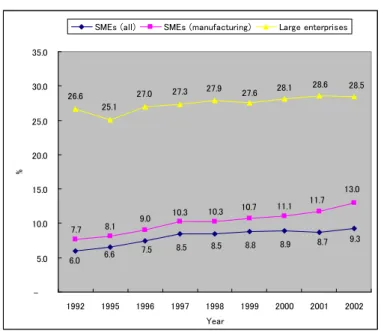
On the surface, the activities of small and medium businesses and those of MNEs seem highly divergent. Until recently, they have operated in largely separate realms, each in its own competitive space with markedly different characteristics; SMEs largely considered to be operating on the domestic market place. However, globalization has dismantled the barriers that traditionally segmented local business opportunities and firms from international counterparts. Local markets in Japan like in other parts of the world are becoming integral part of the broader, global market. Evidence indicates that SMEs, which were considered passive victims of globalization, in the last few decades, have become active players by setting up activities beyond their home markets and their role is increasingly crucial in contributing to the growth of the industry. Fig. 1.1 and 2.1 show how manufacturing Japanese SMEs increasingly engage in overseas production. As SMEs engage in overseas production, new strategic synergies through collaborative arrangements with large-scale firms in the global arena are created, with SMEs frequently entering the global value chain of the MNEs.
The fact that SMEs increasingly engage in FDI brings crucial questions
although it is well known that the fundamental objective of firms is growth and
development. It has been studied that, as firms internationalize their operations
they face a number of challenges such as liability of foreignness or disadvantages
faced by firms to compete with local firms in their markets (Hymer, 1976). Other
problems faced by firms when investing outside home country include
geographical distance, which increases both the costs of communication and
travel and the complexities of managing geographically dispersed assets. In addition, firms face the problem of psychic distance, because they must compete with local firms that have greater knowledge of the local culture and language, as well as of local legal, regulatory and marketing practices. There the question seems to be why SMEs engage in FDI despite the fact that it exposes them to a more complex and risky business environment. Moreover with their perceived relatively simple organizational structures and objectives, and less resource, FDI by SMEs rises the question about what offer them the prospects to compete on a par with other global manufacturers rises a great concern. Therefore, the theme of this paper is to identify what can explain the FDI by SMEs by looking at the Japanese small and medium size auto parts manufacturers.
Drawing from a number of existing theories on internationalization and FDI of firms, a very well explanation of the necessary conditions that explain why and how overseas production is dominated by MNEs is provided. However, in order to try to explain the FDI by SMEs less is well know about to explain the FDI by SMEs. What these theories do not explain clearly is what determines the FDI by SMEs based on the discussion in the previous paragraph. From the study conducted in this paper, the application of the existing frameworks does not give sufficient explanation of what makes SMEs to engage in overseas production. The previous studies, which are discussed in detail on chapter 3 of this paper, indicate the importance of firm’s specific advantages in determining not only how MNEs engage in FDI, but also in explaining why MNEs establish production in specific locations. Emphasizing on firm’s specific advantages, these frameworks seem not sufficient in explaining the reasons why foreign markets are not served by a local firm in industries where local firms are more competitive or why SMEs do not internalize their specific advantages in the foreign markets. An example of this case is found in the Japanese auto industry, where most of Japanese first-tier SMEs auto parts suppliers continue to serve their major customer in the foreign markets even when they have less competitive advantages compared with other local suppliers as it indicated in the case studies of this paper. In addition, it is observed that SMEs in Japanese auto industry have offered their ownership advantages in their overseas subsidiaries by establishing joint venture and technical assistance agreements instead of exploiting them internally.
Given the weaknesses of the existing theories to explain the FDI by SMEs, the
theme of this paper builds its logic upon the basic insights developed in network
approach (Richardson, 1972; Johanson and Mattsson (1987); and Johanson and
Vahlne (1990)) to show that the decision to invest abroad by SMEs is not
necessarily the result of short-term economic profitability. This is in contrast to many authors of FDI theories, because the motive to implement FDI is shown as a reaction to other factors, such as maintaining the firm’s network relationship, fear of losing principal customer, gaining reputation in the eyes of their principal company and competition.
The network approach, which is derived from the industrial systems, where firms engage in production, distribution and use of goods, describes relationships between firms as a division of work. This means that firms are dependent on each other and therefore their activities need to be coordinated. Because of the interdependence 1 , the coordination is not achieved through traditional market model or an organizational hierarchy, but rather take place through interaction among firms in the network in which price is just one of several influencing conditions. Richardson, G. (1972) and Itoh, M. et al ., (1993), described this kind of coordination between firms as chukan-soshiki (intermediate organization) in his efforts to explain Japanese suppliers system - subcontracting ( shita-uke ) and keiretsu. From this benchmark, it implies that in the industrial systems individual business transactions among firms usually take place within the framework of established relationships. These relationships which take time and effort to establish creates bonds which are developed through product and process adjustments, logistic coordination, knowledge about the counterparts, personal confidence and liking 2 , and long-term contracts. The bonding (relation specific investments), leads to relationships that are mutually orientated to each other. The mutuality implies that there are specific inter-firm dependence relationships that are different in nature from the general dependence relationship to the market in the traditional market model (Johanson and Mattsson, 1987). The Japanese suppliers system in automobile industry illustrates this kind of intermediate organization and therefore this paper intends to explain the FDI by SMEs from this benchmark.
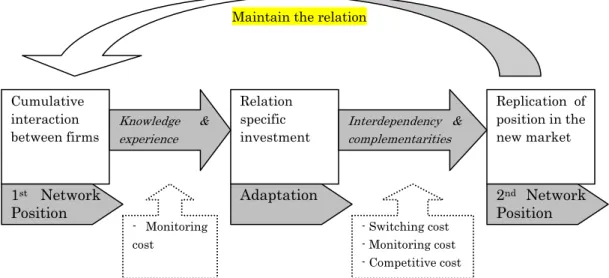
We have seen that adaptations in a number of dimensions such as technically, logistically, administratively, knowledge development or specific capital investment are required to develop a mutual orientation relationship. In addition, since mutual orientation is affected by interaction process between firms, adaptations occur through continuous processes as a result of day-to-day experiences. Because of cumulative nature of mutual relationship, firm’s position in network characterizes its relations to others because of earlier activities in the
1
Although these dependencies are mutual, but it may be assumed that they are more or less asymmetrical in the sense that one party is more dependent on the relationship than the other (Johanson and Mattsson, 1987)
2
Because of adaptation in attitude and knowledge of the parties
relationships. As it takes time and efforts to establish and develop such a position, the network position therefore aggregates the base that grants both the possibilities of further transactions and constraints of possibilities to change counterparts. The implication here is that linked to the mutual relationships, might influence the degree and type of uncertainty in continuation of business especially to the SMEs, which depends more on the relationship. To that end, any adjustments in the industrial landscape will send strong signals to these firms to respond on time because of the fear to lose their major customer. And since mutual orientation is established, developed and maintained through interaction processes, its strength and character are developed and maintained through interactions. Hence, in the fear to lose major customer, this study established that, SMEs in auto parts industry engage in FDI to respond to the requirements and requests by their major customer in order to develop and maintained their established relationships. This means that inter-firm networks in terms of supplying relationship offers the prospect for smaller firms to compete on a par with other global manufacturers because the relationship with principal customer furnishes them not only with the initial credibility in the foreign market but also with the rich knowledge about market requirements through shared information, management, technology and other resources.
1.1.2 Japanese automobile suppliers system and FDI by SMEs suppliers
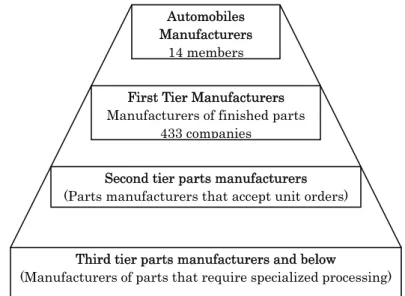
The structure of the Japanese automobile industry resembles a pyramid, with the automobile manufacturers at its apex and automobile parts manufacturers, comprising of both large-scale and SMEs at the bottom broadly divided into first-tier, second-tier and third-tier with first-tier parts manufacturers supply parts directly to the automobile company. The development and manufacturing of many automobiles parts are carried out by dividing the labor between different companies below this apex (keiretsu or Japanese subcontracting system).
Although as many as 20 to 30 thousand parts are required to construct a single automobile; under this system the automobile companies only manufacture around 30% of these parts in-house, and the majority are manufactured by automobile parts makers (JETRO, 2005). This suggests that there is a strong interdependence between suppliers of specific auto parts and customers, as it is explained in the above discussion about the chukan-soshiki . Chapter 4 is dedicated to explain about the Japanese supply system and its distinctive features.
Automobile parts are essentially developed in one of two ways. The
automobile company may carry out design and development of a part the give the parts manufacturers the blue print (design-supplied subcontractor) or the marts manufacturers may develop a part based on the specifications laid down by the automobile manufacture (design-approved subcontractors). In the Japanese suppliers system the later system is widely employed in which the parts maker receives technical assistance from the automobile manufacturers and participates in the development process from the product design stage onwards.
In return, most of auto parts suppliers significantly invest in specialized assets and human resources such as dies, moulds and jogs, located their plants quite close to the manufacturers and invested in customer-specific human capital 3 to carter for a particular customer for a particular car model. This symbiotic relationship is built on long-term cooperation that underpins both capital and personnel, Japanese auto companies like to have assembly plants that are geographically close to one another and to suppliers to facilitate face-to-face communication and Just-In-Time production system. Many scholars have indicated that, the formation of keiretsu system played a significant role in the development of the Japanese automobile industry.
By examining the distinctive features of the Japanese customer-supplier relationship in automobile industry it is evident that the symbiotic relationship with major customers determines the reasons for the FDI by small and medium size suppliers because of the difficult to change the existing relation specific investment to orient to another customer. The reasons for the switching cost are a result of time and efforts needed to adapt to other customers and the cost involved in shifting the production lines to fit a new customer (SMEs lack enough resources for this transition). Therefore, SMEs in auto parts industry feel the pressure to engage in FDI, to ensure the continuation of their relationship with major customer, while looking for possibilities to diversify customers in the host country to be independent. These firms, which were corralled by their principal customer in the Keiretsu system, now feel the pressure to take global strategy because of the fear that they may lose major customers due to the current changes in the landscape of the industry.
The traditional keiretsu system, which played a significant role in the development of Japanese automobile industry now send signals of uncertainty in continuation of business to most SMEs in auto parts industry. This is because increasingly automobile manufacturers are now seeking to optimize their supply by conducting more business with companies that do not belong to their keiretsu
3
For instance, let their engineers develop significant partner-specific knowledge.
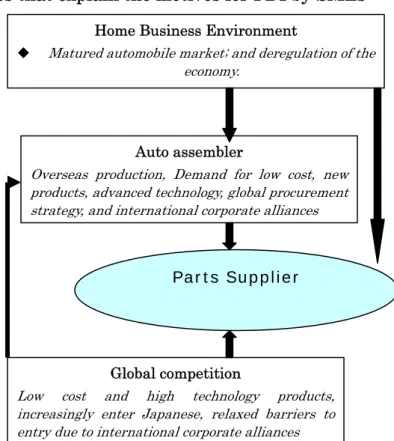
group. Other transitions that bring uncertainty in continuation of business are growing demand for price reductions because of intensifying competition, fall in domestic orders due to matured demand for automobiles and increasing overseas manufacturing operations by automobile companies, increased collaboration between Japanese and foreign automobile companies which allows foreign parts manufacturers to enter Japanese market, growing need for new technology such as environmentally friendly technology, and the recent wave of global industrial restructuring towards modular manufacturing of which auto assemblers intent to shrink the number of important suppliers to only those who can supply the required module for assembly line.
This realignment in the industry provide significant impetus for automobile manufacturers to transcend conventional procurement practices to further promote business with companies outside their keiretsu group and also to adopt global procurement strategy in effort to reduce costs. Also because of the fear that they may lose their competitive edge if they restrict themselves to procuring parts only from parts makers that are members in their keiretsu, Japanese automobile companies have increased the amount of business with companies outside their keiretsu. This move is in an effort to respond to the intensifying global competition and increased need for new technology (JETRO, 2005).
Therefore, while during the era of rapid economic growth the traditional keiretsu system was a kind of competition-free business because automobile company corralled parts manufacturers, now the auto parts suppliers must respond flexibly to the changes in the landscape of the industry in order to remain competitive in the industry (JETRO, 2005).
To respond to these to these changes SMEs must flexibly respond to the
request by principal customer because automobile manufacturers are
increasingly seeking to procure parts locally for their overseas production
operations. Since the Japanese subcontracting system put potential competitors
together, SMEs suppliers are forced to take on their competitors in the host
country because failure to response to the FDI by principal customer can let the
competitor in contact with its principal customer, which could eventually mean
losing business in Japan. Also to continue or increase orders from major customer,
rivals and potential suppliers are supposed to compete based on quality and price,
therefore for fear to lose major customers small and medium size auto parts
manufacturers invest abroad in an effort to increase productivity and reduce cost
of production. In this case, most parts manufacturers established export bases in
Southeast Asia and China. This follows a major initiative embarked by
automobile manufactures around year 2000 to reduce the cost of parts purchased by 20 – 30% with view of becoming more competitive, thus the survival of the parts makers depend on how they respond.
Given the mature economy in Japan and the growing momentum of localized production overseas, this study establishes that, first-tier small and medium size parts suppliers invest abroad in order to maintain or expand business with Japanese affiliates overseas that could not have been approached domestically.
The recent tendency by automobile manufacturers is to use products that are best in terms of cost, technology and quality irrespective of which keiretsu the supplier belongs. In this case, a manufacturer is sure to select companies that are capable of supplying these parts internationally ahead of companies that can supply products of equal quality, but only in Japan. This is evident the opportunities for Japanese SMEs that can establish early entry position in the foreign markets especially in the fast growing markets such as China and Thailand because they can easily develop new relationship with Japanese affiliates.
Therefore, this study considers firms as social units whose coordination is achieved through interaction processes. In addition, as social units, firms are dependent resources since the use of on asset in one firm is dependent on the use of other firm’s assets. This means that, the investment processes and their consequences are also interdependent in the network relationship (Johanson and Mattsson, 1987). Since firms are engaged in a mutual orientation to each other, the value of the relation specific investment of a supplier depends on the continued trading with a particular customer (Miwa and Ramseyer, 2000). The fact that, SMEs decision makers are rational they will respond to changes in the industrial landscape as market-seekers and/or efficiency seekers in order to attain profitability and growth. This implies that, as long as FDI will develop or maintain the relationship with major customer, SMEs will engage in overseas manufacturing operations because decision makers are are adopting FDI following the rule of maximizing the expected return and minimizing risks of the relation specific investment incurred.
In the following section, this paper will present the definition on SMEs that is
going to be adapted, and then it will follow the presentation of the research plan
and methodology that is applied in this study. The last section of will outline the
structure of the whole work, giving brief description of the contents of each
chapter.
1.2 Definition:
The definition of Small and Medium Enterprises (SMEs) varies from country to country and even within country, it varies from industry to industry. For instance while the international Finance Corporation defines SMEs as firms with less than 300 employees and total assets less than US$15 million, in the smaller economies, SMEs are defined as firms with less than 20 employees. Moreover, in Japan Manufacturing, construction and transport industries’ SME definition varies with that of other industries such as wholesale, service or retail industries (see table 1). According to these definitions, the classification of the enterprises can be based on the firm’s assets, number of employees, or annual sales. This paper examines the Japanese small and medium size automobile manufacturers therefore the legal definition by Small and Medium Enterprise Agency (Japan) on the manufacturing SMEs will be used. This agency defines manufacturing SME as business establishment that satisfies the following conditions in table 1.1 below:
Table 1.1: Definitions of Japanese SMEs
Industry
Small and medium enterprises (meet one or more of the
following conditions)
Of which small enterprises Capital No. of regular
employees No. of regular employees 1. Manufacturing, construction,
transport, other industries (excluding 2-4)
Up to ¥300
million Up to 300 Up to 20
2. Wholesale Up to ¥100
million Up to 100 Up to 5
3. Services Up to ¥50
million Up to 100 Up to 5
4. Retail Up to ¥50
million Up to 50 Up to 5
1.3 Research objective
The overall objective of this study is to connect the Japanese customers-suppliers relationship with the FDI behavior of Japanese SMEs suppliers of automobile parts. The aim of this work is to examine the nature and features of Japanese suppliers system in automobile industry, represented by subcontracting and keiretsu system, to develop a model to explain FDI by SMEs.
As firms internationalize their operations they face a number of challenges
such as liability of foreignness or disadvantages faced by firms as they expand
abroad and compete with local firms in their markets (Hymer, 1976). Other problems faced by firms when investing outside home country include geographical distance, which increases both the costs of communication and travel and the complexities of managing geographically dispersed assets. In addition, firms face the problem of psychic distance, because they must compete with local firms that have greater knowledge of the local culture and language, as well as of local legal, regulatory and marketing practices. From these premises, although it is well known that the fundamental objective of firms is growth and development, the crucial questions seems to be why SMEs engage in FDI despite the fact that it exposes them to a more complex and risky business environment?
It is crucial to answer this question in order to understand how SMEs can survive the challenges of FDI in the host country. This investigation is motivated by the facts that, compared to large firms, SMEs are perceived to be relatively simple in their organizational structures and objectives, and seem to be relatively less well-resourced and unprepared to manage overseas subsidiaries.
The examination of the influence of inter-firm relationship on the FDI decision by SMEs attracted this study because the common image of firms engaging in FDI is those MNEs, which are big to compare. Recently we are witnessing rather small companies that do not meet the definition of MNE actively taking part in the international production. These small and medium sized firms despite there less resource in terms of management, technological and finance engage in FDI to face the global competition, which involves large firms.
And this phenomenon rise a concern, why small firms engage in FDI and what strategy do they use to withstand the global competitor? The questions about what facilitate successful entry into the foreign country also encourage this study to look at the business relationship with main customers at home in order to identify the driving force for FDI.
When examining the motives for FDI from the perspective of Japanese
suppliers system, this paper intends to find whether the global environmental
drivers such as; economies of scale, exploitation of lower input costs, risk
compensation and optimality of market segmentation, can be applied to Japanese
small and medium size auto parts suppliers. This comes from the fact that the
existing trend towards fragmentation and modularization of production process
in automobile industry gives SMEs suppliers an opportunity to become
specialized suppliers in the industry. Considering Japanese subcontracting
system, can these environmental drivers explain the FDI behavior of Japanese
SMEs in auto industry?
Lastly this work intends to examine whether existing theoretical frameworks for FDI, most of which have been tailored towards MNEs, can be applied to firms which are not MNEs as in the case Japanese SMEs auto parts manufacturers.
This is because firms of this kind do not have their own FDI strategies and in most cases respond to the overseas expansion plans of there principals. In terms of capital involvement, control, and number of countries, these companies implement overseas production, SMEs of the type of Japanese auto parts manufacturers cannot be considered as MNEs because they serve few markets and their main customers in the host countries are limited to those they serve at home. By revisiting the existing theoretical works, gaps can be identifies and reinforcement to the existing will be brought to light. This will stimulate further researches on the FDI of SMEs in case of any disagreement or modification on the existing theoretical framework so as we can achieve a deep understanding of the forces and motives for FDI by Japanese SMEs in auto industry.
Through this research, the environment that created the successive development and growth of Japanese small and medium scale enterprises in the global arena can be unveiled and hence a lesson on how best this can be assimilated in developing economies will invite further studies. In addition, the implication of the influence of the Japanese suppliers system on FDI by small and medium size automobile parts manufacturers on the business will be identifies for the benefit of the growth of international business.
1.4 Research question
The purpose of this study is to gain a deeper understanding of the motives for Japanese SMEs in the automobile industry to engage in FDI instead of exporting from Japan despite the fact their small size expose them to intensified competitive environment in the host country where industry global players have established to take advantage of the progressing global market. Therefore this paper seeks to find out the role played by the existing Japanese customer-supplier relationship in FDI of the first-tier SMEs in auto parts industry.
Based on the premises of this paper, the empirical analysis from this study will answer the following question:
①
Why Japanese small and medium size manufacturers of automobile parts,
despite of their perceived resources constraints engage in FDI?
From this question, this paper intends to identify factors, which motivate SMEs to consider FDI. In the first place, looking at the industry landscape, the stimuli for SMEs will be identified in order to be able to investigate what factors determine the FDI by SMEs, which are perceived to have limited resources in terms of management and technology to face the challenges brought about by setting overseas production operations.
②
What determines the engagement of SMEs in the FDI?
After identifying the stimuli for FDI by SMEs, looking at the auto industry this paper attempts to investigate what makes SMEs to engage in FDI. This question will be answered by looking at how the Japanese suppliers system could influence the decision makers in small and medium size suppliers to engage in overseas production operations. In this way, answering this question will enable us to understand what the main reasons are for FDI by SMEs.
③
What model (s) is appropriate to explain the FDI of Japanese first-tier SMEs manufacturers of automobile parts?
After re-visiting the existing theoretical works on internationalization and FDI of firms, this work intends to link to the case of Japanese SMEs in automobile parts industry in order to identify which theory can best be applied in this situation. This question aims at identifying how far the existing theoretical frameworks can explain the internationalization of SMEs, by focusing on Japanese first-tier SMEs in auto parts industry.
1.5 Research rationale
In reviewing the relevant literatures on firms’ foreign direct investment
(Hymer, 1976; Kogut, 1983; Porter 1985; Dunning 1988, 1995; Rugman, 1986),
little is know to explain the FDI motives or driving forces for small and medium
enterprises. One has no doubt, whether any of the existing theories and
explanations for motives to invest abroad is made to apply to SMEs because most
of these studies focused on the FDI of MNEs. Considering the case of Japanese
small and medium size auto parts manufactures, which show their presence in
several countries behind their major customers (affiliates of their customers in
Japan), it become obvious that the investigation of their motive for FDI can
reinforce the existing theoretical explanations about FDI and fill the gaps in
these theories.
A number of authors over the years have proposed that internationalization of firm is affected by multiple influences (Reid, 1983). This perspective gives rise to a number of contingency frameworks), which emphasize the importance of the firm’s environment and particular circumstances in explaining its internationalization trajectory. Based on these premises, this paper builds its logic upon basic insights developed in network approach to industrial system and firm’s internationalization (Richardson, 1972; Johanson and Mattsson, 1987, 1988) to explain the FDI behavior of these SMEs in automobile industry by examining the Japanese customer-suppliers in automobile industry.
The interest to study the FDI by SMEs come from the fact that despite of the small size, SMEs are increasingly showing their presence outside their home countries and actively contribute to global sourcing and fragmentation 4 of production (sequential stages of production). In Japanese automobile industry in particular, it is common to see the kind of relationship assets specific, where suppliers, most of which are SMEs, customize their investment to serve one or a few customers and automobile companies entrust their suppliers with product development from the very design stage rather than treating them as mere subcontractors. This is fueled by the shift towards modular of manufacturing process. Since SMEs are becoming the drive for this new production phenomenon, it worth investigating the contents of their relationship with manufacturers in order to identify if there is any relationship between the home business environment and FDI behavior of SMEs. This considers the fact that most SMEs are relatively unprepared and own fewer resources to enable them to extend production to overseas markets. Therefore, since manufacturing SMEs are increasingly becoming the pillar of industrial and economic growth and change, identifying different factors driving FDI by SMEs is now one of the most important research areas.
1.6 The premises of this thesis
This paper assumes that firm’s network relationships (customer-supplier relationship) trigger and motivate SMEs to internationalize, and influence their foreign market investment and location selection decision. Moreover the relationship helps SMEs to gain initial credibility in the new markets; allows access to additional relationships that could not be formed while in Japan; allows SMEs with access to established channels; help in lowering cost and reducing
4
The framework work as firm’s different stages of productions is allocated among different suppliers located across
countries.
risk; and therefore the customer-supplier relationship influence their internationalization pace and pattern. This paper adopts a rationale by assuming that the internationalization of a firm is unique and highly situation-specific (Reid, S.D., 1984), which allows us to draw from various theoretical perspectives to investigate the influence of domestic inter-firm relationships in Japanese auto industry on the FDI by Japanese first-tier SMEs suppliers.
1.7 RESEARCH PLAN AND METHODOLOGY
Since this masters thesis intends to explore the Japanese automobile suppliers system, with the aim of gaining a deeper understanding of its influence on the engagement in FDI by Japanese small and medium size automobile parts manufactures; the exploratory 5 study approach will be adapted. This will help us to find out in the new light from Japanese firms’ networking, what motivates small and medium size manufacturers of auto parts to invest in productions abroad.
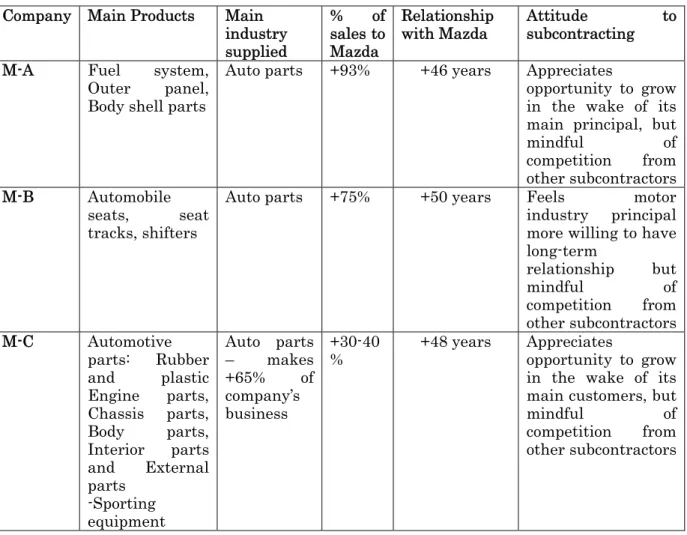
Considering the research objective and the premises surrounding this topic, the scope of this paper is on Japanese SMEs automobile parts manufacturers (in the first-tier) with overseas subsidiary(s). This paper focus on the study of auto parts suppliers who are involved in the direct relationship with automobile manufacturers in order to be able to establish how the customer-supplier relationship can influence the FDI behavior of SMEs. Since there are thousands of auto parts suppliers it is not possible, given time and financial constraints to study all suppliers and all manufacturers relationships. For that reason, this paper concentrates on one automobile manufacturer in order to answer the research questions. Because of its clear relationship with suppliers, Mazda Auto Corporation was selected as a focus, which enables us to study three of its suppliers in order to support the theoretical background of Japanese supplier system and to test the FDI model that is developed in this paper. The characteristics of Mazda and its suppliers group are clear because almost all are located around Hiroshima area. It was easier to establish the relationships between the companies we visited for this study and Mazda because Hiroshima is the home of only one auto assembler. This location character makes the ties between Mazda and its suppliers to be close and representative of the popular Japanese subcontracting system. In addition, the selection of Mazda’s suppliers as the focus of this study is motivated by the fact that there are fewer studies to
5
Saunders and Lewis, 2000
explain Japanese suppliers system conducted on Mazda as compared to other giant auto manufacturers like Toyota and Nissan. This fact then will enable researchers to apply the facts we gathered for this study on the existing literatures about Japanese supplier system.
A number of reasons drive the focus on the auto industry. Firstly, automobile represent the largest cases of FDI in the Japanese FDI by manufacturing industry. From the data on the FDI by Japanese manufacturing firms, it is indicated that more cases of FDI happen in transport industry, which is represented, by more than 90% cases of FDI by automobile METI (2004).
According to this classification transportation industry includes manufacturers of motor vehicles, parts and accessories, aircraft and parts, industrial trucks and parts, shipbuilding and repairing and other miscellaneous transportation equipments (METI’s industrial classification, 2004).
Another reason for selecting Japanese auto industry is its popular subcontracting system. Many authors have indicated that Japanese subcontracting system displays a much better relations between customers and their suppliers that resulted in lower costs, higher quality and greater innovativeness (Asanuma 1985a, b, 1989; Richardson J., 1993; Dyer 1993). This is based on the fact that Japanese auto industry suppliers system presents some distinguishing features from the rest of the world. The feature of the Japanese automobile industry manufacturing is that most of the parts and subassemblies of the industry are purchased from external suppliers under long-term subcontracting arrangements. A substantial portion of these external suppliers are members of a well-defined group of firms closely associated with one of the primary automobile manufacturers. Thus by focusing on Japanese auto industry it will be easy to identify the relationships between firms and thereby examine the FDI behaviour of SMEs firms in the network of firms.
The approach toward this thesis will be in the form of case study using
multiple case studies approach. Because of the time and other resources
constraints, three companies representing the case of Mazda Motor Corporation’s
auto parts suppliers have been used to answer the research questions and to
support the premises of this paper. This approach will enable us to discover
similarities and differences if exist in the motives and driving forces for FDI by
Japanese SMEs manufacturers of auto parts. All these three companies in my
case studies have their production subsidiaries in overseas market, and relay
significantly on their main customer, Mazda Motor Corp. These companies with
the main products in the bracket are M-A Corporation (Fuel system, outer panel,
Body shell parts and Cabin and Body), M-C Corporation (Rubber and plastic parts for Engine, chassis, body, interior and exterior of cars), and M-B Kogyo Co.
Ltd, (Automobile seats, shifters and door checkers). The selection of these supplier was made to have a sample that is representative of the SMEs first-tier suppliers actively taking part in FDI.
The case study approach is used in this paper because it enables researchers to gain a rich understanding of the context of the Japanese firm’s relationship (customer-supplier relationship) and how this relationship influences first-tier SMEs suppliers to engage in the FDI. Therefore, case study research excels at bringing us to an understanding of a complex issue of why Japanese SMEs in automobile industry decide to take in overseas production. Thus, using the case study approach will enable us to extend the experience or add strength to what is already known from previous researches. Researcher Robert K. Yin defines the case study research method as an empirical inquiry that investigates a contemporary phenomenon within its real-life context; when the boundaries between phenomenon and context are not clearly evident; and in which multiple sources of evidence are used.
The three companies selected for the case study have direct ties with Mazda Motor Corporation serve to counterbalance the emphasis on the business network relationship as a determinant for FDI by auto parts suppliers. Further, these companies illustrate the general historical background of the development of subcontracting relationship between auto firm and suppliers in Japan. All the three cases vividly illustrate the interdependence of customer and supplier and demonstrate how FDI decision by suppliers is affected by the FDI strategy of principal customer. Looking at the evolution and the nature of their relationship with Mazda, of these three companies are representative of the form of Japanese firm’s networking that is found in auto industry. So taken together, from a firms’ network perspective, these companies supply background for the analysis of suppliers’ motives and intention to set up overseas production.
To answer the research questions and to support the premises of this paper, empirical data collection was done mainly through intensive onsite interviews with the sampled companies, which enabled the construction of the case study.
The methodology of the interview and how the case study were constructing is explained in chapter 5 which is the chapter dedicated for case study and analysis.
Secondary data in the forms of Publications, Archival analysis, and survey
studies and other secondary data have been mostly used to supplement the
information gathered from the interviews, which was based on the case of
Mazda’s suppliers, in order to get the broader picture of the Japanese auto industry as a whole.
Most of the information used in this work was collected from secondary data, primarily because these kinds of data on the Japanese auto parts industry were readily available. They are standard statistical sources, such as the census of manufacturers and annual survey of output, establishments and other items; and Survey of Overseas Business Activities of Small and Medium Enterprises. Others sources included official sources on small business such as the annual chusho kigyo hakusho (white paper on SMEs in Japan), published by the Small and Medium Enterprise Agency; the Kogyo Kihon Jittai Chosa (Basic Survey of Manufacturing), undertaken every five years by the Ministry of Economy, Trade and Industry (METI) and the Small and medium Enterprises Agency. In addition, information was obtained from Quarterly survey of overseas subsidiaries, Basic survey of overseas business activities and White paper on international economy and trade, which are published by METI. Data are also published by the auto and auto parts industry associations and in directories of firms. Also data were available using the statistics of FDI issued by Ministry of Finance. In addition to these published materials and FDI literatures, small business literatures and Japanese inter-firms’ network literatures; this study utilizes case studies of three first tier suppliers to Mazda Motor Corporation conducted in Sept 2008 around Hiroshima area. These case studies draw upon interviews, company histories and unpublished materials made available by firms. The case studies provide details on the customer-supplier relationship in Mazda’s keiretsu and the influence of this relationship on the FDI by the SMEs suppliers in the auto industry. This study makes an important contribution on the literatures about the FDI.
To arrive at a conclusion of this paper qualitative analysis was used as it
enables researchers to study a number of relationships with more depth to be
able to gain better understanding of the topic. This method required the use of
data expressed in attitudes and perceptions, which make behavioral analysis of
the motive for FDI easier. Not limited to qualitative data alone, the study used
quantitative data analysis to examine the relationships of variables in
descriptive manner. This data analysis will rely on the existing theoretical
preposition used in this paper since a number of previous studies have been
conducted on the FDI of firms. That means, we are going to compare the data in
each case to the theoretical framework applied. This will highlight any
agreement or disagreement between the existing framework and what is actually
happening.
1.8 The structure of the paper
This paper is organized into six chapters. The first chapter carries the introduction and research plan and methodology for this work. This part includes the introduction of this paper, definition of key words (SMEs), and overview of Japanese MNEs and the case of SMEs, Research objective, research questions, rationale, research premises and research plan and methodology.
The remainder of this paper is organized as follows. Chapter 2 is about the state of overseas expansion by Japanese SMEs. This section examines the patterns of foreign investment by Japanese SMEs and FDI by auto parts suppliers to establish the trends and relationship between their engagements in FDI. This chapter also covers the discussion about the changing business environment in Japan and its impact on SMEs, the characteristics, motives and purpose of FDI by Japanese SMEs in manufacturing industry and automobile parts manufacturers. In this way, factors behind engagement in FDI by SMEs in auto industry can be established. This chapter primarily uses the secondary data obtained from the published information in Japan. Mostly from the annual White Paper on SMEs issued by Japanese SMEs Agency; annual White Paper on International economy and Trade, Facts and figures about the Japanese economy, and Market reports all published by JETRO; Survey of overseas business by automobile supplies, published by Japan Auto Parts Industries Association and other statistical reports and surveys published by METI and MOF.
Chapter 3 is divided into three parts, the first parts gives an overview of
existing frameworks on internationalization theories and FDI. This section will
also cover the theoretical frameworks of FDI (for factors determining FDI and
Industrial location). Extensive literature review is covered in this section to get a
deeper understanding in this area of study to derive the relationships among
parameters, in order to be able to use the existing theoretical framework to
analyze the data collected and thereby develop a link with the case of Japanese
SMEs automobile parts suppliers’ FDI. The discrepancies and agreements are
discussed as well. The theoretical work discussed in this chapter includes stage
model, internalization theory, the transaction cost theory, eclectic paradigm,
network approach to internationalization, corporate decision making approach,
and Ricardian model of differences in factor prices, gravity framework. The
second part of literature review presents the theoretical background for the
existence of subcontractors. This section tries to show why all firms not vertically
integrated, in the effort to explain the internationalization of firms as embedded
actors in the market.
Chapter four of this thesis presents and discusses the theoretical background of Japanese suppliers system (keiretsu and subcontracting systems). This chapter unveils the network relationship in auto industry and then discusses the contents and issues in the Japanese auto industry suppliers system. This will enable us to understand the kind of relationship that exists between small and medium size auto parts suppliers and large multinational enterprises (Automobile makers). From these relationships, we can establish why despite of their small size, SMEs auto parts suppliers engage in FDI. After the discussion about the features and characteristics of Japanese subcontracting system, this chapter will present the customer-supplier relationship model to explain the FDI by SMEs. Therefore, this and the previous chapters are intended to set a stage for main analysis on Japanese suppliers system and FDI by SMEs manufacturers of automobile parts.
The following chapter five includes the presentation and interpretation of the case studies. Using the empirical data collected from the three automobile parts supplier, the analysis of the case studies and conclusion of the findings from the case studies analysis are also presented. This chapter discusses the evidence of the motives and intentions of SMEs auto parts suppliers to engage in FDI from the case of Mazda’s first-tier small and medium size auto suppliers. At the end of the chapter, the model of FDI developed in chapter 4 will be applied to three case studies.
Lastly, chapter six presents the main knowledge generated by the whole
exercise. This chapter discusses the applicability of the customer-supplier
relationship model in the case of FDI by Japanese SMEs in auto industry. In the
discussion section, this chapter is dedicated to reinforce the existing FDI
explanatory framework by applying the corporate decision approach (Aharoni,
1966) and network approach to internationalization (Johanson and Mattsson,
1988) to the case of Japanese SMEs in auto industry. Because of this work,
chapter six also outlines the implications to the interest of both future research
works on FDI by SMEs, and the business world. Then at the end of the paper,
limitations for this work, which includes, the narrow area of study constrains are
presented.
CHAPTER 2
2 STATE OF OVERSEAS EXPANSION BY JAPANESE SMEs AND AUTO PARTS MANUFACTURERS
2.1 Introduction
Popular information disseminated about Japanese companies is about large companies, for instance Toyota, Nissan, Mazda, Honda, Sony, Matsushita, or Komatsu type as if they were the model of all Japanese companies. This can be seen from the information about Japanese management system, which is disseminated from these large companies, as if their management systems applied to all firms without distinction. In addition, most of the FDI theories have been tailored to explain the motives for FDI by these large MNEs. Although it is true that at the top layer of the Japanese industrial hierarchy in terms of strength, size and prestige, these large-scale companies are undoubtedly important, yet an indication of the general recognition of the importance of these firms and where they fit in the industrial structure is the existence of SMEs. The SMEs form the group of suppliers and subcontractors (both in Japan and overseas) to these large firms praised today for their global competitiveness. In automobile industry, for instance about 96% of automobile parts suppliers are SMEs supplying major automobile assembles with important parts and components of high quality and at a competitive price.
This chapter surveys the general overseas expansion by Japanese SMEs to show their position in Japanese outward FDI. Generally, this chapter intends to show that not only large-scale firms but also SMEs are increasingly and actively engage in overseas production, responding to similar motives and global environmental drivers, such as seeking for markets and low cost of production in the need for growth and profitability (appendix 1). Trends in the FDI by manufacturing SMEs and transport industry will give light on relationship between firms in order to establish how the parent firm’s business landscape influences the FDI decisions. This chapter utilizes the survey and research results by METI and Japan Auto Parts Industry Association (JAPIA), to establish the FDI trends for manufacturing SMEs and SMEs in automobile parts industry, and the purpose for engaging in overseas production.
Data that solely shows the FDI by SMEs in automobile parts industry, however, was
not readily available, despite that fact that about 96% of Japanese automobile parts
suppliers are SMEs (JETRO, 2005). Therefore for the purpose of this study instead,
information that relate to Japanese SMEs in automobile parts industry was compiled from the data on FDI by manufacturing SMEs 6 , FDI by transport industry 7 (issued by METI) and that of auto parts manufacturers (issued by Japan Auto Parts Industries Association). This effort enabled the analysis of the state of overseas expansion by Japanese manufacturing SMEs in automobile parts industry.
The theme of this analysis work is to identify the motives for FDI by SMEs and automobile parts manufacturers in order to explain the FDI by SMEs in automobile industry. In the following sections, this chapter will discuss about overview of Japanese MNEs and the case of overseas expansion by Japanese SMEs, changes in the business environment affecting SMEs in general and auto parts industry in particular and the purpose for FDI by SMEs and by Japanese auto parts manufacturers. Then, at the end of this chapter the importance for conducting studies to explain the FDI by Japanese SMEs using the network approach will be shown.
2.2 An Overview of Japanese MNEs and the case of Overseas expansion by Japanese SMEs
One of the main features of the Japanese MNEs, which differentiate them from the MNEs of other countries when examining the aspect of FDI, is the role of SMEs.
Although generally speaking in most cases SMEs are considered to lack strong firm-specific advantages to enable them to invest in overseas on their own, SMEs parent companies take a large share of Japanese FDI (Dicken, 1992.). The fact that a large share of FDI is taken by SMEs raises questions about what determines the successful FDI by Japanese manufacturing SMEs.
Japanese MNEs increased their number as well as their overseas operations over the years. As it has been indicated above, the increase in MNEs is not occupied by large-scale enterprises alone but the trends shown on figure 2.1 indicate that the increase in Japanese MNEs is characterized by gradual increased involvement in FDI by Japanese SMEs. According to figure 2.1, increasingly Japanese manufacturing SMEs 8 follow the trend towards FDI, just like large-scale enterprises. Figure 2.1, which present the results of METI’s Basic survey on overseas Business activities shows that the proportion of SMEs with overseas subsidiaries 9 in manufacturing industry has risen by the years, increasing from
6
Accounting for industries, such as general machinery, fabricated metal products, electronic parts and devices, transport equipments and other machinery-related industries (METI’s industrial classification)
7
This classification includes manufacturers of motor vehicles, parts and accessories, aircraft and parts, industrial trucks and parts, shipbuilding and repairing and other miscellaneous transportation equipments (METI’s industrial classification).
8
SMEs are as defined under the Small and Medium Enterprise Basic Law (1999)
9