Redesigning the Physical Boundary:
The Emergence of the Glass Age of Museum Architecture from the 1990s
潘 夢斐*
Mengfei PAN
Contemporary museum architecture is seeing an age of glass. Both renovation projects and new constructions have been exploiting glass extensively, as if it is the best solution to serve the spatial functions, present the architects’ concepts, and address t h e i n s t i t u t i o n s ’ m i s s i o n s a n d s o c i a l expectations. Prominent examples include the Louvre Pyramid by I. M. Pei (1989)
and SANAA’s designs for The 21st Century Museum of Contemporary Art, Kanazawa
(2004) and Louvre-Lens, France (2012).
This trend of increasing use of glass by museum architecture deviates from the previous model of museums, temples and shrines, with grand staircases and formidable look. A new physical boundary of museums, glass walls with their possibility to mediate visual penetration and similarity with media interfaces that interact with the surrounding and the spectators, is designed in contrast with the older type that stresses the
buildings’ exalted status. This kind of extensive glazing has become an almost indispensable part of the new generation of museum architecture.
By contextualizing the phenomenon of extensive glazing in museum architecture, this paper aims to discern its connections w i t h t h e m u s e u m s i t u a t i o n a n d t h e contemporaneity and locality of Japan. It argues that the increasing exploitation of glass in museum architecture demonstrates the influence of Neoliberalism on the public institutions and the architects to embrace visually appealing, technologically demanding, and commercial elements. It challenges the pre-dominant association of glass with transparency and modernity and argues for a contextualized reading of glass. Previous research in the field of architectural studies focused on glass employment in all types of buildings and overlooked the specific situation of museums; while museum studies
1.INTRODUCTION
showed more interest in exterior and space d e s i g n a n d n e g l e c t e d t h e b u i l d i n g s ’ materiality. This research adopts an inter- disciplinary methodology including visual analysis of museum buildings, literature review of policy papers, prior theories and architects’ discourse, and site observations.
It starts with perspective clarifications, offering close-up discussions on museums as architecture typology, architecture in the theoretical discourse of museum studies, the definition of museum used in this paper, and the reasons for selecting the timeframe from the 1990s; followed by brief historical accounts of architectural glass and previous
theories elucidating the material’s social meanings. Then it moves to the analysis of glass use in museum architecture, with a focus on Japanese examples since the 1990s.
This paper contends that the increasing employment of glass in museum buildings in Japan is mainly a result of architects’ design preference, which is made possible by technological development and reflects the social climate celebrating Neoliberalism. The extensive glazing reveals the architects’ ideal of museums. By redesigning the physical b o u n d a r i e s , t h e a r c h i t e c t s a n d t h e i r commissioners aim to establish a less elitist profile for the museum.
2.PRE-REQUISITES FOR DISCUSSIONS
Museums occupy an important position in the architectural world. This can be seen in architecture education and design manuals that assume “museum” as one self- referential type. As Igarashi Taro remarks on architecture education, college students majoring in architecture usually start with designs of private houses followed by art museums, schools, and collective housing
(2002, 228). Design manuals, e.g. Building Type Basics for Museums in the American W i l e y ’ s B u i l d i n g T y p e B a s i c s s e r i e s
(RosenBlatt 2001) and the Japanese Data Files of Architectural Design & Detail
(Kenchiku Sekkei Shiryo) (Architectural Thought Research Institute 1995) and Space Design Series (Space Design Series Editors, 1995), configure museums as a particular
“program”, or function of building, and highlight issues specific to museums.
Probably because of this long held belief and design practice attempting to conform to architecture typology, unconventional projects pose challenges to architects.
Recalling the process of proposing a design for Sendai Mediatheque, a public facility encompassing gallery space, library and information center, Ito Toyo mentioned the 1) Museum as architecture typology
Architecture can be seen as the largest piece in the collection of a museum that reflects the institute’s identity. It has been an integral part in the discourse of museum studies to analyze exterior and spatial designs, visitor behavior and social impact.
Tony Bennett and Margaret Lindauer are two prominent scholars who pay attention to museum architecture. Bennett develops his argument over museums’ disciplinary power based on Michel Foucault’s celebrated theory of Panopticon architecture (1995). Inspired by Foucault’s Discipline and Punish: The Birth of the Prison (1977), Bennett ascertains that museums in the nineteenth century functioned as a governing apparatus similar to asylums, clinics, and prisons, in which the visitors’ behavior was disciplined from above and by mutual gazes (1995;
Crimp 1993, 44-65). Margaret Lindauer lists architecture as the first check item for a
“critical museum visitor” to examine
(2006, 203-25). Lindauer suggests museum literacy include scrutiny over the museums exterior resemblance with other institutions and visitor experience precipitated by the architecture.
Architectural theories have also been i n c r e a s i n g l y b o r r o w e d t o u n d e r s t a n d museum space. Bill Hillier and Kali Tzortzi’s Space Syntax: The Language of Museum Space (2006) and Koike Shihoko and Nakagawa Osamu’s research on the inner spatial design of public art museums in Japan
(2011a&b) are examples that try to comprehend museums’ inner space by employing Space Syntax, a set of theories for analyzing spatial configurations. These previous studies shed light on the possibility to apprehend museums from the perspective of architecture. However a dearth of works focusing on the material of museum buildings can also be identified and this paper aims to fill this gap.
difficulty of creating an unprecedented model and selecting particular techniques to accommodate the various functions (Sendai Mediatheque Project Team 2003, 21). The
bi-lateral influence between the changing museum and architecture spheres will continue to be a focal point of discussions in this paper.
2) Architecture in Museum Studies
This paper follows the definition of museums given by the International Council of Museums (ICOM) and focuses on those
with physical space. It does not distinguish museums of various types. A burgeoning literature has pointed out the fluidity and 3) Definition of museum in this paper
multi-layeredness of the concept of museum
(Hooper-Greenhill 1992, 1-2; Murata 2014, 24-25). To smooth the following discussions on architectural glass in museum buildings, this paper adopts the ICOM’s definition of museums:
“non-profit, permanent institution(s) in the service of society and its development, open to the public, which acquires, conserves,
researches, communicates and exhibits the tangible and intangible heritage of humanity and its environment for the purposes of education, study and enjoyment” (2007).
This definition, acknowledging the diversity of museum activity and purpose, serves well as the premise of the discussions in this paper.
The timeframe of the research is targeted on the 1990s to the present for three main reasons, from the perspectives of cultural p o l i c i e s , m u s e u m a d m i n i s t r a t i o n a n d architecture. As a first reason, the 1990s and 2000s has witnessed museum transformation under the changing policies of governments.
Prominent examples include Thatcher’s and Reagan’s policies; and in the Japanese context, the Act on General Rules for I n c o r p o r a t e d A d m i n i s t r a t i v e A g e n c y
(Dokuritsu gyousei hojinho; abbreviated as IAA Act) promulgated in 2001 and the Designated Administrator System (Shitei kanrisha seido; abbreviated as DA System)
were introduced in 2003.
IAA Act was introduced as a part of The Basic Law on the Administrative Reform of the Central Government (Chuoshochoto kaikaku kihonho) in 2001 (E-government, Japan 2011). The central government reform was born in the late 1990s climate of
economic recession and a pressing need to re-evaluate the efficiency of government performance in the country (Kato et al.
2001, 16-17; MIC 2007). Abiding by the IAA A c t , n a t i o n a l m u s e u m s a n d r e s e a r c h i n s t i t u t i o n s w e r e r e - o r g a n i z e d a s Incorporated Administrative Agencies and granted a new identity between public and private sectors. The reform aims at not only improving the institutions’ administrative efficiency and downsizing the central g o v e r n m e n t t o a s m a l l e r o n e
(chiisanaseifu), but also at attracting funding from outside the government (Kato et al. 2006, 16-17).
DA System also reveals a hands-off approach of the government but on a more local level. Introduced as a part of the Local Autonomy Law (Chiho jichiho) in 2003, this system establishes a new administration model of public institutions including cultural facilities such as cultural halls, theatres, and 4) Reasons for the timeframe from 1990s
museums. Taking a further step from the 1991 Usage Fee System (Riyoryoukin seido) which allows the so called “third sector”, or a mix of public and private funders/administrators, to take a portion from the institutional revenues, the DA System allows the appointed organizations including private foundations or companies to carry out a managerial role for a designated period of time (Katayama 2007, 1-29).
Largely as a response to the changing policies, and as a second reason, museum a d m i n i s t r a t i o n h a s u n d e r g o n e commercialization under the influence of Neoliberalism and the worldwide-celebrated doctrines of Thomas Krens, director of the Guggenheims between 1998 and 2008. The commercialization scheme, fueled by public budget cuts, involves commoditization of culture and arts, branding of museums, and stronger connection between museums and regional revitalizations agendas. In Japan, the oldest public museum, The Tokyo National Museum, opened the first museum shop in t h e c o u n t r y i n 1 9 9 0 a n d m a n y o t h e r museums have followed suit.
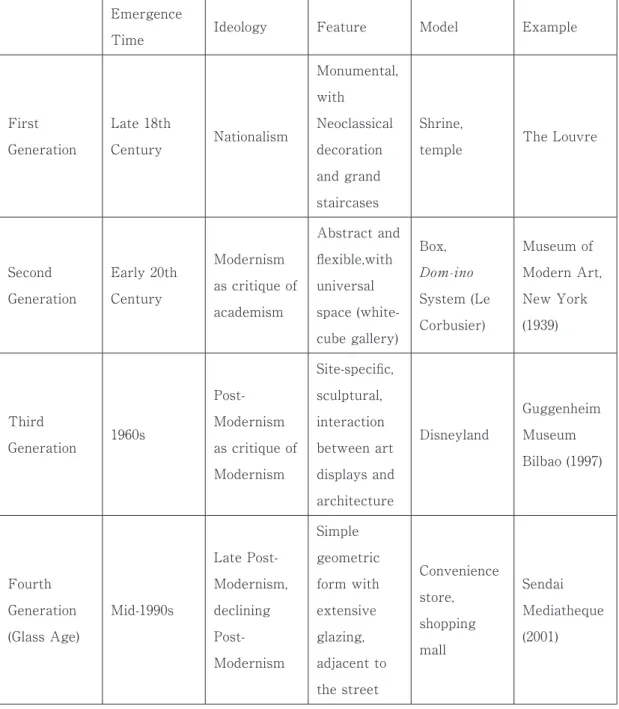
A final reason lies in the change of museum architecture. This paper regards the 1990s as the starting time of the new m u s e u m a r c h i t e c t u r e p a r a d i g m ( s e e Appendix). These museums with extensive glass exteriors and simplistic forms, such as Kirchner Museum in Davos, Switzerland
( 1 9 9 2 ) a n d K u m a n o k o d o N a k a h e c h i Museum (1998), mark a paradigm shift of museum architecture. They deviate from the three generations of museums articulated by Isozaki Arata: the First Generation as power institution embodying nationalist ideology, the Second Generation as universal space f l e x i b l e a n d a b s t r a c t , a n d t h e T h i r d Generation as site specific with unique characteristics (1996, 39-43). Arguably, a Fourth Generation started to appear from the 1990s with extensive glazing and simplistic form, which will be elaborated later. It falls on the extension line of the S e c o n d a n d T h i r d G e n e r a t i o n s b u t distinguishes itself in its visual humbleness and resemblance to everyday facilities
(Fig. 1).
Figure 1. Four Generations of Museum Architecture (Developed based on Arata Isozaki, 「美術館」, 『造物主義論―デミウルゴ モルフィスム』, 東京:鹿島出版会, 1996, 39-59;a+u, 『チャールズ・ジェンクス:象徴的建築をめざして』, Jan. 1986, 212-13.)
Emergence
Time Ideology Feature Model Example
First Generation
Late 18th
Century Nationalism
Monumental, with Neoclassical decoration and grand staircases
Shrine,
temple The Louvre
Second Generation
Early 20th Century
Modernism as critique of academism
Abstract and flexible,with universal space (white- cube gallery)
Box, Dom-ino System (Le Corbusier)
Museum of Modern Art, New York (1939)
Third
Generation 1960s
Post- Modernism as critique of Modernism
Site-specific, sculptural, interaction between art displays and architecture
Disneyland
Guggenheim Museum Bilbao (1997)
Fourth Generation (Glass Age)
Mid-1990s
Late Post- Modernism, declining Post- Modernism
Simple geometric form with extensive glazing, adjacent to the street
Convenience store, shopping mall
Sendai Mediatheque (2001)
3.HISTORY AND MEANING OF ARCHITECTURAL GLASS
The historical development of architectural glass in the world can be roughly divided into five periods: the Gothic Age (twentieth- sixteenth century), the Industrial Age
( m i d - n i n e t e e n t h c e n t u r y - W W I ) , t h e M o d e r n A g e ( 1 9 2 0 s - 1 9 6 0 s ) , t h e Postmodern Age (1960s-1980s), and the Late Postmodern Age (1990s-present). The r e s p e c t i v e p a r a d i g m s a r e t h e G o t h i c churches; shop windows and ferrovitreous
buildings such as palm houses, arcades and railway stations; curtain wall (non-load- bearing outer membrane made of glass)
office buildings; iconic landmarks of major cities; and serene glass buildings. In each age, glass takes on different meanings and serves the ethos of the respective times. The focus of this paper, the Fourth Generation museum, falls into the category of the serene glass buildings of the Late Postmodern Age.
Architectural glass shares a similar trajectory of development with the local museums in Japan: they both began with importation and later interacted with the indigenous context. The earliest glazing for houses in Japan is perhaps for the residence of Date Tsunamune (1640-1711), the third feudal lord of Sendai clan, in Shinagawa, Tokyo. It is said that more than 400 pieces of flat glass were imported as windowpanes for this Japanese timber structure (Aqura 2015). The Meiji Era (1868-1912) unveiled the age of bulk imports of glass to fulfill the government’s ambition to build Western-
style architecture at home. Also possibly because of the large openings of Japanese traditional houses, engawa veranda places, the glass industry soon found a large market in Japan. Today the prevalence of curtain wall structures, best represented by the arrays of official buildings in Marunouchi and boutique stores in Ginza and Omotesando, Tokyo, reveals the contemporary popularity of glass architecture in Japan (Kido and Cywinski 2013, 229-37). Two Japanese companies, Asahi Glass and Nippon Sheet Glass, are among the largest glass companies in the world.
1) Brief history of architectural glass in the world
2) Brief history of architectural glass in Japan
Glass buildings have diverse social roots and implications, among which strong
connections with technology development and commercial experience are noteworthy.
3) Meanings of architectural glass
I n f l u e n c e f r o m m a t e r i a l a n d b u i l d i n g technology has been persistent in the development of glass architecture. Gothic churches were sustained by a newly matured structure composed of stone frames, flying buttresses and vaults that made possible large openings for stained glass and sacred light (Wigginton 1996, 14-15). Epitomizing the Industrial Glass Building, the Crystal Palace designed by Joseph Paxton at the first Great Exhibition in London in 1851, was not just for the industrial machines and art displays contained inside; it was also an excellent demonstration of the most updated materials, the possibility of artificial rendering of daylight, and more importantly, as the earliest prefabricated construction, the rationality underpinning the making process
( I b i d . , 3 - 3 5 ; H i x 1 9 7 4 , 1 0 5 - 0 9 ) . Technological development also prepared the way for the prevalence of curtain wall glass architecture. Since the 1950s, with the wide availability of steel-and-concrete structures that free the walls and mass productivity of flat and transparent glass, curtain wall architecture and skyscrapers sprung up around the world. As Yamamoto Gakuji argues, the presence of architectural glass along with concrete and steel witnessed to the great potential of artificial rendering of natural materials and continuous scientific pursuit for modern life and space (1966, 162-3).
Glass architecture has also been strongly associated with creation of commercial life.
Contextualizing the industrial glass buildings in nineteenth-century European society, Walter Benjamin and Wolfgang Schivelbusch provide illuminating interpretations of glass architecture. By examining the Parisian arcades in Paris, Benjamin’s Passagen Werk found the city-like arcades incubating consumer culture and modern metropolitan life that embody both errors and utopian dreams of the bourgeoisie (Benjamin 1999;
Buck-Morss 1990, 39). Echoing Benjamin’s finding and investigating the Crystal Palace and glass architecture of all types in the nineteenth century, Schivelbusch stresses t h a t t h e i n t r o d u c t i o n o f g l a s s i n t o architecture and invention of artificial light led to a re-organized sensibility of space
(Schivelbusch 1986, 45-51; 1988, 138-54).
The new sensibility dissolved the customary contrasts between the inside and the outside, light and shadow, and reality and fantasy. In particular, shop windows with overflowing light during night create spatial ambiguity and illusionary affordability, instigate desire i n t h e s p e c t a t o r s , a n d s y m b o l i z e t h e beginning of consumer culture. The two features, connections with technological development and commercial experience, will remain as the focus in the discussions about glass employment in museum architecture.
4.ARCHITECTUAL GLASS IN MUSEUMS
Foregrounding the previous discussions on development of architectural glass, glass in museum architecture takes on particular meanings in the museum context. Since the early nineteenth century, introducing skylight from glazed ceilings has been established as an integral part of art galleries
(Suzuki 2001, 83). Two early museums, Kröller Müller Museum, Otterlo (1954)
and Louisiana Museum of Modern Art, Copenhagen (1958) show more extensive use of glass to incorporate picture windows a n d h a r m o n i z e w i t h t h e i r n a t u r a l environment (Persner 1974=2014, 252-3).
More radical employment of glass however can be seen in the Museum of Modern Art in New York (MoMA) (1939) and Center Pompidou in Paris (1977) that depict the institutions’ visions to use architecture and glass elements to build up distinguishing visual identities. The original MoMA building designed by Edward Stone and Philip Goodwin in 1939 adopted a curtain wall structure, which was not yet prevalent at the
time, and translucent glass for its façade.
The glass surface lent the building a modern a p p e a r a n c e i n s t a r k c o n t r a s t t o t h e b r o w n s t o n e t o w n h o u s e s i n t h e neighbourhood. This visual appearance manifests the concept of “modernity” that underpins the institution (Murray 2013, 40- 49). When built, Center Pompidou designed by Renzo Piano and Richard Rogers, with its superstructure composed of steel lattice, exterior escalators, and glassy walls, looked totally alien in its stony environment. The large area of glass overspreading the building not only serves as a blank canvas to set off the steel skeleton and colored parts, such as blue for circulating air, yellow for circulating electricity and red for circulating people, but also completes the institution’s machine-like look and expresses its futuristic vision. Glass assists with the two museums’ visual statements, one upholding modernity and one looking towards the future to set themselves apart with the conventional images of museums when they were built.
1) Before the 1990s
A parade of museum architecture, arguably the Fourth Generation, adopting extensive glazing and simplistic forms, started to surface in the 1990s and became fully fledged
after 2000. These buildings tend to restrain from making strong statements and show less visual distinction from commercial building types. This long list includes 2) Emergence of the Fourth Generation Museum after the 1990s
Kirchner Museum in Davos, Switzerland designed by Annette Gigon and Mike Guyer in 1992, Kunsthaus Bregenz, Austria by Peter Zumthor in 1997, Sendai Mediatheque by Ito Toyo in 2001, and the art museum oeuvre of SANAA.
In the global museum scene, rather than replacing the former three generations, the Fourth Generation is produced along with the other three that have not yet lost their validity and appeal. The museums of the Glass Age deviate from the tradition in their distinguishing agenda, to be closer to daily life by incorporating commercially well- adopted language. At first glance, their appearance seems to bear resemblance with the Second Generation modernist box-like museums. It is however apparent that the Second and the Fourth were born in entirely different contexts. The Second Generation museums, e.g. the 1939 MoMA and Center Pompidou, echoing the anti-institutional art movements instigated by Dadaism emerging in the mid-1910s, decries the monumental and palace-like First Generation museums.
Their functionalist spatial design and white-
cube galleries provide neutral backgrounds for the displays, aim to create the best s p e c t a t o r e x p e r i e n c e w i t h m i n i m a l distraction, and advocate rationality and order. The Fourth Generation, receiving inspiration from the spectacular Third Generation epitomized by The Guggenheim Museum Bilbao designed by Frank Gehry and opened in 1997, seems to return to Modernism in its form but with attempts to reappraise and formalize the commercial elements. To put it in other words, the S e c o n d G e n e r a t i o n w a s b o r n a s a denunciation of the exalted palace-like First Generation Museum while the Fourth inherits the capitalism-oriented Third G e n e r a t i o n b u t w i t h l e s s i n t e r e s t i n interrogation of Modernism and visual spectacularity. If the Third Generation looks u p t o D i s n e y l a n d a n d P o s t m o d e r n playfulness, the Fourth, or declining Post- modernism, seeks references from both Modernist simplicity and everyday facilities such as convenience stores and shopping malls.
A closer inspection at glass leads to a clearer understanding of how the Fourth Generation museum shares the features of glass architecture in terms of its close relation with technological development and
creation of commercial life. As previously discussed, museums occupy an important position in the architectural world. An ambition to use or stimulate the invention of new technology and materials has often 3) Relation between the Fourth Generation Museum and glass architecture
accompanied the design process of museums.
Sharing the architectural manifestation of the Crystal Palace, MoMA, and Center Pompidou to exploit the most updated building and material technology at the time, recent museum projects also show their vibrancy to s t i m u l a t e i n d u s t r i e s t o d e v e l o p n e w materials and building methodology.
The most prominent example is Sendai Mediatheque designed by Ito Toyo and opened in 2001. This shelf-like building, composed of slabs (floors), vertical steel lattice columns, and glass façades, takes one more step forward than Le Corbusier’s Dom- ino House System. By utilizing ship building technology, the design not only frees the walls of buildings and turns them into a
“skin” but also replaces the structural columns with seaweed-like tubes that accommodate staircases, elevators, and light shafts (Ito 1997, 9). The double-glazed façade allowing visual penetration from the outside completes an aquarium-like cube that showcases the activities and physical structure inside and blurs the boundary between the outside and the inside. The building becomes an embodiment of the i n s t i t u t i o n ’ s b a r r i e r - f r e e i m a g e , I t o ’ s
“blurring architecture” concept, and possibility of technology to achieve the two.
In addition to the continuous exploitation of technology similar to glass architecture in history, the Glass Age museum architecture
also ties closely with commercial space. If the nineteenth-century shop windows and arcades created a new space and sensation of consumption, the Fourth Generation museum architecture consciously incorporates the language of commercial space. While the Second Generation museums correspond with Modernist buildings in which architectural glass often stresses order and creates cage- like space and the Third celebrates early Postmodern lightheartedness with glass mainly playing a subsidiary role in shaping the exterior, the Glass Age museums return t o v i s u a l s e r e n i t y a n d f o r m a l i z e t h e commercial space as an integral part of museum experience.
The glass space, often not for display of art but accommodating amenities such as atriums, shops, cafes, and restaurants, quotes the language of shop windows and arcades.
Evidence can be first seen in the recent projects at two prominent museums, the Louvre and The British Museum. With its famous skylight, Carrousel du Louvre, a shopping mall opened in the Richelieu Wing of the Louvre in 1993, shows remarkable reminiscence of arcades. It provides one of the entrances to the Louvre and echoes architect I. M. Pei’s positive attitude towards t h e m i x t u r e o f “ a r t , c u l t u r e a n d commerce” (Sancton 1993, 59; cited by McTavis 1998, 175). The Great Court of The British Museum designed by Foster and
Partners and opened in 2000 is another strong example. This extended space offers a glazed canopy for the entrance hall and shops. It resembles a railway terminal where visitors separate and embark on their own journeys to different galleries. The naturally lit-up and glassy space, conforming to the tradition of mass culture consumption space, expresses the two museums’ vision to enhance their accessibility and promote a less elitist profile by embracing low or non- art.
Examples can be further found in Japan with both coherences with the two fore- m e n t i o n e d r e n o v a t i o n p r o j e c t s a n d distinguishing features. In the case of the National Art Center, Tokyo, designed by Kurokawa Kisho and opened in 2007, there is similarity in its spatial design with the former two examples. The gallery space is set back from the undulating glass façade and retains a character of universality of w h i t e - c u b e g a l l e r i e s . T h e a t r i u m accommodates shops, cafes and restaurants on each floor. During the day, the natural light coming in from the glass façade lends a sense of temporariness to the commercial space. During night, the building glows and becomes a lantern. One of its restaurants, Paulbocuse, on the third floor, stays open
after the Museum closes. The glass space offers a choice of consumption in addition to a r t a p p r e c i a t i o n a s t h e c o n v e n t i o n a l experience of a museum.
T h e 2 1 s t C e n t u r y M u s e u m o f Contemporary Art, Kanazawa (abbreviated as Kanazawa 21) designed by SANAA and opened in 2004 is the epitome of the Glass Age museum architecture. It is different f r o m t h e f o r m e r e x a m p l e s w i t h i t s democratic and empowering inner spatial design. Inside its extensive and clean glazing, discrete exhibition halls and un-ticketed areas are allocated. Along with multiple entrances connecting with the main streets and the park, Kanazawa 21 allows choices and encourages visits. It looks both like a spaceship floating in the old townscape of Kanazawa and a convenience store with immediate physical and visual accessibility.
While the National Art Center, Tokyo separates the consumer space and gallery for art appreciation, with the former allocated to a glassy area and the latter to more artificially controlled boxes, Kanazawa 21 intermingles the two. It proposes a new kind of museum experience with intermittent encountering of glass areas, non-art-display space, surrounding of the building, and closer to everyday life.
5. AESTHETICS AND DESIGN CONCEPTS OF ARCHITECTS AS THE MAIN REASON FOR THE EMERGENCE OF THE GLASS AGE OF MUSEUM ARCHITECTURE
Architects, especially those heavily exposed to media and award-winning star- c h i t e c t s , a r e o f t e n c o m m i s s i o n e d b y governmental officials or private foundations to build museums. The aesthetics and concepts of architects play a strong role in promoting the Glass Age museums, which is o f t e n n e g l e c t e d i n t h e d i s c o u r s e o f Neoliberalism.
The discussion among architects about the employment of glass can be traced back to the Modern Age when glass had been mainly a s s o c i a t e d w i t h “ t r a n s p a r e n c y ” - simultaneous perception of different spaces.
I n C o l i n R o w e a n d R o b e r t S l u t z k y ’ s celebrated theory, glass embodies two kinds o f t r a n s p a r e n c y , t h e l i t e r a l a n d t h e phenomenal, with the former existential and the latter involving imagination (1963).
Based on Rowe and Slutzky’s argument, Cesar Pelli puts forward a more complicated reading requiring both the eye and the mind to understand both space and time, the co- presence of reflections, the glass itself, the inside, and things further behind the building
(1976). Many museums of the Second Generation are endowed with the concept of
“transparency” and incorporate glass to create diverse optical effects and spatial orders.
More recently, especially in the case of the Fourth Generation museums, the fervent passion for transparency seems to be replaced by an emphasis on nature and temporality. Contemporary architects have rediscovered the ambiguity and plurality of t h e m e a n i n g o f a r c h i t e c t u r a l g l a s s
(Hasegawa and Kurokawa 1977; Yagi 2001, 42-106). The concept of “architectural phenomenology” demonstrates a new kind of utilization of glass to interact with natural light and create a sense of passing of time.
One of the best examples is the translucent glass façade of Kunsthaus Bregenz, Austria designed by Peter Zumthor. Along with the building’s simplistic form, it coheres with Zumthor’s concept of phenomenology and the m a t e r i a l g l a s s l e n d s a t m o s p h e r e a n d ephemerality to the building (Zumthor 2006).
Japanese architects with their popularity at home and abroad are also important designers of the Fourth Generation museums.
A glance at their discourse leads to an understanding of their ideal image towards architecture, humble and submissive, e.g.
“blurring” and “permeable” by Ito,
“weak” by Fujimoto So, and “erasing”
and “defeated” by Kuma Kengo in the early 2000s. In the case of the Glass Pavilion
of Toledo Museum of Art designed by SANAA and opened in 2006, the low and flat building almost entirely covered by clear class is a solution not only paying tribute to the glass making history of Toledo but also addressing the neo-classical 1912 main building of the Museum and Gehry’s 1992 Center for the Visual Arts. A similar a p p r o a c h c a n b e s e e n i n S A N A A ’ s Kumanokodo Nakahechi Museum (1998), Kanazawa 21, and the winning proposal for the New South Wales Art Gallery expansion, Sydney (2015). Their signature, extensive glazing, blurs the boundary between the inside and the outside; low, flat and simple shape minimalizes the buildings’ presence, creating gradational space and respect to the genius loci rather than sheer intrusions
(Editorial Department of SD 1999, 102-07;
GA JAPAN 2015, 168).
However, the preference of the architects is not always economical. After the Great East Japan Earthquake on March 11 2011, energy and architectural sustainability has become an increasingly pressing issue within Japan and has gained attention. Towada Art Center designed by Nishizawa Ryue, is criticized by Mae Masayuki and Dana Buntrock (2015). It courts controversies for the building’s high maintenance cost partly due to the low insulation and energy performance of the extensive glazing and the institution’s heavy budgetary reliance on
“Power Generation Regional Plan Subsidy- related Grants”, money collected from nuclear waste recycling and treatment in Aomori Prefecture. The sustainability issue and suitability of all-glass spaces for art display continues to be a heated topic of debate in both the architecture and museum worlds. Pressured to shrink their budgets, museums are expected to balance aesthetic consideration and maintenance cost and assume social responsibility.
Some architects are well literate about the situation of museums (Ito et al. 2013).
Rather than blindly pursuing their passion for glass, workshops with the commissioners and museum curators lead to consensus on design details and employment of glass.
Yamamoto Riken, designer of Yokosuka Museum of Art (2007), is one of the prominent figures that invest time in collecting voices from the curators (2003).
When talking about his Oita Prefectural Art Museum design (2015), Ban Shigeru also expresses his concern over museums’ elitist image and concomitant inaccessibility for ordinary people, and financial straits especially for provincial museums outside Tokyo (GA JAPAN 2015, 72-74). Ban mentioned his particular awareness of the openness of pharmacy shops and electronics retail stores (Ibid., 72). His proposal included foldable glass doors that can turn the Museum’s entrance hall into a semi-
exterior plaza, and flexible spatial design that accommodates adjustable gallery spaces and income-generating amenities. The design expresses his vision towards museums as a part of the street, the city, and everyday life.
By blurring the physical boundary between the inside and the outside, the architects of the Fourth Generation museums aim to establish a less intimidating and elitist image of museums.
To sum up, this paper investigates the phenomenon of increasing exploitation of glass in museum buildings. It challenges the predominant association of glass with transparency and modernity and argues for a contextualized reading of glass. It establishes that the increasing employment of glass in museum buildings from the 1990s witnesses to a paradigm shift in museum architecture.
This is mainly a result of architects’ design preference, which is made possible by technological development and reflects the
social climate celebrating Neoliberalism. The extensive glazing of the buildings reveals the architects’ ideal of museums, as open and accessible. By redesigning the physical b o u n d a r i e s , t h e a r c h i t e c t s a n d t h e i r commissioners aim to establish a less elitist profile for the museum. A few questions remain for future research regarding how effective glass is at boosting attendance and generating actual revenue and the response from the users including museum staff and visitors.
6.CONCLUSIONS
1 Notes: Japanese names in this paper follow the natural Japanese language with family names before the given names.
BIBLIOGRAPHY
a+u, 1986.『チャールズ・ジェンクス:象徴的建築をめざして』, Jan., 212-13.
Acuraアキュラホーム. 2015. 「Vol.20 ガラスの歴史」. Accessed May 15 2015. http://www.aqura.co.jp/about/knowledge/
aquranews/20.html.
Architectural Thought Research Institute 建築思潮研究所, ed. 1995. 『13 美術館』, 東京:株式会社建築資料研究社.
Benjamin, Walter. 1999. The Arcades Project. Howard Eiland and Kevin McLaughlin, trans. Cambridge, Mass.: Belknap Press of Harvard University Press.
Bennett, Tony. 1995. The Birth of the Museum: History, Theory, Politics. London and New York: Routledge.
Buck-Morss, Susan. 1990. The Dialectics of Seeing: Walter Benjamin and the Arcades Project. Cambridge, Mass.: MIT Press.
Buntrock, Dana. 2015. “Japanese Architecture: What it is; What it ain’t.” Speech at Department of Architecture, The University of Tokyo, May 8.
Crimp, Douglas. 1993. On the Museum’s Ruins. Cambridge, Mass.: MIT Press.
E-government, Japan. 2011. “The General Incorporated Associations and General Incorporated Foundations Law.” Updated May 25.
Accessed August 1 2015. http://law.e-gov.go.jp/htmldata/H18/H18HO048.html.
Editorial Department of SD SD編集部. 1999. 「熊野古道なかへち美術館」, 『ガラス建築』, 東京: 鹿島出版会, 102-07.
Foucault, Michel. 1977. Discipline and Punish: The Birth of the Prison. London: Allen Lane.
GA JAPAN. 2015.「開放性、可変性、先端性:大分県立美術館(OPAM)」, No. 135, July-August, 72-75.
____.「その場所ならではのアートギャラリーの展開:シドニー・モダン・プロジェクト SANAA」, No. 135, July-August, 168.
Hasegawa, Gyo and Tetsuro Kurokawa 長谷川尭, 黒川哲郎. 1977. 『建築光幻学: 透光不透視の世界』. 東京: 鹿島出版会.
Hillier, Bill and Kali Tzortzi. 2006. “Space Syntax: The Language of Museum Space.” In A Companion to Museum Studies, edited by Sharon Macdonald. Oxford: Blackwell, 282-301.
Hix, John. 1974. The Glass House. London: Phaidon.
Hooper-Greenhill, Eilean. 1992. Museums and the Shaping of Knowledge. London and New York: Routledge.
Igarashi, Taro and Nobuyuki Okawa五十嵐太郎, 大川信行. 2002. 『ビルディングタイプの解剖学』. 東京:王国社.
ICOM (International Council of Museums). 2015. “Museum Definition”. Accessed May 13 2015. http://icom.museum/the-vision/
museum-definition/.
Isozaki, Arata 磯崎新. 1996. 「美術館」, 『造物主義論:デミウルゴモルフィスム』, 東京: 鹿島出版会, 39-59.
Ito, Toyo, Kazuhiko Namba, and Norihide Imagawa 伊東豊雄, 難波和彦, 今川憲英. 1997. 「座談会: 時代は透明性へ向かうか」, SD「特 集 ガラス建築」, Oct., 6-12.
Ito, Toyo, et al. 伊東豊雄等. 2013. 「第II章 寄稿:建築家の視点」, 『美術館と建築』, 京都: 青幻舎, 39-77.
Katayama, Taisuke 片山泰輔. 2007. 「指定管理者制度の今—制度の概要と論点」, 『指定管理者は今どうなっているのか』, 東京: 水曜 社, 10-29.
Kato, Tetsuhiro, et al. 加藤哲弘等. 2001. 『変貌する美術館—現代美術館学<2>』, 京都:昭和堂.
Kido, Ewa Maria and Zbigniew Cywinski, 2013. “The new steel-glass architecture of buildings in Japan.” Steel Construction , Vol. 6, No. 3, 229-37.
Koike Shihoko, and Osamu Nakagawa 小池志保子, 中川理. 2011a. 「空間構成からみた日本の公設美術館の変化に関する考察」, 日本 建築学会計画系論文集, no. 549, vol. 76, Jan., 221-27.
____. 2011b. 「スペース・シンタクッス理論を用いた日本の公設美術館の空間構成に関する考察」, 日本建築学会計画系論文集, no.
662, vol. 76, Apr., 851-57.
Lindauer, Margaret. 2006. “The Critical Museum Visitor.” In New Museum Theory and Practice: An Introduction, edited by Janet Marstine, 203-25. MA., U.S.; Oxford, the U.K.; Victoria, Australia: Wiley-Blackwell.
Mae, Masayuki. 2015. “Actual energy consumption in Japanese house and method for its reduction” class at Department of Architecture, The University of Tokyo, April 13.
McTavish, Lianne. 1998. “Shopping in the Museum? Consumer Spaces and the Redefinition of The Louvre.” Cultural Studies, Vol.
12, Iss. 2, 168-192.
MIC (The Ministry of Internal Affairs and Communication, Japan). 2007. “Evaluation of Incorporated Administrative Agencies.”
Accessed August 25 2014. http://www.soumu.go.jp/main_sosiki/hyouka/dokuritu_n/english.pdf.
Murata, Mariko 村田麻里子. 2014. 『思想としてのミュージアム』, 京都:人文書院.
Murray, Scott. 2013. Translucent Building Skins: Material Innovations in Modern and Contemporary Architecture. New York:
Routledge.
Pelli, Cesar. 1976. “Transparency- Physical and Perceptual.” A+U, 76:11, No. 71, 75-86.
Persner, Nikolaus, 1974=2014. 「第8章 博物館」, 『建築タイプの歴史I: 国家と偉人の記念碑から』, trans. 越野 武, 東京: 中央公論 , 205-266.
RosenBlatt, Arthur. 2001. Building Type Basics for Museums. New York: John Wiley & Sons.
Rowe, Colin, and Robert Slutzky. 1963. “Transparency: Literal and Phenomenal.” Perspecta, Vol. 8, 45-54.
Schivelbusch, Wolfgang. 1986. “Excursus: The Space of Glass Architecture.” In The Railway Journey: the Industrialization of Time and Space in the 19th Century. Berkeley and Los Angels, California: University of California Press, 45-51.
____. 1988. Disenchanted night: the industrialization of light in the nineteenth century. Angela Davies, trans. Berkeley: University of California Press.
Sancton, Thomas. 1993. “Pei’s Palace of Art.” Time, 29 Nov., 59–60.
Sendai Media Project Team せんだいメディアテークプロジェクトチーム. 2003. 『せんだいメディアテーク・コンセプトブック』, 東 京: NTT出版.
Space Design Series Editors S. D. S. 編集委員会. 1995. 『美術館・博物館』. 名古屋:新日本法規出版.
Suzuki, Hiroyuki 鈴木博之. 2001. 「ガラスと近代建築の神話的関係」, 『GA 素材空間02: ガラスの可能性』, GA, 80-91.
Wigginton, Michael. 1996. Glass in Architecture. London: Phaidon.
Yagi, Koji 八木幸二, et al. 2001. 「座談会 ガラスの魅力」, 『ディテール』, no. 150, Oct., 42-106.
Yamamoto, Gakuji 山本学治. 1966. 『素材と造形の歴史』. 東京: 鹿島出版会.
Yamamoto, Riken 山本理顕. 2003. 『つくりながら考える/使いながらつくる』. 東京: TOTO出版.
Zumthor, Peter. 2006. Atmosphere: Architectural Environments – Surrounding Objects. Basel: Birkhäuser GmbH.
APPENDIX Time line of major museum architecture projects exploiting glass 1989 Pyramids at the Louvre, Paris (I.M. Pei & Partners);
Tokyo Sea Life Park and Crystal View, Observation House (Taniguchi Yoshio) 1992 Kirchner Museum, Davos, Switzerland (Annette Gigon and Mike Guyer) 1996 Anpanman Museum (Furuya Nobuaki)
1997
Kunsthaus Bregenz, Austria (Peter Zumthor);
Auguste Rodin Museum, Seoul (KPF Associates);
Hiroki Oda Museum, Shiga (Ando Tadao)
1998 Kiasma - Museum of Contemporary Art in Helsinki (Steven Holl);
Kumanokodo Nakahechi Museum (SANAA)
1999
Gallery of Horyuji Treasures, Tokyo National Museum (Taniguchi Yoshio);
Midori no naka, Nemunoki Art Museum, Shizuoka (Ban Shigeru);
Ogasawara Museum (SANAA)
2000 Great Court of British Museum (Foster and Partners) 2001 Sendai Mediatheque (Ito Toyo)
2002 Modern Art Museum of Fort Worth, Texas (Ando Tadao);
Pola Museum of Art (Nikken Sekkei)
2004 Expansion of Museum of Modern Art, New York (Taniguchi Yoshio and KPF);
21st Century Museum of Contemporary Art, Kanazawa (SANAA) 2005 Nagasaki Prefectural Art Museum (kengo kuma and associates) 2006 Glass Pavilion, Toledo Museum of Art, Ohio (SANAA);
Musée du quai Branly, Paris (Jean Nouvel)
2007
New Museum, New York (SANAA);
Bloch Building Addition, Nelson-Atkins Museum of Art, Kansas City (Holl);
National Art Center, Tokyo (Kurokawa Kisho);
Yokosuka Museum of Art (Yamamoto Riken) 2008 Towada Art Center (Nishizawa Ryue)
2009 New building of Nezu Museum (kengo kuma and associates) 2011 Hiroshi Senju Museum, Karuizawa (Nishizawa)
2012 Louvre-Lens, France (SANAA);
Paper and Material Institute (PAM) in Shizuoka Prefecture (Ban Shigeru)
2014
Annex of Tokyo Metropolitan Teien Art Museum (Tokyo Metropolitan Government and Kume Sekkei Co., Ltd.);
Heisei Chishinkan Wing, Kyoto National Museum (Taniguchi Yoshio)
2015
Mudec Museum of Cultures, Milano;
Oita Prefectural Art Museum (Ban Shigeru);
SANAA chosen to design New South Wales Art Gallery expansion, Sydney
潘 夢斐(ぱん・めんふぇい)
[生年月] 1988 年 1 月
[出身大学または最終学歴] シドニー大学 Master of Museum Studies; 東京大学学際情報学府アジア情報社会修士
[専攻領域] ミュージアム・スタディーズ
[主たる著書・論文]
“East/West: Selfhood and Cultural Issues-The Paintings of Jiawei SHEN and Lindy LEE”, Allens Art Journal, No. 2, 2012, pp.7-14, http://www.allens.com.au/art/journal/issue2.htm.
“An Assessment of the State’s Role in Governing Culture and Arts in Japan”, IOS-IASA 4th Joint Workshop
& AsiaBarometer Workshop 2013-“Understanding Changing Faces of Asian Societies”, Mar. 1-2, 2013, The University of Tokyo. http://ricas.ioc.u-tokyo.ac.jp/aasplatform/achivements/pdf/2013_ab_14.pdf.
“Comic Pamphlets as Museum Marketing Strategy: A Case Study of Nya-eyes of The Tokyo Metropolitan Museum of Photography”, Episteme, 11-12, Center for Applied Cultural Sciences, Korea University, 2014, pp.
257-81, http://cacs.or.kr/bbs/board.php?bo_table=3_column&wr_id=140&page=2.
[所属] 東京大学大学院 学際情報学府 アジア情報社会博士課程
[所属学会] 全日本博物館学会
Contemporary museum architecture is seeing an age of glass. Both renovation projects and new constructions have been exploiting glass extensively, as if it is the best solution to serve the spatial functions, present the architects’ concepts, and address the institutions’ missions and social expectations. Prominent examples include the Louvre Pyramid by I. M. Pei (1989) and SANAA’s designs for The 21st Century Museum of Contemporary Art, Kanazawa (2004) and Louvre-Lens, France (2012). This trend of increasing use of glass by museum architecture deviates from the previous model of museums, temples and shrines with formidable look. A new physical boundary of museums, glass walls that interact with the surrounding and the spectators, is designed in contrast with the older type that stresses the buildings’ exalted status.
This kind of extensive glazing has become an almost indispensable part of the new generation of museum architecture.
By contextualizing the phenomenon of extensive glazing in museum architecture, this paper aims to discern its connections with the museum situation and the contemporaneity and locality of Japan. It argues that the increasing exploitation of glass in museum architecture demonstrates the influence of Neoliberalism on the public institutions and the architects to embrace visually appealing, technologically demanding, and commercial elements. It challenges the pre-dominant association of glass with transparency and modernity and argues for a contextualized reading of glass. This research adopts an inter-disciplinary methodology including visual analysis of museum buildings, literature review of policy papers, prior theories and architects’ discourse, and site observations. This paper contends that the increasing employment of glass in museum buildings in Japan is mainly a result of architects’ design preference, which is made possible by technological development and reflects the social climate celebrating Neoliberalism. By redesigning the physical boundaries, the architects and their commissioners aim to establish a less elitist profile for the museum.