Introduction
The first stratigraphic knowledge of the Hitoe- gane and Shinhirayuonsen area in Okuhidaonsen- gou, Takayama-shi, Gifu Prefecture, Central Japan was provided by Nakai (1984), who divided the Silurian sediments into the Hitoegane and Uwaji- gane Formations. In his definitions, the Hitoe- gane Formation considered a unit largely of
“andesitic pyroclastic rocks”, with minor in- terbedded fossiliferous limestone in its upper- most horizon, alternation of tuffaceous shale and sandstone, and conglomerate. The Uwajigane Formation consists mostly of alternating beds of tuffaceous shale and sandstone with frequent in- tercalations of felsic tuff. Subsequently, two dif- ferent interpretations were proposed for these formations. Igo (1990) stated that the Uwajigane Formation and the most part of the Hitoegane Formation are equivalent to the Yoshiki Forma- tion, defined by Igo et al., (1980) for the sand- stone to shale sequence in the adjoining Fukuji area, and the uppermost limestone represents the
upper division of the Yoshiki Formation as the Hitoegane Limestone Member. Harayama (1990) denied the Nakai’s (1984) subdivision, and united these strata into the Hitoegane Formation. In more recent mapping and stratigraphic work by Tsukada (1997), a rather broad diagnosis has given for the Hitoegane Formation, which he considered as a thick (more than 800 m) stratum ranging from the Middle or Late Ordovician to Late Silurian age. The designated type localities for the Hitoegane Formation (or the Hitoegane Limestone Member) in the preceding stratigraph- ic workers are as follows; a ridge sandwiched be- tween Takahara-gawa and Gamata-gawa Rivers (locality A; see fig. 1 in Niko, 2001) in Nakai (1984), locality A in Igo (1990), locality A and road cut on the Hitoegane Forest Road (locality B) in Harayama (1990), and locality B and road cut on a forest road along the lower reaches of the Iwatsubodani Valley (locality C) in Tsukada (1997).
The purposes of this paper are to document auloporid tabulate corals from the newly fund
Stratigraphy of the Upper Silurian Hitoegane Formation and Auloporid Tabulate Corals from a New Outcrop of the Formation in the
Shinhirayuonsen Area, Gifu Prefecture
Shuji Niko
Department of Environmental Studies, Faculty of Integrated Arts and Sciences, Hiroshima University, 1–7–1 Kagamiyama, Higashihiroshima, Hiroshima 739–8521, Japan
E-mail: [email protected]
Abstract A new outcrop of the Hitoegane Formation in the Shinhirayuonsen area, Takayama-shi, Gifu Prefecture is discovered, resulting in a stratigraphic redefinition of the formation as the Late Silurian (mainly Ludlow) shallow marine succession. Fossiliferous limestone (biolithite and bio- clastic wackestone), tuffaceous sandstone and shale are principal constituents of the formation, whose thickness ranges 40–50 m, but its original thickness was in excess of those amounts. The auloporid tabulate corals in the present new locality are described. They are Aulopora? sp. indet., Syringoporella yamakoshiiNiko, 2001 and Aulostegites? sp. indet. Among them, S. yamakoshiiis a common species with the type locality of the formation.
Key words : Late Silurian, tabulate corals, Auloporida, stratigraphic redefinition, Hitoegane For- mation, Gifu.
outcrop, and to redefine the Hitoegane Formation on the basis of information from the locality. All specimens dealt with this study are deposited in the National Science Museum (abbreviation NSM).
Stratigraphy
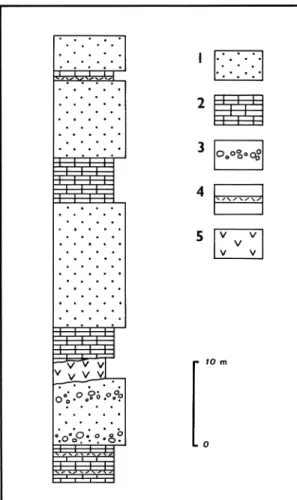
The new locality studied here is situated at the western bank of the Takahara-gawa River in the Shinhirayuonsen area (locality D; Fig. 1), where steeply (70°) north-dipping beds with general strikes of N 50°W are exposed. Its typical rock types and lithostratigraphic section are given in Figs. 2, 3. The lower and upper limits in this lo- cality are in fault contact with basaltic to an- desitic volcanic rocks of the Sorayama Forma- tion. Although this stratum has been identified as a part of the Devonian Fukuji Formation by Nii- kawa (1980), its lithology and auloporid tabulate
corals apparently indicate affinities to those of the Hitoegane Formation at the type locality (see below). On the basis of the present knowledge, the concept of the formation is restricted to the shallow marine sedimentary succession of Late Silurian age in the Hitoegane and Shinhirayuon- sen area.
Type locality and geographic distribution: The distribution of the Hitoegane Formation is con- fined to NE-SW trending narrow zone having up to 50 m in width and approximately 1500 m in length. The main outcrops are observable on an unnamed ridge (above mentioned locality A) and the present new outcrop. Among them, outcrop at locality A serves as the type locality. Tazawa and Kaneko (1991) documented the occurrence of a Silurian trilobite, Encrinurus cf. fimbriatus Kobayashi and Hamada, 1974, from the tuff bed, that is in roughly midway of these main outcrops and probably assignable to the formation. There
44 Shuji Niko
Fig. 1. Index map of the Shinhirayuonsen, Hitoegane and Fukuji area in Okuhidaonsen-gou, Takayama-shi, Gifu Prefecture. Arrow indicates position of the present new outcrop (locality D). Base map is “Yakedake”
(1 : 25,000 quadrangle) published by Geological Survey Institution.
Fig. 2. Lithology of the Hitoegane Formation in a new outcrop. All figures are photomicrographs of thin sec- tions. 1, 2, tuffaceous sandstones including gravels of basaltic lava (Fig. 2-1) and crinoid ossicle (Fig. 2-2). 3, 4, calcareous shales including favositid tabulate coral (Fig. 2-3) and ostracode (Fig. 2-4). 5, 6, impure lime- stones of bioclastic wackestones including brachiopod and bluegreen algae, Girvanella(Fig. 2-5) and bio- clasts of unknown origin (Fig. 2-6). Scale bar equals 1.0 mm for Figs. 2-1–4, 6, and 0.4 mm for Fig. 2-5.
is a possibility that the sequences at localities B and C belong to the Yoshiki Formation. Thus, the subsequently designated two stratigraphic types in Harayama (1990) and Tsukada (1997) are now proposed to discard.
Lithology: In the type locality, the formation is composed of dark gray limestone intercalated with shale films and greenish gray calcareous shale. Biolithite consisting mainly of tabulate corals is recognized as a main sedimentary facies of the limestone. On the other hand, an alternat- ing series of tuffaceous sandstone and calcareous (or partly tuffaceous) shale to impure limestone
predominate in locality D. The sandstones are principal constituents, greenish gray color and laminated, interbedded with gravels of basaltic lava (Fig. 2-1) and limestone fragments. Isolated crinoid ossicles are rarely found in the sand- stones (Fig. 2-2). Numerous macro-fossils, such as echinoderms, corals, brachiopods, ostracodes and trilobites, are visible in the calcareous shales to impure limestones (Figs. 2-3–6). Lithology of the limestones is bioclastic wackestone (Figs. 2- 5, 6). The most noticeable feature linking these limestones in the both area is the presence of tuffaceous material. Based on microfacies of the limestones, the environment of deposition is in- terpreted as a shallow marine condition. As noted by Harayama (1990), “andesitic pyroclastic rocks”
in the original definition are apparently intrusive rocks and eliminated from the formation.
Thickness: The thickness is estimated to be about 40 m in the type locality (Igo, 1990) and exceeds 50 m in locality D. Judging from the measured strike and dip (N 50°W, 70°N), geo- graphic positions and disparity in altitudes of the localities, there is a possibility that the less cal- careous succession in locality D occupies the more lower part of the formation than that in the type locality. Thus, the original thickness was in excess of those amounts.
Age: On the basis of trilobites (Kobayashi and Hamada, 1974, 1987) the formation at locality A has been dated as the Late Silurian (middle to late Ludlow, and may be extending to Pridoli in part). Its tabulate coral fauna (Kamiya and Niko, 1998; Niko, 2001, 2004, 2007) also indicates a resemblance to those from the Late Silurian in Tarim, Siberia and the Southern Kitakami Moun- tains in northeast Japan. An auloporid, Syringo- porella yamakoshii Niko, 2001, is common to localities A and D.
Systematic Paleontology
Order Auloporida Sokolov, 1947 Superfamily Auloporoidea Mile-Edwards and
Haime, 1851
46 Shuji Niko
Fig. 3. Stratigraphic columnar section of the Hi- toegane Formation at a new outcrop. 1, tuffa- ceous sandstone. 2, calcareous shale – impure limestone. 3, gravels. 4, tuffaceous shale – mudstone. 5, dyke rock.
Fig. 4. 1–4, Aulopora? sp. indet., NSM PA16382, thin sections. 1, 2, 4, longitudinal to oblique sections of coral- lites, 10. 3, transverse to oblique sections of corallites, 10. 5, 6. Syringoporella yamakoshiiNiko, 2001, NSM PA16378, thin sections. 5, transverse sections of corallites, 10. 6, longitudinal to oblique sections of corallites, 10.
Family Auloporidae Milne-Edwards and Haime, 1851
Genus Aulopora Goldfuss, 1829
Type species: Aulopora serpens Goldfuss, 1829.
Aulopora? sp. indet.
(Figs. 4-1–4)
Material examined: Two coralla, NSM PA16382, 16385.
Description: Coralla encrusting, composed of proximal prostrate and distal free portions, the former of which may be anastomosed. Corallites cylindrical with weakly inflated calice, 0.5–0.9 mm in diameter; length of free portions is vari- able, ranging from 1.7 to 4.0 mm. Thickness of corallite walls is 0.09–0.13 mm in proximal por- tion, then thickened attaining 0.17 mm in distal one; high-conical septal spines, 0.16 mm in length, are rarely developed; apparent tabula not detected.
Occurrence: This species was collected from the float blocks of greenish gray tuffaceous shale (NSM PA16382) and dark gray impure limestone (NSM PA16385).
Discussion: No adequate material is available for the basis of the above description, this identi- fication is questionable because of the lack of at- tachment scar in the proximal portions.
Superfamily Syringoporoidea Fromentel, 1861 Family Multithecoporidae Sokolv, 1955
Genus Syringoporella Kettner, 1934 Type species: Syringopora moravica Roemer, 1883.
Syringoporella yamakoshii Niko, 2001
(Figs. 4-5, 6)
Syringoporella yamakoshiiNiko, 2001, p. 68, 70, figs. 4- 1–4; Hirata, 2006, p. 32, pl. 10, figs. 36-1, 2.
Material examined: Five coralla, NSM PA16377, 16378, 16381, 16383, 16384.
Occurrence: All examined coralla occur inside stromatoporoid colonies, that were collected from the float brocks of black calcareous shale (NSM PA16377, 16381), greenish gray tuffa- ceous sandstone (NSM PA16378), and dark gray impure limestone (NSM PA16383, 16384).
Discussion: Although the material from the new outcrop shows slightly larger corallite diam- eters than the type specimens of Syringoporella yamakoshii from the Hitoegane Formation in the stratigraphic type locality of the Hitoegane area, I can see no significant differences in other mor- phologic respects between the coralla from the two localities. Thus, it is not to need redescrip- tion.
Family Roemeriidae Poˇcta, 1904 Genus Aulostegites Lejeune and Pel, 1973 Type species: Aulostegites hillae Lejenue and Pel, 1973.
Aulostegites? sp. indet.
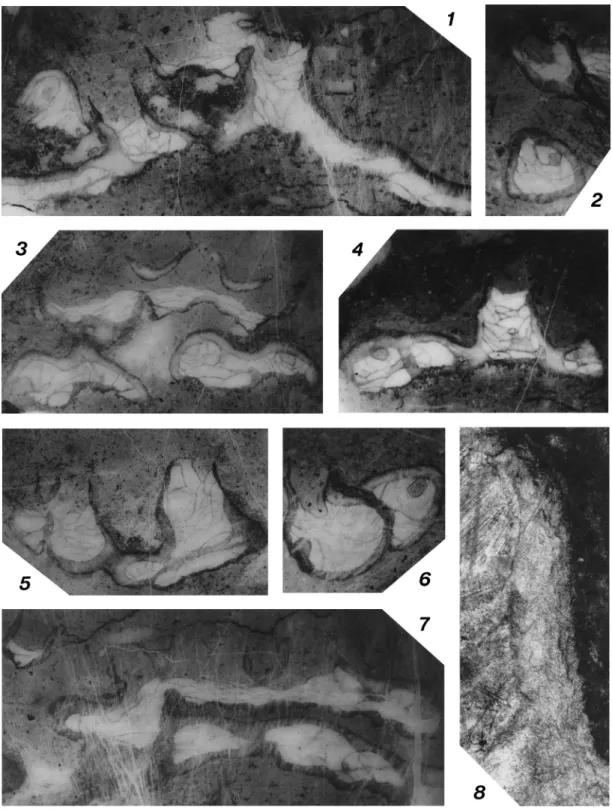
(Figs. 5-1–8)
Material examined: Two coralla, NSM PA16379, 16380.
Description: Coralla encrusting, thin tabular growth form. Each corallite consists of proximal prostrate portion indicating alveolitoid-like arrangement and distal upwardly directed por- tion; distal corallites are phaceloid in basic arrangement, but corallite adherence commonly developed; transverse sections of corallites are subcircular, subtriangular, or semicircular to crescentic in adhered portions; approximate corallite diameters range from 1.1 to 2.4 mm;
calices very shallow to relatively shallow. Coral- lite walls thick, 0.16–0.30 mm in usual thickness, and differentiated into epitheca and stereoplasm;
microstructure of stereoplasm is not preserved;
relatively large mural pores, with 0.18 mm in di- ameter, occur between adhered corallites; no sep- tal spine detected; tabulae well developed, in- complete with vesicular profiles, or complete in rare cases, and form discontinuous axial syrinxes
48 Shuji Niko
Fig. 5. Aulostegites? sp. indet., NSM PA16380, thin sections. 1, 3–7, transverse sections of corallum, 10. 2, transverse and oblique sections of corallites, 10. 6, transverse sections of adhered corallites, 10. 8, partial enlargement to show corallite wall structure, longitudinal section, 75.
with 0.25–0.47 mm in diameter; position of axial syrinxes is tabularium margin.
Occurrence: This species was collected from the float brocks of dark gray impure limestone (NSM PA16379) and brownish gray calcareous shale (NSM PA16380).
Discussion: These two coralla differ from typi- cal form of Aulostegites by having the axial sy- rinxes. There are also other possibilities that the specimens represent a new genus of the Aulo- porida or the immature growth stages of a genus Thecostegites Milne-Edwards and Haime, 1849.
Well-preserved material must be discovered be- fore this can be evaluated. The present assign- ment is, therefore, tentative.
Acknowledgements
The author thanks Messrs. Yoshihito Senzai and Teruo Ono for their help in the field. Dr.
Hisayoshi Igo is thanked for helpful suggestions to improve the manuscript.
References
Goldfuss, A., 1826. Petrefacta Germaniae, tam ea, quae in Museo Universitatis Regiae Borussicae Fridericiae Wil- helmiae Rhenanae servantur, quam alia quaetunque in Museis Hoeninghusiano, Muenstriano aliisque extant, iconibus et descriptionibús illustrata. Abbildungen und Beschreibungen der Petrefacten Deutschlands und der angranzenden Länder, unter Mitwirkung des Herm Grafen Georg zu Münster. pp. 77–164, pls. 26–50, Arnz & Co., Düsseldorf.
Harayama, S., 1990. Geology of the Kamiko¯chi District.
With Geological Sheet Map at 1 : 50,000. Geol. Surv.
Japan, 175 pp. (In Japanese with English abstract.) Hirata, Y., 2006. Tabulate corals from the Paleozoic strata
in the Fukuji · Hitoegane area. Kaseki no Tomo, (51):
11–33. (In Japanese.)
Igo, H., 1990. Paleozoic strata in the Hida “Gaien” Belt.
InK. Ichikawa et al.(eds.), Pre-Cretaceous Terranes of Japan, pp. 41–48. Pubulication of IGCP Project No.
224, Osaka.
Igo, H., S. Adachi, H. Furutani & H. Nishiyama, 1980.
Ordovician fossils first discovered in Japan. Proc.
Japan Acad., Ser. B, 56: 499–503.
Kamiya, T. & S. Niko, 1998. A Late Silurian tabulate
coral Planocoenites from the Hitoegane Formation, Gifu Prefecture, Central Japan. Chigakukenkyu, 47: 67–
70. (In Japanese with English abstract.)
Kettner, R., 1934. Paleontologické studie z ˇCelechovického Devonu. ˇCást 5) O nˇekter´ych Alcyonariich. Cˇas. Vlaste- neckého Muz. Spoloku Olomuckého, 47: 1–15
Kobayashi, T. & T. Hamada, 1974. Silurian trilobites of Japan. In comparison with Asian, Pacific and other fau- nas. Palaeont. Soc. Japan, Special Paper, (18): 1–155, pls. 1–12.
Kobayashi, T. & T. Hamada, 1987. On the Silurian trilo- bite faunule of Hitoegane near Fukuji in the Hida Plateau, Japan. Trans. Proc. Palaeont. Soc. Japan, N.
S., (147): 131–145.
Lejeune, M. & J. Pel, 1973. Un autre Tabulé nouveau du Givétien de l’Ardenne Belge: Aulostegites hillaegen. et sp. nov. Ann. Soc. Géol. Belg., 95: 451–462, pl. 1.
Milne-Edwards, H. & J. Haime, 1849. Mémoire sur les polypiers appartenant aux groupes naturels des Zoan- thaires perforés et des Zoanthaires tabulés. Acad. Sci.
Paris, C. R., 29: 257–263.
Nakai, H., 1984. On the Silurian of Hitoegane, Gifu Pre- fecture. Abstracts of the 1984 Annual Meeting of the Geological Society of Japan, p. 223. (In Japanese.) Niikawa, I., 1980. Geology and biostratigraphy of the
Fukuji district, Gifu Prefecture, Central Japan. Jour.
Geol. Soc. Japan, 86: 25–36. (In Japanese with English abstract.)
Niko, S., 2001. Late Silurian auloporids (Coelenterata:
Tabulata) from the Hitoegane Formation, Gifu Prefec- ture. Bull. Natn. Sci. Mus., Tokyo, Ser. C, 27: 63–71.
Niko, S., 2004. Late Silurian Favositida (Coelenterata:
Tabulata) from the Hitoegane Formation, Gifu Prefec- ture. Bull. Natn. Sci. Mus., Tokyo, Ser. C, 30: 21–46.
Niko, S., 2007. Syringopora fujimotoi, a new species of Late Silurian tabulate coral from the Hitoegane Forma- tion, Gifu Prefecture. Bull. Natn. Sci. Mus., Tokyo, Ser.
C, 33: 53–56.
Roemer, F., 1883. Lethaea geognostica order Beschrei- bung und Abbildung der für die Gebirgs-Formationen bezeichnendsten Versteinerungen. Herausgegeben von einer Vereinigung von Paläontologen. 1. Theil. Lethaea palaeozoica, Lief. 2, pp. 113–544, E. Schweizer- bart’sche Verlangshandlung (E. Koch), Stuttgart.
Tazawa, J. & A. Kaneko, 1991. Encrinurus(Silurian trilo- bite) from tuff in Hitoegane of the Fukuji district, Hida Mountains, central Japan and its significance. Erath Science (Chikyukagaku), 45: 61–64. (In Japanese.) Tsukada, K., 1997. Stratigraphy and structure of Paleo-
zoic rocks in the Hitoegane area, Kamitakara Village, Gifu Prefecture. Jour. Geol. Soc. Japan, 103: 658–668.
(In Japanese with English abstract.)
50 Shuji Niko