A Pilot Analysis of the Role of Learning
Styles in Online Learning Environments : The
Case of an American Pacific Island University
著者
INOUE Yukiko
journal or
publication title
南太平洋研究=South Pacific Study
volume
32
number
1
page range
45-58
Notes
A Pilot Analysis of the Role of Learning Styles in Online Learning Environments:
The Case of an American Pacific Island University
INOUE Yukiko
Educational Psychology and Research, School of Education,
University of Guam, UOG Station, Mangilao, Guam 96923 USA [email protected]
Abstract
Students generally learn by reading, hearing, and experiencing. Which of the learning styles are likely to be most compatible with online learning? Keeping this question in mind, the author conducted a study using a two-step procedure. Students in an educational psychology course offered during summer 2010 took a learning
style inventory first and then completed a questionnaire about online learning. Students in this sample exhibited the homogeneity of learning styles common among today's college students, and yet, also demonstrated in common the characteristics for successful online learning or distance education. The results from this study are one indication of the influence of learning-style preferences in today's online learning environments, but only a beginning.
Key words: higher education, learning styles, learning style inventory, online learning styles
Introduction
Because there is generally no one looking over your shoulder in a distance learning class, students need to be motivated and self-directed.... Another
important element is a comfort level with computers. Although current online learning systems are made to be user-friendly, it helps to have a basic comfort
level with using a computer to search the web, send email and perform other
basic functions. (SUCCESSDEGREES.COM 2010)
Online learning or distance education is becoming an important long-term strategy for many institutions of higher education around the world. It is evidenced by the fact that over 80% of educational institutions in the United States offer some form of online education;
Received: 6 May, 2011 Accepted: 4 July, 2011
46 South Pacific Studies Vol.32, No.1, 2011
nevertheless, "attrition from these programs is reaching epidemic proportions, and if educational institutions are to fulfill their commitment to offer courses equivalent to their traditional counterparts, they must investigate ways to address the learning needs and the styles of different types of learners" (TERRELL 2005: 5). Furthermore, by examining the learning styles (approaches or ways of learning) of online students and the corresponding levels of students' engagement, an instructor can include in the online course the components necessary to support student learning (GARLAND and MARTIN 2005).
Even at an American Pacific island university, where I have been teaching since 1997, online courses are increasing every year. Because of its multiple visual and audio elements, online learning environments have become more and more popular for teachers and learners (HSIEH and DWYER 2009). It is also believed that, in comparison with traditional classroom instruction, online learning allows for more flexibility in adapting to any learning situation or style. This belief strongly motivated me, as a teacher education faculty member, to conduct an analysis of the role of learning styles in students' responses to online learning environments. This paper thus reports the analysis: a case study of students in the School of Education at the University of Guam enrolling about 3,500 students, with approximately 200 faculty members, who represent diverse Pacific and Asian ethnicities.
Review of the Literature
An overview of learning styles
As college professors or school teachers, we educators are very much interested in students' learning styles. The term "learning styles," which has been popularly used in educational psychology, "refers to the concept that individuals differ in regard to what mode of instruction or study is most effective for them.... The learning-styles view has acquired great influence within the education field, and is frequently encountered at levels ranging from kindergarten to graduate school" (PASHLER et al. 2009: 105). Most simply conceived, in SMITH and DALTON'S (2005) words, learning style is the typical way an individual likes to go about learning. Although there are characteristics of learning style that are quite stable in an individual across different learning tasks and contexts, there can still be variation in the same learner. Most learning styles taxonomies are `type' theories: "they classify people into supposedly distinct groups, rather than assigning people graded scores on different dimensions" (PASHLER et al. 2009:107).
Educators investigate styles to devise complementary learning environments and to teach students more adaptive styles in order to enhance learning and motivation (SCHUNK 2008: 306). Learning styles involve individual variations in ways of perceiving, organizing, processing, and remembering information. The terms "learning styles" and "cognitive styles" are "often used interchangeably: "both operate without the individual's awareness and are assumed to be less amenable to change and conscious control" (HOWLES 2009: 4). HOWLES provides definitions of several different terms: cognitive style (an innate habitual approach to processing information when engaging in cognitive tasks such as problem
solving, thinking, and remembering); learning style (an innate pattern of thinking, problem solving, and remembering when approaching a learning task); learning strategy (a chosen plan of action in how to approach a given learning task; individuals are usually conscious of strategies); learning preference (an expressed personal preference favoring one type of learning environment, method of teaching or instruction over another); and learner aptitude (innate capacities that give rise to competencies in dealing with specific types of content: musical sounds, interpersonal relations, and body movement).
Criticisms of learning styles
Although more than 30 different learning styles have been identified by various researchers, it is generally agreed upon that none of them have been empirically validated: learners' characteristics (e.g., prior knowledge, motivation, confidence, and innate talents) may not be as appealing as global learner traits such as styles (HOWE et al. 1998). Kolb's model, for instance, explains that the ideal learning process engages four stages: concrete
experience; abstract conceptualization; reflective observation; and active experimentation. Like many other models, Kolb's model has been also criticized, as some argue that this model does not adequately address the process of reflection (HOWE et al. 1998). The relationship between the learning process and knowledge acquisition seems to be more complex than Kolb has theorized. Speaking of reflection, it is true indeed that: "everybody is active sometimes and is reflective sometimes: a balance of the two is desirable. If you always act before reflecting you can jump into things prematurely and get into trouble, while if you spend too much time reflecting you may never get anything done" (FELDER and
SOLOMAN n. d.: 1). Moreover, FELDER and SOLOMAN'S words:
In most college classes very little visual information is presented: students mainly listen to lectures and read material written on chalkboards and in
textbooks and handouts. Unfortunately, most people are visual learners, which means that most students do not get nearly as much as they would if more visual
presentation were used in class. (p. 2)
The above observation seems to be exaggerated, even though traditional classrooms rely on book-based teaching. Educational technologies — such as multimedia, PowerPoint slides, and Web sites—are commonly used in contemporary college classes. Many textbooks are accompanied with a CD that contains video segments of chapters in the textbook. Instructional methods using multimedia and technology create "visual" learning environments, enabling student-centered approaches to teaching and learning. At their best, these methods permit students to utilize visual materials in whichever way works best for them.
In any case, the concept of learning styles may be among the most frequently misunderstood in today's educational communities; and, one of the reasons for this misunderstanding "is the complexity of how the human brain functions as it relates to one's modalities in receiving information (visual, aural, kinesthetic) and how the brain processes
48 South Pacific Studies Vol.32, No.1, 2011
that information (cognition)" (HOLDEN and WESTFALL 2010: 3).
Predominant learning styles
Visual (reading, seeing), auditory (listening, speaking), and tactile (doing) are considered to be the three predominant learning styles: reading, seeing, and listening are the passive modes; and speaking and doing are the active modes. There are thus listening learners, seeing learners, and experience-based learners. Most people perhaps learn best through a combination of these three styles. Yet, SHIRLEY'S (n. d.) description, as follows, is intriguing: Listening learners heard their mother, believed the information, and never touched a stove; seeing learners watched their brother touch the stove, and never touched it; and experience learners touched the stove, but only once. In online classes, all are so related as to perform effectively: "There is a lot of passive learning done through reading textbooks, listening to audio clips, and seeing graphics, but the active speaking mode is done very much through writing, emailing, and chatting... they learn more in online classes than traditional settings" (LEARNING STYLES n. d.: 2).
"Online" learning styles
Online learning has at least five benefits: 1) enhancing student-to-student and faculty-to-student communication (students experience a sense of equality, and instructors are more acceptable); 2) enabling student-centered teaching approaches (accommodate different learning styles, and providing opportunities for exploration); 3) providing 24/7 (24 hours a day, 7 days a week) accessibility to course materials (continual access to materials, and removing reliance on physical attendance); 4) providing just-in-time methods to assess and evaluate student progress (online assessment tools provide instructors with many ways to compile information quickly and easily); and 5) reducing the amount of faculty time spent on "administrative" tasks (use time effectively, and maximize the classroom experience) (BLACKBOARD INC. 2000).
Graf et al. (2010) investigated the navigational behavior of 127 students in an online course within a learning management system, finding that active learners went more frequently to the discussion forum but checked only a few pages there, while reflective learners seem to go less frequently to the forum, but if they are there they read many postings. Resubmitting exercises and jumping from content objects to conclusions are typical navigation patterns for active learners, but not for reflective learners. HSIEH and DWYER (2009) focused on the effects of online reading strategies and learning styles on students' academic achievements.
Their findings include: not all types of reading strategies are equally effective in facilitating different learning objectives; and even though different reading strategies may be structurally different, they are functionally identical in terms of the cost and amount of time required for student interaction. TERRELL's (2005) study using Kolb's model and its learning styles have indicated that there was no significant difference in learning styles between graduates and non-graduates from their doctoral program, and that the average learner balanced their preferred learning styles with the skills needed to succeed in the
online environment.
Beyond computer literacy skills, successful online learners have at least five characteristics in common: they 1) do just as well without people looking over their shoulders (self-motivated); 2) never or rarely procrastinates (do not wait until the last moment to write papers); 3) have good reading comprehension skills (can comprehend texts without the direct guidance of a teacher); 4) can resist constant distractions (know how to filter out the constant disturbances that threaten the study progress); and 5) feel alright about missing the social elements of traditional schools and are comfortable with the current
social situation (LITTLEFIELD 2010).
Data and Method
Most students learn by listening to lectures and taking notes, but the majority of online students are expected to master the study materials through mostly reading alone. Therefore, the question was: Which of the learning styles are likely to be most compatible with online learning?
Step1: Online learning style inventory
Participants in this study were twenty undergraduate students in an educational psychology course I taught in summer 2010. They participated in a two-step procedure. As stated earlier, visual, auditory, and tactile styles are the three predominant types of learning styles. The participants completed the Online Learning Style Inventory (see Appendix A) developed by researchers at the PENNSYLVANIA STATE UNIVERSITY (n. d.) (This inventory was used with the University's permission.) The 24 self-assessment items in the Inventory were based on three response options (seldom, sometimes, and often). The items include: "I can remember more about a subject through the lecture method with information
, explanation, and discussion"; "I prefer information to be presented with the use of visual aids"; and "I like to write things down or to take notes for visual review." According to the description of the Inventory: visual learners (look at materials and practice visualizing words or concepts in their head); auditory learners (listen and take notes, reviewing notes frequently; and recite materials aloud); and tactile learners (trace words as they are saying them: facts that must be learned should be written several times). Results from this sample indicated that 18 were visual learners (who would like to write everything for frequent and quick visual reviews), and 2 were auditory visual learners (who prefer a combination of auditory and visual learning styles). None of them were tactile learners.
According to SILVERMAN (2003), an auditory learner is a step-by-step learner, is an analytical thinker, attends well to details, follows oral directions well, can write quickly and neatly, is well organized, can show the steps of work easily, has good auditory short-term memory, may need some repetition to reinforce learning, learns well from instruction, learns in spite of emotional reactions, and is academically talented. In contrast, a visual learner is a whole-part learner, is a good synthesizer, sees the big picture (may miss
50 South Pacific Studies Vol.32, No.1, 2011
details), reads maps well, is much "better at keyboarding" than handwriting, creates unique methods of organization, arrives at correct solutions intuitively, has good long-term visual memory, learns concepts permanently (does not learn by drill and repetition), develops his or her own methods of problem solving, is very sensitive to teachers' attitudes, and is creatively, technologically, or mechanically gifted.
Step 2: Online learning questionnaire
Now the question was: How do visual learners describe themselves in answers to the online learning questionnaire? Participants completed the Online Learning/Distance Education Questionnaire developed by the Center for Study of Learning and Performance at CONCORDIA UNIVERSITY (2004) (This questionnaire was used with the Center's permission) in order to investigate learners' attitudes toward distance education and online courses based on their learning approach preferences including use of computers. Among 26 question items in the Questionnaire, six items (e.g., "I can practice English grammar during Internet activities outsides of class") that did not fit for the present study were eliminated. The original response options (4 = strongly agree; 3 = agree; 2 = disagree; and 1 = strongly disagree) were changed to the following response options: 4 = a lot like me; 3 = like me; 2 = a little like me; and 1 = very little like me. The reliability coefficient alpha across the 20 items was .840, suggesting that all the items were measuring the same thing. Regarding demographic information, 17 were female and 3 were male; and 11 were traditional aged (18-22): 6 (23-27); 1 (28-32); and 2 (33 or more).
Results and Discussion
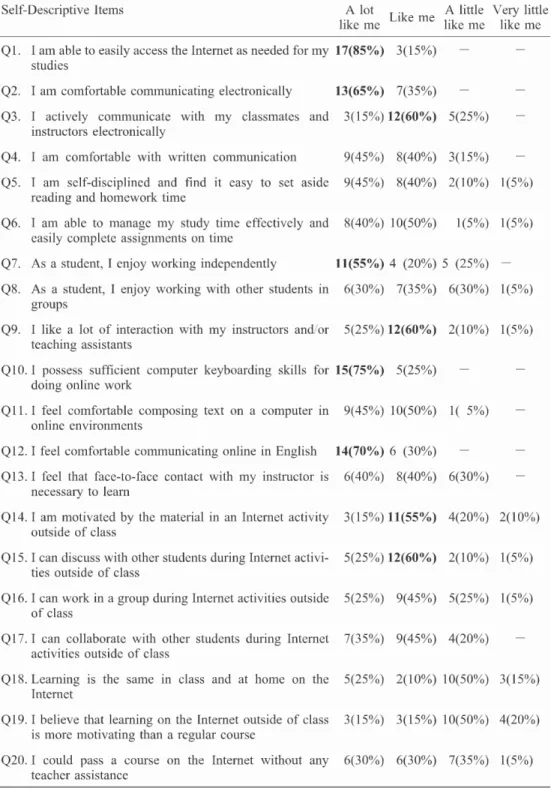
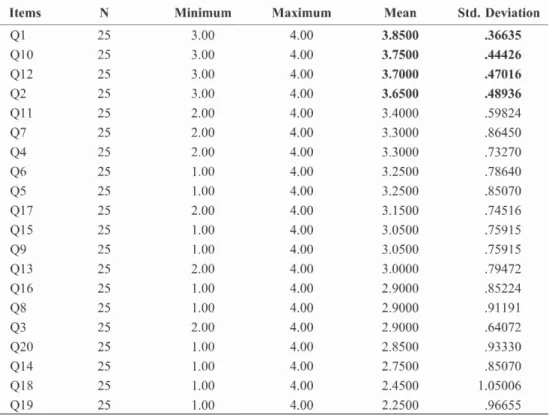
As seen in Table 1, overall, the item with "a lot like me" responses was Q1 (85%) followed by Q10 (75%), Q12 (70%), Q2 (65%), and Q7 (55%). The item with "like me" responses was Q3 (60%) followed by Q9 (60%), Q15 (60%), and Q14 (55%). The standard deviations (SDs) for the items with "a lot like me" responses were relatively small, indicating the consistency of responses; but the SDs for the items with "like me" responses were larger (see Table 2). The students of this sample:
• are able to easily access the Internet as needed for their studies (M = 3.85; SD = .366) • possess sufficient computer keyboarding skills (M = 3.75; SD = .444)
• feel comfortable communicating online in English (M = 3.70; SD = .470)
• are comfortable communicating electronically (M = 3.65; SD = .489)
• enjoy working independently as students (M = 3.30; SD = .865)
• actively communicate with classmates/instructors electronically (M = 2 .90; SD = .640) • like interaction with their instructors and/or teaching assistants (M = 3.05; SD = .759)
• can discuss with classmates during Internet activities (M = 3.05; SD = .759)
• are motivated by the material in an Internet activity outside of class (M = 2 .75; SD = .851)
Table 1. Descriptive statistics for students' responses to the online learning/distance education questionnaire.
Se lf-Descriptive Items A lot
like me Like me A little like me
Very little like me
Q1. I am able to easily access the Internet as needed for my 17(85%) 3(15%)
studies
Q2. I am comfortable communicating electronically 13(65%) 7(35%)
Q3. I actively communicate with my classmates and 3(15%)12(60%) 5(25%)
instructors electronically
Q4. I am comfortable with written communication 9(45%) 8(40%) 3(15%)
Q5. I am self-disciplined and find it easy to set aside 9(45%) 8(40%) 2(10%) 1(5%)
reading and homework time
Q6. I am able to manage my study time effectively and 8(40%) 10(50%) 1(5%) 1(5%)
easily complete assignments on time
Q7. As a student, I enjoy working independently 11(55%) 4 (20%) 5 (25%) Q8. As a student, I enjoy working with other students in 6(30%) 7(35%) 6(30%) 1(5%)
groups
Q9. I like a lot of interaction with my instructors and/or 5(25%) 12(60%) 2(10%) 1(5%)
teaching assistants
Q10.I possess sufficient computer keyboarding skills for 15(75%) 5(25%)
doing online work
Q11. I feel comfortable composing text on a computer in 9(45%) 10(50%) 1( 5%)
online environments
Q12.I feel comfortable communicating online in English 14(70%) 6 (30%)
Q13.I feel that face-to-face contact with my instructor is 6(40%) 8(40%) 6(30%)
necessary to learn
Q14.I am motivated by the material in an Internet activity 3(15%)11(55%) 4(20%) 2(10%)
outside of class
Q15. I can discuss with other students during Internet activi- 5(25%)12(60%) 2(10%) 1(5%)
ties outside of class
Q16.I can work in a group during Internet activities outside 5(25%) 9(45%) 5(25%) 1(5%)
of class
Q17. I can collaborate with other students during Internet 7(35%) 9(45%) 4(20%)
activities outside of class
Q18. Learning is the same in class and at home on the 5(25%) 2(10%) 10(50%) 3(15%)
Internet
Q19.I believe that learning on the Internet outside of class 3(15%) 3(15%) 10(50%) 4(20%)
is more motivating than a regular course
Q20. I could pass a course on the Internet without any 6(30%) 6(30%) 7(35%) 1(5%)
52 South Pacific Studies Vol.32, No.1, 2011
Table 2. Mean/Standard Deviation for students' preparedness for and attitudes toward online learning
Items N Minimum Maximum Mean Std. Deviation
Q1 25 3.00 4.00 3.8500 .36635 Q10 25 3.00 4.00 3.7500 .44426 Q12 25 3.00 4.00 3.7000 .47016 Q2 25 3.00 4.00 3.6500 .48936 Q11 25 2.00 4.00 3.4000 .59824 Q7 25 2.00 4.00 3.3000 .86450 Q4 25 2.00 4.00 3.3000 .73270 Q6 25 1.00 4.00 3.2500 .78640 Q5 25 1.00 4.00 3.2500 .85070 Q17 25 2.00 4.00 3.1500 .74516 Q15 25 1.00 4.00 3.0500 .75915 Q9 25 1.00 4.00 3.0500 .75915 Q13 25 2.00 4.00 3.0000 .79472 Q16 25 1.00 4.00 2.9000 .85224 Q8 25 1.00 4.00 2.9000 .91191 Q3 25 2.00 4.00 2.9000 .64072 Q20 25 1.00 4.00 2.8500 .93330 Q14 25 1.00 4.00 2.7500 .85070 Q18 25 1.00 4.00 2.4500 1.05006 Q19 25 1.00 4.00 2.2500 .96655
The items with the highest percentages of "a lot like me" responses for the traditional aged (18-22) and non-traditional aged (23 or more) students are illustrated below. The patterns of these two groups indicate very similar responses.
Traditional-aged students 1. Q1 (access Internet) 2. Q10 (keyboarding skills) 3. Q12 (online in English) 4. Q2 (communicate electronically) Non-traditional-aged students 1. Q1 (access Internet) 2. Q12 (online in English) 3. Q10 (keyboarding skills) 4. Q2 (communicate electronically) Implications
The results from the Questionnaire in this study were not new; however, insights drawn from knowledge of how current students make use of the Internet have clarified these results. For many students, the computer has become an important learning "tool" that enhances their performance in the course. The notion that visual-spatial learners will have difficulty excelling in traditional auditory-sequential tasks because these learners are
disorganized may become obsolete. Personal computers seem to be contributed much to enhancing visual learners' abilities to structure such tasks. A laptop computer may replace the pencil and notebook for visually oriented students who wish to take detailed, organized notes, and to absorb the lecture.
Visual learners trust their own eyes. It does appear that computer literacy skills are a "necessity" for visual learners. This is because they remember the study materials best when they see what is being taught, and they prefer to read printed materials, or to read information in a text or on PowerPoint slides, rather than listening to lectures. That is why visual learners tend to sit where they can see the instructor and the visual aids—even paying attention to the professor's body language and facial expression. Visual learners tend to trust their own "eyes." In this regard, "many university courses now involve elaborate simulations, digital images (both moving and still), and many other techniques to open up whole new areas of learning" (BLIGH et al. 2010: 2), and thus, today's visual approach to higher education is tremendously beneficial for visual learners. It is no wonder that "now researchers conclude that 60% of American students are visual dominant learners, 37% are auditory dominant learners, and 3% are kinesthetic dominant learners" (ROGERS 2000: 20). In this study, almost all the students scored as visual learners. One explanation is that they have to be visual learners, simply because learning in the contemporary college classroom has itself become more visual.
English is an Internet language. Students in this study have confidence in their English language abilities. They "feel comfortable communicating online in English" (with 100% endorsing either "a lot like me" or "like me" in their responses): this has important implications for how they learn. English became the official language for the people of this Pacific island in 1898. Students on this island today speak English fluently, which facilitates their use of the Internet, where "some 70% to 80% of the world's Internet home pages are in English, compared with 4.5% in German, and 3.1 percent in Japanese" (McCRUM 2010: 35). In McCRUM's words, "English is now used, in some form, by approximately 4 billion people on earth—perhaps two thirds of the planet—including 400 million native English speakers" (33). English is not only an international language, but also an Internet language.
Visual learners, including students in this study, love to access to the Internet. Internet use has contributed enormously to the shift from an old learning paradigm, in which learners receive knowledge, to a new paradigm in which learners actively construct knowledge. At one time, the wealth of information on the shelves of libraries made the library the major source of information for most college students. Now the Internet is the major source of information.
In this course, about 50% of students brought their laptop computers to class. It is evidenced that their computers offered them more advantages than just a fast way of taking notes. For example, I was talking about eight forms of intelligence based on Howard Gardner's theory (EGGEN and KAUCHAK 2010), as discussed in the textbook. Suddenly one student raised her hand and said, "Professor, Gardner's work suggests nine intelligences now." I asked, "How do you know?" The student replied, "This Internet document says so." This student was doing multiple things at the same time: taking notes, listening to my
54 South Pacific Studies Vol.32, No.1, 2011
lecture, looking at the textbook, observing other classmates, and accessing the Internet for new information (which is possible because of the wireless network). The Internet is even
changing students' learning behavior in the classroom.
In their reflection papers, students in this sample described themselves as visual learners. Some representative descriptions, below, highlight the characteristics of this sample:
-I enjoy visual aids because I can remember actions better than what I hear without them.
-I learn best when information is presented in a written language format or visual format.
-I capture the idea by coupling my thoughts with a picture in my head . -I prefer to use images
, pictures, diagrams, charts or colors to organize information.
-PowerPoint slides and videos supplement the text
, giving me a deeper understanding.
-I do better in a class if I can look slides
, handouts, or even student-teacher
interactions.
A chicken-or-the-egg question
Although a classroom lecture might appeal to auditory learners, visual learners may learn more efficiently by reading text, and tactile learners may prefer to collaborate on a group project. This general perspective on different learning styles is still valuable. Nevertheless, today's college teaching and learning are heavily "visually" oriented, and online computer resources are seen as essential for learning. The fact that almost all students in this study were visual learners suggests a "chicken or the egg" question. Were they visual learners by nature, or did they become visual learners because educational materials they engaged in college were so visual?
In American higher education, people have perceived teachers differently at times: at one time, if a student did not learn, then the instructor had failed as a teacher. Now, the emerging consensus is that teachers should be less directive, and act more as facilitators for a student's learning. Online courses make sense given this perspective, and the fact that so many college students are visually oriented. Self-directed learning is necessary in order for a student to succeed in an online course. Online education complements the preferences of visual learners. They generally do not like to work in study groups. Instead, they "enjoy working independently as students" (with 75% endorsing either "a lot like me" or "like me" in their responses), as indicated in this study. Other characteristics of visual learners, such as being much "better at keyboarding than handwriting" (with 100% endorsing either "a lot like me" or "like me" in their responses)
, having good long-term visual memory, and being creatively, technologically, mechanically, and emotionally gifted, also provide
Conclusion
The results from this study support O'CONNOR's (n. d.) conclusion, as follows: When the opportunities offered by new technologies are combined with the new view of the learning process provided by learning style research, the promise to revolutionize the teaching paradigms found in the academy begins to gain some direction. And yet, many things about the different ways in which people learn remain to be discovered. Learning itself is dynamic. Online learning, in particular, is a very active and engaged process. The study reported in this paper compared learning styles in terms of cognitive perspectives. Learning involves simultaneously complex psychological, physiological, and emotional elements. It is important to learn how these elements, as the ways in which they differ across different learning styles, contribute to students' responses to online learning environments. This study revealed useful information about the characteristics of online learners. Future research should be draw on larger samples from a diversity of disciplines, in order to provide a more thorough analysis of the role of learning styles in students' responses to online learning. This study is only a beginning, and it is ongoing.
Finally, this preliminary analysis provides evidence that matching instructional approaches to learning styles does not always work well. The evidence commends instead a focus on cognitive styles. This is because "a learning style or modality describes how information enters the brain: visually, aurally, or tactically, whereas cognitive style refers to how the information is processed once the information gets to the brain" (HOLDEN and WESTFALL 2010: 5). Future research should address interventions both to learning styles and to cognitive styles, with systematic comparisons of effects.
Acknowledgements
The author thanks Concordia University and Pennsylvania State University for permission to use their instruments in this study, and thanks the students in this course for
their participation.
References
BLACKBOARD INC. 2000. Educational Benefits of Online Learning. Retrieved June 10, 2010, from http://www.aunwesha.com/Edu_Benefits_of Online_Learning.pd£ BLIGH, B., WIESEMES, R. and MURPHY, R. 2010. Introduction to the Special Issues on
Visual Learning in Higher Education. International Journal of Media, Technology and
Lifelong Learning, 6(1): 1-6.
CONCORDIA UNIVERSITY 2004. Online Learning/Distance Education Questionnaire.
56 South Pacific Studies Vol.32, No.1, 2011
http://doe.concordia.ca/cslp/Downloads/PDF/OnlineInstrument_23Aug04.pdf.
EGGEN, P. and KAUCHAK, D. 2010. Educational Psychology: Windows on Classrooms, 496 pp., Pearson Education, Inc., Upper Saddle River, New Jersey.
GARLAND, D. and MARTIN, B. N. 2005. Do Gender and Learning Style Play a Role in How Online Courses Should be Designed? Journal of Interactive Online Learning, 4(2): 67-81.
GRAF, S., LIU, T. C. and KINSHUK. 2010. Analysis of Learners' Navigational Behavior and Their Learning Styles in an Online Course. Journal of Computer Assisted Learning,
26: 116-131.
FELDER, R. M. and SOLOMAN, B. A. n. d. Learning Styles and Strategies. Retrieved June 5, 2010, from http://www4.ncsu.edu/unity/lockers/users/f/felder/public/ILSdir/styles.htm. HOLDEN, J. T. and WESTFALL, P. 2010. Learning Styles and Generational Differences: Do They Matter? 11 pp., Federal Government Distance Learning Association, Washington, DC, USA. (http://www.fgdla.us/uploads/FGDLA_White_Paper_on_Learning_Styles_ and_Generational_Distinctions_v1_0.pdf)
HOWE, M. J. A, DAVIDSON, J. W. and SLOBODA, J. A. 1998. Innate Talents: Reality or Myth? Behavioral and Brain Sciences, 21: 399-442.
HOWLES, L 2009. Learning Styles: What the Research Says and How to Apply It to Designing E-learning. Online Classroom, pp. 1-8.
(http://isg.urv.es/library/papers/learning%20styles_overview.pdf)
HSIEH, P. H. and DWYER, F. 2009. The Instructional Effect of Online Reading Strategies
and Learning Styles on Student Academic Achievement. Educational Technology and Society, 12(2): 36-50.
LEARNING STYLES n. d. E-Learning Essentials. Retrieved June 6, 2010, from http:www.worldwidelearn.com/index.htm.
LITTLEFIELD, J. 2010. Is Distance Learning Right for You? Retrieved June 10, 2010, from http:distancelearn.about.com/od/isitforyou/a/considering.htm.
MCCRUM, R. 2010. Globish. In: Newsweek (June 21, 2011), 32-35, the Washington Post Company, USA.
O'CONNOR, T. n. d. Using Learning Styles to Adapt Technology for Higher Education.
Retrieved May 8, 2011, from
http: //www. indstate. edu/cirt/id/pedagogies/styles/learning.html.
PASHLER, H., MCDANIEL, M., ROHRER, D. and BJORK, R. 2009. Learning Styles: Concepts and Evidence. Psychological Science in the Public Interest, 9(3): 105-119.
PENNSYLVANIA STATE UNIVERSITY n. d. Online Learning Style Inventory. Retrieved June 24, 2010, from www.personal.psu.edu/bxbll/LSI/LSI.htm.
ROGERS, D. 2000. A Paradigm Shift: Technology Integration for Higher Education in the New Millennium. Association for the Advancement of Computers in Education
Journal, 1(13): 19-33.
SCHUNK, D. H. 2008. Learning Theories, 578 pp., Pearson/Merrill Prentice Hall, Upper Saddle River, New Jersey.
http://www.worldwidelearn.com/education-articles/how-do-you-learn.htm.
SILVERMAN, L. K. 2003.The Visual-Spatial Learner: An Introduction. Soundview School Dolphin News, Winter: 6-7.
SMITH, P. and DALTON, J. 2005. Getting to Grips with Learning Styles. ERIC Database (Reproduction #ED493991), The National Center for Vocational Education Research.
Australia.
SUCCESSDEGREES. Com 2010. What Personality Type Do You Need to Succeed at Online Learning? Retrieved June 4, 2010, from
http://www.successdegrees.com/right-personality-for-distance-learning-courses.html. TERRELL, S. 2005. Supporting Different Learning Styles in an Online Learning Environment.
Online Journal of Distance Learning Administration, 8(2): 1-9.
58 South Pacific Studies Vol.32, No.1, 2011
Appendix A
LEARNING STYLE INVENTORY
Instructions: Mark only one that best describes you. Please answer each question as honestly as you can.
QUESTIONS Seldom
Some-times Often
1. Can remember more about a subject through the lecture method with information, explanation and discussion
2. Prefer information to be presented the use of visual aids
3. Like to write things down or to take notes for visual review
4. Prefer to make posters, physical models, or actual practice and some activities in class
5. Require explanations of diagrams, graphs, or visual directions
6. Enjoy working with my hands or making things
7. Am skillful with and enjoy developing and making graphs and charts
8. Can tell if sounds match when presented with pairs of sounds
9. Remember best by writing things down several times
10. Can understand and follow directions on maps
11. Do better at academic subjects by listening to lectures and tapes as opposed to reading a textbook
12. Play with coins or keys in pockets
13. Learn to spell better by repeating the words out loud than by writing the word on papers
14. Can better understand a news article by reading about it in the paper than by listening to the radio
15. Chew gum, smoke, or snack during studies
16. Feel the best way to remember is to picture it in your head
17. Learn spelling by tracing the letters with my fingers
18. Would rather listen to a good lecture or speech than read about the same material in a textbook
19. Am good at working and solving jigsaw puzzles and mazes 20. Play with objects in hands during learning period
21. Remember more by listening to the news on the radio rather than reading about it in the newspaper
22. Obtain information on an interesting subject by reading relevant materials
23. Feel very comfortable touching others, hugging, handshaking, and so on
24. Follow oral directions better than written ones
Note: The items listed here are reproduced with permission from the Pennsylvania State University, copyright holder.