Local People’s Perspectives in Social Development
; An Analysis of the Contents of a Collaborative Leaning Class
SUZUKI Yayoi, RITCHIE Zane and YAMAZAKI Masaru
Abstract
Thepurposeofthispaperistoexaminetheimpactoftheclass“LocalPeople’sPerspectives inSocialDevelopment”onstudentswhoattendedit.TheinauguralclasswastaughtinEnglish inthe2018fallsemesterasacollaborativesubjectbelongingto“University-wideLiberalArts Courses”.
Intheclass,studentsweregiventheopportunitynotonlytoacquirespecializedknowledge, butalsotothinkdeeplyaboutglobalsocialissuesthankstodirectcommunicationwithlecturers familiarwiththefieldofsocialdevelopmentatthegrassrootslevel.
Theimportanceofsocialdevelopmenthasemergedsinceithasbecomerecognizedthatlarge- scaledevelopmentaimedatincreasingcountries’GNPundertheidealofmodernizationhadled toserioussocialissuesanditselfbecomeacauseofpovertyindevelopingcountries.Intheclass, studentslearnedtheroleofnon-governmentalorganizationsatthegrassrootslevelinpromoting socialdevelopmentfromseveralcasestudies.Also,whiletherapiddevelopmentandspreadof scienceandtechnologyhavebroughtconveniencetopeoplelivingindevelopedcountries,they havenotnecessarilybeenconducivetohumanwell-being.Rather,extractingnaturalresources fromdevelopingcountriesforthepurposeofachievingeconomicdevelopmentintheprocessof globalizationhasledtotheexhaustionofnaturalresourcesandcausedpollutionthatthreatens theEarth’sfragileecosystems.
Theclassalsoprovidedstudentswiththeopportunitytothinkabouttheroleofdemocracy, andwhatweshoulddotobreakthesilenceinthiscriticalsituation.Throughthelectures,the studentsseriouslyconsideredtheroleofdemocracyforpeoplearoundtheworldandtherolethat theyshouldplayincreatingapeacefulsocietywithoutnuclearweaponsorwar.Inaddition,the coordinatorandstudentassistantwereinstrumentalinencouragingandpromptingstudentsto getinvolvedinthedebate,sothestudentswereabletoparticipateindiscussionsonserioussocial issuesfromallaroundtheworld.
Thispaperfindsthatthecollaborativelectureshavefunctionedasacollaborativelearning classfocusedonsocialdevelopment,localsocialissues,globalsocialinequalitiesandpeacebuild- ingatthegrassrootslevel.Furthermore,theclosecooperationofsixguestlecturers,thestudent assistant,andthecoordinatorsnotonlystimulatedstudents’participationandraisedtheiraware- ness,butalsocausedapositivesynergisticeffectintermsoflearningintheentireclass.
Key words:socialdevelopment,well-being,localpeople’sperspectives,grassrootslevel, non-governmentalorganizations,localsocialissues,globalsocialinequalities
Ⅰ.Introduction
Theauthorsinitiatedaclassentitled,“LocalPeople’sPerspectivesinSocialDevelopment”in thefallsemesterof2018.Itfollowedthe“LocalPeople’sPerspectivesinInternationalCulturaland SocialProblems”,whichwastaughtinthespringsemesteraspartoftheUniversity-wideLiberal ArtsCourses.(1)
Globalizationnotonlystimulateshigheconomicgrowth,butalsooftencausesseriouslocal socialissues,environmentaldestruction,aswellasglobalsocialinequalities.Furthermore, unfortunately,thedevelopmentofnewtechnologiesusedinconflictandwarisincreasing,andso isdevastationinconflictzonesthatcausesharmtolocalpeople,especiallythemostvulnerable.
Intheclass,studentslearnedthedefinitionofsocialdevelopment,theroleofcivilsociety, andhowanemphasisoneconomicgrowthhasbroughtaboutvarioussocialissuesandbecome acauseofpoverty.Theclassalsoprovidedstudentswiththeopportunitytodeepentheir understandingofthesocialstructurebehindconflictandwar,notonlyfromglobalperspectives butalsofromlocal,grassrootslevelperspectives.Inaddition,sustainableapproachestopeace buildingandadvancinghumanwell-beingwereconsidered.Furthermore,theclassprovided studentswithanopportunitytothinkabouttheroleofdemocracyandwhatweshoulddoto breakthesilenceconcerningthecriticalsituationtheworldisin.
Atthebeginningoftheclass,theauthorswereconcernedthatthestudentsmighthesitateto cometotermswithsomeoftheseriousglobalsocialissueswehavetoface.However,theauthors noticedthatthestudentsactivelyparticipatedinthelecturesandeffectivelyusedthediscussion opportunitiesthatwerepresentedtothem.Theresultsofaclassevaluationsurveyheldatthe endofthetermshowedahighdegreeofsatisfactionwiththeclassamongthestudents.
Themainobjectiveofthispaperistoanalyzetheimpactoftheclassonthestudentsthrough anexaminationofthepurposeandcontentsoftheclass,theconceptofsocialdevelopment,and ofconcreteexamples.Italsoexaminesthehypothesisthatthecollaborativelearningclassofthe coordinators,thestudentassistantandthesixguestlecturershadasynergistic,positiveeffecton thestudents.
Ⅱ.Class Outline
Thissectionintroducesthepurposeandcontentsoftheclass.Theofficialtitleis,‘LocalPeople’s PerspectivesinSocialDevelopment’,andthepurposeandobjectivesarebelow,aspertheonline syllabus.
1. Course Objectives
Thelectureserieswillanalysethedevelopmentalissuesascarriedoutwithaprevious
emphasisoneconomicgrowthmodel.Also,youwilllearnabouttheimportanceofsocial developmentandtheidealsandactivitiesofInternationalnon-governmentalorganizations (NGOs),andotheruniqueandcommunity-basedapproachesasamediumforpromotingsocial development.
2. Course Contents
Economicgrowth-orientedassistanceanddevelopmentasledbydevelopedcountriesand internationalorganizationshascausednumeroussocialandenvironmentalissuesonaglobal scale.Acontinuingworldwidegapbetweentherichandpoorandenvironmentaldestruction affectusall.Whilethedevelopmentmodelhasitsplace,societyneedstoadoptmeasuresto moveawayfromcurrenteconomicgrowthfocusedparadigmandmovetowardapeople- centeredapproachandpromotewell-being,asrecognizedbyNGOs,theUnitedNationsandother community-basedapproaches.Comprehendingdevelopmentalissuesandtheimportanceofsocial developmentascarriedoutwithapreviousemphasisoneconomicgrowth,andunderstanding oftheidealsandactivitiesofInternationalNGOsasamediumforpromotingsocialdevelopment arebothimportantfactorsinunderstandingsocialdevelopment.
3. Course Schedule
Table1outlinesthecourseschedule.Theauthorsinformedthepurposeandthecontent ofeachclasstotherelevantlecturerbeforehand,viaemail.Theyalsorequestedthelecturer makeslidesinsimpleEnglishsinceitwasimportantthatthestudentscouldfollowthecontents.
Allthelecturersusedslidesintheirpresentations,whichnotonlymadethematerialeasierto understand,butalsomotivatedthestudents.
Eachlecturemaintainedthestructureasoutlinedintheintroductiontotheclass.Theauthors heldadiscussionsessiononthecontentofeachlecturebeforehandandcollaboratedbefore andaftereachlectureasfollows:(1)Beforethelecture→Theauthorsheldabriefmeetingto discussregardingthecontentsandtimeallotmentwiththeguestlecturer;(2)Thebeginning ofthelecture→Theauthorsbrieflyintroducedthelecturertothestudentsandoutlinedthe contentswithslides;(3)Followingthelecture→Thelecturerandtheauthorsreadthestudents’
commentpapersandanalyzedanddiscussedthecontents.Theauthorsalsopreparedfeedback togivestudentsinthenextlecture;(4)Thebeginningofthesubsequentlecture→Theauthors reviewedstudents’commentsandquestionsfromthepreviouslecture;(5)Theendofthe subsequentlecture→Theauthorsintroducedcommentstothepreviouslecturewithslides,and inviteddiscussion.
Thestudentswerealsorequiredtowriteareport(onlyapenandpaperwereallowed)inthe
finalclass,withthesubject:Whatwasthebestthing(topicsortheme),orwhatimpressedyou mostinthisclass?①Writethethemeortitle(1-2lines).②Writeanoutline(about5lines).③ Writeyourthoughts.”
Theauthorsanalyzethecontentofeachinthenextsectionbasedonthisclassification.
Table 1: Class Schedule
Name Title Classification
1. SuzukiandRitchie Introductiontotheclassandlecture
DoesforeignaidreallyworkinfavourofpoorpeopleinBangladesh?
Whatissocialdevelopment? 1and2
1and2 2. MasaruYamazaki TheroleofNGOsandcivilsocietyinpromotingsocialdevelopment. 1and2 3. MasaruYamazaki Communitydevelopmenttoachievewell-beingforallpeople. 1and2 4. Upalat
Korwatanasakul Theroleofeducationinsocialandcommunitydevelopment:
educationandsocialissuesinThailand. 2
5. FutoshiSato Let’sreexamine“prosperity”and“ourviewpoints”. 1and2 6. RitchieZane TheroleofSocialDevelopment:TheStudentVolunteerArmyits
roleintherecoveryfollowingtheChristchurchEarthquakesof 2010and2011inNewZealand.
1and2
7. NaglRobertHans Culturaldiversity,wealth,andpovertyintheUnitedStates
throughtheeyesofanAustrianimmigrant. 1
8. GhamraRifai Syriawhathappenedandwhyithappened:Theoncebeautiful
ancientcitiesofmyhomeland 3
9. DaniNehushtai Isitgoodtodieforthecountry? 3
10. GhamraRifai Syriawhathappenedandwhyithappened:fromtheeyesofa
Syriancitizen. 3and4
11. DaniNehushtai Myideasregardingthepossibilityofcreatingapeacefulsocietyin
theworld. 3and4
12. NaglRobertHans Hopeofwealthandhappiness:Observeddreamsandrealitiesliving corporatelifeintheUnitedStatesforthirtyyears,andcontinuing inJapan.
1
13. FutoshiSato Sustainabledevelopmentchanges. 1~4
14. SuzukiandRitchie Finalreport.
Note:Thecontentofeachlectureisclassifiedasfollows:
1.Howhaspastemphasisoneconomicgrowthledtosocialissuesandcausedpoverty?
2.Definingsocialdevelopmentandtheroleofcivilsociety.
3.Thesocialstructurebehindconflictandwar,andsustainableapproachestopeacebuildingandad- vancinghumanwell-being.
4.Theroleofdemocracyandwhatweshoulddotobreakthesilenceconcerningthecriticalsituation theworldisin.
Ⅲ.What is social development?
1. How has past emphasis on economic growth led to many social issues and caused poverty?
Associaldevelopmentwasanimportantconceptintheclass,itwasdefinedintheveryfirst
lecture,Inaddition,thefirstlecturewasoneofthemostimportant,andstudentswereexpected toattendasinstructedinthecoursesyllabus.
(1) Introduces to the class and individual lectures.
Inthefirstlecture,SuzukiintroducedRitchieastheco-coordinatorandChangasthestudent assistanttotheclass.Next,Suzukioutlinedthebasicguidelinesofthecourse.Suzukithen presentedabriefoutlineofherresearch:
“IhavevisitedBangladeshtwelvetimesbetween1997and2012.IhavebeenreceivingGrantin AidfromtheJapaneseMinistryofEducation,Culture,Sports,ScienceandTechnology(MEXT) since1999.Myspecialtyissocialdevelopment,andIhaveundertakenmanydifferenttypesof researchinBangladesh.Mystudytherestartedwithananalysisofforeignaidfromacritical perspective.Afterthat,Iproceededtodoresearchonsocialdevelopmentandtheroleofcivilso- cietyatthegrassrootslevel,fromendogenousdevelopmentperspectives.Furthermore,through manyhomevisitsinruralBangladesh,Ilearnedabouttheconcretesituationinwhichpoorpeople whowereforcedtoimmigrateunderdebtinordertoaccessnewopportunitiesforworkandfind themselvesindifficultsituations.IhavealsocarriedoutresearchintheUnitedArabEmirates (UAE)threetimessince2010,andhavevisitedintheUnitedStatesofAmericaeleventimes since2009.IalsostudiedasavisitingscholaratColumbiaUniversityinNewYorkCityduring mysabbaticalyearfromApril2017toMarch2018.”
(2) Does foreign aid really work in favour of poor people in Bangladesh?
Theclassgavestudentsanopportunitytothinkaboutthefollowing:
①WhereisBangladeshlocated?(2)②Doesforeignaidwork?③Ifitdoes,howeffectiveis it?④Whatisitsimpactonpoorpeoplelivinginruralcommunities?
Anenormousamountofforeignaidforlarge-scaledevelopmenthasbeenprovidedtoBangla- deshsinceitsindependencein1971,contributingtotheeconomicdevelopmentofthecountry.
Despitethis,Bangladeshstillfacesnumerousserioussocialissues,whichhavebeenoutlinedin somepreviousstudies,includingtheSuzuki’sownresearchsince1997.
ThesituationinDaka,(3)thecapitalofBangladesh,hasworsenedovertheyears.Large-scale developmentconductedbyusingforeignaidisoneofthecauses;itsnegativeimpactmainly stemsfromthefactthatithascenteredontheexpansionoftheroadnetworkandconstructionof buildings.Despitesuchinfrastructureprojects,alackofemploymentopportunitiesisstillevident, andevenwhenpoorpeopledogainaccesstoworkopportunities,theyoftenenduptoilingin hazardousworkingconditions,forlowwages.Indeed,manypoorworkerswhocamefromrural Bangladeshhavebeenforcedtoresideininferiorhousing-theyoftenhavenopowertochoice
buttoliveinshabbyhousesinsideslums,onnarrowvacant,andlotsorsidewalksthataredan- gerouslyclosetoroads.
Compulsoryevictionsfromslumsettlements,theexistenceofstreetchildrenandchildlabour- ers(especiallychilddomesticservants)aresomeofthemostserioussocialissuesinlargecities inBangladesh.Manypoorpeoplewholivedinslumsfacedtheproblemofevictionbecauseof thepushforeconomicdevelopmentandmodernization.Alsoworthnotingisthatslumdwellers, streetchildrenandchilddomesticservantstypicallycomefrompoorruralareas.Thatis,behind thesesocialissuesincities,theproblemofpovertyinruralareasstilllurks(Suzuki,2016).
Thesesocialissuesarecloselyrelatedtothedevelopmentinruralareaswhichisfundedby foreignaid,whichisoneoftheunderlyingcausesofpoverty.Forexample,Kumilla(4)isatypical areainwhichforeignaidhasbeenconcentratedsincebeforeindependence,withtheUnited StatesAgencyforInternationalDevelopment(USAID)andJapan’sofficialdevelopmentassis- tance(ODA)takingtheleadinitsdevelopment.Concretely,aspartofitsGreenRevolutioninitia- tive,duringtheEastPakistanerainthe1960s,theUSAIDimplementedtheso-called“Commila Model”intendedforintroducingmodernfarmingmethods,andconductedaruralconstruction programmeintendedfortheimprovementofinfrastructure,withthegoalofmodernizingrural areas.Thisprojectprovidedhigh-yieldvarieties(HYVs)Bororicethatwereadaptedforplanting duringthedryseasononly,alongwithagriculturalpesticides,chemicalfertilizersandirrigation equipmentthatwereexpectedtoexpandmodernagriculturalproduction.Themodelgradually spreadthroughouttheprovince,aconsequencewasthattraditionalmethodsofagriculturalpro- ductiondeclinedandthecommunities’lifestylesatthelocallevelgraduallycametobeaffected.(5) Followingindependence,theRoadExpansionProjecttoconnectthecapitalDakaandthe commercialportofChittagonwasimplementedaspartoftheAsianHighwayNetworkProject fundedbytheAsianDevelopmentBank.Inconjunctionwiththisproject,theMeghnaBridgeand MeghnaGumtiBridgewerealsobuilttoconnectDakawiththeDaudkandidistrictinKumilla, whichwasselectedasthemainareafortheModelRuralDevelopmentProject(MRDP).Both oftheseinfrastructureimprovementsaswellastheMRDPwerefundedthroughJapan’sODA.
Theselarge-scaledevelopmentprojectshavehadvariousimpactsonthelivingconditionsofthe poor.(6)
Followingthemainlecture,Suzukiaskedstudents,“WhatdoyouthinkabouttheRoadExpan- sionProject?”
Theprojectwascarriedoutaspartofamodernizationandeconomicdevelopmentdrive,but placedhugepressureonthepoor,especiallythemostvulnerableslumdwellerswholivedclose toanationalhighway,withmanyofthemforciblyremovedfromtheirlivingspacesundercom- pulsoryevictionorders.Thatputtheminanevenmoredifficultsituation,astheynowhaveto
usetheirmeagerwagestopayrent,whichputsextrapressureontheirtightfamilybudgetsand oftencausesthemtofallintodebt.
Duetothis,someofthechildrenhadtodropoutfromelementaryschoolorjuniorhighschool.
TheytoldSuzukiinasmallvoice,hesitatinglyinBengali:“Therearenochildrenwhodonotwant togotoschool”.Amongthem,anadolescentgirlhadtogiveupherstudyatajuniorhighschool, becauseshehadtostartworkingatajutefactoryduetoherfamily’sfinancialwoes.Thenone day,onadim,earlymorningafterfinishingwork,shefellandfracturedherarmonthesideofa roadthatwasinpoorshapeduetoconstructionworkoftheroadexpansionproject.Herfather thenhadtoborrowmoneyinordertocoverthehighcostofmedicaltreatmentforherinalocal hospital.Thisisjustoneexampleoftherealitiesthatslumdwellerswhohavebeenaffectedby theroadexpansionprojecthavetofaceduetothepushforeconomicdevelopment.
Theproject,itmaybesaid,hasdeprivedthemoftheirhumanrightsandwell-being.Thepoor- est,thosewhousedtoliveinslums,havelosttheirverysmallbutveryimportantlivingspaces, aswellastheirpreciouscommunities,whichwereabsolutelynecessaryfortheirexistence.In addition,theprojecthasledtoserioustrafficjams,severeenvironmentalpollution,healthhazards andothersocialissues.Tosumup:theconventionalmethodthatlaysemphasisoneconomic growthhasbroughtaboutmanysocialissuesinKumilla.
2.The concept of Social Development
Accordingtosen(2007),thepreviousideaofdevelopmentinthe1930sor1940shadbeen dominatedbyeconomicgrowththeorythataimedatincreasinggrossnationalproduct(GNP)in developingcountries.
“Itwasdominatedbythebasicvisionthatpoorcountriesarejustlow-incomecountries,and thefocuswassimplyontranscendingtheproblemofunderdevelopmentthrougheconomic growth,increasingGNP,andsoon.Thatprovedtobeanotverygoodwayofthinkingabout development,whichhastobeconcernedwithadvancinghumanwell-beingandhumanfreedom (Sen,2007,p.3)”.Forthatreason,SenandMahbubconsideredalternativetheoriestoreplacethe economicgrowthmethodthatfocusesonincreasingGNP(Ibid.,pp.3-5).
TheHumanDevelopmentReport,whichhasbeenpublishedannuallybytheUnitedNations DevelopmentProgram(UNDP)since1990,drawssubstantiallyonthehumandevelopment approachbasedonSen’sworkoncapabilities(Ibid.,p.4).AccordingtoSen,“Humandevelopment, asanapproach,isconcernedwithwhatItaketobethebasicdevelopmentidea:namely, advancingtherichnessofhumanlife,ratherthantherichnessoftheeconomyinwhichhuman beingslive,whichisonlyapartofit”(Ibid.).
Inaddition,“threefoundationsforhumandevelopmentaretolivealong,healthyandcreative
life,tobeknowledgeable,andtohaveaccesstotheresourcesneededforadecentstandard ofliving.Oncethebasicsofhumandevelopmentareachieved,theyopenupopportunitiesfor progressinotheraspectsoflife”.(7)
Serioussocialissuesfacedbythepoorarisenotonlyfromincomepoverty,butalsofromalack ofaccesstoopportunitiestoacquireliteracy,education,primaryhealthcare,safewater,nutrition, decentwork,andbeingunabletoparticipateinsocialactivities.Inaddition,ithasbeenfoundthat thepoorareoftenentangledinhumanpovertyandforcedtoliveinsqualidlivingconditionsthat areverydifficulttobreakawayfrom,whichcreatesaviciouscircle.Inshort,theyaredeprived oftheirfundamentalhumanrightsandhaveverylimitedaccesstoopportunitiestoadvancetheir humanwell-being.
Inordertosupporttheadvancementofpoorpeople’swell-being,humandevelopment approachaimsnotonlytosimplyincreaseGNPorgrossdomesticproduct(GDP),butalsoto extendaccesscapacityandhuman-centereddevelopmentforpoorpeople.
Anagreementthatthedevelopmentmodelfocusedoneconomicgrowthshouldbereviewed wasachievedattheUnitedNationsWorldSocialDevelopmentSummitheldinCopenhagen, Denmarkin1995,whereaconsensuswasreachedontheimportanceofadvancing“social developmentashumanwell-being”(Nishikawa,1995:1998).
Aspreviouslymentioned,economicgrowthcancausevarioussocialissuessuchaspoverty, unemployment,andthedeepeningofsocialdivisions.Suchnegativeoutcomesarerootedinthe previousdevelopmentidealsthathaveprioritizedeconomicgrowth.
Theconceptofsocialdevelopmentrecognizesthatitisnecessarytofocusonhuman-centered socialdevelopmentratherthanoneconomicgrowth,andhumandevelopmentfocusingonhuman well-beingandhumanfreedomisafirstpriority.
3. The role that local non-governmental organizations (NGOs) in Bangladesh play in promoting social development
ManylocalNGOsareworkingwithpoorpeopleduetoserioussocialconditionsinBangladesh.
Amongthem,BRAC(BuildingResourcesAcrossCommunity)hasanalyzedthecausesof povertyandhasbeenworkingtowardimplementingadequateapproachesforassistingpoor peopleatthegrassrootslevel.“WomenandgirlshavebeenthecentralanalyticallensofBRAC’s mainapproach,recognizingboththeirvulnerabilitiesbutalsotheirthirstforchange.”(8)
AccordingtoSuzuki’sresearch,BRAC’sprogrammeofficerswhoarestaffmembersinitiated talksatthegrassrootslevelwithpoorwomenwhowereexcludedfromtheforeign-aid-funded ruraldevelopmentprojectwhichwasbeingconductedbasedontheassumptionthatatrickle- downeffectwouldensue.Theyrealizedthatthesepoorwomenwouldbeabletonotonly
becomekeypersonsintheirfamiliesandcommunities,butwouldalsobeabletopromotesocial developmentatthegrassrootsleveliftheycouldgainaccesstosocialopportunitiesandadequate support.Theprogrammeofficersgraduallyurgedwomentoformavillageorganization.
AtthecoreofBRAC’sideaandactivitiesforpromotingsocialdevelopmentatthegrassroots levelinruralareasarevillageorganizations(“samity”inBengali),eachofwhichismadeup ofbetween20to30femalemembers.(9)Traditionally,mutualsupportamongpoorwomenhas beenremarkable,andthissupporthasbeenmaintainingtheformationofvillageorganizations.
Throughtheseorganizations,Bangladeshiwomeninruralareasarenowabletoaccessthe opportunitiestoacquirebasicliteracyandaccesssocialsupport,primaryhealthcare,and educationforchildren(especiallyforgirls).Theycanalsoattendbriefcoursesonraisingpoultry orcattlewithinincomegenerationprogrammes,accessmicrofinanceprogrammes,aswellas legalassistanceprogrammes.Bydoingso,womengraduallyraisetheirsocialawareness,become empowered,andadvancehumanwell-beingnotonlyforthemselvesbutalsofortheirfamily members.(10)Someamongthewomenhavebecomekeypersonsinpromotingsocialdevelopment andhavebeenworkingwithpoorwomenatthegrassrootslevelinruralvillagestoimprovethe primaryhealthandnutritionofinfants.
BRAC’suniqueandholisticapproachtoprioritizingempowermentofthepoorestwomen, advancinghumanwell-beingandpromotingsocialdevelopmentisfundamentallydifferent frommodernizationmethodsthatarebasedonforeignaidandassumetheexistenceofthe trickle-downeffect.Inruralvillages,poorwomen’smutualsupportandmutualunderstanding, theirparticipationinvillageorganizationactivities,andtheprogrammeofficers’appropriate approachatthegrassrootsleveltotheissueswomenarefacingallhaveasynergisticeffect.This studyfoundsomecasestudiesthatprovetheendogenousdevelopmenttheorytobevalid throughtheSuzuki’sresearchinDaudkandidistrictofKumilla.
4.The role of NGOs and civil society in promote social development
Overtwoclasses,Yamazakiintroduced“TheroleofNGOsandcivilsocietyinpromotesocial development”and,“Communitydevelopmenttoachievewell-beingforallpeople”throughnot onlypreviousstudiesbutalsohisideals,andthroughhiswealthofactivitiesinCambodiaand Luanda,thecapitalofAngola,inAfrica.Asummaryofhislectureisasfollows.(11)
Whatisthegoalofsocialdevelopment?Itisnoteasytoanswerthissimplequestionsince itrequirestodealwithadiversityofthepeople’sperspectives.Sincesomeone’spolitical andeconomicbehaviorsbasedontheirperspectivesmayaffectothers’life,socialnorms andregulationsshouldberespectedtomaintainasustainablesociety.However,normsand regulationsarenotalwaysfunctioningfairlytoallmembersofsocietyaswehaveobserved
marginalizedpeopleallovertheworld.Therefore,discussingtheidealnormsandregulations forsocietyisnotenoughtoachievethegoalofsocialdevelopment.Neitherpoliticalsystem noreconomicsystemdoesnotachievethecoexistingsocietysincetheyconsistofthenorms andregulations.Whatismore,eachpersonneedstoexpanditscapacitytoallowpeople’s perspectivestocoexistinsociety,andpublicspherewasadvocatedbyphilosophersand socialscientistsasanalternativesystem.Sincethen,NGOsandothercivilsocietieshavebeen expandingpublicsphereunderthepressuresfromtheexistingpoliticalandeconomicsystem.
Ifthesocietyaimstobeinclusive,expandingpublicsphereshallbeanessentialroleofsocial development.Wewillalsodiscusstheconceptof‘StructureViolence’(Galtung,1969)toraisethe issuesofpoverty.
(1) The role of NGOs and civil society in promoting social development (12)
①Structure of our society
Wewilldiscussthestructureofoursocietyfromthreemainviewpoints,suchasState (redistribution),Market(exchange),andthePublicsphere(sharing)tounderstandtheroleof NGOsandcivilsociety.
②How does poverty begin, and it is sustained?
Reviewingthedata,whichshowshowwideningthegapbetweentherichandthepoor,we willanalyzethecauseofpoverty.Wewillalsodiscusshowwecontributetothepovertyina globalizedworld.
③Does economic development contribute to poverty reduction?
Incomegenerationisconsideredasasolutiontopovertyreduction.However,doesitreally contributetothepovertyreductionoreradication?Wewillwatchadocumentaryvideo(about 7mins)(13)whichtalksaboutthesituationofIndianfarmersanddiscusstheimpactsofeconomic developmentoneconomicallydeprivedpeople.
④What is the importance of social development?
Basedonthediscussionsabove,wewillconsiderthedifferencebetweenequalityandequity inoursociety.Wewillalsodiscusstheutilitarianapproachandthealtruistapproachinsocial developmenttodefinetheroleofsocialdevelopment.
⑤What is the role of NGOs?
Finally,wewillagaindiscusstheroleanditspossibilityofNGOsinsocialdevelopmentto
achieveafairandsafesociety.WewilllearnthatNGOisnotjustaserviceprovider,butan importantactortoleadthecivilsocietyforpositivesocialchanges.
(2) Community development to achieve well-being for all people (14)
①What is sustainable development?
Inthebeginning,wewillreviewthemeaningofdevelopment,andthenwewilldiscussthe importanceoftheprocessandtheresultofdevelopment.Basedonthediscussion,wewill considerhowtoachievesustainabledevelopmentandlearnabouttheessentialfactorsfor sustainabledevelopment,suchassocialfactors,environmentalfactors,andculturalfactors.
②Approach for community development
Wewilldiscusstheapproachesofcommunitydevelopmenttoachievethegoalofsocial development.Iwillexplainthreeapproachesforcommunitydevelopment,suchastheCharity approach,TechnicalSupportApproach,andSocialDevelopmentApproach,usingtheactual casesofNGOprojects.
③Natural resources and sustainable society
Degradationofnaturalresourcesisoneofthefactorsoftheconflicts.Properdistributionand managementofnaturalresourcesaresignificantforasustainablesociety.Wewillreviewthe conceptoftheTragedyoftheCommons,anddiscussindividualandcollectiverightstoresources.
④Participation of the local people
Thedifficultyofdecisionmakingisoneofthechallengesofcommunitydevelopment.
Participationisnotonlytoclaimtheirownrightsbuttoacceptanotherperson’srights.
Therefore,goodparticipationrequiresmutualcommunication.Wewilllearnhowtopromotefair andeffectivecommunicationthroughactionandreflection.
⑤From ‘Moral Act’ to ‘Beautiful Act’
Finally,wewilldiscusshowtoachieveourwell-beingforallpeoplewhohavedifferent worldviewsandvalues.Sinceeachpersonhastheirownworldviewandvalue,thereisnota perfectanswerinsocialdevelopment.Itisessentialtofollowtherulesorpublicmorals,but whoserealityisaccountedfortherulesormorality?InspiredbyNaess(1987),wewilldiscuss thepossibilityoftakinga‘BeautifulAct’byrealizationandexpansionofselftoachieveourwell- beingforallpeople.
5.Examine of social development
Inthissection,theauthorssummarizethecontentofeachlectureraccordingtotheirtalksand slides.
(1) Let’s reexamine “prosperity” and “our viewpoints” (October 31), and Sustainable development changes (January 16)
Lecturer:Futoshi,Sato
Thelecturefirstfocusedonwhyeconomicdevelopmentcausespollutionandenvironmental degradation.Heexplained:ThepurposeofeconomicdevelopmentisobviouslytoincreaseGDP, whichmeansinvestingmoremoneyintoproductsandservicestobuyandsell.Inaddition,in ordertoproducemoreproducts,wemustdependonfossilfuels(oil,coal,naturalgas)etc.,in additiontolimitedearthresourcesasnaturalresources.
Thereisonlyonepreciousearth,andoursocietyfacestheseriousenvironmentalissuesof moreemissionsofmaterialwasteandcarbondioxidecausedbyhugeeconomicdevelopmentthat placespriorityonmodernization.Itisnotonlyverydifferentfromasustainablelife,butithasalso ithasledtoserioussocialissues.Also,ifwemeasureourlivesaccordingtoGDPonly,childcare andelderlycarebyfamilymembersathome,volunteerwork,andcommunityworketcetera, mayhaveleftbehind.Forthisreason,alternativeindexestomeasurelevelsofhumanwell-being arenecessary.HeintroducedtheHumanDevelopmentIndexandtheEcologicalFootprint.He emphasizedthatweonlyhaveoneearth,andweneedtoprotectit.
Followingthemainlecture,studentswereproposedwithaquestion,(15)Howcanweachieve higherHumanDevelopmentIndexwithlowerEcologicalFootprint?Healsogaveanassignment tostudentstoprepareforthenextlectureonJanuary16:Pleasepreparetoexplainoneofthe followingtopics.
1)Chooseasocialproblemthatyouareinterestedin:Whydoyouthinkitisaproblem?
2)Thinkofanactivitythatyouwanttopromote:Whydoyouwanttopromoteit?
Themainprocedureoftheworkshopwasasfollows(16):①Makeagroupof4persons;②Share youowninterestanditsbackgroundorreasonsinthegroup;③Makelistofissues/activitiesin thegroup;④Sharethelisttothewholeclass;⑤Makegroupsaccordingtotheissue;⑥Share yourcurrentconcernsandactivities.
(2) Cultural diversity, wealth and poverty in the United States through the eyes of an Austrian immigrant (November 14), and The Hopes of wealth and happiness: Observed dreams and realities living corporate life in the United States for thirty years, and continuing in Japan.
(January 9) (17)
Lecturer:Nagr,RobertHans
NagrwasborninVienna,Austria,thecapitalofmusic.HewasfascinatedbytheUnitedStates veryearlyinhislife,mainlybecauseofthecountry’sgoodimagethatwasportrayedormanip- ulatedbythemediaandfilm.Inthosedays,hebelievedthathewouldhavebetterjobopportu- nitiesandabetterlifeingeneralwhenlivingintheUnitedStates.However,afterimmigrating there,heimmediatelyencounteredtheharshrealitiesofdiscriminationagainstimmigrants,mi- norities,poorandvulnerablepeople;itwasaverydifferentsituationthanheexpected.Thenhe recognizedtheimportanceofeducationandknowledge.Hansdecidedtoattenduniversityand studytowardsobtainingamaster’sdegreeintheUnitedStates.Manypeoplealsolistenedtohis musicperformanceswhenheplayedthepianoortheorganatchurch.Hediscoveredthatmusic doesnotonlyspeakmanylanguages,butitalsogivesspontaneouspowertowardsovercoming manykindsofcomplexhardships.
NagrgainedexperienceworkingformajorcompaniesintheUnitedStates.Atthestartofhis lifeasanemployee,itseemedhehadfinallyrealizedhislong-awaiteddream.Hecouldpossess hisownhouseandcouldgainaccesstocreditandinsurance.However,gradually,hehadtoface theserioussocialandeconomicissuescreatedbyleadershipoflargecorporationsthroughmany timespoliticalmaneuvering.They,manytimes,tookcontrolofwealth,employmentopportunities, lengthofemployment,whileatthesametimecriticallyinfluencingindividualandfamily destinies.Hewasdisappointedbyseriousissuescausedbysocialinequalities,wealthgapand criticallivingconditionsofpoorpeoplewhocouldnoteasilyescapepovertyanddiscrimination intheUnitedStates.Serioussocialissuesalsoarosebecauseofminimalrestrictionsongunsales andusage.Finally,HansgaveuplivingintheUnitedStatesanddecidedtomovetoJapan.
Thislecturealsointroducedmajorcommunicationtechnologyinventionssincethe1980sand examinedthepositiveandnegativeimpactsoftheseonpeopleintheUnitedStates.
(3) The Role of Education in Social and Community Development: Education and Social Issues in Thailand (October 17) (18)
Lecturer:UpalatKorwatanasakul
Thelecturefocusedontheroleofeducationinpromotingsocialdevelopment.Thelecturer firstintroducedseveraldefinitionsofeducationandexplainedbothpositiveeffectsandnegative aspectsofeducation.Oneoftheinterestingissuesthatthelecturerpointedoutisthateducation
maydeprivechildrenoftheirchildhood.Forexample,inJapan,evenelementaryschoolstudents areexpectedtospendtimeatacramschool(asupplementaryschoolheldafterschooloron weekends),ratherthanlearningfromplayingoractivitiesoutsidetheclassroom.Thisissue mainlycomesfromparents’expectationsregardingentranceexaminationsatanylevelsof education.
Afterthat,thelecturerpresentedadetailedexplanationofsocialissuesinThailandbasedon indicatorsofsustainabledevelopment.Thelectureremphasizedtheimportanceoffreedomof speech,accesstoequitablelearningopportunities,andacquiringliteracyandknowledgeandalso examinedtheissueofindigenouspeopleandminoritiesandsocialinequalityinThailand.
Attheendofthelecture,thelecturershowedexamplesofworkcarriedoutbylocalNGOsand internationalorganizationstoachievetheSustainableDevelopmentGoals(SDGs).Theintroduced examplesweremainlybasedoncommunity-basedlearningapproachwhereeducationand communityareutilizedtohelppromotingsustainablesocialdevelopmentatindividualand communitylevels.Therefore,thestudentsweregiventheopportunitytoconsiderhoweducation mayhelpsolvethesesocialissuesatthegrassrootslevelinThailand.
(4) The task of Social Development: The Student Volunteer Army and the recovery following the Christchurch Earthquakes of 2010 and 2011 in New Zealand (November 7) (19) Lecturer:ZaneRitchie
RitchiestartedwithabriefintroductiontoNewZealand,andemphasizedthatthecountry ispronetonaturaldisasters,andinparticularearthquakes,duetoitsgeographiclocation.He discussedhowNewZealandhasdisastercontingencyplansinplace,withregularearthquake drillscarriedoutinschools,strongbuildingcodes,andhowthereisgeneralawarenessofthe importanceofdisasterpreparednessamongthegeneralpopulation.However,in2010and2011 whentwinearthquakesdevastatedthesecondlargestcityofChristchurch,emergencyservices andCivilDefencewereoverwhelmedbythesheerscaleofthedisaster.
Inparticular,thesecondquakeonFebruary11,2011devastatedthecentralcityandeastern suburbs,leavingmanycommunitiesunabletocope,astheirlifelinesweresevered.Inthis context,astudentattheUniversityofCanterbury,SamJohnson,tookituponhimselftoorganize fellowstudentstocreateagrassrootsresponsegroupusingthesocialmediaplatform,Facebook.
TheStudentVolunteerArmyorganizedthousandsofstudentsandsentthemoutintothe communitytocleartherubbleandsiltfromliquefaction,todistributereliefsupplies(including foodparcelssentfromalloverthecountry)andgenerallycontributeinanywaytheycouldto helpoutthosemostinneed.
TheStudentVolunteerArmyplayedavitalrolewiththereliefeffortandwasrecognizedby,
andworkedwiththeauthorities.RitchiearguedthattheStudentVolunteerArmywasasuccess intheNewZealandcontextduetopeoplehavingastrongsenseoftakingtheinitiativeand gettinginvolvedintheircommunities,thetimingofthedisaster(thesecondquakeoccurredat thebeginningoftheschoolsemester),thecentrallocationoftheUniversity,andsupportfromthe authorities.
Ⅳ. The social structure behind conflict and war, and sustainable approaches to peacebuilding and advancing human well-being
Thissectionintroducesfourlecturesaboutthesocialstructurebehindconflictandwar,from notonlyglobalperspectivesbutalsofrompeople’sperspectivesatthegrassrootslevel.
1. Is it good to die for the country? (December 5) and My ideas regarding the possibility of creating a peaceful society in the world (December 19)
Lecturer:DaniNehushtai
DaniNehushtaiisawoodcraftartistbasedinSaitamaprefecture,andtheauthorof“IsItGood todiefortheCountry?”Hehasbeenheldupto500publiclecturessince2008,andhastaken partinvarioussocialactivitieswithcolleagues,schools,townhallsandorganizationsallover Japan.
Thefirstclassstartedwithhimtellingthestudentsabouttheholocaust,withafocuson Auschwitzwhichwasconnectedtosomeofhisrelatives.Following,heexplainedthehistory ofPalestineandIsrael,theMiddleEastwars,andtheexpansionoftheIsraelioccupationand attacksonPalestine.Inparticular,heanalyzedhowIsraelhasdeprivedthePalestiniansoftheir landsince1948,onlythreeyearsaftertheendofWorldWarII.Healsoexaminedthesocial structurebehindtheoccupationandtheinvolvementofmajorpowers.Heusedmapstoillustrate howPalestine’slandwasdividedbetweenGazaandtheWestBank,andhowunderunilateral occupation,itwasfurthersuppressedandreduced.HealsomentionedthatIsraelseizedthe GolanHeights,whichisaveryimportantarea,fromSyriaduringtheSix-Day(MiddleEast)war, andhowithasbecameazoneofmilitaryoccupationsince1967.
Inaddition,hereferredtohisownbook,“Isitgoodtodieforthecountry?”Healsotouched uponeducationinIsrael,andprovidedstudentstheopportunitytothinkabouthoweducation makesinfluencestochildren.InIsrael,manypeoplejointhearmywithoutanydoubtsateighteen yearsold,andheexaminedhowthisphenomenonisinvolvedintheschoolingstudentsreceive, particularlyattheprimarylevel.Educationisoneofthemostimportantissuesrelatedtojoining thearmyinIsrael.
ThesecondclassfocusedonthepresentsituationregardingnotonlyIsraeli-Palestinianissues,
butalsocurrentaffairsinJapan.Accordingtohisanalysis,Japanhassomethingsincommon withIsrael.Forexample,seventy-fiveyearsagoduringWorldWarII,Japaneseelementary schoolchildrenweretaughtthattheyhadtoadmirethesuccessoftheJapanesemilitary.Some educated,youngJapaneseboyswerealsosenttowaranddied.Following,hementionedthe preparationforfuturewarinJapanandtheexpansionofmilitarybudget.Healsoemphasized thatcontinuedmilitaryindustrialexpansionwillbeleadendlessconflicts,warandhuge devastation.Finally,hementionedtheverycriticalsituationregardingtheuseofnuclearpower plantsandtheFukushimadisasterinJapan.
2. Syria what happened and why it happened: from the eyes of a Syrian citizen (November 21); and Syria what happened and why it happened: The once beautiful ancient cities of my homeland (December 12)
Lecturer:Ghamra,Rifai
Inthefirstlecture,GhamraexplainedthelocationofSyriaandhowithaslongglorioushistory asanancientlandforthousandsofyears.Itintroducedthedifferentethnicities,religions,tradi- tionalculture,officiallanguageandhowSyriaisamultilingualsocietyandhasculturaldiversity.
Italsodiscussedfamilystructure,accesstoequitablelearningopportunities,theliteracyrate,and women’spositioninsociety.
ShethenintroducedthepicturesquesceneryandthelifestylesofSyriansbeforethecon- flict,withphotoslidesandhermemories.People’slifestylesthatblendedintotraditionwere beautifulinthepictures.Obviously,italsoattractedmanylocalpeopleandtouristsbeforethe conflict.Syria’straditionalcultureandreligionhadimportantimplicationsforSyriansociety, includingnotonlyeatinghabits,traditionalcostumes,butalsofamilytiesandtheirholidays,hos- pitality,diversity,acceptance,andgenerosity.Theyspentprecioustimewithfamilymembers, relativesandfriends.SyriaalsoacceptedmanyPalestinianrefugeesbeforetheconflict.How- ever,manySyrianshavehadtoleavetheareaasrefugeesormanylosttheirlivesafter2011.
ThesecondlecturefocusedontheSyrianRevolutionafter2011,armamentoftherevolution andaseriesofinternationalcommunityfailures.Thelecturerexplainedthepoliticalatmosphere inSyriaregardingelections,governance,freedomofspeechandthemedia,andcallsforchange.
However,anightmareofthemassacreinHomscitywheregrewup,causedmuchlocalpeople’s confusionandanguish.
Duringtheconflict,peoplesufferedimmenselyandtherewerearrests,theuseofweaponsof massdestruction,andchemicalweapons.Aseriesofinternationalinterventionsfailedtofindany sustainableapproachestopeacebuildingandwasnotabletoquellthechaos.Thesituationin SyriaisprecariousandsheexplainedaboutitthroughtheeyesofaSyriancitizen.
WhileshewasstudyingadoctoralcourseinJapan,shebecameinterestedinhumanitarian assistance,andshethendecidedtosupportchildrenwhosufferedfromwar.Shethenbecamean NGOstaffmemberandpostponedherstudiesasanengineeringPhDstudent.
Ⅴ.Introduction to a coordinator and a student assistant
Thissectionintroducesabriefintroductiontoacoordinatorandastudentassistant.
1.Coordinator
ZaneRitchieperformedtheroleofco-coordinatorforthisclass.(20)Hepresentlydevoteshimself toresearchprojectsincommunitydevelopmentandsocialissuesandhasbeenlivinginJapanfor twenty-fiveyears.Oneofhisresearchprojectsinvolvesworkingatthegrassrootslevelwithin withlocalpeopleandcommunitiesinChristchurch,NewZealand,followingthemassiveearth- quakestherein2010and2011.TheindigenousMaori,theelderlyandthosefromthepeoplein low-incomebracketswereparticularlyhardhit,asmanyofthemlivedontheheavilydamaged easternsideofthecity.Also,manycommunitieshaveyettofullyrecover,evennineyearson sincethetwindisasters.(21)RitchiehasalsobeenaccompanyingstudentsfromJosaiUniversity totheUniversityofCanterburyinChristchurchsinceMarch2018forashort-termprogramto learnaboutMaoricultureandsocialdevelopment.Theretheycarryouthands-onactivitieswith theMaoricommunityandstudythestateofthecity,andstudythestateofthepost-quakecity rebuild.(22)AnotherprojectthatheundertakesisinaslumschoolinNairobi,Kenya,wheremost childrenlackaccesstoevenabasiceducation.Fromtheperspectiveofendogenousdevelopment atthegrassrootslevel,heworkstoimprovetheeducationalenvironmentforchildren,withfew resources.AndinAugustthisyear,RitchieaccompaniedninestudentstoNairobiaspartofa projecttoimprovechildren’seducationalopportunitiesthroughthedevelopmentofacomputer lab.Therethestudentsdonatedcomputerstotheschooltoincreasethenumberofcomputers.
Throughthisinitiative,thepupilsareabletoaccessdigitaltextbooksthroughanetworkofcom- puterswiththeaimtoimprovetheirdigitalliteracy.
2.Student assistant
ChongwooChangisastudentintheDepartmentofCommunityDevelopment,Collegeof CommunityandHumanServices,(23)andoriginallyhetookseveralofRitchie’scourseswhen RitchiewasalectureratRikkyoUniversityin2014.Thefollowingyearthat,hechoseSuzuki’s FieldStudy(full-yearseminar)offeredforsophomorestudentsintheDepartmentofCommunity Development.Changwasaverymotivatedstudentwhoparticipatedpositivelyintheseminar andhebecameakeypersoninhiseyesofhispeers.Hehasreceivedascholarshipasanaward
basedonhisgoodgrades,andeverythingwaslookingtobegoingsmoothlyinJuneof2015.
However,rightthen,heinformedSuzukithathewouldhavetoreturntoKoreaformilitary dutyfromthatSeptember.Itseemedverysuddenforeverybodyasjustamonthlater,theclass plannedtovisittheHiroshimaPeaceMuseum,thePeaceParkandtheAtomicBombDomeand otherareasrelatedtotheatomicbombingsofAugust1945.Theretheclassgotthinkingabout creatingapeacefulsocietywithoutwarornuclearweaponsinHiroshima,whichisaspecialplace forus.Atthesametime,thedifficulthistorybetweenKoreaandJapanalsocameup.Students werereluctantthathehadtoleaveJapanandtheyknewthathealsofeltthatway.InHiroshima, whereeveryoneconsiderspeacebuilding,therewerecomplexfeelingsandsadnessamongthe seminarstudents.Afterthefallsemesterof2015,wewerethinkingaboutwhatwecoulddoto prayforhissecurity,everysingleweek.
TheclassvisitedKoreawithseminarmembersthefollowingyear,aspromisedinHiroshima.
TheyhadtheopportunitytovisitSeodaemunPrisonHistoryHall,PatriotAhnJung-geunMe- morialHall,andHan-gangPromenadethathaverebuiltbylocalpeopleatthegrassrootslevel.
TheretheyhelddiscussionswithhimaboutthehistorybetweenKoreaandJapan.
Hefinishedhisarmydutyin2017andreturnedtotheSuzuki’sFieldStudyinthespring semesterof2018.Addition,heonceagainreceivedascholarshipinApril2018.Besides,wecould revisittheHiroshimaPeaceMuseumagainthissummerwithseminarmembers.Afterthis experience,hehighlydesiredtoworkasaStudentAssistantinthiscourse.Wearesothankful forthefactthathehascomebacksafelyandchosentoworktogetherwithus.Inaddition,the authorswereproudthattheycouldworkwithhimanddiscussissueswithhiminthisspecial course.
Ⅵ.The result of the class evaluation 2018
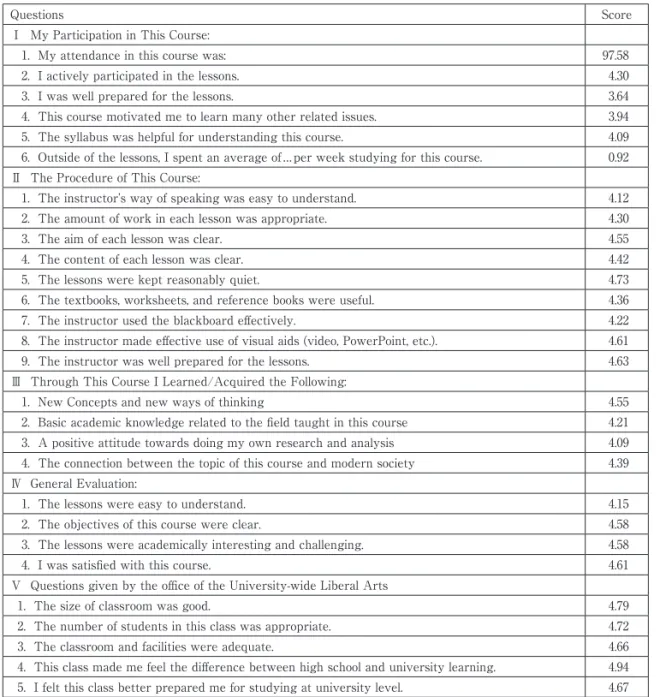
Inthissection,theauthorsanalyzetheresultsoftheclassevaluation2018for,‘LocalPeople’s PerspectivesinSocialDevelopment’(RefertoTable2intheAppendix).
InSectionI~V:Accordingtothetotalresultsoftheclassevaluation2018(seeAppendixI), theaverageofstudents’attendanceinthiscoursewas97.58percent,whichwasduetothe priorityplacedonattendanceandparticipation.Amongthetotalresults,itwasfoundthat therewereonlytwoinstancesofscoresbelow4.0insectionⅠoftheStudents’Participation:
Students’preparation(3.64)andProgressivelearning(3.94).Studentsspentanaverageofjust 0.92hoursperweekpreparingforclasses,whichwaslowerthanexpected,eventhoughadequate preparationwasanimportantexpectationandoneoftherequirements.Thereareseveralissues thatshouldbeaddressedinthefuture.Forexample,theamountofpreparationexpectedofthe studentsshouldbeclearlystatedinthesyllabus.
InSectionII:TheProcedureofThisCoursesectionwashighlyevaluated.Thehighestscore was:Theinstructorwaswellpreparedforthelessons(4.63),followedby;Madeeffectiveuseof slidesorvisualaidsetc.(4.61);Thelessonswerekeptreasonablyquiet(4.73);andTheaimofeach lessonwasclear(4.55).
InSectionIII:ThroughThisCourseILearned/AcquiredtheFollowing,thehighestscorewas:
Acquirednewconceptsandnewwaysofthinking(4.55),followedby;Theconnectionbetween thetopicofthiscourseandmodernsociety(4.39);Basicacademicknowledgerelatedtothefield taughtinthiscourse(4.21);andApositiveattitudetowardsdoingmyownresearchandanalysis (4.09).
InSectionⅣ:ThescoreoftheGeneralEvaluationsectionwerealsoveryhigh:IwasSatisfied withthecourse(4.61);Iimprovedacademicallyinterestingandchallenging(4.58);Theobjectives wereclear(4.58);andThelessonswereeasytounderstand(4.15).
InSectionⅤ:ThequestionsgivenbyLiberalArtsalsoreceivedhighratings.Thesizeof classroom(4.79),Thenumberofstudents(4.72),Theclassroomandfacilities(4.66),Thisclass mademefeelthedifferencebetweenhighschoolanduniversitylearning(4.94),andIfeltthis classbetterpreparedmeforstudyingatuniversitylevel(4.67).
TheauthorsalsoanalyzedthatincooperationwiththeofficesofUniversity-wideLiberalArts tohaveledtosuchevaluations.Inaddition,theofficeoftheeducationalsectioninNiizaCampus alsoprovidedthebestfacilitiesforthecourse.
Below,theauthorsintroduceandanalyzesomeofthestudents’commentsontheclasses(see AppendixII).
“Wecouldunderstandthecurrentsituationoverseas(mainlytheguestlecturers’home region/country)throughslidepreparations,materials,andlecturesbymultipleguestspeakers”.
“ItwasveryattractivetolearnEnglishandlearnaboutsocialdevelopment.Ialsolearned manysocialissuesIdidnotknowbeforetheclass.Theinterestinsocialissuesincreased throughthetopicstaughtbythelecturers”,weresomeoftheresponses.Also,participation intheworkshopswasverypopular.Inaddition,thereisnodoubtthatstudentsthoughtit wasespeciallyavaluableopportunitytobeabletolearnfromseveralofthelecturerswho focusedontheissuesofSyria,Palestine,andIsrael,whichtheJapanesemediatendnottopay muchattentionto.However,itwaspointedoutthatitwasdifficulttosolvetheseserioussocial problemsandthesolutionswerenotclear.
Oneofthestudents’thoughtactivelyrespondedthoughtfully:“IthinkthatIhavereallygained importantpowerbecausetherearefewsuchclasses.Therewasalotoftimetocometoterms withmythoughtsandIwasstimulatedalot.”Also:“Forthefirsttime,IlearnedinEnglishand wasabletoreconsiderthefunofuniversitylearning.”
AtNiizaCampus,thiswasthefirsttimetoinitiateaclass,thatintroducedviewsonsocial issuesthatwastaughtbymultiplelecturers,whichseemstohaveattractedstudents’interest.
Ⅶ.Conclusion
First,theclassplacedanemphasisontheconceptofsocialdevelopment,whichis,needless tosay,aprerequisiteforunderstandingsocialdevelopment.Italsoprovidedstudentswiththe opportunitytolearnhowtheimportanceofsocialdevelopmentcametobeadvocateddueto theperceptionthatlarge-scaledevelopmentundermodernizationleadstoserioussocialissues andcausespovertyindevelopingcountries.Accordingtocommentpapersfromstudents,atthe beginningoftheclass,someofthestudents,althoughaverysmallnumber,wereconfusedabout thedifferencebetweentheconceptsof‘socialdevelopment’and‘economicdevelopment’,sothe authorsreviewedthecontentsandmadesupplementaryexplanationstoclarifythedifference.
Yamazaki’slecturescontributedgreatlytothis,asheofferedananalysisofpreviousresearch aswellashisownextensiveexperienceonsocialdevelopment.Thestudentswereabletodeepen theirknowledgeoftheconceptofsocialdevelopment,thecausesofpoverty,andtheroleofcivil societyandNGOsinpromotingsocialdevelopment.Yamazakiintroducedconcreteexamples hebecamefamiliarwiththroughhisrichexperienceofalmosttwentyyearsofresearchin Cambodia,whichshowedushoweconomicdevelopmentadvocatedunderthemodernization haddeprivedCambodiansoftheirwell-being,endogenousdevelopment,andlifeinforestswith abundantresources.Thestudentsalsolearnedaboutglobalstructuralsocialissues,suchasglobal socialinequalities,andtheconceptsofequalityandequity.
Furthermore,studentsattendingtheclassalsolearnedaboutlocalsocialissuesdirectlyfrom lecturerswhopossessfirst-handgrassrootslevelknowledgeaboutsuchissues.Thatraisedthe students’awareness,sotheybecamemoreinterestedinlearningaboutsocialdevelopment,the criticalglobalsituation,peacebuilding,andsustainablesociety.
Althoughtimewassetasidefordiscussionfollowingeachlecture,atfirst,thestudentswere quitehesitanttoexpressthemselves,especiallyinEnglish.Therefore,Ritchie,whohastaughtat thetertiarylevelinJapanforfifteenyearsandisanativespeakerofEnglish,playedanimportant roleinencouragingthemtogetinvolvedinthediscussion.Hehasagoodunderstandingof Japanesestudents,andhepaidcarefulattentiontotheirneedsandencouragedthemtotakepart indiscussionsbyputtingthemintogroupstohavethemanswerquestionsortodiscussontopics thathadbeenposedbythelecturers.
Changalsoplayedanothervitalrole.Ithelpedthathewasofasimilaragetothestudentsand thatheknewseveralofthempersonally,whichcreatedamorerelaxingatmosphere.Whenthe studentsweresometimesreluctanttooffertheiropinions,hewouldtaketheleadindiscussion
andansweringquestionstobridgethegapwiththelecturer.Healsocreatedacomfortzoneto makethestudentsfeelateasesothattheywouldslowlygetinvolved,ratherthanhavingthem jumpintothedeep-endwhichwouldonlyencourageresistanceandsilence.
Asthesemesterworeon,thestudentsgraduallybecamemorewillingtoactivelytakepartin discussions,questionsandworkshopsandthesesessionscametoplayanimportantroleinthe class.Amongthem,Sato’sworkshopwasparticularlypopular,sinceitgerminatedinteresting responsesfromamongthestudentsandgotthemthinkingdeeplyaboutalternativewaysof measuringeconomicgrowth.Thediscussionalsolivenedupwhenstudentsbegantosharetheir opinionsandideas.
Humanscontinuetoextractnaturalresourcesfromtheearth.Especially,multinational companiescontinuetoexploittheearth’sresources,seekingtomaximizeprofitsbyincreasing productioninaworldwhereglobalizationhasspread.And,althoughconvenientgoods,plastics andothercheapcommoditiesmaybringconveniencetoourlives,thiscausespollutionthat threatenstheearth’sfragileecosystems.Wealsohavetoconsiderthatthesecommoditiescome fromthesweatoflaboursrelativelycheapwagesindevelopingcountries.Whatwecandoto improvetheenvironment,whichalllifedependson?Whyisitimportanttothinkaboutecological processes,ouruseofcommunityresources,reducingplasticandotherwaste,andlivinginan environmentallyfriendlyway?Studentswereexcitedtobeinthisclassbecausetheycameto realizethatitispossibletochangetheworldfromsmallactivities,beginningatthegrassroots level.
Nagl’slecturealsocoveredthegapbetweenidealsandrealitythathehadfeltinthe beginning,thebackgroundtocontemporarymigration,harshrealitiesfacedbyvulnerablepeople, andsomeofthecomplexsocialissuesintheUnitedStates.Thelecturealsofocusedonthe recenttechnologicaladvancesthatarebecomingincreasinglyprominent,suchasinformation technologiesandartificialintelligence.However,willadvancesinmoderntechnologybringabout humanwell-beingorfreedom?
Theauthorsreferredtosomeconcreteexamples.Unfortunately,shortlyafterthesalesof thelatesttabletmodelbeganinMarch2011,oneofthelocalpeople’sfavoritebookstoreswent bankrupt.(24)Therewasacafeteriainsideofit,wherewebrowsedbooksortalkedtoeachother overacupofcoffee.Thebankruptcywasnotonlyduetothesalesofthehardware,butalso thespreadofelectronicbooks,andasurgeofonlinebookshopping.Suchnewtechnologiesare convenientforusersandyieldgreatprofitstolargecompanies,butitmaybesaidthatbecause ofthemthelocalshavelosttheirpreciouscommunity.
Inaddition,throughuniversalizingthelecturer’smaterialandaddingdataandtopicsaboutnot onlyglobalinequalitybutalsoJapaneseissues,theclassbecamelivelier.Forexample,Larmer
mentionedinTheNewYorkTimesMagazine(October17,2018),“InJapan,theultimatehope wasthatwomenwouldnolongerbefacedwiththecruelchoicebetweenremainingsingle(to pursueacareeramongmen),orhavingafamily(andgivingupacareer).Yetmostoftheworkis part-timeandrelativelylowpaid”.Actually,Japan’sGlobalGenderGapscore’srankingwas80th outof151countriesin2006,andfellto125thoutof145countriesin2018.Also,thelowestranks in2018werePoliticalempowerment(125th)andEconomicparticipationandopportunity(117th).(25) StudentshaveagreatinterestinJapaneseworkingwomen’sissuesandtheycordiallywelcomed thesetopicssincetheywereabletodiscusshowtheycouldchangeseriousissuescausedbythe socialstructureinJapan.
Followingthat,fromUpalat,thestudentshadtheopportunitytolearnaboutcertaincrises, theroleofeducationinNGOs’activities,andthepromotionofsocialdevelopmentinThailand, basedonlocalpeople’sendogenousperspectivesatthegrassrootslevel.Also,inthehandout,he quotedNelsonMandela’s(26)wordsthat“educationisthemostpowerfulweaponwhichyoucan usetochangetheworld”.Next,duringDani’slecture,thestudentsalsoconsideredthesewords inconnectionwitheducationinIsrael.Althoughthiswasnotexpectedbeforethebeginningof theclasses,theauthorsfoundacertainconnectionbetweenthesetwolectures.
Thereisaworldouttherethatisusuallyonlymadeknowntousthroughinformationon theinternet,news,radioortelevisioninsideofJapan.Whatisworse,ithasbecomedifficultto distinguishwhethertheinformationistrueorfalse,whichisanegativeaspectsofhavingtoo muchinformationavailableduetorecentadvancesininformationtechnology.
Also,unfortunately,itisalwaysverydifficulttoaccuratelygraspthepresentstateofaffairs, theperipheralcircumstances,whatisactuallyhappeninginconflictzones,andwhatisbehinda conflictorawar.Tohaveanopportunitytolearnaboutzonesofintensiveconflictandthelocal people’sperspectivesfrompersonscomingfromSyriaandIsraelisveryrareinJapan.Forthat reason,DaniandGhamra’slectureswerenothinglessthanextraordinary.Thefourlecturesby thetwoofthemprovidedstudentswithapreciousopportunitytolearnaboutthegravityofthe situationintheabove-mentionedconflictzonesandfactorsbehindconflictandwaringeneral,as wellasabouthowinternationalinterventionshavefailed.Wearesometimesleftspeechlessupon hearinghowsevereandcriticalthecircumstancesfacedbythelocalsare.
Certainly,therearestillnovisibleprospectsforthesolutionofconflictsbetweennations.
Internationalinterventionscan,infact,causevarioussocialproblemsandexacerbatethe confusionontheground.TheauthorsalsodiscussedtheseissueswithGhamraandDani.
Althoughthepositionsofthetwocountriestheycomefromcontainmutuallyincompatible elementsandinternationalorganizationsandinternationalinterventionshavenotbeenableto workoutapeacefulsolutiontotheirborderdisputes,theauthorsandthetwolecturers,onefrom
SyriaandtheotherfromIsrael,allmethereatRikkyoinJapan,andwe,believe,becamefriends.
Thus,toputitsuccinctly,thefirststeptopeacebuildingandfindingsolutionsisatourfeet.The solutionmightbefoundbytranscendingnationsandnationalborders,inplaceswherepeoplecan connectatthegrassrootslevel.
Inotherwords,whatisneededwhenaimingforpeacebuildingistalksandcollaborationatthe grassrootslevel.Humansdesiretoliveinaworldfreeofdiscrimination,weaponsandwar.Wedo notwishtojustbealive-wewouldliketoliveinthisworldashumans.Wewouldliketospend ourlivesinpeace.Ourvoicesarenotweapons!And,weneverdesirewar!Weneedtorecognize theimportanceofpeace.Fightingdoesnotsolveanything.Violenceisnotthesolution.
Dani’slectureanalyzednotonlytheterritorialexpansionandoccupationbyIsraelandits attacksonPalestine,butalso,theexpansionofnuclearpowerandmilitaryspending,aswell thewarpreparationsanddevastationinJapan,whichwasaveryimportantpointinhisspecial lecture.Finally,atthisverymomentPalestinianscontinuetosufferandtheJapanesepeoplemay thinkthattheyhavenothingtodowitheitherthePalestiniansorIsraelis.However,accordingto hislecture,JapanandIsraelhavesomethingincommon.
Heemphasizedthatitwasnecessarytofigureoutwhethertheinformationtheywere receivingwascorrectornot,andtouseusingtheirheartsandbrainstothink.Also,itisvery importantthatweexpressouropinionsandspeakoutagainsttheoftenstrongpowerofthestate.
Wehavetobreakthesilence,stateouropinions,andcontinuewithoureffortstoachieveaworld freeofwarsandnuclearweapons.
Acknowledgement
Theauthorswouldliketoexpresstheirdeepgratitudetothesixguestlecturersfortheir stimulatinglectures,andtotheofficeofRikkyoUniversity-wideLiberalArtsCoursesforits kindsupportandorganization.Specialthanksshouldalsogotothestudentassistant,Chang Chongwoo,aswellastothestudents.Youallcertainlyworkedhardandputalotofeffort andconcentrationintotheclassandwewouldliketothankyouverymuchforyourkind contributions,withoutwhich,theclasswouldnothavebeenthesuccessitwas.Thiscollaborative lectureseriescertainlyfulfilleditsroleinstimulatingandinvokingyouallinthelearningprocess.
Theauthorsareveryproudoftheentireclass,andwishtoexpresstheirsincerethanksto everyoneinvolved.
Lastly,thispaperisdedicatedtoProfessorJunNishikawa,whohadbeenencouraging collaborativeworkforsocialdevelopmentinEnglish.
Additional note
Suzuki’sstudywaskindlysupportedbyGrantAidforScientificResearch(c)byJapan SocietyforthePromotionofSciencesince1999untiltoday.Thelatesttwoworks(inJapanese) are:InternationalLabourMigrationandGlobalization:AStudyontheLivingConditionsof BangladeshiWomenMigrants(GrantNumber26380709,2014-17,bySuzuki,YayoiandSato, Kazuhiko)andAStudyofBangladeshiMigrantsinNewYorkCity:TheLivingConditionsof SecondGenerationMigrants(GrantNumber18K11792,2018-21,bySuzuki,Yayoi).
Appendix I
Table 2: Class Evaluation 2018: Local People’s Perspectives in Social Development
Questions Score
ⅠMyParticipationinThisCourse:
1.Myattendanceinthiscoursewas: 97.58
2.Iactivelyparticipatedinthelessons. 4.30
3.Iwaswellpreparedforthelessons. 3.64
4.Thiscoursemotivatedmetolearnmanyotherrelatedissues. 3.94
5.Thesyllabuswashelpfulforunderstandingthiscourse. 4.09
6.Outsideofthelessons,Ispentanaverageof…perweekstudyingforthiscourse. 0.92
ⅡTheProcedureofThisCourse:
1.Theinstructor’swayofspeakingwaseasytounderstand. 4.12
2.Theamountofworkineachlessonwasappropriate. 4.30
3.Theaimofeachlessonwasclear. 4.55
4.Thecontentofeachlessonwasclear. 4.42
5.Thelessonswerekeptreasonablyquiet. 4.73
6.Thetextbooks,worksheets,andreferencebookswereuseful. 4.36
7.Theinstructorusedtheblackboardeffectively. 4.22
8.Theinstructormadeeffectiveuseofvisualaids(video,PowerPoint,etc.). 4.61
9.Theinstructorwaswellpreparedforthelessons. 4.63
ⅢThroughThisCourseILearned/AcquiredtheFollowing:
1.NewConceptsandnewwaysofthinking 4.55
2.Basicacademicknowledgerelatedtothefieldtaughtinthiscourse 4.21 3.Apositiveattitudetowardsdoingmyownresearchandanalysis 4.09 4.Theconnectionbetweenthetopicofthiscourseandmodernsociety 4.39
ⅣGeneralEvaluation:
1.Thelessonswereeasytounderstand. 4.15
2.Theobjectivesofthiscoursewereclear. 4.58
3.Thelessonswereacademicallyinterestingandchallenging. 4.58
4.Iwassatisfiedwiththiscourse. 4.61
ⅤQuestionsgivenbytheofficeoftheUniversity-wideLiberalArts
1.Thesizeofclassroomwasgood. 4.79
2.Thenumberofstudentsinthisclasswasappropriate. 4.72
3.Theclassroomandfacilitieswereadequate. 4.66
4.Thisclassmademefeelthedifferencebetweenhighschoolanduniversitylearning. 4.94 5.Ifeltthisclassbetterpreparedmeforstudyingatuniversitylevel. 4.67
Appendix Ⅱ
Students’ comments on the Class Evaluation 2018: Local People’s Perspectives in Social Development 1. What specific aspects of the course did you find good, and why?
スライドの準備があったこと、映像資料が豊富だったのがとても良かったです。
毎回違うゲストスピーカーがいらっしゃるのも新せんでした。
ThelessonswerereallyinterestingandIlearnedalotofnewthings.Andmywayofthinkingandpeintofnew changedtoo.
先生が気さくで質問しやすかった、ほんとうにもっとききたいとおもってきょうみをもてた!
英語で行われることによって他の授業より緊張感があったと思う。
色々な海外の方のお話を伺うことができた。
大学の授業として始めて英語で行う科目を学び、大学の学問のおもしろさに改めて考えることが出来た。
たくさんのゲストスピーカーの授業を受け(ら)れる点。
英語でうけるのは貴重なのでよかった。
今現在起きている色々な問題にふれあい、またそこから他の分野にも興味が持てとてもよかったと思いました。
ゲストの方や先生と話すことによって他の授業より先生との距離が深まり理解が深まった。
Noteによる授業で英語を鍛えることができた。
英語も学べるし、社会開発についても学べる点はとても魅力的であったと思う。又、自分の知らなかったことも色々 学ぶことができた。
教員の準備がとても周到で、授業の内容が明確だった。また、ゲストスピーカーに対する感謝の姿勢など人として見 習いたいと思う点があった。
ワークショップがあったりして、周りの人と意見を交わせたのが何より刺激的だった。立教の授業はこういう体系を とっている授業が少ないので、本当に大切な力をつけられたと思う。自分の考えと向きあう時間もふえたし、相手に 刺激されることも沢山あった。1 人でこの授業をとって本当によかった。
授業のやり方がさまざまで楽しかった。
様々なゲストスピーカーに出会えた。明るかった。(雰囲気)
2. Is there anything that can be done to improve this course?
少し教室が寒かったです。
解決策(solution)を生み出すことが出来なかった。
プレゼンの一貫性がないこともあり、つかみにくかった。
Ithinkmoreteamworkandmorequestionsthatmakepeopleparticipate,evenmakeusparticipatebecauseIknow peopleareshyandtheydon’treallywanttoanswerevenwhentheyknowtheanswer.
Notes
(1)SeeSuzukiandRitchie(March2019).
(2)Abriefexplanationoftherelationshipbetweenthecountryorregionandneighboringcountrieswasalsoadded, accordingtoeachtheme.
(3)“Daka”istheoriginalBengalispellingforthecapitalofBangladesh,while“Dhaka”istheEnglishspelling.Inthis paper,theauthorsuse“Daka”toreflectthelocalpeople’sperspectives.
(4)“Kumilla”istheoriginalBengalispellingforthisprefectureofBangladesh,whichiswhytheauthorsuseitinthis paper.InUSEnglish,itis“Comilla”.TheComillaModelwasdevelopedandmanagedbyUSAID,andissomething verydifferentfromthegrassrootslevelendogenousdevelopmentinBangladesh.
(5)SeeSuzuki(2016,IntroductionandChapter1,pp.1-68)fordetailsconcerningtheComillaModel,andtheimpact ithashadonthelivingconditionsofthepoorinKumllla.Also,refertoKhan(1968:1969a:1969b).
(6)FormoredetailsregardingtheMRDPandtheimpact,theprogramhashadonthelivingconditionsofnotjustthe poor,butalsoafewpeoplewithvestedinterestintheDaudkandidistrict,Kumlllaprefecture,seeSuzuki(2016, IntroductionandChapter2,pp.1-40andpp.69-115).
(7)UnitedNationsDevelopmentProgram,HumanDevelopmentReports(http://hdr.undp.org/en/humandev/)<
retrieved:February10,2020 >.
(8)BRAC,HealthyNewbornNetwork(https://www.healthynewbornnetwork.org/partner/brac/)<retrieved:
January23,2020 >.
(9)Suzuki’sresearchatvillageorganizationsinruralBangladesh.
(10)ThisconclusionwasdrawnbasedonSuzuki’sresearchatthebranchofficeandvillageorganizations,especially manyinterviewswithwomenandstaffmembersinDaudkandidistrict,aswellasonherresearchatthecentral officeinDaka.Fordetails,seeSuzuki(2016)andSuzukiandSato(2011).
(11)ThissectionwaswrittenbyYamazaki,himself.Inaddition,thematerialsthathecreatedforthelectureareposted astheyare.Also,refertoGaltung(1969),Naess(1987)andGeddes(1915).
(12)Ibid.
(13)RefertoDemocracyNow(2011).
(14)Op.cit.,afootnote12.
(15)RefertoSlidescreatedbyFutoshiSato.
(16)Ibid.
(17)SummarizedbySuzukiandHans.
(18)SummarizedbySuzukiandUpalat.
(19)SummarizedbyRitchie.
(20)Ritchiewasalsocoordinatorofthespringsemester,2018.SeeSuzukiandRitchie(2018)formoreinformationhis uniqueteachingstyle.
(21)RitchiehasbeentoChristchurchsixtimesbetween2014and2019toconductresearchontheaftermathofthe quakes;thisincludesamonthattheUniversityofCanterburyinAugust2016,throughGrantinAidfromthe InstituteofCollegeandHumanServicesinRikkyoUniversity.
(22)RitchiehasbeentoNairobi,Kenyafourtimesbetween2015and2019forresearchonaslumschoollocatedthe NairobisuburbofKorogochotoworkonthecomputerlaboratoryproject.
(23)Changhasalsoworkedasastudentassistantinthespringsemesterof2018.
(24)Coincidentally,SuzukivisitedBostoninMarch2011andnoticedalonglineinsidethesebookstores.Ithadbecome necessarytosellbooksatsignificantlydiscountedprices,beforeshuttingupshop.Ontheotherhand,displaysof thelatesttabletmodelswerenoticeableinwell-fundedbookstores.Atthebigstore,Idoubtedtheclerk’sviews onthatmatter,“Paperbookswillnotbenecessaryinthefuture”.Recently,newtechnologicaldevelopmenthas accompaniedconflictovermaterials,anditisknownthatthisdeprivespoorpeopleoftheirnaturalresourcesand theirhumanrights,devastatestheircommunitiesandcausesmanykindsofsocialissues.
(25)RefertoWorldEconomicForum(2018)p.139.TherankingofEducationalattainmentwas65thin2018.Even Healthandsurvival’srankfadedout1stof2006to40thof2018(Ibid.).
(26)MandelawasinfluencedbyMahatmaGandhi’sideaofnon-violence.HejoinedtheAfricanNationalCongressthat initiallypursuingnonviolence.However,whenhebecamethepresidentofthecongress,andlater,whilefighting theapartheidsysteminSouthAfrica,hestartedthinkingthatviolentactionwasneeded.RefertoAjgonkar (1995)andBoehmer(2008).Also,SuzukivisitedManiBhavanGandhiSangrahalaya(MahatmaGandhiMuseum) inMumbai,IndiainMarch2019.
References
Abed,FazleHasan(November21,2003)The Emergence of NGOs in Bangladesh: A BRAC Perspective,DhakaCourier.
Ajgonkar,Sri.MeghshyamT(1995)Mahatma: A Golden Treasury of Wisdom—Thoughts and Glimpses of Life,Hripra Publication:India.
Ali,Syed(2010)Dubai: Gilded Cage,YaleUniversityPress:NewHavenandLondon.
Ali,SyedandHartmann,Douglas(2015)Migration,Incorporation, and Change in an Interconnected World,Routledge:New YorkandLondon.
Boehmer,Elleke(2008)Nelson Mandela: A Very Short Introduction,OxfordUniversityPress:Oxford.
Bosman,JulieandMerced,J.DeLaMichael(February16,20117:25am)Borders Files for Bankruptcy in New York Times (https://dealbook.nytimes.com/2011/02/16/borders-files-for-bankruptcy/)<retrieved:February27,2020 >.
Chatterjee,Partha(2007)Post colonialism and the New ImperialisminShaikhNermeen,The Present As History: Critical Perspectives on Global Power,ColumbiaUniversityPress:NewYork,PartTwo,Fifth,pp.71-93.
Comilla-US AID Conference Report(June1963)PakistanAcademyforRuralDevelopmentComilla.
Costanza,Robert,Hart,Maureen,Posner,StephenandTolbertJohn(January2009)Beyond GDP: The Need for New Measures of Progress, Boston University,TheFrederickS,PardeeCenterforthestudyoftheLong-RangeFuture2009 (https://www.bu.edu/pardee/files/documents/PP-004-GDP.pdf)<retrievedFebruary5,2020>.
Dani,Nehushtai(2016)Is it good to die for the country?Kobunken(InJapanese).