鳥飼慎一郎 TORIKAI Shinichiro
Synonyms in Legal Discourse:
A Corpus-based Approach to a New Legal English Dictionary
TORIKAI ShinichiroKey words:
類義語、司法英語、コーパス、発信型、司法英語辞書
legal synonyms, legal discourse, corpus-based, production-oriented, legal English dictionary
Abstract
Legal discourse is full of legal synonyms. Students of law need to spend an enormous amount of time and energy to understand them accurately and to become able to use them properly. This paper aims to set up a model example of a corpus-based, production-oriented legal English dictionary for the non-native English-speaking students of law in order to help them reduce the handicap of learning legal English and to encourage them to compete with the students from diff erent countries in colleges and universities in English speaking countries. With the typical seven legal synonyms: decision, decree, fi nding, judgment, ruling, sentence and verdict, I will review how they are treated in thesauruses, general English dictionaries, and law dictionaries. Then I will take up verdict as an example and demonstrate how this legal technical term is actually used in legal discourse. Finally, I will show a sample model description of verdict in the dictionary.
1. Introduction
1. 1. Synonyms in legal discourse
Legal discourse is full of synonymous words. The words we use almost interchangeably in our daily lives are strictly distinguished and used as separate technical terms. The following two groups of words, for example, look similar in meaning, and for those who have not received professional legal education it is diffi cult to distinguish the one from the other.
(1) prison, jail, gaol, lockup, penitentiary
(2) lawyer, solicitor, barrister, counselor, attorney
How many laypersons can explain how the following terms are diff erent in meaning, and can use them correctly in legal discourse?
(3) act, bill, bylaw, code, decree, edict, enactment, law, ordinance, regulation, rule, statute
Technical discourse in every academic and professional fi eld is inevitably and unavoidably needed to adopt synonymous words to distinguish seemingly similar but technically diff erent phenomena for the sake of accuracy. Legal discourse is no exception.
For example, in law three diff erent terms are intentionally employed to distinguish three diff erent types of crimes involving the killing of others, and the diff erent defi nitions are as follows (Black’s Law Dictionary, 2004):
homicide: The killing of one person by another.
murder: The killing of a human being with malice afterthought.
manslaughter: The unlawful killing of a human being without malice afterthought.
One of the fi rst things the students of law need to do is to become able to distinguish how such technical terms are diff erent from each other.
The purpose of this paper is to explore how these legal technical terms that are seemingly similar in meaning to laypersons (hereafter referred to as legal synonyms) are explained in thesauruses, general English dictionaries, and law dictionaries. Then, I propose a new type of corpus-based, production-oriented legal English dictionary to help non-native, English-speaking law students understand and use legal synonyms properly.
鳥飼慎一郎 TORIKAI Shinichiro
1. 2. Corpus-based, production-oriented legal English dictionary for non-native, English-speaking law students
Masayuki Tamaruya of the Law Department of Rikkyo University and I started a project of compiling a corpus-based, production-oriented legal English dictionary for Japanese law students in 2011. The entire objective of our project is to help Japanese law students who are working to earn a law degree or who are preparing for the bar exams in English-speaking countries. The reason we started this project was because we found that Japanese law students need to spend an enormous amount of time and energy familiarizing themselves with legal English or legal use of English before they are fully embarked on learning law. Japanese law students typically learn legal technical terms or legal expressions randomly; that is, they learn them in the order they encounter them.
They do not know how frequently those legal terms are actually used in legal discourse while they are learning them. In short, the learning of new legal terms is time-consuming and ineffi cient.
Even if Japanese law students acquire enough legal English after the long process of trial and error, their knowledge of legal English remains in themselves and it cannot be shared with other Japanese law students. Consequently, every Japanese law student repeats basically the same learning process. We think this is very unproductive and a waste of time. We believe that by accumulating the knowledge of legal English in the form of a legal dictionary we can pass on the legal English knowledge the former generation of the Japanese students has faced to the next generation in order to help the forth-coming generation start from the stage where the former generation fi nished.
2. Objectives, Data, and Methodology
2. 1. ObjectivesThe objectives of this paper are twofold. First, we investigate how legal synonyms are shown and explained in thesauruses, general English dictionaries and law dictionaries.
Second, we propose a model example of how these legal synonyms will be featured in our corpus-based, production-oriented legal dictionary.
The legal synonyms discussed are:
decision, decree, fi nding, judgment, ruling, sentence, verdict.
These seven legal synonyms all designate the judicial conclusion of the legal case.
2. 2. Data
I am going to use the following corpus data which Tamaruya and I collected for the project of compiling a corpus-based, production-oriented legal dictionary. This project is supported by the Japanese government Grants-in-Aid for Scientifi c Research (#90180207).
The corpora I am going to use in this paper are as follows:
UK Supreme Court Judgments issued in 2008 (UK JDG): 1,451,263 words US Supreme Court Judgments issued in 2008 (US JDG): 1,574,403 words UK law journals issued in 2008 (UK LJ): 1,267,048 words
US law journals issued in 2008 (US LJ): 1,303,223 words
We downloaded the above date from the following offi cial sites:
http://www.supremecourt.gov.uk/
http://www.supremecourt.gov/
UK law journals we used to compile our UK Law Journal Corpus are:
Cambridge Law Journal (2008), Oxford Journal of Legal Studies (2008), Law Quarterly Review (2008), Edinburgh Law Review (2008), Modern Law Review (2008)
US law journals we used to compile our US Law Journal Corpus are:
Harvard Law Review (2008), Stanford Law Review (2008), Columbia Law Review (2008), Yale Law Journal (2008), The University of Chicago Law Review (2008), New York University Law Review (2008), Michigan Law Review (2008), University of Pennsylvania Law Review (2008), California Law Review (2008), Virginia Law Review (2008), Duke Law Review (2008), Northwestern University Law Review (2008), Cornell Law Review (2008), Georgia Law Review (2008)
2. 3. Methodology
I am going to use the corpus software Sketch Engine and some statistical indexes built into the software.
鳥飼慎一郎 TORIKAI Shinichiro
3. Legal synonyms in conventional dictionaries
3. 1. ThesaurusesSynonyms are traditionally dealt with in a thesaurus1, 2). A thesaurus is a collection of groups of different words having similar meanings. Many thesauruses have been published since 1805 when Peter Mark Roget fi rst compiled an original form of the present day thesaurus, but almost all of them are basically edited on the same principle:
grouping together the words that have similar meanings. They do not explain how the listed words in the same group are diff erent from each other, nor show how they are actually used in the real world. Kipfer (2001: xiii) aptly explains what a thesaurus is for, in contrast with a dictionary as follows:
A dictionary will tell you many things about a word–spelling, pronunciation, meaning, and origins. You use a thesaurus when you have an idea but do not know or cannot remember, the word or phrase that expresses it best or when you want a more accurate or eff ective way of saying what you mean.
Below is an example entry of a legal term in a traditional thesaurus. Longman Synonym Dictionary (1979) lists 20 synonyms of verdict as follows:
verdict, n. decision, fi nal decision, judgment, adjudication, Law. award, Sport. call;
determination, resolution, settlement, arbitration, arbitrament; finding, conclusion, Law. opinion, ruling, Law. sentence, decree, edict, order, command.
These 20 synonyms are divided into three subsections where we can fi nd semantically more coherent synonyms. On the other hand, Collins Thesaurus the Ultimate Wordfi nder from A to Z (1995) lists seven synonyms of verdict, and arranges them in alphabetical order as follows:
verdict adjudication, conclusion, decision, fi nding, judgment, opinion, sentence
Although the number of synonyms and the way they are arranged are diff erent in these two thesauruses, the approach is basically the same: showing a list of words or phrases of similar meaning. Yet, users cannot understand how these synonyms are used and how they should use these synonyms in legal discourse.
Recent thesauruses are more user-friendly in that some of them show how the headword is used. Concise Oxford Thesaurus (2002) lists an example phrase or an example
sentence of some headwords. Oxford Thesaurus of English (2009) (hereafter OTE for short) attaches an example use for each sense of the headword taken from the Oxford English Corpus. The example use is shown in italics and the closest synonym in meaning is in bold. Let us see how the seven legal synonyms we are investigating are shown in the OTE below. Due to space limitinations, I will only list the group of the words used in the legal sense with which we are concerned.
decision NOUN 2 they’re delighted with the judge’s decision: verdict, fi nding, ruling, recommendation, judgement, pronouncement, adjudgement, adjudication, arbitration; sentence, decree, order, rule, injunction; fi ndings, results; Law determination; N. Amer. resolve; rare arbitrament.
decree NOUN 2 the council succeeded in obtaining a court decree against him;
judgement, verdict, adjudication, ruling, rule, resolution, arbitration, decision, conclusion; fi ndings.
fi nding NOUN 2 (often fi ndings) he appealed against the tribunal’s fi ndings:
conclusion, result; decision, verdict, pronouncement, judgement, ruling, rule, decree, order, recommendation, resolution; Law determination; N. Amer. resolve.
judgement NOUN 2 a country-court judgement: verdict, decision, adjudication, ruling, pronouncement, decree, fi nding, conclusion, determination; sentence.
ruling NOUN the judge’s ruling was slammed by medical experts and union leaders: decision, pronouncement, resolution, decree, determination, injunction;
judgement, adjudication, fi nding, verdict; sentence.
sentence NOUN 1 Jones showed no emotion as the judge passed sentence:
judgement, ruling, pronouncement, decision, determination, decree; verdict;
punishment.
2. her husband is serving a three-year sentence for fraud: prison term, prison sentence, jail sentence, penal sentence; life sentence, suspended sentence;
INFORMAL time, stretch, stint; BRIT. INFORMAL porridge; N Amer. informal rap;
rhyming slang bird.
verdict NOUN the coroner recorded a verdict of death by misadventure:
judgement, adjudication, adjudgement, decision, fi nding, ruling, resolution,
鳥飼慎一郎 TORIKAI Shinichiro
pronouncement, decree, order, settlement, result, conclusion, opinion, prognosis, conviction, assumption, presumption; sentence, punishment; N. Amer. resolve;
Law determination.
It is interesting to notice that the above seven synonyms (decision, decree, fi nding, judgement, ruling, sentence, verdict) repeatedly appear in the synonym set of the other six legal synonyms. Some of these legal synonyms are even closer to the headword than other synonyms in meaning: verdict is a core synonym of judgement, and judgement is a core synonym of verdict, decree and sentence; verdict is a core synonym of decision;
decision is a core synonym of fi nding; decision and judgement are core synonyms of ruling.
This heavily interconnected relationship among the seven synonyms can be illustrated as follows:
sentence Ќ
verdict я judgement Ў Ў Ў decision Ѝ ruling decree
Ў finding
The above chart indicates that the term judgement is the core of cores, but it is not clear how these seven synonyms are similar or diff erent in use.
3. 2. General English dictionaries
General English dictionaries, both bilingual and monolingual, are useful to learn these legal synonyms. Many English dictionaries commonly list some synonyms beside the headword. Kenkyusha’s New English-Japanese Dictionary (2002) lists some synonyms of judgment in parentheses as follows:
judgment /ʤʌʼʤmənt/ n 1a 判決; 審判 (cf. court order, decree 2, sentence, verdict)
The same dictionary explains in detail some well-known legal set phrases and set expression of verdict in Japanese as follows:
verdict /vɚʼ:dɪkt | vəʼ:-/ n. 1〘法 律〙(小 陪 審 の)評 決、答 申(cf. jury11): a ~ for the plaintiff 原告勝訴の評決/ a special ~特別評決⦅陪審が法の運用に疑義を生じ
た場合に事実の審理を止めて判決を裁判官に一任するもの;刑事事件では極めてま れ⦆/ ⇨ open verdict, partial verdict, privy verdict, sealed verdict / bring in [return, deliver, give] a ~“guilty”[“not guilty”]有罪〔無罪〕の評決を下す / The ~ was in. 評決が下された.
Collins COBUID Advanced Learner’s English Dictionary (2006) lists two synonyms, i.e. verdict and ruling, beside the defi nition of judgment in legal use as follows:
3 A judgment is a decision made by a
N-VAR
judge of by a court of law. □The industry was
= verdict,
awaiting a judgment from the European Court.
ruling
These additional descriptions function as a kind of cross-reference to the headword.
One of the great assets of general English dictionaries is that they list example phrases and/or sentences to show how the headwords are used. Those example phrases and sentences used to be written by the dictionary writers, but are often criticized as being unauthentic and unnatural. The Collins COBUILD Series (Sinclair et al. 2006) are unprecedented in the sense that the example phrases and sentences are taken from their own corpus, the Bank of English. In order to provide further information to help users, many of the general English dictionaries published recently create a special corner where the users can fi nd synonyms and collocations (Inoue & Akano 2013, Mayer et al. 2009, Konishi & Minamide et al. 2006).
Let us see how these six legal synonyms are dealt with in general English dictionaries.
The following are quotes from the Longman Dictionary of Contemporary English (2009) (hereafter LDOCE for short), a representative of general English dictionaries for ESL/EFL learners.
decision 3 [U] the act of deciding something: The Court has the ultimate power of decision.
decree 2 a judgment in a court of law
fi nding 2 law a decision made by a judge or JURY
judgement 3 LAW [C,U] an offi cial decision given by a judge or a court of law:
The company were fi ned £6 million, following a recent court judgment.
鳥飼慎一郎 TORIKAI Shinichiro
ruling [C] an offi cial decision, especially one by a court: [+on] the recent Supreme Court ruling on defendants’ rights
sentence 2 a punishment that a judge gives to someone who is guilty of a crime: She received an eight-year prison sentence. | He has just begun a life sentence for murder.
verdict n 1 an offi cial decision made in a court of law, especially about whether someone is guilty of a crime or how a death happened: The verdict was ‘not guilty’.
The Kenkyusha Dictionary of English Collocation (electronic version) (2005) (hereafter KDEC for short) is the fi rst full-scale collocation dictionary in Japan. The preface to the dictionary explains that all the example phrases and sentences were originally taken from the Kenkyusha English Corpus, and then they were rewritten by the native English-speaking writers. The following are the collocations of verdict listed in this dictionary (due to the space limitations in this paper, Japanese translations are omitted):
♦accept a verdict
•accept the verdict of the majority
♦The next day the verdict was announced in court.
♦appeal a verdict
♦await a verdict
♦The jury brought in a verdict of manslaughter against….
•The coroner brought in a verdict of death by suicide due to temporary insanity.
•bring in a verdict of “not proven”
♦carry out a verdict
♦The union defi ed [ignored] the verdict of the court and continued their strike.
♦deliver a verdict
♦The verdict of his teacher was fulfi lled by his future career.
♦The lawyers managed to get [obtain] a verdict “not guilty.”
♦A verdict of £12,000 damages and costs was given against….
♦after the verdict was handed down
♦hear a verdict
♦overturn a verdict
♦pass a very unfavorable verdict on Carlyle
♦The prisoner shook nervously as the judge pronounced the verdict.
♦quash a verdict
♦The jury has failed to reach a verdict.
•Ladies and gentlemen of the jury, have you reached a verdict?
♦after the verdict was read
♦reject sb’s verdict
♦return a verdict to the eff ect that…
•return a verdict of “guilty”
♦Later critics reversed the verdict.
♦set aside a verdict
♦sustain a verdict
♦like a culprit waiting (for) the verdict
•waiting (for) the verdict of time
This dictionary is quite helpful in fi nding the possible collocations used in general English discourse; however, important information about the headwords, such as frequencies of use, genres in legal English, regional distinctions, and historical backgrounds, are absent.
We will closely compare the collocations of these legal synonyms in general English dictionaries and in legal discourse later.
So far we have explored how legal technical terms are treated in general English dictionaries. General English dictionaries are edited to meet the demands and request of the general users who read and write general discourse, and do not assume that legal professionals are the primary audience. Consequently, they do not list enough legal technical terms, nor do they show enough about how such terms are used in legal discourse. This is why general English dictionaries are not satisfactory to the learners of legal English.
3. 3. Law dictionaries
Law dictionaries are superb in precise and exhaustive defi nitions. Dictionary of Anglo- American Law (1991) lists 13,000 English legal terms and phrases, and explains them in Japanese. Black’s Law Dictionary (2004) includes more than 24,500 legal terms and phrases, and also provides more than 2,000 example quotations from scholarly works. Let us see how the seven legal synonyms are described in Black’s Law Dictionary.
decision, n. 1. A judicial or agency determination after consideration of the facts and the law, esp., a ruling, order, or judgment pronounced by a court when considering or disposing of a case. See JUDGMENT (1); OPINION (1).
鳥飼慎一郎 TORIKAI Shinichiro
decree, n. 1. Traditionally, a judicial decision in a court of equity, admiralty, divorce, or probate – similar to a judgment of a court law <the judge’s decree in favor of the will’s benefi ciary>. 2. A court’s fi nal judgment. 3. Any court order, but esp. one in a matrimonial case <divorce decree>. See JUDGMENT; ORDER (2);
DECISION.
fi nding of fact. A determination by a judge, jury, or administrative agency of a fact supported by the evidence in the record, usu. presented at the trial or hearing <he agreed with the jury’s fi nding of fact that the driver did not stop before proceeding into the intersection>. ―Often shortened to fi nding. Cf.
CONCLUSION OF FACT; CONCLUSION OF LAW.
judgment. 1. A court’s fi nal determination of the rights and obligations of the parties in a case. ● The term judgment includes an equitable decree and any order from which an appeal lies. … Cf. RULING (1); OPINION (1).
ruling, n. 1. The outcome of a court’s decision either on some point of law or on the case as a whole. … Cf. JUDGMENT (1); OPINION (1).
sentence, n. The judgment that a court formally pronounces after fi nding a criminal defendant guilty; the punishment imposed on a criminal wrongdoer <a sentence of 20 years in prison>.
verdict. 1. A jury’s fi nding or decision on the factual issues of a case.
Garner’s Dictionary of Legal Usage (2011) explains how these seven legal synonyms are diff erent in legal use as follows:
decree; judgment. Traditionally, judicial decisions are termed decrees in courts of equity, admiralty, divorce, and probate; they are termed judgments in courts of law. ...
Nevertheless, in modern usage decree is broad enough to refer to any court order, whether or not the relief granted or denied is equitable in nature. … See judgment (c).
decision; opinion; judgment. Technically, in the U.S., judges are said to write opinions to justify their decisions or judgments; they do not write decision or
judgments. … See JUDGMENTS, APPELLATE-COURT & opinion. Cf. speech.
fi nding; holding. A court properly makes fi ndings of fact and holdings or conclusions of law. …
In appellate courts, properly, only holdings are affi rmed, whereas factual fi ndings are disturbed only when clearly erroneous, against the great weight of the evidence, etc., depending on the standard of review. Generally, it is not correct for an appellate court to say that it affi rms a fi nding of fact.
Nor should the verb fi nd be used when the court rules on a point of law….
judgment. A. Spelling. Judgment is the preferred form in AmE and seems to be preferred in British legal texts, even as far back as the 19th century. Judgement is prevalent in British nonlegal texts, and was thought by H. W. Fowler to be the better form; Glanville Williams states that, in BrE, “judgement should really be the preferred spelling.” Learning the Law 153 (11th ed. 1982). Not in AmE.
B. AmE & BrE Senses. In AmE, a judgment is the fi nal decisive act of a court in defi ning the rights of the parties. It “includes a decree and any order from which an appeal lies.” Fed. R. Civ. P. 54(a).
In BrE, judgment is commonly used in the sense in which judicial opinion is used in AmE: “The facts of this case, which are fully stated in the judgment of Lord Hanworth M. R., were briefl y as follows.” Payne v. Cardiff Rural Dist. Council, [1932] 1 K.B. 241, 241. Continental legal systems likewise use judgment in this way.
See JUDGMENTS, APPELLATE-COURT, decision & opinion.
C. And decree. Though decree is traditionally the term for a fi nal disposition in equity, the term judgment applies, in most American states, to the fi nal disposition made by a court in an equitable as well as in a legal proceeding. See Restatement of Judgments, Intro. at 3(1942). See decree.
D. Court judgment. This phrase is a REDUNDANCY, though perhaps an understandable one when the likely readers are nonlawyers. For example, the title of the following book might have miscued general readers if the word court had been removed: Gine G. Scott et at., Collect Your Court Judgment (1991).
E. And verdict. See verdict (D).
ruling. A ruling is the outcome of a court’s decision either on some point of law (such as the admissibility of evidence) or on the case as a whole. The word is not synonymous with opinion, as here wrongly suggested: “The district court…issued
鳥飼慎一郎 TORIKAI Shinichiro
a thoughtful 159 page ruling [read opinion] that discusses in meticulous detail all aspects of the testing as well as each claim in Cooper’s petition.” Cooper v. Brown, 565 F.3d 581, 639 (9th Cir. 2009). See JUDGMENTS, APPELLATE-COURT. Cf.
opinion.
verdict. A. Etymology. Voir dire is etymologically equivalent to verdict, having passed into English through French. Verdict came through Anglo-Norman (verdit) but was refashioned after the medieval Latin vere dictum or verdicum, itself based on the French verdict. See voir dire.
B. Who Hands Down. Juries, not judges, hand down verdicts (both civil and criminal). Strictly, verdicts are returned by juries, although we have the lay colloquialisms to pass a verdict on and to give a verdict on. Cf. sentence.
C. Verdict for vote. The jury collectively renders a verdict; individual jurors tender votes, not verdicts…
D. Verdict for judgment. In journalistic references to appellate-court judgments, this error is frequent…
3. 4. Linguistic researches on synonyms
Synonyms have been investigated by many linguists and teachers of English for many years. However, more studies on synonyms are becoming corpus-based in today’s world.
Yamazaki (1998) analyzed how respect, esteem and regard were used diff erently based on the COBUILD Direct, and compared the descriptions of these three verbs in the fi ve popular learner’s English-Japanese dictionaries. Yagi & Umesaki (1998) argued two different verbs, injure/injury and wound, from the viewpoint of intentionality and synonymy. Otani (1998) studied six confusing synonymous verbs, defend, guard, protect, safeguard, shield, shelter and tried to explain how they are diff erent. Kita (1999) compares appear with look, and discussed the possibility that these two verbs are complementarily distributed. Inoue (2001) examined how happen and take place are used from three diff erent perspectives by using the COBUILD Direct. Shimada (2003) advocated that synonym descriptions in English-Japanese dictionaries be improved by using corpus fi ndings. Ishikawa (2004) attempted a corpus-based approach to explain how sorrow, grief and sadness are diff erent. Nishina (2008) tried to fi nd possible synonyms of recession by using parallel corpora. Inoue (2010) investigates nouns and verbs that quiet and silent collocate with based on the Bank of English. Umesaki (2013) studied how synonymous words investigate, examine, explore, and analyse/analyze are diff erent by using the BNC and the ukWaC .
3. 5. Summary
We have examined how legal technical terms are dealt with in thesauruses, general English dictionaries, and law dictionaries. We can summarize the strengths and weaknesses of each group as follows:
Thesauruses are strong at showing a great number of synonyms at one time, but generally weak at explaining how they are diff erent and how they are actually used in legal discourse.
General English dictionaries are strong at giving comprehensive information on the headword, and particularly good at showing the example use of the headwords, but weak at giving professional explanation of the legal terms and practical information on how to use them in legal discourse.
Law dictionaries are strong at giving professional defi nitions of the legal technical terms and phrases, but weak at demonstrating how they are actually used in legal discourse.
Our corpus-based, production-oriented legal English dictionary should be the one that makes up for those weaknesses of thesauruses, general English dictionaries and law dictionaries.
4. Proposal
―a corpus-based, production-oriented legal English dictionary for non-native, English-speaking students of law
We have looked over thesauruses, general English dictionaries, and law dictionaries, and discussed briefl y their strengths and weaknesses. Based on the discussion we have had, I propose a new type of corpus-based, production-oriented legal English dictionary as a conclusion to this paper. The discussion so far tells us that in order to make the new legal English dictionary innovatively useful, the information of the frequency and collocation about headwords is indispensable.
4. 1. Frequencies of the seven legal synonyms
First, I would like to investigate how the seven legal synonyms we have been focusing at are actually used in legal discourse. The following Table 1 and Figure 1 show
鳥飼慎一郎 TORIKAI Shinichiro
how frequently these seven legal terms are actually used in our four legal corpora.
Table 1 Frequencies of seven Legal Terms in our Legal Corpora per million
UK JDG UK LJ US JDG US LJ Total
decision 1509.0 1081.3 1064.5 1313.7 4968.5
decree 2.1 10.3 69.2 29.2 110.8
fi nding 178.5 129.4 164.1 172.6 644.6
judgment 856.5 491.3 892.4 570.9 2811.1
ruling 55.1 43.4 74.3 248.6 421.4
sentence 576.7 86.0 388.7 144.3 1195.7
verdict 15.2 7.9 92.1 110.5 225.7
0 200 400 600 800 1000 1200 1400 1600
decision decree ϔg judgment ruling sentence verdict UK JDG UK LJ US JDG US LJ
Figure 1 Frequencies of the seven legal synonyms per million
Table 1 and Figure 1 present a lot of important information that traditional thesauruses and dictionaries fail to provide concerning these seven legal synonyms. The fi rst is their frequency diff erences. The most frequent term is decision appearing 4968.5 times per million running words, and the least frequent term is decree occurring 110.8 times per million in our four legal corpora. The disparity is about 45 times. Thus, it is clear that those seven legal synonyms are not equally used in number in legal discourse. The second is the regional diff erence. Table 1 shows that decision, fi nding, judgment and sentence are almost evenly used in the United States and the United Kingdom. Meanwhile, Table 2 shows more clearly decree, ruling and verdict are predominantly used in the US.
Table 2 Frequencies of decree, ruling and verdict per million (regions) decree (US: 98.4 vs UK: 12.4)
ruling (US: 322.9 vs UK: 98.5) verdict (US: 202.6 vs UK: 23.1)
This result indicates that some legal terms are regionally imbalanced with regard to usage.
The third is the genre diff erence. Table 3 below illustrates that judgment and sentence are more frequently used in the Judgments in both countries. Therefore, it is clear that these two terms are more favored in the genre of courts’ judgments than in law journals. The way ruling is used in legal discourse is somewhat more complicated. It is popular in US law journals, but not in UK Judgments, in UK law journals, or in US Judgments. It seems that both regional and genre factors are involved in determining the frequency of ruling in legal discourse.
Table 3 Frequencies of judgment, sentence and ruling per million (genres) judgment (JDG: 1748.9 vs LJ: 1062.2)
sentence (JDG: 965.4 vs LJ: 230.3) ruling (USLJ: 248.6 vs the rest: 172.8)
In sum, the frequencies of these seven legal synonyms are diverse in legal discourse.
Thus, it is self-evident that in order to help law students understand these seven legal synonyms correctly and to become able to use them properly in legal discourse, it is necessary to include regional and genre factors as key perspectives in legal English dictionaries.
4. 2. Collocations
It is often said that words are not used alone, they are used together with other words (Firth 1957, Hori et al. 2009, Hori 2009). This is why general English dictionaries provide more information about collocations these days. The following shows how the word verdict collocates with other words in LDOCE.
COLLOCATIONS VERBS
reach/arrive at a verdict (=agree on a decision) The jury failed to reach a verdict.
return/give/announce/deliver a verdict (=offi cially say what a verdict is) The inquest jury returned a verdict of ‘unlawful killing’.
consider your verdict (=think about what it should be) The jury retired to consider
鳥飼慎一郎 TORIKAI Shinichiro
their verdict.
ADJECTIVES/NOUN + verdict
a unanimous verdict (=when the whole jury agrees) The jury found him guilty by a unanimous verdict.
a majority verdict BrE (=when most of the jury agrees)| a guilty/not guilty verdict | an open verdict BrE (= stating that the facts about someone’s death are not known)
PHRASES
a verdict of guilty/not guilty
The above list looks rather exhaustive and explains typical collocations of verdict. However, you may wonder if the term verdict is used in legal discourse in the same way as general English dictionaries explain. In order to fi nd the answer to this question, I investigated how verdict is actually used in our four legal corpora. The reasons I chose verdict for my sample investigation are twofold: (a) the way this term is used in the UK and in the US are diff erent quantitatively and qualitatively, so that we may be able to fi nd some interesting regional and genre discrepancies in the use of this term in the UK and in the US legal discourse; and (b) although the term verdict is basically a legal term, this term is rather well illustrated in general English dictionaries, so we may expect some interesting diff erence between the way this term is explained in general English dictionaries and the way this term is actually used in legal discourse.
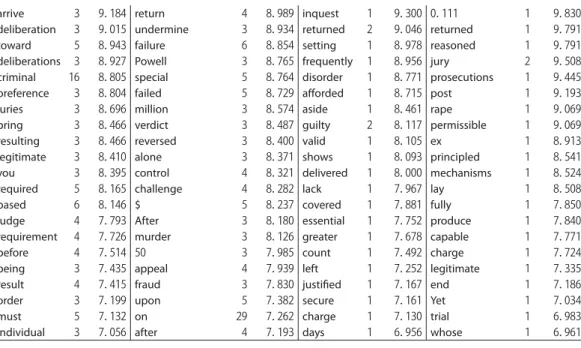
Table 4 shows the words that occur within fi ve words to the right and the left of verdict in our four legal corpora. (Hereafter all the frequencies are not normalized.)
Table 4
USLJ USJDG UKJDG UKLJ
corpus size 1,303,223 corpus size 1,574,403 corpus size 1,451,263 corpus size 1,267,048 frequency of verdict 144 frequency of verdict 145 frequency of verdict 22 frequency of verdict 10
No logDice No logDice No logDice No logDice
unanimous 22 11.913 jury 54 11.131 narrative 2 10.752 unmotivated 1 11.541
jury 40 11.570 acquittal 10 10.715 coroner 2 10.574 untutored 1 11.300
attaches 7 10.415 reach 17 10.653 convicting 1 10.415 abandoning 1 11.193
reach 10 10.177 returned 7 10.222 culminate 1 10.415 reporter 1 11.193
legitimacy 10 10.157 guilty 10 10.046 jury 9 10.382 forwarded 1 11.193
guilty 7 9.593 counts 8 9.840 criticising 1 10.300 idiosyncratic 1 11.093
requiring 7 9.504 NGI 4 9.516 acquittal 2 10.093 Guilty 1 11.000
reaching 4 9.476 confi dence 4 9.461 inaccurate 1 10.093 punishments 1 10.830 rendered 4 9.438 breach-of-contract 3 9.290 routinely 1 9.956 jurors 1 10.476
agree 5 9.403 presently 3 9.245 suspects 1 9.913 aspirations 1 10.476
correct 5 9.240 inconsistent 5 9.240 Fusilier 1 9.574 generating 1 10.356
jurors 4 9.238 grounded 3 9.184 Gentle 1 9.476 homicide 1 10.356
ultimate 4 9.232 inability 3 9.101 demand 1 9.445 Anglo-American 1 10.142
trial 9 9.184 devices 3 9.061 cast 1 9.445 culpable 1 10.142
arrive 3 9.184 return 4 8.989 inquest 1 9.300 0.111 1 9.830
deliberation 3 9.015 undermine 3 8.934 returned 2 9.046 returned 1 9.791
toward 5 8.943 failure 6 8.854 setting 1 8.978 reasoned 1 9.791
deliberations 3 8.927 Powell 3 8.765 frequently 1 8.956 jury 2 9.508
criminal 16 8.805 special 5 8.764 disorder 1 8.771 prosecutions 1 9.445
preference 3 8.804 failed 5 8.729 aff orded 1 8.715 post 1 9.193
juries 3 8.696 million 3 8.574 aside 1 8.461 rape 1 9.069
bring 3 8.466 verdict 3 8.487 guilty 2 8.117 permissible 1 9.069
resulting 3 8.466 reversed 3 8.400 valid 1 8.105 ex 1 8.913
legitimate 3 8.410 alone 3 8.371 shows 1 8.093 principled 1 8.541
you 3 8.395 control 4 8.321 delivered 1 8.000 mechanisms 1 8.524
required 5 8.165 challenge 4 8.282 lack 1 7.967 lay 1 8.508
based 6 8.146 $ 5 8.237 covered 1 7.881 fully 1 7.850
judge 4 7.793 After 3 8.180 essential 1 7.752 produce 1 7.840
requirement 4 7.726 murder 3 8.126 greater 1 7.678 capable 1 7.771
before 4 7.514 50 3 7.985 count 1 7.492 charge 1 7.724
being 3 7.435 appeal 4 7.939 left 1 7.252 legitimate 1 7.335
result 4 7.415 fraud 3 7.830 justifi ed 1 7.167 end 1 7.186
order 3 7.199 upon 5 7.382 secure 1 7.161 Yet 1 7.034
must 5 7.132 on 29 7.262 charge 1 7.130 trial 1 6.983
individual 3 7.056 after 4 7.193 days 1 6.956 whose 1 6.961
4. 2. 1. Unanimous verdict
LDOCE lists unanimous verdict on top under the ADJECTIVES/NOUNS + verdict category of COLLOCATIONS. In our four legal corpora unanimous appears with verdict(s) 23 times in the US LJ corpus and twice in the US JDG. Table 5 shows how unanimous collocates with verdict in the US LJ.
Table 5 Collocations of unanimous verdict
unanimous verdict(s) 9
unanimous jury verdict(s) 6
unanimous criminal verdict(s) 2 unanimous criminal jury verdict 3 criminal jury verdicts be unanimous 1 criminal verdicts be unanimous 1 correct verdict was a unanimous one 1
Unanimous verdict shown in LDOCE occurs nine times out of 23 in the US LJ, but the remaining 14 examples shown above are used either with other adjectives before verdict or used as a predicative adjective. This corpus fi nding suggests that a simple collocation of unanimous verdict is not the only possibility that unanimous collocates with verdict.
4. 2. 2. Guilty verdict, not guilty verdict, open verdict, and majority verdict
In addition to unanimous verdict, LDOCE lists the above four collocations. Guilty verdict
鳥飼慎一郎 TORIKAI Shinichiro
occurs 17 times in total in our four legal corpora: 6 (US LJ), 9 (US JDG), 1 (UK LJ), 1 (UK JDG). Not guilty verdict occurs only three times in the US JDG. The following two examples are the related examples of verdict of not-guilty, but they are used in more complicated structures in legal discourse.
only a verdict of guilty or not-guilty satisfi es the instruction (US LJ)
Nor, I think, would a verdict against B of not guilty of murder, (UK JDG)
Open verdict does not occur, and majority verdict only occurs once in the form of a simple- majority verdict in the US LJ.
4. 2. 3. Collocations not found in a general English dictionary
The following collocations are rather frequent in legal discourse, but are not found in general English dictionaries or law dictionaries.
jury verdict
This collocation occurs 19 times in the US LJ, 24 times in the US JDG, and zero times in the UK LJ and in the UK JDG. In some examples jury verdict is premodifi ed by some nouns and adjectives, and in some examples it is postmodifi ed by a prepositional phrase.
The $50 million adverse jury verdict had been entered before the election (US JDG)
The earliest record of a unanimous jury verdict dates back to 1367. (US LJ)
both consecutive and concurrent sentences are authorized after only a jury verdict of guilt (US JDG)
jury’s verdict
Jury’s verdict appears in the US LJ four times, in the US JDG 16 times, in the UK LJ zero times, and in the UK JDG seven times. Similarly to the case of jury verdict, jury’s verdict is often modifi ed by an adjective, a noun or a prepositional phrase in legal discourse as shown below:
The jury’s verdict shows that they accepted the case for the prosecution (UK JDG)
the jury's not-guilty verdict on the fraud counts (US JDG)
the jury's securities fraud verdict was not necessary (US JDG)
an apparent inconsistency between a jury's verdict of acquittal on some counts and its failure to return a verdict on other counts (US JDG)
legitimacy and legitimate with verdict
The noun legitimacy and its adjective legitimate seem to co-occur closely with verdict in legal discourse. Legitimacy co-occurs with verdict in the US LJ 10 times, and legitimate co-occurs with verdict in the US LJ three times and in the UK LJ once. In the four examples out of 10 in the US LJ, legitimacy co-occurs with verdict in the structure of legitimacy of verdict or in the same structure with some more modifi ers as follows:
only enhances the legitimacy of verdicts arrived at through that system. (US LJ)
public acceptance of the legitimacy of jury verdicts (US LJ)
the symbolic legitimacy of the ultimate verdict as a community pronouncement.
(US LJ)
the legitimacy associated with an actual verdict (US LJ)
Legitimate and verdict seem to be compatible with each other in legal discourse as well. This is probably because the validity of verdict often becomes the issue of debate in the court of law.
would be perceived as more legitimate than a verdict rendered by a single judge (US LJ)
the verdict appears more legitimate if one perceives (US LJ)
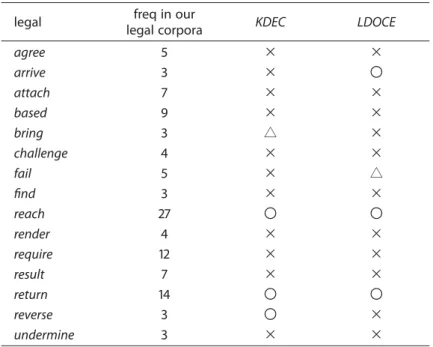
As we saw in 3. 2., the KDEC lists 25 verbs and verb phrases that collocate with verdict, and LDOCE shows seven verbs which collocate often with verdict. Do these verbs and verb phrases actually collocate with verdict in legal discourse, and are there any other verbs and verb phrases that collocate well with verdict in legal discourse? To fi nd the answer I checked all the verbs that are counted more than twice in Table 4. with the verbs and verb phrases listed as the collocates in the KDEC and LDOCE. The following Table 6 is a list of the verbs that collocate with verdict more than twice in our legal
鳥飼慎一郎 TORIKAI Shinichiro
corpora:
Table 6 The collocate verbs of verdict in the KDEC and the LDOCE
legal freq in our
legal corpora KDEC LDOCE
agree 5 × ×
arrive 3 × 〇
attach 7 × ×
based 9 × ×
bring 3 △ ×
challenge 4 × ×
fail 5 × △
fi nd 3 × ×
reach 27 〇 〇
render 4 × ×
require 12 × ×
result 7 × ×
return 14 〇 〇
reverse 3 〇 ×
undermine 3 × ×
The KDEC lists bring in as a collocate of verdict, but we found that bring appears in the form of bring about, bring back and bring in in one instance each. LDOCE does not list fail as a collocate, but it includes fail in the example sentence of the collocate reach. Table 6 demonstrates that among the 25 collocations of verdict listed in the KDEC, only three of them collocate more than twice in our four legal corpora. As for LDOCE, among the seven collocations it lists, about half of them appear in our four legal corpora. These results may come from the diff erence between the collocations in general discourse and legal discourse, but it is rather clear that general English dictionaries are not always satisfactory for the use of law students who are learning legal discourse.
The following are the verbs and verb phrases that collocate with verdict in legal discourse, but are not referred to in general English dictionaries.
attach to
This verb phrase appears seven times only in the US LJ.
maintaining the legitimacy that attaches to criminal jury verdicts (US LJ) the legitimacy that attaches to a unanimous jury verdict (US LJ)
agree on/to [usually in the negative]
Agree on/to appears four times only in the US LJ: three times with on and once with to. Three fourths of them are used in a negative sentence.
a jury's inability to agree on a verdict occurred in 1807. (US LJ)
If all jurors did not agree to a verdict, (US LJ)
require
Require occurs in the form of requiring (six times) and required (fi ve times) only in the US LJ. It is interesting that all six examples of requiring take verdict as its direct object, but three out of fi ve examples of required take a to-infi nitive form as its direct object. All fi ve examples of required are used in passive constructions.
The greatest benefi ts we reap from requiring unanimous jury verdicts (US LJ)
the supermajority that is ultimately required to arrive at a verdict (US LJ)
Unanimous jury verdicts are required in federal felony trials, (US LJ)
Requirement collocates with verdict three times, as shown below:
widespread requirement that criminal jury verdicts be unanimous (US LJ)
The link between verdict accuracy and the unanimity requirement (US LJ)
the requirement that a guilty verdict attach only upon proof beyond a reasonable doubt (US LJ)
The link between requirement and verdict is more distant semantically and structurally than the link between require and verdict. The above facts suggest that many legal things are being required to enter the verdict in the court.
enter
Enter occurs only twice as the collocate of verdict, but this verb is popular in legal discourse collocating with similar kinds of other legal technical terms as shown below:
鳥飼慎一郎 TORIKAI Shinichiro Table 7 Collocations of enter with other legal documents
US LJ US JDG UK LJ UK JDG
judgment 8 judgment 22 contract 7 agreement 5
agreement 4 plea 19 contract 3
order 4 injunction 13 plea 3
decree 2 order 13 arrangement 2
fi nding 2 transaction 2
an extremely small minority cannot prevent a verdict from being entered (US LJ) before a verdict is entered against another citizen. (US LJ)
Black’s Law Dictionary (2004) defi nes enter as follows:
2. To put formally before a court or on the record <the defendant entered a plea of no contest>. 3. To become a party to <they entered into an agreement>.
An interesting aspect of legal discourse is that very basic general English verbs such as enter, fi le and bring are often used in an extended sense, and express a fundamental legal procedure or an action in an old style. The verb enter originally is meant to enter a legal document in the court record.3)
on … count(s)
Count looks like a general English word but it is not. Black’s Law Dictionary (2004) defi nes count in legal discourse as follows:
count, n. Procedure. 1. The part of an indictment charging the suspect with a distinct off ense.
Count used with on in this legal sense appears in the US JDG 73 times (46,4 times per million), in the UK JDG 41 times (28.3 times per million), in the US LJ 11 times (8.4 per million), and in the UK LJ three times (2.4 times per million). Count collocating with verdict in the form of verdict of…on count(s) appears eight times in the US JDG, and once in the UK JDJ.
an apparent inconsistency between a jury's verdict of acquittal on some counts and its failure to return a verdict on other counts (US JGD)
of acquittal
Acquittal is defi ned by Black’s Law Dictionary (2004) as follows:
acquittal, n. 1. The legal certifi cation, usu. by jury verdict, that an accused person is not guilty of the charged off ense.
The frequency of acquittal and the number of collocations of acquittal, verdict of acquittal and judgment of acquittal in our four legal corpora are as follows:
Table 8 Frequencies and collocations of acquittal
acuittal of acquittal verdict of acquittal judgment of acquttal
US JDG 63 (43.2 per m) 14 9 5
UK JDG 42 (28.9 per m) 2 2 0
US LJ 17 (13 per m) 0 0 0
UK LJ 3 (2.4 per m) 0 0 0
Acquittal is used 63 times (43.2 times per million) in the US JDG, 42 times (28.9 times per million) in the UK JDG, 17 times (13 times per million) in the US LJ, and three times (2.4 times per million) in the UK LJ. Acquittal is used with of as in of acquittal 14 times in the US JDG, and among these 14 examples nine of them are in the form of verdict of acquittal and fi ve of them are in the form of judgment of acquittal. In other legal corpora, of acquittal and verdict of acquittal are only found twice in the UK JDG and acquittal of judgment is not found at all. It seems clear that acquittal and the collocations of acquittal are predominantly used in the US JDG.
a logical inconsistency between a guilty verdict and a verdict of acquittal does not impugn the validity of either verdict (US JDG)
the civil court which would cast doubt on the verdict of acquittal in the criminal trial (UK JDG)
4. 3. Conclusion a model sample of our Corpus-based, Production-oriented Legal English Dictionary
The following is a model sample of our legal dictionary with verdict based on this paper.