Interactive Genetic Algorithm using Initial Individuals Generated from Human Sensitivity
Noriko OKADA* Mitsunori MIKI** Tomoyuki HIROYASU*** and Masato YOSHIMI**
(Received January 17, 2011)
In this paper, we propose new methods to generate initial individuals which reflects human’s sensitivity in Interactive Genetic Algorithm (IGA). Specifically, we propose the initial individuals generation method based on color harmony theories. IGA is an optimization method based on Genetic Algorithms (GA) which simulates the evolution of living things, where the evaluation part of the GA is handled subjectively by a user. Color harmony theory are the principles used to create harmonious color combinations. In the proposed methods, by including user’s favorite individuals in an initial population, we aim at to increase efficiency of searching solution and reducing user’s loads. We constructed a system which designs a color combination of individual workspace and experimented to verify the validity of the proposal methods. The experiment showed that a design with a user’s high level of satisfaction is generable in the system using the proposal methods. In addition, we figured out that the proposed methods are effective, and found out that it was useful in reducing the psychological fatigue of the users.
Key words optimization, interactive evoluationary method, Interactive Genetic Algorithm, color combination
1.
1) 2)
* Graduate Student, Department of Intelligent Information Engineering and Sciences, Doshisha University, Kyoto Telephone:+81-774-65-6924, E-mail:[email protected]
** Department of Intelligent Information Engineering and Sciences, Doshisha University, Kyoto Telephone:+81-774-65-6930, Fax:+81-774-65-6796, E-mail:{mmiki, myoshimi}@mail.doshisha.ac.jp
*** Department of Biomedical Information, Doshisha University, Kyoto
Telephone:+81-774-65-6932, Fax:+81-774-65-6019, E-mail:[email protected]
(Interactive Genetic Algorithm:IGA)3)
IGA Genetic Algorithm:
GA 4)
IGA
IGA
IGA
IGA
IGA
2.
2.1 IGA
GA
5) GA
IGA
6, 7,8)
IGA IGA
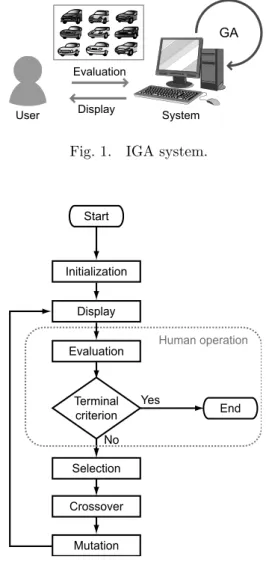
Fig. 1 IGA
Fig. 2
User System
GA
Display Evaluation
Fig. 1. IGA system.
Initialization
Evaluation
Selection
Crossover
Mutation Start
Yes End No Display
Human operation
Terminal criterion
Fig. 2. Flow chart of IGA.
2.2
IGA
IGA
IGA
IGA
10 20
3.
3.1 3.1.1
2
9)
PCCS(Practical Color Co-ordinate System) 10)
PCCS
3.1.2 PCCS PCCS
1964
10)
PCCS HSB
3
(tone) 2
PCCS Fig.
3
PCCS
PCCS 4
4 12
24
PCCS Fig. 4
p Pale
ltg Light Grayish
g Grayish
v Vivid b
Bright
s Strong
dp Deep lt
Light
sf Soft
dk Dark d Dull
dkg Dark Grayish W
White
ltGy Light Gray
mGy Medium Gray
dkGy Dark Gray
Bk Black
Saturation High
Low
Brightness
Low High
Fig. 3. Tone of PCCS.
3.2
IGA
20 20
1
2:R 3:yR
4:rO 5:O
6:yO 7:rY 8:Y
9:gY 10:YG
11:yG
13:bG
14:BG 12:G
15:BG
16:gB
17:B
21:bP 24:RP
23:rP 22:P
20:V 19:pB 18:B 1:pR
yellowish red reddish orange
red
yellowish green green
bluish purple reddish purple purplish red
yellow green
red purple
purplish blue
blue green
blue bluish green
purple
violet
greenish blue
Fig. 4. Hue circle of PCCS.
3
8 10)
3 1
4
Fig.
5
•
• 3
4
•
Fundamental color
Faux-Camaieu Tone on Tone
Gradation Natural harmony
Fig. 5. Example of color combination.
3.3 3.2
4
1
4 3
3
Fig. 6. Method of generating initial individuals based on color the harmony theory.
4.
4.1
•
3 3
•
HSB 10)
HSB
(Hue) (Saturation) (Brightness) 3
5
0 360
0 100
•
1 1
HSB
HSB
0.0 1.0 4.2
1.
3.3
3
1
9 2.
1 1
1 5 5
5 9
3.
4.
GA
(BLX-α)11)
BLX-α 2 di α
BLX-α
BLX-
7 8
Parent2 Parent1
Child1 d Child2
Fig. 7. Crossover for hue.
0.0 1.0
Parent1 Parent2
d
Child1 Child2
Fig. 8. Crossover for saturation and brightness.
5.
NV 1
6.
5.
5.1
IGA
2
20 20
2 2
Table 1
•
1
3 9
•
IGA
9
Table 1. Parameter.
Number of individuals 9
Number of design variables 9 Number of search generations Arbitrary Crossover rate NPN−NE
P
Mutation rate N1
V
NP:Number of individuals NE:Number of elite individuals NV:Number of design variables
1
2
3
1
5 2
5 3
5
IGA
5.2
1 3 Fig. 9
Fig. 11 1
2
3
5% Table
2
Satisfactory Satisfactory so-so Can't really say
Dissatisfied Rather dissatisfied
Random system 30%
6 people
Color harmony system 65%
13 people
15%
3 people
80%
16 people 5%
1 people 5%
1 people
Fig. 9. Result of satisfactory level for the proposed system.
Yes Somewhat yes Can't really say
No Somewhat no
Random system Color harmony system
15%
3 15%
3 people
40%
8 people 15%
3 people 30%
6 people
10%
2 people
15%
3 people 30%
6 people
35%
7 people
Fig. 10. Result on the indicated of many preferred individuals in the initial generation.
Fig. 9 1
95% 19
Delightful Delightful so-so Can't really say
Dreary Rather dreary
Random system Color harmony system
20%
4 people
60%
12 people 15%
3 people 1 people5%
35%
7 people
25%
5 people 10%
2 people 25%
5 people 1 people5%
Fig. 11. Result on the pleasantness of the design process in the proposed system.
Table 2. Result of sign test.
Evaluation item Significance probability Item 1 Color harmony system 1.90×10⁻⁵ Random system 9.53×10⁻⁷ Item 2 Color harmony system 9.44×10⁻² Item 3 Color harmony system 1.84×10⁻³ Random system 7.08×10⁻²
Fig. 10 2
Fig. 11 3
80% 16 60% 12
Fig. 12
0 2 4 6 8 10 12 14 16 18 20 22 24 26 28 30
User
2 3 5 6 7 8 9
1 4 1011121314151617 181920
Number of generations
Fig. 12. Number of search generations.
9.15 12.1
4.46 5.63
IGA
6.
IGA
IGA
1) HCD
( 2006) p.22-56.
2)
Vol.64 No.10 p.1419-1422 (1998).
3)
Vol.13 No.5 p.692-703 (1998).
4) D.E.Goldberg Genetic Algorithms in Search Optimization and Machine Learnig (1989).
5)
4 ( 2000) p.325-361.
6) Hideyuki Takagi Interactive Evolutionary Computation: Fusion of the Capabilities of EC Optimization and Human Evaluation Proceedings of IEEE (2001).
7) GA 3 CG
Vol.J81-D-2 No.7 p.1601-1608 (1998).
8)
Vol.10 No.2 p.243-251 (2008).
9) (
1997) p.227-244.
10)
( 2004).
11) Eshleman,L.J and Schaffer,J.D Real-Coded Genetic Algorithms and Interval-Schemata Foundations of Genetic Algorithms Vol.2 p.187-202 (1993).
p Pale
ltg Light Grayish
g Grayish
v Vivid b
Bright
s Strong
dp Deep lt
Light
sf Soft
dk Dark
d Dull
dkg Dark Grayish W
White
ltGy Light Gray
mGy Medium Gray
dkGy Dark Gray
Bk Black
Saturation High
Low
Brightness
Low High
2:R 3:yR
4:rO 5:O
6:yO 7:rY 8:Y
9:gY 10:YG
11:yG
13:bG
14:BG 12:G
15:BG
16:gB
17:B
21:bP 24:RP
23:rP 22:P
20:V 19:pB 18:B 1:pR
yellowish red reddish orange
red
yellow ish gr
een green
bluish purple reddish purple purplish red
yellow green
red purple
pu rplish lu b
e
blue green
blue bluish green
purple
violet
greenish blue
Parent2 Parent1
Child1 d Child2 Fundamental color
Faux-Camaieu Tone on Tone
Gradation Natural harmony