〔報告〕高松塚・キトラ両古墳からの主要細菌分離 株:Bacillus・Ochrobactrum両属分離株の分子系統 学的位置
著者 半田 豊, 立里 臨, 佐藤 嘉則, 木川 りか, 佐野 千絵, 杉山 純多
雑誌名 保存科学
号 56
ページ 33‑48
発行年 2017‑03‑23
URL http://doi.org/10.18953/00003918
Creative Commons : 表示 ‑ 非営利 ‑ 改変禁止 http://creativecommons.org/licenses/by‑nc‑nd/3.0/deed.ja
No.56 (2017)
高松塚・キトラ両古墳からの主要細菌分離株:
Bacillus
・Ochrobactrum 両属分離株の分子系統学的位置
半田 豊・立里 臨・佐藤 嘉則・木川 りか・佐野 千絵・杉山 純多
独 立 行 政 法 人 国 立 文 化 財 機 構
東 京 文 化 財 研 究 所
保存科学 第56号 別刷 平成28年度
〔報告〕
高松塚・キトラ両古墳からの主要細菌分離株:
Bacillus ・ Ochrobactrum 両属分離株の 分子系統学的位置
半田 豊 ・立里 臨 ・佐藤 嘉則・木川 りか ・佐野 千絵・
杉山 純多
1 . はじめに
高松塚古墳およびキトラ古墳は,終末期古墳時代(7世紀末期から8世紀初期)の極彩色(多 彩色)の壁画を有する古墳である。高松塚古墳壁画は,石室内の湿度がほぼ100%RHに近い高 湿度環境にて現地保存されていたが,発見から30年以上を経過し,石材の脆弱化や生物劣化な どのために,同環境下での現地保存が困難となり,古墳石室を解体して,石材とともに壁画を 修理することが決定された 。2007年より,古墳石室の解体作業が行われ,石材と壁画は現在も 仮設修理施設にて修理作業が続けられている。一方のキトラ古墳壁画は,発掘調査が行われて 以降,相対湿度を高く保つ必要がある石室内環境において,バイオフィルムなどによる壁画の 微生物劣化が認められ,様々な対応策が取られてきた 。2004年には,古墳石室はそのままに,
漆喰壁画の漆喰部分のみを取り外すことが決定され,2010年には余白漆喰を含むすべての壁画 の取り外しが終了した。2013年10月には石室は封印され,埋め戻しが行われた 。壁画は修理が 行われ,現在はキトラ古墳壁画体験学習館の「四神の館」内で保存・公開が行われている。
高松塚古墳とキトラ古墳については2004年より,それぞれの石室および壁画を取り巻く様々 な環境中の微生物調査が行われてきた 。対象とした微生物(カビ・酵母・細菌)のうち,細 菌についても,培養法とそれに続く16S rRNA遺伝子塩基配列(以下,16S rDNA)を用いた 分類群推定による調査の結果,両古墳にはそれぞれ特徴的な分類群の存在が明らかとなった 。 特に,両古墳ともBacillus cereusおよびBacillus simplexに近縁な細菌が優占種として分離さ れた 。Bacillus cereus近縁種(当初,Bacillus aff. thuringiensisと表記 ,以下B. cereus
group)は高松塚古墳では,解体以前の現地保存期間中の石室内の最も主要な分類群であり,解
体中,解体後の石室内外環境からの主要分類群の一つでもある。もう一方のBacillus simplex近 縁種(当初,Bacillus aff.simplexと表記 ,以下B.simplex group)は,高松塚古墳の解体以 前の現地保存期間中の石室内からは分離されていないが,石室解体中ならびに解体後の目地漆 喰,石壁間などの試料からの主要な分類群であり,キトラ古墳石室内試料においてもBacillus 属での主要な分類群である。さらに,Ochrobactrum属は,高松塚古墳の石室内外における主要 な分類群の一つであるが,キトラ古墳からは分離されていない。
分離株の種同定に用いた16S rDNAによる解析は,細菌の種レベルの系統推定に有効な手法 の一つである。しかし,16S rDNAでは極めて近縁な種の識別が難しいことから,生存,増殖 のために必須のタンパク質生合成に関わるハウスキーピング遺伝子と呼ばれるいくつかの遺伝 子塩基配列を用いた解析も用いられている。両古墳の主要分離株として検出されたBacillus属
株式会社テクノスルガ・ラボ 九州国立博物館 株式会社テクノスルガ・ラボ 千葉分室
:現 株式会社シーエーエフラボラトリーズ
およびOchrobactrum属には病原細菌として知られる種も含まれる 。特にBacillus cereus
groupの既知種には,セレウス菌や炭そ菌などの病原細菌が含まれるため ,より詳細な同定の
必要がある。よって,高松塚・キトラ両古墳から分離された主要細菌分類群であるBacillus属 の2グループおよびOchrobactrum属の各分離株について,ハウスキーピング遺伝子を用いて,
詳細な帰属分類群の推定を行ったので,その結果について報告する。なお,その他の主要な細 菌分離株については,すでに個別に発表されている 。
2 . 試料および方法
2 − 1 . 供試菌株と解析領域遺伝子
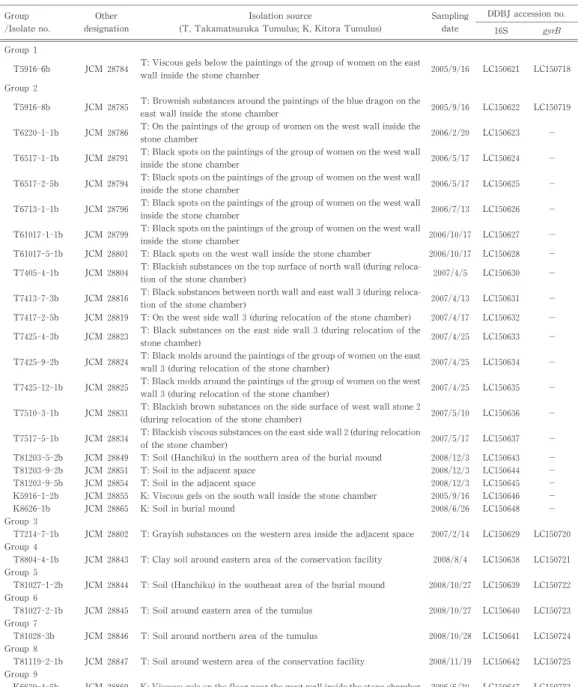
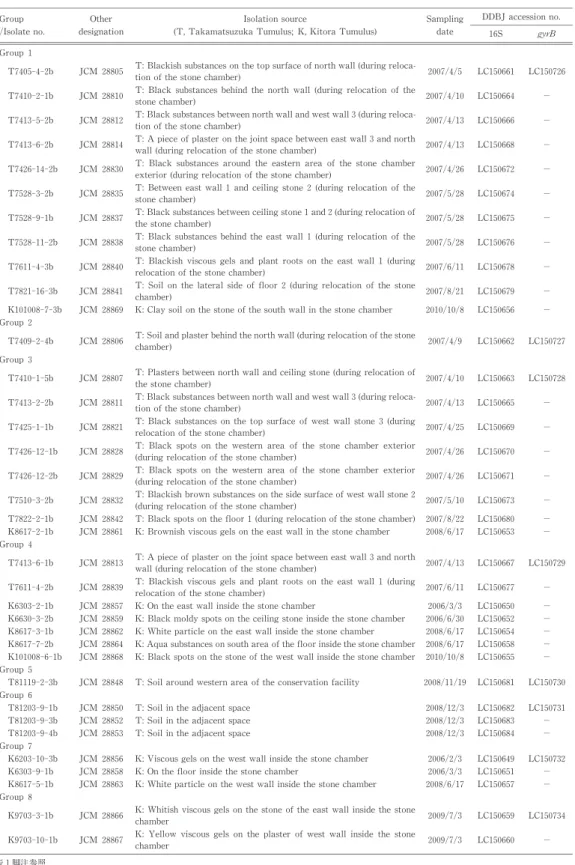
解析に用いた高松塚・キトラ両古墳からの分離株を表1から表3に示した。16S rDNAの解 析 結 果 か ら,B. cereus group分 離 株 は28株(表 1),B. simplex groupは36株(表 2),
Ochrobactrum属は17株(表3)であった。このなかからさらに,16S rDNA塩基配列の相同性
や分子系統解析などを基にハウスキーピング遺伝子の解析に供する菌株を選抜した(表1〜3,
DDBJ accession no.のgyrB,groELに記載のある菌株を指す)。Bacillus属は,DNA gyrase subunit B遺伝子(以下,gyrB)を,Ochrobactrum 属は,gyrB遺伝子および60‑kDa heat shock protein GroEL遺伝子(以下,groEL)を解析の対象とした。なお,試験に用いた分離株は理
化学研究所バイオリソースセンター(Japan Collection of Microorganisms; JCM)に寄託し,
決定した遺伝子塩基配列は国立遺伝学研究所DNA Data Bank of Japan(DDBJ)に登録した。
それぞれの登録番号は表中に示した。
2 − 2 . 遺伝子塩基配列解析方法
ハウスキーピング遺伝子(gyrBおよびgroEL)の塩基配列の決定と,16S rDNAおよびハウ スキーピング遺伝子の塩基配列に基づく分子系統解析の基本操作は,Handaら に従った。
各供試菌株は,普通寒天培地(CM3,Oxoid)にて,30℃で24〜48時間培養した。生育したコ ロニーを集菌し,コロニーからのDNAの抽出は,溶菌酵素アクロモペプチダーゼを用い,抽出 DNAは,必要に応じてMarmurの方法 に従い精製した。今回の解析の対象とする目的の遺伝 子断片のPCR(Polymerase Chain Reaction)法による増幅と,塩基配列の解読のためのシー クエンシングに用いたプライマーは,Bacillus属分離株は,Gotoら およびYamamotoら
(gyrB)に,Ochrobactrum属分離株はHuberら (gyrBおよびgroEL)に従った。使用した 各プライマーの塩基配列については表4に示した。決定したgyrBおよびgroELの各塩基配列 は,国際塩基配列データベース(DDBJ/ENA/GenBank)に対するBLAST(Basic Local Alignment Search Tool)を用いた相同性検索により,近縁と考えられる細菌種に由来する塩
基配列の検索を行った 。相同性検索による塩基配列の相同率の結果を基に,近縁と考えられる 細菌種の基準株(type strain)に由来する塩基配列データを国際塩基配列データベースから取 得し,分離株との塩基配列の差異に基づく類縁関係の比較のため,分子系統解析に供した。分 子系統解析のための塩基配列の前処理として,MUSCL program を用いて,取得した塩基配 列の整列(多重アライメント)を行った。分子系統解析は,ソフトウェアMEGA ver.6 を用 い,近隣結合法と木村の二変数法を組み合わせて行った。系統樹の各系統枝の信頼性のための 統計検定は,ブートストラップ法 により解析し,その値(ブートストラップ値)は各系統枝の 分岐点に示した。
表 1. 高松塚・キトラ両古墳から分離されたBacillus cereus group分離株
Group /Isolate no.
Other
designation Isolation source
(T, Takamatsuzuka Tumulus;K, Kitora Tumulus)
Sampling
date DDBJ accession no.
16S gyrB
Group1
T5916‑6b JCM28784 T:Viscous gels below the paintings of the group of women on the east
wall inside the stone chamber 2005/9/16 LC150621 LC150718
Group2
T5916‑8b JCM28785 T:Brownish substances around the paintings of the blue dragon on the
east wall inside the stone chamber 2005/9/16 LC150622 LC150719 T6220‑1‑1b JCM28786 T:On the paintings of the group of women on the west wall inside the
stone chamber 2006/2/20 LC150623 −
T6517‑1‑1b JCM28791 T:Black spots on the paintings of the group of women on the west wall
inside the stone chamber 2006/5/17 LC150624 −
T6517‑2‑5b JCM28794 T:Black spots on the paintings of the group of women on the west wall
inside the stone chamber 2006/5/17 LC150625 −
T6713‑1‑1b JCM28796 T:Black spots on the paintings of the group of women on the west wall
inside the stone chamber 2006/7/13 LC150626 −
T61017‑1‑1b JCM28799 T:Black spots on the paintings of the group of women on the west wall
inside the stone chamber 2006/10/17 LC150627 −
T61017‑5‑1b JCM28801 T:Black spots on the west wall inside the stone chamber 2006/10/17 LC150628 − T7405‑4‑1b JCM28804 T:Blackish substances on the top surface of north wall (during reloca-
tion of the stone chamber) 2007/4/5 LC150630 −
T7413‑7‑3b JCM28816 T:Black substances between north wall and east wall3(during reloca-
tion of the stone chamber) 2007/4/13 LC150631 −
T7417‑2‑5b JCM28819 T:On the west side wall3(during relocation of the stone chamber) 2007/4/17 LC150632 − T7425‑4‑3b JCM28823 T:Black substances on the east side wall3(during relocation of the
stone chamber) 2007/4/25 LC150633 −
T7425‑9‑2b JCM28824 T:Black molds around the paintings of the group of women on the east
wall3(during relocation of the stone chamber) 2007/4/25 LC150634 − T7425‑12‑1b JCM28825 T:Black molds around the paintings of the group of women on the west
wall3(during relocation of the stone chamber) 2007/4/25 LC150635 − T7510‑3‑1b JCM28831 T:Blackish brown substances on the side surface of west wall stone2
(during relocation of the stone chamber) 2007/5/10 LC150636 −
T7517‑5‑1b JCM28834 T:Blackish viscous substances on the east side wall2(during relocation
of the stone chamber) 2007/5/17 LC150637 −
T81203‑5‑2b JCM28849 T:Soil (Hanchiku)in the southern area of the burial mound 2008/12/3 LC150643 −
T81203‑9‑2b JCM28851 T:Soil in the adjacent space 2008/12/3 LC150644 −
T81203‑9‑5b JCM28854 T:Soil in the adjacent space 2008/12/3 LC150645 −
K5916‑1‑2b JCM28855 K:Viscous gels on the south wall inside the stone chamber 2005/9/16 LC150646 −
K8626‑1b JCM28865 K:Soil in burial mound 2008/6/26 LC150648 −
Group3
T7214‑7‑1b JCM28802 T:Grayish substances on the western area inside the adjacent space 2007/2/14 LC150629 LC150720 Group4
T8804‑4‑1b JCM28843 T:Clay soil around eastern area of the conservation facility 2008/8/4 LC150638 LC150721 Group5
T81027‑1‑2b JCM28844 T:Soil (Hanchiku)in the southeast area of the burial mound 2008/10/27 LC150639 LC150722 Group6
T81027‑2‑1b JCM28845 T:Soil around eastern area of the tumulus 2008/10/27 LC150640 LC150723 Group7
T81028‑3b JCM28846 T:Soil around northern area of the tumulus 2008/10/28 LC150641 LC150724 Group8
T81119‑2‑1b JCM28847 T:Soil around western area of the conservation facility 2008/11/19 LC150642 LC150725 Group9
K6630‑4‑5b JCM28860 K:Viscous gels on the floor near the west wall inside the stone chamber 2006/6/30 LC150647 LC150733
16S rDNAによるグループ分けの結果と各グループに含まれる分離株番号をGroup/Isolation no.に,各分離株の,理化学研究所バイオリソースセンター
Japan Collection of Microorganisms(JCM)への寄託番号をOther designationに,分離源の情報をIsolation sourceに,決定した塩基配列の国立遺 伝学研究所DNA Data Bank of Japan(DDBJ)への寄託番号をDDBJ accession no.に示す。分離株番号がTから始まる分離株は高松塚古墳試料に由 来し,Kから始まる分離株はキトラ古墳試料に由来する。
表 2. 高松塚・キトラ両古墳から分離されたBacillus simplex group分離株
Group /Isolate no.
Other
designation Isolation source
(T, Takamatsuzuka Tumulus; K, Kitora Tumulus)
Sampling
date DDBJ accession no.
16S gyrB
Group1
T7405‑4‑2b JCM28805 T:Blackish substances on the top surface of north wall (during reloca-
tion of the stone chamber) 2007/4/5 LC150661 LC150726
T7410‑2‑1b JCM28810 T: Black substances behind the north wall (during relocation of the
stone chamber) 2007/4/10 LC150664 −
T7413‑5‑2b JCM28812 T:Black substances between north wall and west wall3(during reloca-
tion of the stone chamber) 2007/4/13 LC150666 −
T7413‑6‑2b JCM28814 T:A piece of plaster on the joint space between east wall3and north
wall (during relocation of the stone chamber) 2007/4/13 LC150668 − T7426‑14‑2b JCM28830 T: Black substances around the eastern area of the stone chamber
exterior (during relocation of the stone chamber) 2007/4/26 LC150672 − T7528‑3‑2b JCM28835 T:Between east wall1and ceiling stone2(during relocation of the
stone chamber) 2007/5/28 LC150674 −
T7528‑9‑1b JCM28837 T:Black substances between ceiling stone1and2(during relocation of
the stone chamber) 2007/5/28 LC150675 −
T7528‑11‑2b JCM28838 T:Black substances behind the east wall1(during relocation of the
stone chamber) 2007/5/28 LC150676 −
T7611‑4‑3b JCM28840 T: Blackish viscous gels and plant roots on the east wall1(during
relocation of the stone chamber) 2007/6/11 LC150678 −
T7821‑16‑3b JCM28841 T: Soil on the lateral side of floor2(during relocation of the stone
chamber) 2007/8/21 LC150679 −
K101008‑7‑3b JCM28869 K:Clay soil on the stone of the south wall in the stone chamber 2010/10/8 LC150656 − Group2
T7409‑2‑4b JCM28806 T:Soil and plaster behind the north wall(during relocation of the stone
chamber) 2007/4/9 LC150662 LC150727
Group3
T7410‑1‑5b JCM28807 T:Plasters between north wall and ceiling stone (during relocation of
the stone chamber) 2007/4/10 LC150663 LC150728
T7413‑2‑2b JCM28811 T:Black substances between north wall and west wall3(during reloca-
tion of the stone chamber) 2007/4/13 LC150665 −
T7425‑1‑1b JCM28821 T:Black substances on the top surface of west wall stone3(during
relocation of the stone chamber) 2007/4/25 LC150669 −
T7426‑12‑1b JCM28828 T: Black spots on the western area of the stone chamber exterior
(during relocation of the stone chamber) 2007/4/26 LC150670 −
T7426‑12‑2b JCM28829 T: Black spots on the western area of the stone chamber exterior
(during relocation of the stone chamber) 2007/4/26 LC150671 −
T7510‑3‑2b JCM28832 T:Blackish brown substances on the side surface of west wall stone2
(during relocation of the stone chamber) 2007/5/10 LC150673 −
T7822‑2‑1b JCM28842 T:Black spots on the floor1(during relocation of the stone chamber) 2007/8/22 LC150680 − K8617‑2‑1b JCM28861 K:Brownish viscous gels on the east wall in the stone chamber 2008/6/17 LC150653 − Group4
T7413‑6‑1b JCM28813 T:A piece of plaster on the joint space between east wall3and north
wall (during relocation of the stone chamber) 2007/4/13 LC150667 LC150729 T7611‑4‑2b JCM28839 T: Blackish viscous gels and plant roots on the east wall1(during
relocation of the stone chamber) 2007/6/11 LC150677 −
K6303‑2‑1b JCM28857 K:On the east wall inside the stone chamber 2006/3/3 LC150650 − K6630‑3‑2b JCM28859 K:Black moldy spots on the ceiling stone inside the stone chamber 2006/6/30 LC150652 − K8617‑3‑1b JCM28862 K:White particle on the east wall inside the stone chamber 2008/6/17 LC150654 − K8617‑7‑2b JCM28864 K:Aqua substances on south area of the floor inside the stone chamber 2008/6/17 LC150658 − K101008‑6‑1b JCM28868 K:Black spots on the stone of the west wall inside the stone chamber 2010/10/8 LC150655 − Group5
T81119‑2‑3b JCM28848 T:Soil around western area of the conservation facility 2008/11/19 LC150681 LC150730 Group6
T81203‑9‑1b JCM28850 T:Soil in the adjacent space 2008/12/3 LC150682 LC150731
T81203‑9‑3b JCM28852 T:Soil in the adjacent space 2008/12/3 LC150683 −
T81203‑9‑4b JCM28853 T:Soil in the adjacent space 2008/12/3 LC150684 −
Group7
K6203‑10‑3b JCM28856 K:Viscous gels on the west wall inside the stone chamber 2006/2/3 LC150649 LC150732 K6303‑9‑1b JCM28858 K:On the floor inside the stone chamber 2006/3/3 LC150651 − K8617‑5‑1b JCM28863 K:White particle on the west wall inside the stone chamber 2008/6/17 LC150657 − Group8
K9703‑3‑1b JCM28866 K:Whitish viscous gels on the stone of the east wall inside the stone
chamber 2009/7/3 LC150659 LC150734
K9703‑10‑1b JCM28867 K: Yellow viscous gels on the plaster of west wall inside the stone
chamber 2009/7/3 LC150660 −
表1脚注参照
表 3. 高松塚古墳から分離されたOchrobactrum属分離株
Group /Isolate no.
Other
designation Isolation source (T, Takamatsuzuka Tumulus)
Sampling
date DDBJ accession no.
16S gyrB groEL
Group1
T5916‑1‑1b JCM28783 T:Viscous gels below the paintings of the white tiger on
the west wall in the stone chamber 2005/9/16 LC150685 LC150735 LC150738 T5916‑7‑1b JCM28782 T:Viscous gels below the paintings of the blue dragon on
the east wall inside the stone chamber 2005/9/16 LC150686 LC150736 LC150739 Group2
T6220‑2‑3b JCM28787 T:Spots around the paintings of the group of women on
the west wall inside the stone chamber 2006/2/20 LC150687 LC150737 LC150740 T6220‑4‑3b JCM28788 T:Viscous gels below the paintings of the white tiger on
the west wall inside the stone chamber 2006/2/20 LC150688 − − T6517‑1‑5b JCM28793 T:Black spots on the paintings of the group of women on
the west wall inside the stone chamber 2006/5/17 LC150689 − − T6517‑3‑3b JCM28795 T:Black spots around the paintings of the group of women
on the west wall inside the stone chamber 2006/5/17 LC150690 − − T6713‑1‑4b JCM28797 T:Black spots on the paintings of the group of women on
the west wall inside the stone chamber 2006/7/13 LC150691 − − T6713‑9‑3b JCM28798 T:Black molds around the paintings of the blue dragon on
the east wall inside the stone chamber 2006/7/13 LC150692 − − T61017‑1‑4b JCM28800 T:Black spots on the paintings of the group of women on
the west wall inside the stone chamber 2006/10/17 LC150693 − − T7405‑3‑2b JCM28803 T:Blackish substances on the top surface of north wall
(during relocation of the stone chamber) 2007/4/5 LC150694 − − T7410‑1‑7b JCM28809 T:Plasters between north wall and ceiling stone (during
relocation of the stone chamber) 2007/4/10 LC150695 − −
T7413‑7‑1b JCM28815 T:Black substances on the joint space between east wall
3and north wall (during relocation of the stone chamber) 2007/4/13 LC150696 − − T7417‑2‑3b JCM28817 T:Side surface of west wall stone3(during relocation of
the stone chamber) 2007/4/17 LC150697 − −
T7417‑7‑3b JCM28820
T:Spots around the paintings of the group of women on the west wall stone3(during relocation of the stone chamber)
2007/4/17 LC150698 − −
T7425‑1‑3b JCM28822 T:Black substances on the top surface of west wall stone
3(during relocation of the stone chamber) 2007/4/25 LC150699 − − T7426‑6‑2b JCM28826 T: Black substances on the south-lateral side of ceiling
stone wall2(during relocation of the stone chamber) 2007/4/26 LC150700 − − T7426‑9‑3b JCM28827 T: Brownish substances on the surface of ceiling stone
wall2(during relocation of the stone chamber) 2007/4/26 LC150701 − − 表1脚注参照
:表中の分離株(T7405‑3‑2b)は,16S rRNA遺伝子のDNA塩基配列データ登録後に,死滅が確認された。
表 4. 試験に用いたプライマー
プライマー名称 プライマーの配列(5ʼ→3ʼ方向) 参考文献 Bacillus gyrB gene
UP‑1G GAAGTCATCATGACCGTTCTGCAYGCNG
GNGGNAARTTYGG Goto et al.,2003
UP‑2r AGCAGGGTACGGATGTGCGAGCCRTCNA
CRTCNGCRTCNGTCAT Yamamoto et al.,1995
UP‑1S GAAGTCATCATGACCGTTCTGCA Yamamoto et al.,1995 UP‑2Sr AGCAGGGTACGGATGTGCGAGCC Yamamoto et al.,1995 Ochrobactrum gyrB gene
GyrB f GATGATGATCTTGTGRTAVCGCAG Huber et al.,2010 GyrB r CGAGGTCATCATGACCCAGCTTC Huber et al.,2010 GyrB int544r GACGCTGACCGGCGATGACTG Huber et al.,2010 Ochrobactrum groEL gene
GroEL f CGGCGAAGACCTGCTGATC Huber et al.,2010 GroEL r GCAACGATACCTTCTTCAACCG Huber et al.,2010
3 . 結果および考察
3 − 1 .Bacillus cereus group
3−1−1. 16S rDNAに基づく分子系統解析
高松塚およびキトラ両古墳から分離されたBacillus cereus groupに含まれる28分離株は,
16S rDNAの相同性から,9つのグループに分けられた(表1,Group1からGroup9,)。特
にGroup2には20株が含まれた(表1)。これらの各グループから選抜した1株の塩基配列に基
づく分子系統解析の結果,Bacillus cereus groupに含まれる分離株のうち8グループは,B.
cereus,B. thuringiensisおよびB. toyonensisの3種とブートストラップ値66%の分岐の枝に 含まれ,横枝が一切無く互いに同じ位置を示すことから,16S rDNAに基づく解析では,これ ら の 分 離 株 の 種 レ ベ ル で の 同 定 は 出 来 な かった(図 1)。他 方,Group4の 1 株 は,B.
pseudomycoidesとブートストラップ値61%の分岐の枝を形成し,互いに全く同一の分子系統学
的位置を示したことから,本種への帰属が示唆された(図1)。
3−1−2.gyrBに基づく分子系統解析
16S rDNAによる解析において,特に,B. cereus,B.thuringiensisおよびB.toyonensisの 3種と同一の分子系統学的位置を示した8グループの分離株は,それぞれ異なる分子系統学的
図 1 Bacillus cereus groupに含まれる高松塚およびキトラ両古墳分離株の16S rDNAに基づく分子 系統樹
株番号のTは高松塚古墳分離株,Kはキトラ古墳分離株を意味し,各分岐点の数字はブートス トラップ検定(1,000回)の再現値(ブートストラップ値,%),左下のバーは1000塩基につき5塩 基の違いを表す。
位置を示した(図2)。Group1および5(T5916‑6bおよびT81027‑1‑2b)は,B. thuringiensis と99%のブートストラップ値で支持されるクラスターを形成し,B. thuringiensisとのgyrBの 相同率は,それぞれ99.7%および98.9%であった。このことから,Group1および5をB. thur- ingiensisと同定した(図2)。また,Group2および3(T5916‑8bおよびT7214‑7‑1b)は,互 いに同一の分子系統学的位置を示し,B. toyonensisと100%のブートストラップ値で支持され るクラスターを形成し,B. toyonensisとのgyrBの相同率は,ともに99.6%であった。よって,
Group2および3をB. toyonensisと同定した(図2)。さらに,Group7(T81028‑3b)はB.
cereusと100%のブートストラップ値で支持されるクラスターを形成し,両者 の 相 同 率 は
99.5%であった。従って,Group7をB. cereusと同定した(図2)。なお,Group4(T8804‑4‑1b) は,16S rDNAの結果と同様に,B. pseudomycoidesと100%のブートストラップ値で支持され るクラスターを形成し,両者の相同率は99.9%であった。よってGroup4をB. pseudomycoides と同定した(図2)。
一方で,Group6,8および9(T81027‑2‑1b,T81119‑2‑1bおよびK6630‑4‑5b)は,100%
のブートストラップ値で支持されるクラスターを形成し,B. cereus groupの既知種とは独立 した分子系統的位置を示した(図2)。また,これら3株のgyrBは互いに97.1%以上の相同率 を示したが,他の既知種との相同率は96.1%以下であった。これら3株はBacillus属の中でも B. thuringiensisおよびB. toyonensisに近縁な新規分類群であることも考えられ,今後より詳
図 2 Bacillus cereus groupに含まれる高松塚およびキトラ両古墳分離株のgyrBに基づく分子系統 樹
株番号のTは高松塚古墳分離株,Kはキトラ古墳分離株を意味し,各分岐点の数字はブートス トラップ検定(1,000回)の再現値(ブートストラップ値,%),左下のバーは100塩基につき5塩基 の違いを表す。
細な試験を行うことが必要であると考えられた。
以上のように,16S rDNAでは同定が困難であったBacillus cereus groupに含まれる分離株 の位置付けについて,gyrBを解析することでより詳細な同定が可能となった。
3 − 2 .Bacillus simplex group
3−2−1. 16S rDNAに基づく分子系統解析
高松塚およびキトラ両古墳から分離されたBacillus simplex groupに含まれる36分離株は,
16S rDNAの塩基配列の比較から,8つのグループに分けられた(表2,Group1からGroup 8)。多数の分離株が含まれるグループとして,Group1(11株),Group3(8株),Group4(7 株)が認められた(表2)。これら各グループから選抜した1株の塩基配列に基づく分子系統解 析の結果,Bacillus simplex groupに含まれる分離株のうち7グループは,既知種とは独立した 分子系統学的位置を示した(図3)。また,このうちの6グループは,互いに同一の分子系統学 的位置を示した。他方,Group2(T7409‑2‑4b)は,B. simplexと同一の分子系統学的位置を 示し,同種への帰属が示唆された。
3−2−2.gyrBに基づく分子系統解析
16S rDNAで同一の分子系統学的位置を示した6つのグループのうちGroup7および8
(K6203‑10‑3bおよびK9703‑3‑1b)は互いに同一の分子系統学的位置を示し,他の4つのグ ループはそれぞれ異なる分子系統学的位置を示した(図4)。しかし,これら6つのグループに,
Group2(T7409‑2‑4b)を加えた7グループは,B. simplexを含む100%のブートストラップ値 で支持されるクラスターを形成した。また,これら7グループとB. simplexとの相同率は,
図 3 Bacillus simplex groupに含まれる高松塚およびキトラ両古墳分離株の16S rDNAに基づく分 子系統樹
株番号のTは高松塚古墳分離株,Kはキトラ古墳分離株を意味し,各分岐点の数字はブートス トラップ検定(1,000回)の再現値(ブートストラップ値,%),左下のバーは1000塩基につき5塩 基の違いを表す。
94.9〜96.4%の範囲であり,他の既知種とは89%未満であった。以上の結果から,これら7つ の グ ループ に 含 ま れ る 分 離 株 をB. simplexと 同 定 し た(図 4)。一 方,16S rDNAでB.
butanolivoransと ク ラ ス ターを 形 成 し たGroup6(T81203‑9‑1)は,gyrBで も 同 様 にB.
butanolivoransと100%のブートストラップ値で支持されるクラスターを形成し,両者の相同率
は98.7%であった。このことから,Group6(T81203‑9‑1)はB. butanolivoransと同定した(図 4)。
3 − 3 .Ochrobactrum属
3−3−1. 16S rDNAに基づく分子系統解析
高松塚古墳の石室内外から分離されたOchrobactrum属に含まれる17分離株は,16S rDNA の相同率から,2つのグループに分けられた(表3,Group1およびGroup2)。Group1には 2株が,Group2には15株が含まれた(表3)。各グループから選抜した1株の塩基配列に基づ く分子系統解析の結果,Group1はO. pecorisに近縁であり,Group2はO.pituitosumに近縁 と考えられた(図5)。
3−3−2.gyrBおよびgroELに基づく分子系統解析
gyrBおよびgroELに基づく分子系統解析の結果,Ochrobactrum属分離株のうち,Group 2
(T6220‑2‑3b)は,gyrBおよびgroELに基づく分子系統解析において,ともにO. pituitosum と100%のブートストラップ値で支持されるクラスターを形成し(図6,図7),gyrBは98.7%,
groELは99.6%の相同率であった。このことから,高松塚古墳石室内外からのOchrobactrum
属主要分離株であるGroup2は,O. pituitosumと推定された。Group1(T5916‑1‑1b)は,gyrB
ではO. anthropiとクラスターを形成したものの,両者の間には系統的に大きく距離が認めら
図 4 Bacillus simplex groupに含まれる高松塚およびキトラ両古墳分離株のgyrBに基づく分子系統 樹
株番号のTは高松塚古墳分離株,Kはキトラ古墳分離株を意味し,各分岐点の数字はブートス トラップ検定(1,000回)の再現値(ブートストラップ値,%),左下のバーは100塩基につき5塩基 の違いを表す。
れ(図6),groELではいずれの既知種とも異なり,独立した分子系統学的位置を示した(図7)。
Ochrobactrum属では,すべての既知種で共通のハウスキーピング遺伝子を用いた解析が行
われているわけではなく,種によって異なる。16S rDNAにおいて,Group1(T5916‑1‑1b) はO. pecorisに最も近縁であったが,本種はgyrBおよびgroELの解析がされておらず,塩基 配列の登録が無い 。したがって,O. pecorisのgyrBおよびgroEL遺伝子を解析して比較す る必要があるものの,現時点では,Group1(T5916‑1‑1b)はOchrobactrum属の新種を構成 する可能性も示唆される。
4 . おわりに
高 松 塚 お よ び キ ト ラ 両 古 墳 の 主 要 細 菌 群 で あ るBacillus属 の 2 つ の グ ループ お よ び
Ochrobactrum属について,ハウスキーピング遺伝子を用いた解析を行い,より詳細な種レベル
での帰属分類群を推定することが出来た。このうち,Bacillus属には,感染症法およびカルタヘ ナ法に記載された細菌種で,バイオセーフティレベル1 (BSL1 ,日和見病原体)以上に分類 されている既知種として3種(B. anthracis,B. cereus,B. weihenstephanensis)が指定され ており(日本細菌学会<http://jsbac.org/infectious disease/bsl level.pdf>に準拠),すべて Bacillus cereus groupに含まれる。高松塚およびキトラ両古墳サンプルから分離されたBacil- lus cereus groupに帰属する分離株のうち,B.cereusに帰属すると推定された分離株はGroup 7のみであり,分離源の試料も高松塚古墳の石室内ではなく,古墳北側の土壌である(表1)。
また,もうひとつのBacillus属分離株の主要グループであるB. simplex group分離株は,今回 の解析により,B. simplexおよびB.butanolivoransに帰属すると推定された。Bacillus属分離 図 5 Ochrobactrum属に含まれる高松塚古墳分離株の16S rDNAに基づく分子系統樹
株番号のTは高松塚古墳分離株,Kはキトラ古墳分離株を意味し,各分岐点の数字はブートス トラップ検定(1,000回)の再現値(ブートストラップ値,%),左下のバーは100塩基につき1塩基 の違いを表す。
株のうちB. toyonensis T5916‑8‑1bおよびB. simplex K6203‑10‑3bについては壁画が描かれ る漆喰の主原料のひとつである炭酸カルシウムを溶解すると考えられる有機酸等の生成や,壁 画の剥落止めや強化処置等に用いられた高分子材料,殺菌剤として用いられたエタノールある いはイソプロパノールなどの有機溶媒の資化性についての試験が行われている 。両分離株 図 7 Ochrobactrum属に含まれる高松塚古墳分離株のgroELに基づく分子系統樹
株番号のTは高松塚古墳分離株,Kはキトラ古墳分離株を意味し,各分岐点の数字はブートス トラップ検定(1,000回)の再現値(ブートストラップ値,%),左下のバーは100塩基につき2塩基 の違いを表す。
図 6 Ochrobactrum属に含まれる高松塚古墳分離株のgyrBに基づく分子系統樹
株番号のTは高松塚古墳分離株,Kはキトラ古墳分離株を意味し,各分岐点の数字はブートス トラップ検定(1,000回)の再現値(ブートストラップ値,%),左下のバーは100塩基につき5塩基 の違いを表す。
は顕著な炭酸カルシウムの溶解は示さなかったものの,酢酸の生成およびわずかなpHの低下 が認められ ,高分子材料や1%程度に希釈された有機溶媒では生育することが確認されてい る 。これらのことから,分離株は石室内での漆喰の劣化や,保存・修復に用いられた資材の 劣化等に関わっていた可能性が考えられる。
壁画からのBacillus属細菌としては,現時点ではB. decolorationis ,B. muralis ,およ びB. murimartini の3種が記載されているが,このうち,Bacillus simplex groupに含まれ るB. muralisは,基準株を含む複数の株がドイツの Lutheran church of Greene-Kreiensen およびスペインの Servilia tomb of the Roman necropolis of Carmona の壁画から分離さ れている 。どちらの壁画も,高松塚,キトラ両古墳石室内のような湿潤な環境ではなく,乾燥 した環境とされているが,これら近縁な細菌種が異なる環境下でどのように壁画の微生物劣化 に関わるのか,非常に興味深い点であると同時に,他の古墳の微生物劣化を考える上での基礎 情報となることが期待できる。
Ochrobactrum属 の う ち,主 要 分 離 株 のGroup 2はO. pituitosumに 同 定 さ れ た。
Ochrobactrum属は,一般に土壌から分離され,植物との関係性(根粒菌,窒素固定)の報告が
あるが,その一方で,ヒト由来の種も認められる (ドイツでは,O. anthropiおよびO.inter- mediumはBSL2に指 定 さ れ て い る(http://www.baua.de/nn 15226/de/Themen-von-A-Z/
Biologische-Arbeitsstoffe/TRBA/pdf/TRBA‑466.pdf))。Group 2が 同 定 さ れ たO.
pituitosumは,工業環境からの分離株であり,病原性に関する報告のない種である 。一方で,
本解析では未同定となったGroup1の分離株は,病原菌とされる既知種とは分子系統的にも異 なっていた。また,これらは2005年9月の高松塚古墳石室内の冷却直後しか分離されておらず,
逆にGroup2は2005年9月の試料からは分離されていない。同じOchrobactrum属の種であっ ても,環境の変化が生息に影響を与えた可能性がある。Ochrobactrum属分離株は粘稠性のコロ ニー形成が認められ,石室内で確認されたゲル状物質(バイオフィルム)を構成する主要な分 類群のひとつであったことが報告されている 。さらにO. pituitosum T6220‑2‑3bは酢酸の生 成とpHの低下 ,1%のエタノールあるいはイソプロパノールの資化性 が認められており,
漆喰の劣化に関与した可能性が示唆される。
培養法による微生物調査は,得られた分離株の特徴づけ(characterization)からその特性を 知る上で重要な情報をもたらすと同時に,分離株を詳細に同定することにより,文献等の既知 情報からその特性を類推することが可能となり,文化財の保存等に有益な情報等をもたらすも のと考える。
参考文献
1) 高松塚古墳壁画劣化原因調査検討会:高松塚古墳壁画劣化原因調査報告書、p.106、文化庁(2010)
2) 木川りか、喜友名朝彦、立里臨、佐藤嘉則、佐野千絵、杉山純多:キトラ古墳の微生物調査報告
(2012年〜2013年)お よ び2004年 か ら2013年 ま で の 微 生 物 調 査 結 果 概 要、保 存 科 学、54、
83‑109(2015)
3) 佐藤嘉則、木川りか、喜友名朝彦、立里臨、西島美由紀、杉山純多:非培養法によるキトラ古墳 の細菌調査、保存科学、52、1‑10(2013)
4) 木川りか、佐野千絵、三浦定俊:高松塚古墳の微生物調査の歴史と方 法、保 存 科 学、43、
79‑85(2004)
5)Sugiyama,J.,Kiyuna,T.,An,K.-D.,Nagatsuka,Y.,Handa,Y.,Tazato,N.,Hata-Tomita,J.,
Nishijima,M.,Koide,T.,Yaguchi,Y.,Kigawa,R.,Sano,C.,Miura,S.:Microbiological survey of the stone chambers of Takamstuzuka and Kitora tumuli, Nara Prefecture, Japan: a milestone in elucidating the cause of biodeterioration of mural paintings.In:Study of Environ-
mental Conditions Surrounding Cultural Properties and Their Protective Measures:Proceed- ings of The31st International Symposium on the Conservation and Restoration of Cultural Property (ed. by Sano, C.),51‑73.National Research Institute for Cultural Properties,Tokyo
(2009)
6) 佐藤嘉則、木川りか、喜友名朝彦、立里臨、西島美由紀、杉山純多:パイロシークエンス法によ るキトラ古墳石室内の微生物群集構造解析、保存科学、54、111‑120(2015)
7)Logan, N. A., De Vos, P.: Genus I.Bacillus Cohn1872,174 . In: Bergeyʼs Manual of Systematic Bacteriology. Volume3: The Firmicutes (ed. by Vos, P., Garrity, G., Jones, D.,
Krieg,N.R.,Ludwig,W.,Rainey,F.A.,Schleifer,K.-H.,Whitman,W.),21‑128.Springer,New York, (2009)
8)Kampfer P.,Wohlgemuth,S.,and Scholz,H.:The Family Brucellaceae.In:The Prokaryotes
―Alphaproteobacteria and Betaproteobacteria.4th ed., (ed. by Rosenberg,E.,DeLong,E.F., Lory, S., Stackebrandt, E., Thompson, F.), pp.155‑178. Springer, Berlin/Heidelberg (2014) 9)Tazato,N.,Nishijima,M.,Handa,Y.,Kigawa,R.,Sano,C.,Sugiyama,J.:Gluconacetobacter
tumulicola sp. nov. and Gluconacetobacter asukensis sp. nov., isolated from the stone chamber interior of the Kitora Tumulus, Nara, Japan, International Journal of Systematic and Evolu-
tionary Microbiology,62,2032‑2038(2012)
10)Nishijima, M., Tazato, N., Handa, Y., Tomita, J., Kigawa, R., Sano, C., Sugiyama, J.:
Gluconacetobacter tumulisoli sp. nov., Gluconacetobacter takamatsuzukensis sp. nov. and Gluconacetobacter aggeris sp.nov.,isolated from Takamatsuzuka Tumulus samples before and during the dismantling work in2007, International Journal of Systematic and Evolutionary Microbiology,63,3981‑3988(2013)
11)Handa, Y., Tazato, N., Nagatsuka, Y., Koide, T., Kigawa, R, Sano, C., Sugiyama, J.:
Stenotrophomonas tumulicola sp. nov., a major contaminant of the stone chamber interior in the Takamatsuzuka Tumulus,International Journal of Systematic and Evolutionary Microbi-
ology,66,1119‑1124(2016)
12)Tazato, N., Handa, Y., Nishijima, M., Kigawa, R., Sano, C., Sugiyama, J.:Novel environ- mental species isolated from the plaster wall surface of mural paintings in the Takamatsuzu- ka tumulus:Bordetella muralis sp.nov.,Bordetella tumulicola sp.nov.and Bordetella tumbae sp.
nov.,International Journal of Systematic and Evolutionary Microbiology,65,4830‑4838(2015) 13)Nishijima, M., Tazato, N., Handa, Y., Umekawa, N., Kigawa, R., Sano, C., Sugiyama, J.:
Krasilnikoviella muralis gen. nov., sp. nov., a new member of the family Promicromonospor- aceae,isolated from the Takamatsuzuka Tumulus stone chamber interior and reclassification of Promicromonospora flava as Krasilnikoviella flava comb. nov., International Journal of Systematic and Evolutionary Microbiology, in press;Published Ahead of Print: 26October 2016, doi:10.1099/ijsem.0.001618(2016)
14)Nishijima, M., Tazato, N., Handa, Y., Umekawa, N., Kigawa, R., Sano, C., Sugiyama, J.:
Characterisation of actinobacteria forming noteworthy colonies on mural painting of the stone chamber interior of ancient tumuli and proposal of Microbacterium tumbae sp. nov., Interna-