Meta Analysis of the Study on Indonesia ‑ Japan Relationship
Case:The Study on Indonesia and
Japan Relationship Conducted in Various Universities and
Research Institutions throughout Jakarta and Surroundings Area
Bambang Wibawarta Nadia Yovani
Abstract
The development of knowledge on Japan in Indonesia is insep- arable from the role of researchers and observers of Japan, both seniors and juniors alike. Their works and studies have formed a typical knowledge of Japan that put Japan as an ideal role model for community improvement in all of its aspects in Indonesia. The results of such studies will eventu- ally reinforce the instilment of Japanese hegemony in In- donesia while at the same time diminishing Indonesiaʼ s own national values. The form of such hegemony as described in the works of these researchers and observers and how much of an influence it exerted is the fundamental question that will be answered in this research. This research benefits from the scientific works of undergraduate final papers,as well as post
‑ graduates thesis and dissertation from several state and private universities around the Jabodetabek areas that have Japanese study programs, a number of which are used as research samples. These researches are significant in a way because they present a systematic and diverse data and infor- mation from the results of studies on the relationship between Indonesia and Japan,their impacts on the research institutions as well as to provide a comprehensive understanding on the
“lesson learned”in those studies and their effect to Indonesia.
1) Faculty of Humanities University of Indonesia.
2) Nadia Yovani,Researcher at Center for Japanese Studies University of Indonesia.
The Gramsci Theory on Hegemony serves as the frame of mind in analyzing the data of this research. This research may in turn provide a description on such results by using the mapping method on the studies on Japan conducted previously in the aforementioned universities and institutions.
Keywords
Meta analysis, Hegemony, Indonesia‑ Japan
1. Introduction
The emergence of Japan as the worldʼ s major economic power has attracted a wide spread attention of scholars and observers from outside Japan. The rapid growth of the Japanese economy, which is founded on manufacturing industry with export orientation, began in the 1960 s.
The 50 s decade might be described as the decade when the basis for the new dynamics in economic, politics and development of Japan was founded, after post World War II destruction . Since then, Japan continues to develop its country using various development strategies that enables it to stand on its own and emerges as the second largest economy after the United States . As an economic power,the country known as the land of The Rising Sun has set up its foreign strategy around a program of official development assistance and investment aimed at developing and poor countries with the orientation of increas- ing the quality of such countries in the form of Official Development Assistance ( ODA ) . ODA is an independent international assistance that manages facilities provided by developed countries or other inter- national organizations in the form of financial, economic or technical assistance to developing countries. That is to say,that this institution is a form of concession for developing countries since all or part of the assistance is in the form of grants and soft loans, or loans with an interest rate that are lower than the ones in the financial market. As an institution, ODA has a substantial role in the development of many countries around the world.
44 JCSC
3) Syamsul Hadi,Strategi Pembangunan Mahathir dan Soeharto: Politik Industrialisasi dan Modal Jepang di Indonesia dan Malaysia (Development Strategy of Mahathir and Soeharto:Politics of Industrialization and Japanese Capital in Indonesia and Malaysia) , Jakarta:Pelangi Cendekia,1005, page203.
4) Robert Garan, Tigers Tamed:The End of Asian Miracle, Sydney:Allen & Unwin, 1998, page23.
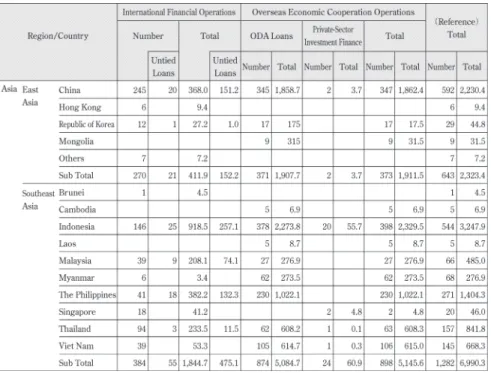
Japanʼ s assistance to Indonesia were not only in the form of grants but also in soft loans in yen ( Yen Loans )amounting to 44 . 47 % of the total Japanese ODA in East Asia, this figure was lower than the 2004 ODA disbursement which was 60 %. Even with such a decrease, In- donesia still ranks the first in the list of recipient of Japanese assistance with a total assistance amounting to 2 , 273 . 8followed by the Philippines with a figure of 1 , 022 . 1 . The value of Japanese investment in Indonesia is bigger in comparison to other countries even if compared to interna- tional organizations. Nonetheless,in the industrial sector,for the year 2004 ,it ranked second after Saudi Arabia . In 2008 ,later data obtained from the Debt Management Office, revealed that the largest loan received by Indonesia was provided by Japan, averaging 71 . 2 % of
5) JBICʼs report on financial operation on March,31,2008
6) The data from the Capital Investing Coordinating Board(BKPM)shows that of the US$10.3billion foreign investment in Indonesia in 2004,Saudi Arabia ranked first with an investment value of US$3.02billion or29.4 % of the total foreign investment. Saudiʼs investment is spread on four projects consisting of artificial compound fertilizer,refineries industry and oil refinery,real estates and trade representative office. The second position was held by Japan with a total investment of US$ 1.68 billion, followed by the United Kingdom with investment value amounting to US$ 1.32billion,Singapore with investment valued at US$576million, Australia with investment valued at US$ 481million―taken from the Press Release of the Indonesian Embassy for Saudi Arabia 2004(http://www.kbri
‑riyadh.org.sa/infoindex/informasi20.html)
Table 1. Georaphical Distribution of Loan and Equity Participation Outstanding 45
Meta Analysis of the Study on IndonesiaJapan Relationship
Indonesiaʼ s loans from other foreign countries and other international donors. The abovementioned data on the extent of Japanese invest- ment reveals Japanʼ s substantial role in Indonesiaʼ s development. In itself,ODA is an almost “perfect”investment,by wrapping the interest of Japan capitalism with social and humanitarian issues such as pov- erty, natural disaster, education, etc. Other form of soft loans and grants are also provided to ease the flow of Japanese investment in Indonesia and to expand the market share of its products in a develop- ing country such as Indonesia.
Japan always announces that Indonesia is its strategic partner, although in practice this notion is still open for debate. Meanwhile, Indonesia dependence on Japanese capitals,which in this case act as the agent of change, will have an impact in nurturing a typical concept of Japan as a cooperation partner. This typical notion also spreads all over the Indonesian society through community socializing agents in Indonesia.
Comics( manga ) ,movies( TV series ) and other products of Japanese culture are widely spread in Indonesia and they become the tools for socializing this typical notion amongst the Indonesian society. It is quite obvious that the existence of these products will affect individuals, groups and communities behaviors, and like it or not this cultural invasion not only touched,it even begins to push aside the local culture.
This is a form of a penetration process of a Japanese hegemony that is slowly and gradually “injected”through the cooperation relationship between Indonesia and Japan,which merely a front of Japanese capital- ism in Indonesia. The shifting of value in behaviors that treats Japan as the role model is often used as the object of studies by varies institu- tions in analyzing the significance of cooperation relationship between Indonesia and Japan.
There are numerous institutions / research centers, universities, governments and competent agencies that have conducted studies and research concerning the relationship between Indonesia and Japan and its impact in various dimensions. The contribution of these studies to policy formulation is actually acknowledged by all concerned parties.
Therefore, within the ranks and files of various government and non‑
governmental institutions,the research division becomes the spearhead in the efforts to develop that institutionʼ s programs and policies.
However,the emerging problem is that these studies,i.e.a compari- son between Indonesia and Japan,produced by these various institutions have come out with conclusions that put Japan as the role model in solving the various problems faced by Indonesia, unfortunately, often
46 JCSC
times without the support of accurate data. Study results such as these in turn would only reinforce the instilment of Japanese hegemony in Indonesia and diminishing Indonesiaʼ s local values. Another problem is that the results and findings of these previous studies are not system- atically arranged. The variety and prolific researches and studies related to the relationship between Indonesia and Japan combined with insufficient mechanism of dissemination and publication has become the influencing factor in the inability of these studies to map the prevailing issues in a comprehensive manner at the macro level. The afore- mentioned aspect also contributes to the miniscule amount of lessons to be learned from the“lesson learned”in these studies,i.e.they are not the beneficial sources of learning in developing the necessary policy to increase the effectiveness of the relationship in both sides and making it more egalitarian in nature.
Hitherto, no institution has conducted a review on the existing studies made by the many institutions and universities that focused on the relationship between Indonesia and Japan in Indonesia. This par- ticular point has made this research important considering that the year 2008is the100 anniversary of the National Awakening Day and the50 anniversary of the relationship between Indonesia and Japan in addition to the signing of the Economic Partnership Agreement ( EPA) . The mapping of issues that have been studied in the 50 years relationship between Indonesia and Japan is becoming a required component not only for Indonesia but also for Japan in formulating a reflection and prediction of the impact brought forth by this bilateral cooperation policy.
To fulfill such a requirement, this study attempts to map and reexamine the various studies on the relationship between Indonesia and Japan and its impact. The mapping will be conducted on the studies conducted by research institutions and civitas academica from various universities in Indonesia during the period from 1997‑2007 .
This is necessary to provide inputs and to formulate a policy direction for an effective and efficient research and study to increase the effectiveness of Indonesia and Japan cooperation in implementing the EPA in the future. The mapping and analysis of the study results on Indonesia and Japan relationship including its impact through reviewing the case studies of Japan written during the period from 1997‑2007 is done to seek answers to the following questions:
1 . What is the overall impression of the map of the studies made by Indonesian researchers that use Indonesia and/ or Japan as their object?
47
Meta Analysis of the Study on IndonesiaJapan Relationship
2 . What is the prevailing perception on Japan in the mind of researches as the result of the widespread global Japanese hegem- ony, specifically in Indonesia?
1.2. The Purpose of the Study
Identifying the purpose, field / aspect of study, concept, method, results / findings and recommendation made by previous studies in the period from 1997‑2007 on the relationship between Indonesia and Japan and its impact.
Mapping the result of study / research done by various research insti- tutions in Jakarta and West Java during the period from 1997‑2007on the relationship between Indonesia and Japan and its impact.
Formulating the formulae / synthesis of the study results on various studies on the relationship between Indonesia and Japan and its impact.
Identifying the form of hegemony occurred in the studies on Japan conducted by Indonesian researchers
This meta research will focus on the results of various studies and researches concerning the effectiveness of the relationship between Indonesia and Japan and its impact. I am hoping that the result of this study may be used as materials to improve the quality of studies on Japan. This is crucial, since there are quite plenty Japanese donor institutions that allocate research funds for Indonesia. The result of this study is expected to be the new starting point in opening a new horizon on Indonesia and Japan relationship in the midst of globaliza- tion.
1.3. Significance of the Study
1 . To present various data and information resulting from the studies on the relationship between Indonesia and Japan and its impact in a systematic manners to research institutions that focused on the study of Japan, Japanese donor institutions and other countries.
2 . To provide a comprehensive understanding on the “lesson learned”
in analyzing the relationship between Indonesia and Japan and its impact to Indonesia.
3 . To provide recommendation on research agenda to researchers who may be interested to conduct their own study on Japan in the future.
1.4. Research Methodology 1.4.1. Literature Studies
Discussion on Japanese studies is inseparable from what is known
48 JCSC
as nihon bunkaron or nihonron or nohonjinron,which are the theories, statements, arguments or discourses on Japanese culture. Nihon bun- karon began to flourish since the Meiji period and it gained more prominence after Japan lost the war.
Many discourses on Japan are founded on orientalism view,which is referred to by Moeran as Japanism, namely discourses on Japan, which are founded on the perspectives, values, ideological experiences and Western doctrines ( Moeran 1990 :1) that generally contain a com- parison between Japanese and Western cultures. Through these, Western researchers conduct their study on Japan through their own perspectives.
Dale,in his works (1986 :introductory )put forward the notion that discourses on Japanese culture are marked by a number of things including the homogeneity of Japanese culture and the particularity or uniqueness of its culture including loyalty,harmony,conformity and so on. These notions were widely disseminated by Western researchers and they have lulled even Japanese researchers that they began to position Japan in line with such Western perspective and participating in the dissemination of the views on their own countries.
With regard to this particularity or uniqueness, Mauer and Sugimoto (1986 :169)stated that nihonjinron is an ideology forced down by the elites, i.e. those in power, both in politics and in economic, domestic and abroad to perpetuate their own interest. Such discourses on Japan with all its peculiarities also influence the perspective of Indonesian researchers in their final papers, thesis and dissertations.
Without being aware, these researchers albeit with different intensity, quoted or perpetuated the Japanese hegemony through their writings.
They are what Gramsci referred to as part of the intellectuals who organized such hegemony practices.
For example,take the hypothesis of Sarontoʼ s thesis on the utiliza- tion of relevant Japanese culture in work mechanism and the success of keiretsu, namely hierarchy, loyalty and closeness ( onjooshugi) and patrimony in the efforts to perpetuate keiretsu as a company ( Saronto 1997 :20) . With regard to the hypothesis,Saronto,further in the discus- sion stated that in a Japanese company categorized as keiretsu, the closeness of the relationship between its members is quite apparent, akin to the relationship between family members who belong in a doozoku, or the relationship between oneʼ s parents or superior consid- ered as honke ( main family )or bunke ( branch family ) .
In his study entitled Identification and Comprehension of the Local Genius of the Globalization Era in Indonesia , Sukarta (1999)
49
Meta Analysis of the Study on IndonesiaJapan Relationship
stated that Japan was well positioned to adopt Western values without losing its own local values. This statement was given in the introduc- tion section of the paper without a clear source as to the origin of this statement. This typical frame of mind on Japan is the cause of the similar perception that prevailed amongst the common people, and it was perpetuated by the intellectuals. Another study by Purnama on The Influence of Kaizen on Work Productivity in a Japanese Com- pany analyzed the positive influence of Kaizen. Throughout the analy- sis, there is no single critic against the Kaizen system itself . The author sees this culture as something that uniquely Japanese and im- plemented by many production organizations in Japan and is a clear example of the success of the production system organization.
1.4.2. Theoretical Frame 1.4.2.1. Hegemony
The term hegemony originating from ancient Greek ʻ
hegemoniaʼ literally expresses the dominant and opressive status of one element in the system over the others. The concept of hegemony greatly contrib- utes to a better understanding of current international relations and power relations. Antonio Gramsci has significantly contributed to the articulation of this concept suggesting that power is not only dependent on force but also on ʻ consentʼ . According to Gramsci,hegemony repre- sents the status of the most powerful country in the international system or the position of a dominant state in a specific region.
Gramsci focused the attention on how power is perpetuated in a modern country. Two targets were considered in his reflection when he prepared his work entitled The Prison Notebook (1927‑1937)― why and how a modern country could obtain a consensus over the majority of the population and why and how one could ensure that this consensus could be changed into another new consensus that support the socialist values. In the Prison Notebook, Gramsci used a number of terms,
7) “...it might be a good idea if we emulate Japan which successfully modernize and bring prosperity to its nation by adopting western influences without abandoning its ancestral heritage. Japanʼs success in advancing its nation is founded on deep cultural roots which are still preserved and maintained, therefore the future generation can still enjoy and use it as an inspiration to create...”( source:www.petra.ac.id/ puslit/journals/ pdf.php?PublishedID=DKV99010104)
8) Kaizen is derived from the word Kai Zen, a Japanese philosophy that means continuous improvement. Kai is translated as changes, while zen is translated as good or being better. When applied to a work place, Kaizen means a continuous improvement, where everybody is involved from the manager down to the employees. The Kaizen philosophy considers that our way of life, the way we work,our social life and our family life need to be improved at all times.(source: http: //www.digilib.ui.edu/opac/themes/ libri2/detail.jsp?id=99713&lokasi=lokal)
50 JCSC
which according to him equals to an ideology,such as philosophy,world perspective or concept of the world. The same goes for the term of
“moral and intellectual reformation” used when Gramsci spoke of awareness transformation as a prerequisite for improvement toward socialism.
Gramsci provided another crucial concept connected to this study, namely hegemony. The starting point for Gramsci concept on hegem- ony,is that a particular class and its members would exert their power on the class below them through two ways, violence and persuasion.
When violence ( repressive )means is done to a lower class it is referred as domination,on the other hand when a persuasion means is applied it is called hegemony. The intermediary party in a domination act is the state apparatus such the police, the army and the judges, while hegem- ony is done by planting a certain ideology to placate the lower class or strata of the community.
Hegemony literally means “leadership”which in this point in time refers to a leadership of a country over another country as opposed to a country state over other states that loosely or tightly connected under a “leader”state. While in Gramsciʼ s view,hegemony,means something much more complex. Gramsci used the concept to analyze certain political, cultural and ideological forms, through which an existing society, a fundamental class may build its leadership as something coercive.
Gramsci believes that the relationship between the two types of leadership, leadership ( direction ) and domination ( dominance ) is a reference of three things. First, domination is applied over all oneʼ s enemies and hegemony is applied over oneʼ s allies. Secondly, hegem- ony is a preconditioning stage before placating the state apparatus or in the narrowest sense the government authority. Third,once the power is achieved, the two aspects of class supremacy, both direction and domination may continue.
Therefore, the hegemony concept by Gramsci is founded on a leadership that is intellectual and moral in nature. Such leadership occurs as a result of a voluntary agreement given by the lower class or society to the leading upper class. The lower class agreement is given due to the success of the upper class in implanting its ideology. Inter- nalization of such ideology is done by developing systems and institu- tions, such as a state, common sense, culture, organization, education etc,which may reinforce such hegemony. On the other hand,hegemony over the lower class is not without obstacles,as barrier and obstruction may come at any time, especially when certain class would not accept
51
Meta Analysis of the Study on IndonesiaJapan Relationship
the hegemony. Overcoming such disagreement may be done through repressive dominating acts by the state apparatus,i.e.the police. Thus, leadership,domination and hegemony are crucial in Gramsciʼ s theory on hegemony.
Gramsciʼ s interpretation of a state is quite complex and encompass- ing all the theoretical and practical activities by which the ruling class not only justifies and perpetuates its domination but it also wins an active participation from those they rule. A state in Gramsciʼ s perspec- tive not only concerns with government apparatus but also hegemony of apparatus or civil society.
A state,therefore,is ʻ an instrument of the upper class or rulerʼand as ʻ a reception tool by one class against anotherʼ . Through the state, the upper class is implementing policies either hegemonic or dominating in nature. The purpose of such policies is none other than perpetuating its own interest or to maintain its power base.
Gramsci distinguishes two areas in a state ―the civil society and the political society. The civil society is important for hegemony concept because it represents an area of “consent”, “a free will”, so to speak, meanwhile,the political society represents a world of violence,coercion and intervention. Therefore, hegemony occurs within the boundaries of civil society, because it represents the moral ethics as the area to instill the ideology mechanism of the upper class. On the other hand, political society represents relationships which dominating in nature and applied throughout the state institutions,for instance,the use of the armed forces, the police, the judicial institutions and prisons. There- fore,a state according to Gramsciʼ s theory is shaped by the relationship between civil society and political society ( Kurniawan, 2007) .
As for the intellectuals,Gramsci is separating the intellectuals who are raised from the earlier production mode, which he refer to as the traditional and the ones that raised from the capitalist production mode as the organic. The hegemonic and contra hegemonic intellectual types. The task of both intellectual types is to continuously organize and re ‑ organize the conscious and subconscious life pursued by the popular ‑ national mass,the first is tasked with ensuring that the worldʼ s view that matches the capitalist view has been accepted by all classes, meanwhile, the second one is tasked to separate the proletariat from such views and strengthen a socialist world view ( Beilharz,2002) .
Hegemony itself may be defined as a subjugation process by a dominant class over the class below and above it, wherein the hegemonic class will support the ideas of the dominant class. This is the process that differentiates it from the domination process. A subju-
52 JCSC
gation process is not done by violence, but it is done by obtaining the consent from the society being dominated.
Such consents may be obtained from various agencies, such as educational institutions, art and cultural institutions or even from government bureaucracy.
The form of such consent may be achieved by a hegemony actor by controlling the basis of thinking,the critical thoughts and the capability of a certain class to be influenced by another class. A class that instills hegemony is molding the senses of a subdued society to be in line with the frame of mind established by the class that perform the hegemony.
Such frame of mind is internalized by efforts including naturalizing the form and meaning of the ruling group.
The hegemony process may occur in a society with a high consen- sus value and a high social stability, wherein the lower class actively supports and accepts the values, ideas, targets and cultural meaning, which binds and unites them to the existing power structure.
In this research, the hegemony process will be analyzed in the context of the relationship between the Indonesian and Japanese soci- ety. There are quite a number of literatures proliferating in Indonesia that point out to the uniqueness of Japan in Indonesian cognitive. The abovementioned will be described in the following literature studies.
1.4.2.2. Literature Studies on Japan‑Indonesia Hegemony
Discourses on Japan with all its uniqueness have influenced the
perspective of Indonesian researchers,among others during the prepara- tion of academic assignment such as undergraduate final papers and post graduate thesis and dissertations. Unwittingly, with a various degree of intensity, these researchers quoted or perpetuated Japanese hegemony through their works. They are what Gramsci referred to as part of the intellectuals who organized such hegemony practices.
For example,take the hypothesis of Sarontoʼ s thesis on the utiliza- tion of relevant Japanese culture in work mechanism and the success of keiretsu, namely hierarchy, loyalty and closeness ( onjooshugi) and patrimony in the efforts to perpetuate keiretsu as a company ( Saronto 1997 :20) . With regard to the hypothesis,Saronto,further in the discus- sion stated that in a Japanese company categorized as keiretsu, the closeness of the relationship between its members is quite apparent, akin to the relationship between family members who belong in a doozoku, or the relationship between oneʼ s parents or superior consid- ered as honke ( main family )or bunke ( branch family ) .
In his study entitled Identification and Comprehension of the Local Genius of the Globalization Era in Indonesia , Sukarta (1999)
53
Meta Analysis of the Study on IndonesiaJapan Relationship
stated that Japan was well positioned to adopt Western values without losing its own local values. This statement was given in the introduc- tion section of the paper without a clear source as to the origin of this statement. This typical frame of mind on Japan is the cause of the similar perception that prevailed amongst the common people, and it was perpetuated by the intellectuals. Another study by Purnama on
analyzed the positive influence of Kaizen. Throughout the analysis, there is no single critic against the Kaizen system itself . The author sees this culture as something that uniquely Japanese and implemented by many production organizations in Japan and is a clear example of the success of the production system organization.
1.4.3. Research Methodology 1.4.3.1. Research Type
The method of this research is meta‑
analysis,wherein it will utilize various study results conducted by research institutions and universities which focus on the relationship between Indonesia and Japan as seen from different aspects from 1997‑2007 . Data will be taken from scien- tific works in the form of undergraduate final papers,thesis and disser- tation as research samples from several state and private universities around the Jabodetabek areas that have Japanese study programs or focusing on Japanese studies. All of the institutions are located in the Jabodetabek area.
1.4.3.2. Research Population
The population of this research is final assignments in the form of
undergraduate final papers, postgraduate thesis and dissertations from various universities that has Japanese studies in one of its faculties.
Analysis units in this research are the school organizations with obser- vation units the final assignments written by the student of that particu- lar university. Name of Universities with Japanese study programs in
9) “...it might be a good idea if we emulate Japan which successfully modernize and bring prosperity to its nation by adopting western influences without abandoning its ancestral heritage. Japanʼs success in advancing its nation is founded on deep cultural roots which are still preserved and maintained, therefore the future generation can still enjoy and use it as an inspiration to create...”( source:www.petra.ac.id/ puslit/journals/ pdf.php?PublishedID=DKV99010104)
10) Kaizen is derived from the word Kai Zen, a Japanese philosophy that means continuous improvement. Kai is translated as changes, while zen is translated as good or being better. When applied to a work place, Kaizen means a continuous improvement, where everybody is involved from the manager down to the employees. The Kaizen philosophy considers that our way of life, the way we work,our social life and our family life need to be improved at all times.(source: http: //www.digilib.ui.edu/opac/themes/ libri2/detail.jsp?id=99713&lokasi=lokal)
54 JCSC
Jabodetabek areas are as follows:
Table 2. List of University Names in Research Samples
No University Faculty which related to Japanese Studies
1
University of Indonesia www.ui.ac.id
Faculty of Humanities (15department including Japanese Studies)
Faculty of Social and Political Science
(8departemen)
Faculty of Economics (Department of Management, Accounting, Development Studies)
Faculty of Law (International Law, constitutional law, etc )
2
Al‑Azhar University www.uai.ac.id
Faculty of Letters (Arabic,English and Japanese Studies)
Faculty of Social and Political Science (department of communication, International Relation )
Faculty of Economics (Department of Management, Accounting)
Faculty of Law
3
Nasional University www.unas.ac.
id
Faculty of Letters (Indonesian,English and Japanese Department)
Faculty of Social and Political Science (Sociology, Public Administration, Political Science, Communication, Int.
Relation)
Faculty of Economics (Department of Management, Accounting)
Faculty of Law (International Law, constitutional law)
4
Bina Nusantara University www.binu.ac.
id
Faculty of Letters (English and Japanese Department)
Faculty of
Communication Faculty of Economics (Department of Management, Accounting)
Faculty of Psychology
5
Dharma Persada University www.unsada.
ac.id
Faculty of Letters (including Japanese Studies)
No Faculty of Social
and Political Science Faculty of Economics (Department of Management, Accounting)
No Faculty of Law,faculty of Psychology
6
Pakuan University www.unpak.
ac.id
Faculty of Letters (including Japanese Studies)
Faculty of Education (Including Japanese Language
Department)
Faculty of Economics (Department of Management, Accounting)
Faculty of Law
7
Hamka University www.uhamka.
ac.id
Faculty of Education (Including Japanese Language
Department)
Faculty of Social and Political Science (Department of Communication)
Faculty of Economics (Department of Management, Accounting)
Faculty of Psychology
1.4.3.3. Sampling Technique
Early in the research,the researcher collected the names of univer-
sities in the Jabodetabek area that have Japanese department in their
55
Meta Analysis of the Study on IndonesiaJapan Relationship
faculties ( see Table 1 . 3above ) . After choosing the libraries to visit, the meta research team began collecting the titles of undergraduate final papers / postgraduate thesis and dissertations and managed to collect 1484 titles of undergraduate final papers / post graduate thesis and dissertations.
Sampling technique is done by first separating the 1484 titles into two categories, scientific papers made by students from Humanities majors and Non ‑ Humanities majors ( stratified sampling) . Under- graduate final papers / postgraduate thesis and dissertations from the Faculty of Economic, Faculty of Law, Faculty of Social and Political Sciences and Faculty of Psychology are categorized as Non‑ Human- ities , while undergraduate final papers / postgraduate thesis and disser- tation from Japanese major are categorized as Humanities papers.
The stratification continues by separating each category into under- graduate final papers category and postgraduate thesis / dissertation category.
1.4.3.4. Data Collection Techniques
The data collection technique is a research technique aimed at
seeking and gathering relevant information for the researchʼ s topic.
The process of data collection in this research is done through survey.
Data collection through survey is done by taking samples from the population and using the questioner as the main data ‑ gathering instru- ment . The questioner in this research is divided into parts, the first part is for mapping based on dimensional analysis framework,research level and methodology ( the first two pages of the questioner ) ,while the other part contains the hegemony measurement and result of the final works analysis.
2. Discussion
2.1. An illustration of the Study on Japan in Indonesia
For the purpose of this research, the team read
134 titles of final papers, however, only 94 titles were eligible for analysis, because the remaining did not have a complete stage component. This research uses undergraduate final papers / postgraduate thesis and dissertations as object for the research. The number of each final paper taken is determined by the number of each type of those particular final papers at the population level that is determined by making a list of all the final papers from various universities in the Jabodetabek area. Using a
11) Masri Singarimbun. Survey Research Method, “Metode Penelitian Survey”.1982. Jakarta:LP3ES. Page3.
56 JCSC
simple random sampling technique on the data collected, the composi- tion of each type of final papers is classified as follows:
The above table shows that 87 . 2 % of the final papers read and studied are undergraduate final papers totaling 82papers. The number of postgraduate thesis and dissertations found in the population is rather low only 12 . 7 % of the total samples.
Most of these papers were written in the interval from 2002‑2007 . The multitude of scientific papers written in that span of time, in this case 76 . 6 %, is closely related to the wide proliferation of Japanese products in Indonesia during that time.
The most common topics raised were social issues in the commu- nity, such as education, family issues and others. About 50 % of the final papers read and studied talked about social issues in the commu- nity.
Of the final papers used as research objects,around 47 . 9 % of them
Table 3.Table on the Frequency of Number Composition of Final Papers
Frequency Percent Valid
Percent Comulative Percent
Valid Under
Graduate 82 87.2 87.2 87.2
Master
Thesis 10 10.6 10.6 10.6
Doctoral
Dissertation 2 2.1 2.1 100
Total 94 100 100
Source:Meta research primary data (2009 )
57
Meta Analysis of the Study on IndonesiaJapan Relationship
were the works of students from the University of Darma Persada.
The University of Darma Persada ( UNSADA) is a private university located in Jakarta organized by the Melati Sakura Foundation under the Association of Indonesia and Japan Friendship ( Persahabatan In- donesia ‑ Jepang, PPIJ)as its legal entity.
UNSADA was officially established on July 6 , 1986on the initia- tive and support of the Japan Alumni Association ( Perhimpunan Alum- ni Jepang, PERSADA)in cooperation with the Association of Indonesia and Japan Friendship ( Persahabatan Indonesia ‑ Jepang, PPIJ) and in accordance with the cooperation charter signed on February17 , 1986 . UNSADA began its activity under the provisions in the Letter of Approval of the KOPERTIS III Number 15/ Kop. III / S.VII/1986dated July 8 , 1986 ( enclosed ) , with four study programs. Determined to dedicate their knowledge to the nation, the founders ( who are also members of PERSADA) continuously work hard to develop UN- SADA . Besides that, ever since its establishment, the most favorite study program in UNSADA is Japanese Study .
Around 83.5% of the approaches used in these final papers were qualitative approach. Around 53 . 2 % of the research was based on data gathered from literatures,wherein analyzed data were taken from secondary sources, from books, statistical data and various journals.
The researchers also conducted a mean comparative test at population level.
12) Accessed from www.unsada.ac.id
13) Since the beginning, the study program of Japan and Chinese at the University Dharma Persada(Unsada)has been the favorites amongst senior high school (SMA) graduates not only in Jakarta but also from all over Indonesia. It was no wonder that the National Accreditation Board(Badan Akreditasi Nasional, BAN )raised the status of the S‑1Japanese Literature in Unsada from B to A.
Table 4. Research Methodology using the Mean Compare Test
Test Value= 0
t df Sig.
(2‑tailed)
Mean Difference
95% Confidence Interval of the
Difference Lower Upper
Data Collection Technique 17.329 93 .0000 4.70213 4.1633 5.2410 Research Approach 33.527 93 .0000 2.14894 2.0217 2.2762 Type of Research based on the
Purpose 37.708 93 .0000 2.71277 2.5699 2.8556
Type of Research based on Time 18.955 93 .0000 1.20213 1.0762 1.3281
58 JCSC
Ho :Type of research based on the purpose of final papers being studied differs from the mean of their population.
Ha :Type of research based on the purpose of final papers being studied does not differ from the mean of their population.
Based on its probability value, the significance value of research typeʼ s mean according to the purpose of final papers is 0 . 0000 where t <0 . 05 ,therefore Ho is rejected. It means that the research type based on purpose that tends to be descriptive without any difference from its mean at population level.
Ho :Type of research based on the time of final papers being studied differs from the mean of their population.
Ha :Type of research based on the time of final papers being studied does not differ from the mean of their population.
As for the scope of research in the 94final papers studied, around 42 . 6 % of the students picked local and national aspects as the scope of their final paper analysis. Meanwhile, 41 . 8 % of the students picked socio ‑ cultural dimension in their final papers.
Based on these phenomenons, we tried to perform the analysis by inserting a variable of where that particular scientific paper is made.
We made a distinction of the two majors based on where the papers were written, Humanities and Non‑ Humanities .
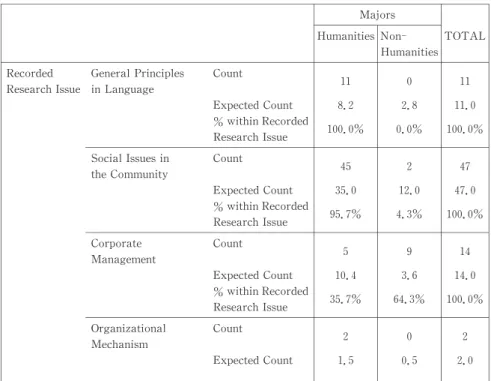
Table 5. Cross Reference Table of Majors and Research Issue Majors Humanities Non‑
Humanities TOTAL
Recorded
Research Issue General Principles
in Language Count
11 0 11
Expected Count 8.2 2.8 11.0
% within Recorded
Research Issue 100.0% 0.0% 100.0%
Social Issues in
the Community Count
45 2 47
Expected Count 35.0 12.0 47.0
% within Recorded
Research Issue 95.7% 4.3% 100.0%
Corporate
Management Count
5 9 14
Expected Count 10.4 3.6 14.0
% within Recorded
Research Issue 35.7% 64.3% 100.0%
Organizational
Mechanism Count
2 0 2
Expected Count 1.5 0.5 2.0
59
Meta Analysis of the Study on IndonesiaJapan Relationship
The cross reference table that contains the relation between majors and research issues above reveals that on average 95 . 7 % or around 45 final papers raised the social issues in the community. Such issues include issues on gender, family, religion and education. On the other hand,for non‑ humanities papers on average only 4 . 3 % of them touched the social issues in the community, while 64 . 3 % of the non ‑ humanities papers discussed issues around marketing management and human resources. This condition also true in the population after the hypothe- sis test on the Pearson Chi Square value of41 . 137 reveals a relationship between the two variables with a significance value less than 0 . 05in this case 0 . 000 .
The analysis conducted on the relationship between the majors and analysis unit reveals that on average 41 . 4 % of the humanities papers or around 29 final papers raised the issue on cultural products as their analysis unit. The said analysis unit in this case includes comics,books etc. For non‑ humanities papers, on average 42 . 9 % or around 9 final papers picked on institutions as their analysis unit. Institution in this case means corporation.
In addition, most of the humanities final papers use qualitative approach as opposed to quantitative approach.
The cross reference table that contains the relation between majors and research approach above,reveals that on average 97 . 1 % of human- ities papers or around 68 final papers use qualitative approach in the research. As for non‑ humanities final papers,around 38 . 1 % or around 8final papers use qualitative approach in the research.
% within Recorded
Research Issue 100.0% 0.0 100.0%
Technology and
Production Count
2 6 8
Expected Count 6.0 2.0 8.0
% within Recorded
Research Issue 25.0% 75.0% 100.0%
Issue on International
Policy Count
5 7 12
Expected Count 8.9 3.1 12.0
% within Recorded
Research Issue 41.7% 58.3% 100.0%
TOTAL Count 70 24 94
Expected Count 70.0 24.0 94.0
% within Recorded
Research Issue 74.5% 25.5% 100.0%
60 JCSC
2.2. Hegemony Analysis
Based on the qualitative data obtained in this research,the form of
hegemony may be differentiate into two types:
1 . ) Type 1:Papers that are not based on accurate data and theory, however, they are making a conclusion of what is previously stated in the background section in the conclusion section of the papers. Example, the following paper ( s ) :
This final paper was not founded on any theory, assumption, hypothesis or even first ‑ rate significance, hence its thought on Japan was embodied in a hegemonic narrative in the introduction section that stated that Japan was in a stable condition during the Tokugawa era.
The data given in the discussion part was more of a confirmation of what have been given in the introduction section.
Such scientific paper provided a conclusion that merely underlining
Table 6.Example of Type 1 Hegemonic Scientific Paper
No.
Questioner (076) Introduction
Title of Final Paper::
METAPHORICAL MEANING OF THE TITLE “MON”IN NOVEL MON BY NATSUME SOSEKI
Hegemonic The condition of Tokugawa society is quite stable for250years.
The liberal principles followed by the government have made the community more individualistic and gave less attention to social relation unlike the previous era.
The community in this era is more rational in comparison to the Tokugawa era where the people were mystical.
3
4 5 Research
Assumption ‑ none
Research
Hypothesis ‑ none
Purpose
and Significance
‑ none
Literature
Studies ‑ none
Discussion Hegemonic The situation prior to Meiji restoration is quite stable, because at that time Japan were not exposed to any external influences.
Conclusion Hegemonic As it turned out, the situation prior to Meiji restoration is quite stable,because at that time Japan were not exposed to any external influences.
61
Meta Analysis of the Study on IndonesiaJapan Relationship
the ones already made in the introduction section.
2 . ) Type 2: Scientific paper that uses accurate data to provide evidence on hegemonic thought on Japan starting from the background to their conclusion.
This second type of scientific paper has a hegemonic background, in which the literature studies supported the points discussed in the introduction chapter. The data used in the discussion chapter such as the ones used to describe the integration of Toyota with the vision and mission of the researched local company are utilized to support the notion of the ideal Japanese company ( hegemonic ) .
Table 7. Example of Type 2 Hegemonic Scientific Paper
Introduction Title of Scien- tific Paper:
Implementation of Toyota Production System to Trans form PT. Bina Busana Internusa into a Learning Organization
Hegemonic It is true that Toyota is known as a corporation with a strong manufactur ing system and quality management (3)
(3)
-
-
Research Assumption
‑ none
Research Hypothesis
‑ none
Purpose and Significance
Hegemonic Provide a comparison study between Toyota and major apparel companies in the world.
Providing a recommendation to PT.
BBI based on TPS(Toyota Produc tion System)
-
Literature
Studies Hegemonic Providing explanation of the produc tion system,history,leadership with a consistent culture, Toyota as a learn ing organization.
All in all, Toyota Production System is not a technical procedural system, but it is more of a way of thinking and philosophy in working.
(5‑22)
(7) - -
Discussion Hegemonic Providing explanation of TPS integra tion with BBIʼs vision, mission and strategy
Providing explanation on the compar ative study with TPS
(49‑53) (57‑58) -
-
Conclusion Hegemonic TPS can be use and it is effective in the garment manufacturing industry, especially in improving the opera tional performance.
To turn itself into a learning organiza tion, PT. BBI may use TPS as its guidance
(58)
- -
62 JCSC
Hegemony in this research is analyzed in partial manners,namely each part of the final paper, from introductory that contains the back- ground, assumption used in the research, hypothesis, purposes and the significance of the research, discussion until its final conclusion.
Around 40 . 4 % of the respondentsʼfinal papers or 38out of the 94 papers were considered valid to be analyzed. The percentage of the neutral category was in 56 . 4 % or 53final papers were able to illustrate the study on Japan with first rate and valid scientific data. The 38 identified hegemony final papers contained their understanding of Japan in the context of its good role model that fit to be emulated without proper scientific data to justify such a statement. The figure of 40.4% hegemonic final papers was considered substantial , because the hegemonic community is the intellectuals with access to valid theo- retical and conceptual understanding to analyze a particular culture.
Obviously the notion established by these Japanese researchers were formed because Japan entered the equation through researchʼ s issues that were founded on the logic of capitalism such as industry, cultural ( mass media )and economic . Case in point,the Japan Foun- dation is a Japanese institution tasked with introducing Japanese cul- ture in Indonesia and since2001 ,it has conducted annual symposiums to introduce and discuss Japanese comics, which is a product of Japanese culture widely accepted by Indonesian society. Comic is one of the components that formed hegemony with such a huge capitalistic element in it. This is apparent from the high selling power of Japanese comics in Indonesian market. A quote from an online source by Veegraph Magazine, PT. Elex Media is able to sell up to 90 thousand copies of each Japanese comic title, such as Detective Conan . This develop- ment in the community is followed by progress in scientific works.
According to the survey conducted for this research, the analysis unit most researched by the researchers of Japan is the cultural product,in which comic is one of the category.
14) On21‑22February2004,Japan Foundation held a symposium titled “Asia in Comics 2004:Asia Joryu Manga no Sekai(Comics by Asian Women)” in Tokyo, Japan. Japan Foundation has held the “Asia in Comics”Forum annually since 2001,and this is its fourth year. While last year,the focus was on Chinese manhua,this year the focus was on women comics world in5countries:Indonesia,Japan,South Korea,Singapore and the Philippines.
It is the first time that an Indonesian speaker was invited to speak in this forum(source:
http://community.livejournal.com/mangacast/516975.html)
15) The Detective Conan serials can be used as example. For each of its title, the comic published by Elex Media is printed up to 90thousand copies. Until now, the publication has reached37volumes, compare this to the fact that other similar books are only printed around10thousand copies per edition. (source: http://www.veegraph.com/ index.php?option=comcontent&view=article&id=37:komikus‑lokal‑menyiasati‑
dominasi‑komik‑jepang‑&catid=5:2darticles‑a‑news&itemid=4)
63
Meta Analysis of the Study on IndonesiaJapan Relationship
The mean is this neutral category is applicable in the population with a probability number less than 0 . 05( p =0 . 000) . The neutral form in the discussion and research purpose is the result of Japanese researchers in Indonesia does not put data that based on certain assump- tion and hypothesis.
Other finding is that 68 % of Japanese researchers in Indonesia, especially those from humanities majors conducted their research using qualitative approaches and 91 . 4 % of them picked a descriptive research.
Therefore,in the discussion part of their studies,these researchers only describe the findings of their literature studies. The majority of Japanese researchers (58 . 6 %)use literature studies a means to gather their data.
Traditional definitions of power in international affairs center around strength‑ military, economic, industrial, etc. Power is the abil- ity to influence the behavior of other actors to affect desired outcomes.
Soft Power,however,includes not only government policy,but also the cultural influence a country or civilization is capable of asserting.
However, I think soft power draws its strength more from hard power than from culture, values, and policies. The economic and military power of a country or nation makes its culture and values more attrac- tive to the people of other countries.
Joseph Nye coined the phrase “soft power”in 1990to describe the ability of nations to obtain desirable outcomes in international relations by relying on their cultural and ideological appeal abroad rather than their “hard power,” i.e. military and economic might. Soft power operates through attraction and seduction rather than coercion or economic incentive.
In recent years Japanʼ s rise has generated worldwide attention.
While a rising Japan has earned admiration from many countries. To counter the Japan threat argument, Japan uses its culture as a diplo- matic platform to project its soft power. By exercising soft power, nations are said to be able to persuade other nations to accept or promote certain values.
Japan, has enormous soft power potential. Japanese soft power
Table 8. Mean of Hegemony Existence in the Section of Research Purposes and Discussions
N Mean Standard
Deviation Standard Error Mean Hegemony in Discussion 81 1.7901 .49285 .05476 Hegemony in Research Purpose 86 1.9419 .35495 .03828
64 JCSC
has been rising alongside the undeniable perception that Japan is one of the worldʼ s most cutting‑ edge, trend ‑ setting nations in the realms of popular and consumer culture.
Since the 1990 s,Japanese comics and animation have gained notice- able popularity in Indonesia. Japanʼ s reputation has been built largely upon its high ‑ tech manufactured goods such as cars and electronics, rather than its culture, especially popular culture. The interplay of multiple factors such as globalization, global capitalism, technological development, domestic changes in Indonesia and content and character development in manga and anime is behind the phenomenon. Through its pop cultural products,Japan first gained regional cultural hegemony in Southeast Asia, and has successfully expanded its cultural influence beyond the region. Globalization has facilitated the transnational circulation of Japanese pop cultural products. The most important fact of globalisation is its ability to influence nations and communities.
For a long time, foreign interest in post ‑ war Japan has centered predominantly on its remarkable economic achievements, while the cultural aspects of the countryʼ s integration into the global economy have been largely disregarded. Japan was widely considered as a one
‑ dimensional economic power with little cultural sway beyond its own borders. This image, however, has changed dramatically over the course of the last few decades ‑ Japan has quietly grown into a pop ‑ culture powerhouse with global appeal. Next to politics and eco- nomics, culture has increasingly become the very important pillar in Japanʼ s diplomacy.
Cultural diplomacy is primarily associated with soft power. Nye explains ʻ cultureʼas one of three sources of a nationʼ s soft power. He identifies three sources of a nationʼ s soft power as its culture, political values, and foreign policies with internationally consented credibility and moral authority ( Nye, 2009) .
Based on the development of domestic cultural industries underpin- ned by politics of identity,cultural diplomacy relates to global competi- tion through soft power and the creative industry. Japan has play the major part in shaping southeast Asiaʼ s political and economic develop- ment. Hegemony now mean not only to exert a political and economic influence, but also soft power influence beyond domestic borders.
Japanese pop culture is most powerful when we take an inter- actional approach,and consider it not just as a resource for Japan,but as a resource for interaction among Japan and southeast Asian Coun- tries, including Indonesia. It is a paradox that people of colonized countries have been inspired more by the culture and values of the
65
Meta Analysis of the Study on IndonesiaJapan Relationship
colonials. I think this is because people enter into a love ‑ hate relation- ship with their masters:they hate the colonial powers for defeating their culture, but also admire them for their sophistication and power.
Great powers both employ cultural commodities to exploit eco- nomic markets and to pursue ideological hegemony. Most ASEAN states have long been recipients of Japanʼ s ODA. Another dimension of Japanʼ s soft power strategy towards ASEAN is to strengthen common interests with ASEAN member states, particularly in economic and trade issues. Socio‑ cultural cooperation is conducive to a sense of community which may forge closer ASEAN‑ Japan relations.
Social and cultural cooperation has become a main theme in ASEAN‑ Japan relations and a new direction for Japanese ODA in the 1990 s. Additionally, the positive and progressive image of Japan in Southeast Asia provides a sound basis for sustaining ASEAN‑ Japan relations. In a 2008 opinion poll on Japanʼ s image in Indonesia, Malaysia, Philippines, Singapore, Thailand, and Vietnam, the result reveal amicable ASEAN‑ Japan relations. 93 % of respondents agreed that Japan is a trustworthy friend for ASEAN countries;96 % of respon- dents approved that Japan is friendly to their country; and 92 % of respondents had positive images of Japanʼ s economic and technical contribution to their country. These results demonstrate a warming attitude of ASEAN people to Japan, and we can see that it also as the results of Japanese Hegemony to ASEAN countries.
3. Conclusion
Through ODA packages,investment strategies,and trade linkages, the collaborative efforts of Japanese political and business elites have clearly exerted a major influence on the Southeast Asia countries.
Governments and policy ‑ makers across the region,including Indonesia have attempted to accommodate, or self ‑ consciously emulate,the style and content of Japanʼ s public policy initiatives. This is plainly evi- dence of Japanese hegemony at both the overt material level of invest- ment flows and production strategies,and at the more subtle ideational level as a role model.
On the other hand, Soft power diplomacy advocates strategies of gaining appreciation, trust and friendship, rather than muscular domi-
16) The Ministry of Foreign Affairs of Japan commissioned TNS Singapore to conduct an opinion poll on Japan in the six ASEAN countries (Indonesia, Malaysia, Philippines, Singapore, Thailand and Vietnam)during February and March2008. Source. (accessed on2010/8/23).
66 JCSC
nance,in the management of image change. The increasing popularity of Japanese drama, manga and anime also reflects significant social and cultural changes in Indonesia. The improvement of positive image of Japan has fostered acceptance of Japanese pop culture. Japanese arts, traditions and,of course,electronic gadgets are often objects of admira- tion among indonesian and Japanese pop culture is regarded as ʻ coolʼ .
In the 1990 s, Japanese popular cultural hegemony in much of Asia became obvious. From music to TV dramas and from animation to video games,Japanese pop culture first generated distinctive trends and then became an integrated part of local cultures. The development of media and communication technology has fostered the popularity of anime and manga in Indonesia. Additionally, as Internet penetration has spread and provided improved services,a wider range of consumers has come to enjoy Japanese pop cultural products. Japanese comics and animation make manifest critical aspects of power relations.
Research on Japan in Indonesia is mostly done by researchers and scholars from humanities majors. In addition,these studies are focused on a type of study that comparative and evaluative in nature. The resulting studies posses the following characteristics:
1 . )The study on Japan is mostly in final undergraduate papers 2 . )The dimension of such studies are mostly cover issues in social and
culture
3 . ) The majority of these studies in socio ‑ cultural issues are done at local and national level, meaning the issues discussed are at local and national level.
4 . ) From the perspective of their methodology, these studies on Japan use qualitative approaches and are descriptive in nature. The descriptive nature of these studies means that these final papers are of a description of Japan from different social aspects,i.e.economic, social and culture. The majority of the data used are obtained from literature studies.
5 . )The object of these studies mostly is comics, books, music, movies and other cultural products. The trend of these studies on cultural products coincides with the period when Japan began to promote its cultural products in earnest since 2001 .
6 . )There are no final papers on Japan that mentioned any constraint and research limitation in the analysis of Japan according to the aspect being studied.
Other interesting characteristic in these studies on Japan is that the majority of these studies do not originated from a particular assump-
67
Meta Analysis of the Study on IndonesiaJapan Relationship