Introduction
Content-Based Instruction (CBI) has become increasingly popular in ESL (English as a Sec- ond Language) and EFL (English as a Foreign Language) programs worldwide. Murphy &
Stoller (2001) assert that CBI leads to a deeper engagement with content sources, meaning- ful content learning, and improved language abilities. This paper explores some of the chal- lenges and opportunities of using a CBI approach to English teaching and learning, with particular emphasis on the issues arising from teaching complex content to lower-level stu- dents.
What is CBI ?
Content-Based Instruction is a method of teaching language which focuses on learning about something in the target language, rather than learning about the target language itself.
For the sake of clarity, this paper will refer to English in the framework of a university EFL language program, but it is worth noting that CBI can be, and is, widely applied in other
Germain Mesureur
Abstract
Content-Based Instruction (CBI) has become increasingly popular in English lan- guage education programs worldwide. It is regarded as an effective way to engage students with content sources, while at the same time improving language abilities.
Traditionally, CBI is considered to be difficult to implement in classes with low levels of English competence. This paper argues that, by carefully choosing con- tent themes linked to the students’ main area of study, and designing adapted as- sessment strategies, CBI can be used in classes of all levels.
Key Words: CBI, Content−Based Instruction, University ESL, Low−level Students.
language learning contexts.
There are three recognized models in CBI, namely sheltered, adjunct and theme-based. The first two models are mostly followed in ESL contexts, usually employed to support foreign students who are registered in programs other than language programs, and to help them better follow the classes delivered in the second language.
The sheltered model uses two teachers in the same class, one to teach the content in the tar- get language, the second teacher being an ESL specialist who will assist the students in un- derstanding the content, as well as lead any part of the course which may be more directly language-related. In the adjunct CBI model, content classes are taught by an ESL teacher, but the themes covered in these programs are directly linked to the students’ major.
The third model, theme−based CBI, is chiefly used in EFL environments as an alternative method to teaching the language. Essentially, in a CBI class, the instructor teaches The Content, in English. For example, in my CBI classes, I teach such themes as Ecology, Evo- lutionary Biology, Advertising, and Cinematography. All CBI classes are delivered in Eng- lish, using authentic materials, with “formal” language education used only if necessary, and usually only when requested by the student(s). A CBI theme will normally last an entire term, although some lower level classes might require coverage of two or sometimes three themes per term, in order to avoid having to resort to material which may be too complex.
Why use CBI ?
The goal of CBI is to engage the learners directly with the material, bypassing the language barrier. Dueñas (2004) states that “high levels of competence can be reached in classrooms where the target language is a medium of communication rather than an object of analysis.”
In other words, CBI focuses on communicating the content rather on how to communicate.
In order to achieve this, the content must be engaging and relevant to the learners needs outside of the language classroom.
A quick read through the traditional EFL textbooks quickly reveals that the vast majority of them offer the opposite: an attractive and wide ranging array of topics (carrier topics), in-
stead of a selection of topics properly linked and connected so as to provide deep instruc- tion. Instead, the topics typically do little more that scratch the surface of the content, and thus fail to provide anything but superficial knowledge of that content. This can be com- pared to reading about a volcanic eruption in an issue of Time magazine, as opposed to reading a textbook on volcanology. Both actions will probably teach the reader something about volcanoes, but only the textbook approach will make the reader substantially more knowledgeable about them. If we want the learners to truly engage and connect with the theme we teach, we need to make sure they can benefit from the content we teach them.
This is particularly true of CBI programs, as students often have difficulty realizing the ad- vances they have made in terms of language learning, because traditional forms of self - or class assessment are not normally present (Turner, 1992).
Of course, we can safely assume that not all learners will engage fully and meaningfully with the theme of a CBI course; not everybody wants to learn about vulcanology. However, by focusing these content courses on themes related to the main areas of studies of the stu- dents, it is more likely that the students will become genuinely interested in the theme. This point actually brings theme-based CBI, traditionally used in EFL education, closer to the sheltered and adjunct models, where the themes covered are often directly linked to curricu- lum elements from the student’s major.
It is nonetheless important to state that, while CBI can - and should − form an important part of modern language−learning programs, conventional English classes should also be part of any EFL program (Bigelow et. al ., 2006). The role of universities is to train and educate students by giving them skills and knowledge , and these skills and knowledge should not be restricted to the students’ major study area alone. The duty to provide gradu- ates with the competence and qualifications required by employers and society is obviously paramount. For instance, in Japan, specified TOEIC test scores are regarded as a prerequi- site for many successful job applications. The training needed to achieve these scores is far better delivered through conventional TOEIC practice classes than through content classes.
Challenges of using CBI with lower-level students
The obvious challenges presented by CBI are that it is often regarded as difficult for most
students, and nearly impossible for those with a low level of English. While this problem is indeed a challenge, two aspects of CBI make it possible for students at all levels to benefit from its use.
The first derives from Krashen’s (1982) concept of comprehensible input, which states that learners benefit from being presented with material just beyond their current level of compe- tence. This is true of most situations in language learning, but is particularly relevant to CBI, and will be addressed in more detail in the next section.
The second aspect is that of motivation. Motivated students study harder. Students are more willing to take on challenging material when this material is relevant to their major (Wiese- mes, 2009). The added challenge of studying more advanced material is more readily ac- cepted when the knowledge output is seen as beneficial , beyond any language-learning value. Students of agricultural science will naturally feel more motivated to study a CBI course related to farming or pesticide pollution than one about American literature.
Practical approaches to teaching CBI to lower-level students Making the content more focused
One rather counter-intuitive way to help low-level students benefit from CBI programs is actually to make the content more complex but, at the same time, more focused. Complex content implies complex vocabulary, but this vocabulary is perceived as being useful and relevant, and the students feel more readily inclined to learn it.
An actual example of how to increase complexity is given below. This approach was used in the second semester of a year-long class, in which I used a textbook in the first part of the year, and full CBI in the second part. The textbook used -Academic Encounters : The Natural World (Wharton, 2009)- is one of the most “content-based” EFL textbooks, but even it uses mostly carrier topics. These rarely cover each topic in enough depth so as to be anything more than trivia. Even the small number of EFL textbooks that focus on one main topic often fail to deliver enough depth in the content to be truly useful. By way of com- parison, the following is a list of the carrier topics covered in Academic Encounters - The Natural World:
1. The water cycle and access to water around the world 2. Causes and effects of volcanoes, earthquakes, and tsunamis 3. The human brain and the human heart
4. Recent medical advances
5. Seeking balance in the natural world
While these topics are all interesting, and certainly relevant to university-level study, they are still far too disparate across the field of biology to be truly engaging for students whose major lies within only one of these topic areas. In the course of the first term, students failed to remain interested and motivated by the textbook.
On the other hand, the second term’s program was centered upon only one of these topic ar- eas, but presented in much greater depth, thus offering much more original knowledge for the students to master. In the fall term, the proper CBI part of the course focused on water (derived from topic area Number 1 above, and included the following subjects for study:
1. Water properties (physical, chemical, essential statistics)
2. Water cycle (stand-alone and in relation to the common nutrients cycles) 3. Importance (in ecosystems, in plants, in human societies, in culture)
This part of the course used authentic (non-EFL) extracts from high school and university science textbooks, as well as graded articles from science journals. The content part was chosen to match a series of classes taken by the students in their regular chemistry classes during that same term . The difference in motivation was immediately noticeable in the classroom, and the assignments submitted by students during the fall term were also of a much higher standard than those received during the spring term. In addition, many students reported positively on the program in the end-of-term questionnaire, stating that they felt the CBI classes had helped them with their regular classes, and that they were happy to have been able to integrate more parts of their curriculum to their learning experience.
Making classes more applied and practical
An easy way to allow students with a low level of English to better understand some com- plex aspects used in CBI programs is to bring practical or applied elements to the class. For example, I often take my horticulture students on tours of the campus, where we can ob- serve plants and insects and understand ecosystems, thus using the new concepts and vo- cabulary in a practical, hands-on setting. What better way to explain the meaning of the words pollination, petal, pollen transfer, and adaptation , than to actually use these words while following a honey bee going from one flower to the next?
It is easy to bring these techniques to a science or technology-oriented CBI class, but there are many activities that would similarly enhance a CBI program in less hands-on areas such as sociology or psychology. These could include getting students to design and complete mini research projects (including questionnaires and surveys) or create a social network ex- periment using FaceBook or Twitter in English. Many examples and suggestions for im- proved practice are explored by different authors in the literature on CBI: techniques and strategies are examined by Short (1991) and Brinton and Masters (1997), and suggestions for the creation and development of CBI syllabi are provided by Eskey (1997).
Linking the EFL CBI program with regular classes
In the adjunct model of CBI programs, the themes covered in the classes are directly linked to those taught in the students’ major. The rationale behind this model is to use the ESL classes to prepare and support the students in their regular classes. By covering some of the content to be learned in the conventional classes ahead of time, the students can focus on understanding the content itself more during lessons, and hopefully struggle less with the language they are delivered in.
I believe there is a case to be made for designing EFL classes in a model which is similar to that of adjunct model for ESL, but built in a way that allows more emphasis to be placed on language acquisition. By choosing CBI themes that are being studied, or have been re- cently studied, by the students as part of their regular classes, we can shift the focus closer to language learning, while still keeping the students engaged and motivated.
Assessing CBI
Students most easily measure their performance by gauging the results they can achieve in a class’s assessments. This poses a challenge to CBI courses in an EFL program, as the posi- tive language gains of the content classes are often more difficult to measure that those of regular language classes (Turner, 1992). A range of assessment options that can engage the learners, and at the same time challenge their language skills, is listed below.
Process writing
Process writing is an effective way to assist students in the production of written material of a higher level than that they would normally deliver from a standard writing assignment. In process writing assignments, the students submit a draft of their work to the teacher, who corrects it for language and/or content, giving feedback to the student who then modifies the draft before submitting it again. The ‘process’ can be repeated any number of times, usually until the teacher feels that the student has reached his/her highest potential. In doing so, the student becomes able to produce material that is more linguistically sound, as well as exhib- iting a deeper understanding of the content (Lyster, 2007).
Timed essays with support material
In this assessment format, the students are under exam-like conditions, and are required to produce an essay-style answer to a content question. It is typically acceptable for students to bring textbooks and notes, as the timed essay assesses understanding and synthesis, rather than pure knowledge. In the EFL classroom, the type of material that students are allowed to use is typically restricted to L1 (Japanese) sources, so as to ensure that the assessment in- cludes a test of the capacity to produce L2 rather than just copy it from sources.
Portfolio
It is important to allow part of the grading of a CBI course to be based on the assessment of the content itself. This part of the program assessment should however be kept small, as the students should be mostly assessed on language performance. A good way to assess stu- dents’ understanding of the content is through the use of portfolios. These can be built in the course of a term, and can give lower level students an opportunity to present work that can be put together slowly in their own time. This slower production method gives them a
chance to produce higher quality work than what they would otherwise deliver under a time constraint.
As one of the key aspects of language learning is an increased knowledge of vocabulary, it is important to integrate formal vocabulary training in CBI programs. Fortunately, keeping a vocabulary log or notebook is a component easily added to any portfolio production. The authentic texts used in CBI programs and compiled in the portfolios offer a great source of new academic vocabulary. In fact, common academic words, such as the words from Cox- head’s Academic World List (AWL), will occur naturally in these authentic texts, giving students a genuine context into which to place the new words.
Students’ Response to CBI
Over the past few years, I have taught CBI courses in many different universities, to stu- dents of many different levels. As expected, CBI programs are always easier to deliver to, and more evidently fruitful for, students whose level of English is intermediate or higher.
These students can cover more material and gain more knowledge, and they already have an English level that is high enough to allow them to express reflective and synthetic thinking.
Nonetheless, even students with low English levels have consistently reported being inter- ested by the themes covered and feeling more competent about understanding mad commu- nicating about these themes in English and in Japanese.
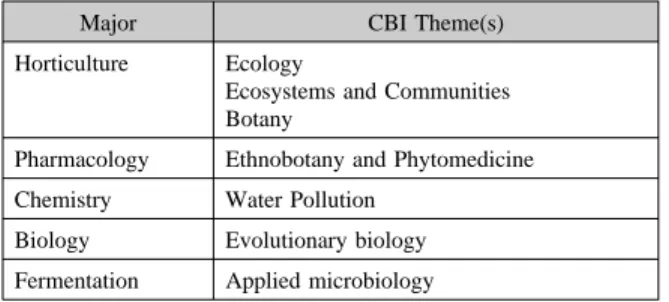
It is worth noting that, with the exception of one control group, the themes of the CBI courses I have taught have always been directly relevant to the majors of the students. Table 1 below provides a list of CBI courses, matched by the students’ major.
Table 1 : Examples of Major/CBI theme links
Major CBI Theme(s)
Horticulture Ecology
Ecosystems and Communities Botany
Pharmacology Ethnobotany and Phytomedicine Chemistry Water Pollution
Biology Evolutionary biology Fermentation Applied microbiology
Even when taking these factors into consideration, students’ response to CBI has ranged from positive to enthusiastic. In addition to the obvious academic benefits of learning some- thing related to their main study area, students often derive intense satisfaction at the idea that they are using non-EFL textbooks, designed and used by native speakers.
Conclusion
Content-Based Instruction in EFL has been demonstrated to provide both language skills and content knowledge to the students, as long as it is integrated into a program that pro- motes deep links between language and content learning . Reports from European and American sheltered and adjunct programs provides compelling evidence that students strongly benefit from this approach. I believe that it is important for EFL programs in Japan to gradually move towards a system of English education integrating CBI at all levels of English competence, in order to meet the expectations of students and employers alike.
References
Bigelow, M., Ranney, S. & Dahlman, A. (2006). Keeping the language focus in content-based ESL in- struction through proactive curriculum planning. TESOL Canada Journal, 24, (1), 40−58.
Brinton, D. & Masters, P. (Eds.) (1997). New ways in content-based instruction . Alexandria, VA:
TESOL.
Dueñas, M. (2004). The Whats, Whys, Hows and Whos of Content-Based Instruction in Second/Foreign Language Education. International Journal of English Studies, 4−1, 73−96.
Eskey, D.E. (1997). Syllabus design in content-based instruction. In M. A. Snow & D.M. Brinton (Eds.) The content-based classroom: Perspectives on integrating language and content . (pp. 132−141).
White Plains, NY: Addison Wesley Longman.
Krashen, S. (1982). Principles and practice in second language acquisition . New York : Pergamon Press.
Lyster, R. (2007). Learning and teaching languages through content: A counterbalanced approach . Amsterdam/Philadelphia: John Benjamins.
Murphy, J.M. & Stoller, F.L. (2001) Sustained-content language teaching: An emerging definition.
TESOL Journal, 10 (2/3), 3−5.
Short, D. (1991). How to integrate language and content instruction: A training manual . Washington DC: Center for Applied Linguistics.
Turner, J.L. (1992). Creating content-based language tests: Guidelines for teachers . CATESOL Journal 5:1, 43−58.
Wharton, J. (2009) Academic Encounters: The Natural World . Cambridge: Cambridge University Press.
Wiesemes, R. 2009. Developing theories of practices in CLIL: CLIL as postmethod pedagogies? in Content and Language Integrated Learning: Evidence from Research in Europe. Clevedon: Multilingual Matters, 41−59.