• 検索結果がありません。

Beneficial Effects of Losartan for Prevention of Paroxysmal Atrial Fibrillation in Patients with Sick Sinus Syndrome -Analysis with Memory Function of Pacemaker-

N/A
N/A
Protected

Academic year: 2021

シェア "Beneficial Effects of Losartan for Prevention of Paroxysmal Atrial Fibrillation in Patients with Sick Sinus Syndrome -Analysis with Memory Function of Pacemaker-"

Copied!
25
0
0

読み込み中.... (全文を見る)

全文

(1)

1

Beneficial Effects of Losartan for Prevention of Paroxysmal Atrial Fibrillation in Patients with Sick Sinus Syndrome

-Analysis with Memory Function of Pacemaker-

Eiichi Takii, MD, Tomohito Inage, MD, Teruhisa Yoshida, MD, Masatsugu Ohe, MD, Takeki Gondo, MD, Go Haraguchi, MD, Shogo Ito, MD, Jun Kmanomido, MD and Tsutomu Imaizumi, MD and Yoshihiro Fukuomoto, MD

Department of Internal Medicine, Division of Cardio-Vascular Medicine, Kurume University School of Medicine, Kurume, Japan

Address for Correspondence: Tomohito Inage

Department of Internal Medicine, Division of Cardio-Vascular Medicine, Kurume University School of Medicine, 67

Asahi-machi, Kurume 830-0011, Japan Phone:+81-942-31-7562

Fax:+81-942-33-6509

E-mail:[email protected]

(2)

2

Abstract

Aims Renin-angiotensin system (RAS) inhibitors may be useful in preventing the occurrence of paroxysmal atrial fibrillation (PAF). However, evaluation of such effect is difficult because many PAF episodes are asymptomatic and not all episodes are detected by intermittent electrocardiographic monitoring. A pacemaker has been developed with dedicated functions for AF detection and electrocardiogram storage.

Accordingly, we examined the effect of losartan, an angiotensin receptor blocker on PAF occurrence using this new modality.

Methods and Results We enrolled 70 consecutive patients who had undergone dual-chamber pacemaker implantation for sick sinus syndrome.

Finally, 62 patients participated in the study. Thirty patients were

randomized to the losartan group (mean 43±12 mg/day) and 32 patients to

the control group. They were followed-up for 3 months. The frequency, the

maximum duration and the total duration of PAF recorded by the stored

electrocardiograms during the 3-month follow-up period were compared

between the two groups. The change in the frequency of PAF from the

observation period in the losartan and control groups was similar (-35±25

(3)

3

times vs. -67±62 times; NS). However, the change in the maximum duration and the total duration of PAF was significantly shorter in the losartan group than in the control group (-493±158 min vs. -10±69 min;

p<0.05, -4007±2334 min vs. 1119±714 min; p<0.05, respectively).

Conclusion Losartan suppressed the maximum duration and the total duration of PAF in patients with sick sinus syndrome without hemodynamic changes. This is the first study to show the effect of a renin-angiotensin system inhibitor on the secondary prevention of PAF using the dedicated functions of a pacemaker for PAF detection and electrocardiogram storage.

KEYWORDS

Atrial fibrillation, Angiotensin receptor blocker, Pacemaker,

Renin-angiotensin system

(4)

4

Introduction

Atrial fibrillation (AF) is the most commonly encountered arrhythmia in daily clinical practice, with an overall incidence of 0.4%. This incidence increases with age 1-2 . Although AF is not a fatal arrhythmia, it sometimes causes thromboembolic complications, including ischemic stroke.

Therefore the prevention of AF is important 3-5 .

Recently, several clinical studies have suggested that angiotensin-converting enzyme inhibitors (ACE-Is) or angiotensin receptor blockers (ARBs) may have a beneficial effect on new-onset AF (primary prevention) 6-9 or recurrent AF (secondary prevention) 10-11 . However, several conflicting results have been reported for secondary prevention, for which the following reasons has been considered: previous studies evaluated AF only by subjective symptoms, routine electrocardiogram, Holter monitoring, or transtelephonic monitoring 12-14 . It is well-known that a significant proportion of paroxysmal atrial fibrillation (PAF) is not always detected by intermittent electrocardiogram monitoring and patients may remain asymptomatic.

A pacemaker with dedicated functions for AF detection and

(5)

5

electrocardiogram storage has been developed. With pacemaker interrogation, we are able to accurately document the frequency and duration of every PAF. Accordingly, we examined the effect of losartan, an angiotensin receptor blocker, on PAF occurrence in patients who had undergone pacemaker implantation for sick sinus syndrome.

Methods

Patient selection and pacemaker programming

This study was a prospective and randomized study. The study design is

illustrated in Figure 1. Consecutive patients who had undergone

implantation of a dual chamber pacemaker for sick sinus syndrome

between December 2008 and December 2011 were screened. Patients were

excluded from the study if they had persistent or permanent AF, a left

atrium size > 50mm by transthoracic echocardiography, New York Heart

Association heart failure class Ⅲ or Ⅳ, a pacemaker implanted less than

one month prior to entry into the study, or valvular heart diseases. They

were all implanted with a Reply DDDR pacemaker (Sorin, Inc., Clamart,

France) that posed both dedicated functions for PAF detection even at a

(6)

6

high rate and electrocardiogram storage. A right atrial lead was placed at the right atrial appendage and a right ventricular lead was placed at the mid-septum site in order to obtain normal electrical activation sequence.

Finally, 70 patients entered the study. PAF was defined with AF burden algorithm described previously 15 . Briefly, for every 32 cycles, the number of cycles in the suspected AF phase was counted; if ≧28 cycles fell into a window of atrial rate acceleration detection or if ≧18 cycles in the last 2 groups of 32 cycles were in this phase, then PAF was confirmed. At each interrogation, the following data were available and used for the current analysis: the frequency of PAF was defined as the total number of atrial tachyarrhythmia episodes, and the maximum duration of PAF was defined as the longest time of the atrial tachyarrhythmia episodes. Moreover, the total duration of PAF was evaluated. A pacing algorithm to suppress PAF was not programmed.

Study procedures

Before randomization to either the losartan or control group, we observed

the patients for 3 months, during which time we evaluated the occurrence

of PAF by the pacemaker functions. Eight patients did not have PAF and

(7)

7

were excluded from the study. Finally, 62 patients were randomized to the losartan group or control group. In the losartan group, losartan was prescribed at a mean dose of 43±12 mg/day (25-50 mg/day). Patients were followed-up for 3 months. Data on the frequency, the maximum duration and the total duration of PAF documented by stored electrocadiograms were obtained and compared between the groups. We compared the frequency, the maximum duration and the total duration of PAF for last one month during observation period and study period because the effect of losartan would be most anticipated for the last month. Blood pressure, cardiac thoracic ratio (CTR) by chest X-ray, and serum brain natriuretic peptide (BNP) levels were evaluated. Septal thickness, posterior wall thickness, end-systolic dimension, end-diastolic dimension, ejection fraction of the left ventricle, and left atrial dimension were also evaluated by echocardiography. Medications other than losartan were not altered during the observation and study periods. This study was approved by the ethics committee of Kurume University, and all patients provided written informed consent to the study.

Statistical analysis

(8)

8

Data were expressed as the mean ± standard error. We analyzed differences between the 2 groups using the χ 2 test and unpaired student’s t test. The value of P < 0.05 was considered significant.

Results

Baseline Characteristics

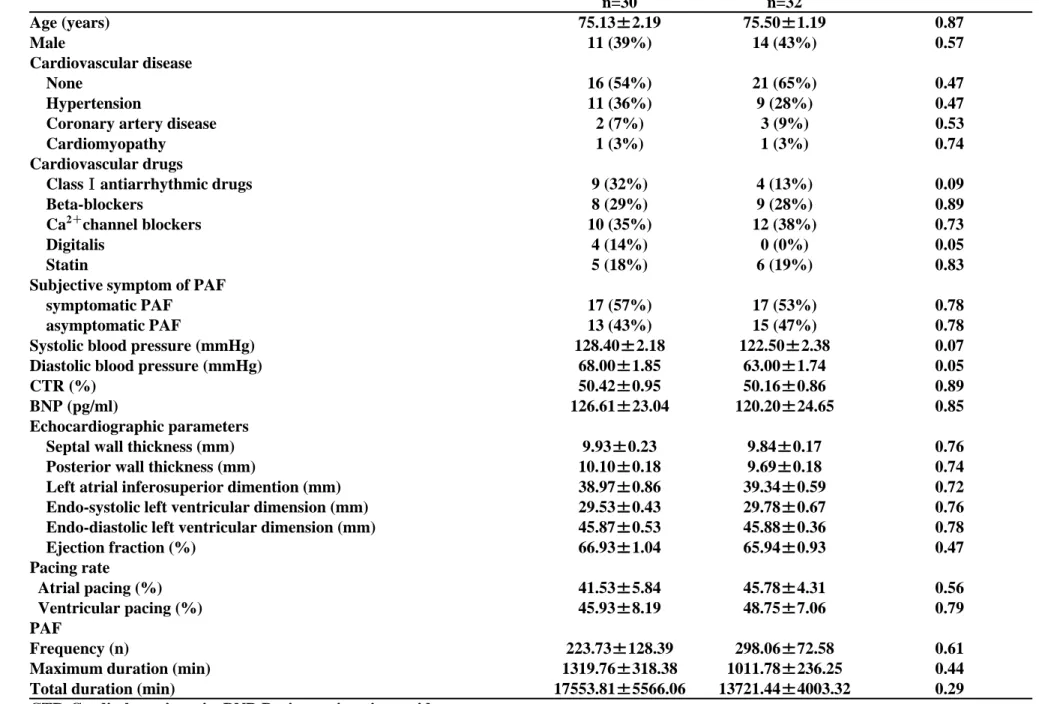
The baseline clinical characteristics of patients in the losartan group vs.

the control group are shown in Table 1 and were not significantly different.

Most patients had no structural heart disease and normal left ventricular systolic function. The use of Class Ⅰ antiarrhythmic drugs, β -blockers, Ca-blockers, and statins was similar between the two groups, except for digitalis. The frequencies of asymptomatic and symptomatic PAF were also similar.

Effects of losartan

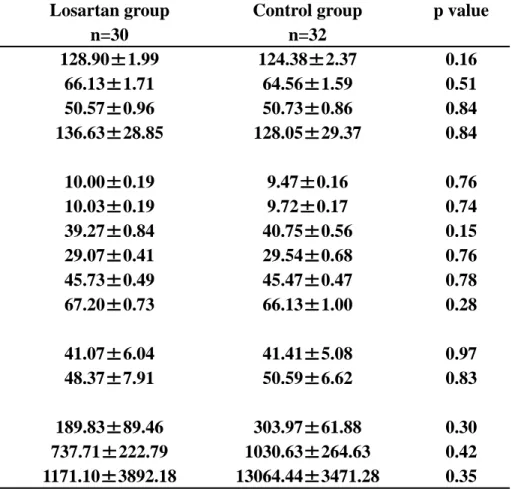
Table 2 shows hemodynamics and cardiac function at the end of the study.

These parameters were similar between the two groups. The percentages of atrial pacing and ventricular pacing were similar between the two groups.

Figure 2 shows the change in the maximum duration and frequency of

(9)

9

PAF from the observation period. The change in the frequency of PAF was similar (-34±44 times vs. 6±31 times; NS). However, the change in the maximum duration of PAF and the total duration of PAF were significantly shorter in the losartan group than in the control group (-493±158 min vs.

-10±69 min; p<0.05, -4007±2334 min vs. 1119±714 min; p<0.05, respectively).

Discussion

Although the sample size was small and the study period was short, this is the first report to describe the beneficial effects of losartan on PAF analyzed by the dedicated functions of a pacemaker. Losartan did not suppress the frequency of PAF. However, losartan suppressed the maximum duration and the total duration of PAF in patients with sick sinus syndrome.

Our results may underlie the rationale for the use of angiotensin receptor blockers for the secondary prevention of PAF.

The mechanisms by which losartan exerted its beneficial effects on PAF

were not elucidated in this study. Several mechanisms have been

considered. First, alterations in hemodynamics or cardiac function might

(10)

10

have contributed. However, this possibility was unlikely because losartan did not change blood pressure, ejection fraction, CTR or BNP. The most likely reason why losartan did not change hemodynamics or cardiac function in our study was that our patients had normal blood pressure and normal cardiac function at baseline 16 . Second, losartan may have regressed remodeling of the heart. In animal models of AF, RAS inhibitors had beneficial effects on structural remodeling by reducing atrial fibrosis and dilatation 17-20 . However, this possibility was unlikely because our study period was only for 3 months and there were also no changes in the left atrial dimension, left ventricular dimension, or wall thickness. We were also not able to detect subtle changes in dimensions and fibrosis by echocardiography. Another possibility was electrical remodeling; however although our results may suggest this possibility, we have no results to confirm this other than the shorter maximal duration and total duration induced by losartan.

Many human trial results have been reported, on the secondary prevention

of PAF by RAS inhibitors, and these results have been conflicting 10-14 . The

reasons for this may include the presence or absence of organic heart

(11)

11

diseases, presence or absence of cardiac dysfunction, concomitant use of anti-arrhythmic drugs or angiotensin converting enzyme inhibitors, and the methods used to detect PAF. The above mentioned factors may have resulted in the conflicting findings described in previous studies 12-14 . Among them, the most important factor may be the methods used to detect PAF. Most previous studies used electrocardiograms to document PAF 21 . Because not all episodes of PAF can be detected by intermittent electrocardiography monitoring, the use of pacemaker diagnostics to detect all episodes of PAF represents a significant advantage. Although we did not compare the detection rate of PAF by intermittent monitoring to that of the method used in this study, the detection rate of PAF by intermittent monitoring is known to be not so high 22 . Many episodes of PAF are asymptomatic and its symptoms correlate very poorly with real episodes of PAF 22-24 . In our study, the occurrence of asymptomatic PAF was 43% in the losartan group and 47% in the control group. Thus, only one half of PAF was detected by symptoms in our study. Another issue is cardiac function.

Several previous studies 25 enrolled subjects with depressed cardiac function,

whereas our study included only subjects with normal cardiac function.

(12)

12

Thus, our study is unique in terms of the detection of PAF and selection of subjects.

The clinical significance of our findings may not be so clear because losartan only decreased the maximum duration and the total duration of PAF and did not reduce the occurrence of PAF. However, managing the maximum duration of PAF is important in clinical settings because patients with a longer PAF duration are known to be at a higher risk of embolism than patients with a shorter PAF duration 3 . Thus, the effect of losartan on PAF duration may be clinically meaningful. However, whether the use of losartan in patients with PAF is associated with a lower risk of systemic embolization should be investigated. Finally, it is not known whether the findings in this study can be caused by other renin-angiotensin system inhibitors. Previous studies reported similar findings in different populations using different methods 10-11 , which suggests that the effect of losartan may be a class effect.

Limitations

The number of subjects may have been too small and the duration of

(13)

13

treatment may have been too short to draw any concrete conclusions. The findings in this study may only be pertinent to only subjects with sick sinus syndrome with normal cardiac function and normal blood pressure.

We enrolled patients with pacemaker implanted for bradycardia and with PAF. Accordingly, all study patients were limited to those with sick sinus syndrome. This may be a serious bias.

Conclusion

Losartan significantly suppressed the maximum duration and the total duration of PAF in patients with sick sinus syndrome. These results suggest that ARBs may be useful for the secondary prevention of PAF.

Conflict of interest The authors declare no conflict of interest.

References

1. Kannel WB, Abbott RD, Savage DD, McNamara PM (1982)

Epidemiologic features of atrial fibrillation: the Framingham study. N

Engl J Med 306: 1018-1022.

(14)

14

2. Wolf PA, Abbott RD, Kannel WB (1991) Atrial fibrillation as an independent risk factor for stroke: The Framingham study. Stroke 22:

983-988.

3. Capucci A, Santini M, Padeletti L, Gulizia M, Botto G, Boriani G, Ricci R, Favale S, Zolezzi F, Di Belardino N, Molon G, Drago F, Villani GQ, Mazzini E, Vimercati M, Grammatico A (2005) Monitored atrial fibrillation duration predicts arterial embolic eventsin patients suffering from bradycardia and atrial fibrillation implanted with antitachycardia pacemakers. J Am Coll Cardiol 46:1913–1920.

4. Nagamoto Y, Inage T, Yoshida T, Takeuchi T, Gondo T, Fukuda Y, Takii E, Murotani K, Imaizumi T (2012) Atrioventricular nodal ablation versus antiarrhythmic drugs after permanent pacemaker implantation for bradycardia-tachycardia syndrome. Heart Vessels 27:

174-178.

5. Suh SY, Kang WC, Oh PC, Choi H, Moon CI, Lee K, Han SH, Ahn T,

Choi IS, Shin EK (2013) Efficacy and safety of aspirin, clopidogrel,

and warfarin after coronary artery stenting in Korean patients with

atrial fibrillation. Heart Vessels. Doi:10.1007/s00380-013-0399-x.

(15)

15

6. Maggioni AP, Latini R, Carson PE, Singh SN, Barlera S, Glazer R, Masson S, Cerè E, Tognoni G, Cohn JN (2005) Valsartan reduces the incidence of atrial fibrillation in patients with heart failure: Results from the valsartan heart Failure traial (Val-HeFT). Am Heart J 149:

548-557.

7. Ducharme A, Swedberg K, Pfeffer MA, Cohen-Solal A, Granger CB, Maggioni AP, Michelson EL, McMurray JJ, Olsson L, Rouleau JL, Young JB, Olofsson B, Puu M, Yusuf S (2006) Prevention of atrial fibrillation in patients with symptomatic chronic heart failure by candesartan in the candesartan in heart failure: Assessment of reduction in mortality and morbility (CHARM) program. Am Heart J 152: 86-92.

8. Wachtell K, Lehto M, Gerdts E, Olsen MH, Hornestam B, Dahlöf B,

Ibsen H, Julius S, Kjeldsen SE, Lindholm LH, Nieminen MS,

Devereux RB (2005) Angiotensin Ⅱ receptor blockade reduces

new-onset atrial fibrillation and subsequent stroke compared to

atenolol: The losartan intervention for end point reduction in

hypertension(LIFE) study. J Am Coll Cardiol 45: 712-719.

(16)

16

9. Vermes E, Tardif JC, Bourassa MG, Racine N, Levesque S, White M, Guerra PG, Ducharme A (2003) Enalapril decreases the incidence of atrial Fibrillation in patients with left ventricular dysfunction insight from the Studies of left ventricular dysfunction (SOLVD) trials.

Circulation 107: 2926-2931.

10. Yin Y, Dalal D, Liu Z, Wu J, Liu D, Lan X, Dai Y, Su L, Ling Z, She Q, Luo K, Woo K, Dong J (2006) Prospective randomized study comparing amiodarone vs. amiodarone plus losartan vs. amiodarone plus perindopril for the prevention of atrial fibrillation recurrence in patients with lone paroxysmal atrial fibrillation. Eur Heart J 27 1841-1846.

11. Madrid AH, Bueno MG, Rebollo JM, Marín I, Peña G, Bernal E, Rodriguez A, Cano L, Cano JM, Cabeza P, Moro C (2002) Use of irbesartan to maintain sinus rhythm in patients with long-lasting persistent atrial fibrillation: A prospective and randomized study.

Circulation 106: 331-336.

12. GISSI-AF Investigators, Disertori M, Latini R, Barlera S, Franzosi

(17)

17

MG, Staszewsky L, Maggioni AP, Lucci D, Di Pasquale G, Tognoni G (2009) Valsartan for prevention of recurrent atrial fibrillation. N Engl J Med 360: 1606-1617.

13. ACTIVE I Investigators, Yusuf S, Healey JS, Pogue J, Chrolavicius S, Flather M, Hart RG, Hohnloser SH, Joyner CD, Pfeffer MA, Connolly SJ (2011) Irbesartan in patients with atrial fibrillation. N Engl J Med 364: 928-938.

14. Goette A, Schön N, Kirchhof P, Breithardt G, Fetsch T, Häusler KG, Klein HU, Steinbeck G, Wegscheider K, Meinertz T (2012) Angiotensin II-antagonist in paroxysmal atrial fibrillation

(ANTIPAF) trial. Circ Arrhythm Electrophysiol 5: 43-51.

15. Sutton R, Stack Z, Heaven D, Ingram A (1999) Mode switching for atrial tachyarrhythmias. Am J Cardiol 83: 202D-210D.

16. Naritomi H, Fujita T, Ito S, Ogihara T, Shimada K, Shimamoto K,

Tanaka H, Yoshiike N (2008) Efficacy and safety of long-term losartan

therapy demonstrated by a prospective observational study in Japanese

patients with hypertension: The Japan hypertension evaluation with

(18)

18

angiotensin Ⅱ antagonist losartan therapy (J-HEALTH) study.

Hypertens Res 31: 295-304.

17. Verheule S, Wilson E, Everett 4th T, Shanbhag S, Golden C, Olgin J (2003) Alterations in atrial electrophysiology and tissue structure in a canine model of chronic atrial dilatation due to mitral regurgitation.

Circulation 107: 2615-2622.

18. Verheule S, Sato T, Everett T 4th, Engle SK, Otten D, Rubart-von der Lohe M, Nakajima HO, Nakajima H, Field LJ, Olgin JE (2004) Increased vulnerability to atrial fibrillation in transgenic mice with selective atrial fibrosis caused by overexpression of TGF-β 1. Circ Res 94: 1458-1465.

19. Singh JP, Kulil A, Levin R, Ellinor PT, Ruskin J, Choudhry NK (2012) Renin-angiotensin-system modulators and the incidence of atrial fibrillation following hospitalization for coronary artery disease.

Europace 14: 1287-1293.

20. Nakashima H, Kumagai K (2007) Reverse-remodeling effects of

angiotensin II type 1 receptor blocker in a canine atrial fibrillation

model. Circ J 71: 1977–1982.

(19)

19

21. Schneider MP, Hua TA, Böhm M, Wachtell K, Kjeldsen SE,

Schmieder RE (2010) Prevention of atrial fibrillation by renin-angiotensin system inhibition a meta-analysis. J Am Coll Cardiol 55: 2299-2307.

22. Israel CW, Gro¨nefeld G, Ehrlich JR, Li YG, Hohnloser SH (2004) Long-term risk of recurrent atrial fibrillation as documented by an implantable monitoring device. J Am Coll Cardiol 43: 47–52.

23. Quirino G, Giammaria M, Corbucci G, Pistelli P, Turri E, Mazza A, Perucca A, Checchinato C, Dalmasso M, Barold SS (2009) Diagnosis of paroxysmal atrial fibrillation in patients with implanted pacemakers:

Relationship to symptoms and other variables. PACE 32: 91-98.

24. Hirayama Y, Atarashi H, Kobayashi Y, Horie T, Iwasaki Y, Maruyama M, Miyauchi Y, Ohara T, Yashima M, Takano T (2005) Angiotensin-converting enzyme inhibitor therapy inhibits the progression from paroxysmal atrial fibrillation to chronic atrial fibrillation. Circ J 69: 671-676.

25. Healey JS, Baranchuk A, Crystal E, Morillo CA, Garfinkle M, Yusuf S,

Connolly SJ (2005) Prevention of atrial fibrillation with

(20)

20

angiotensin-converting enzyme inhibitors and angiotensin receptor blockers: a meta-analysis. J Am Coll Cardiol 45: 1832-1839

FIGURE LEGENDS

Figure 1

Design of the study.

After enrollment, there was a 3 month observation period. Following this patients were randomized to either the losartan group or control group.

Patients were then followed-up for 3 months.

Figure 2

The mean ± SE change in the frequency, the maximum duration and the

total duration of PAF for last one month during observation period in the

losartan group and control group.

(21)

21

The change in the frequency of PAF from baseline was similar in the

losartan group and control group. However, the maximum duration and

total duration of PAF was significantly shorter than in the control group in

the losartan group.

(22)

Figure 1

n=62

n=30 n=32

PMI patients with SSS n=70

8 patients excluded because of no PAF

Losartan group Control

3 months observation periods

3 months

study

periods

(23)

Figure 2

Fr equency

(n)

Losartan group Control group NS

-100 -50 0 50 100 150 200

-800 -600 -400 -200 0

Maximum duration

(min)

Losartan group Control group p<0.05

T o tal duration

(min)

Losartan group Control group p<0.05

-7000

-5000

-3000

-1000

1000

(24)

Table 1 Baseline clinical characteristics

Losartan group Control group p value

n=30 n=32 Age (years) 75.13±2.19 75.50±1.19 0.87

Male 11 (39%) 14 (43%) 0.57

Cardiovascular disease

None 16 (54%) 21 (65%) 0.47

Hypertension 11 (36%) 9 (28%) 0.47

Coronary artery disease 2 (7%) 3 (9%) 0.53

Cardiomyopathy 1 (3%) 1 (3%) 0.74

Cardiovascular drugs

Classantiarrhythmic drugs 9 (32%) 4 (13%) 0.09

Beta-blockers 8 (29%) 9 (28%) 0.89

Ca

2+

channel blockers 10 (35%) 12 (38%) 0.73

Digitalis 4 (14%) 0 (0%) 0.05

Statin 5 (18%) 6 (19%) 0.83

Subjective symptom of PAF

symptomatic PAF 17 (57%) 17 (53%) 0.78

asymptomatic PAF 13 (43%) 15 (47%) 0.78

Systolic blood pressure (mmHg) 128.40±2.18 122.50±2.38 0.07

Diastolic blood pressure (mmHg) 68.00 ± 1.85 63.00 ± 1.74 0.05

CTR (%) 50.42 ± 0.95 50.16 ± 0.86 0.89

BNP (pg/ml) 126.61±23.04 120.20±24.65 0.85

Echocardiographic parameters

Septal wall thickness (mm) 9.93±0.23 9.84±0.17 0.76

Posterior wall thickness (mm) 10.10 ± 0.18 9.69 ± 0.18 0.74

Left atrial inferosuperior dimention (mm) 38.97 ± 0.86 39.34 ± 0.59 0.72

Endo-systolic left ventricular dimension (mm) 29.53±0.43 29.78±0.67 0.76

Endo-diastolic left ventricular dimension (mm) 45.87±0.53 45.88±0.36 0.78

Ejection fraction (%) 66.93±1.04 65.94±0.93 0.47

Pacing rate

Atrial pacing (%) 41.53 ± 5.84 45.78 ± 4.31 0.56

Ventricular pacing (%) 45.93 ± 8.19 48.75 ± 7.06 0.79

PAF

Frequency (n) 223.73±128.39 298.06±72.58 0.61

Maximum duration (min) 1319.76 ± 318.38 1011.78 ± 236.25 0.44

Total duration (min) 17553.81 ± 5566.06 13721.44 ± 4003.32 0.29

CTR:Cardiothoracic ratio, BNP:Brain natriuretic peptide.

(25)

Table 2 Clinical characteristics at the end of the study

Losartan group Control group p value

n=30 n=32

Systolic blood pressure (mmHg) 128.90±1.99 124.38±2.37 0.16

Diastolic blood pressure (mmHg) 66.13±1.71 64.56±1.59 0.51

CTR (%) 50.57±0.96 50.73±0.86 0.84

BNP (pg/ml) 136.63±28.85 128.05±29.37 0.84

Echocardiographic parameters

Septal wall thickness (mm) 10.00±0.19 9.47±0.16 0.76

Posterior wall thickness (mm) 10.03±0.19 9.72±0.17 0.74

Left atrial inferosuperior dimention (mm) 39.27±0.84 40.75±0.56 0.15

Endo-systolic left ventricular dimension (mm) 29.07±0.41 29.54±0.68 0.76

Endo-diastolic left ventricular dimension (mm) 45.73±0.49 45.47±0.47 0.78

Ejection fraction (%) 67.20±0.73 66.13±1.00 0.28

Pacing rate

Atrial pacing (%) 41.07±6.04 41.41±5.08 0.97

Ventricular pacing (%) 48.37±7.91 50.59±6.62 0.83

PAF

Frequency (n) 189.83±89.46 303.97±61.88 0.30

Maximum duration (min) 737.71±222.79 1030.63±264.63 0.42

Total duration (min) 1171.10±3892.18 13064.44±3471.28 0.35

CTR:Cardiothoracic ratio, BNP:Brain natriuretic peptide.

Table 1    Baseline clinical characteristics
Table 2    Clinical characteristics at the end of the study

参照

関連したドキュメント