Acta Med. Nagasaki 39:34-38
In Vivo and in Vitro Activation of Lymphocytes by IFN‑α and IFN‑γ in Patients with Renal Cell Carcinoma
Miki SAKAGUCHI
The Department of Urology, Nagasaki University School of Medicine Nagasaki, Japan
Treatment with interferon (IFN) for renal cell carcinoma was started in 1982 as one of the immunotherapies, but it is not so effective and no definite way of administration has been established yet. In thie report for the purpose of study-
ing the action mechanism of IFN‑α and IFN‑γ, cytotoxic
activity of peripheral blood mononuclear cells (PBMNCs) of the patients with renal cell carcinoma.
When the patients' PBMNCs were treated with IFNs at various concentrations, difference was noted in each patient referring to IFNs and their concentrations for obtaining the maximum LAK-like activity using ACHN derived from human renal cell carcinoma as target cells. Further, the
combined effect of cytotoxicity obtained by IFN‑α and IFN‑
γ at their optimal concentration was additive in comparison with LAK‑like activities upon therapy with IFN‑α or IFN‑
γ alone respectivly. Further, when the action mechanism of IFN‑γ was studied referring to subpopulation of the normal donor'PBMNCs by cell sorting, the strong LAK‑like activity was induced on the lymphocyte fraction CD3(+)CD4(‑).
Further in consideration of cytokine concentrations meas‑
ured and the above results, it seems that IFN‑γ acts directly
on the lymphocyte fraction CD3(+) CD4(-) to induce the LAK-like activity.
INTRODUCTION
Metastasis to distant organs is the principal cause of death from renal cell carcinoma. No commonly accepted therapy is available for renal cell carcinoma with metasta- sis. However, it is suggested that interferon (IFN) can influence the natural course of the disease. Since 1982 when IFN was firstly used for renal cell carcinoma, the results of clinical studies investigating single agent IFN- a sug- gest that this induces objective resonse in about 20W") of the patinets with renal cell carcinoma; IFN- r is associ- ated with a 20-33% 61--91 response rate among these patinets.
In recent years as one of trials in the combination therapy with various biological response modifiers (BRM), the combination of IFN- a and IFN- r was successful, with an objective response rate of 15-50% lo)-14) We studied on immunological changes and action mechanism in the patients with renal cell carcinoma under the combination therapy with IFN- a and IFN- r .
MATERIAL AND METHOD
Patients
From September 1989 to September 1993, nine patients with reanl cell carcinoma were treated with natural inter f eron- a (nIFN- a) and recombinant interferon- r (rIFN- r).
Five patients were male and four were female. Their age ranged from 56 to 74 (mean 68.4) years. Three patients had undergone nephrectomy and six patients had progressive metastasis of renal cell carcinoma. The tumor were staged as described by Robson. One patient had stage 1, two had stage 2, and six had stage 4. None had received any cytotoxic or immunomodulatory antitumor therapy during IFN treatment.
Theraputic Protocol
Patients had been treated with combination therapy of nIFN- a (HLBI, Sumitomo Chemical Industries, LTD., Osaka, Japan) and rIFN- r (OH-6000; Othuka Farma- ceutica, Co. Ltd., Tokusima, Japan) for 1 to several weeks.
The nIFN- a was given intramuscular injection (dose:3 X 10⁶ international units (IU)) every day and nIFN- r was given as continuos subcutaneous injection for 12 hours (dose: 3 X 10⁶ IU) every day. The nIFN- a was started at first and rIFN- r was added 7 days later.
Isolation of peripheral blood mononuclear cells
Peripheral blood mononuclear cells(PBMNCs) were iso- lated from heparinized blood samples of reanl cell carci- noma patients by centrifugation over Ficoll-hypaque gradients. PBMNCs were washed three times and sus- pended in RPMI-1640 medium.
Assesment of natural killer (NK) and lymphokine acti- vated killer (LAK)-like activities
Fresh PBMNCs were placed in culture wells and cultured in nIFN- a at concentration of 4 X 10²-4 X 10⁴ IU/ml or rIFN-
'at concentration of 5 X 10 - 4 X 10³ IU/ml . Cells were
M. Sakaguchi: IFN- r Induced Killer Activity
incubated for 48 hours at 37°C in a humidified atmosphere of 5% CO2 in air and were then washed three times in RPMI-1640 prior to the use.
Target cell lines used in this study included NK cell sensitive human myelogeneous leukemia cell line K562 cells and NK resistant human renal cell carsinoma cell line ACHN cells. These cell lines were maintained in suspension culutre in RPMI-1640 medium supplemented with 10%
fetal calf serum.
NK and LAK-like activities were assayed by 18 hours" Cr release assay 15) against K562 and ACHN. Target cells were radiolabeled with 100 ,u Ci Na2 Cr04 at 37°C 1, hour. They were washed three times and finaly resuspended 1 X 10' cells /ml in complete medium." Cr-labeled target cells (5 X 10³ cells/0.05m1) were dispensed into the wells of 96-well V shaped bottomed microtiter plates, after which graded numbers of effector cells were added to give effector cells to target cell ratio (E:T ratio) of 50:1, 25:1, 12.5:1, and 6.25: 1. Each assay was performed in triplicate. The plates were incubated for 18 hours at 37°C in a humidified atmos- phere of 5% CO2 in air. After incubation, aliquots(100g1) of supernatant were removed from each well, and their radioactivity was determined in a r - counter (ARC-500, Aloca, Tokyo, Japan). The data were expressed as the percentage of" Cr release, and calculated according to following fomula:
cpm. experimental release-cpm. spontaneous release X 100 cpm. maximal release-cpm. spontaneous release
Spontaneous release was the radioactivity release in supernatants from target ceells incubated in medium only, and maximal release was determined by counting an aliquot of resuspended target cells.
One lytic unit(LU) was defined as the number of effector cells required to lysis 20% of 5 X 10³ target cells.
The data are presented as LU/10' effector cells (Fig. 1).
Cell sorting
Antibody in the Leu-series of Becton Dickinson Monoclonal Center Inc. (Mounntain View, CA), was used.
For cell soarting FACScan and FACStar (Becton Dickinson) were used. As materials for cell soarting lymphocytes obtained from 400m1 of peripheral blood in the normal donors were used in various combinations with the antibody. We checked LAK-like activity of each subpopulation induced rIFN- r before and after sorting as follows:
1) PBMNCs were sorted first and 24 hours later each subpopulation was set up to culture in rIFN- r at 500 IU/
ml for 24 hours at 37°C 5% CO2 in air. Cells were washed three times and LAK-like activity was assayed against ACHN by "Cr release assay.
2) PBMNCs were cultured first in rIFN- r at 500 IU/ml for 24 hours at 37'C, 5% CO2 in air and sorted. LAK-like
Effector Target
Patient's peripheral blood K562(NK senstive)
4, ACHN(NK resistant)
PBMNCs were isolated by centrifugation over Ficoll-Hypaque gradients.
Adherent celld removed after 1 h 37°C labeled with 51 Cr for 1 h incubaton on plastic dishes precoated
supplemented with RPMI 1640 and IFN-a 4x10²-4x10⁴lU/ml and IFN-y 5x10-4x103 IU/ml.
effector ells(1 x 10⁷/ml) target cells(1 x 10⁵/ml)
(Elf ratio 50:1,25:1,12.5:1,6.25:1)
standard 18hs 51 Cr release assay cpm test - cpm medium
%lysis= x 100
cpm max. - cpm medium
Counts per minute(cpm) max. was determined by counting an aliquot of resuspe nded target cells; cpm medium was determined wells containing targets only with no effector added. All experiments were done in triplicate in V-shaped 96well microplates(Nuc.Denmark) 1 LU was defined as the neumber of effector cells required to cause 20% lysis of 5 x 10³ targets. The data are presented as LU/107 effector cells.
Fig.1 Experimental Method
activity was assayed against ACHN by "Cr release assay.
Analysis of cytokines
Cytokines (IL-1 a, IL-1,6, IL-2, IL-6, IFN- a, IFN- r and TNF- a) in the serum of patients treated with nIFN- a and rIFN- r were analyzed. Serum samples were obtained patient before IFN therapy and 1, 2, 3weeks after IFN therapy. Cytokines were analyzed by sandwitch enzyme- linked immunosorbent assay (ELISA) to detect the amount of the specific antigen.
RESULTS
1) NK and LAK-like activities of PBMNCs in vitro in 9 patients with renal cell carcinoma
PBMNCs from patients with renal cell carcinoma were stimulated with nIFN- a or rIFN- r and tested in" Cr release assay against K562 and ACHN before administra- tion of nIFN- a or rIFN- r.
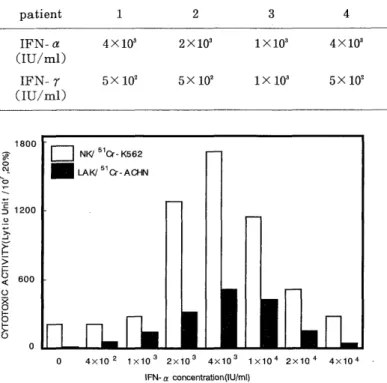
Optimal concentration of nIFN- a or rIFN- r : As shown in Table 1, LAK-like activity increased after stimulation with nIFN- a or rIFN- r in all patients and the optimal concentration of nIFN- a or rIFN- r which induce maximal LAK-like activity differ in each patient. NK and LAK-like activities in patient were shown in Fig.2 and Fig.3.
Table 1 Concentration of IFN- a and IFN- r inducing the maximum LAK-like activity into lymphocytes in peripheral blood of the patinents before starting therapy with IFN-s
patient 1 2 3 4 5 6 7 8 9
IFN-a 4X10³ 2X10³ 1X10³ 4X10³ 2X10³ 4X10³ 4X10³ 2X10³ 4X10³
(IU/ml)
IFN- r 5X 10² 5X 10² 1X10³ 5X 10² 1X10³ 5X10² 5X10² 5X10² 5X 10²
(IU/ml)
Table 2 LAK-like activity of lymphocytes in peripheral blood of the patients withe renal cell carcinoma after induction assay for 48 hours at the optimal IFN concentration
patient 1 2 3 4 5 6 7 8 9
IFN-a 512 426 512 853 426 1137 320 320 320 (20%LU)
IFN- r 284 284 568 256 142 320 142 521 284 (20%LU)
IFN- a & r 1853 646 1024 1024 853 1706 568 1137 426 (20%LU)
Fig.2 NK and LAK-like activities at various IFN- a concen- tration in the induction assay for the patient with renal cell carcinoma (patient 1)
The optimal concentaration was 4 X 10³ IU/ml.
Fig.3 NK and LAK-like activities at various IFN- r concen- tration in the induction assay for the patient with renal cell carcinoma (patient 1)
The optimal concentaration was 5X 10² IU/ml.
LAK-like activity induced by optimal concentration of nIFN- a or rIFN- 7 in patients: LAK-like activity induced by optimal concentration of nIFN- a or rIFN- r differ in patients(Table 2). The combination of nIFN- a and rIFN-
r induced LAK-like activity was not synergistic but additive.
The optimal kind of IFN: LAK-like activity induced by
nIFN- a was stronger than that by rIFN- 7 in patient 1, 2, 4, 5, 6, 7 and 9. LAK-like activity induced by rIFN- r was stronger than that by nIFN- a in patient 3 and 8 (Table 2).
This fact showed that the optimal kind of IFN differ in patients.
2) NK and LAK-like activities in vivo of patient treated with nIFN- a and rIFN- r
NK and LAK-like activities in vivo developed administra- tion of nIFN- a. The activity was enhanced after addition of rIFN- 7 and returned after stopping administration of rIFN- r (Fig.4).
3) Production of cytokines in the serum of patient treated with nIFN- a and rIFN- r
We could not detect significant elevation of IL-1 a, IL-1,8, IL-2, IL-6, and TNF- a except administrated IFN- a and IFN- r.
4) Subpopulation of lymphocytes obtained by cell sorting and their LAK-like activitiy
We measured the LAK-like activity of each subpopulation of PBMNCs induced by rIFN- r. The strong LAK-like activity was seen in the fraction CD3(+)CD4( - ) ob- tained by cell sorting after LAK induction assay(Fig.5).
The strong LAK-like activity was also in the fraction CD 3(+)CD4(-) obtained by LAK induction assay after cell sorting (Fig.6).
Table 3 Change of cytokine concentration with the passage of time under the combination therapy with IFN- a and IFN- r in the patient with renal cell carcinoma (patient 9)
1L-1 a IL-1,8 1L-2 1L-6 IFN- a IFN- r TNF- a
(pg/ml) (pg/ml) (pg/ml) (pg/ml) (pg/ml) (pg/ml) (pg/ml)
pretreatment 10> 20> 121 20> 20> 20> 20>
1week 10> 20> 20> 20> 68 20> 20>
2week 10> 20> 20> 20> 70 20> 20>
3week 10> 20> 20> 20> 57 523 20>
Fig.6 LAK-like activity of cell sorted subpopulation after induction assay
Fig.4 Change of NK and LAK-like activities of the patient's PBMNCs under the combination therapy with IFN- a and IF N- r with passage of time (patient 9)
Fig.5 LAK-like activity of subpopulation cultured for 24 hours in medium with and without IFN- 7500 IU/ml after cell sorting
DISCISSION
Renal cell carcinoma is comparatively rare in urological tumors, but the prognosis is not so good. The 5-year survival rate after nephrectomy is 55-65%. Death of cancer is noted frequently during the observation even in the
lower stage groups expected to have the favorable progno- sis after surgical treatment. Nevertheless, no established treatment is available. The immunotherapy is said to be comparatively effective but the response rate is about 20%. In recent several combination therapies of BRM have been tried. We have applied the nIFN- a and rIFN- r to patients with metastasis at first and recurrence.
PBMNCs are incubated with interferon in vitro and the killer cells which have broad spectrum are induced. Our results showed that there is an optimal concentration for individual patient to induce the maximal LAK-like acitvity in renal cell carcinoma-bearing patients. Further rIFN- 7 developed the higher cytotoxicity in comparison with nIFN- a in 2 patients, while nIFN- a induced the higher cytotoxicity in comparison with rIFN- 7 in other patients. This result suggests that there is an optimal kind of BRM suitable to each patient. Weigent et al 16) reported that the cytotoxicity in combination use of IFN- a and IFN- 7 was synergistic in vitro. However, it seems to be additive in our study.
We could not detect significant elevation of IL-1 a, IL- 1,8, IL-2, IL-6, and TNF- a levels in the serum of patients undergoing nIFN- a and rIFN- 7 therapy. Kubota 17) re- vealed that PBMNCs from normal healthy donors acti- vated with nIFN- a in vitro showed strong LAK-like activity, while no increase of cytokines other than nIFN- a is noted in the supernatant of culture. Results of Kubota's experiment and this study suggest that cytotoxic
activity induced by IFN does not depend on other cytokines but IFN acts directly on the lymphocytes. Further, the strongest cytotoxicity induced by rIFN- r against ACHN was seen in the fraction CD3(+) CD4(-) either by the induction assay after cell sorting or by cell sorting after the induction assay. IFN- r seems to work directly on this fraction to induce LAK-like activity. Kubota " ) demon- strated that IFN- a acted on the fraction CD3( - ) CD16(+) to induce LAK-like activity. The subpopulation of PBMNCs stimulated by IFN- r is different from subpopulation stimulated by IFN- a. This fact showed that combination therapy with IFN- a and IFN- r may be useful for the treatment of renal cell carcinoma.
CONCLUSION
The effect in combined use of IFN- a and IFN- r on renal cell carcinoma and action mechanisms were studied.
(1) There seems to exist an optimal kind of BRM and an optimal concentration in each patient with renal cell carcinoma.
(2) In vivo, the additive effect was noted on increased cytotoxic activity of PBMNCs of the patients with renal cell carcinoma upon combined use of IFN- a and IFN- r.
(3) IFN- r seems to have induced the LAK-like activity to the fraction CD3(+)CD4(-) of lymphocytes in its action mechanism.
REFERENCES
1) Quesada, J.R., Suenson, D.A. and Gutterman, J.U.: Phase study of interferon alpha in metastatic renal-cell carcinoma: A progress report.
J. Clin. Oncol. 3:1086-1092, 1985.
2) Mamumo, K., Murai, M., Hayakawa, M., et al.: Human lympho- blastoid interferon therapy for advanced renal cell carcinoma. Urology
24:567-561, 1984.
3) Vugrin, D., Hood, L., Taylar, W., et al.: Phase Study of human lymphoblastoid interferon in patients with advanced renal cell
carcinoma. Cancer Treaat. Rep. 669:817-820, 1985.
4) Greegory, S., Robert, F. and Jeaan de, K.: Interferon in renal cell carcinoma the UCLA experience. Cancer 59:610-612, 1987.
5) Rober, J.S.: Clinical overview of alpha interferon studies and direc- tions. Cancer 50, 997-1002, 1987.
6) Quesada, J.R., Kurzrock, R., Sherwin, S.A., et al.: Phase II studies of recombinat human interferon gamma in metastatic renal cell carci-
noma. J.Biol. Resp. Mod. 6,:20-27, 1987.
7) Koiso, K.: Recombinant human interferon gamma (S-6810) research group on renal cell carcinoma: Phase II study on recombinant human
interferon gamma on renal cell carcinoma. Cancer 60:929-933, 1987.
8) Aulitzky, W., Gastl, G., Aulitzky, W. E., et al.: Successful treatment of metastatic renal cell carcinoma with a biologically active dose of
recombinant interferon gammaa. J. Clin. Oncol. 7:1875-1884, 1989.
9) Grups, J.W., Frohmuller, H.G.: Cyclic interferon gamma treatment of patients with metastatic renal cell carcinoma. Br.J. Urol. 64:218-220,
1989.
10) deMulder, P.H.M., Debruyne, F.M., Franssen, M.P.H., et al.: Phase I / II study or recombinant interferon a and r in advanced progressive
renal-cell carcinoma. Cancer Immunolo. Immunother. 31:321-324, 1990.
11) deMulder, P.H.M., Geboers, A.D.H., Debruyne, F.M.J., et al.:
Recombinant (R) interferon (IFN) alpha and gamma in treatment of
advanced renal cell carcinoma ( RCC) [abstract]. Proc. Am. Soc. Clin.
Oncol. 7:13, 1988.
12) Nair, S.G., Kirkwood, J.M., Colao, D., et al.: Phase I A/B trial of recombinant interferons (rIFN) alpha ( a ) and gamma ( r ) in
patients (PTS) with metastatic (MET) reanl cell carcinoma
( RCC) [ abstract]. Proc. Am. Soc. Clin. Oncol. 7:126, 1988.
13) Quesada, J., Evans, L., Saks, S.R., Gutterman, J.U.: Recombinant
interferon alpha and gamma in combination as treatment for metastatic renal cell carcinoma. J. Biol. Response Mod. 7:234-239, 1988.
14) Geboers, A.D., deMulder, P.H.M., Debruyne, F.M., Srijk, S.P., Damsma, 0.: Alpha and gamma interferon in the treatment of
advanced renal cell carcinoma. Semin. Surg. Oncol. 4:191-194, 1988.
15) Werkmeister, J., Roder, J.C., Curry, C. and Pross, H.F.: The effect of unphosphorylated and phosphorylated sugar moieties on human and
mouse natural killer cell activity : Is there selective inhabitton at the
level of target recongnition and lutic acceptor site ? Cell Immunol.
80:172-186, 1983.
16) Weigent, D.A., Langford, M.P., Fleischman, W.R., et al.: Potential of lymphocyte natural killing by mixtures of alpha or beta interferon
with recombinant gamma interferon. Infe Immun. 40:35-37, 1983.
17) Kubota, S.: Lysis of autologous tumor cells by peripheral bllod lymphocytes treated with IFN- a in patients with renal cell carci-
noma., J.Jpn. Urol. 83:1781-1788, 1992.(Japanese)