Message Strategies, Informativeness and Value Appeals in Chinese Television Advertising:
An Empirical Study
201281 王 力勇 指導教員名 プラート カロラス
高宮城 朝則 平成26年度提出
Abstract
Based on the long-running debate on standardization versus adaptation in international advertising, the issue of differences in advertising content has been widely investigated. Results of many of these empirical studies have led their authors to suggest the appropriateness of a contingency approach to developing advertising content. However, previous studies have principally focused on advertising from Western countries. In addition to a relative lack of research on Chinese advertising, the extant studies on Chinese advertising that have been conducted invariably use analytical and conceptual frameworks that were originally developed in Western countries. This poses the question as to the validity and appropriateness of these frameworks in a non-Western context such as that of China. In order to address the relative lack of research on advertising in China, this dissertation examines in detail the characteristics of Chinese advertising in terms of three aspects of advertising content: message strategy, informativeness, and value appeals.
Based on systematically collected sample commercials from Chinese Central Television station (CCTV) and three carefully modified frameworks, I conducted three content-analytical studies on the above-mentioned three aspects of advertising content. I report the results of statistical analyses of data collected pertaining to message strategy, informativeness and value appeals, and discuss the theoretical and managerial implications of the findings.
Regarding advertising message strategy (Chapter 4), I first concentrate on the improvement of the extant typologies. Using the modified typology, this dissertation content analyzes message strategies manifest in Chinese TV commercials. Results show
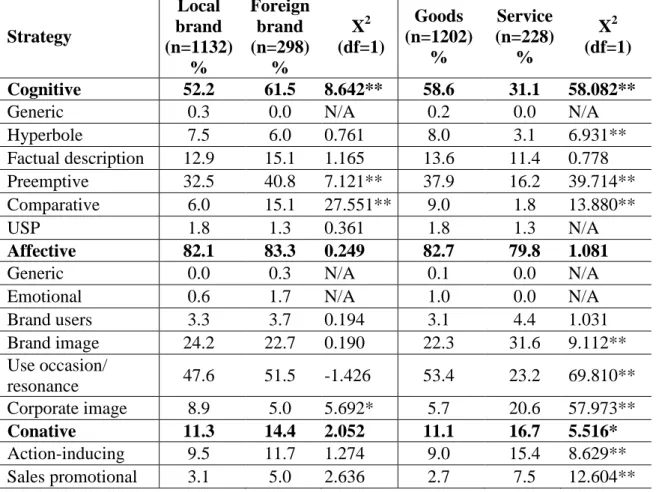
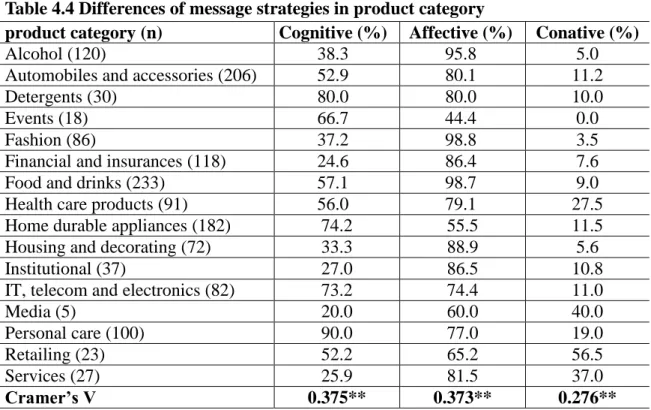
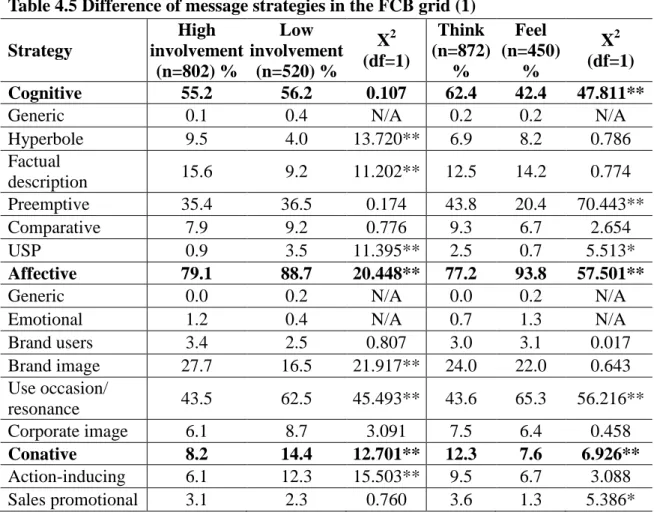
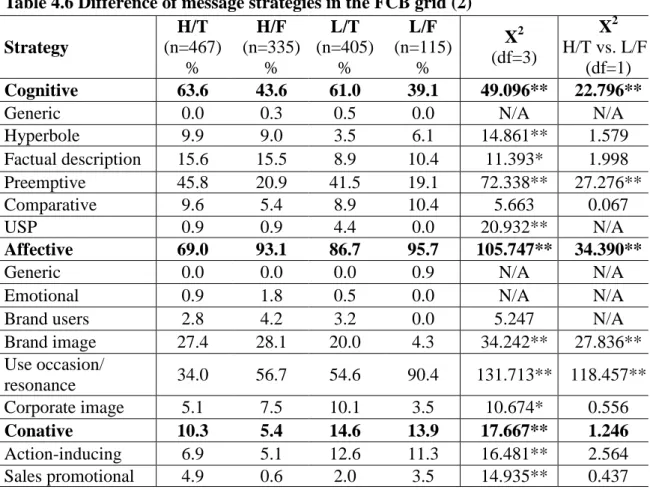
that affective message strategy (82.3%) is the most frequently used, followed by cognitive message strategy (54.1%), and that conative strategy is the least frequently used (12%). Furthermore, around one third of commercials use both affective and cognitive strategies simultaneously. In regard to brand origin, commercials for foreign brands use more cognitive message strategies. Comparison between goods and services ads indicates that goods ads contain significantly more cognitive strategies whereas services ads contain more conative strategies. Product category is shown to be an important factor influencing the usage of advertising message strategy. Results of analyses using the FCB grid model indicate that ads for low-involvement products use more affective and conative strategies than those for high-involvement products, while ads for think products use more cognitive but less affective message strategies than those for feel products.
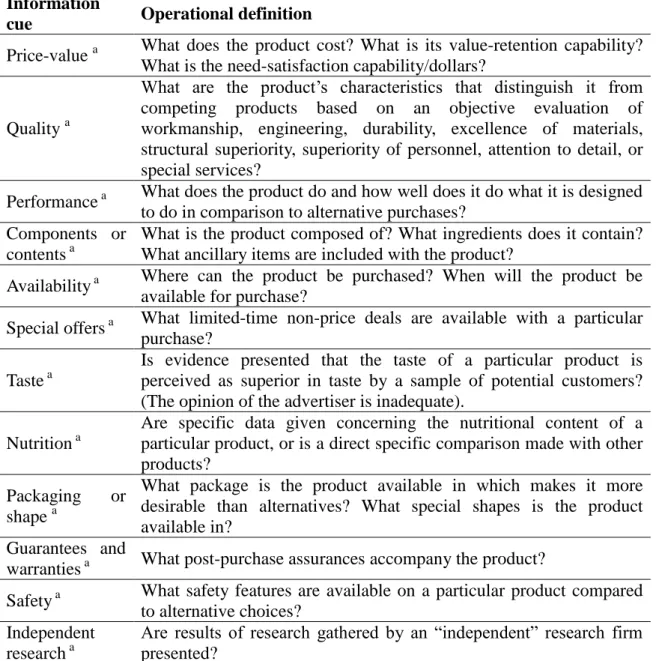
As far as information content is concerned (Chapter 5), I extensively review extant studies on this topic and formulate hypotheses. Using an expanded version of the framework developed by Resnik and Stern (1977), I conduct content analysis and report findings. In general, results show that the informative level in this study is significantly higher than that reported in Chan and Chan (2005). The current study finds that 76.3%
of ads contain at least one information cue and that an average of 1.6 cues are used in Chinese TV advertising. The most frequently used information cues are performance, variety, and components/contents. In terms of brand origin, ads for foreign brands use more information cues than those for local brands. Furthermore, ads for goods use more information cues than ads for services. Hypotheses related to product involvement level and product durability are not supported since ads for high-involvement products do not use more information cues than those for low-involvement products. In addition, ads for
durable products do not use more information cues than ads for non-durable products.
On the other hand, ads for think products contain more information content than those for feel products. In addition, results also indicate that product category influences the usage of information content.
With respects to the topic of value appeals (Chapter 6), I also supplemented the extant framework developed by Pollay (1983) by incorporating more Chinese traditional value appeals. Using this modified framework, I conducted a content analysis. Results show that the most frequently used value appeals are enjoyment/leisure, effectiveness, quality, and trustworthiness. Most probably as a result of the high-context communication and collectivism characteristics of Chinese culture, symbolic as well as Eastern value appeals are significantly used more frequently than utilitarian and Western value appeals respectively. Furthermore, ads for domestic brands use more Eastern appeals whereas ads for foreign brands use more Western appeals. Moreover, ads for high-involvement products contain more utilitarian and less symbolic appeals than those for low-involvement products while ads for think products contain more utilitarian appeals than those for feel products. In addition, ads for goods contain more utilitarian and Western appeals while ads for services contain more symbolic and Eastern appeals.
Consistent with the above findings, results indicate that value appeals vary across product categories.
In conclusion, this study examines the influence of brand origin, product category, involvement level, and involvement type on advertising content in terms of the three main research topics of message strategies, informativeness, and value appeals.
Findings tend to demonstrate consistency in respect to the influence of brand origin and product category. However, the two dimensions (involvement level and involvement
type) of the FCB grid model show inconsistent influence on the use of the three topics in Chinese television commercials. Furthermore, the characteristics of Chinese television commercials as well as their implications in terms of each of the three topics are discussed in detail in Chapters 4, 5, and 6.
Findings of this dissertation have implications for both practitioners and academics.
While this study focuses on advertising in a single country, its findings nevertheless allow international advertising practitioners who are to develop their advertising strategy in the Chinese market, to compare the characteristics of Chinese television advertising with those of their home market or the global market. Therefore, I believe that the findings reported in this dissertation will assist practitioners in deciding whether to standardize advertising strategy or to adapt to the particularities of the Chinese market. The study also modifies the extant analytical frameworks on message strategies, informativeness, and value appeals and makes important contributions to an increased understanding of the nature of advertising in China, which I believe should be of interest to academic researchers.
Acknowledgement
This dissertation is the result of three years of work during which I have received the support of many people. Without their support and encouragement, this dissertation would not have been possible. I would like to express my sincere appreciation here to all of them.
First and foremost, I am grateful to Professor Carolus Praet, my supervisor. I owe him thousands of thanks for introducing me to this type of research. He has been guiding me in my research process since the time when I was a research student. It is because of his encouragement and backup that I was able to experience international academic conferences and publish my research findings. Without his insightful suggestions and strong support, I would not have been able to smoothly finish this dissertation. Besides being an excellent research supervisor, Professor Praet is also very kind and has become a good friend.
I then express my appreciation to Professor Tomonori Takamiyagi, my vice supervisor. He has always provided invaluable suggestions on my research and has also lent his support to me on many other issues beyond academic research.
I would also like to thank the members of my PhD committee: Professor Makoto Anazawa and Professor Hajime Itoh for their insightful and encouraging comments.
Their suggestions helped me improve my work.
I truly extend many thanks to Dr. Kazuhiro Suzuki. He is very warmhearted and generous and gave me valuable advice on statistical analysis. Without his help, I might not have been able to solve these issues efficiently.
My thanks also go out to all the coders who participated in the content analysis used
for this dissertation for their careful coding work. Without their dedication, thoroughness and hard work, it would have been difficult to conduct a valid and reliable scientific study.
In addition to the faculty members mentioned above, I also want to express my appreciation to Otaru University of Commerce, which has provided me with the opportunity to finish the doctoral program. Furthermore, I appreciate the financial support that the university has provided for conducting and reporting my research.
In addition, I sincerely appreciate the financial support provided by the Rotary Yoneyama Memorial Scholarship Foundation. Without the generous donation of Rotarians, I would not have been able to fully concentrate on my research in the past two years, nor would I have been able to afford the travel expenses associated with presenting my work in international conferences.
I am also deeply grateful to my parents for collecting the television broadcast programming containing all the commercials that constituted the sample of this study on my behalf. Since I was in Japan and did not have access to Chinese television programs, they recorded all the television programs for an entire year. Without their help, this research would have been a castle in the sky.
Finally yet importantly, I truly express my special gratitude to my wife. She has always been positive toward and supportive of my pursuit of a doctoral degree. Not only did she support me in daily life, she also performed coding work for this study. I hereby dedicate this dissertation to my wife for her unlimited affectionateness.
Table of Contents
Abstract ... i
Acknowledgement ... v
Table of Contents ... vii
List of Tables ... xi
Chapter 1 Introduction ... 1
1.1 Research Background ... 1
1.2 Research Framework ... 9
1.3 Structure of the Dissertation ... 11
Chapter 2 Key Constructs and Model ... 14
2.1 Culture and Advertising ... 14
2.2 High- versus Low-Context Communication ... 19
2.3 The FCB Grid Model ... 20
Chapter 3 Methodology and Sample ... 25
3.1 Content Analysis ... 25
3.2 Sample Collection ... 26
3.3 Sample Profile ... 27
Chapter 4 Message Strategy ... 29
4.1 Introduction ... 29
4.2 Prior Typologies of Message Strategy ... 31
4.3 A Modified Typology of Message Strategies ... 36
4.4 Empirical Examination of Message Strategies ... 41
4.4.1 Formulation of research questions and hypotheses ... 41
Cultural influence on message strategies ... 42
Influences of brand origin ... 44
Goods versus services ... 46
Product categories ... 47
The FCB grid model ... 48
4.4.2 Method - Coding procedures ... 50
4.4.3 Empirical results ... 51
4.4.4 Discussion, implications, limitations and future research ... 59
The modified typology and its implications ... 59
Differences between ads for local and foreign brands ... 61
Differences between ads for goods and services ... 62
Influence of the FCB grid model on message strategies ... 64
Implications, limitations and future research ... 66
Chapter 5 Information Content ... 69
5.1 Introduction ... 69
5.2 Literature, Hypotheses and Research Questions ... 70
5.2.1 Advertising informativeness ... 70
5.2.2 Factors affecting advertising informativeness ... 73
5.2.3 Influence of national culture ... 74
5.2.4 Influence of product category on informativeness ... 75
5.2.5 Goods versus services ... 78
5.3 Method ... 79
5.3.1 Coding framework ... 79
5.3.2 Coding procedure ... 81
5.4 Results ... 82
5.5 Discussion ... 95
5.5.1 Update of the framework ... 95
5.5.2 Explanations for high informativeness ... 96
5.5.3 Differences of information content by brand origin ... 98
5.5.4 Differences of information content by product category ... 100
5.5.5 Limitations and future research ... 104
Chapter 6 Cultural Value Appeals ... 107
6.1 Introduction ... 107
6.1.1 Values and appeals ... 107
6.1.2 Limitations of previous analytical frameworks ... 110
6.2 Literature, hypotheses and research questions ... 111
6.2.1 International advertising studies on value appeals ... 111
6.2.2 Prior research on Western countries ... 112
6.2.3 Prior research on Eastern countries ... 113
6.2.4 Prior research related to Hong Kong, Taiwan, and Mainland China ... 115
6.2.5 Formulation of hypotheses and research questions ... 118
Utilitarian versus symbolic value appeals ... 118
Western versus Eastern value appeals ... 119
Influence of brand origin ... 120
Influences of the FCB grid dimensions ... 121
Value appeals in ads for goods versus ads for services ... 122
Influence of product category ... 124
6.3 Method ... 126
6.3.1 Coding framework ... 126
6.3.2 Coding procedure ... 130
6.4 Results ... 131
6.5 Discussion ... 148
6.5.1 Updated analytical framework ... 148
6.5.2 Utilitarian value appeals versus symbolic value appeals ... 149
6.5.3 Western value appeals versus Eastern value appeals ... 152
6.5.4 Influence of product category ... 153
Chapter 7 Conclusion, Limitation and Future Research ... 159
7.1 Conclusion ... 159
7.2 Implications, Limitations and Future Research ... 164
References ... 170
List of Tables
Table 2.1 Hofstede country scores of China, Japan and United States ... 18
Table 3.1 Distribution of commercials across product categories ... 27
Table 3.2 Distribution of commercials in terms of FCB grid ... 28
Table 4.1 A modified typology of message strategies ... 40
Table 4.2 Frequencies of message strategies ... 52
Table 4.3 Differences of using message strategies in brand origin and product tangibility ... 54
Table 4.4 Differences of message strategies in product category ... 55
Table 4.5 Difference of message strategies in the FCB grid (1) ... 57
Table 4.6 Difference of message strategies in the FCB grid (2) ... 59
Table 5.1 Information cues and operational definitions... 80
Table 5.2 Information level of Chinese television commercials ... 83
Table 5.3 Information cues in Chinese television commercials ... 84
Table 5.4 Information level in terms of FCB grid (1) ... 85
Table 5.5 Information level in terms of FCB grid (2) ... 86
Table 5.6 Test of between-subject effects in terms of cues per ad ... 87
Table 5.7 Simple main effects of three-way ANOVA in terms of cues per ad ... 88
Table 5.8 Information cues across FCB grid (1) ... 89
Table 5.9 Information cues across FCB grid (2) ... 90
Table 5.10 Information level by product category ... 91
Table 5.11 Percentages of information cues by product category ... 94
Table 5.12 Information level between goods and services ads ... 95
Table 5.13 Information cues between goods and services ads ... 95
Table 6.1 Value appeals and operational definitions ... 127
Table 6.2 Frequencies of value appeals in Chinese television commercials ... 132
Table 6.3 Frequencies of value appeal across brand origin ... 135
Table 6.4 Frequencies of value appeals across FCB dimensions (1) ... 135
Table 6.5 Frequencies of value appeals across FCB dimensions (2) ... 137
Table 6.6 Frequencies of value appeals across FCB dimensions (3) ... 138
Table 6.7 Differences of value appeals in goods and services commercials ... 141
Table 6.8 Percentages of value appeals across product categories ... 145
Table 6.9 Test of between-subject effects (three-way ANOVA) - dependent variable: utilitarian, symbolic ... 147
Table 6.10 Simple main effects of three-way ANOVA ... 147
Table 7.1 Summary of findings with respect to message strategy ... 160
Table 7.2 Summary of findings with respect to information content... 161
Table 7.3 Summary of findings with respect to value appeals ... 162
Chapter 1 Introduction
1.1 Research Background
In the field of international marketing, the debate of standardization versus adaptation has been a key theme in both academic circles and business community for over five decades. To what extent international marketing strategy should be standardized has long been the focal questions raised by practitioners. The standardization of international marketing relates to two aspects: marketing program (marketing-mix) and marketing process (Jain, 1989; Sorenson and Wiechmann, 1975; Walters, 1986). A majority of researchers have focused on the standardization of the international marketing mix (Agrawal, 1995; Jain, 1989; Ryans et al., 2003). As far as marketing strategy standardization is concerned, it is defined as a common marketing program on a worldwide basis (Jain, 1989), or as a standardized pattern of resource allocation among marketing mix variables across national markets (Szymanski et al., 1993).
Further, Zou and Cavusgil (2002, p. 42-43) conceptualize global marketing strategy as
“the degree to which a firm globalizes its marketing behaviors in various countries through standardization of the marketing-mix variables, concentration and coordination of marketing activities, and integration of competitive moves across markets.”
Proponents of standardization argue that because of the development of technology in the field of communication, transport and travel, and the homogenization of consumer wants for products with lower price and high quality, the emergence of global markets calls for standardized consumer products and therefore companies must learn to operate as if the world were one large market ignoring superficial regional and national differences (e.g., Levitt, 1983; Simon-Miller, 1986). Ohmae (1989, p. 161) argues for
thinking globally and states that “customer needs have globalized, and we must globalize to meet them.” Similarly, Werther (1996) stated that the growing uniformity of global youth culture and the expansion the freed trade had brought the world to competitive convergence. The logic why so many scholars argue for international marketing standardization is that international marketing standardization may offer a number of benefits, such as cost savings through economies of scale (Buzzell, 1968;
Fatt, 1967; Levitt, 1983; Simon-Miller, 1986; Sorenson and Wiechmann, 1975), consistency in product and brand image with customers (Buzzell, 1968; Fatt, 1967;
Levitt, 1983; Sorenson and Wiechmann, 1975), improved planning and control (Buzzell, 1968; Fatt, 1967), and exploiting good marketing ideas (Buzzell, 1968; Fatt, 1967).
Although a number of researchers argue that globalization is accelerating and that there is a trend toward a homogenization of the world’s wants (e.g., Fatt, 1967; Levitt, 1983), few empirical findings have lent support to this assertion (Douglas and Wind, 1987;
Walters, 1986; Wind, 1986).
In contrast, proponents of adaptation argue that international marketing strategy should be adapted to meet local consumer needs and wants (Britt, 1974; Clark, 1990;
De Mooij, 2000; Harvey, 1993; Kashani, 1989; Light, 1990; Papavassiliou and Stathakopoulos, 1997; Quelch and Hoff, 1986; Shao et al., 1992; Thrassou and Vrontis, 2006). This is because among countries significant differences exist, including –but not limited to– consumer needs and buying behavior (Britt, 1974; Clark, 1990; Kotler, 1986; Light, 1990), market needs and resources (Sheth, 1986; Light, 1990), culture (Britt, 1974; Buzzell, 1968; Clark, 1990; De Mooij, 2000; Mueller, 1992), stage of economic and industrial development (Buzzell, 1968; Papavassiliou and Stathakopoulos, 1997), stage of product life cycle (Buzzell, 1968; Papavassiliou and Stathakopoulos,
1997), competition (Buzzell, 1968; Kotler, 1986), advertising agencies and media availability (Buzzell, 1968; Light, 1990; Papavassiliou and Stathakopoulos, 1997), and legal restrictions (Buzzell, 1968; Kotler, 1986; Papavassiliou and Stathakopoulos, 1997).
Instead of pure standardization or total differentiation, many researchers argue for a contingency approach and suggest mixed marketing strategies taking both standardization and adaptation into account (Buzzell, 1968; Douglas and Wind, 1987;
James and Hill, 1991; Kotler, 1986; Porter, 1986; Sheth, 1986; Sorenson and Wiechmann, 1975; Walters, 1986; Wind, 1986; Yip, 1989). Walters (1986) argues that the attractiveness of standardization strategies is very situation-specific. Wind (1986, p.
26) suggests a useful guideline for practitioners called “think globally, act locally,” i.e.,
“overall design follows worldwide perspective but every detail of the marketing strategy takes into account the idiosyncratic country characteristics and cultural differences.”
Based on an integrative analysis of 36 empirical studies on strategy standardization/adaptation, Theodosiou and Leonidou (2003) conclude that the decision whether to standardize or adapt international marketing strategy largely depends on the unique set of circumstances that the company is confronted by within a particular overseas market.
As far as individual elements of the marketing-mix are concerned, a large segment of literature on this debate has concentrated on advertising (Cheon et al., 2007; Elinder, 1965; Fatt, 1967; Harris, 1994; Laroche et al., 2001; Melewar et al., 2009; Miracle, 1968; Okazaki et al., 2006; Onkvisit and Shaw, 1999; Theodosiou and Leonidou, 2003;
Walters, 1986). The issue of advertising standardization in foreign markets was first discussed in the 1960s. Elinder (1965, p. 8) strongly argues that advertising should be
“going all-European” to be “synchronized to fit the all-European media, and must take advantage of border-crossing tourists, readers, and viewer.” Fatt (1967) believes that an international advertising campaign with a truly universal appeal can be effective in any market. On the one extreme, those proponents of the standardization approach to international advertising argue that buyers everywhere in the world share the same or very similar wants and needs, and therefore a single advertising message with only minor modifications, or even advertisements with proper translations, can be used in all countries to reach consumers (Papavassiliou and Stathakopoulos, 1997). On the other extreme, proponents of adaptation approach argue that separate messages should be used to reach buyers in different markets by fitting the message to each particular country or even region due to insurmountable differences in culture, economy, legal issues, media and product dissimilarities (Papavassiliou and Stathakopoulos, 1997).
Light (1990, p. 32) suggests that the world will not evolve into an undifferentiated sea of homogenization and that advertisers should move from global standardization to global marketing, i.e., “the maximization of global efficiency while simultaneously optimizing local selling effectiveness.” He also argues that it is more effective to customize and individualize international marketing. Furthermore, Kanso and Nelson (2002) suggest that the key to effective international advertising is adaptation to uncontrollable environmental differences in each country (i.e., market infrastructure, cultural, economic, and legal forces, etc.). Rather than an absolute standardization or adaptation approach, some scholars suggest that it is desirable to standardize certain aspects of the advertising campaign in particular situation while at the same time to adapt other aspects to different market conditions, consumer characteristics and environmental factors (Ducan and Ramaprasad, 1995; Kanso, 1992; Jain, 1989;
McCarty et al., 2007; Peebles et al., 1977; Quelch and Hoff, 1986; Shao and Waller, 1993; Sheth, 1978; Taylor and Johnson, 2002; Waller et al., 2010). Sriram and Gopalakrishna (1991) clustered 40 countries into six groups based on their similarity economically, culturally, and in their media availability and usage, and propose standardization of international advertising within each of these clusters. Shao and Waller (1993) contend that in general, agencies were neither standardizing nor customizing their sales platforms or creative contexts; instead, they tended to utilize the adaptation approach. Similarly, Harris (1994) points out that standardization is a flexible and adaptive policy that can take many forms and that many adverting campaigns are neither totally adapted, nor totally standardized. Kanso (1992, p. 13) argues that communication is largely determined by cultural conditions and that advertising practitioners should consider each foreign business opportunity as a unique challenge, pursuing “global commitment to local vision.” In a review of academic versus practitioner oriented papers on advertising standardization from the 1950s to the 1980s, Agrawal (1995) found that while practitioners alternated between adaptation and standardization, academics tended to favor either a contingency or an adaptation approach to advertising. Birnik and Bowman (2007) reviewed more than 100 high-quality studies on the debate of standardization versus adaptation of international marketing and reported that advertising exhibited a medium level of standardization.
Their findings illustrates that multinationals are facing very complex decisions regarding advertising standardization in terms of possible types and degrees rather than a simple choice between advertising standardization and adaptation.
Based on this long-lasting debate in international advertising, the issue of differences in advertising content has been widely investigated (Okazaki, 2004) and results of
studies have usually led their authors to suggest the appropriateness of a contingency approach (Karande et al., 2006). Some of the main themes studied in international advertising content analysis research include creative (message) strategy and execution (e.g., Farrall and Whitelock, 2001; Karande et al., 2006; Wei and Jiang, 2005; Zandpour et al., 1992), information content (i.e., level of informativeness) (e.g., Choi et al, 2006;
Resnik and Stern, 1977; Zandpour et al, 1994), and cultural value appeals (e.g., Cheng and Schweitzer, 1996; Hoeken et al, 2007; Shavitt et al, 2006; Tse et al., 1989). The following chapters of this dissertation comprehensively review the previous studies on these themes in depth.
One way to classify previous studies on advertising creative strategy (message strategy), information content (level of informativeness), and cultural value appeals is by the geographic scope of the countries studied. The first group of studies are comparisons of advertising content between Eastern countries/culture and Western countries/culture (e.g., Abernethy and Franke, 1996; Cheng and Schweitzer, 1996; Cho et al., 1999; Hong et al., 1987; Keown et al., 1992; Lin, 1993; Madden et al., 1986;
Mueller, 1987; Mueller, 1991; Okazaki, 2004; Okazaki and Mueller, 2008; Ramaprasad and Hasegawa, 1992; Taylor et al., 1997; Wei and Jiang, 2005; Zandpour et al., 1994;
etc.). A second group of studies are comparisons of advertising content between countries that share a similar culture (Chan and Cheng, 2002; Frazer et al., 2002;
Karande et al., 2006; Moon and Chan, 2005; Nevett, 1992; Weinberger and Spotts, 1989). A third group of studies focus on advertising content in one single country (Aaker and Norris, 1982; Abernethy, 1992; Benedetto et al, 1992; Chan, 1999; Farrall and Whitelock, 2001; Mueller, 1992; Pollay, 1983; Resnik and Stern, 1977; Taylor et al,
1996; Wang and Praet, 2013a, 2014a, 2014b1).
In addition to geographic scope, some studies add an additional analytical angle by focusing on particular product categories and examining the influence of product category on advertising messages (Caillat and Mueller, 1996; Cheong et al., 2010;
Tansey et al., 1990; Wang and Praet, 2012, 2013b, 2013c). Irrespective of whether studies compare advertising from multi-countries or focus on advertising from one single country, there is a strong concentration of studies focusing on advertising in Western countries with many studies involving advertising from the United States.
Among Eastern countries, Japan and South Korea have long been popular targets among advertising researchers, not in the least because of the relatively high proportion of students from these countries pursuing research degrees in the United States. In recent years international advertising researchers and practitioners have increasingly shifted their attention to the world’s largest developing market, China. Taylor (2005, p. 7) reports that Asia has been the region examined most frequently with respect to international advertising by research publications in the Journal of Advertising from 1995 to 2004 and “the especially fast growth of the world’s most populous country, China” partially explains this trend. In 2010 China surpassed Japan to become the second largest economy in the world, trailing only the United States. In addition, to date the majority of studies on Chinese advertising content are comparative in nature (Cheng and Schweitzer, 1996; Emery and Tian, 2010; Lin, 2001; Chan and Cheng, 2002), and relatively few studies have concentrated particularly on Chinese advertising content with respect to message strategy (Chen and Taylor, 2012) and information content (Chan and Chan, 2005). Even though some studies have examined cultural values and appeals in Chinese advertisements (Cheng, 1997; Zhang and Harwood, 2004), these
studies have inherent limitations in that their analytical schemes originated from Western culture. In order to address these gaps in the literature, this dissertation will examine in detail the characteristics of Chinese advertising content in terms of message strategy, information content, and value appeals.
As far as advertising media is concerned, television has been the most important advertising medium in China since 1995 (Cheng and Chan, 2009). According to China Advertising Yearbook (2010), Chinese consumers on average watch television for 175 minutes every day, which is much more than the time they spend interacting with any other mass medium. In 2007, television accounted for 25.4% of total advertising billings, attracting 350 million households to watch TV for an average of three hours per day (Cheng and Chan, 2009). Because of the importance of television as an advertising medium in China, I decided to focus on Chinese television advertising as the object of investigation for this dissertation.
This dissertation intends to make contributions in relation to the standardization versus adaptation debate in international advertising, reviewed above. Contributions are useful for both practitioners and academics. As a study that focuses on advertising in a single country its results do not allow straight comparisons with advertising in other nations. While this clearly is a limitation of the current study, its findings will nevertheless allow international advertising practitioners who are to develop their advertising strategy in Chinese market, to compare the characteristics of Chinese television advertising with the characteristics of advertising in their respective home markets or in the global market. Therefore, this dissertation is believed to assist practitioners in deciding whether to standardize advertising strategy or to adapt to the particularities of the Chinese market. The study also makes important contributions to
an increased understanding of the nature of advertising in China and thus is also of interest to academic researchers.
1.2 Research Framework
In order to communicate with target consumers, advertisers have two basic types of messages at their disposal: informational and emotional advertising. Aaker and Norris (1982, p. 61) have suggested that all advertising is either “image, emotional, and feeling”
or “informative, rational, and cognitive.” Informational advertising communicates rational, logical facts about the product or brand, whereas emotional advertising tries to establish a favorable feeling between the consumer and the product or brand (Puto and Wells, 1984; Laskey et al., 1989; Crask and Laskey, 1990; Chan and Chan, 2005). The goal of informational or rational advertising is to focus directly on the features or benefits of the product; in contrast, transformational advertising emphasize the experience that consumption of goods or services will provide to the consumer (Puto and Wells, 1984; Okazaki, Mueller and Taylor, 2010).
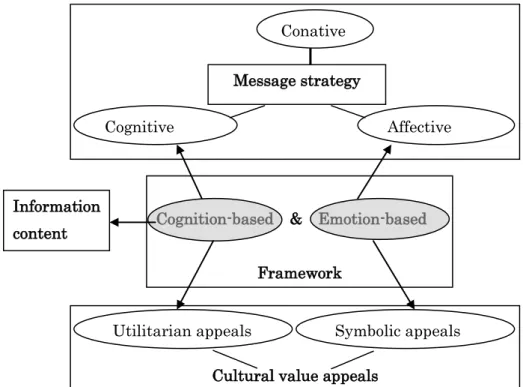
This study employs the cognition-based and emotion-based advertising scheme as the fundamental research framework. Based on the framework, this dissertation extensively examines the Chinese advertising content in terms of message strategy, information content, and cultural value appeals, which are the most frequently researched and the most important research subjects in international advertising (Okazaki, 2004). First, formulation of an appropriate advertising creative (or message) strategy2 is crucial for any successful advertising campaign (Ramaprasad and Hasegawa, 1992) to the extent that some researchers have called it ‘perhaps’ the most important marketing decision for
2 Definition of and relation between creative strategy and message strategy would be illustrated in
many consumer goods marketers (Frazer, 1983). Traditionally message strategy has been classified into 2 categories: informational and transformational strategies (Laskey et al., 1989; Puto and Wells, 1984). Clow et al. (2002) later added a third category of
‘conative strategy’ to their message strategy scheme. Based on a thorough review of prior frameworks, message strategy in this dissertation incorporates three components:
cognitive, affective, and conative strategies. Cognitive and affective strategies correspond to the cognition-based and emotion-based scheme respectively. Second, in relation to cognition-based advertising content, informativeness refers to the extent to which advertising contains useful product-related information. The inclusion of information in advertising is deemed important to help consumers make informed purchasing decisions (Aaker and Norris, 1982). Third, cultural influence has long been a key factor that affects international advertising standardization due to the fact that advertising tends to reflect the prevalent values of the culture in which it originates, and cultural values, norms, and characteristics are embedded in advertising appeals (Mueller, 1987). Cultural value appeals in general are classified into two categories: utilitarian and symbolic, and these correspond with the cognition-based and emotion-based scheme respectively. Figure 1.1 illustrates the framework of this dissertation.
Figure 1.1 Research framework of this dissertation
1.3 Structure of the Dissertation
Chapter 1 reviews the debate of international advertising standardization versus adaptation and introduces the main topics addressed in this dissertation: message strategy, informativeness, and value appeals in Chinese television advertising. It also provides the rationale for choosing Chinese television advertising as the object of the dissertation. Finally, it presents the research framework that forms the basis for this dissertation and shows how the basic constructs of the framework are interrelated.
Chapter 2 introduces two theoretical models for cultural analysis and one advertising classification scheme used in this dissertation. An explanation of these models and the classification scheme is included as it is necessary for understanding the contents of the following chapters. I review two fundamental models used for investigating cultural differences among countries: Hofstede’s cultural dimensions model and Hall’s high/low
Cognitive Affective
Information content
Cultural value appeals
Utilitarian appeals Symbolic appeals
Message strategy
Cognition-based & Emotion-based
Framework Conative
context communication model in addition to the FCB grid model used for delineating advertising planning strategy.
In Chapter 3, I describe the methodology of content analysis utilized in the current study. This chapter also describes the method of sample collection and the sample profile.
Chapter 4 first concentrates on the modification of an integrated typology of message strategy. The chapter then reviews previous studies on advertising message strategies, and formulates research questions and hypotheses. Next, using the modified typology of message strategy described earlier in the chapter, this chapter describes the coding procedures. Finally, findings of a content analysis are reported and discussed.
In Chapter 5, I report results of a content analysis of the informativeness of Chinese television commercials. I first review extant studies on the topic and formulate hypotheses. Then I discuss how I supplemented Resnik and Stern’s (1977) framework for measuring informativeness, and describe coding procedures. Finally, I report and discuss the empirical results.
Chapter 6 focuses on cultural value appeals. Following the same process, I first review previous studies and formulate hypotheses. Because of the inherent Western bias and consequent inability to adequately capture aspects of Chinese culture of the existing frameworks, I include some more Eastern value appeals that are derived from Confucian philosophy in the framework. Subsequently, I report content analysis results after describing coding procedures. Finally, results are discussed. From Chapter 4 to Chapter 6, in addition to a general analysis of the dependent variables, I also examine the influence of brand origin, product category, involvement level, and involvement type on the results.
In Chapter 7, I summarize the main findings of the three content analysis studies reported in Chapter 4-6 and address the limitations of the current study as well as possible venues for future research.
Chapter 2 Key Constructs and Model
This chapter introduces two theoretical models for cultural analysis and one advertising classification scheme used in this dissertation. An explanation of these models and the classification scheme is included as it is necessary for understanding the contents of the following chapters. In this chapter I review two models used for investigating cultural differences among countries: Hofstede’s culture dimension model and Hall’s high/low context communication model. This chapter also explains where China is positioned based on these two cultural classification schemes and also briefly reviews how these schemes have been used in international advertising research. Finally, I also introduce the FCB grid model, which is an often-used model for advertising planning.
2.1 Culture and Advertising
Culture is defined as “patterned ways of thinking, feeling and reacting, acquired and transmitted mainly by symbols, constituting the distinctive achievements of human groups, including their embodiments in artifacts; the essential core of culture consists of traditional (i.e., historically derived and selected) ideas and especially their attached values” (Kluckhohn, 1951, p. 86). In line with this, Hofstede (2011, p. 3) defines culture as “the collective programming of the mind that distinguishes the members of one group or category of people from others.” He also argues that culture is a not a characteristic of individuals but encompasses a number of people who were conditioned by the same education and life experience. De Mooij (2005, p. 36) argues that individuals are products of their culture, i.e., “Our ideas, our values, our acts, and our emotions are
cultural products. We are individuals under the guidance of cultural patterns, historically created systems of meaning.” In this perspective, “advertising reflects these wider systems of meaning,” that is, “all manifestations of culture, at different levels, are reflected in advertising (p. 36).”
Culture differs across countries. The most frequently cited and arguably most useful work on the cultural diversity among countries is the dimensions of culture framework proposed by Geert Hofstede (Cateora and Graham, 2002; De Mooij and Hofstede, 2010).
Studying over 90,000 people in 66 countries, Hofstede initially published his framework in 1980 and showed that national cultures differed along four primary dimensions:
individualism versus collectivism, power distance, uncertainty avoidance, and masculinity versus femininity. In a subsequent study, he added a fifth dimension:
long-term versus short-term orientation. Recently in 2010, another dimension was incorporated into his model.
Hofstede (2011, p. 8) describes the six cultural dimensions as follows:
1. Power Distance, related to the different solutions to the basic problem of human inequality;
2. Uncertainty Avoidance, related to the level of stress in a society in the face of an unknown future;
3. Individualism versus Collectivism, related to the integration of individuals into primary groups;
4. Masculinity versus Femininity, related to the division of emotional roles between women and men;
5. Long Term versus Short Term Orientation, related to the choice of focus for people’s efforts: the future or the present and past.
6. Indulgence versus Restraint, related to the gratification versus control of basic human desires related to enjoying life.
Power distance is defined as the extent to which the less powerful members of organizations and institutions (like the family) accept and expect that power be distributed unequally (De Mooij and Hofstede, 2010). For instance, in small power distance cultures, older people are neither respected nor feared and subordinates expect
to be consulted whereas in large distance culture, older people are both respected and feared and subordinates expect to be told what to do (Hofstede, 2011). Chinese culture tends to feature large power distance (with a Hofstede country score of 80).3 That is to say, Chinese believe that inequalities among people are acceptable; the subordinate-superior relationship tends to be polarized and there is less defense against power abuse by superiors; individuals are influenced by formal authority and are in general optimistic about people’s capacity for leadership and initiative.
Uncertainty Avoidance deals with a society’s tolerance for ambiguity. It indicates to what extent a culture programs its members to feel either uncomfortable or comfortable in unstructured situations, which are novel, unknown, surprising, and different from usual (De Mooij and Hofstede, 2010). For instance, in weak uncertainty avoidance culture, people are comfortable with ambiguity and lock of structure and show more tolerance of deviant persons and ideas whereas in strong uncertainty avoidance culture, people need for clarity and structure and show less tolerance of deviant persons and ideas (Hofstede, 2011). Chinese culture has a low score (30) on uncertainty avoidance.
That is, adherence to laws and rules in China may be flexible to suit the actual situation;
Chinese are comfortable with ambiguity as the Chinese language is full of ambiguous meanings that can be difficult for Western people to follow.
Individualism, versus its opposite Collectivism, is the degree to which people in a society are integrated into groups (Hofstede, 2011). On the individualist side cultures in which the ties between individuals are loose; everyone is expected to look after him/herself and his/her immediate family; “I” consciousness is more important and personal opinion is expected. On the collectivist side cultures in which people are
3 The explanations of the six dimensions related to China and the Hofstede country scores of China are based on “The Hofstede Centre” retrieved from the website below:
http://geert-hofstede.com/china.html
integrated into strong, cohesive in-groups often extended families (with uncles, aunts and grandparents); “We” consciousness is more important and opinions are predetermined by in-groups (De Mooij and Hofstede, 2010). China is a highly collectivist culture (with a score of 20) where people act in the interests of the group and not necessarily of themselves. Personal relationships prevail over task and company.
Masculinity, versus its opposite Femininity, refers to the distribution of values between the genders (Hofstede, 2011). A masculine society tends to be driven by competition, achievement and success whereas in a feminine society the dominant values are caring for others and quality of life (De Mooij and Hofstede, 2010; Hofstede, 2011). With a score of 66, China tends to be a masculine society oriented and driven by success. The need to ensure success can be exemplified by the fact that many Chinese sacrifice family and leisure priorities to work.
Long-term orientation is the extent to which a society exhibits a pragmatic future-orientated perspective rather than a conventional historic or short-term point of view. Values included in long-term orientation are perseverance, ordering relationships by status, thrift, and having a sense of shame. The opposite is short-term orientation, which includes personal steadiness and stability, and respect for tradition (De Mooij and Hofstede, 2010). Chinese culture (with score of 87) tends to be long-term oriented and very pragmatic. Chinese believe that truth depends very much on situation, context and time and they adapt traditions easily to changed conditions.
Indulgence versus restraint dimension is defined as the extent to which people try to control their desires and impulses, based on the way they were raised. Indulgence stands for a society that allows relatively free gratification of basic and natural human drives
related to enjoying life and having fun. Restraint stands for a society that suppresses gratification of needs and regulates it by means of strict social norms (Hofstede, 2011).
China is a restrained society (with score of 24), that is, Chinese society does not put much emphasis on leisure time and control the gratification of their desires. People with this orientation have the perception that their actions are restrained by social norms and feel that indulging themselves is somewhat wrong.
In order to have an apparent understanding of Hofstede’s six dimensions, Table 2.1 shows the country scores of China, Japan and United States.
Table 2.1 Hofstede country scores of China, Japan and United States Power
distance Individualism Masculinity Uncertainty avoidance
Long-term
orientation Indulgence
China 80 20 66 30 87 24
Japan 54 46 95 92 88 42
U.S. 40 91 62 46 26 68
Source: data from Hofstede’s official website:
http://www.geerthofstede.com/dimension-data-matrix
Based on Hofstede cultural dimensions, a number of researchers have investigated the differences in advertising content across countries and cultures. For instance, Albers-Miller and Gelb (1996) examined the correlation between advertising appeals in business advertising magazines from 11 countries and Hofstede’s original four dimensions and results indicated that a part of value appeals (10 out of 30) were significantly related to Hofstede’s cultural dimensions, i.e., the ornamental, vain, dear, and status appeals positively related while the cheap appeal negatively related to power distance dimension; the untamed, magic, and youth appeals negatively related to uncertainty avoidance; the convenience appeal positively related while the modest appeal negatively related to masculinity dimension. Albers-Miller and Stafford (1999)
examined the differences in using advertising appeals across experiential and utilitarian services for 11 culturally diverse countries and confirmed the significance of cultural influences on the use of appeals. Moon and Chan (2005) studied the differences in value appeals in terms of two of Hofstede’s cultural dimensions: masculinity versus femininity and uncertainty avoidance between Hong Kong and Korea. Results show that femininity is an important variable for explaining differences in advertising between the two countries.
2.2 High- versus Low-Context Communication
Another scheme that distinguishes cultural differences across countries was developed by Edward T. Hall (1976), who proposed the concept of high- versus low-context types of communication style. A high-context culture is one in which people are deeply involved with each other. As a result of intimate relationships among people, a structure of social hierarchy exists, individual inner feelings are kept under strong self-control, and information is widely shared through simple messages with deep meaning. Based on this concept, most communication in high-context culture relies more on the physical context or is internalized in the person, and less information is contained in the verbal part of the message such as in words and sentences (Hall, 1976). In other words, since high-context culture values intuition, interpersonal relationships and contemplation, messages in high-context communication appear to be implicit and indirect and one needs to put the messages in the appropriate context in order to understand the right meanings conveyed in the messages. It is explicitly pointed out that most of the Eastern countries and regions (e.g., South Korea, Japan, and Taiwan) belong to high-context cultures (Hall, 1976; Hall and Hall, 1987). The
classification of China as a high-context culture is supported by a variety of studies (De Mooij and Hofstede, 2010; Kim et al., 1998; Lin, 2001; So, 2004; Zhou et al., 2005). On the other hand, a low-context culture is one in which people are highly individualized, somewhat alienated, and fragmented, and there is relatively little involvement with others. Accordingly, communication or information in low-context cultures is vested in the explicit code, that is, in the words, sentences, and grammar (Hall, 1976). In other words, as low-context culture values facts and directness, low-context messages tend to be more logical, factual, and linear rather than intuitional or contemplative, and people prefer to rely on the literal and precise meaning of the words they use through communication. The U.S. is a typical representative of low-context culture.
2.3 The FCB Grid Model
Vaughn (1980, 1986) introduced the FCB Grid, an advertising planning model that he and his colleagues had developed at advertising agency Foote, Cone & Belding. They developed the FCB grid model based on traditional response theory of the hierarchy of effects and its variants. In addition to the dimension of involvement level, the dimension of think versus feel involvement type is added in the FCB grid. Involvement dimension relates to the importance and required thought of making purchasing decision and potential loss or risk in case of wrong decision (Vaughn, 1986; Ratchford, 1987).
High-involvement products have been described as relevant, unusual, difficult to understand, risky, or otherwise worthy of a consumer’s attention while low-involvement products are described to be commonplace, easy to use, or involve minimal risk or consideration, which suggests different advertising strategy for products in different level of involvement (Choi et al., 2012). The dimension of think versus feel is
theoretically based on brain specialization. The right/left brain theory suggests that the left side of the brain is more capable of rational, cognitive thinking and primarily responsible for verbal information, sequential analysis and the ability to be conscious while the right side deals with more visual, pictorial, emotional and nonverbal information and engages more in the affective functions (Belch and Belch, 2009;
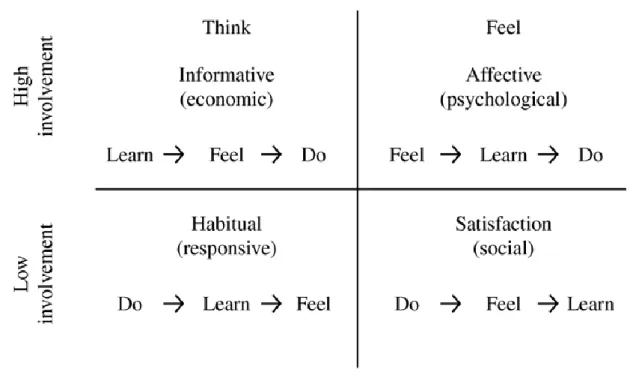
Hawkins and Mothersbaugh, 2010). Think-oriented purchasing decision thus usually tends to be logical and objective, and mainly based on functional product attributes while feel-oriented purchasing decision derives from image, feelings and sensory effects (Vaughn, 1986; Ratchford, 1987). By these two dimensions of high/low involvement level and think/feel involvement type, the FCB grid classifies consumer decision-making for products and services into four types (quadrants):
high-involvement/think, high-involvement/feel, low-involvement/think, and low-involvement/feel. Accordingly, these four types of consumer decision-making delineate four primary types of advertising planning strategies: informative, affective, habit formation, and self-satisfaction. As shown in Figure 2.1, Vaughn (1986) suggests that the informative strategy is appropriate for highly involving products and services where rational thinking and economic considerations prevail and the standard learning hierarchy ‘learn-feel-do’ is the typical response model or the sequence in which consumers process advertising messages. Examples of this type of products are cars, appliances and insurance. The affective strategy is for highly involving and emotionally motivated purchases of products that fulfill the need for self-esteem, or for which purchase decisions are driven by subconscious and ego-related impulses. Accordingly, the hierarchy of advertising processing for this type of products e.g., cosmetics, jewelry and fashion clothing typically follows the feel-learn-do sequence. The habit formation
strategy is for low-involvement/think products with such routinized consumer behavior that learning occurs most often after exploratory trial buying. A ‘do-learn-feel’
hierarchy is typical for such products as household cleaners and gasoline. A satisfaction strategy is appropriate for low-involvement/feel products, items of personal taste such as beer, cigarettes and candy, for which product experience is a necessary part of the communication process. The hierarchy for this type of products typically follows a
‘do-feel-learn’ sequence.
Figure 2.1 Vaughn’s (1986, p. 58) FCB grid model
Thus, the FCB grid model allows categorization of products into four quadrants by combining the two dimensions of high versus low involvement level and feel versus think involvement type (Vaughn, 1986; Ratchford, 1987; Weinberger and Spotts, 1989;
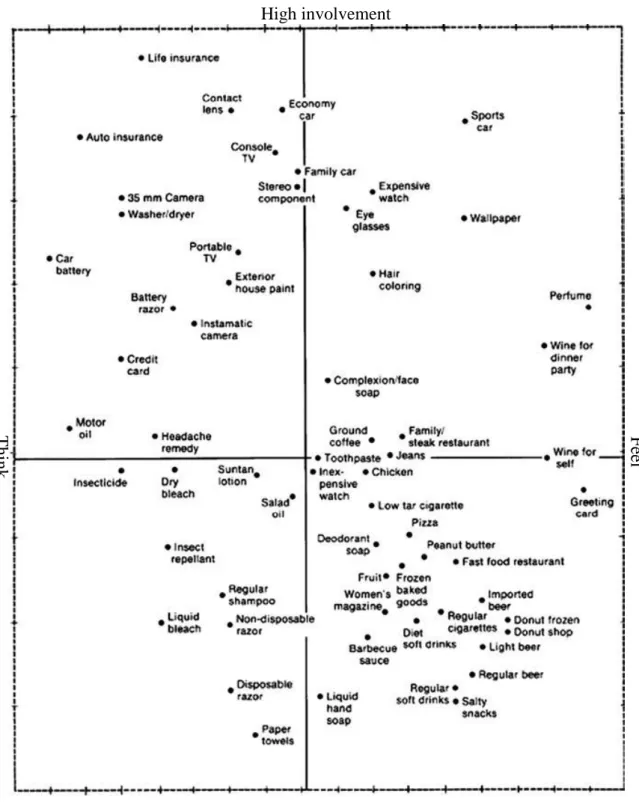
Choi et al., 2006; Choi et al., 2012). Ratchford (1987) presented a detailed account of the development of scales for measuring the locations of various products and mapped 60 types of products on the FCB grid (Figure 2.2). To accommodate the appearance of
new product categories, researchers (Weinberger and Spotts, 1989; Choi et al., 2006) incorporated more types of products into each quadrant without depicting specific positions on the grid.
For this dissertation I categorized products according to the updated FCB grid. The first quadrant (high-involvement/think products) includes home appliance, battery razors, buses, car insurance, computers, electric-bicycles, electronics, family cars, life insurance, powder milk, securities, tires, and trucks. The second quadrant (high-involvement/feel products) includes Chinese alcohol, cosmetics, expensive watch, face soap, fashion clothes, floor, furniture, house decoration, house maintenance, jewelry, lighting, luxury cars, paint, sports cars, SUV cars, tile, wallpaper, wig, and wine for a party. The third quadrant (low-involvement/think products) includes baby napkins, banks, battery, body soap, communication service, credit cards, detergent, food, insect repellant, milk, motor oil, oil, OTC drug, paper towels, razors, sanitary napkins, shampoo, suntan lotion, tea, and toothpaste. The fourth quadrant (low-involvement/feel products) includes beer, candy, fast food, and soft drinks.
High involvement
Low involvement
Figure 2.2 Ratchford’s (1987) categorization of 60 common products on the FCB grid
Think Feel
Chapter 3 Methodology and Sample
3.1 Content Analysis
With respect to research methodology, researchers studying advertising content have utilized both conceptual and empirical approaches. As far as empirical approaches are concerned, some researchers conduct surveys or experiments from the perspective of consumers while other researchers use content analysis. In this dissertation I use the method of content analysis to explore the characteristics of Chinese television commercials in terms of message strategy, information content, and cultural value appeals, and provide both academics and practitioners with knowledge about how each of these topics manifest themselves in Chinese television advertising.
Content analysis has been a vital and popular technique as a reputable research method to social researchers (Cutler and Javalgi, 1992) and has long been the frequently used research method for studying advertising (Leiss, Kline and Jhally, 1997; Mulvey and Stern, 2004; Okazaki and Mueller, 2007; Taylor, 2005). According to Berelson (1952, p. 15), content analysis is defined as “a research technique for the objective, systematic, and quantitative description of the manifest content of communication.”
Leiss, Kline and Jhally (1997) made further explanations to this definition as below.
Objectivity means that the analysis is pursued on the basis of explicit rules, which enable different researchers to obtain the same results from the same messages.
Systematic description means that the same set of criteria should be applied to all the data under examination and that the data set is a preselected sample chosen by recognized random procedures. Furthermore, description by content analysis can be tied to specific quantitative procedures that permit a degree of precision in measurement. In
addition, Leiss, Kline and Jhally also assert that content analysis needs to deliberately restrict itself to measuring the manifest or surface content of the message, so that coders can reach acceptable levels of agreement.
Prasad (2008, p. 181) summarized the procedure of conducting content analysis as the following six steps:
1. Formulation of the research question or objectives;
2. Selection of communication content and sample;
3. Developing content categories;
4. Finalizing units of analysis;
5. Preparing a coding schedule, pilot testing and checking inter coder reliabilities;
6. Analyzing the collected data.
For this dissertation I conducted three independent content analyses of message strategy, information content, and cultural value appeals respectively. The results of each of these analyses are reported in Chapter 4 through Chapter 6. Each of these content analyses was conducted according to the steps as described by Prasad (2008). The objective of this dissertation in general is stated in Chapter 1. Specific objectives, the formulation of research questions and hypotheses, the development of coding frameworks and operationalizations as well as coding process related to each topic are described respectively in Chapters 4 through 6. In the current chapter I explain the method of collecting the sample commercials and also describe the sample profile.
3.2 Sample Collection
A sample of commercials was systematically collected during the entire year of 2010.
I recorded once a week in an interval of 8 days, i.e. January 1st (Friday), January 9th (Saturday), January 17th (Sunday), and so forth. I selected Channel 1 and Channel 2 of China Central Television (CCTV), the largest national television broadcaster with coverage of over 97% of the PRC’s population. In order to cover the time slots with the
highest audience concentration I recorded all programming during the six hours from 18:00 to 24:00. In order not to bias the sample towards high GRP advertisers and following Stern and Resnik (1991) the unit of analysis was each unique (non-duplicated) Chinese TV commercial. Public service ads and ads for TV programs were excluded from the sample. The final sample consists of 1439 commercials.
3.3 Sample Profile
Sample commercials (n=1439) could be classified into a variety of categories based on different categorization schemes. Based on brand origin, sample commercials are categorized into 2 groups: ads for domestic brands (n=1140) and ads for foreign brands (n=299). In terms of product category, commercials are generally categorized into ads for products (n=1202) and ads for services (n=228), and are furthermore classified into Table 3.1 Distribution of commercials across product categories
Product category No. %
Alcohol 120 8.3
Automobiles and accessories 206 14.3
Detergents 30 2.1
Events 18 1.3
Fashion 86 6.0
Financial and insurances 118 8.2
Food and drink 233 16.2
Health care 91 6.3
Home durable appliances 182 12.6
Housing and decorating 72 5.0
Institutional 37 2.6
IT, telecom and electronics 82 5.7
Media 5 0.3
Personal care 100 6.9
Retailing 23 1.6
Other services 27 1.9
Miscellaneous 9 0.6
Total 1439 100.0
16 categories as well as ‘miscellaneous’ based on product industry. Table 3.1 shows the distribution of commercials across various product categories.
Based on the FCB grid model, sample commercials are classified into 4 categories:
ads for high-involvement/think products, ads for high-involvement/feel products, ads for low-involvement/think products, and ads for low-involvement/feel products (Table 3.2).
Table 3.2 Distribution of commercials in terms of FCB grid
Thinking Feel Subtotal
No. % No. % No. %
High involvement 467 35.3 335 25.3 802 60.6
Low involvement 405 30.6 115 8.7 520 39.3
Subtotal 872 65.9 450 34.0 1322a 99.9b
a: Among the total commercials (n=1439), 108 commercials are difficult to allocate into any quadrant based on previous research and thus are not included in analysis related to the FCB grid.
b: the percentage is less than 100% because of rounding.
H/T (high-involvement/think) products: home appliance, battery razors, buses, car insurance, computers, electric-bicycles, electronics, family cars, life insurance, powder milk, securities, tires, trucks;
H/F (high-involvement/feel) products: Chinese alcohol, cosmetics, expensive watch, face soap, fashion clothes, floor, furniture, house decoration, house maintenance, jewelry, lighting, luxury cars, paint, sports cars, SUV cars, tile, wallpaper, wig, wine for party;
L/T (low-involvement/think) products: baby napkins, banks, battery, body soap, communication service, credit cards, detergent, food, insect repellant, milk, motor oil, oil, OTC drug, paper towels, razors, sanitary napkins, shampoo, suntan lotion, tea, toothpaste;
L/F (low-involvement/feel) products: beer, candy, fast-food, soft drinks.