volume 41
number 2
page range 251‑258
year 1993‑09
URL http://hdl.handle.net/10098/4195
Adsorption of Bovine Serum Albumin and ,,-Globulin on Chitosan Membrane
Kensuke SAKURAI*, Kazuhiro NAKAJIMA *, and Toshisada TAKAHASHI*
(Received Aug. 20, 1993)
Adsorption of proteins on chitosan, which has positively charged proups, was inves- tigated. The amount of adsorption depended on pH values and showed the maximum at the isoelectric point of BSA (pH 4.5-5.0) as was recognized in non-charged polymer membl-anes. Also it depended on an ionic strength, which affected the maximum point as well as the amount itself. It was considered that the positive charge of chitosan may affect the isoelectric point of BSA at which the smallest lateral interaction appeared to make the compactest form of BSA molecule.
Whereas, contrary to the general tendency observed at much lower concentration of BSA, the amount of maximum adsorption decreased as the ionic st.rength decreased. This suggests that at relatively high concentration, the reduction of shielding effect of ions may give the increase of repulsion between BSA molecules rather than that of interaction between BSA and chitosan molecules. The adsorption of ,-globulin was studied, too.
Futhermore, the adsorption of chitosan onto a silk fiber as substitute for human hair was studied to result in the usefulness as the rinsing agent.
INTRODUCTION
Chitosan is a deacetylated product of the alkali treatment of chitin which is obtained from abundant natural resources of crustaceans such as crabs, shrimps, lobsters and krills.
Applications of chitosan to bio-, medical, pharmaceutical cmd membrane materials have been investigated widely. The adsorption behavior of proteins on chitosan should be
*
Dept. of ~:Jaterials Science and EngineeringThe chitosan powder sample was kindly supplied by Katakura Chikkarin Co.Ltd., having the degree of deacetylation of 97%. It was suspended in distilled water and then the swollen chitosan vvas dissolved in a 2% aqueous acetic acid solution at the chitosan concentration of l.4w/v%, with stirring at 25· C for 4 hL
The membrane was prepared by casting the chitosan solution on a styrene dish at 60
• C for 4 hr after the insoluble substances had been eliminated with a glass- filter. The cast membrane taken off from the dish was immersed into a 4% aqueous NaOH solution for 24 hr to be neutralized. rinsed with water and kept in distilled water.
To avoid dissolution at low pHs. a small amount of crosslinkage was introduced between chitosan molecules. The chitosan membrane was immersed into a 0.5N NaOH solution including 1% epichlorohydrine at 55' C for 30 min and then rinsed with water and kept in distilled water. The thickness of the swollen membrane was about 60 jJ, m.
Degree of Hydration
The degree of hydration of membrane, H. is the volume fraction of water in the swollen membrane. which is calculated using the equation: H={(Ws-VVd)/ P w}/Vs, \-vhere vVs and VVd are the weights of the dried and swollen chitosan membranes, p w is the density of water and V s is the volume of the swollen chitosan membrane, related to the following equation. Vs = vVd./ P m + (vVs-Vld.)/ P w, where P m is the density of the dried membrane (1.4 g/cm 3 ) .
Adsorption of Protein
Two kinds of proteins were used; bovine serum albumin (Sigma Co., isoelectric point pHi4.6-5.0, average molecular weight of 69,000) and 7' -globulin (Sigma Co., pHi6.5-7.0, 156.000). They were dissolved in the buffer solutions such as acetic-acetate, phosphates, Tris-HCI, and glycine-NaOH with an adjusted ion strength using NaCI, depending on the pH value at the concentration of O.lw/\v%.
Prior to adsorption, the weight - known dried membrane was swollen in a given buffer solution without protein for 30 min. The adsorption was carried out by removing this swollen membrane into a tlask containing the 0.1% protein solution of 109 in the incubator at 25' C. The amount of adsorption was determined from the concentration change of the protein solution measured by the absorbance on 280 nm using Shimazu UV -160 spectro-
photometer. The concentration of the solution after 5 min was regarded as the initial concentration. The equilibrium adsorption, Q, 'vas determined from the concentration after 3 hr using the follo,ving equation; Q=(Co-C)·Vo/W. where Co and C are the concentrations after 5 min and 3 hr, respectively and Vo is the volume of the protein sol ution after 5 min and W is the weight of the dried membrane.
SEI\.·1 Observation
The freeze-dried samples were observed by Hitachi SEM Model S-510 at accelerating voltage of 25 kV, after gold -spattering.
RESULTS AND DISCUSSION
The adsorption curve of BSA onto a chitosan membrane was shown in Figure 1. An equilibrium adsorption was achieved at more than 3 hr. The adsorption time of 3 hr was employed to estimate the adsorption in the equilibrium state. In Figure 2 the adsorption of BSA onto a chitosan membrane ,vas plotted against the pH value of the buffer solution used during adsorption. The ma-..::imum of adsorption was observed in the region of the
30~---'
'" I
o
c:
o 20
10
•
2.5 7.5 10
Adsorption Time (h)
Fig.1 Adsorption curve of BSA onto chilosan membrane at BSA initial concn. 0.1 (w/w)~fo, pH 4.9, ionic strength 0.1 and 25 ' C.
isoelectric point of BSA (pH4.5-S.0) as was recognized in other polymer membranes without charged groups. It has been explained by the broadening of a protein molecule in the solution casused by an electrostatic interaction in the intra- and inter-molecules; it might be attributed to the compactest form and the smallest lateral interaction of molecules at the isoelectric point.
30
~
"-
bO... I
0 20
c=
0 ...
0. 10
I-.
0 rJ]
"d
<
0
2 4 6 8 10 12
pH
Fig.2 BSA adsorption onto chitosan membrane as a function of pH at initial concn. 0.1 (W/W) % , ionic strength 0.1 and 25' C.
c o
.~
I
~ 15
<lJ
<lJ
L..
(Jl
<1J
o
0.8 ~
0.7
0.6 '--_ _ _
..L..-_ _ _ ..L....-_ _ _ J . -_ _ _ - L - - J4.0 5.0 6.0
pH
7.0 8.0
Fig.3 Degree of hydration of chitosan membrane as a function of pH at 25· C.
Let us calculate the maximum adsorption of BSA per unit area of chitosan. Taking into account the density of dried chitosan 0.4 g/cm 3 ), the degree of swelling (ca. 5) and the thickness of membrane (ca. 60 j.L m), we can get the value of 63 mg/m 2 which is
much larger than that onto polystyrene latex (ca. 3.0 mg/m 2 ) at the same concentration of BSA [1].
30 IlD
'"
IlD«l I
0 20
c:
a
..,
0- 10
....
•
a
•
en
"0
• •
-< 0 .-
•
2 4 6 10 12
pH
Fig.4 7' -globulin adsorption onto chitosan membrane as a function of pH at 7' -globulin initial concn. 0.1 (W/W) %, ionic strength 0.1 and 250 C.
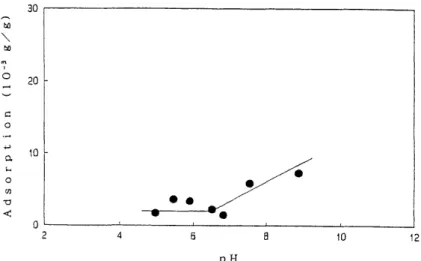
In Figure 4 the adsorption of 7' -globulin onto a chitosan membrane was plotted against the pH values. In this case. the maximum of adsorption cannot be seen near the isoelectric point of 7' -globulin (pH6.5-7.0) and the adsorption increases with increase of pH value in the region over pH6.5. It may be due to a hydrophobic adsorption, since 7' -globulin is one of hydrophobic proteins and the chitosan membrane seems to become hydrophobic at these pHs from the viewpoint of hydration behavior shown in Figure 3.
Figure 5 shows the dependence of an ionic strength on BSA adsorption. The ma.ximum adsorption appeared at any ionic strength. The pH value which showed the ma.ximum adsorption shifted to lower pH values when the ionic strength was reduced. In this case, BSA molecules may be much affected by the basic nature of chiosan, i.e., the isoelectric point of BSA in the local field seems to shift to the acidic side. On the other hand, the amount of maximum adsorption also decreased as the ionic strength decreased.
The opposite tendency has been observed in other polymers under the condition of the much lower concentration of BSA [1]. It is explained from the increase of interaction between BSA and a polymer caused by reduction of the shielding effect of ions.
Therefore. 'i;ve must present another reason for much adsorption at relatively high concentration in our case. A following speculation was made. The reduction of the ionic strength may bring about not only the increase of interaction between BSA and chitosan molecules but also a broadening and a lateral interaction of BSA molecules. I.e., the increase of an intermolecular repulsion of BSA molecules at high concentration. BSA
on , a
c::
0
0.
I-.
0 (J)
"0
«
20
10
0
2 4 6 8 10 12
pH
Fig.5 Dependence of ionic strength on BSA adsorption onto chitosan
membrane at initial concn. 0.1 (w/w)q1o and 25 ) C. • :0.1, .. :0.01, • :0.001.
!:D 30
"-
bO'" ,
0
20 c::
0
...,
0. I-. 10
/
0
•
(JJ
"0
-<
0
0 0.1 0.2 0.3 0.4
Can c e n t r a t ion % (W /\0
Fig.6 Adsorption isotherm of BSA onto chitosan membrane at pH 4.9, ionic strength 0.1 and 25· C.
The adsorption isotherm of BSA is shown in Figure 6. The adsorption increases up to the concentration of 0.2% and would be saturated over it though the smaller value "vas measured at 0.4%. The viscosity of BSA solution becomes higher in the region more than 0.2% to cause the diffusion of BSA molecules delay. It means that it is necessary
a
b
c
Fig.7 SEM photographs of silk fibers. a: before adsorption (untreated), b: after adsorption, c: separated after adsorption.
Chitosan was dissolved in the acetic acid solution and then the pH value was adjusted with 0.5N sodium hydroxide so as to reach to pH5.5. This solution with chitosan concentration of 0.74% (w,lvv) \vas used. Silk fibers were swollen in water for 30 mm before they were immersed into the chitosan solution and kept for 2 hr at 25' C. A large adsorption was observed. The isoelectirc point of the silk protein was presumed to be about pH4.5 from the preliminary experiment. It can therfore be expected that the electrostatic interaction between anionic silk protein and cationic chitosan may occur at pH5.5 to result in a large adsorption. Figure 7b shows the silk fiber after adsorption, the surface of ,~vhich is as smooth as that before adsorption shown in Figure 7 a. The chitosan membrane can be also seen at intersections of the silk fibers. In order to make it clear visually, the silk fibers separated each other by a needle were observed shown in Figure 7c. The coarse surface appeared, in which the chitosan membrane had been peeled out of the silk fiber surface.
These facts indicates that chitosan molecules uniformly coat the silk fiber surface to make it smooth. In addition, chitosan can be expected to be useful as the rinsing agent for human hair, taking into ac.count that the adsorption is caused by the electrostatic interaction between chitosan and a protein fiber.
References
1. H.Shirahan1a, rvlembrane Soc., Jpn., Preprint 14, 20 (1992) H.Shirahama et.al., Adv. Colloid Interface Sci., ~ 139 (1991)
2. K.Kataoka, 1\1.0kano, " Medically Suitable Polymer", Kyoritsu Press, (1988)