115
Figure 1. Linguistic Roots of English
Figure 1. Linguistic Roots of English
In contrast, Japanese language and social norms developed in relative isolation, and therefore have an organization or logic that is sometimes subtly different that English, and at other times, so different that social interactions for both Japanese and non-Japanese people are frustrating. In discussions of English Language Education (ELE) in Japan, one factor that invariably gets mentioned both by Japanese and native
instructors of English is the shyness of Japanese students. It is often discussed as a barrier regarding behaviors in the classroom, during international exchange experiences, and during study abroad. Shyness, however, has very different meanings and connotations in English and Japanese (Matsushima, Shiomi, Kuhlman, 2000), so even these discussions can become complicated. Regardless of whether shyness is seen as a positive or negative quality, the techniques and therapies for dealing with social noninteraction or social passivity have been developed in counseling fields such as clinical psychology, counseling education, and social work. This paper seeks to explain how, with minor adaptation, these techniques might be applied in the setting of ELE in Japan.
TThheeoorreettiiccaall CCoonnssiiddeerraattiioonnss
At first glance, it might appear that language education, with its focus on
vocabulary, grammar, and the four skills of reading, writing, speaking, and listening, is far Introduction
While languages are often studied in terms of their linguistic structures such as grammar, vocabulary, or intonation, the primary purpose of language is to interact with other people. Just as engineering is important to having a well-functioning car, the primary purpose of the car is transportation. Thus, just as it is important for drivers to understand the rules of driving and safety (probably more so than the engineering behind the car), it is important for second language learners to master the social functions of the language they are learning.
For English language learners in Japan, this problem is much more complex than it is, for example, for Europeans. European languages share not only common grammar and vocabulary; estimates say 30-45 percent of English words come directly from French, 30 percent from Latin, which is the basis of all the Western European Languages, and another 25 percent from Germanic languages (Williams, 1986). As social systems and language systems develop together, Europeans also share many social and cultural values and systems.
In contrast, Japanese language and social norms developed in relative isolation, and therefore have an organization or logic that is sometimes subtly different that English, and at other times, so different that social interactions for both
* Okayama Prefectural University
A Social Skills Approach to English Language Education in Japan
ERIC DES MARAIS*
Abstract:The primary purpose of language is to interact with other people; it is a social process. Due to long-term historical isolation, Japanese social interactions can be quite different from those of European cultures. These differences, which are usually not addressed in EFL curriculum, can create difficulties for Japanese students, both in terms of interacting with foreign faculty and in terms of having meaningful relationships with non-Japanese people. Japanese students would therefore benefit from explicit social skills training to help them thrive in non-Japanese social environments. This paper will explain how social skills approaches can be adapted into the EFL classroom and outline areas for future research.
岡山県立大学保健福祉学部紀要 第27巻1号2020年 Japanese and non-Japanese people are frustrating. In discussions of English Language Education (ELE) in Japan, one factor that invariably gets mentioned both by Japanese and native instructors of English is the shyness of Japanese students. It is often discussed as a barrier regarding behaviors in the classroom, during international exchange experiences, and during study abroad. Shyness, however, has very different meanings and connotations in English and Japanese (Matsushima, Shiomi, Kuhlman, 2000), so even these discussions can become complicated. Regardless of whether shyness is seen as a positive or negative quality, the techniques and therapies for dealing with social noninteraction or social passivity have been developed in counseling fields such as clinical psychology, counseling education, and social work. This paper seeks to explain how, with minor adaptation, these techniques might be applied in the setting of ELE in Japan.
Theoretical Considerations
At first glance, it might appear that language education, with its focus on vocabulary, grammar, and the four skills of reading, writing, speaking, and listening, is far removed from the field of counseling with its focus on individual and group therapy to treat mental health disorders. However, applied linguistics is a syncretic field, freely pulling from a variety of knowledge bases: “Rather than simply borrowing theories from linguistics to try to solve language-related problems in the real world, applied linguistics should serve as a point of interdisciplinary synthesis where theories with their own integrity develop in close interaction with language users and professionals” (Rampton, 1997). And, there is an understanding within the literature that communicative function and social actions are intertwined: “If you accept Hymes’ notion that a model of language must be designed with a face toward communicative conduct and social life…. Then it follows that a model for teaching language must also be designed with a face toward communicative conduct and social
life” (Paulson, 1974, as cited in Wedeiman, 2007). It is therefore reasonable to expect that students learning English as a foreign language might also need social or cultural training in order to help them adapt to the local context of an English language environment.
Of course, whether a student needs to understand social norms of English-speaking countries depends on the goals of one’s study of a foreign language. If the only goal is to pass an entrance examination or obtain a high score on a standardized test to improve one’s resume, then a focus on the social skills associated with English communication might not be important. However, if the final goal is to have rewarding and positive experiences with native speakers of English, then consideration of the associated social norms should be a priority. The shallower forms of culture and society can be interesting to learn about, and is sometimes referred to as the “food, flags, and festivals” approach. Often used in low-level foreign language classes, it involves short readings or videos about interesting festivals, strange foods, or famous places. It might also include recent trends in the culture.
One problem with this is that focusing only on the symbols of a society can lead to students assuming that the deeper structures of the language and associated social norms are like their own. For example, direct eye contact in Japanese culture can be impolite or rude, yet in English extended eye contact shows interest and support, and in almost all cases is positive. Learning these social cues requires not just simply reading a paragraph about it, it requires behavioral practice. And thus, the knowledge of the counseling fields becomes important to language teachers. Especially from the background of Cognitive Behavioral Therapy, there are workbooks, group and individual skills sheets, and workshop materials that focus on skills such as forming and maintaining healthy relationships, being assertive, communicating needs effectively, and protecting one’s own boundaries that would all be useful for
someone not familiar with the cultures associated with English.
The remainder of this paper will focus on a case-in-point that arises in discussions of Japanese students studying English – that of shyness. Shyness has different connotations in English and Japanese, but more than this, it plays different roles in the two societies. It is therefore a good example for explaining how social skills approaches can be applicable in the English as a Foreign Language (EFL) classroom.
Shyness, Society, and the Norms of Communication
Shyness in both English and Japanese is associated with certain behaviors. These behaviors include talking quietly or not talking, making little eye contact, not participating in group activities, being passive around other people, or not interacting with other people. However, the way this group of behaviors is interpreted in the two cultures is almost opposite (Matsushima, Shiomi, Kuhlman, 2000). In English, shyness has a negative connotation and is usually associated with social anxiety or some other shortcoming. In Japanese, shyness has positive meanings as well, including humility and modesty (Matsushima, Shiomi, Kuhlman, 2000). Benedict (2005) conceptualizes shyness in Japan through the lens of a “culture of shame” as opposed to the lens of psychological abnormality prevalent in Western definitions. These different connotations point to value differences in the cultures.
For example, it is not uncommon in a communicative EFL classroom in Japan to have a few students who do not speak loud enough to be heard by the teacher, or they might not answer at all. In English speaking countries, students should always look the teacher in the eye and respond in a loud, clear voice. Even if the answer is incorrect, it is better to answer than to not answer. Students are expected to ask questions to the teacher – this shows they are paying attention, are thinking about the topic, and are interested in learning. In elementary
school, if a student is too quiet, they might receive speech therapy in order to help them gain more confidence in communicating in class.
However, in a Japanese classroom, giving an incorrect answer can be embarrassing, and the class is teacher-centered, so the teacher usually provides the perfect model answer for students. Asking a question to a teacher might show that the student has not properly studied the material or has not put in enough effort to understand the teacher. In some cases, the teacher might feel challenged by the question.
When within their own cultures, both ways of dealing with student “shyness” are acceptable, but it becomes more complicated in the context of the communicative ELE classroom. Anderson (1993) finds some of the difficulties foreign teachers
perceive of managing a communicative classroom
in Japan are that students don’t initiate discussion, avoid new topics, don’t challenge or ask questions of their teacher, and don’t volunteer answers. Furthermore, Japanese students studying overseas have a reputation of being too nervous to talk to people, have difficulty making friends with non-Japanese people, and not participating in communication classes.
In English speaking countries, these students would generally be considered shy. Many people would assume Japanese students have negative self-thoughts that makes them comfortable in social situations, making it difficult to pursue their interpersonal or professional goals (Henderson, L., Zimbardo, P., & Carducci, B., 2010). This form of shyness would consist of four components: 1) cognitive (negative self-thoughts); 2) affective (negative emotions); 3) physiological (racing heart, shortness of breath); and 4) behavioral (for example, failure to respond appropriately). In contrast, the same Japanese student might evaluate themselves quite differently. In Japanese culture, a shy person: 1) has empathy (cares what other people think); 2) doesn’t want to upset others (caring); and 3) worries that their mistakes might make it difficult for other people (consideration). Thus, the Japanese
岡山県立大学保健福祉学部紀要 第27巻1号2020年
student might not recognize the concerns of the English teacher, and the English teacher might be overly worried about the well-being of the Japanese student.
Importantly, in English speaking countries, quiet people can also be recognized as thoughtful, caring, and empathetic, just as in Japan crippling social anxiety is acknowledged as a psychological problem in need of treatment. The above illustration is only meant as an example of the complexity of the intersection of two different sets of social norms.
There are also some tacit differences in communication styles that make it difficult to trust one’s instincts about what is right or wrong when judging communication from another language. These values regarding communication are often unquestioned, making intercultural communication even more difficult.
Note that the purpose of this paper is not to suggest that one set of values is better than the other. Instead, the question is how to reconcile these differences so that Japanese learners of English can be successful at the primary goal of language – forming rewarding relationships with other people.
The Intersection of Teaching and Psychosocial Skills
At a cursory glance, it might seem that incorporating approaches developed in Cognitive Behavioral Therapy or other forms of therapy might be outside the professional scope of foreign language teachers. However, both communicative language pedagogy and modern
forms of psychotherapy are informed by Humanist approaches of interaction. Thus, a variety of techniques appear in both psychotherapy settings and classrooms that incorporate active learning. For example, group discussions, self-reflection through journaling, or role plays are common in both settings. The communicative language classroom is student-centered just as therapy sessions tend to be client-centered. For teachers adopting a humanist approach, the growth of the students is paramount, as is the case in therapy. However, there are important differences which should be considered carefully. While the goal of the classroom is to support the intellectual growth of the student and to help them develop their knowledge base, the goal of psychotherapy is to help people overcome chronic or acute cases of mental disorders such as depression, trauma, anxiety, phobias, personality disorders, or psychotic breaks. I am not suggesting that foreign language teachers (or any teachers) should engage in unlicensed psychotherapy. Issues of power balance, confidentiality, and the dangers of creating a traumatic experience mean that teachers must be careful to make sure activities do not require students to share their personal lives, while the main goal of the psychotherapist is to create a safe environment in which clients can explore their inner lives. However, there are areas of overlap in which there is a safe place for language teachers to adapt some approaches, especially around managing anxiety and developing effective communication skills.
6
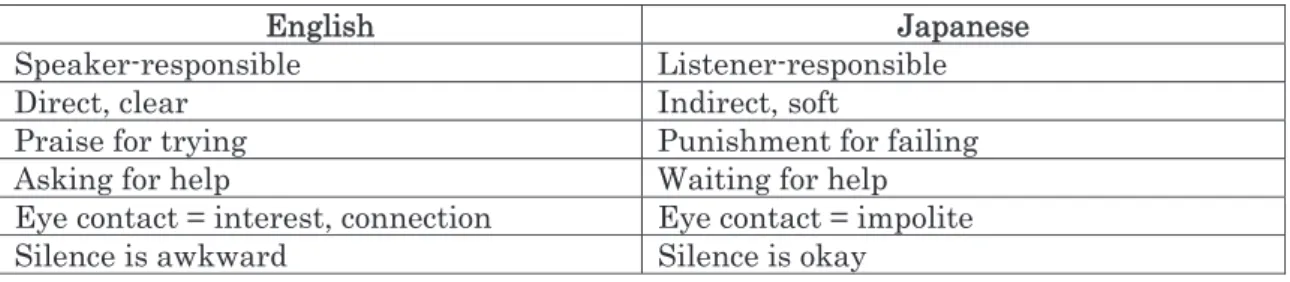
Table 1. Classroom Communication Differences between English and Japanese E
Enngglliisshh JJaappaanneessee Speaker-responsible Listener-responsible
Direct, clear Indirect, soft
Praise for trying Punishment for failing
Asking for help Waiting for help
Eye contact = interest, connection Eye contact = impolite
Silence is awkward Silence is okay
Note that the purpose of this paper is not to suggest that one set of values is better than the other. Instead, the question is how to reconcile these differences so that Japanese learners of English can be successful at the primary goal of language – forming rewarding relationships with other people.
TThhee IInntteerrsseeccttiioonn ooff TTeeaacchhiinngg aanndd PPssyycchhoossoocciiaall SSkkiillllss
At a cursory glance, it might seem that incorporating approaches developed in Cognitive Behavioral Therapy or other forms of therapy might be outside the professional scope of foreign language teachers. However, both communicative language pedagogy and modern forms of psychotherapy are informed by Humanist approaches of interaction. Thus, a variety of techniques appear in both psychotherapy settings and classrooms that incorporate active learning. For example, group discussions, self-reflection through journaling, or role plays are common in both settings. The communicative language classroom is student-centered just as therapy sessions tend to be client-centered. For teachers adopting a humanist approach, the growth of the students is paramount, as is the case in therapy.
However, there are important differences which should be considered carefully. While the goal of the classroom is to support the intellectual growth of the student and to help them develop their knowledge base, the goal of psychotherapy is to help people overcome chronic or acute cases of mental disorders such as depression, trauma, anxiety, phobias, personality disorders, or psychotic breaks. I am not suggesting that foreign language teachers (or any teachers) should engage in unlicensed psychotherapy. Issues of power balance, confidentiality, and the dangers of creating a traumatic experience mean that teachers must be careful to make sure activities do not require students to share their
Social Skills Approach English Education Japan Des Marais Eric
7
personal lives, while the main goal of the psychotherapist is to create a safe environment in which clients can explore their inner lives. However, there are areas of overlap in which there is a safe place for language teachers to adapt some approaches, especially around managing anxiety and developing effective communication skills.
Table 2. Comparison of Teacher Skills and Psychotherapist Skills E
EFFLL CCllaassss OOvveerrllaapp PPssyycchhootthheerraappyy Grammar explanation Practicing how to make
friends Discussion of personal trauma Vocabulary Test Learning how to express
needs and wants assertively Identifying triggers for alcoholism Practice writing
professional emails Learning to protect personal boundaries Identifying personal anger triggers
A
A SSoocciiaall SSkkiillllss AApppprrooaacchh AAddaapptteedd ttoo tthhee CCllaassssrroooomm
The following example is based on exercises in the book Messages: The
Communication Skills Book (McKay, Davis, and Fanning, 2009). While there are many personal exercises in the book, there is also a lot of useful information and exercises that are informative about communication styles appropriate and appropriate for classroom use. The goal of the lesson is for students to be able to communicate using “Whole
Messages.” Objectives of the lesson include learning about the four expressions needed to make a “Whole Message,” recognizing the difference between Whole, Partial, and
Contaminated Messages (defined below) and then to demonstrate making a whole message in a scenario and small group discussion.
The first part of the lesson involves didactically pre-teaching and giving examples of the four types expressions: 1) Observations (objectives facts that the speaker has direct knowledge of); 2) Thoughts (opinions, beliefs or theories which are based on fact and may or may not be correct); 3) Feelings (one’s emotions or physiological feelings); and 4) Needs (explaining what makes one happy). To practice using the knowledge, students work in small groups to sort a list of statements into the appropriate expression category.
Once students can demonstrate the ability to understand the four types of expressions, the teacher explains about the differences between Whole Messages (which utilize all four expressions), Partial Messages (which only use some of the expressions, and sometimes results in misunderstandings); and Contaminated Messages (which mix
expressions or mislabel statements which lead to confusion, anger or frustration in the A Social Skills Approach Adapted to the
Classroom
The following example is based on exercises in the book Messages: The Communication Skills Book (McKay, Davis, and Fanning, 2009). While there are many personal exercises in the book, there is also a lot of useful information and exercises that are informative about communication styles appropriate and appropriate for classroom use. The goal of the lesson is for students to be able to communicate using “Whole Messages.” Objectives of the lesson include learning about the four expressions needed to make a “Whole Message,” recognizing the difference between Whole, Partial, and Contaminated Messages (defined below) and then to demonstrate making a whole message in a scenario and small group discussion.
The first part of the lesson involves didactically pre-teaching and giving examples of the four types expressions: 1) Observations (objectives facts that the speaker has direct knowledge of); 2) Thoughts (opinions, beliefs or theories which are based on fact and may or may not be correct); 3) Feelings (one’s emotions or physiological feelings); and 4) Needs (explaining what makes one happy). To practice using the knowledge, students work in small groups to sort a list of statements into the appropriate expression category.
Once students can demonstrate the ability to understand the four types of expressions, the teacher explains about the differences between Whole Messages (which utilize all four expressions), Partial Messages (which only use some of the expressions, and sometimes results in misunderstandings); and Contaminated Messages
(which mix expressions or mislabel statements which lead to confusion, anger or frustration in the receiver of the message). Then, as a class discussion, the teacher provides examples of a Whole Message and Contaminated Messages and the class talks about why the Whole Message is helpful, and the difficulties that might arise from Partial or Contaminated Messages. As Japanese is a listener responsible language and English is a speaker responsible language, the teacher then puts the students into small groups to think of examples of how this might be different than what is expected in Japanese for effective communication. These examples are shared in a short class discussion.
In the final exercise, students are divided into small groups. They are given roleplays in which a Japanese student is studying overseas in the United States and must deal with various issues such as talking to a frustrating roommate about cleaning, trying to make friends or date someone in the same university club, or dealing with a miscommunication with a teacher. Each group must come up with a whole message appropriate to the situation. The groups then share their different answers and assumptions.
At the end of the lesson, students work in small groups to identify similarities and differences in how the scenarios would be handled in Japanese as opposed to English. The teacher might provide some prompts such as keigo, tatemae/honne, amae, and emotional expression. Some of the small groups might then share their ideas with the class. The teacher then reviews that both cultures have useful ways to communicate and that one is not
岡山県立大学保健福祉学部紀要 第27巻1号2020年 better than the other.
G u i d a n c e f o r B o u n d a r i e s i n t h e Classroom
Although the above exercise is based upon psychosocial skills training from the field of psychotherapy, it is not a therapeutic exercise. It is important that teachers respect the rights to privacy of the students. While sometimes it is okay for students to volunteer self-disclosures in class, teachers need to make sure that students are neither required nor expected to share anything about their personal lives, especially regarding difficulties interacting with their friends or family. Teachers should not try to use any students’ personal examples as points for class discussion or roleplay if a student does talk about a difficult personal situation. By using scenarios and roleplays, students are protected from the need to share anything about their personal lives. And, by having most of the exercises done in small groups, students do not have to worry about having to express their own thinking or emotions to the whole class.
Teachers also need to be respectful of sociocultural differences. Thus, it is important that the instructor clarifies that these social skills might increase successful interactions with native speakers of English, but that the students get to choose whether to use them or not. It is perfectly okay for a student to choose to follow Japanese social norms even when interacting with native speakers – that is a great learning experience for the native speakers, too.
C o n c l u d i n g T h o u g h t s a n d F u t u r e Research
While studying grammar and vocabulary are important foundations for learning a foreign language, it is also important to understand how sociocultural factors affect communication, and this should also be a part of language study, especially when the cultural differences create such huge language differences like those between English
and Japanese. Having rewarding experiences with people from other cultures involves expecting different communication styles and learning how deal with those differences effectively.
While the example scenarios were quite typical daily life problems, there are also more difficult situations that students who study overseas need to be able to deal with. For example, if a student got an unexpectedly low grade, what is the appropriate way to talk to the teacher about it? Without a sempai/kohai social system, how does one get help or advice, and who is it okay to ask? Or, if a female is being sexually harassed at a party, how can she safely end the interaction? These are all situations that can be practiced through a social skills approach.
While psychosocial therapies have been researched in the context of mental health, psychosocial skills approaches should also be researched in terms of intercultural communication. This would involve adapting or creating new workbooks that focus on intercultural communication differences between English and Japanese to target what specifically are hurdles between the two languages. These would need to be tested for both length of the training and its effects. For example, can learning how to be assertive result in behavioral changes with just two or three lessons, or does it require an intensive approach? It is also important to determine if, for example, a semester long social skills training course increases the confidence of students going overseas compared to students who do not receive the training.
While it is important to learn the grammar and vocabulary of a language and also the four basic skills of reading, writing, speaking, and listening, there is also a social foundation that students need to practice. While societies that are already similar to English cultures such as French, German, or Swedish, might not need clearly presented lessons on sociocultural differences, when the social norms are quite difference, social skills practice would be beneficial.
References
Anderson, F. (1993). The enigma of the college classroom: Nails that don't stick up. In P. Wadden (Ed.). A handbook for teaching English at Japanese colleges and universities (pp. 101-110). New York: Oxford.
Benedict, R. (2005). The chrysanthemum and the sword: Patterns of Japanese culture. Houghton Mifflin Harcourt.
Henderson, L., Zimbardo, P., & Carducci, B. (2010). Shyness. The Corsini encyclopedia of psychology, 1-3
Matsushima, R., Shiomi, K., & Kuhlman, D. M. (2000). Shyness in self-disclosure mediated by social skill. Psychological Reports, 86(1), 333-338.
Paulston, 1974. As cited in Weideman, A. (2007). The redefinition of applied linguistics: Modernist and postmodernist views. Southern African linguistics and applied language studies, 25(4), 589-605.
Rampton, B. (1997). Retuning in applied linguistics. International journal of applied linguistics, 7(1), 3-25.
Williams, J. M. (1986). Origins of the English language. Simon and Schuster.