Chemotherapy
Concurrent chemotherapy was performed in 62 cases, neoadju-vant chemotherapy in 25 cases, and adjuneoadju-vant chemotherapy in 39 cases (Table 2). Chemotherapy regimens were DFP (docetaxel, 5 -fluorouracil and cisplatin), FP (5 - -fluorouracil and cisplatin), tegafur/ gimeracil/oteracil potassium and nedaplatin plus 5 - fluorouracil. Outcome and toxicity analysis
Overall survival was defined as the period from the date of the first RT fraction to the date of death. Survival was calculated with Kaplan-Meier methods, and the significance of differences was examined with the log - rank test. Cox’s proportional hazard model was used for multivariate analysis. Differences were defined as statistically significant at p!0.05. Late radiation morbidity was defined as a complication occurring more than 90 days after com-pletion of RT. Grading of the morbidity was performed according to the Radiation Therapy Oncology Group/European Organization for Research and Treatment of Cancer late radiation morbidity scoring schema. We used the Statistical Package for Social Science
(SPSS version 25 ; International Business Machines Corporation, Armonk, NY, USA) for all analyses.
RESULTS
Figure 1 shows the local control rate for all patients and for each stage. The 5 - year local control rate of stage I, II, III, and IVA was 71.4%, 100%, 9.4%, and 38.5%, respectively. Univariate analysis Table 1. Characteristics of patients
Age Median (range) 69 (44-94) Sex Male 57 Female 13 PS (ECOG) 0 27 1 36 2 7 Location Cervical 7 Thoracic 56 Abdominal 3 Cervical - Thoracic 4 Pathological type
Squamous cell carcinoma 66
Adenocarcinoma 2 Unknown 2 T (UICC 8th) 1 16 2 8 3 14 4a 5 4b 27 N (UICC 8th) 0 24 1 20 2 21 3 5 Stage (UICC 8th) ! 16 " 9 # 10 $a 35
ECOG, Eastern Cooperative Oncology Group ; PS, performance status ; UICC, Union for International Cancer Control
Table 2. Setting of chemotherapy
n (%)
Neoadjuvant chemotherapy 25 (35.7)
Concurrent chemotherapy 62 (88.6)
Adjuvant chemotherapy 39 (55.7)
Fig. 1
(a) Local control rate of all patients. (b) Local control rate according to the stage.
a
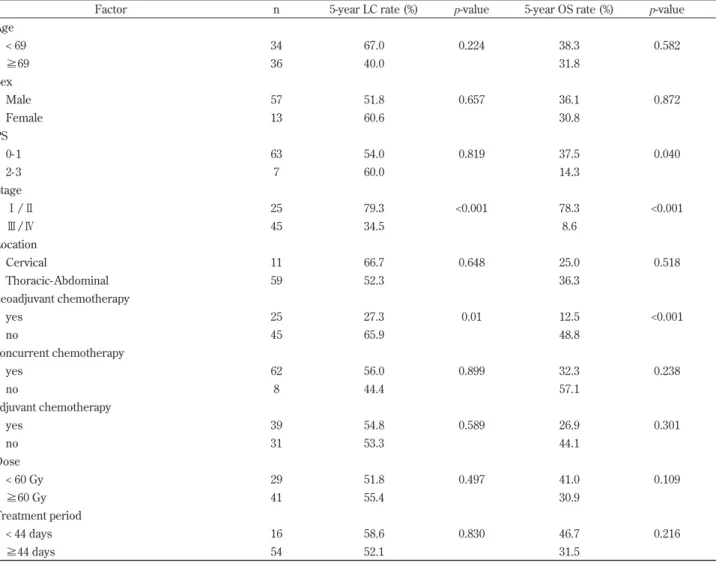
revealed that stage and neoadjuvant chemotherapy were signifi-cant prognostic factors of local control (Table 3), although only stage was a significant factor in multivariate analysis (Table 4). Local recurrence occurred in 24 patients and lymph node recur-rence within the irradiation field was observed in 8 patients. Lymph node metastasis outside the irradiation field occurred in 12 cases and distant metastasis was present in 20 cases. About half of the cases were judged to be complete response after radiotherapy, and only one salvage surgery was done.
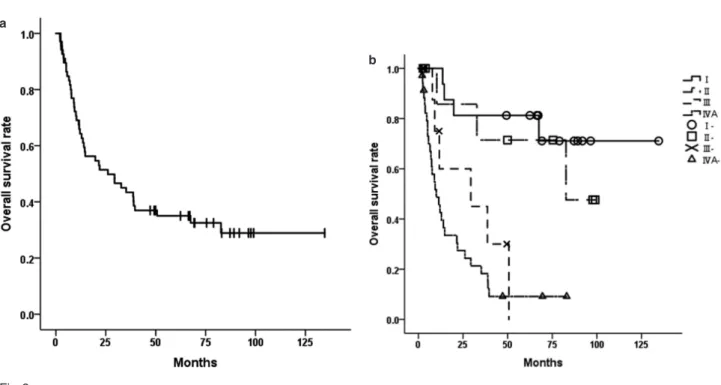
The 5 - year overall survival rate for stage I, II, III, and IVA was 81.3%, 71.4%, 0%, and 9.1%, respectively (Figure 2). Univariate analysis of 5 - year overall survival revealed that performance status, clinical stage, and neoadjuvant chemotherapy were significant prognostic factors of overall survival (Table 3), and these factors remained significant in multivariate analysis (Table 5). No signifi-cant relationship between radiation dose and clinical outcomes was observed.
Table 6 shows clinical characteristics each of Stage!!"and
Table3. Univariate analysis of 5-year local control rate and overall survival rate
Factor n 5-year LC rate (%) p-value 5-year OS rate (%) p-value
Age < 69 34 67.0 0.224 38.3 0.582 "69 36 40.0 31.8 Sex Male 57 51.8 0.657 36.1 0.872 Female 13 60.6 30.8 PS 0- 1 63 54.0 0.819 37.5 0.040 2- 3 7 60.0 14.3 Stage #/$ 25 79.3 <0.001 78.3 <0.001 %/& 45 34.5 8.6 Location Cervical 11 66.7 0.648 25.0 0.518 Thoracic- Abdominal 59 52.3 36.3 neoadjuvant chemotherapy yes 25 27.3 0.01 12.5 <0.001 no 45 65.9 48.8 concurrent chemotherapy yes 62 56.0 0.899 32.3 0.238 no 8 44.4 57.1 adjuvant chemotherapy yes 39 54.8 0.589 26.9 0.301 no 31 53.3 44.1 Dose < 60 Gy 29 51.8 0.497 41.0 0.109 "60 Gy 41 55.4 30.9 Treatment period < 44 days 16 58.6 0.830 46.7 0.216 "44 days 54 52.1 31.5
LC, Local control ; OS, Overall survival p-value was calculated using log-rank test.
Table4. Multivariate analysis of 5- year local control rate
Factor n p-value Hazard Ratio 95%CI
Stage #/$ 25 0.003 1.00 %/& 45 4.95 1.71- 14.33 Neoadjuvant chemotherapy yes 25 0.079 1.00 no 45 0.47 0.20- 1.09
Stage#!$. There were more patients undergoing neoadjuvant chemotherapy in Stage#!$, although no significant difference was observed in other factors. Univariate analysis of 5 - year overall survival revealed that performance status and neoadjuvant chemo-therapy were significant prognostic factors in Stage#!$, and neoadjuvant chemotherapy was a significant prognostic factor in Stage!!" (Table 7). In multivariate analysis, performance status and neoadjuvant chemotherapy were significant prognostic factors in Stage#!$(Table 8).
Late radiation morbidity of Grade 5 occurred in four cases ; three patients died of radiation - induced lung injury and the other patient died of hematemesis due to esophageal perforation. Fibrocystic change of the lungs that showed a past history of interstitial pneu-monia was observed on computed tomography before radiother-apy in three patients who developed Grade 5 radiation-induced lung injury.
DISCUSSION
The treatment results of RT for patients with esophageal cancer at Tokushima University Hospital were similar to those of previous reports (1, 11). The outcome of patients with advanced esophageal cancer is still not satisfactory and reports indicate that there has been no significant improvement in treatment outcomes of esopha-geal cancer since the 2000s (9, 7) . In the present study, a history of neoadjuvant chemotherapy was related to poor prognosis regard-less of Stage. Possible reasons for this association include cases in which surgery could not be performed because the tumor did not shrink and crossover resistance of chemotherapy and radiother-apy. The long - term results of NRG (National Surgical Adjuvant Breast and Bowel Project, Radiation Therapy Oncology Group, Gynecologic Oncology Group) Oncology Radiation Therapy Oncology Group 0246 demonstrate promising efficacy of a selec-tive surgical resection strategy in patients with esophageal cancer after definitive concurrent chemoradiotherapy (12). In addition, a report on preoperative chemoradiotherapy for resectable esophageal cancer showed that chemoradiotherapy plus surgery significantly reduced 3 - year mortality, but postoperative mortality was signifi-Fig. 2
(a) Overall survival rate of all patients. (b) Overall survival rate according to the stage.
Table 5. Multivariate analysis of 5- year overall survival rate
Factor n p-value Hazard Ratio 95%CI
PS 0- 1 63 0.008 1.00 2- 3 7 3.44 1.38- 8.55 Stage "/# 25 <0.001 1.00 $/% 45 6.44 2.71- 15.33 Neoadjuvant chemotherapy yes 25 0.002 1.00 no 45 0.36 0.19- 0.69
p-value was calculated using cox’s proportional hazard model. a
cantly increased by neoadjuvant chemoradiotherapy (13, 14). However, these studies contain many cases of adenocarcinoma, and it is unclear whether similar results will be obtained in Japan where squamous cell carcinoma is dominant. A three-arm phase III trial comparing cisplatin plus 5 - FU (CF) versus docetaxel, cis-platin plus 5 - FU versus RT plus CF as preoperative therapy for locally advanced esophageal cancer (JCOG1109) (15) is being conducted in Japan and the results are expected to lead to the development of new treatment strategies for esophageal cancer.
In the present study, a different dose of 50.4 Gy/28 fractions or 60 Gy/30 fractions was delivered to a patient at random, and no significant relationship between radiation dose and clinical outcomes was observed. Further research is necessary to determine the optimal dose of radiotherapy for esophageal cancer in Japan.
It has been previously reported that the occurrence of radiation -induced lung injury is associated with radiation dose and volume of lungs ; in particular, low - dose factors such as V20 Gy (volume percentage of the lungs that 20 Gy or greater are irradiated) and V10 Gy are regarded as important (16-18). Guidelines of JASTRO in Japan recommend that V20 Gy of the lungs should be 30-35% or less ; however, the V20Gy of the lungs of three patients who developed Grade 5 radiation - induced lung injury in the pre-sent study was 23.4%, 18.3% and 17.3%, respectively. Except for these three patients, interstitial pneumonia was not observed in the pretreatment computed tomography. Thus, in patients with a past history of interstitial pneumonia, even if the dose to the lungs is low there is a possibility of causing severe radiation-induced lung injury and strict attention should be paid to the indication of RT.
There are several limitations in the present study. It was a
retrospective study in a single institute and the number of cases was small. There was no strict decision regarding radiation field, and various regimens were used for chemotherapy.
In conclusion, the results of definitive radiotherapy for esopha-geal cancer in stage I/II at Tokushima University Hospital were similar to those of previous reports. However, treatment results of the patients in stage III/IV were not satisfactory, and those who could not undergo surgery after neoadjuvant chemotherapy had the worst prognosis. The results of large-scale randomized trials in Japan are expected to drive the development of new treatment strategies to improve the prognosis of locally advanced esophageal cancer.
CONFLICT OF INTEREST
All authors have no financial relationships to disclose for this study.
REFERENCES
1! Tachimori Y, Ozawa S, Numasaki H, Ishihara R, Matsubara H, Muro K, Oyama T, Toh Y, Udagawa H, Uno T, Registration Committee for Esophageal Cancer of the Japan Esophageal S : Comprehensive Registry of Esophageal Cancer in Japan, 2010. Esophagus 14 : 189 - 214, 2017
2! Nomura M, Kato K, Ando N, Ohtsu A, Muro K, Igaki H, Abe T, Takeuchi H, Daiko H, Gotoh M, Kataoka K, Table6. Characteristics of Stage#/$and Stage%/&
Factor Sum(n) Stage#/$(n) Stage%/&(n) p-value
Age < 69 34 23 11 0.624 "69 36 22 14 Sex Male 57 20 37 1.000 Female 13 5 8 PS 0- 1 63 23 40 1.000 2- 3 7 2 5 Location Cervical 11 2 9 0.306 Thoracic- Abdominal 59 23 36 neoadjuvant chemotherapy yes 25 4 21 0.018 no 45 21 24 concurrent chemotherapy yes 62 20 42 0.124 no 8 5 3 adjuvant chemotherapy yes 39 10 29 0.078 no 31 15 16 Dose < 60 Gy 29 11 18 0.803 "60 Gy 41 14 27 Treatment period < 44 days 16 8 8 0.236 "44 days 54 17 37
Wakabayashi M, Kitagawa Y : Comparison between neoadju-vant chemotherapy followed by surgery and definitive chemora-diotherapy for overall survival in patients with clinical Stage II/ III esophageal squamous cell carcinoma (JCOG1406 - A). Jpn J Clin Oncol 47 : 480 - 486, 2017
3! Kato K, Muro K, Minashi K, Ohtsu A, Ishikura S, Boku N, Takiuchi H, Komatsu Y, Miyata Y, Fukuda H, Gastrointestinal Oncology Study Group of the Japan Clinical Oncology G : Phase II study of chemoradiotherapy with 5 - fluorouracil and cisplatin for Stage II - III esophageal squamous cell carcinoma : JCOG trial (JCOG 9906). Int J Radiat Oncol Biol Phys 81 : 684 -90, 2011
4! Ando N, Kato H, Igaki H, Shinoda M, Ozawa S, Shimizu H, Nakamura T, Yabusaki H, Aoyama N, Kurita A, Ikeda K, Kanda T, Tsujinaka T, Nakamura K, Fukuda H : A randomized
trial comparing postoperative adjuvant chemotherapy with cisplatin and 5 - fluorouracil versus preoperative chemotherapy for localized advanced squamous cell carcinoma of the tho-racic esophagus (JCOG9907). Ann Surg Oncol 19 : 68 - 74, 2012
5! Ariga H, Nemoto K, Miyazaki S, Yoshioka T, Ogawa Y, Sakayauchi T, Jingu K, Miyata G, Onodera K, Ichikawa H, Kamei T, Kato S, Ishioka C, Satomi S, Yamada S : Prospective comparison of surgery alone and chemoradiotherapy with selective surgery in resectable squamous cell carcinoma of the esophagus. Int J Radiat Oncol Biol Phys 75 : 348 - 56, 2009 6! Wong SK, Chiu PW, Leung SF, Cheung KY, Chan AC, Au-Yeung AC, Griffith JF, Chung SS, Ng EK : Concurrent chemoradiotherapy or endoscopic stenting for advanced squamous cell carcinoma of esophagus : a case-control study. Table7. Univariate analysis of 5- year overall survival rate by Stage
Factor Stage#/$(%) p-value Stage%/&(%) p-value
Age < 69 88.9 0.101 15.1 0.800 "69 71.4 0.0 Sex Male 83.3 0.112 6.5 0.381 Female 60.0 12.5 PS 0- 1 81.0 0.278 9.8 0.039 2- 3 50.0 0.0 Location Cervical 100.0 0.616 14.3 0.819 Thoracic- Abdominal 77.3 6.3 neoadjuvant chemotherapy yes 50.0 0.039 5.0 0.026 no 84.2 13.9 concurrent chemotherapy yes 77.8 0.667 9.0 0.319 no 80.0 0.0 adjuvant chemotherapy yes 87.5 0.687 7.9 0.662 no 73.3 10.9 Dose < 60 Gy 100.0 0.136 0.0 0.111 "60 Gy 64.3 12.1 Treatment period < 44 days 58.7 0.344 12.5 0.680 "44 days 75.0 8.7
p-value was calculated using log-rank test.
Table8. Multivariate analysis of 5- year overall survival rate of Stage%/&
Factor n p-value Hazard Ratio 95%CI
PS 0- 1 63 0.014 1.00 2- 3 7 3.57 1.30- 9.80 Neoadjuvant chemotherapy yes 25 0.012 1.00 no 45 0.41 0.20- 0.82
Ann Surg Oncol 15 : 576 - 82, 2008
7! Jingu K, Umezawa R, Matsushita H, Sugawara T, Kubozono M, Yamamoto T, Ishikawa Y, Kozumi M, Takahashi N, Katagiri Y, Kadoya N, Takeda K : Chemoradiotherapy for T4 and/or M1 lymph node esophageal cancer : experience since 2000 at a high - volume center in Japan. Int J Clin Oncol 21 : 276 - 282, 2016
8! Minsky BD, Pajak TF, Ginsberg RJ, Pisansky TM, Martenson J, Komaki R, Okawara G, Rosenthal SA, Kelsen DP : INT 0123 (Radiation Therapy Oncology Group 94 - 05) phase III trial of combinedmodality therapy for esophageal cancer : high -dose versus standard - -dose radiation therapy. J Clin Oncol 20 : 1167 - 74, 2002
9! Nishimura Y, Jingu K, Itasaka S, Negoro Y, Murakami Y, Karasawa K, Kawaguchi G, Isohashi F, Kobayashi M, Itoh Y, Ariga T : Clinical outcomes of radiotherapy for esophageal cancer between 2004 and 2008 : the second survey of the Japanese Radiation Oncology Study Group (JROSG). Int J Clin Oncol 21 : 88 - 94, 2016
10!Nishimura Y, Koike R, Ogawa K, Sasamoto R, Murakami Y, Itoh Y, Negoro Y, Itasaka S, Sakayauchi T, Tamamoto T : Clinical practice and outcome of radiotherapy for esophageal cancer between 1999 and 2003 : the Japanese Radiation Oncology Study Group (JROSG) Survey. Int J Clin Oncol 17 : 48 - 54, 2012
11!Anbai A, Koga M, Motoyama S, Jin M, Shibata H, Hashimoto M : Outcomes of patients with stage IVA esophageal cancer (Japanese classification) treated with definitive chemoradio-therapy. Jpn J Radiol 31 : 270 - 6, 2013
12!Swisher SG, Moughan J, Komaki RU, Ajani JA, Wu TT, Hofstetter WL, Konski AA, Willett CG : Final Results of NRG Oncology RTOG 0246 : An Organ - Preserving Selective Re-section Strategy in Esophageal Cancer Patients Treated with
Definitive Chemoradiation. J Thorac Oncol 12 : 368 - 374, 2017 13!Fiorica F : Preoperative chemoradiotherapy for oesophageal cancer : a systematic review and meta analysis. Gut 53 : 925 -930, 2004
14!Tepper J, Krasna MJ, Niedzwiecki D, Hollis D, Reed CE, Goldberg R, Kiel K, Willett C, Sugarbaker D, Mayer R : Phase III trial of trimodality therapy with cisplatin, fluorouracil, radiotherapy, and surgery compared with surgery alone for esophageal cancer : CALGB 9781. J Clin Oncol 26 : 1086 - 92, 2008
15!Nakamura K, Kato K, Igaki H, Ito Y, Mizusawa J, Ando N, Udagawa H, Tsubosa Y, Daiko H, Hironaka S, Fukuda H, Kitagawa Y, Japan Esophageal Oncology Group/Japan Clinical Oncology G : Three - arm phase III trial comparing cisplatin plus 5 - FU (CF) versus docetaxel, cisplatin plus 5 - FU (DCF) versus radiotherapy with CF (CF - RT) as preoperative therapy for locally advanced esophageal cancer (JCOG1109, NExT study). Jpn J Clin Oncol 43 : 752 - 5, 2013
16!Tsujino K, Hirota S, Endo M, Obayashi K, Kotani Y, Satouchi M, Kado T, Takada Y : Predictive value of dose-volume histo-gram parameters for predicting radiation pneumonitis after concurrent chemoradiation for lung cancer. Int J Radiat Oncol
Biol Phys 55 : 110 - 115, 2003
17!Kumar G, Rawat S, Puri A, Sharma MK, Chadha P, Babu AG, Yadav G : Analysis of dose-volume parameters predicting radiation pneumonitis in patients with esophageal cancer treated with 3D- conformal radiation therapy or IMRT. Jpn J Radiol 30 : 18 - 24, 2012
18!Nomura M, Kodaira T, Furutani K, Tachibana H, Tomita N, Goto Y : Predictive factors for radiation pneumonitis in oeso-phageal cancer patients treated with chemoradiotherapy without prophylactic nodal irradiation. Br J Radiol 85 : 813 - 8, 2012