Chaotic
Difference
Equations
in Metric
Spaces
of
Fuzzy
Sets
同志社大学理工学部数理システム学科(SeijiSAITO)
Department of
Mathematical
Sciences, Doshisha UniversityAbstract. In this article
we
introduce Kloeden-Li’s paper (2006) which isconcerning results on the appearance of chaos of difference equations in
finite dimensional spaces, Banach spaces and complete metric spaces of
fuzzy sets. We discuss the ideas due to Kloeden-Li and iUustrate examples
of the chaos to
difference
equations in finite dimensionalspacesand completemetric spaces of fuzzy sets.
1.
Introduction.
Consider the following difference equation
$x_{n+1}=f(x_{n}),$ $11=0,1,2,\ldots$ (1)
where $x_{n}\in J$(an interval) and$f:Jarrow J$ be continuous. For $x$in $J$, we denote
$P(x)=x$ and$f^{n+l}(x)=1(P(x))$ for $n=0,1,2,\ldots$ Apoint $x^{*}$is called a k-periodic
point if$x^{*}$in $J$ and $x^{*}=F(x^{*})$with $x^{*}\neq P(x^{*})$ for
$1\leq p<k$. If$k=1$, then $x^{*}$
$=Xx\mathfrak{h}$ is called a fixedpoint. In Section 2 the Li Yorke’s theorem and
Chaos,
for which a sufficient condition of a 3-periodic point in the one-dimensional
space is mentioned. In Section 3 a generalized Marotto’s result in the higher
dimensional space is dealt with and our main example of
an
$R^{m}$-mapping,where a positive integer$m$, with a 3-periodicpointbutno expandingis given. Section 4 introduces a chaos criterion to fuzzy mappings which are due to
Kloeden$\cdot$Li are given.
2.Li
$-$Yorke$s$ Chaos
Li-Yorke’s theorem[2] on chaos in the one$-$dimensional space is as
Theorem 1. Let $J$be
an
interval and $f:Jarrow J$be continuous. Assume that there is onepoint $a\in J$, for which the points $b=f(a),$ $c=JV(a))=f^{2}(a)$and$d$$=f^{3}(a)$ satisfy $d\leq a<b<c$ $(or, d\geq a>b>c)$. Then the following statements (i) and
(ii)hold tmly.
(i)Forevery$k=1,2,\ldots$, there is ak-periodicpoints on$J_{2}$
(ii) There is an uncountable set $S\subset J$, containingno periodic points, which
satisfies the following conditions (a) and (b):
(a) For every
no
periodic$p,$ $q$in $S$with $p\neq q$, itfollows that$\lim_{narrow\infty}\sup 1f^{n}(p)- f^{n}(q)|>0$and $\lim_{narrow\infty}$int’$|f^{n}(p)- f^{n}(q)|=0$;
(b) For every noperiodic$p$ in $S$and periodic $q$in $J$, itfollows that
$\lim_{narrow\infty}\sup^{1}f^{n}(p)-.f^{n}(q)|>0$.
Example 1. The tent map $T(x)=1-|1-2x|$ for $0\leq x\leq 1$ is wellknown
as a
chaotic function in the sense of Li$-$Yorke. It has six 3-periodic points
{2/9,
4/9, 8/9} and
{27,
47,67}.
3.Generalized Marotto’s Theorem for the Li-Yorke’s Chaos In this section we consider an m-dimensional difference equation
$x_{n+1}=f(x_{J\ddagger}),$ $n=0,1,2,\ldots$ (2)
where $f:R^{m}arrow R^{m}$ is continuous and differentiable in the neighborhood of
the fixed point $x^{*}=f(x^{*})$. Let $||x||$ be the Euclidean
norm
of$x$ in $R^{m}$ anddenote by $B_{\Gamma}(x)$ the closed $baU$ in $R^{m}$of radius $z$
.
and centered at $x$. Marottointroduced the following definitions (1) and (2). See [1].
Definition 1
(1) Let $f$be differentiable on $B(x^{*})$, where $x^{\star}$ is a fixed point of $f$ The
point $x^{*}$ is called an expanding fixed point of$f$ on $R(x^{*})$ if$||Df(xt|>1$ for
all $x$in $B(x^{*})$. Here $Df(x)$ is the Jacobian matrix at $x$.
(2) Assume that $x^{*}$ is an expanding fixed point in $B(x^{*})$ for
some
$r>0$.point$J^{\gamma}$in
$R(x^{\star})$ with$J^{7}\neq x$, i.e., $f^{M}(.V)=x^{*}$ and the determinant $\det(Df^{M}(V))$
$\neq 0$ for some positive integer $M$.
It can be seen that in the one-dimensional space the existence of the
snap-back repeller is equivalent to the existence of a 3-periodic point for the
map $f^{p}$ with a positive integer $p$.
Marotto claimed that Definitionl(l) means the following expanding property
of$f$
Expanding Property. There exist $s>1$ and $r$ $>0$ such that $|I^{f}(x)_{-f}\psi)||>s||x-yl1$
for all $x,$ $.\gamma$in $B(x^{*})$.
The following example shows that the mapping $f$ has a $3\cdot perodic$ point
butit is not expanding.
Example 2. Consider the following$R^{2}$-valued function.
$J^{\cdot}(x_{1},x_{2})=\{\begin{array}{l}7cos\frac{2\pi r_{1}}{7}sin\frac{2_{J}a_{2}}{7}\end{array}\}$ with $||(x_{1},x_{2})||=\sqrt{|x_{1}|^{2}+|x_{2}|^{2}}$
It has three fixed points $(\Phi 1,0),$ $\oplus_{2},0)$ and (7,0), where $fp_{1},$ $\Phi 2$ are
about 1.75, 6.65, respectively, and has six 3-peridoc points. See Fig.1.
3-periodicpoints.
Function $f$ has the Jacobian matrix such as
$Df(x)=$$\frac{f}{f\mathfrak{r}}(x_{1},x_{2})=(-(2\pi)\sin\frac{2\pi r_{1}}{7}0\frac{2\pi}{7}\cos\frac{2_{J}\alpha_{2}}{7}0)(x=(x_{1},x_{2}))$ .
Fig.2. The Euclidean norms of the Jacobian matrix are larger than 1 at $x=$
$\Phi 2$ and 7.
It follows that the values of the Euclidean norm to the Jacobian matrix are
larger than 1 at $x=\Phi 2$ and 7. See Fig.2. Then Definitionl(l)
are
satisfieswith$f$
Ifsuppose that $||f(x)_{-}f(V)||>s||x^{-}y||$ with $s>1$ , then at $x=t(7,0)$
and$y^{r}=t(7, \epsilon)$ itfollows that, $f(7,0)=t(7,0)$ with $s\epsilon>2\pi 7$,
$||f(7, \epsilon)_{-}f(7,0)||>$ $s||^{t}(7, \epsilon)- t(7_{2}0)||$ ,
so that
1
$|^{t}(0,(2\pi 7)\cos(2\pi c7))||>s||^{t}(0, \epsilon)||$for $0<c<\epsilon$ in the mean value theorem, which means
2 $\pi’ 7>$ $s\epsilon$ $>$ 2 $\pi’ 7$
The existence of snap$-$back repellers show that
function $f$ of (2) has
homoclinic orbits under that $f$ satisfies Definitionl(2) and that (R) there
exists an eventually fixed point $xo=f^{n}(z)$ for a fixed point $z$ and positive
integer $n$, providedthat
$\det(Df^{j}(xo))\neq 0$ for$j=1,2,..,n$. See Fig.3.
$\blacksquare x_{0}$
$=\backslash ^{t}\sim$
Fig.3. Function $f$ has a homoclinic orbit.
Theorem 3. ([1]) Let $z$ be a fixed point of $f$ Assume that Function $f$is
continuously
differentiable
and absolute values of all eigenvalues to $Df(x)$ at$x$ in a neighborhood of $z$ are larger than 1 under the above condition(R).
Then there exists a positive integer $N$such that for each positive integer $p\geq$
$N,$ $f$ has a$p$-periodic point. Moreover there exists an uncountable set $S$such
that $S$.) $f(S)$ andthat statements (ii)(a-b) of Theorem 1 hold truly.
4.Chaos
Criterion
to Fuzzy MappingsLet ffi be the set of all functions, $ca\mathbb{I}ed$ fuzzy sets, $u$ : $R^{m}arrow[0,1]$ for
which $u$is normal, fuzzy convex, upper semi-continuous andhas thecompact
support. Let $d$be the Hausdorff metric and
$D(u,v)= \sup_{0<\alpha\leq 1}d([u]^{\alpha},[v]^{\alpha})$. Here $[u]^{\alpha}=\{x\in R^{m}:u(x)\geq\alpha\}$.
Kloeden$-$Li[11 gives criteria on the Li-Yorke’s chaos.
Theorem 4. Let $f:E^{m}arrow ffi$ be continuous and suppose that there exist
non$-$empty compact subsets $A$ and $B$of$E^{m}$ andintegers$p,$ $q\geq 1$ such that
(i) $A$is homeomorphic to a
convex
subset of$E^{m}$ ;(ii) $A\subset f(A)$ ;
(iii) there exists $s>1$ such that $\alpha f(u),$ $f(v))>sNu,v)$ for all $u,$ $v$in $A$; (iv) $B\subset A$ ;
(v) $f^{p}(B)\cap A=\emptyset$;
(vi) $A\subset f^{p+q}(B)$ ;
(v\"u) $f^{p+q}$ is one to$-$one on $B$.
Then the mapping $f$ satisfies the conclusions of Theorem 1. Denote
$a( \alpha)=\inf[u]^{\alpha},$ $b( \alpha)=\sup[u]^{\alpha},$ $E_{0}^{1}=\{u\in E^{1}:a(0)=0\}$,
$I_{0}^{1}=\{u\in E_{0}^{1}$ :$a( \alpha)=\frac{\alpha}{2}(b(O)-L)$ and $b( \alpha)=b(O)-\frac{\alpha}{2}(b(O)-L)\}$ for$0\leq L\leq b(0),$ $\Delta_{0}^{1}=\{u\in I_{0}^{1} : L=0\}$.
Fig.4. membership functions of$1^{1_{0}}(1eft)$ and $\Delta^{1_{0}}$($\dot{n}$ght).
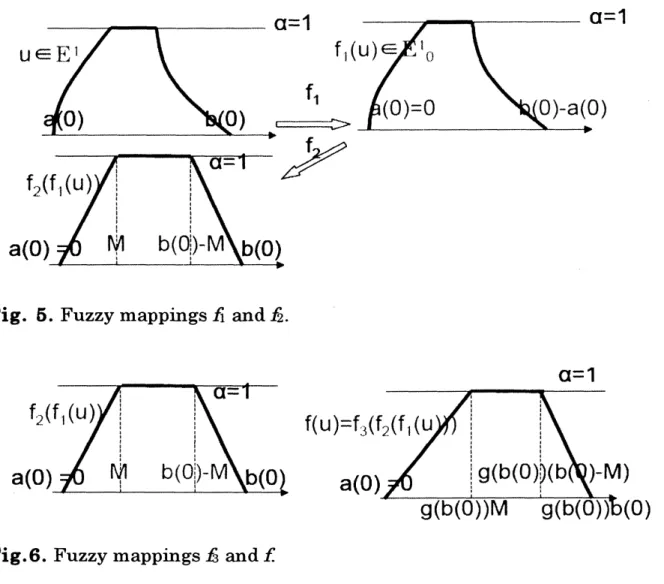
Consider a fuzzy mapping $f:E^{1}arrow E$ by $f(u)=B(B(fi(u)))$, which is
continuous with $D$ andmaps $\Delta^{1_{0}}$ into itself. Here
$f_{1}$ :$E^{1}arrow E_{0}^{1}$ by $[f_{1}(u)]^{a}=[a(\alpha)-a(O),b(\alpha)-a(O)]$;
$f_{2}$ :$E_{0}^{1}arrow I_{0}^{1}$ by $[.f_{2}(u)]^{\alpha}=[\alpha l4,b(0)-\alpha M]$,where$M= \frac{1}{2}b(O)-\frac{1}{8}(b(1)-a(1))>0$;
$f_{3}$ :$I_{0}^{1}arrow I_{0}^{1}$ by $[.f_{3}(u)]^{a}=g(b(O))[u]^{\alpha}$,where$g(x)=T(x)/x$.
Fig. 5. Fuzzymappings
fi
md$f_{2}$.$\mathfrak{a}=1$
Fig.6. Fuzzy mappings fi and$f$
Denote $b=b(O)$, then wehave $f(ub)=u\tau(b)$.
Example 3. In order to apply Theorem 4 we consider the following
compact sets $A$ , $B$ and$p=q=1$ with
$A= \{u_{b}\in\Delta_{0}^{1}:\frac{9}{16}\leq b\leq\frac{7}{8}\},$ $B= \{u_{b}\in\Delta_{0}^{1}:\frac{3}{4}\leq b\leq\frac{7}{8}\}$.
Then
$f(A)= \{u_{b}\in\Delta_{0}^{1}:\frac{1}{4}\leq b\leq\frac{7}{8}\},$ $f(B)= \{u_{b}\in\Delta_{0}^{1}:\frac{1}{4}\leq b\leq\frac{1}{2}\},.f^{2}(B)=\{u_{b}\in\Delta_{0}^{1}:\frac{1}{2}\leq b\leq 1\}$.
Conditions (ii),(v) and (vi) hold truly andit follows that for $u_{x},$ $u_{J^{r}}$in $A$
$\alpha f(u_{X}),f(u_{V}))=2\alpha_{u_{X}},$ $u_{V})$.
and $f^{2}$ is one$-$to one on $B$. By Theorem 4 $f$is chaotic in the
sense
of5.Concluding Remarks
In this article we introduced Kloeden Li’s paper (2006) which is
concerning results on the appearance of chaos of difference equations in
complete metric spaces of fuzzy sets. We discussed the ideas due to
Kloeden-Li and illustrate examples of the chaos to difference equations in
complete metric spaces offuzzy sets.
References
1. P. Kloeden and Z. Li: Li$-$Yorke Chaosin Higher Dimensions: AReview, J.
Difference Equations andAppl. 12, pp247-260, 2006.
2. T. V. Li and J. A. Yorke : Period Three Implies Chaos, Amer. Math.