最節約復元順序集合の極値問題について
-On extremal problems of
MPR-posets-東海大理情報数理 宮川湯平 (Kampei Miyakawa)
東海大理情報数理 成嶋 弘 (Hiroshi Narushima)
We first review several definitions and theorems used latter. The set $\{1, 2, \cdots, n\}$ of
$n$ elements is denoted by $[n]$
.
Let $a_{i}(i\in[2n])$ be any elements in $\Omega$, and be sorted inascending order as follows:
$x_{1}\leq x_{2}\leq\cdots\leq x_{n}\leq Xn+1\leq\cdots\leq x_{2n}$
.
Then we call $x_{n}$ and $x_{n+1}$ the median two points of the numbers $a_{i}(i\in[2n]),$ alld denote
$\langle x_{n},x_{n+}1\rangle$ by
$\mathrm{m}\mathrm{e}\mathrm{d}2\langle a_{1}, a_{2}, \cdots, O2n\rangle$ or $\mathrm{n}\mathrm{l}\mathrm{e}\mathrm{d}2\langle a_{\dot{|}} :i\in[2n]\rangle$
.
We also call $x_{n-\mathrm{I}},x_{n},$$x_{n+}1$ and $x_{n+2}$ the median
four
points of the numbers $a_{i}(i\in[271])$,and denote $\langle_{Xxx_{n+}}n-1,n’ 1, X_{n}+2\rangle$ by
$\mathrm{m}\mathrm{e}\mathrm{d}4\langle a_{1}, a_{2}, \cdots, a_{2n}\rangle$ or $\mathrm{m}\mathrm{e}\mathrm{d}4\langle a_{i} :i\in[2n]\rangle$
.
Let $I_{i}=[a_{i}, b_{i}](i\in[m])$ be any family of closed intervals in $\Omega$
.
Then we denote themedian two points $\mathrm{m}\mathrm{e}\mathrm{d}2\langle a_{i} : i\in[m], b_{i} : i\in[m]\rangle$ of all the endpoints $a_{i}$ and $b_{i}$ of $I_{i}$
$(i\in[m])$ by
’
$\mathrm{m}\mathrm{e}\mathrm{d}2\langle I_{1}, I_{2}, \cdots, I_{m}\rangle$ or $\mathrm{m}\mathrm{e}\mathrm{d}2\langle^{-}I_{1}.:i\in[m]\rangle$
.
We also denote the median four points $\mathrm{m}\mathrm{e}\mathrm{d}4\langle a_{i} : i\in[m], b_{i} : i\in[m]\rangle$of all the $\mathrm{e}\mathrm{n}\mathrm{d}\mathrm{p}_{\mathrm{o}\mathrm{i}_{1}}1\mathrm{t}_{\mathrm{S}}$ $a_{i}$ and $|y_{i}$ of$I_{i}(i\in[m])$ by
$\mathrm{m}\mathrm{e}\mathrm{d}4\langle I_{1,2}I, \cdots , I_{m}\rangle$ or $\mathrm{m}\mathrm{e}\mathrm{d}4\langle I_{i} :i\in[m]\rangle$
.
Let $\mathrm{m}\mathrm{e}\mathrm{d}2(I_{i}$ : $i\in[m]\rangle=\langle x_{m}, x_{m+}1\rangle$
.
Then wecall the closed interval $[x_{m},x_{m+1}]$ in $\Omega$ the median interval of the closed intervals $I_{1}$. $(i\in[m])$, which is the key concept in a series ofour papers, and denote it by
$\mathrm{m}\mathrm{e}\mathrm{d}\langle I_{1}, I_{2}, \cdots, I_{m}\rangle$ or $\mathrm{m}\mathrm{e}\mathrm{d}\langle I_{i} :i\in[m]\rangle$
.
The following is Lemma 1 in [3] (lemma $\mathrm{B}$ in [5]). It is very useful to investigate
cllarac-teristics of each MPR.
Lemma A. Let $a$ and $b_{i}(i\in[2m])$ be any elements in $\Omega$
.
ThenFrom Theorem 1 in [1], we see that $\mathrm{m}\mathrm{e}\mathrm{d}\langle[\lambda(p(u)),\lambda(p(u))], I(v) : uarrow v\rangle$ is the MPR-set
of node $u$ under the condition that an element $\lambda(p(u))$ in $S_{\mathrm{p}(u)}$ has been assigned to $u’ \mathrm{s}$
parent$p(u)$
.
This subset of the MPR-set $S_{u}$ is denoted by $S_{u}|x$.
That is,$S_{\mathrm{u}}|x=\mathrm{m}\mathrm{e}\mathrm{d}\langle[x,x], I(v) : uarrow v\rangle$,
where $x$ is an element in $S_{p(u)}$
.
The following is Theorem 1 in [3].Theorem B. Let $T$ be a rooted $el$-tree $(T_{s}, r)$
.
Then eadl $MPR$-set $S_{u}$for
eadl intemalnode $u$
of
$T$ is recursively decided by$S_{u}=[ \min(S_{\mathrm{u}}|\min(S_{\mathrm{P}(}u))), \max(S_{u}|\max(s_{\mathrm{p}(u})))]$
.
$\square$We now show a sufficient condition for a $\sigma(r)$-version MPR-poset to have both the
greatest element and the least element.
Proposition 1. Let $T$ be an $el$-tree, and$r$ be any element in $V_{O}$
.
If
$\sigma(r)$ $\leq$ $\min$
{
$\min(S_{u})|\forall u\in V_{H},$$S_{u}is$ a non-singleton} $or$$\sigma(r)$ $\geq$ $\max$
{
$\max(S_{\mathrm{u}})|\forall u\in V_{H},$ $S_{u}is$ anon-singleton},
tllen $(\mathrm{R}\mathrm{m}\mathrm{p}(\tau), \leq_{\sigma(\mathrm{r})})$ has both the greatest element and the least element, $\square$
Figure 1: An$\mathrm{e}1$-tree $T_{1}$
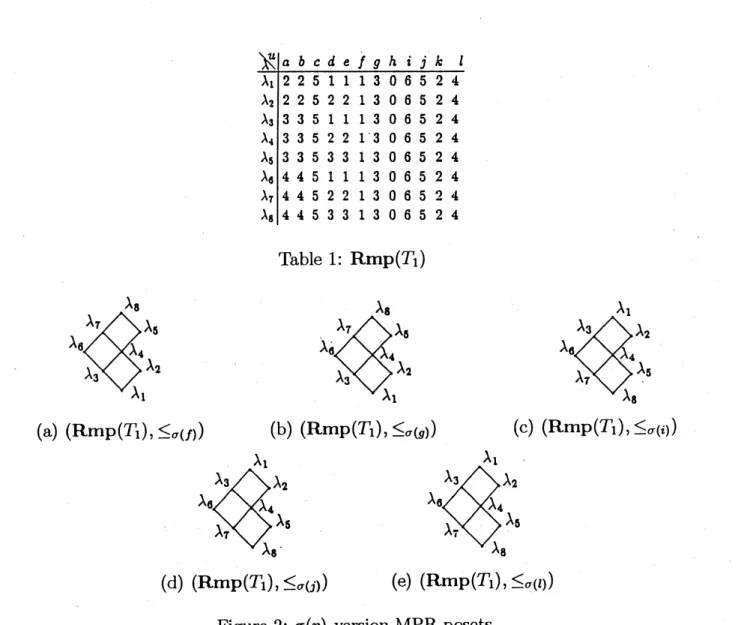
Weheregive some examplestoillustrateproposition 1. Let$T_{1}$ be an $\mathrm{e}1$-treeshown in Fig
1. The set $\mathrm{R}\mathrm{m}\mathrm{p}(T_{1})$ ofMPRs is also given in Table 1. Then$f,g,i,j$ and $l$ in $V_{O}(T_{1})\mathrm{s}\mathrm{a}\mathrm{t}\mathrm{i}\mathrm{s}\mathfrak{h}$’
the conditionsinproposition 1. Thereforewesee that $(\mathrm{R}\mathrm{m}\mathrm{p}(\tau_{1}), \leq_{\sigma(f)}),$ $(\mathrm{R}\mathrm{m}\mathrm{p}(\tau_{1}), \leq_{\sigma(g)})$,
$(\mathrm{R}\mathrm{m}\mathrm{p}(\tau_{1}), \leq_{\sigma(i)}),$ $(\mathrm{R}\mathrm{m}\mathrm{p}(\tau_{1}), \leq_{\sigma(j)})$ and ($\mathrm{R}\mathrm{m}\mathrm{p}(\tau_{1}),$$\leq_{\sigma \mathrm{t}^{\iota_{)})}}$ have both the greatest element
and the least element (Fig 2 (a) $\sim(\mathrm{e})$).
We get easily the following remark from proposition 1.
Remark 1. Let $T$ be an $el$-tree rooted at $r$ such that $\sigma(r)=\min(\sigma(Vo))$. TTlen $\sigma(r)-$
version $MPR$-poset, $(\mathrm{R}\mathrm{m}\mathrm{p}(\tau), \leq_{\sigma(\mathrm{r})})$ has both the greatest element and the least element.
Table 1: $\mathrm{R}\mathrm{m}\mathrm{p}(T_{1})$
(a) $(\mathrm{R}\mathrm{m}\mathrm{p}(T1), \leq_{\sigma \mathrm{t}}f))$ (b) ($\mathrm{R}\mathrm{m}_{\mathrm{P}(T_{1}),)}\leq\sigma(g)$ (c) $(\mathrm{R}\mathrm{m}\mathrm{p}(\tau_{1}), \leq\sigma(i))$
(d) $(\mathrm{R}\mathrm{m}\mathrm{p}(\tau_{1}), \leq_{\sigma(j)})$ (e) $(\mathrm{R}\mathrm{m}\mathrm{p}(\tau_{1}), \leq\sigma(l))$
Figure 2: $\sigma(r)$-version MPR-posets
We now have the main theorem in this paper, which answers for whether there exists the least$\cdot$element in a $\sigma(r)$-version MPR-poset or not.
Let $T$ bearooted $\mathrm{e}1$-tree $(T_{s}, r)$
.
Wedefine areconstruction$\lambda$ on $T$as follows. We define $\lambda$ by
$\lambda(u)=x$ in $S_{u}$ satisfying $x\leq_{\sigma(r)}y$ for any $y$ in $S_{u}$, that is, $x$ is the least element of
a subposet $(S_{u}, \leq_{\sigma(r)})$ in the poset $(\mathrm{R}\mathrm{m}\mathrm{p}(\tau), \leq_{\sigma(r)})$
.
This reconstruction $\lambda$ is particularlywritten as $\lambda_{\min}^{<\sigma(r)}>$
We can get the following implicitly from propostion 1.
Remark 2. Let $T$ be a rooted $el$-tree $(T_{s}, r)$.
If
$\sigma(r)\leq\min$
{
$\min(S_{u})|\forall u\in V_{H},$$S_{u}is$ a non-singleton},then $\lambda_{\min}^{<\sigma(r)}>=\lambda_{\min}$
.
The dual case also holds. $\square$Lemma 1. Let $T$ be a rooted $el$-tree $(T_{s}, r)$
.
For each $u$ in $V_{H}$, we have$\lambda_{\min}^{<\sigma(r})>(u)=\{$
$\min(S_{u})$ $( \sigma(r)\leq\min(s_{u}))$
$\sigma(r)$ $( \min(s_{u})<\sigma(r)<\max(s_{u}))$
Theorem 1. Let$T$ be a rooted $el$-tree $(T_{s},r)$
.
Then the reconstruction$\lambda_{\min}^{<\sigma(r)>}is$ the leastelement
of
$(\mathrm{R}\mathrm{m}\mathrm{p}(\tau), \leq_{\sigma(\mathrm{r})})$.
$\square$Wehere show some examples oftheMPR $\lambda_{\min}^{<\sigma(r)}>$
.
Let $T_{1}=(T_{c},j)$ be the tree $T_{1}$ rootedat node$j$. Then for each$u$ in $V$
we can
decide $\lambda_{\min}^{<\sigma(j)>}(u)$, which is shown in Fig3. We alsocan see that $\lambda_{\min}^{<\sigma(j)>}$ is equal to $\lambda_{8}$ in $\mathrm{R}\mathrm{m}\mathrm{p}(T_{1}),$ $\mathrm{i}.\mathrm{e}$, the least element of $(\mathrm{R}\mathrm{m}\mathrm{p}(\tau_{1}), \leq_{\sigma(j)})$
(Fig 4).
Figure 3: $\lambda_{\mathrm{m}\ln}^{<\sigma}(j)>_{\mathrm{o}\mathrm{n}T1}=(T_{c},j)$ Figure 4: $(\mathrm{R}\mathrm{m}\mathrm{p}(\tau_{1}), \leq_{\sigma(j)})$
Itis known that $(\mathrm{R}\mathrm{m}_{\mathrm{P}()}\tau, \leq_{\sigma(r)})$ dosen’t always have the greatest element. So, we show
one ofthe requirements for a reconstruction $\lambda$ in $\mathrm{R}\mathrm{m}\mathrm{p}(T)$ to be a maximal element in the
$\sigma(r)$-version MPR-poset.
Lemma 2. Let$T$ be a rooted$el$-tree $(T_{s}, r)$
.
Foreach$u$ in$V$, we have $\max S_{p\mathrm{t}u}$) $\leq\min I(u)$,$\max I(u)\leq\min S_{\mathrm{P}()}u$ or $S_{p(u)}\subseteq I(u)$ hold. $\square$
Let $T$ be a rooted $\mathrm{e}1$-tree $(T_{s},r)$
.
We define two reconstructions $\alpha^{<\sigma(r)>},\beta^{<\sigma \mathrm{t}r}$)$>$
on $T$
as follows. We define $\alpha^{<\sigma(r)}>$
and
$\beta^{<\sigma(r)>}$ by $\alpha^{<\sigma(r)>}(u)=$ the smallest element $x$ underthe usual ordering $\leq$ of maximal elements in the subposet $(S_{u}, \leq_{\sigma(r)})$ and $\beta^{<\sigma(r)>}(u)=$
the greatest element $x$ under the usual ordering $\leq$ of maximal elements in the subposet
$(s_{u}, \leq_{\sigma()}r)$
.
Lemma 3. Let $T$ be a rooted $el$-tree $(T_{s},r)$
.
For each $u$ in $V_{H\mathrm{z}}$ we have$\alpha^{<\sigma(r)>}(u)=\{$
$\min(S_{u})$ $( \sigma(r)>\min(s_{u}))$ $\max(S_{\mathrm{u}})$ $( \sigma(r)\leq\min(s_{u}))$
$\beta^{<\sigma(r)>}(u)=\{$
$\min(S_{u})$ $( \sigma(r)\geq\max(s_{u}))$
$\max(S_{u})$ $( \sigma(r)<\max(s_{u}))$ $\square$
Proposition 2. Let $T$ be a rooted $el$-tree $(T_{s}, r)$
.
Then, both $\alpha^{<\sigma(r)}>$ and $\beta^{<\sigma(r)>}$ aremaximal elements
of
$(\mathrm{R}\mathrm{m}\mathrm{p}(\tau), \leq_{\sigma\langle r)})$.
$\square$We here show some examples of the MPR $\alpha^{<\sigma(r)}>$ and $\beta^{<\sigma(r)>}$
.
Let $T_{1}=(T_{b}, k)$ bethe tree $T_{1}$ rooted at node $k$
.
Then for each $u$ in $V$ we can decide $\alpha^{<\sigma(k)>}(u)$ and$\beta^{<\sigma(k)>}(u)$, which are shown in Fig $5(\mathrm{a})$ and (b) respectively. We also see that $\alpha^{<\sigma(k)>}$
and $\beta^{<\sigma(k)}>\mathrm{a}\mathrm{r}\mathrm{e}$ equalto $\lambda_{6}$ and $\lambda_{8}$ in $\mathrm{R}\mathrm{m}\mathrm{p}(T_{1})$, respectively, which aremaximal elements
of $(\mathrm{R}\mathrm{m}\mathrm{p}(\tau_{1}), \leq_{\sigma\langle k)})$ (Fig 6).
Figure $5(\mathrm{a}):\alpha^{<\sigma(k})>_{\mathrm{o}}\mathrm{n}\tau_{1}=(T_{b}, k)$ (b): $\beta^{<\sigma(k)>}$ on $\tau 1=(T_{b}, k)$
Figure 6: $(\mathrm{R}\mathrm{m}\mathrm{p}(\tau_{1}), \leq_{\sigma(k)})$
Finally, we show interesting examples on the number of maximal elements of a $\sigma(r)-$
version MPR-poset. Let $T_{2}$ be an$\mathrm{e}1$-treeshown in Fig 7. When $T_{2}$ is rooted at$p$ in $V_{O}(T_{2})$,
we seethat $(\mathrm{R}\mathrm{m}\mathrm{p}(\tau_{2}), \leq_{\sigma(P)})$ has three maximal elements $\lambda_{1},$$\lambda_{3}$ and $\lambda_{6}$ shown in Fig 8. In
other words, it shows that the number of maximal elements of a $\sigma(r)$-version MPR-poset
Figure 7: An $\mathrm{e}1$-tree $T_{2}$ Figure 8:
$(\mathrm{R}\mathrm{m}\mathrm{p}(\tau_{2}), \leq_{\sigma(p)})$
参考文献
[1] M. IIanazawa, H. Narushima and N. ${\rm Min}$
. $\mathrm{a}\mathrm{k}\mathrm{a}$, Generating most parsiInonious
recon-structions on a tree: a generalization of the $\mathrm{F}\mathrm{a}\mathrm{r}\mathrm{r}\mathrm{i}\mathrm{s}-\mathrm{S}\mathrm{W}\mathrm{o}\mathrm{f}\mathrm{f}_{\mathrm{o}\mathrm{r}}\mathrm{d}-\mathrm{M}\mathrm{a}\mathrm{d}\mathrm{d}\mathrm{i}_{\mathrm{S}}\mathrm{o}\mathrm{n}$ metllod,
Dis-crete Applied Mathematics 56 (1995) 245-265.
[2] N. Minaka, Algebraic $\mathrm{P}\mathrm{r}\mathrm{o},.\mathrm{p}\mathrm{e}\mathrm{r}\mathrm{t}\mathrm{i}\mathrm{e}\mathrm{s}$ of
th.
$\mathrm{e}$ Most ParsimoniousReconStruCtiO.n
$\mathrm{S}$ of theIIypothetical Ancestors on a Given Tree, Forma 8 (1993) 277-296.
[3] H. Narusllima and M. Hanazawa, A more efficient $\mathrm{a}\mathrm{l}\mathrm{g}\mathrm{o}\mathrm{r}\mathrm{i}\mathrm{t}1_{1}\mathrm{m}$ for MPR problems in
$\mathrm{P}^{1_{1}}\mathrm{y}\mathrm{l}\mathrm{o}\mathrm{g}\mathrm{e}\mathrm{n}\mathrm{y}$, Discrete Applied Mathematics 802-3 (1997) 227-234.
[4] II. NaruslliIna and N. Misheva, On a role of tlle MPR-poset of most-parsimonious
reconstructions in phylogenetic analysis –A combinatorial optimization problern in
phylogeny-, Proc. The International Symposium on Combinatoircs and Applications
($\mathrm{e}\mathrm{d}\mathrm{s}:\mathrm{W}.\mathrm{Y}.\mathrm{C}$.Chen, $\mathrm{D}.\mathrm{Z}$.Du, $\mathrm{D}.\mathrm{F}$.IIsu, II.Y.Hap) (June 28-30, 1996: Nankai Institute
of Mathematics, Nankai University, Tianjin, $\mathrm{P}.\mathrm{R}.\mathrm{C}1_{1}\mathrm{i}\mathrm{n}\mathrm{a}$) 306-313.
[5] H. Narushima and N. Misheva, On the characteristics of $\mathrm{t}1_{1}\mathrm{e}$ ancestral cllaracter-state
reconstruction under $\mathrm{t}1_{1}\mathrm{e}$ accelerated transformation optimization,
$\mathrm{p}\mathrm{r}\mathrm{e}\mathrm{p}\mathrm{r}\mathrm{i}_{11}\mathrm{t}$
.
[6] H. Narushima, On most-parsimonious reconstruction in phylogeny and extremal