A
time
domain fast boundary integral equation
method
for
three
dimensional
elastodynamics
理化学研究所 高橋徹(Torn Takahashi) 京大・工学研究科 西村直志(NaoshiNishimura)
TheInstituteofPhysicalandChemicalResearch Department of Civil Engineering, Kyoto Univ.
1
Introduction
Boundary Integral Equation Method(BIEM) is consideredto be
an
efficient solverforexteriorproblems. This isparticularly truein
wave
problems suchas
those inacoustics,electromagnetics and elastodynamics, because thereisno
needto introducetechniquesto avoid non-physical reflections from artificial boundaries with BIEM.Indeed,one
can
find examples of successfuluse
ofBIEM inwave
related engineeringproblems inliterature (See Kobayashietal. [1]forexample). Itis therefore consideredtobeworththe effortstofurtherenhance theperformance of BIEM in
wave
problems byinvestigatingafast method.Inelastodynamics,
one can
findsome
attemptstodevelopfast BIEMin frequencydomain,as
reviewedin Nishimura[2].Intimedomain, however, notmuchhas beendone except in the work by Takahashietal. [3] wherethese authors
extended the approach by Lu et al. [4]in the
wave
equationtoelastodynamics in$2\mathrm{D}$.
As amatteroffact one
may
say
that almost all ofthe fundamentalsof the fast BIEMinwave
problems intime domainhaveso
farbeen developedin Michielssen’s
group.
Theirmostadvanced approachisfoundin Ergineta1.[5]wherethey proposed afast method(PlaneWaveTime Domain(PWTD)algorithm)for the
wave
equationin$3\mathrm{D}$ which utilises the planewave
expansionof thefundamentalsolutionin thespace-timeand multilevelimplementation. See Nishimura[2]for
more
references.The
purpose
of thispaper
istocontinue the efforts by Takahashietal.[3]in$2\mathrm{D}$,andtoextend the PWTD approachtoelastodynamicsin$3\mathrm{D}$.As
we
shallsee
theextension is straightforward, but is byno
means
automatic. This is becauseof thepresenceoftwo
waves
($\mathrm{P}$and$\mathrm{S}$waves)in elastodynamics and the timeintegrationfoundintheelastodynamicfundamental solution. Inview ofthis,
we
shallpresentthedetail of the derivation of the planewave
expansionforelastodynamicsinthispaper.
This paperbegins with the fundamentalsof the BIEM in thetime domain elastodynamicsin $3\mathrm{D}$
.
Afterabriefrecapitulation of thetime-marchingmethod with the conventionalBIEM,
we
derive theplanewave
expansionof thetime domain elastodynamic fundamental solution in$3\mathrm{D}$ in section 2. Afterpreparing
some
mathematical tools,we
proceed tothedescription of the algorithm in section 3. It is shown that the complexity of the proposed approach
is either$O(N_{s}\log^{2}N_{s}N_{t})$
or
$o(N_{s}^{3/2}N_{t})$ dependingon
thealgorithm used for the Legendre transformation. Theperformance of the proposed algorithm is tested insection4whereproblems having thespatial DOF of$O(10^{4})$
are
considered. The proposed approachisconcluded to outperform the conventional BIEM
even
in the smallest problemconsidered.
2
Formulation
2.1
Governing equations and BIE
Let$D\subset \mathrm{R}^{3}$beadomain having asmooth boundary$\partial D=S$
.
Theinitial boundary value problem for 3dimensionalelastodynamicsin time domainisformulated
as
follows: To solve$\mu u_{\dot{l},jj}(x, t)+(\lambda+\mu)uj,ij(x, t)+b_{:}(x, t)=\rho^{\text{\"{u}}}:(x, t)$ (1)
for the unknown vectorfunction(displacements)$u_{i}(x, t)(x=(x_{1}, x_{2}, x_{3})\in D, t\in(0, \infty))$subject tocertain initial
andboundaryconditions,where$u$standsforthedisplacementvector,$and$t$
are
thespatialvariable andtime,Aand$\mu$
are
Lam\"e’sconstants,$\rho$isthe density and$b$isthebodyforceper
unitvolume,respectively. Also,we
haveused thesummation conventionforrepeated indices. Astypicalinitial andboundaryconditions
we
considerthefollowing:initial condition $u(x, \mathrm{O})=\dot{u}(x, 0)=0$ in$D$
boundarycondition $u(x, t)=\overline{u}(x, t)$
on
$S_{1}$ (2)$t(x, t)=\overline{t}(x,t)$
on
$S_{2}$where$(^{-}.)$indicates functiongiven
on
the boundary.Also,$S_{1}$and$S_{2}$
are
parts of the boundary$S$such that$S=S_{1}+S_{2}$holds,and$t$stands for thetractiondefined by
$t_{:}(x, t)=C_{\dot{|}jk\iota}n_{j}(x)uk,l(x, t)$,
数理解析研究所講究録 1265 巻 2002 年 229-240
where
n
is the outward normal vector toS and$C_{jkl}\dot{.}$isthe elasticitytensordefined intermsof Lamb’sconstantsAand$\mu$by$C_{\dot{l}jk\iota}=\lambda\delta_{jj}\delta_{kl}+\mu(\delta:k\delta jl +\delta i\iota\delta jk)$
.
Assuming the body forceto vanish,
we
obtain from(1)thefollowing boundary integralequation:$\frac{1}{2}u:(x,t)+\dagger_{S}T_{\dot{|}j}(x,y,t)*u_{j}(y,t)dS_{y}=\int_{S}\Gamma_{\dot{|}j}(x-y,t)$
,
$t_{j}(y, t)dS_{y}$ $x\in S$, $t>0$ (3)where the superimposed -stands for the Cauchy principal value of
an
integral$\mathrm{a}\mathrm{n}\mathrm{d}*\mathrm{i}\mathrm{n}\mathrm{d}\mathrm{i}\mathrm{c}\mathrm{a}\mathrm{t}\mathrm{e}\mathrm{s}$ the convolution withrespecttotime.Theintegrals
on
theRHS and LHS of(3)are
called thesingle and double layerpotentials, respectively,whose kernels$\Gamma$and$T$
are
definedby(4)
$\Gamma_{\dot{|}j}(x,t)=\frac{1}{4\pi\mu}[\frac{\delta(t-|x|/c_{T})}{|x|}\delta_{\dot{|}j}-c_{T}^{2}\partial_{\dot{1}}\partial_{j}(\frac{(t-|x|/c_{T})_{+}}{|x|}-\frac{(t-|x|/c_{L})_{+}}{|x|})]$ ,
$T_{\dot{|}j}(x,y,t)=Cj \mathrm{t}nmn\iota(y)\frac{\partial}{\partial y_{n}}\Gamma_{\dot{|}m}(x-y,t)$ (5)
where$c_{L}$ and$c_{T}$
are
velocities of$\mathrm{P}$and$\mathrm{S}$waves
definedby$c_{L}=\sqrt{\frac{\lambda+2\mu}{\rho}}$, $c_{T}=\sqrt{\frac{\mu}{\rho}}$,
$\delta_{\dot{|}j}$
is
Kronecker’s deltaand$f_{+}=(|f|+f)/2$.
2.2
Plane
wave
expansions
of
the
kernels
Themostimportantingredient in the proposed fast method of solving integralequationsintimedomainistheplane
wave
expansionof thefundamental solution$\Gamma$.
To obtain one,we
use
amore
concise expressionfor$\Gamma$thantheone
in(4). Namely,
we use
$\Gamma_{j}.\cdot(x,t)=\frac{1}{\rho}[\partial.\cdot\partial_{j}\int\int\frac{\delta(t-|x|/c_{L})}{4\pi|x|}dtdt+e_{\dot{\mu}k}e_{q\mathrm{j}k}\partial_{p}\partial_{q}\int\int\frac{\delta(t-|x|/c_{T})}{4\pi|x|}dtdt]$ (6)
whereeXjk is the alternating symbol. From thisexpression,
we see
that the planewave
expansionof$\Gamma$ isobtainedfrom asimilar expansion for the function
$\Lambda_{\dot{|}j}(x,t;c)=\partial_{\dot{1}}\partial \mathrm{j}\int\int\frac{\delta(t-|x|/c)}{4\pi|x|}dtdt$,
where$c$isapositiveconstant.
In ordertoexpand$\Lambda_{\dot{\iota}j}$ into planewaves,
we
startfiom the Fourier transform of Awith respecttospace
andtime:$\frac{\xi.\xi_{\mathrm{j}}}{\omega^{2}(|\xi|^{2}-\omega^{2}/c^{2})}$
.
(7)
where$\xi$
:and
$\omega$me
the spatial andtime Fourierparameters. In theinverse
transformof(7)we use
the$\mathrm{w}\mathrm{e}\mathrm{U}$-knownlim-iting absorptionprinciple whichstatesthatacausal(anti-causal)Fourierinverse transform(see(8)for thedefinition)
is obtainedas
one
takesthe$\omega$integralon
therealaxisas
the limitfromtheImu $>0$(Imu$<0$)sidein the complexplane. Therefore the integral
$\lim_{{\rm Im}\omegaarrow\pm 0}\frac{1}{(2\pi)^{4}}\int\int\int\int\frac{\xi_{\dot{1}}\xi_{j}e^{\dot{|}\xi\cdot x-idt}}{\omega^{2}(|\xi|^{2}-\{v^{2}/c^{2})}d\xi_{1}d\xi_{2}d\xi_{3}\mathrm{d}v$ (8)
gives$\Lambda_{\dot{|}j}(x,t;c)$if
one
takes theupper
limitin(8)while thesame
integral willbe equal to$\Lambda_{j}’.\cdot(x,t;c)=\partial_{\dot{1}}\partial_{\dot{g}}\int\int\frac{\delta(t+|x|/c)}{4\pi|x|}dtdt$
if the other limitis taken.
We
now
rewritetheintegralin(8)intothefollowingform:$\lim_{{\rm Im}\omegaarrow\pm 0}\frac{1}{(2\pi)^{4}}\int\int\int\int\frac{\xi_{\dot{1}}\xi_{j}e\xi\cdot x-udt}{\omega^{2}(|\xi|^{2}-\omega^{2}/c^{2})}.\cdot d\xi_{1}d\xi_{2}\tilde{d}\xi_{3}\mathrm{d}v$
$=$ $\mp\frac{t}{8\pi}\partial_{\dot{1}}\partial_{j}\frac{1}{|x|}+\frac{1}{(2\pi)^{4}}\lim_{\mathrm{I}\mathrm{m}\mathrm{t}darrow\pm 0}\not\in$ $\int\int\int\frac{\xi_{\dot{1}}\xi_{j}e^{\dot{l}\xi\cdot x-\dot{u}dt}}{\omega^{2}(|\xi|^{2}-\omega^{2}/c^{2})}d\xi_{1}d\xi_{2}\ \mathrm{d}v$, (9)
where thesignof
integration
withasuperimposed$=\mathrm{i}\mathrm{n}\mathrm{d}\mathrm{i}\mathrm{c}\mathrm{a}\mathrm{t}\mathrm{e}\mathrm{s}$ thattheintegral istakeninthe
sense
of the finite part.Wenext
assume
$x_{3}>0$toevaluate the 2ndtermon
theRHS of(9),denotedbyI,in thefollowingform:$I= \frac{1}{2(2\pi)^{3}}\lim_{{\rm Im}\omegaarrow\pm 0}\not\in$$\int\int\frac{\xi_{i}\xi_{j}e^{i(\xi_{1}x_{1}+\xi_{2}x_{2})-\sqrt{\xi_{1}^{2}+\xi_{2}^{2}-\omega^{2}/c^{2}}x_{3}-i\omega t}}{\omega^{2}\sqrt{\xi_{1}^{2}+\xi_{2}^{2}-\omega^{2}/c^{2}}}d\xi_{1}d\xi_{2}d\omega$
where
we
now
have$\xi_{3}=i\sqrt{\xi_{1}^{2}+\xi_{2}^{2}-\omega^{2}/c^{2}}$
.
Usingthe change ofvariables givenby
$\xi_{1}=R\cos\phi$, $\xi_{2}=R\sin\phi$,
we
have$I= \frac{1}{2(2\pi)^{3}}\not\in$ $\int_{0}^{\infty}\int_{0}^{2\pi}\lim_{{\rm Im}\omegaarrow\pm 0}\frac{\xi_{i}\xi_{j}e^{\dot{l}(\xi_{1}x_{1}+\xi_{2}x_{2})-\sqrt{R^{2}-\{v^{2}/c^{2}}x_{3}-\dot{l}1dt}}{\omega^{2}\sqrt{R^{2}-\omega^{2}/c^{2}}}RdRd\phi d\omega$
.
(10)Splitting the domain of the$R$integrationinto subdomains $|R|$ $>|\omega|/c$and $|R|$ $<|\omega|/c$andusing
some
changes ofthe variables
we
obtain$\lim_{{\rm Im}\omegaarrow\pm 0}\frac{1}{(2\pi)^{4}}\int\int\int\int\frac{\xi_{\dot{l}}\xi_{j}e^{\dot{\iota}\xi\cdot x-\iota\omega t}}{\omega^{2}(|\xi|^{2}-\omega^{2}/c^{2})}d\xi_{1}d\xi_{2}d\xi_{3}d\omega$
$=$ $\mp\frac{t}{8\pi}\partial_{i}\partial_{j}\frac{1}{|x|}\mp\frac{\partial_{t}}{2(2\pi)^{2}c^{3}}\int_{S_{k}\cap\{k_{3}0\}}>k_{i}k_{j}\delta(t-x_{l}k_{l}/c)dS_{k}<$
$+ \frac{1}{2(2\pi)^{3}c^{3}}\not\in$ $\int_{1}^{\infty}\int_{0}^{2\pi}.\frac{|\omega|\eta_{i}\eta_{j}e^{i(\eta_{1}x_{1}+\eta_{2}x_{2})-\cup\sqrt{\rho^{2}-1}x_{3}-\dot{|}\omega t}\overline{\mathrm{c}}\mathrm{c}}{\sqrt{\rho^{2}-1}}.\rho d\rho d\phi d(l[]$ (11)
where $k$ is aunit vectorand $s_{k}$ isthe unit sphere in$\mathbb{R}^{3}$
.
Since the last integralon
the RHS is
common
to bothapproachesof$\omega$in the complex plane,
we
takethedifference between these limits in(11)tohave$\Lambda_{ij}(x, t;c)-\Lambda_{\dot{|}j}’(x, t;c)=-\frac{t}{4\pi}\partial_{tj}\partial\frac{1}{|x|}-\frac{\partial_{t}}{8\pi^{2}d}\int_{S_{k}}kikj\delta(t-x \cdot k/c)dS_{k}$
.
(12)This result holds true fornegative $x_{3}$ also. Substituting (12) into (6)
we
obtain the planewave
expansion for thefundamental solution givenby
$\Gamma_{\dot{|}j}(x, t)-\Gamma_{j}’.\cdot(x, t)=-\frac{\partial_{t}}{8\pi^{2}}\int_{S_{k}}[\frac{k_{\iota}k_{j}}{\rho c_{L}^{3}}\delta(t-x\cdot k/c_{L})+\frac{k_{p}k_{q}e_{\mu k}e_{qjk}}{\mu_{T}^{3}}\delta(t-x\cdot k/c_{T})]dS_{k}$
.
(13)In thisexpressionthefunction$\Gamma’$stands for the ‘ghost’,
or
the anti-causalfundamental solutiongivenby$\Gamma_{\dot{l}j}’(x, t)=\frac{1}{\rho}(\Lambda_{ij}’(x, t;c_{L})+e_{pk}:e_{qjk}\Lambda_{pq}’(x,t;c_{T}))$
.
Thisfunctionsatisfies$\Gamma’(\cdot, t)=0$for$t>0$,or,is ‘anti-causal’.
Eq.(13) givesthe plane
wave
expansion for$\Gamma$.
One also obtains the planewave
expansion for the double layerkernel
$T$as
one
substitutes(13)into(5).Notice that the non-integral term (thefirst term
on
the RHS)in (12) vanishesas
one
substitutes (12) into(13).In other words, both $\mathrm{P}$ and $\mathrm{S}$
wave
components in (13) (the integrals of the 1st and 2nd terms in the integrand,
respectively)include non-causaltermsin additiontocausal$\Lambda_{cj}$and anti-causal$\Lambda_{ij}’$andthese non-causal terms cancel
with each other. This
means
that the$\mathrm{P}(\mathrm{S})$wave
component in(13)does not vanish before the arrival of$\mathrm{P}(\mathrm{S})$ wave,even
after the ghost vanishes. One therefore hastoevaluateboth$\mathrm{P}$and $\mathrm{S}$wave
components in(13) together
even
insituationswhere the physics tells that only the$\mathrm{P}$
wave
should be present2.3
Evaluation
of
potentials
with the plane
wave
expansion
We
now
describe aPWTD algorithmtoevaluate potentials inthetime
domain elastodynamics using theexpansion
in(13).
Let$S_{s}$and$S_{o}$bedisjoint spherical domainswithradiusof$R$centred at$s$and$0$,respectively.Thedistance between
$s$and$0$,
or
$|\mathit{0}-s|$,willbedenoted by$R_{c}(>2R)$.
Also,assume
that$S_{s}$ includesapartof$S$denoted byS..
Weare
now
interestedin evaluatingthesingleanddoublelayerpotentials producedbydensities$t$and$u$on S.
$\mathrm{x}(0,t]$ andobservedat$(x,t)(x\in s_{o}, t\in(0,\infty))$
.
Eq.(13) shows that the plane
wave
expansion
for thefundamental solution includes anon-physical ghost. Inutilising thisexpansion
we
havetodevelopan
approachwhich guarantees that the ghost doesnotpollutethe solution.Inordertoobtain such
an
approach,we
follow the developments of Erginetal. [5]to writethe density functions$u$and$t$
as sums
of functions$u^{z}$and$t^{z}$ $(z=1, 2, \ldots)$,which have supportsinthefinite interval$(T_{1}^{z},T_{2}^{z}]$:
$u= \sum_{z}u^{z}$, $t= \sum_{z}t^{z}$
.
Since
we
are
interestedin
aPPlying the planewave
expansion in
the evaluation of the the part ofintegrals in
thediscretisedintegral equation in(3)which represent the effect from the past,
we
may
assume
thattheintegrals including$u^{z}$ and$t^{z}$
are
evaluated only for$t>T_{2}^{z}$.
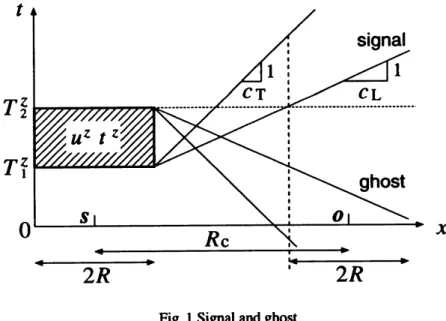
Asone sees
from Fig. 1the signal from$s_{s}\mathrm{x}(T_{1}^{z},T_{2}^{z}]$ reaches $S_{o}$ after$t=T_{2}^{z}$ if
$R_{c}-2R\geq c_{L}(T_{2}^{z}-T_{1}^{z})$ (14)
holds. One also
sees
that theghost willnever
pollutethe solution if the conditionin(14)is satisfied sincetheghostwill vanishbefore the arrival of the signal.
$x$
Fig. 1Signalandghost
If the conditionin(14) issatisfied,
one
can
evaluatepotentialfunctionsin elastodynamicsfor$(xx, t)(x\in S_{o},t>$T22)and known densities$t^{z}$and$u^{z}$ in (S. $\mathrm{x}$ $(T_{1}^{z},T_{2}^{z}])$via
$\int_{S}$
.
$(T_{\dot{l}j}(x, y,t)*u_{j}^{z}(y, t)-\Gamma_{\dot{|}j}(x-y,t)*t_{j}^{z}(y,t))dS_{y}$$=$ $- \frac{\partial_{t}}{8\pi^{2}}\int_{S_{k}}[k_{\dot{*}}\delta(t- (xx -s)\cdot k/c_{L})*\mathcal{O}^{z}(s, t, k)+e_{p’ k}k_{p}\delta(t-(xx -s)\cdot k/c_{T})*\mathcal{O}_{k}^{z}(s,t,k)]dS_{k}(15)$
where the functions$O^{z}$and$O_{k}^{z}(k=1,2,3)$,called outgoing
rays,
are
definedby$\mathcal{O}^{z}(s,t, k)$
$=$ $\int_{S}$
.
$( \frac{C_{jlnm}n_{\mathrm{t}}k_{m}k_{n}}{\mu_{L}^{4}}\dot{u}_{j}^{z}(y,t-(s-y)\cdot k/c_{L})-\frac{k_{j}}{\rho d_{L}}t_{j}^{z}(y,t-(s-y)\cdot k/c_{L}))dS_{y}$, (16a)$\mathcal{O}_{k}^{z}(s, t, k)$
$=$ $\int_{S}$
.
$( \frac{C_{jlnm}n_{l}e_{qmk}k_{q}k_{n}}{\rho c_{T}^{4}}\dot{u}_{j}^{z}(y,t-(s-y)\cdot k/c_{T})-\frac{e_{q\mathrm{j}k}k_{q}}{\rho c_{T}^{3}}t_{j}^{z}(y, t-(s-y)\cdot k/c_{T}))dS_{y}$.
(16b)Theoutgoing
rays
are
consideredtobe thetimedomain counterparts of themultipolemomentsintheFast MultipoleMethod(FMM).Notice that the elastodynamic potential functions
are now
expressedintermsof4components(onefrom$O$ andthree from$\mathcal{O}_{k}$)of theoutgoing
rays.
Thesame
property has beenobservedin elastostaticsas
wellas
inelastodynamics in frequencydomain[2].
For$(x, t)(x\in S_{o},t>T_{2}^{z})$
one
can
furtherrewrite(15)into$\int_{S}$
.
$(T_{ij}(x, y, t)*u_{j}^{z}(y,t)-\Gamma_{ij}(x-y, t)*t_{j}^{z}(y, t))dS_{y}$$=$ $- \frac{1}{8\pi^{2}}\int_{S_{k}}[k_{i}\delta(t-(x-\mathit{0})\cdot k/c_{L})*\mathrm{I}^{z}(\mathit{0}, t, k)+e_{pik}k_{p}\delta(t-(x-\mathit{0})\cdot k/c_{T})*\mathrm{I}_{k}^{z}(\mathit{0},t, k)]dS_{k}(17)$
where thefunctions$\mathrm{I}^{z}$ and
Ij
$(k=1,2, 3)$,called theincoming rays,are
defined by$\mathrm{I}^{z}\mathrm{S}\mathrm{o},\mathrm{t}k)$ $=$ $\mathcal{T}(\mathit{0}-s, t, k;c_{L})*O^{z}(s, t, k)$, (18a)
$\mathrm{I}_{k}^{z}(\mathit{0}, t, k)$ $=$ $\mathcal{T}(\mathit{0}-s, t, k;c\tau)*\mathcal{O}_{k}^{z}(s,t, k)$
.
(18b)and
$\mathcal{T}(\mathit{0}-s,t, k;c)=\partial_{t}\delta(t-(\mathit{0}-s) \cdot k/c)$
.
Theincoming
rays
are
conceptually similartothecoefficients of the localexpansionin FMM.Also,theexpansionin(17) andthe relations in(18)
are
considered to be thetimedomain counterparts of the localexpansionand the$\mathrm{M}2\mathrm{L}$relationintheoriginalFMM.
Finally one
sums
up thecontributionsfrom the $z\mathrm{t}\mathrm{h}$ time intervals givenby (17)to compute theelastic potential
dueto$u$and$t$definedin$S_{*}\mathrm{x}(0, t]$ andobservedat
$x\in So,t>T_{2}^{z}$ by
$\int_{S_{\mathrm{s}}}(T_{ij}(x, y, t)*u_{j}(y, t)-\Gamma_{ij}(x-y,t)*t_{j}(y,t))dS_{y}=-\sum_{v=1}^{z}\frac{1}{8\pi^{2}}$
$\mathrm{x}$
$\int_{S_{k}}[k_{i}\delta(t-(x-\mathit{0})\cdot k/c_{L})*\mathrm{I}^{v}(\mathit{0}, t, k)+e_{\mu k}k_{p}\delta(t-(x-\mathit{0})\cdot k/c_{T})*\mathrm{I}_{k}^{v}(\mathit{0}, t, k)]dS_{k}$
.
(19)3
PWTD
Algorithm for elastodynamics
In this section
we
shall describe amulti-level PWTD algorithm for elastodynamics in$3\mathrm{D}$ usingan
$\mathrm{o}\mathrm{c}\mathrm{t}$-tree structureof theboundaryelements and the plane
wave
expansionof the potentials. We shall also discuss thecomplexityof thealgorithm.
3.1
Computation
of the
outgoing
rays
We
now
describe howwe
evaluate theoutgoing raysin(16)usingthenotation$\varphi(t)$for either of the densityfunctions$u$
or
$t$.
Wefirst discuss how
we
panition$\varphi$intothesum
of$\varphi^{z}$ which isnonzero
only in $(T_{1}^{z},T_{2}^{z}]$.
Weassume
that$\varphi$is
very
smooth,or
isband limited by$\omega_{\max}$.
Thetime increment At isthenchosenas
$\Delta t=\pi/\omega_{f}$ with$\omega_{f}=\chi_{1}\omega_{\max}$,where$\chi_{1}(>1)$stands for the
over
samplingratio. As Erginetal.suggest[5],we
interpolate$\varphi$usingan
approximatelytimeandbandlimitedbase function$\psi(t)$
as
$\varphi(t)\simeq\sum_{\alpha}\varphi(\alpha\Delta t)\psi(t-\alpha\Delta t)$ (20)
and
group
consecutive$M$termstogether todefine$\varphi^{z}(t)=\sum_{\alpha=(z-1)M+1}^{zM}\varphi(\alpha\Delta t)\psi(t-\alpha\Delta t)$
.
(21)We thussplit$\varphi$into
asum
ofapproximately timeandbandlimited functions$\varphi^{z}$with thehelpof$M$samples of$\varphi$
.
Forthe present
purpose,
Erginetal.[5]suggesttouse
thefollowingfunction for$\psi$:
$\psi(t)=\frac{\omega_{0}}{\omega_{f}}\frac{\sin(\omega_{0}t)}{aJ_{0}t}\frac{\sin(\Omega p_{t}\Delta t\sqrt{(t/p_{t}\Delta t)^{2}-1})}{\sinh(\Omega p_{t}\Delta t)\sqrt{(t/p_{t}\Delta t)^{2}-1}}$
(22)
where$\omega_{0}=\omega_{\max}(\chi_{1}+1)/2$,$\Omega=\omega_{\max}(\chi_{1}-1)/2$,and$p_{t}>0$is
an
integer.In(22)we
interpret$\sqrt{(t/pt\Delta t)^{2}-1}=$$i\sqrt{1-(t}/p_{t}\Delta t)^{2}$ when $t<p_{t}\Delta t$
.
Itisseen
that $\psi$isband limited by $\omega f$ and almost vanishes for$|t|>p\iota^{\Delta t}[5]$.
Hence,$\varphi^{z}$is certainlyband limited andapproximately timelimited. Since
one
has$T_{1}^{z}=((z-1)M+1-p_{t})\Delta t$, $T_{2}^{z}=(zM+p_{t})\Delta t$ (23)
from(21),
one sees
that theconditionin
(14)is
satisfied ifone
sets$M$so
that$M \leq\frac{R_{\mathrm{c}}-2R}{c_{L}\Delta t}-2p_{l}+1$ (24)
holds. The parameter$p_{t}$ isselectedappropriatelyconsidering the
accuracy
and efficiencyoftheanalysis. Onemay
generally
say
that alarge$p_{t}$ will be desirable fiom thepointofviewof theaccuracy
of(20),while taking$Pt$toolargewillmake$M$in(24)small
or
even
negative,thus making the analysis inefficient.With$\varphi^{z}$thusconstructed,
one
may
use
anumerical quadratureon
boundary elements and thedefinition in(16)tocompute theoutgoing
rays
producedby densitieson S..
Thetimederivative for$u^{z}$ includedin(16)may
easily beobtainedwith thehelp of FFT.
In thesequel,
we
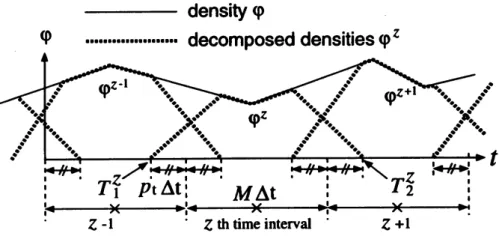
shall call the time interval$((z-1)M\Delta t, zM\Delta t](z=1,2, \ldots)$the zthtimeinterval. Notice thatthistime interval is includedin$(T_{1}^{z},T_{2}^{z}]$
as one can see
in Fig. 2.$\mathrm{d}\mathrm{e}\mathrm{n}\mathrm{s}\dot{|}\mathrm{t}y\varphi$
Fig. 2Decomposition of adensity$\varphi$to$\varphi^{z}$
3.2
Discretisation of
integrals
on
the
unit
sphere
In the numerical analysis the integral
on
the unit sphere $s_{k}$ in (17) hasto be evaluated with acertain numericalintegration. Itisobviously
necessary
toselectan
appropriateset of$k\mathrm{s}$as
theintegration points. Areasonablechoiceis obtained
as one
considers theprocess
ofcomputingtheoutgoingandincomingrays.
We rememberthat the densities$u^{z}(t)$ and$t^{z}(t)$
are
band-limitedto$\omega f$,so
thatthe wavenumber of the densitiesisestimatedtobe$\omega_{f}/c$atthe largest, where$c$isthe velocity of the relevant
wave.
Therefore theoutgoingrays
fromsources
distributed in thesource
sphere$S_{s}$,which has radius of$R$,will berepresentedbysphericalharmonicsof theorderof
$K= \frac{2R\omega_{f}\chi_{2}’}{c_{T}}$
.
(25)$(\mathrm{c}\mathrm{f}c\iota >c_{T})$
.
Theintegralon
theRHS of(19)is
now
approximatedas
$\int_{S}$
.
$(T_{\dot{|}\mathrm{j}}(x,y,t)*u_{j}^{z}(y,t)-\Gamma_{\dot{|}j}(x-y,t)*t_{\mathrm{j}}^{z}(y,t))dS_{y}$$\simeq$ $- \frac{1}{8\pi^{2}}\sum_{p=0}^{K}\sum_{q=-K}^{K}w_{pq}[(k_{pq})_{i}\delta(t-(x-\mathit{0})\cdot k_{pq}/c_{L})*\mathcal{T}(\mathit{0}-s, t, k_{pq};c_{L})*\mathcal{O}^{z}(s, t, k_{pq})$
$+e_{jik}(k_{pq})_{j}\delta(t-(x-0)\cdot k_{pq}/c_{T})*\mathcal{T}(\mathit{0}-s, t, k_{pq};c_{T})*\mathcal{O}_{k}^{z}(s, t, k_{pq})]$
$=$ $- \frac{1}{8\pi^{2}}\sum_{p=0}^{K}\sum_{q=-K}^{K}w_{pq}[(k_{pq})_{i}\delta(t-(x-\mathit{0})\cdot k_{pq}/c_{L})*\mathrm{I}^{z}(\mathit{0}, t, k_{pq})$
$+ejik(k_{pq})_{j}\delta(t-(x-0)\cdot k_{pq}/c_{T})*\mathrm{I}_{k}^{z}(s, t, k_{pq})]$
(26)
(27)
where$k_{pq}$,$w_{pq}$,$\theta_{p}$and$\phi_{q}$$(p=0, \ldots, K, q=-K, \ldots, K)$
are
defined by$k_{pq}$ $=$ $\sin\theta_{p}\cos\phi_{q}i_{1}+\sin\theta_{p}\sin\phi_{q}:_{2}+\cos\theta_{p}:_{3}$, (28a)
$w_{pq}$ $=$ $\frac{4\pi\sin^{2}\theta_{p}}{(2K+1)[(K+1)P_{K}(\cos\theta_{p})]^{2}}$, (28b)
$\theta_{p}$ $=$ $(p+1)$throotofequation$P_{K+1}(\cos\theta)=0$, (28c)
$\phi_{q}$ $=$ $\frac{2\pi q}{2K+1}$ $(28\mathrm{d})$
intermsof the orthonormal base vectors :for thecartesiancoordinateaxis.
3.3
Description of the algorithm
To solve the BIEgiven by(3),
we
havetoevaluate elastic potentials with known densities. In fast algorithms of themulti-level FMM tyPeto evaluate thesepotentials atapoint $x$,
we
split the boundary intotwo parts: i.e. the part$s_{f}^{(l)}(xx)$whichisfarfrom$xx$and$S_{n}^{(\mathrm{t})}(x)=S$$\backslash S_{f}^{(l)}(x)$ whichisclose to$x$
.
Thecontributionstothepotentialsfrom$S_{f}^{(\mathrm{t})}(x)$iscomputed with the help of the plane
wave
expansion,while the evaluation of the contributions from$S_{n}^{(l)}(x)$ispassedto$l+1\mathrm{t}\mathrm{h}$level. At the deepest level(largest$l$),
we
compute the contributions from$S_{n}^{(l)}(x)$directlyusingtheconventional methods.
Todescribe this algorithm
more
precisely,we
havetodefine whatwe mean
by the words ‘far’ and ‘level’. We firstdiscretise the boundary integral equation(3)using boundary elements having$N_{s}$ spatial degrees of freedom and$N_{t}$
timeintervals of the length At. Fordefiniteness,
we
assume
theboundary elementstobepiecewiseconstantandthetimebasefunctionstobepiecewiselinear,although theseassumptions
are
notessential.Wenextconstructthe$\mathrm{o}\mathrm{c}\mathrm{t}$-treestructureof boundary elementsin the following
manner.
Wefirst take acube whichincludesthe domain$D$
.
Thiscube is called the cell of the level0. This cube is subdivided into 8equalsub-cubes,of which thosecontainingboundary elements
are
called cells of the level 1. Werepeatthissubdivision until the cellcontains less than afixed number(denotedby$N_{cell}$)ofboundary elements. Acell without childreniscalledaleaf,
andthe level number of the deepest cell is denoted by$l_{\max}$
.
We
say
twocells$C$and$C’$of the level$l$tobe close if$|C_{\dot{l}}-C’.\cdot|<(\beta+1)L^{(l)}$ $i=1,2$, 3 (29)
holds,where$c_{\dot{l}}$ and$C_{\dot{1}}’$
are
the coordinatesof the centroids of$C$and $C’$,$\beta$isanatural number and$L^{(l)}$ istheedgelength of the level$l$cell. With thisdefinition, theset$S_{n}^{(l)}(x)$ isdefinedto be theunionof level$l$cells $C’$which is
closeto$C$if$x\in C$
.
The cells$C’$of the level$l$whichare
notclose to$C$are
saidtobefar from$C$.
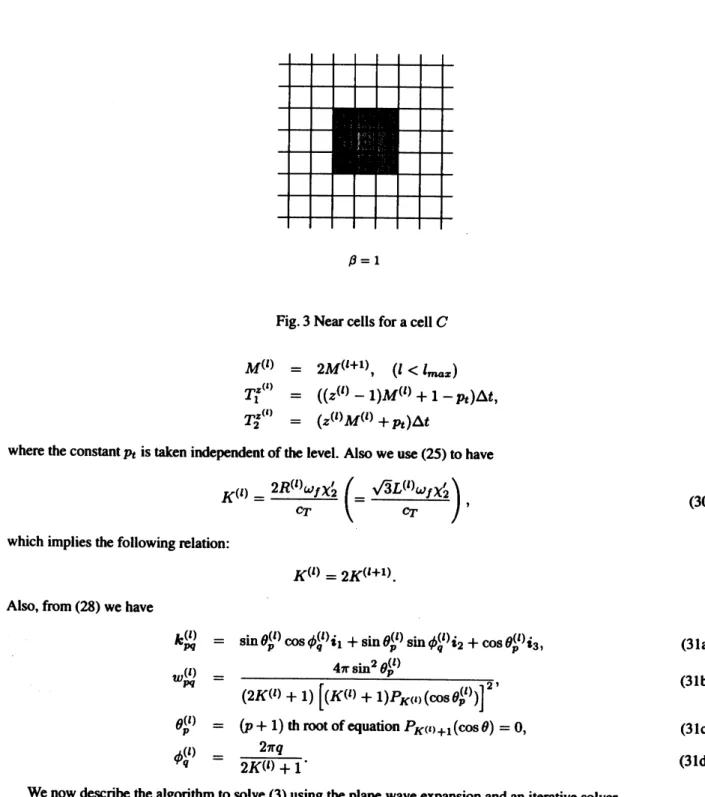
In Fig.3we
haveindicated cells closetothe cell$C$when$\beta$isequalto 1. In therestof this
paper
we
shallassume
that$\beta=1$.
In the evaluation of elastic potentialsatapoint$x$ in alevel$l$cell$C$,
we
shalluse
theplanewave
expansionwhenwe
computetheeffects from boundary elements includedinalevel$l$cell $C’$whichisfar from$C$.
Thecontributionsfromfar cells
are
evaluatedin the form of theincoming raysassociated with$C$.
To compute contributions from cells far from$C$,
we
havetodetermine,foreach level 1, numbers$R^{(\mathrm{t})}$,$R_{\mathrm{c}}^{(l)}$,$T_{1}^{z^{(1)}}$,$T_{2}^{z^{(1)}}$and$M^{(l)}$ whichsatisfy(14)and(24),where the superposed (/) indicates that the associatedquantityisfor level
$l$cells. Itisconsidered naturalto set
$R^{(l)}= \frac{\sqrt{3}L^{(l)}}{2}$, $R_{c}^{(l)}=2L^{(l)}$,
except in (14), whose LHS
can
be put equal to $\beta L^{(l)}(=L^{(l)})$, since it is sufficient to set the LHSof(14)as
theminimumdistance between$S_{o}$and$S_{s}$
.
Accordingly,one
puts$M^{(l)}$,$T_{1}^{z^{(l)}}$ and$T_{2}^{z^{(\mathrm{t})}}$tobe
$M^{(l_{\max})}$ $=$ $\frac{L^{(\mathrm{t}_{\max})}}{c_{L}\Delta t}-2p_{t}+1$,
$\beta=1$
Fig. 3Nearcells for acell$C$
$M^{(\mathrm{t})}$ $=$ $2M^{(l+1)}$, $(l<l_{\max})$ $T_{1}^{z^{(\downarrow)}}$ $=$ $((z^{(l)}-1)M^{(l)}+1-p_{t})\Delta t$, $T_{2}^{z^{(I)}}$ $=$ $(z^{(l)}M^{(l)}+p_{\mathrm{C}})\Delta t$
where the constant$pt$ istakenindependent of the level. Also
we
use
(25)tohave$K^{(l)}= \frac{2R^{(l)}\omega_{f}\chi_{2}’}{c_{T}}(=\frac{\sqrt{3}L^{(l)}\omega_{f}\chi_{2}’}{c_{T}})$ , (30)
whichimpliesthefollowingrelation:
$K^{(l)}=2K^{(l+1)}$
.
Also,from(28)
we
have$k_{\mathrm{p}q}^{(l)}$ $=$ $\sin\theta_{p}^{(\mathrm{t})}\omega \mathrm{s}\phi^{(l)}q:1+\sin\theta_{\mathrm{P}}^{(l)}\sin\phi_{q}^{(l)}:_{2}+\cos\theta_{p}^{(l)}:_{3}$, (31a)
$w_{\mathrm{N}}^{(l)}$ $=$
$\frac{4\pi\sin^{2}\theta_{p}^{(l)}}{(2K^{(l)}+1)[(K^{(l)}+1)P_{K\mathrm{t}}\mathrm{t})(\cos\theta_{p}^{(l)})]^{2}}$, (31b)
$\theta_{p}^{(l)}$ $=$ $(p+1)$throotofequation
$P_{K^{(2)}}\dagger 1(\cos\theta)=0$, (31c)
$\phi_{q}^{(l)}$ $=$ $\frac{2\pi q}{2K^{(l)}+1}$
.
$(31\mathrm{d})$
We
now
describethe algorithmtosolve(3)usingthe planewave
expansionandan
iterative
solver.1. Initial
guess
Let thecurrenttime be$t_{\alpha}=\alpha\Delta t$ $(\alpha=1, 2, \ldots, N_{t})$ andall theboundary displacementsandtractions inthe
past,i.e.$u(\cdot,t_{\alpha’})$ and$t(\cdot,t_{\alpha’})$for$t_{\alpha’}(\alpha’=1, \ldots,\alpha-1)$,
are
known.We then provide initial
guesses
tothe unknown parts of$u(\cdot,t_{\alpha})$ and$t(\cdot$,$t_{\alpha})$arbitrarily. Givingthe values forthe
same
quantitiesat$t_{\alpha-1}$ wouldbe areasonable choice.2. Evaluationof potentials dueto
sources on
$S\mathrm{x}(0, t_{\alpha}]$As the densityfunctions
on
$S\mathrm{x}(0,t_{\alpha}]$are
given,the potentialsin(3)for each collocationpoint$x$dueto
sources
on
$S\mathrm{x}(0,t_{\alpha}]$are
dividedintocontributions from thenear
part$S_{||}^{(l)}(x)\mathrm{x}(0,t_{\alpha}]$ andfarpart$S_{f}^{(l)}(x)\mathrm{x}(0,t_{\alpha}]$.
$2\mathrm{a}$
.
Conhibutions
from the
near
part$S_{n}^{(\mathrm{t})}(x)\mathrm{x}(0,t_{\alpha}]$For each cell(denotedby$C$) of the level$l(l\geq 2)$,
use
the conventional directintegrationto computecontri-butions to the elastic potentialsatthe collocationpoints $(x, t_{\alpha})(x\in C)$from densities $u(\cdot, t_{\alpha’})$ and$\mathrm{t}$($-$,ta)
$(\alpha’=1, \ldots, \alpha)$distributedin
a
neighbouring cell$C’$of the level$l$(including$C$itself)if either$C$
or
$C’$isaleaf$2\mathrm{b}$
.
Contributionsfrom the farpart$S_{f}^{(\mathrm{t})}(x)\mathrm{x}(0, t_{\alpha}]$
Let$l$be the level of the leaf containing
$x$
.
We notethefollowing: for alevel $l$cell,the time$t_{\alpha}$belongstothe$z_{\alpha}^{(l)}\mathrm{t}\mathrm{h}$
timeinterval, where $z_{\alpha}^{(l)}=\lfloor\alpha/M^{(l)}\rfloor$ and $\lfloor\cdot\rfloor$ stands for the ‘floor’operation. At$t_{\alpha}$ theoutgoing
rays
$\mathrm{o}^{z^{(l)}}$
(intherestof this
paper we
shalluse
acollectivenotation$0^{z^{(l)}}$for ($\mathcal{O}^{z^{(\mathrm{t})}}$
,$\mathcal{O}_{i}^{z^{(l)}}$)) and theincoming
rays
$\mathrm{I}^{z^{(1)}}$
correspondingto$z^{(l)}=1,2$,$\ldots$,
$z_{\alpha}^{(\mathrm{t})}-1$
are
all known(seetheprocedure in$4\mathrm{b}$below). Theincoming rays
$\mathrm{I}^{z^{(l)}}$
determine the layer potentials duetodensities$u^{z^{(l)}}$
and$t^{z^{(l)}}$ distributedin
$S_{f}^{(l)}(x)\mathrm{x}(T_{1}^{z^{(l)}}, T_{2}^{z^{(l)}}]$via(27),
which
we
have had already computed instep$4\mathrm{b}$.
Namely, atthecollocationpoint $(x, t_{\alpha})$ thelayer potentialsdue to densities$\sum_{z^{(l)}=1}^{z_{\alpha}^{(l)}-1}u^{z^{(\mathrm{t})}}$ and$\sum_{z^{(l)}=1}^{z_{\alpha}^{(l)}-1}t^{z^{(l)}}$
on
$S_{*}\mathrm{x}(0, T_{2}^{z_{\alpha}^{(l)}-1}]$ have been computed and stored. Onejustrecalls the values thus stored. We note that thepotentialsdue todensities distributed
on
$S_{f}^{(\mathrm{t})}(x)\mathrm{x}(T_{2}^{z_{\alpha}^{(l)}-1},t_{\alpha}]$will not reach collocationpoints$(x,t_{\alpha})$ before$t=T_{2}^{z_{\alpha}^{(l)}}$,
and do nothave to be takeninto consideration. We
have thus evaluated potentials due to densitiesin$S_{f}^{(l)}(x)\mathrm{x}(0, t_{\alpha}]$
.
3. Determination of thecurrentunknowns
We update the unknownsat$t=t_{\alpha}$following the procedures oftheiterative solver used and returnto step 1
if the discretised version of the BIE in(3)isnotsatisfied to within
an
allowableerror.
Otherwise the assumedvalues for the unknownsat$t=t_{\alpha}$
are
adoptedas
thesolution at ta. If$\alpha<N_{t}$we
go
tostep4. Otherwisewe
terminatetheanalysis.
4. Computation ofoutgoing raysandincoming rays
Compute theoutgoingandincoming
rays
for$z_{\alpha}^{(l)}$in the following
manner:
$4\mathrm{a}$
.
Computataionof theoutgoingrays
(upward)Startingfrom leaves
up
tolevel 2cellswe
computetheoutgoingrays
$\mathit{0}^{z_{\alpha}^{(l)}}$atthecentroid of the cellforthe
$z_{\alpha}^{(l)}\mathrm{t}\mathrm{h}$
time intervalif andonly ifthe currenttime stepnumber$\alpha$ is amultiple of$M^{(l)}$. To compute
$\mathit{0}^{z_{\alpha}^{(l)}}$
we
use
thedefinition in(16)if$C$is aleaf. For non-leaf cellswe
add theoutgoingraysof the child cells$\mathit{0}^{z_{\alpha}^{(\mathrm{t}+1)}-1}$and $\mathit{0}^{z_{\alpha}^{(1+1)}}$
after shifting thecentresof the expansion from those of the children $(s’)$to that of$C(s)$
.
Sinceuppercellsrequire
more
directions(k) than the lowerones
because of(30),we
have toincrease the numberof directions
as we go up
thetree structureof cells. Tocopewiththisrequirementwe use an
operation called‘interpolation’.See[5]for the detail.
$4\mathrm{b}$
.
Computation oftheincomingrays
(downward)Starting from level 2cells
we
computetheincoming raysfor thecurrent$(z_{\alpha}^{(\iota)}\mathrm{t}\mathrm{h})$time intervalatthecentroids of
level$l$cells if and only if the
currenttimestepnumber$\alpha$is amultiple of$M^{(l)}$,
as
instep$4\mathrm{a}$.
Inthisprocess we
define theincoming raysassociated with alevel$l$cell$C$tobe the
sum
of theincoming raysfrom all the level$l$cells(denotedcollectively by$C’$)which
are
notcloseto$C$.
Such$C’\mathrm{s}$consistof level$l$cellswhichare
notcloseto$C$but whoseparents
are
closetothe parent of$C$(interaction list)andthose whose parentsare
notclosetotheparentof$C$
.
The contributionsto$\mathrm{I}^{z_{\alpha}^{(l)}}$from the former(cellsin theinteractionlist of$C$)
are
evaluatedvia(18),butinthefrequencydomainusingasmoothed$\mathcal{T}$(See [5]). On the otherhand,thecontributions ffom the latter
$C’\mathrm{s}$
are
obtainedas
one
shifts the incoming raysof the parent of$C(\mathrm{I}^{z_{\alpha}^{(l-1)}})$ from the centroid of the parent$(\mathit{0}’)$tothat of$C(0)$. Notice that the number of directions$k$ required for$C$ is lessthanthatpossessed by the
parent. Therefore
one
has to ‘anterpolate’ theincoming raysin the downward path of the algorithm[5]. When$C$isaleaf,
one
uses
theincoming raysfor$C$thusobtained$(\mathrm{I}^{z_{\alpha}^{(l)}})$and(27)tocomputethe elastic potentials for
$t>T_{2}^{z_{\alpha}^{(\mathrm{t})}}$
dueto$u$and$t$inthepastdistributedin far cells. Thecomputation iscarriedoutinthe ‘castforward’
manner
withrespect to time,and stored. The results will be recalledin step$2\mathrm{b}$later.5. Update
Update$\alpha$by$\alpha+1$and
go
to step 1..4
Complexity
of
the algorithm
$t\mathrm{e}$consideraseriesof problemswithincreasingdomainsizesolved with the
same
accuracy
(i.e.the number ofnodes
$\underline{\sim}\mathrm{r}$
wave
lengthremainsconstant). Ergin etal. [5] estimated that the complexity of their PWTD algorithm for theave
equationin$3\mathrm{D}$appliedtotheseriesof problems of thistyPeis$O(N_{s}\log^{2}N_{s}N_{t})$.
Usingthesame
argumentas
1Erginetal.,
one
shows that the complexity of thepartof thepresentalgorithm using the planewave
expansionisidentical with that ofErginet al.Onealsoshows that the directcomputationpart of theelastodynamic algorithmscales
as
$O(N_{s}N_{t})$inspiteof thetime integrationincludedinthepotential representationof the solution. Thisisbecause theelastodynamic fundamental solution in $3\mathrm{D}$ vanishes after the time required for$\mathrm{S}$
waves
generatedatthe collocationpoint$x$to
sweep
outthe part of the boundary where the contributiontothepotentialsat$x$isevaluated directly. Onetherefore concludes that the overallcomplexityof theproposed approach is$O(N_{s}\log^{2}N_{s}N_{t})$ if
one
followscloselythe approachproposedbyErginetal.
Erginetal., however,
assumes
that theyuse
fast method of evaluating the Legendre transform[6]in theinterpola-tionandanterpolationtoestablish theircomplexity estimate. Since
our
implementationuses
thestandard(sometimescalled.semi-fast algori thm[6]for this
purpose,
however,our
algorithmcannotbe faster than$O(N_{s}^{3/2}N_{t})$.
Inprob-lemsof thesize considered in this
paper,
itmay
notbeobvious if theuse
of ’fast’ methods for the Legendre transformactuallyimprovestheperformance ofthealgorithm
or
not.4Numerical analysis
4.1
Details
of the
present implementation
Inthe following examples
we use
GMRES withoutpreconditioningas
the iterativesolver to obtain the solution ofdiscretisedversionof(3)in both fast and conventional BIEM. As the initial
guess,
we
use zero
for the first time step,and the solutions at theprevioustimestep for the rest of analysis
Ashas beenseen,
our
implementationrequiresthe following parameters: $N_{ce}\iota\iota$:maximumnumber of boundaryelements in aleaf cell(see3.3),$n$:parameters relatedtothe interpolation functions with respecttotime(see(22)),$\chi 1$
:
over
samplingrate,At: time increment whichisrelatedtothemaximum frequencyof the fieldquantities$\omega_{\max}$ by$\omega_{\max}=\pi/(\chi_{1}\Delta t)$and$\chi_{2}’$:aparameter relatedtothe number of directions$k$(see(25)).The following choices of the
parameters
are
used in theexamplesgivenbelow: $\chi_{1}=3.0$,$\chi_{2}’=0.2$and$p_{t}=3$.
This choice for$\chi_{1}$means
thatone
uses
6timenodesper
theshortest of theexpected periods.Also,we
have usedan
appropriate non-dimensionalisationto set$cL=1$,$c\tau$ $=1/\sqrt{2}$and$\rho=1$
.
Thismeans
that the Poisson’sration is equalto0.
In thecomputation
we
haveused Fujitsu$\mathrm{V}\mathrm{P}\mathrm{P}800/63$ with$7\mathrm{G}\mathrm{B}$of the mainmemory.Thecodeisnotparallelised.4.2
Numerical example
(32)
Weconsider
as
thedomain$D$ parallelepiped having the lineconnecting(0,0,0)and$(X,\mathrm{Y}, Z)$as
thespace
diagonal.Inthe initial boundary value problemconsidered,theinitialdisplacement and velocity
are
assumed to vanish. As theboundary condition
we
prescribethetraction computedfiom thefollowingfield:$u(x,t)=d[1$ -Cos$\frac{2\pi}{\Lambda}(t-\frac{d\cdot x}{c_{L}})]$ ,
where$d$isaunitvectorand thefunctionCos is definedby
$\mathrm{C}\mathrm{o}\mathrm{s}x=\{$
$\infty \mathrm{s}x$ $0\leq x\leq 2\pi$
1 $x<0$, $x>2\pi$ (33)
Thefunction$u$obviously represents aplane$\mathrm{P}$
wave
propagatinginto the direction$d$.
The solutiontothe problemunderconsiderationisobviously$u$itself. Weset$d=(0, 0, 1)$,$\mathrm{A}=0.5$,$Z=0.80$and$N_{t}=2\alpha$].For the parameters
$X$and$\mathrm{Y}$
we
consider the 10cases
listed in Table1. This table also shows$N_{s}$.
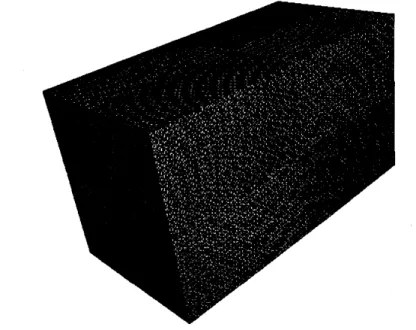
See Fig.4(thisfigure shows thecase
10 inTable1)for
an
example of the boundarydiscretisation. Other parametersare
setas
$\Delta t=0.\mathrm{O}1$and$N_{ceu}=150$.
Thedepth of the$\mathrm{o}\mathrm{c}\mathrm{t}$-tree$l_{\max}$is equal to2in
case
2,3incases
2-9, and4incase
10.We note that the choice$\chi_{2}’=0.2$yields that the number$K^{(2)}$ tobe24 in
cases
1-9and56
incase
10.Thenumberof directionsinlevel 2cellsisthengiven by $(K^{(2)}+1)(2K^{(2)}+1)$
.
Table 1 $X,\mathrm{Y}$,$Z$and$N_{t}$
Fig. 4Boundary element discretisation used incase10(78,480 DOF)
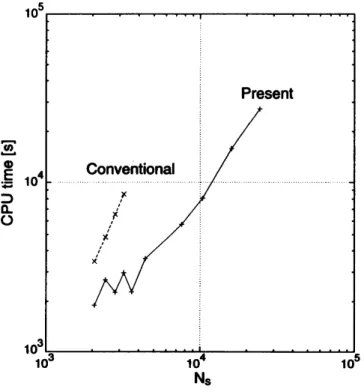
Fig.5showsthe CPUtime(sec)
vs
the number of unknowns $N_{s}$.
Thisfigure shows that the present method iscapableofcarryingoutelastodynamic analysisin timedomain
more
efficientlythan the conventional methodinall theexamples considered. The fluctuation of theCPUtimeforsmall$N_{s}$
seems
tobedue to the condition of the computer,whichisshared bymanyusers.
Because of therestriction of the memoryit
was
not possibleto solvecases
5-10 with the conventional BIEM.IfCPUtime isnotimportant, however,
one
mayuse
the conventional method in larger problems by not storingallthe integration results, but by recalculating them when needed. In thisway
we
could solve all thecases
with theconventional approachusing adesktopcomputer(Alpha21264 (600[MHz]), $2[\mathrm{G}\mathrm{B}]$ofmemory),and could
compare
the results of the proposed and conventional approaches in all
cases.
Itwas
found that the maximumerror
of theboundary displacements(relativetothemaximum boundary displacement$(=2)$)
was
about3% in both proposed andconventional methods.
Wefinally remark that the following url includes animations of other examples solved with the proposed method.
http:$//\mathrm{g}\mathrm{e}\mathrm{e}\mathrm{h}\mathrm{o}\mathrm{s}\mathrm{t}$.gee
.
$\mathrm{k}\mathrm{y}\mathrm{o}\mathrm{t}\mathrm{o}-\mathrm{u}.\mathrm{a}\mathrm{c}$.
$\mathrm{i}\mathrm{p}/\sim \mathrm{t}\mathrm{t}\mathrm{a}\mathrm{k}\mathrm{a}/\mathrm{e}\mathrm{a}\mathrm{b}\mathrm{e}$ .html5Conclusion
Inthis
paper we
could successfully extend the PWTD algorithm proposed for thewave
equationbyErginetal. [5]toelastodynamicsin$3\mathrm{D}$
.
We could also show the effectiveness of the proposedapproach insimpletestproblems of thespatialsize of$O(10^{4})$
.
Since the method isstill inits incipientstage of developments
we
still needtorefine the codeso
thatitcan
beappliedtolarger problems found in engineeringapplications. However, thefundamentals of the approach
are now
established and the numerical results
seem
tobepromising.References
[1] Kobayashi Setal..Wave Analysis and Boundary Element Methods. KyotoUniversityPress;2000(in Japanese).
[2] Nishimura N. Fastmultipoleacceleratedboundary integralequationmethods.acceptedforpublicationin Applied
MechanicsReviews2002.
[3] TakahashiT,NishimuraN,Kobayashi S. Fast boundary integralequationmethod for elastodynamicproblemsin
2Din timedomain. Trans JSME$2\propto 11j\mathrm{A}67- 661:14\{\mathrm{D}-16$(in Japanese).
$\overline{\underline{\infty}}$
$.\vee\underline{\Phi\in}$
$\mathrm{o}\mathrm{L}\supset$
Fig. 5Comparisonof computationaltime
[4] Lu M,WangJ, ErginAA,Michielssen E. Fastevaluation of
tw0-dimensional transient
wave
fields. J ComputPhys2000;
158:161-85.
[5] ErginAA,ShankerB,Michielssen E. Fast analysis oftransient acoustic
wave
scatteringfrom rigid bodiesusingthe multilevel plane
wave
time domain algorithm. J Acoust Soc Am$2\propto \mathrm{K}1;107:1$168-78.[6] ChienRJ,Alpert BK. Afast spherical filter with uniform resolution. JComputPhys 1997;136:580-4