Guinea : myth and reality of Japanese
expansion in the South Seas
著者
IWAMOTO Hiromitsu
journal or
publication title
南太平洋研究=South Pacific Study
volume
15
number
1
page range
25-47
Nanshin and Japanese migrants in Papua and New Guinea:
myth and reality of Japanese expansion in the South Seas
i)
Hiromitsu Iwamoto
Abstract
Not many studies have been done on Japanese emigration to Nanyo (the South Seas) in relation to
nanshin (southward advance) or nanshin-ron (southward advance theory). Among the few studies are
Hayase's study on emigration to the Philippines, Hara's study on emigration to British Malaya and Goto's on emigration from Okinawa (Hayase, 1989; Hara, 1986; Goto,1993). However, their analyses tend to place less emphasis on the effects of western perceptions of Japanese migrants. As Nanyo (Micronesia, Melanesia, Australia and Southeast Asia) was mostly western colonies, the presence of Japanese migrants there needs to be analysed not only by their relation to Japan's nationalist ideology but also by their interaction with that of western counterparts. This paper draws this point to attention through the analysis on Japanese emigration to Papua and New Guinea in the pre-Pacific War period in the context of two contending nationalist perceptions — Japan's nanshin-ron and Australia's 'White Australia Policy'.
Key words: Nanshin, Japanese migrants, Papua and New Guinea, myth, reality.
Introduction
Memory of the Pacific War is so intense that it can easily overshadow the prewar presence of the small number of Japanese migrants. They did not play an influential role in the South Seas history. However, Japan and Australia perceived them in terms
of their national interests and created myths to serve those interests. Hence, the mig
rants did play a passive role. The result after the war was that they lost everything — their homes and families. It is easy to conclude that it is merely another tragedy of the war. However, their tragedy was deeply rooted in the prewar policies of the two na tions — Japan's hasty aggressive nanshin from the late 1930s and Australia's 'White Australia Policy' from the mid-1890s. Through these policies, Japan and Australia cre ated images of the migrants in a mythical world where they never actually lived. Therefore, the clarification of origins and effects of the myths is essential to under standing how the migrants were tossed about on the cruel sea of national interests. In an attempt to clarify these myths, in this paper, firstly I shall briefly give an empirical
1) Division of Pacific and Asian History, Research School of Pacific and Asian Studies, The Austra lian National University, Canberra, ACT 0200, Australia.
account of Japanese migration to Papua and New Guinea. Second, I examine the Japanese interest in the South Seas in order to grasp the position of the migration to Papua and New Guinea in the context of overall Japanese involvement. Third, I focus on the ideas underlying the national policies of Japan and Australia — nanshin-ron and 'White Australia Policy', in order to analyse the process of mystification. Last, I analyse the linkage between the myths and the reality of the migrants.
1. Japanese migration to Papua and New Guinea
History
Japanese migration to Papua and New Guinea began around the turn of the 19th century. It was an offshoot from the settlement of Japanese shell collectors {saikai
gyo-sha)^ on Thursday Island where they were squeezed out by the Australian res
triction on migration and by the exhaustion of shell beds. The migration was also a re sult of a series of searches for new beds and a place to settle by an adventurous Japanese skipper, Isokichi Komine. He was born in Shimabara in Nagasaki in 1866 and after worked in Korea for a trade company he went to Thursday Island to be a diver in 1890.(2) In the same period, Japanese migration to Queensland and other South
Pacific Islands was proceeding. Japanese labourers were systematically sent to the sugar cane plantations and mines in Queensland (1892-97), Fiji (1894-95), New Cale donia (1892-1920), Ocean Island (1905-09) and Makatea Island (1910) through Japanese immigration companies (Ishikawa, 1970). At the same time, Japanese trad ers were actively operating in German Micronesia. Among those Japanese, migrants to Papua and New Guinea show a sharp contrast. They were not labourers for European entrepreneurs like those in Queensland and other South Pacific Islands. Nor were they like traders who were scattered on the islands in Micronesia. The Japanese in Papua and New Guinea had their own independent business interests in trading, fishing and copra plantation, although the scale of their business operations was small.From 1890 to 1894, Komine explored the waters of New Guinea in a schooner for shell fishing and searched for a new shell fishing ground (Komine, 1896). In November 1894 he made a second voyage with Ken'nosuke Tsuji, an agent of the Yoshisa Im migration Company on Thursday Island. Tsuji was also a member of the Shokumin Kyokai (the Colonisation Society) which Takeaki Enomoto established in 1893 to promote Japan's economic development in the South Seas by trade and emigration. Probably Komine and Tsuji stayed somewhere in German New Guinea for a while, as two Japanese were recorded by the German administration in 1894 (Annual Report, 1885). After this voyage, Tsuji showed a strong interest in New Guinea as a possible emigration destination and he approached the British New Guinea administration. In December 1895, he managed a half day talk with Lientenant-Governor Sir William MacGregor of British New Guinea over the possibility of leasing land to Japanese set tlers, but with no success (Tsuji, 1895). Nevertheless, the move to acquire land in
British New Guinea was pushed by Gonzaemon Ogirima, an agent of the Kosei Im
migration Company.(3) In 1900, Ogirima had a talk with Governor Le Hunt and re
quested the admission of Japanese migrants. He also met a general manager of Burns Philp Co. to inquire about the possibility of sending Japanese under the contract be tween Burns Philp and the Kosei Immigration Company. However, his attempt alsofailed.(4)
In addition to the refusal of Japanese migration to British New Guinea, the Queens land government's refusal of Komine's application for naturalisation in 1898 drove him to German New Guinea (Sissons, 1972). According to Komine, he reached Rabaul in
New Britain in October 1901 to accidentally meet Governor Hahl who was under siege
of locals, and Komine saved Hahl's life.(5) Hahl also noted the encounter in his diary,
although no reference about the siege, that the problem of lack of vessels to perform administrative tasks had been solved by Komine's offer of his boat for chartering (Sack and Clark, 1980). Thus relationship developed based on mutual benefits —Komine's search for a place to settle down and Hahl's need of a vessel. As a result,
Komine was able to acquire a 1,000 hectare lease in Manus Island and began operat
ing a copra plantation in 1910.(6) In the same year he set up a ship building yard in
Manus. In 1911, he expanded his ship building business to Rabaul with great success. In 1912 he established the Nan'yo Kogyo Kaisha (The South Seas Industry Company)after he gained further concessions from the administration — a 500 hectare lease,
fishing and collecting marine products, and the Company's discretion of bringing in
Japanese employees.(7) The company's headquarters were at Kobe in Japan and it im
ported materials for ship building and sundries from Japan and exported shells and
copra from New Guinea (Kamuo, 1941).
The expansion of Komine's business contributed to the increase of Japanese popula
tion to 109 in 1914 and created a fleeting golden period until the outbreak of World
War I.(8) The Japanese community at Rabaul was even accompanied by a Japanese
brothel — a barometer of Japanese economic prosperity in Nan'yo (Kawasaki and Maruba, 1913; Yano, 1975). Meanwhile, limited Japanese migration to British New Guinea proceeded despite the administration's reluctance. In 1905, 7 Japanese settled
in (The Commonwealth of Australia, 1906).
After the outbreak of World War I, immigration policy and trade restriction by the Australian military administration effectively blocked the expansion of Japanese influ
ence. The Japanese population declined to 87 in 1921. Furthermore, after the estab lishment of the Australian civil administration in May 1921 continued the ordinances that had been legislated during the military period (The Commonwealth of Australia,
1922), the Japanese in New Guinea shrank to 36 in 1939.(9) At the outbreak of the Pacific War Japanese residents were all arrested and interned in Australia just before the landing of Japanese troops. The internees were never allowed to return to Papua
and New Guinea on security grounds.(10) Thus the Japanese community was totally
Background of the migrants
Most migrants came from rural areas of south-west Japan. As Table 1 shows, the distribution of birth places of migrants shows a concentration in Kumamoto (23.2 per cent), followed by Nagasaki (22.6 percent) and Wakayama (13.9 percent). Both Kumamoto and Nagasaki are in Kyushu, and together with migrants from other pre fectures of Kyushu (Saga 5.2 percent, Fukuoka 4.6 percent, Kagoshima 2.9 percent), the proportion from Kyushu amounts to 58.6 percent. Of those prefectures, Kumamo to, Nagasaki, Wakayama and Fukuoka are among the top ten out of the total 47 pre fectures in the number of emigrants; the top ten prefectures occupy 71.3 percent of
Table 1. Birth places of migrants
birth places (prefectures) number of migrants percentage
Kumamoto 40 23.2 Nagasaki 39 22.6 Wakayama 24 13.9 Saga 9 5.2 Kanagawa 9 5.2 Hiroshima 9 5.2 Fukuoka 8 4.6 Osaka 6 3.4 Kagoshima 5 2.9 Tokyo 5 2.9 Chiba 3 1.7 Okayama 3 1.7 Other 12 6.9 Total 172 100.0
Source: Kaigai ryo ken kafu hyo The record of issuing passport for overseas travel], Japanese Diplomatic Record (JDR), 3.8.5.8. (for 1901-25) and Gaikoku ryo ken kafu hyo [The list of overseas passport issues], J2.2.0.J13-7 (for 1926-40)
Table 2. The number and percentage of Japanese emigrants* by top ten
prefectures, 1899-1941prefectures number percentage (%)
Hiroshima 179,514 16.6 Kumamoto 116,211 10.7 Okinawa 108,762 10.1 Fukuoka 87,802 8.1 Yamaguchi 83,073 7.7 Wakayama 53,487 4.9 Fukushima 41,002 3.8 Okayama 36,320 3.3 Nagasaki 33,420 3.1 Ni'igata 27,752 2.5 others 309,433 28.7 Total 1,076,776 100.0
*Excludes emigrants to fomer colonies (Manchuria, Korea, Taiwan and Micronesia) Source: data from Kokusai Kyoryoku Jigyo-dan (1991)
the total emigrants (Table 2).
Close observation shows most migrants were from coastal areas (Amakusa in Kuma moto, Shimabara in Nagasaki, southern Wakayama, Miura peninsula in
Kanagawa).(11) Shimabara and Amakusa are also well-known for karayuki-san (the
Japanese overseas prostitutes). The common economic and demographic conditions from the late 19th century to the early 20th century of those coastal areas were the low productivity of agriculture and rapid population increase and major economic acti vities were half-farming and half-fishing. Historians agree that these conditions stimu lated overseas migration (Kitano, 1985a; Wakayama-ken, 1957; Hane, 1982).
However, local historians also stress other factors. In the case of emigration from
Amakusa, Hamana attributes the motivation to "Amakusa's proximity to Nagasaki,
one of the few international ports of Japan for hundreds of years, that made Amakusa people feel overseas countries were close" (Hamana, 1981). Kitano, having acknowledged the same cause, suggests that their characteristically strong affection towards
parents partly affected by their Catholic belief caused Amakusa youths to emigrate toreduce their parents' economic burdens (Kitano, 1985a; 1985b). In the case of emigra
tion from southern coastal Wakayama, Iwasaki also concluded that "the cause foroverseas emigration cannot be found in the poverty of local economy but in factors
such as stimulation by neighbours [who made a fortune overseas] and tradition" (Iwa
saki, 1938).
Those explanations make sense in each case and are to some extent common to all
the localities of birth places of emigrants to Papua and New Guinea. However, what
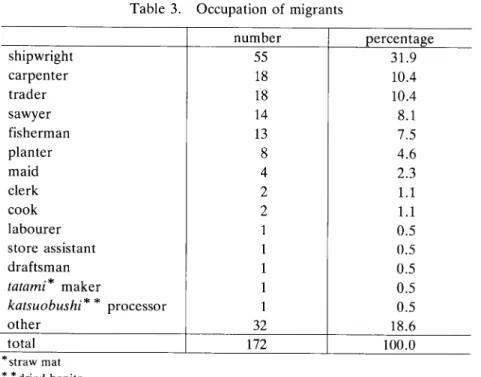
characterises the emigrants is that they are maritime people. This is clearly indicated
Table 3. Occupation of migrants
number percentage shipwright 55 31.9 carpenter 18 10.4 trader 18 10.4 sawyer 14 8.1 fisherman 13 7.5 planter 8 4.6 maid 4 2.3 clerk 2 1.1 cook 2 1.1 labourer 0.5 store assistant 0.5 draftsman 0.5 tatami* maker 0.5 katsuobushi processor 0.5 other 32 18.6 total 172 100.0 straw mat * * dried bonito
by their occupational background; 50.3 per cent were occupied by maritime occupa
tions — shipwrights (31.9 per cent), traders (10.4 per cent), fishermen (7.5 per cent)
and katsuo-bushi processors (0.5 per cent) (Table 3). Goto suggests the relation be tween maritime nature and emigration, exemplifying the nature of maritime race
(kaiyo minzoku sei) of Okinawans (Goto, 1993). Okinawans were one of the largest
emigrant group in Japan (Table 2). This outward-looking maritime nature was prob ably another important cause for the emigration.
2. Japanese interest in the South Seas
Policy toward the South Seas
Japan had no policies towards the South Seas before the early 20th century, while Britain, France, Germany, and the United States (US) were busy competing for terri tories. That was not only because the groups of remote, small islands were of no direct importance to Japan, but also because Japan had more important issues with its East Asian neighbours. To fend off Russian expansion and to secure markets, sources of raw materials and cheap labour in East Asia in order to catch up with western powers were Japan's most urgent tasks (e.g. Irie, 1966). Although Japan began to be involved in the South Seas after the outbreak of World War I, that was a windfall rather than the result of systematic empire-building. The primary motivation for entry into the war was to entrench its interests in China; occupation and subsequent colonisation of Mic ronesia was a concurrent boon. This low profile was illustrated well by the contrasting attitudes of the government; Japan was determined to persist in the so-called Twenty-one Demands to China whereas it could compromise over the Yap issue with the US. Although thereafter Japan consolidated colonial rule in Micronesia, this was no way as salient as East Asia where Japan exerted maximum political, economic, military influ ence. Benefits derived from the South Seas were far less than those from East Asia. Japan's major concern in the South Seas was strategic — maintenance of naval super iority over the US, that Japan achieved through the Washington Naval Treaty of 1922 and the London Naval Treaty of 1930 (Hosoya, 1988).
However, in the 1930s, the 'Washington System' disintegrated when protectionism became an international trend due to the prolonged effects of the Great Depression and when the Japan-US conflict over China was deadlocked. As a result, when fascism in Germany and Italy challenged the international order in Europe, the Middle East and Africa, so did the Japanese militarism in the Asia-Pacific. The army invaded Man churia, and at the same time the domination of the 'Fleet Faction' in the navy led Japan to violate those naval treaties. It was at this time that the South Seas emerged on the national policy agenda. Characteristically, the rise of militarism determined the course of expansion into the South Seas. The government announced the integration of nanshin into the national policy of 1936, influenced by the navy's establishment of the Tai-nan'yo hosaku kenkyu iin-kai (the Committee to study policies toward the
South Seas) of 1935. In the late 1930s the army also began to support nanshin, stimu lated by the lightning German victory in Europe. Then the Konoe cabinet of July 1940 "decisively" adopted a nanshin policy (Yano, 1979). The government officially in
cluded the South Seas in the 'Greater East Asia Co-prosperity Sphere' in September.
Hence, the policy towards the South Seas was executed as an invasion, as Japan launched an attack on Pearl Harbour in December 1941. However, Japan's aggressive nan
shin policy vanished quickly with its defeat in 1945.Trade
Despite the lack of national policy, trade relations developed rapidly. As Table 4
shows, the value of Japanese trade with the South Seas rapidly increased in the
pre-Pacific War period, although its proportion of Japan's total trade remained small. Thedramatic increase took place after the outbreak of World War I, as the lack of Euro
pean goods due to the war created a vacuum for Japanese goods. Thereafter the prop
ortion of the South Seas trade expanded steadily from 10.2 percent in 1920 to 14.5percent in 1937 (Table 5).
Table 4. Japanese trade with the South Seas from 1868 to 1937 (million yen)
Micronesia Southeast Asia* Australia* *
export import export import export import
1880 - - n . a . n . a . 0.1 0.03 1900 - - 1.63 10.9 2.5 2.4 1913 - - 23.4 80.9 8.6 14.9 1916 0.06 0.03 51.1 43.2 30.8 53.9 1920 0.03 0.09 184.8 125.9 67.7 62.4 1930 0.06 0.2 133.0 130.4 28.6 94.6 1937 0.3 1.2 382.6 325.4 91.3 213.8
n.a. no data available
The countries of Southeast Asia varied by year due to the availability of statistics: 1900: French Indochina, Thailand, the Philippines, and Dutch East Indies
1913, 1916, 1920: British Malaya, Dutch East Indies, French Indochina, the Philippines and Thailand 1930, 1937: British Malaya & Borneo, Dutch East Indies, French Indochina, the Philippines and Thai
land
Includes New Zealand from 1916
Source: data from Tokei-in (1882; 1914; 1918), Kokusei-in (1921), Naikaku Tokei Kyoku (1931; 1938)
Table 5.
Percentage of the South Seas trade* (export & import) in total Japanese
trade, 1868 to 1937 percentage 1900 3.5 1913 9.3 1916 9.5 1920 10.2 1930 12.8 1937 14.5
Emigration
Like trade, none of emigration to the South Seas was assisted by the government. Most emigrants were recruited and sent by private emigration companies. The number of emigrants in the South Seas including Southeast Asia in 1936 was 96,951 or 8 per cent of the total (Ishikawa, 1972). The main destination in the South Seas was the mandated territory of Micronesia, but the number going there was a trickle compared to Manchuria, Brazil and North America. The small scale is partly attributable to the lack of governmental support, which shows a sharp contrast to emigration to Brazil and Manchuria where the government provided generous subsidies. In addition, Mic ronesia had a limited capacity to absorb migrants due to the limited land and econo mic activities; in Southeast Asia generally, there was little demand for a Japanese work force because of the availability of abundant cheap labourers; in Melanesia, the failures of early emigrations to Fiji and New Caledonia were discouraging; and Austra lia restricted Asian migration.
Nanshin-ron
The evolution of nanshin-ron was closely associated with the development of nation
al policy. Nanshin-ron was never mainstream ideology until the late 1930s. Japan had been preoccupied with the East Asian affairs that accompanied mainstream ideology — Asianism — supported by the army's continental policy. As a result, nanshin-ron based on the navy's maritime policy had been overshadowed. The low profile of nanshin-ron was clearly reflected in the number of Nan'yo-reXdXtd publications. According to the bibliography by the Nihon Takushoku Kyokai (the Japan Colonisa
tion Society), as shown in Table 6, the number was only 7 before 1909 but increased
to a stunning 865 in 1940-42. The publications from 1930 alone occupy 88.8 percent of
the total. This enormous flow of publications makes nanshin-ron overlap with expan sionist ideology.
However, the nature of nanshin-ron shows stark contrast between the Meiji period
(1868-1912) and the prewar Showa period (1926-1945). It changed corresponding to
Table 6. The number of publications (books and journal articles) of yVWyo-related literature, 1868-1942
no. of publication percentage (%)
1868-1909 7 0.4 1910-1919 61 4.2 1920-1929 99 6.8 1930-1939 405 28.1 1940-1942 865 60.1 total 1437 100.0
Note: the publications include only those classified under the title 'the General South Sphere' and do not include those under specified titles such as 'Hainan,' The Philippines,' and 'Dutch East Indies.' Source: data from Nihon Takushoku Kyokai (1944)
the changes of Japan's position in international relations. The advocates of the Meiji period emphasised peaceful economic expansion through free trade (e.g. Enomoto, 1893; Shiga, 1880; Suzuki, 1893), reflecting Japan's primary aim to remove unequal treaties imposed by the western powers. The Taisho period (1912-1926) was transition al, reflecting the entrenchment of Japan as a colonial power. As territorial expansion became possible through the occupation of German Micronesia, more expansionist tone emerged (e.g. Inoue, 1914). Consequently, the conflict between nanshin and
hokushin (northward advance) — the ideological conflict between the navy and the
army — disappeared (Shimizu, 1987) because nanshin was incorporated as a part of Japan's overall expansionism. At the same time the geographical notion of the South Seas was extended to Southeast Asia. In the Showa period, the emergence of the navy's aggressive 'Fleet Faction' and the joining of the army in nanshin stimulated by German victory in Europe (Yano, 1979) led to the integration of nanshin-ron in the 'Greater East Asia Co-prosperity Sphere.'
3. Nanshin-ron and Japanese migrants in Papua and New Guinea Even in the emergence of the Showa nanshin-ron, Papua and New Guinea occupied a very marginal position, as nanshin-ron advocates were interested mainly in Southeast Asia where products (e.g. oil, rubber, rice) important to the war effort were abun dant. The marginality was manifested in the number of publications. Nanpo bunken mokuroku [the Bibliography of the South Seas Literature] of 1944 listed only six books and journal articles on Papua and New Guinea, in a remarkable contrast to hundreds on other areas like French Indochina, British Malaya, Dutch East Indies, and so on (Nihon Takushoku Kyokai, 1944). Corresponding to the overall rise of nanshin-ron, the publications are concentrated in the 1930s and 1940s.
Mystification
Despite the fact that up to the 1930s nobody paid attention to the Japanese in Papua and New Guinea, nanshin-ron advocates from the late 1930s suddenly began to highlight them, to justify Japanese expansion to the South Seas. Thus the myth was born. The Japanese in Papua and New Guinea were all passionate patriots who emi grated there with a national mission to demonstrate the excellence of the Japanese race and to prepare the way for the expansion of the Empire. The migrants were abruptly co-opted into empire building.
A typical example is Ono's Toa kyoei ken to nyu ginia [the East Asia Co-prosperity Sphere and New Guinea] of 1942 (Ono, 1942). Ono described Komine as a patriotic and brave pioneer, introducing tales about how he saved the German official from the local people's attack and how he captured a German ship with his bravery and wisdom
at the outbreak of World War I.
Kami-jo's Sensen ichi-man kairi: zen taisen ji nanyo no rekishi [The ten thousand-mile war front: the history of the South Seas during World War I] of 1941 (Kamijo, 1941). Kamijo devoted one chapter to introducing Komine with a long title — 'Showa no
Yamada Nagamasa, Nihon-to o sasagete tanshin doku-kan o ikedoru: Nanyo no kaitaku-sha Komine Isokich? [Nagamasa Yamada of the Showa period, captured a
German ship alone with a Japanese sword: a pioneer of the South Seas, Isokichi Komine]. Yamada is a popular legendary figure who was believed to have served the Ayutaya dynasty as a military commander in the 17th century. Comparing Komine to Yamada, Kamijo detailed the capture of the ship in a dramatic touch to exalt Komine to national hero. The same story was repeated in Nagakura's Goshu oyobi minami
taiheiyo [Australia and the South Pacific] in 1943.
Even a mixed-race Japanese was turned to myth. Okada, a special correspondent of the Asahi newspaper, wrote a chapter on Wakao Yamashita, a son of a Japanese father and a local mother, and made him a super hero in Nyu ginia kessen ki [Bloody battle in New Guinea] (Okada, 1943). Okada wrote that Wakao paddled from Manus to Rabaul, leading five hundred canoes to assist the Japanese forces when they landed.
4. 'Yellow Peril' and Japanese migrants in Papua and New Guinea
Well before the migrants became heroes in Japan, Australians formed quite diffe
rent views on their presence in Papua and New Guinea. Particularly Canberra(12) de
veloped a negative view along with the emergence of the 'Yellow Peril' and 'White Australia Policy'. It nervously perceived the threat from the north, especially from Japan, as security was a prime concern for a newborn white nation far away from its mother country. The Immigration Restriction Act of 1901, the assertion of the Class C
Mandate over former German territories in the South Pacific and the denial of the
Japanese proposal for racial equality at the Paris Peace Conference of 1919, the re placement of the Anglo-Japanese Alliance with the Washington Treaties of 1921 and the appeasement policy in the 1930s were all manifestations of Canberra's struggles to cope with the fear of Japan's expansionism (Hudson, 1967; 1970). Interestingly, Can berra's fear mirrored Showa nanshin-ron in that they both developed views of migrants serving national policies. Canberra's view also makes a sharp contrast to the attitudes
of the German and Australian administrations at Rabaul.
German attitudes
The German administration showed few symptoms of the 'Yellow Peril' syndrome. On the contrary, the administration granted European status to the Japanese and accepted the migrants as far as they were employees with a responsible employer. It
also granted a series of commercial concessions in the early 1910s.(13) However, in a
real life, the Germans did not treat the Japanese as full-fledged Europeans; the Japanese lived like non-Europeans in a Chinese residential area and their court cases
were heard in a court room separate from the European one (Threlfall, 1988). Nevertheless, the Japanese population increased and exceeded that in Micronesia by
1914.
The attitude of the administration in New Guinea also showed contrast to that in Micronesia where there was "an episodic struggle of prohibitions and confiscations by local German colonial authorities and evasions by Japanese traders" (Peattie, 1988). The leniency of the New Guinea administration can be explained by two reasons. The Japanese established a good relationship with the Germans, as shown in the Komine's relationship with Governor Hahl. Second, the Japanese presence hardly constituted a menace to German interests. About a hundred Japanese were much fewer than the Chinese, and their business activities were much smaller than those of their Japanese counterparts in Micronesia.
Canberra's fear
In sharp contrast, abrasive 'Yellow Peril' erupted in Australia constituted one of the causes for the Japanese migration to Papua and New Guinea. Although the 'Yellow Peril' had originally referred to Chinese migration in the mid-19th century, it was ex tended to the Japanese after the Sino-Japanese War (1894-5) and intensified after the Russo-Japanese War (1904-5). Combined with the outright racism based on social Dar winism (Yarwood and Knowling, 1982), the Japanese also met fierce opposition from the rising unionists. As a result, the Queensland government restricted migration from Japan, particularly to Thursday Island, where the industrious Japanese dominated the pearl industry and threatened the interests of their Australian counterparts. Moreover, Australia's traditional mentality of "lonely white outpost" (Yarwood and Knowling, 1982) facilitated the enforcement of the Immigration Restriction Act of 1901. Conse quently, this 'White Australia Policy' to restrict Asian migration and other laws to res trict Japanese shell-fishing in the northern Queensland waters drove some Japanese to German New Guinea.(14)
Canberra's paranoid anxiety was even directed towards the Japanese in German New Guinea. Canberra was monitoring Japanese commercial activities, suspecting any
linkage to Japan's southward expansion.^ ' Although Japan was an ally of Britain by
the Anglo-Japanese Alliance, this did not affect Australia's general suspicion of Japan as a possible future invader (Hornadge, 1971). As a result, after military occupation of New Guinea during World War I, Canberra enforced policies to restrict migration and trade between New Guinea and Japan. The enforcement of those polices had, as Radi points out, two implications: to make a buffer against possible Japanese invasion and to channel profits from Japanese commerce to Australia in order to monopolise all economic benefits (Radi, 1971).The 'Yellow Peril' came true when the Pacific War broke out in December 1941.
Canberra's fear, inflated with hatred, underlay the course of wartime and postwar policies. It decided to eliminate the Japanese from Papua and New Guinea entirely. Before the Japanese landing at Rabaul on 23 January in 1942, Canberra ordered the
Rabaul administration to arrest all Japanese and ship them to Australia for intern ment. As most Japanese were married to local women and had children, the intern ment separated them from their families. After the war, Canberra deported them to Japan despite their plea to return to New Guinea to rejoin their families, as Canberra regarded their prewar presence as part of Japan's systematic southward expansion:
Japanese who were in the islands pre-war, can only be regarded as having been part of the Japanese system of infiltration and espionage related to their so-called 'southward expansion movement'....The South West Pacific area is a vital strategic region in which unremitting vigilance is a constant requisite. Clearly, no Japanese should again be allowed anywhere within such strategic zone Upon all material counts the re-entrance of any Japanese would be of ill-effect and it is strongly advised that none be allowed to proceed to any of the areas referred to.(16)
The deportation was executed despite the reports by internment camp officers that
indicated no security risk.(17) Canberra's paranoia was so serious that it even refused
the entrance of Australian ex-servicemen who tried to bring their Japanese wives tothe territory.(18) Thus, at the height of fear and hatred after the war, Canberra com
pleted the myth that the Japanese migrants were pawns of nanshin.
Rabaul's view
It is natural to think that the fear of the Japanese by the Australian administration at Rabaul would have been much deeper than that of Canberra, for it was actually fac ing those suspected as part of systematic infiltration, and it was physically neighbour ing to the Japanese colony in Micronesia. However, the actual policies, relationships and opinions in local newspaper do not reveal direct hostility. Contrarily, the adminis tration showed leniency, and in some cases more than the former German administra tion. Of course, it is valid to argue that such leniency was possible after Canberra cas trated Japanese influence through tight migration and trade restrictions. However, a series of policies adopted by the administration suggest that the administration took at
least a neutral attitude.
As in the German period, such relationships were partly attributable to Komine's personal endeavours. Because of his assistance to Australian military action in captur ing a German ship, the Komet, during World War I, the administration granted him the title of captain (Jackson, 1914) and the privilege that he did not need to take off
his hat in front of Australian officers except an administrator.(19) Furthermore, the
first administrator, Holmes, made Komine's ship-building yard available to repair cap tured German ships; the second administrator, Pethebridge, arranged for the import of trade goods from Japan to counter the monopoly of Burns Philp and decided not to legislate against Japanese migration (Rowley, 1958). Pethebridge even provided finan cial assistance to Komine's business that was badly affected by the war. Indeed, it was the Australian administration, not the Japanese government, that helped Komine,when he asked both for financial assistance.(20) Furthermore, in 1917, Komine re
his company.(21)
However, the leniency of the Australian administration did not last long, as Canber ra intervened in response to Japan's exclusive control of Micronesia. In 1917, G. Pearce, Minister for Defence, formulated a migration policy that the number of mig rants should not exceed the level of September 1914 (Rowley, 1958). Also, from April 1918 shipment in Japanese vessels from New Guinea to Japan was refused as a
response to restrictions placed on Australian trade in Micronesia.(22)
At a personal level Komine enjoyed respect from the white population. For exam ple, Komine's second petition in 1929 to the Japanese government for financial assist ance contained references from Administrator Wisdom, the Catholic Missionary Socie
ty, the Methodist Church, and the Anglican Bishop.(23) His funeral in 1934 was
attended by Acting-Administrator Wanliss, and other officials.(24) Opinions in The
Rabaul Times also indicate that the white population generally had little hostilityagainst the Japanese, although they had been suspicious about the development in
Micronesia.(25) Surprisingly, no criticisms were made against the local Japanese in rela
tion to the Japanese invasion in China or the colonisation in Micronesia, whereas out
right racist opinions were frequently expressed against the local Chinese.(26) In fact,
the newspaper reported the funeral of Komine with expressions such as "one of the oldest and best-known identities in the Territory" and "whole community extends its
sympathy".(27) The empathy was shown even after the outbreak of World War II in
Europe in October 1939. When the Japanese trade company, the Nan'yo Boeki (the South Seas Trade Co.), showed a picture on touring Japan at the Regent Theatre, "a crowded house fully appreciated the interesting portrayal of Japanese social and in dustrial life".(28) Thus, there was a clear distinction between Canberra and Rabaul in viewing the migrants. Canberra feared them as part of an expanding nation, but Rabaul got along with them as individuals. In other words, the administration was able to differentiate the Japanese in New Guinea from the 'Japs' whom Canberra abjured.5. Reality of Japanese migrants in Papua and New Guinea
Linkage to the Japanese government
The Japanese in Papua and New Guinea had little linkage with their government. Unlike their counterparts in Micronesia after World War I, they received no gov ernmental assistance or government-backed investment. The lack of interest was illus trated well in that the government never assisted Komine's business in spite of his
petitions of 1916(29) and 1930.(30) Similarly, in stark contrast to the migration issue in
Queensland, the Japanese government did not protest when the Australian govern ment enforced restrictive migration and trade policies in New Guinea. Two reasons can explain the disinterest. The first is economic. Papua and New Guinea were unim portant; their negligible trade with Japan was too small even to appear on thestatistics.(31) The second is political. Japan was prudent not to make any unnecessary
dispute with Australia that "was determined to retain these territories [New Guinea and the Bismarck Archipelago] upon the conclusion of the war ... to prevent further Japanese southward expansion in the Pacific" (Peattie, 1988). Japan's major concern was to secure German Micronesia without provoking interference from Australia. Similarly, the migrants had no linkage with large capitalists. The most successful businessman, Komine, attempted to gain financial backers in Japan but failed because of the outbreak of World War I.(32)
Linkage to nanshin-ron
The emigration had a discontinuous linkage with nanshin-ron, beginning with
Eno-moto's unrealised plan of 1877 to colonise New Guinea.(33) Hattori also made a speci
fic reference to the emigration in 1894 (Hattori 1894). However, nobody followed them until the myth of patriot Komine was created at the height of the Showa nanshinfever from the late 1930s.
However, the image cannot be totally denied because Komine actually had linkages with the nanshin-ron circle. He was a member of Enomoto's Colonisation Society, although close observation does not reveal him as a full-fledged nanshin-ron activist. In 1896 Komine wrote an article about his voyages to the waters in British, German and Dutch New Guinea in the journal of the Colonisation Society (Komine 1896), in which he simply reported his voyages and the conditions of shell fishing. He made no
nanshin-ron-\ike statements such as Japan's need to expand its economic or territorial
influence in New Guinea expressed by earlier nanshin-ron protagonists such as Sasaki
(Sasaki, 1881) and Yoko.(34) Two more facts indicate Komine's weak linkage to the
nanshin-ron circle. Firstly, the Colonisation Society became inactive in 1902 and seems to have dissolved, and six years later Enomoto passed away. As a result, by the time Komine established himself as a businessman in the early 1910s, he could not possibly have reinforced his connection with nanshin-ron advocates. Second, he does not seem to have joined the South Seas Society (Nan'yo Kyokai) which was established by newnanshin-ron advocates in 1915.
Nevertheless, Komine made his first nanshin-ron-\ike statements in his petition let ters for financial assistance to the Japanese consul general at Sydney of 1916 and 1930 when his business was severely hit by the post-World War I recession and the Great Depression of 1929. In the first petition he mentioned his contribution to developing Japan's trade and emigration to New Guinea and to developing Japan's influence in
German New Guinea by establishing a good relationship with Hahl.(35) In the second
he wrote "I began operating this business not only for the purpose of seeking a profit but also for the purpose of laying a foundation for the Empire's future
development".(36) However, as it is obvious that Komine made those statements to
gain assistance, it is questionable whether he was a passionate nanshin-ron advocate. As for other emigrants in New Guinea, the possibility of their interaction with
nanshin-ron is even lower. By the time sizeable emigration began in 1912, the Nan'yo
employees on two to three year contracts, which would have made it difficult to de velop a special attachment to New Guinea as an extended territory of Japan or a sense of being part of a national mission. In addition, as nanshin-ron was a Tokyo-based ideology limited to intellectuals, it is doubtful that most migrants from the poor rural south-west Japan were exposed to it. Thus the linkage to nanshin-ron seems to have developed where actual emigrants were not directly involved.
Linkage to the Japanese occupation during the Pacific War
It is more difficult to validate Canberra's connection of the migrants with Japanese
military operations. First, the migrants had already been interned in Australia before Japanese troops landed in New Guinea makes improbable Canberra's allegation that
they were spies.(37) If the migrants had been acting as spies, they could have known
about the outbreak of the war and could have avoided internment. But all migrants were arrested without resistance in December 1941. Indeed, the testimony of an inter nee from Rabaul, saying that he and other Japanese just hoped for Japanese troops to rescue them from the jail, indicates they had little knowledge of the military
operation.(38)
Secondly, apart from about ten Japanese internees, most Japanese left New Guinea
in the late 1930s sensing the likelihood of the war.(39) Despite that, those who deter
mined to stay and consequently were interned were either long-time residents (20 to 40 years) with entrenched business interests or those who had married local women and had children. That suggests that their determinations seem to have been motivated by their business interests and loyalty to their families rather than by desire to assist the military operation.Third is the Rabaul Military Tribunal hearing of Tsunesuke Tashiro, an ex-Rabaul resident who worked for the Minsei-bu (the civil administration department) of the Japanese navy at Rabaul as a navy civilian during the war. Tashiro was a long-time re sident at Rabaul. He was the eldest son of Otomatsu Tashiro who came to Rabaul to
trade before 1916. In 1916, Otomatsu brought his wife and his son, Tsunesuke.(40) La
ter Tsunesuke began to work as an agent of the Nan'yo Boeki. He had gone back to Japan just before the war but returned during the war to work as an interpreter. At the Rabaul trial, he was first found guilty of beating a New Guinean to death andsentenced to be imprisoned for ten years/41} Tashiro lodged a petition and white mis
sionaries also wrote letters to defend him that he had acted to protect the missionaries and other local people who were put in camps by the Japanese force during the war.(42) The defence claimed Tashiro's alibi that he was not on the scene when the death happened and that the allegation against him had been made by a local who worked for a European trade company which had been a rival of Tashiro's. However, the petition was dismissed, although his sentence was mitigated to five years. Local elders also talk about Tashiro's good reputation in the prewar period that he was always on the side of locals (especially the Chinese) and helped them during the war.(43)
Although there is no doubt that he was very useful to the Japanese force since he wasfamiliar with local topography and language, it is doubtful that he was assisting the military voluntarily.
Relations with other races
The oral history suggests that locals, the Chinese and some Australians in Papua and New Guinea perceived the migrants with little fear and suspicion. Generally the Japanese kept good relations with other races, although the nature of their relations differed according to race and location. There were two distinct groups in the Japanese population. One mainly consisted of Komine's employees such as boat-buil ders, mechanics and clerks who stayed at Rabaul temporarily. The other consisted of fishermen, traders and plantation managers who were scattered around the Bismarck Archipelago and Milne Bay and settled down almost permanently.
According to Threlfall, the former group did not mingle with the white population except for the formal appearance of Komine and his wife at the administration's func tions (Threlfall, 1988). Probably only a limited number of whites had chances to meet the Japanese. Among them was an Australian trader who made very good friends with some Japanese, and his friendship with the descendants of the migrants is
still continuing.(44) An ex-Rabaul Japanese shipwright also remembers that he got
along with Australian shipwrights.(45) Moreover, the testimony of an interned Japanese
shipwright, saying "I can get a job at any time from Burns Philp or Carpenters [bothAustralian firms]" upon his return to New Guinea(46\ indicates that at least a non-hos
tile relation existed. Similarly, the Japanese kept good relations with the Chinese, as a prominent ex-Rabaul Chinese businessman recalls, "Japanese people were very friend ly with the Chinese, especially Mr Taichi Nagahama [a successor of Komine], who had close business connection with the Chinese".(47) Some other Chinese and Indonesianresidents at Rabaul also recall friendly relationships.(48)
In contrast, the latter group developed relations more with the indigenous popula tion than with the white and Chinese. The Japanese outside Rabaul had daily contact more with the indigenous population as they employed them as plantation labourers and as crew on their ships, and there were fewer non-indigenous populations around. More importantly, the group consisted of quite a few Japanese who married local women. Probably due to development of these kinship relations, the oral history from mixed-race descendants and local elders emphasised the development of a cordial re
lationship and made few negative comments.(49) The informants uniformly described
the Japanese as kind, generous and fair. The only exception was the tale of an elder on Lou Island in Manus, who worked for a Japanese skipper with other islanders. The Japanese treated locals so badly, often with violence, and the elder (then a young man) ran away, but he was caught by an Australian kiap (district officer) and returned to the Japanese again. The kiap warned him that he would be taken to court if he ranaway again.(50) It is hard to judge whether the tale was a special case or common to
other Japanese, but it is important because it can verify that a master-servant relation was entrenched and maintained with the help of the Australian district officer. TheJapanese were, like Germans and Australians, mastas. Therefore, apart from intermar riages, it can be argued that the Japanese developed 'good' relationships within this
hierarchical framework.
Conclusion
Japanese Nanshin-ron advocates and Australian officials in Canberra perceived the migrants as part of an expanding empire. As a result, both developed perceptions in a
mythical world where the migrants never lived. The reality was that most migrants left Japan to alleviate their poverty at home and they were hardly a menace to the Austra
lians in Papua and New Guineas economically or militarily. However, stuck in this
myth, the migrants were obliged to play dual antagonistic roles. Their presence gave
moral support to Japanese expansionism through Showa nanshin-ron, and it was
wrongly connected with the Japanese invasion during the Pacific War and provided Canberra with grounds to eliminate them. It is ironic that the migrants made good friends with locals, the Chinese, Australians and Germans. Their only enemy was a
mythical monster called nanshin created by the nations against which powerless indi
viduals had no weapons to fight.
Notes
(1) They are generally known as pearl divers, but they were also engaged in collecting trochus shell and green turban as well as pearl shell.
(2) Interview by the author with Sato, Yachiyo (a daughter of a nephew of Isokichi Komine), 1 July 1993, Nagasaki-shi, Nagasaki, Japan; Komine to Shimizu, 19
May 1916, Japanese Diplomatic Record [JDR] 3.4.6.3, Nan'yo ni okeru hojin
kigyo kankei zakken [Miscellaneous matters concerning Japanese enterprises in the South Seas], vol.1
(3) Ogirima to Foreign Minister Aoki, 11 May 1900, Iijima to Sugimura, 4 September 1900, JDR, 3.8.2.67, Kosei imin kaisha gyomu kankei zakken [Miscellaneous mat ters related to operation of the Kosei Emigration Company], Vol.2
(4) Iijima to Aoki, 5 March 1901, JDR 6.1.5.6-32, Kakkoku chuzai teikoku ryoji
nin-men zakken taunzubiru no bu [Miscellaneous matters on appointnin-ment of consuls posting in various countries, section of Townsville]
(5) Komine to Shimizu, 19 May 1916, JDR 3.4.6.3 (6) Ibid.
(7) Concessions of the German administration with Japanese translation, 18 May 1913, JDR 3.5.2.201, Nan'yo sanbutsu chosa ikken [Report of the investigation on South Seas products]
naigai-jin no koguchi chosa zakken dai-yon-kan [Miscellaneous matters on the survey of
overseas Japanese households, Vol.4]
(9) Central Administration at Rabaul to Prime Minister's Department, 20 January
1939, Australian Archives [AA], A816/1-19/304/188, Japanese interests on Papua
New Guinea
(10) Assistant Secretary, External Territory, 29 September 1947, AA A373/1-11505/48,
Japanese Internees
(11) Kaigai ryo ken kafu hyo [The record of issuing passport for overseas travel], JDR
3.8.5.8. (for 1901-25) and Gaikoku ryo ken kafu hyo [The list of overseas passportissues], J2.2.0.J13-7 (for 1926-40)
(12) Although the Parliament of the Commonwealth of Australia was in Melbourne
until 1927, the author uses Canberra to represent Australia's view to contrast the
view of the administration at Rabaul.
(13) Concessions of the German administration with Japanese translation, 18 May
1913, JDR 3.5.2.201, Nan'yo sanbutsu chosa ikken [Report of the investigation onSouth Seas products]
(14) Memorandum from the Governor-General to the Prime Minister, 10 July 1913;
Prime Minister to the Secretary of the Defence Department, 22 July 1913; Sub-district naval officer at Thursday Island to the Naval Secretary, 27 July 1913, AAMP1049/1, Japanese enterprises in South Seas
(15) Sub-district naval officer at Thursday Island to the Naval Secretary of Navy
Office, 17 November 1913, Memorandum from the Governor-General to the
Prime Minister, 10 July 1913, Prime Minister to the Secretary of the Defence De
partment, 22 July 1913, Sub-district naval officer at Thursday Island to the Naval
Secretary, 27 July 1913, Sub-district naval officer at Thursday Island to the Naval Secretary, 10 September 1913, Report by Conningham Greene, 8 July 1913, AA
MP1049/1, Japanese enterprises in South Seas
(16) Japanese Internees Ex-islands, Director-General of Security, 5 September 1947,
AA A472-W32123
(17) Case No.65, AA 367 C72537, Ikesaki Tokuyoshi; Case No.66, AA A367 C72546
Kikuchi Ichisuke; Case No. 68, A A A367 C72533, Asanuma Ichimatsu; Case No. 69, A A A367 C72534, Hagiwara, Hikota; Case No. 90, AA A367 C72539, Endo Shigetaro
(18) Papua and New Guinea entry of Japanese wives of Australian ex-servicemen, De partment of Territories, 23 September 1955, AA A518 -FD822/1, Immigration
policy. Entry of Japanese wives of ex-servicemen into Papua New Guinea
(19) Interview by the author with Sato
(20) Komine to Shimizu, 19 May 1916, JDR 3.4.6.3
(21) Komine shokai baishu shimatsu, 1917, JDR3.5.12.12, Nan'yo dokuryo shoto ni
okeru tsusho narabi sangyo kankei zakken [Miscellaneous matters concerning commerce and industry in German territories in the South Seas]
League of Nations, Geneva, November 1920, No.VII, AA A5954-1203/2, New
Guinea and White Australia Policy: papers prepared for first assembly of League
of Nations - 1920
(23) Wisdom, 14 July 1930; Catholic Missionary Society, 22 July 1930; Methodist Church, 23 July 1930; F. Bishop Anglican Chaplain, 25 July 1930; JDR E2.2.1.3-1, Honpo kaisha kankei zakken nan'yo sangyo kabushiki kaisha [Miscellaneous
matters concerning Japanese companies: the South Seas Industry Co. Ltd.] (24) Pacific Island Monthly, November 1934: 16
(25) The Rabaul Times, 22 April 1932, 'The Japs and their mandate', 15 September
1933, 'Japan and her mandate islands: traveller's first hand impressions', Rabaul
(26) The Rabaul Times, 14 March 1930, Editorial, 'unemployment', Rabaul, 5 August
1932, 'The Chinese in Rabaul', Rabaul, 2 June 1933, Correspondence to the edi
tor, 'Chinese and trading', Rabaul, 4 August 1933, Correspondence to the editor, 'Chinese trading', Rabaul
(27) The Rabaul Times, 5 October 1934, 'Death of a pioneer: Captain I. Komine',
Rabaul
(28) The Rabaul Times, 20 October 1939, 'Local and general', Rabaul (29) Komine to Shimizu, 24 October 1916, JDR 3.4.6.3
(30) Inoue to Shinohara, 30 October 1930, JDR E2.2.1.3-1
(31) Tokei-in 1882, 1914, 1918, Kokusei-in 1921, Naikaku tokei kyoku 1931, 1938
(32) Komine to Shimizu, 19 May 1916, JDR 3.4.6.3
(33)Enomoto Takeaki Monjo [Enomoto Takeaki archives] 6-13 shi, 1877, "Yamauchi
Teiun ate Enomoto Takeaki shokan" [A letter from Enomoto Takeaki to Yamauchi Teiun], National Diet Library, Tokyo
(34) Asano Shimbun, 23 November 1887, uYoko Tosaku nan'yo tanken kara kikou" (Tosaku Yoko. Return from exploration of the South Seas), Asano shimbun-sha,
Tokyo
(35) Komine to Shimizu 19 May 1916, JDR 3.4.6.3 (36) Komine to Inoue 12 August 1930, JDR E2.2.1.3-1
(37) Japanese Internees Ex-islands, Director-General of Security, 5 September 1947,
AA A472-W32123
(38) Interview by the author with Otosaku Hatamoto (a shipwright at Rabaul from 1939 to 1941), 3 July 1993, Minami-matsu'ura-gun, Nagasaki, Japan
(39) Interview by the author with Phillip Tabuchi (a mixed-race son of ex-Rabaul resi dent, Yoshimatsu Tabuchi), 4 February 1994, Kavieng, New Ireland, Papua New
Guinea (PNG)
(40) October to December 1916, JDR 3.8.5.8, Kaigai ryo ken kafu hyo [The record of
issuing passport for overseas travel]
(41) Record of Military Court (Japanese War Criminals) of Tsunesuke Tashiro, prom
ulgated 25 January 1948, AA A471/1 81211, War crimes. Proceedings of Military
Tribunal. Tashiro Tsunesuke
War Crime Commission, 24 July 1947; Statement regarding the Japanese Prisoner Tashiro by missionaries at Vunapope, 16 July 1947, AA A471/1 81211, War crimes. Proceedings of Military Tribunal. Tashiro Tsunesuke
(43) Various interviews by the author with elders (mixed-race Japanese, Chinese and
Australians) from January to March 1994, Rabaul, Kavieng, PNG, Brisbane, Au
stralia
(44) Interview by the author with Gordon Ehret (ex Rabaul Australian trader), 22 March 1994, Brisbane, Queensland, Australia
(45) Interview by the author with Otosaku Hatamoto
(46) Interview with Japanese internees at No.4 camp, Taura, Case No. 90, ENDO,
Shigetaro, 23 July 1943, A A A367 C72539
(47) A letter from Bernard Chan to the author, 8 July 1994, Sydney
(48) Interview by the author with Barbara Croydon (a Chinese lady), 24 January 1994, Kai Chew (a Chinese elder), 25 January 1994, Andrew Sigas (an Ambonese), 24
January 1994, Rabaul, East New Britain, PNG
(49) Based on the numerous interviews by the author from December 1993 to March 1994 in Milne Bay, East New Britain, West New Britain, New Ireland, and Manus, PNG
(50) Interview by the author with Korup Kolomat and Poloat Pokomon (elders who
worked for the Japanese captain), 26 February 1994, Lou Island, Manus, PNG
Acknowledgment
I express my gratitude to Professor Donald Denoon, Professor Hank Nelson and Professor Gavan McCormack for useful advice. I am also greatly grateful for coopera tion of informants and their unforgettable hospitality in Japan, Papua New Guinea and
Australia.
References
Annual Report. 1885, 41pp., Rabaul
The Commonwealth of Australia. 1906. British New Guinea Annual Report. 30pp.,
Canberra
1922. Report on Territory of New Guinea. 19pp., Canberra
Enomoto, T. 1893. Enomoto kaicho no enzetsu (Address delivered by the President Enomoto). Shokumin kyokai hokoku, 1: 5-6
Goto, K. 1993. Gyogyo, Nanshin, Okinawa [Fishery, South advancement, Okinawa].
In: Kindai nihon to shokumin-chi 3, shokuminchi-ka to sangyo-ka (Eds. Kobayashi, H. et al), 153-182, Iwanami shoten, Tokyo:
In: Shin kumamoto no rekishi 7: kindai, Vol.2, Kumamoto nichi nichi shimbun sha, Kumamoto: 149-168
Hane, M. 1982. Peasants, Rebels and Outcasts: The Underside of Modern Japan. 208pp., Pantheon Books, New York
Hara, F. 1986. Nihon-tonan ajia kankei-shi II: eiryo Malaya no nihon-jin [History of Japan-Southeast Asia relations II: the Japanese in British Malaya]. Ajia keizai kenkyu-sho, Tokyo
Hattori, T. 1894. Nankyu no shin-shokumin [A new colony in the southern hemis phere]. 47pp., Hakubun-sha, Tokyo
Hayase, S. 1989. 'Bengetto imin' no kyozo to jitsuzo: kindai nihon tonan ajia kankei shi no ichi kosatsu [Image and reality of 'Benget migrants': thought on modern Japan's relations with Southeast Asia]. Dobunkan, Tokyo
Hornadge, B. 1971. The Yellow Peril: A squint at some Australian attitude towards Orientals. Review. 52pp., Publications, Dubbo
Hosoya, C. 1988. Ryo taisen kan no nihon gaiko [Japanese diplomacy between the two wars]. 2pp., Iwanami shoten, Tokyo
Hudson, W. 1967. Problems in Australian history: Towards a Foreign Policy: 1914-1941. Cassell Australia, Melbourne
1970. Australian Diplomacy. Macmillan of Australia, Melbourne Inoue, K. 1914. Nan'yo to nihon [South Seas and Japan]. Taisho sha, Tokyo Irie, A. 1966. Nihon no Gaiko [Japan's foreign policy]. Chuokoron-sha, Tokyo
Ishikawa, T. 1970. Nihon shutsu-imin shi ni okeru imin kaisha to keiyaku imin ni tsuite [Emigration Company and contract emigrants in the history of Japanese emigration]. Ryukyu daigaku ho-bun gaku bu kiyo, shakai 14: 19-46
1972. Tokei yori mita imin-shi [Emigration history in the view from statistics]. Chiri kagaku, 16: 25-31
Iwasaki, K. 1938. Kii hanto nangan ni okeru kaigai dekasegi imin no kenkyu, dai 2 ho
[Study on overseas emigrants from southern coastal areas of Kii peninsula, II].
Chirigakuhyoron, 13(3): 183-200
Jackson J. 1987. Correspondence. In: The Australians at Rabaul (Ed. Mackenzie, S.), 131-136, University of Queensland Press, Brisbane
Kamijo, F. 1941. Sensen ichi man kairi: Zen sekai taisen ji nan'yo no sen-shi [War front in a thousand miles away: war history in the South Seas in the previous war]. 184pp., Nan'yo gunto bunka kyokai, Tokyo
Kawasaki, R. and Maruba, S. 1913. Taiheiyo ho hoko, Doku-ryo nan'yo shoto [The treasury of the Pacific: German South Seas islands], 3pp., Nan'yo doshi-kai, Tokyo
Kitano, N. 1985a. Amakusa kaigai hatten shi [History of overseas development of Amakusa], 1: 311-313, Ashi shobo, Fukuoka
1985b. Amakusa kaigai hatten shi [History of overseas development of Amaku sa], 2: 370-371, Ashi shobo, Fukuoka
Sta-tistics]. 118-123, Tokyo
Kokusei-in (Ed.). 1921. Nihon teikoku tokei nenkan [Statistical yearbook of Japan Empire], 40: 142pp., Tokyo
Komine, I. 1896. Nan'yo tanken jikkyo hokoku [The report on the exploration in the South Seas]. Shokumin kyokai hokoku, 40: 83-87
Naikaku Tokei-kyoku (Ed.). 1931. Nihon teikoku tokei nenkan [Statistical yearbook of Japan Empire], 50: 168pp., Tokyo
1938. Dai Nihon teikoku tokei nenkan [Statistical yearbook of the Greater Japan Empire], 57: 204-209, Tokyo
Nihon Takushoku Kyokai (Ed.). 1944. Zoho nanpo bunken mokuroku [Additional Biography of the South Seas Literature]. 1-60, Daido shoin, Tokyo
Okada, S. 1943. Nyu ginia kessen-ki [Bloody Battle in New Guinea]. 202-230, Asahi shimbun-sha, Tokyo
Ono, Y. 1942. Toa kyoei-ken to nyu ginia [The East Asia Co-prosperity Sphere and New Guinea]. Toe shoin, Tokyo
The Pacific Island Monthly. 22 November 1934, Sydney
Peattie, M. 1988. Nan'yo: The rise and fall of the Japanese in Micronesia 1885-1945. 23-47, University of Hawaii Press, Honolulu
Radi, H. 1971. New Guinea under Mandate 1921-41. In: Hudson, W. (Ed.). Austra lia and Papua New Guinea, Sydney University Press, Sydney: 74-137
Rowley, C. 1958. The Australians in German New Guinea 1914-1921. 84-85, Mel bourne University Press, Melbourne
Sack, P. and Clark, D. (Eds.). 1980. Albert Hahl: Governor in New Guinea. 91-92, Australian National University Press, Canberra
Sasaki, T. 1881. Honpo oyobi nyu ginia no kankei [The relation between Japan and New Guinea]. Tokyo chigaku kyokai hokoku, 2 (8): 401-402
Shiga, S. 1927. Nan'yo jijl [Current Affairs in the South Seas]. In: Shiga Shigetaka zenshu, (Ed. Shiga Shigetaka zenshu kanko kai), 3: 1-111, Tokyo
Shimizu, H. 1987. Nanshin-ron: its turning point in World War I. Developing Econo mies, 25 (4): 386-402
Sissons, D. 1972. Immigration in Australian-Japanese relations. In: Japan and Austra lia in the Seventies, (Ed. Stockwin, J.), 193-210, Angus and Robertson, Sydney Suzuki, T. 1893. Nanto junko ki [Record of a cruise in the southern islands]. Keizai
zasshi sha, Tokyo
Threlfall, N. 1988. From Mangroves to Frangipani: the story of Rabaul and East New Britain. 118-119, Australian National University, Canberra
Tokei-in (Ed.), 1882. Nihon teikoku tokei nenkan [Statistical yearbook of Japan Empire], 1: 295pp., Tokyo
1914. Nihon teikoku tokei nenkan [Statistical yearbook of Japan Empire], 33: 216pp, Tokyo
1918. Nihon teikoku tokei nenkan [Statistical yearbook of Japan Empire], 36: 164pp., Tokyo
Tsuji, K. 1895. Toresu kaikyo tanken nikki [Diary of exploration in Torres Strait]. Shokumin kyokai hokoku, 30: 15-24
Wakayama-ken (Ed.). 1957. Wakayama ken imin shi [History of emigrants from Wakayama prefecture]. 125pp., Wakayama
Yano, T. 1975. 'Nanshin' no keifu [The Genealogy of 'southward advance']. 220pp., Chuokoron-sha, Tokyo
1979, Nihon no Nan'yo shi kan [Japanese historical view of the South Seas]. 182pp., Chuokoron sha, Tokyo
Yarwood, A. and Knowling, M. 1982. Race Relations in Australia: A History. 235-248, Methuen Australia, Melbourne