Reconsidering the place of visual methods within the tertiary classroom.
Applied Visual Enquiry (AVE): outline and overview.
A.R. Woollock
Abstract
Perhaps more so than at any other time in the history of humankind the visual has become the predominant driving force in moving and shaping culture and society. Whether: YouTube®, Facebook®, Instagram®, Netflix®,
Amazon Prime®, Pinterest®, or any number of web-based platforms, the list of visual interfaces is both extensive and
pervasive. That established, however, this simple admission is not reflected in tertiary pedagogic practice du jour. Taking a position that one of the primary functions of higher or further education is to equip the student learner with the skills (both academic and social) for their futures, to be ‘future ready,’ why then, are visual methods not readily incorporated into the tertiary curriculum for both teaching and assessment? Applied Visual Enquiry (AVE) was created as an attempt to counter these issues by providing a clear and robust theoretical frame aimed at re-framing and justifying the inclusion of a range of visual pedagogies in the tertiary sector. After first presenting the rationale which undergirds the theory, this paper will then set out a range of practical pedagogical tools, methods, and approaches the tertiary educator can draw from to best assimilate with their learning goals and the aims and objectives of curricula.
Keywords:
Applied Visual Enquiry (AVE), Content Based Instruction (CBI); English (as a) Medium (of) Instruction (EMI); Andragogy; Postmodernism
1: Introduction
In the current post-postmodern epoch, the primary method by which information is accessed is in visual form. Whether via television, monitor, tablet or smartphone the conduit de rigueur is that of the visual. Even allowing for disparities in access to technology and internet connectivity, the fact remains that more than half of all learners (the largest group) display a proclivity for visual preference when categorised according to the four modalities: visual, auditory, tactile, and kinesthetic. China, for example, may block popular Western websites like YouTube®,
Google®, Spotify®, and WhatsApp®, but these are not eliminated entirely, rather, they have merely been replicated
by domestic variants, Youku, Baidu, QQ Music, and WeChat. Regardless of which interface is used, and by whom, where, and in which language, the way in which people access information is strikingly unidirectional. Interaction with media or information is invariably mediated on a visual platform accessed via a visual interface (screen). And whilst research suggests that a limited number of tasks, for example reading physical books is still preferable to e.books (Grady, 2019, Handley, 2019), these data do not, however, convey the whole picture. Pertaining largely to a simple comparison between physical and e.book sales of any given novel they fail to take into account basic factors such as access to technology and income1 . Furthermore its focus on a singular task does not offer any significance to
the question of how access to information (as a general) task is performed. That screen-based media is the practice
¹Clearly in order to read an e.book one not only needs to purchase the reader, but requires internet access to download e.books, a stable electricity supply to charge the reader and power the wi-fi hub, and of course financial capital to pay for all this.
de rigueur is unequivocal, and because of the way screen-based interfaces are configured, coupled with the increasing absence of a physical keyboard, modes of interaction and engagement with friends, peers, and information itself is becoming increasingly visually-based and interactive.
Acknowledging this to be the case, why then is global tertiary education not following suit? Why do modes of delivery du jour in tertiary education look more like 1920 than 2020? One reason may lie in the awkward framing and misunderstanding of what constitutes visual methods. Whilst visual practice often seems accepted or tolerated in the primary and secondary sectors (as stand alone ‘art’ classes), its inclusion (in any form) is much less welcome or even excluded from the mainstream tertiary classroom. The root of this problem perhaps lies in part, to the current global turn towards quantitative methods, standardised testing, metrics, and league tables. These elements which are presented as being somehow more ‘robust’ stand antithetical to qualitative practices such as visual methods, which, being a largely subjective pursuit, cannot be ranked and classified according to the same metrics. Part of the problems of course, however, lies not with the actual practice per se, rather, the inappropriate method of evaluation. The net result of this, is that to many of us from qualitative or visual arts backgrounds, the exclusion of visual methods from tertiary education seems not only a puzzling phenomena, but something bordering on discriminatory practice.
Drawing from more than two decades of primary research and scholarship, this paper attempts to provide a framework for Applied Visual Enquiry (AVE) - an extensive, relevant, and dynamic contemporary visually-based andragogy, and to demonstrate what approaches to use may look like in the mainstream tertiary classroom. As has been documented elsewhere Woollock, 2008; Woollock, 2019; Crosby & Woollock, 2019; Woollock, 2020, the initial hypothesis for AVE was formed after the aforementioned turn away from qualitative methods to quantitative methods and metrics. Seen as pedagogically unsound and ignoring needs analysis based not just on established learning proclivities (the Four Modalities &c.) but also the current advancements in technology, the initial theory was formed. Developed in the Japanese tertiary classroom, it was inspired by a position arguing for the existence of high levels of visual literacy amongst Japanese students2 . Although this hypothesis still holds true making the theory equally
applicable for Hong Kong, Taiwanese, and Chinese students too, the focus of this later research has now shifted to become a more encompassing and universal theory. Although the example section below contains several examples drawn from the author’s primary research in the Japanese tertiary classroom, this should, however, not be seen as an exclusive domain. It is hoped that by presenting more of a practical ‘how to’, any methods can be honed, adapted, and made appropriate for a range of micro environments from which a working body of knowledge can be shared for the development and advancement of the theory. Although the theory of AVE is largely codified3 , In keeping with the
principles of postmodernism, the methodological outworkings are seen as more of a ‘wiki’ or community property, and practitioners are encouraged to modify and adapt approaches to best serve their own learning environment and desired learning outcomes.
2: Defining parameters and terms: explanation of structure
Due in part to the religious origins of almost all education, historically, the teacher has invariably occupied ground at the centre of traditional learning paradigms. As authority figure, oracle, disseminator, mouthpiece for the divine, or other such asymmetrical power structures, the teacher has been the keystone around which learning was constructed. Being desirous of revolutionising such top-down modus operandi, often described as ‘oppressive’ or ‘didactic’ in nature, progressive educators such as: Friere, Mclaren, Giroux, Apple, Dewey, Steiner, Neil et al, made
²Briefly, the initial hypothesis was based upon the fact that the Sino-Japanese kan-ji characters, are visually encoded hieroglyph/ pictograms/pictographs. The kan-ji reader, therefore, it has been argued, has a highly developed visual literacy and is adept at both receiving and processing ‘other’ information through the conduit of the visual.
³One of the major criticisms of Arts-based Research (ABR) and Arts-based Educational Research (ABER), the forerunners to AVE, was the fact that they neither had a codified theoretical base to establish what was and, more importantly, what was not included in their theory. This ambiguity completely nullified any potential for generating robust data which could be re-tested and validated, or for demonstrating the potential for qualitative methods in an increasingly quantitative academy.
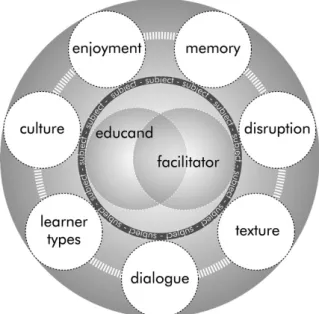
the erroneous decision to simply replace the teacher with the student at the centre of their humanistic/liberal ‘student-centric’ paradigm. The problem with such structure is that irrespective of the mode of delivery, style of learning transaction, or best intentions, a student cannot occupy this locus. In every strata of education (by the inerrant nature of them being a student) they occupy a position whereby they are to various and varying degrees learning, accessing or processing knowledge and information. In sum, rather than located within the student, the body of all knowledge is the starting point for learner engagement, with both the educand and facilitator being the channels by which knowledge is processed and engaged; they are not the centre per se, and not of primacy. Based upon this rationale, the model of AVE places the subject at the centre although in the graphic below one can see the educand and facilitator within this sphere undergirding all learning activities. Surrounding the subject, which remains of core importance, are 5 pedagogical underpinnings: culture, memory, texture, learner types, and disruption. These were recorded from a ‘grounded’ approach as being the elements in the learning transaction which, it had been observed, not only provide inclusion for the largest number of learner types, but also that from a neurological perspective would enhance memory retention and understanding of what was being studied. Through extended research and discourse with peers, this model was later revised to include two additional tenets, enjoyment and dialogue. The sum of this model is that the ecucand and facilitator can engage with core subjects through a variety of visual methods. By approaching learning in this holistic and mufti-faceted way, it should enhance their enjoyment of learning, increase long-term memory storage, disrupt modes of established delivery and traditional learning patters and outcomes, and add texture and depth to learning. These, it is hoped, will support memory and increase intrinsic motivation, encourage learning to be dialogical or interrogative in nature(not just with the facilitator, but also the subject), and allow for material to be accessed and processed by the widest number of edcucands. All this, it is hoped, presents learning in such a way that a single activity can be interpreted or evaluated in various forms, to reinforce the relationship between language and information as being manifestations of culture, and allow for learning to be culturally specific. Finally, it is further hoped that that learning should continue to be enjoyable throughout the educand’s educational journey. The structure of the theory of AVE can be seen in the graphic below:
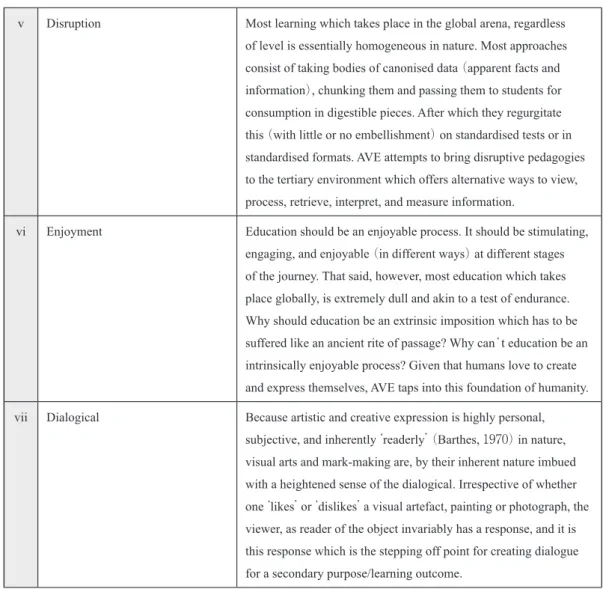
Pedagogical aspect Brief descriptor
i Culture (Asian specific) The theory aligns to the innate learning propensities of the students who are kan-ji readers, who, it is hypothesised, are highly visually literate in nature. It aims to exploit this proclivity for visual learning, visual stimuli, and visual literacy as a means to engage with a secondary task or pedagogical outcome. Whilst the initial theory was developed in Japan, there is significant scope for further testing with other kan-ji readers such as learners from Taiwan, Hong Kong, and China.
ii Memory Partly inspired by Atkinson and Sciffrin's Modal Model of memory (1968), AVE hopes to not only store information in the Long-term Memory (LTM), but make retrieval and retention of learning better. Due to the multiplicitous nature of the engagement (visual, motor, spacial, logic & problem solving &c) memory should be separated and stored in numerous areas of the brain, rather than one or two, thus, when the memory is reassembled its chances of attrition should be greatly reduced.
iii Texture It is hoped to improve the quality and texture of learning. That is, it is hoped that various sensory information will form a learning ‘cluster’ around new data from learning. It is hypothesised that by
attaching added stimuli to learning this will both assist with accurate encoding and storage of the new information - which will result in the learning being stored in multiple areas of the brain. In addition, it is also hypothesised that this multifaceted or multidimensional clustering will assist retrieval.
iv Learner types As many scholars have told us, all learners are not the same. As global (higher) education moves closer towards standardised metrics and evaluations, AVE approaches attempt to counter this homogeneity by using a more multiplicitous approach to learning. This aims to incorporate the widest possible number of learner types in the learning transaction, and better serve students to find approaches which suit their individual learning type and style. This aspect is also appropriate when dealing with large classes (and/or) mixed levels.
v Disruption Most learning which takes place in the global arena, regardless of level is essentially homogeneous in nature. Most approaches consist of taking bodies of canonised data (apparent facts and information), chunking them and passing them to students for consumption in digestible pieces. After which they regurgitate this (with little or no embellishment) on standardised tests or in standardised formats. AVE attempts to bring disruptive pedagogies to the tertiary environment which offers alternative ways to view, process, retrieve, interpret, and measure information.
vi Enjoyment Education should be an enjoyable process. It should be stimulating, engaging, and enjoyable (in different ways) at different stages of the journey. That said, however, most education which takes place globally, is extremely dull and akin to a test of endurance. Why should education be an extrinsic imposition which has to be suffered like an ancient rite of passage? Why can't education be an intrinsically enjoyable process? Given that humans love to create and express themselves, AVE taps into this foundation of humanity. vii Dialogical Because artistic and creative expression is highly personal,
subjective, and inherently ‘readerly’ (Barthes, 1970) in nature, visual arts and mark-making are, by their inherent nature imbued with a heightened sense of the dialogical. Irrespective of whether one ‘likes’ or ‘dislikes’ a visual artefact, painting or photograph, the viewer, as reader of the object invariably has a response, and it is this response which is the stepping off point for creating dialogue for a secondary purpose/learning outcome.
2:1 Cultural
As has been described elsewhere in some depth Woollock, 2007; Woollock, 2018; Crosby & Woollock, 2018; Woollock, 2019, it is both hypothesised and recorded from longitudinal primary observations in the field, that Japanese students have a heightened proclivity for the visual. Whether by being immersed in the Japanese aesthetic4 , or
by receiving visual information through paper-based media e.g. comics, product advertising, and packaging &c, electronic media; TV advertising, signage, neons &c, or any of the number of methods prevalent in this heavily visually saturated culture. Couple this with the aforementioned discussion pertaining to the visual nature of kan-ji, and there is ample evidence to provide robust grounds for closer inspection as to why there is not a greater use of visual methods within not just the Japanese tertiary sector, but also the primary and secondary too. This inclusion does not mean ‘art,’ rather it means exploiting visual methods as a conduit through which to approach secondary or tertiary leaning objectives which are ‘mainstream’ in nature.
2:2 Memory
There is much data which points to the complexity of memory. Scholars such as James McGaugh, Karim Nadar, Eric Kandell, and Elizabeth Loftus have all offered theories on memory making and memory retention. In this field, however, notable amongst the literature is Atkinson and Shiffrin’s seminal hypothesis, the Modal Model of memory (1968) which postulates that memory consists of three repositories: a sensory register, short-term memory (STM), and long-term memory (LTM). Thus far in the average student’s educational career it has been the STM which has been exploited largely for test taking; however, most students I have encountered are unable to recall much of their previous studies. According to Atkinson and Shiffrin, information is encoded in three main ways; visually, aurally, and semantically̶through images, sound or meaning. Lantolf extends this, noting
“people generally have little choice over which of the events in their lives remain in natural memories. On the other hand, because two stimuli are connected in mediated memory, people are able to exercise much greater control over what, and even how, they remember when assisted by a symbolically created link. This is what happens when a person ties a string around his or her finger, uses paper and pencil to write down a phone number, or sketches an outline of a recently read text.” (1995: 109)
2:3 Textural
Here, textural refers to the both quality of the learning experience, and a group-orientated, co-constructed activity based upon kinship, peer development, and experiential learning. To take the first definition, if one simply remembered that the capital of France is Paris, this fact would have no texture whatsoever - it is simply a singular word/sound. If, however, whilst learning this fact, you were concurrently shown realia or visual artefacts, e.g. statues of la Tour Eiffell, or photographs of L'arc de Triomphe, then you would couple this information together, and whilst you would still remember ‘Paris.’ this apparently inert word would now have added texture. The second definition, what Rogers calls ‘shared spaces’ and ‘shared experiences’ (2005: 9), is similar to what McNiff states when he notes that ‘[a]rt-based research can be defined as the systematic use of the artistic process, the actual making of artistic expressions [ ] as a primary way of understanding and examining experience’ (2007: 29). This sharing and co-construction, it is hoped, adds texture to the information learned.
⁴It is arguable that Japan is one of the few remaining countries which still has an immediately recognize visual code or aesthetic, something which is instantly recognisible as ‘Japanese’ or fuu (和風). Whether this be architecture; ken-chiku (和建築)、 tattoo; bori (和彫り)、 clothing; fuku(和服)、 food;
2:4 Learner Types
Sinner et al note ‘the specific contribution arts-based research can make to education’ (2006: 1227), however, despite such opinion and seminal research pertaining to learner types, proclivities, modalities, and intelligences by the likes of Gardner (1983); Barsch (1991); Kolb (1984); and Spearman et al, together with research by Felder and Silverman (1998) showing the existence of eight basic modalities or learner types (sensing or intuitive, visual or verbal, active or reflective, and sequential or global learners), and of course the VARK model, which identifies four primary types of learners: visual, auditory, reading/writing, and kinesthetic. Despite all this research, however, the vast majority of learning which takes place in all classrooms not only fails to acknowledge any learner types, but fails to test for their existence and adapt curricula and learning methods accordingly. In short, the vast majority of tertiary education (regardless of subject disciplinary) makes little or no effort to accommodate the myriad of learners who arrive in our classrooms with their complex heterogeneous mélange of learning styles, characters, predispositions, and quirks. AVE attempts to redress this imbalance.
2:5 Distruption
Many progressive educators such as Henri Giroux, Peter McLaren, John Dewey, Paulo Freire et al have discussed the positive aspects of disruptive pedagogies. In their arena, however, disruption is focused upon reconfiguring the hegemonic or neo-liberal discourse as a way to facilitate social change. In this context, however, the focus is concentrated more at the micro level. Here disruptive means that new approaches to teaching and learning cause both the facilitator and the learner to re-think preconceptions and to explore new and often radical ways to engage with learning, in what Petrescu (2007: 56) calls ‘spaces of uncertainty.’ The author maintains that this theory is especially relevant to young post-millennial learners from the iGeneration, (Kelson, 2009; Rosen, 2012; Philip and Garcia, 2013) that is, those who have been heavily exposed to learning technology such as tablets and smart phones. It is clear that this generation has a huge disconnect between how they receive and process information on a personal level, and how they are made to in university classroom. As noted above, most global education is extremely myopic and discriminatory (of learner types) and fails to facilitate the most advantageous learning possible. AVE disrupts this state of homogeneity by encompassing a wide variety of pedagogies which counter and stand antithetical to nearly all mainstream approaches.
2:6 Enjoyment
It’s a moot point to state that we excel at the things we like doing, not just the things which are easy. That it is not to infer that the teacher should be reduced to some kind of performer and make lessons ‘fun,’ but there is no reason why learning cannot be ‘enjoyable’ as Lantolf, (2010: 13) notes
‘Play is an especially important activity in Vygotsky's theory of development, because it is in play that children create, usually in collaboration with other children, a zone of proximal development [...] activities that are not just about having fun, but allow children to project into the future. Thus, play is an important activity for child development”
observations, almost all of the tertiary classes they have encountered could be described as residing somewhere on the spectrum between bearable and dull. Furthermore, if you photographed a lesson in 2020 and compared it to one in 1920, there would be little difference - students sitting in neat rows facing the teacher who stands behind a lectern in front of a board. Most students would concur that this is not enjoyable, and the author would argue further that this has a negative impact on learning in the L2 environment where confidence may already be lacking..
2:7 Dialogical
American art historian Grant Kester’s has written much about ‘dialogical art’ (1995, 2005, 2013). Whether one likes a particular artwork or not, visual art, artefacts, realia, and totems invariably produce a response. From this response it is then possible to engage further and elicit information pertaining to choices, tastes, and prejudices. Thus it appears that the visual can be a natural leaping-off point to dialogue. This fact was corroborated by the author during their doctoral research (2013-2016), when their findings revealed that a simple visual artefact, such as a Japanese wooden votive tablet e-ma (絵馬), had the potential to generate oral data of four kinds: monologue data, discursive data, focus-group data, and ‘ethereal’ or reflexive data. Artigal explains further:
“the language acquisition device is not located in the head of the individual but is situated in the dialogic interaction that arises between individuals engaged in goal-directed activities [...] the locus of learning in the dialogic interactions that arise between socially constituted individuals engaged in activities which are co-constructed with other individuals rather than in the heads of solipsistic beings. Learning hinges not so much on richness of input, but crucially on the choices made by individuals as responsible agents with dispositions to think and act in certain ways rooted in their discursive histories.”(1992: 110)
3: Methods
This section aims to give the classroom practitioner some basic tools with which to apply the above theory. As a postmodern, pluralist paradigm it is important to note that whilst the theory is necessary in order to establish, maintain, and be incorporated into the corpus of knowledge surrounding AVE, this should be a point of departure for the classroom practitioner to elect and develop methods which best suit their own classes. In that regard, any methodology is considered a genre of wiki, that is, in a constant state of development. Below is a table which outlines eight methods of AVE which the author has used mostly within the Japanese tertiary classroom. Following the example and use, the target learning outcomes are identified for each methodology. This is more of a description of what methods have been used by the author in the development of the theory of AVE, than a ‘how to’ necessarily, and approached may be adapted and re-configured by the facilitator to focus on their individual class needs or curricula requirements.
Method Use Examples Model-making For a content-based class on
environmental issues, students used recycled materials throughout the term to make models of various artefacts (e.g. wind-turbines, solar phone, and phone charger). Whilst the secondary learning aim was to imbue the classes with added texture, the primary goal, however, was to use these artefacts as a stepping-off point for activities and tasks, e.g. presentation, pair-work, and small-group discussion. As Lantolf notes, “Physical tools [...] establish an
indirect, or mediated, relationship between ourselves and the world [...] properties of the natural, or biologically specified, brain are organized into a higher, or culturally shaped, mind through the integration of symbolic artifacts into thinking. (2000: 1-2)
Target [learning] outcome(s) After initial research and knowledge building, the students engage in Higher-order Thinking Skills (HOTS5) to find physical solutions
to ideas or problems posed. These activities allow the learner to see the transference and development of an idea through its 2D rendering into three-dimensional form. They also allow them to see if the choices they made extrapolated out to ‘reasonable’ decisions (e.g. are dimensions poor, or lines too thin/thick &c). As with many AVE approaches, it also provides an artefact to ‘share’ and thus instigates specific discourse, both inside and outside of class.
⁵Woollock (2020) described HOTS as comprising the following skills; i)Problem solving, and Rationalisation, ii)Critical thinking, iii)Learning for transfer, iv) Critical Discourse and deconstruction, v)Analysis, vi)Synthesis, vii)Creativity, viii)Criticality, ix)Autonomy, x)Multiplicity/heterogeneity, xi)Metacognition, xii) Abstraction, xiii)Inference, xiv)Pattern Observation, xv)Original conception, and xvi)360° thinking.
Method Use Examples Favourite words In the first two classes of an
college writing class for non-English language majors, students used air-drying clay to make models of their favourite words. These words could be based on the onomatopoeic quality of the word, the meaning in Japanese, or the actual English word - students were free to choose. In addition to the model, students also made a A4 back-sheet on which the model was placed for photographing. Again, this sheet also took a number of forms depending on which of the above noted approaches was used for the model.
Target [learning] outcome(s) This activity presents an
opportunity which allows students (both L1 and L2), to think deeply yet very specifically about individual words. Through this multifaceted engagement with a simple word, it was hoped that academic writing classes could not only begin on a less daunting level, but that a taster could be given to the students to show them how different it is possible to teach when compared to their previous (Japanese) teachers and the very conservative approaches generally used. It was hoped that the word (and English words, in general) could be viewed differently after the activity - more tangible, and holding a more nuanced and textural meaning.
Method Use Examples Visual textbooks For teaching any subject to students
in their L1 or L2, visual textbooks allow the learner to take ownership of the ostensible empty textbook. It allows them to personalise their learning experience and response - a factor which is of primacy in the field of andragogy. The format for these texts is that on the front side of a page students produce a visual response (drawing, mark-making, collage, or photos) to a given problem. On the back, they then articulate their visual response in written form. The theory and methodology behind these types of textbook has been extensively discussed prior (see Woollock, 2019. and Crosby & Woollock 2019)
Target [learning] outcome(s) Coupling visual imagery to written words, concepts, and ideas attempts to reinforce and deepen the learning which arises as a result of interaction. It allows information to be presented in different forms and allows a wider variety of learner types to engage with a topic than ordinarily possible. Students can elect both the type of response and the volumes based upon their own proclivities. E.g. student ‘A’ may write more and stick a few images cut from magazines, whilst student ‘B’ may write less and spend longer time on drawing. The point to reinforce here, is that both students with different learning propensities and interests are engaging with the same topic on their terms.
Method Use Examples Personal Visual narratives (PVN) In an earlier publication
(Woollock, 2020), the author has extensively explored the use of PVNs as a single component of broader university EMI course. PVNs can be used a To elicit a single-person response, a pair, and a small-group and as such are flexible and inclusive. In a close-knit group they can also be used to exchange personal information in a way which is non-invasive, and produce an opportunity for bonding. When an opportunity is needed for students to express a personal perspective on a topic PVNs can be useful as a complimentary tool to other learning strategies.
Target [learning] outcome(s) Much learning which takes place regardless of strata or jurisdiction is highly impersonal in nature. It is arguably less about understanding the individual educand, ascertaining their views on life or a subject, and more about arriving at a quasi consensus. PVNs allow students to take a common theme and produce a visual artefact which then gives them a springboard from which to enter into discourse with others. It allows for a subject which is to be discussed orally, to be manifested visually. It allows for the ‘author’ to explain, the interlocutor to elicit, and also project and interpret; thus ideas of ownership, or ‘correct and ‘incorrect’ become unimportant.
Method Use Examples Relational Diagrams (films) Relational diagrams are useful tools
for helping students understand the character dynamics and structure of a film or novel. They can be hand-written or made as a collage. When used to describe films (where the author has employed them most extensively), they assist students in organsing and understanding the characters and main structural elements of a film. This not only provides a solid framework for organising complex information in time and space, but in real terms provides a physical visual artefact which they can then use to produce an oral explanation, take questions, or seek clarification.
Target [learning] outcome(s) When asked about a film it can be extremely difficult and daunting for a student to explain to another; this is compounded in the case of L2. Having made (drawn/collage) their relational diagram, however, which contains a visualisation of the main characters and their inter-relations, plus supplementary information regarding actor names and character types &c, students are better able to perform this task. Using this visual output, students are provided with a leaping-off point to explaining a film and its narrative structure to others.It also aids in helping them make sense of complex narratives where language only explanations might be hard to comprehend.
Method Use Examples Mind-mapping and Planning Akin to the above relational
diagrams, mind-mapping and planning can be used as a way to visually render ideas, data, information, solutions, and words. Organising and displaying data in a visual form requires a higher cognitive function of transposition. When conducted in teams or pairs this allows for students with differing strengths to shine. It also allows for group decision making, justification, rationalising, and arbitration - highly useful social skills. Depending upon the built environment, when produced on large scales (such as the sustainable towns shown in the adjacent photos), they can also provide useful decoration to sanitised classrooms, and provide stimulation for other (unrelated) classes or learning.
Target [learning] outcome(s) Whether single-sheet or larger, visual responses in the form of mind-mapping, planning, and cartography can be a useful learning device in two ways. Firstly, the product (the output), and secondly the (process), the act of engaging and producing. As has been noted prior, the actual physical artefact provides a springboard from which to make conversation, and elicit questions. From a process perspective they invariably provide an opportunity for group/team work, planning, organisation, delegation, and sharing. Whilst completing the artefact those who prefer to work silently can do so, and those who prefer to chat can also do so.
Method Use Examples Photovoice/Photo elicitation Both photovoice (Wang 1999, Wang
and Burris, 1997) and its forerunner photo elicitation were initiated from the work of Paulo Friere who used visual images to elicit responses from illiterate adults in Recife, Brazil. With photography, the method has been used successfully with marginalised groups and individuals who have used these methods as both a way to record and highlight social problems for civic action In a Freirean sense, they can also be viewed in a ‘problem-posing’ manner. That is to use images as a way to both interrogate social, political or cultural issues often from those who are under-educated or without voice. In this way parallels can be drawn to L2 learners who may lack the verbal skills to articulate their ideas or intentions.
Target [learning] outcome(s) Complex, taboo, or marginal issues can be discussed and interrogated when participants/students are given actual photos of the topic at hand. In this case they are not always required to produce the visual materials themselves, thus widening the scope of engagement to include those who do not have visuality amongst their preferred learning modalities. Thematic photos are used to engage with a topic and initiate dialogue/ discourse amongst participants. Students are able to connect or draw parallels between images spread out and this allows them to find common thread and personalise the learning. Interrogative language can be employed to elicit learning/realisation from students in an intrinsic manner. This platform utilises neither correct’ nor ‘incorrect’ structures.
Method Use Examples
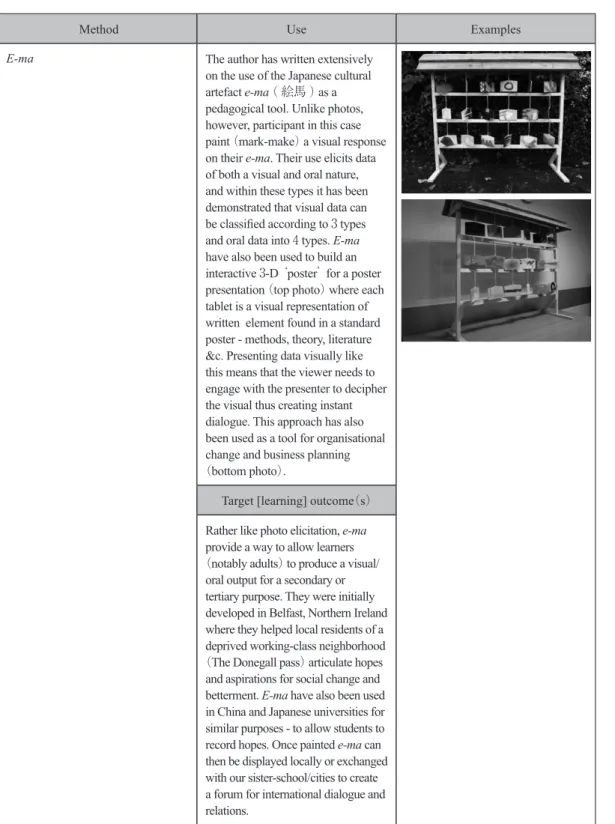
E-ma The author has written extensively
on the use of the Japanese cultural artefact e-ma ( 絵馬 ) as a pedagogical tool. Unlike photos, however, participant in this case paint (mark-make) a visual response on their e-ma. Their use elicits data of both a visual and oral nature, and within these types it has been demonstrated that visual data can be classified according to 3 types and oral data into 4 types. E-ma have also been used to build an interactive 3-D ‘poster’ for a poster presentation (top photo) where each tablet is a visual representation of written element found in a standard poster - methods, theory, literature &c. Presenting data visually like this means that the viewer needs to engage with the presenter to decipher the visual thus creating instant dialogue. This approach has also been used as a tool for organisational change and business planning (bottom photo).
Target [learning] outcome(s) Rather like photo elicitation, e-ma provide a way to allow learners (notably adults) to produce a visual/ oral output for a secondary or tertiary purpose. They were initially developed in Belfast, Northern Ireland where they helped local residents of a deprived working-class neighborhood (The Donegall pass) articulate hopes and aspirations for social change and betterment. E-ma have also been used in China and Japanese universities for similar purposes - to allow students to record hopes. Once painted e-ma can then be displayed locally or exchanged with our sister-school/cities to create a forum for international dialogue and relations.
4: Discussion
Vygotsky developed a unified theory of human mental functioning that initiated a new way of thinking about development. He acknowledged that the human mind was comprised of lower mental processes, but the distinctive dimension of human consciousness was its capacity for voluntary control over biology through the use of higher-level symbolic artifacts (i.e., language, literacy, numeracy, categorization, rationality, logic, etc.). These artifacts, all of which derive from the historical accumulation of human cultural activity and development (Tomasello, 1999)
If we take Vygotsky’s sentiment noted above, and, taking those ‘higher-level symbolic artefacts’ think of their neurological underpinnings, then we can find assimilation with many of the methods mentioned in the previous section. That artefacts “serve as a buffer between the person and the environment and act to mediate the relationship between the individual and the social-material world” (Lantolf et al 2015: 3), should not be forgotten. “Educators can also benefit from keeping in mind that, besides content, instructional tasks and text types can influence learning transfer. [...] Beyond content, tasks, and text types, however, educators who are interested in stimulating learning transfer need to attend to the broader context of instruction. (James, 2006: 803). The point to note here is that
Any activity [...] comprises the behavior that is actually produced when an individual (or group) performs a task. It is the process, as well as the outcome, of a task, examined in its sociocultural context. Unlike a task, an activity has no set of objectives in and of itself - rather, participants have their own objectives [...] Activities have no inerrant parameters or boundaries, except imposed those by the task and by the interpretations and expectations of the individuals involved int he given task. (Coughlan & Duff, 1994: 175)
AVE aligns with scholars such as Coughlin & Duff, 1994; Newman, Griffin & Cole, 1989; Roebuck, 1998). who have challenged the assumption of task as a unitary fixed construct. The use of open-ended or ‘borderless’ activities is of primary importance. By refusing specific learning outcomes, by focusing on engagement with the activity (often for engagement’s sake) AVE is attempting to counter the hegemonic quantitative methods currently dominating the academy which ignore the increasingly complex array of learners who find themselves in our classrooms; ignoring their learning proclivities, tastes, and interests.
AVE is an important approach to pedagogy/andragogy and offers a comprehensive array of tools and methods to engage learners in the current epoch which are both appropriate and increasingly necessary. Although some outward aspects of society (e.g. law, equality, and human rights) and the humans which populate nations have changed immeasurable since the enlightenment. Other aspects, however, both human (class) and institutional (education) have not kept pace. That the way that we educate people has not significantly changed since the c.17th and remains largely unidirectional is both true and something societies should rue. University graduates may dress better, have better working conditions, and work in front of ‘clean machinery’ (like a computer). Stripped down, however, and critically examined, most ‘middle-class’ white-collar wage-slaves are simply performing a variation of a rudimentary or linear task not dissimilar to their indentured or ‘working-class,’ blue-collar ancestors; those who worked in factories, mills, in service or on farms. Likewise, and in parallel to this situation, it is fair to say that the majority of educational provision from primary to tertiary, delivered on a global scale has failed to advance beyond surface changes. Most education, regardless of jurisdiction falls within an extremely narrow bandwidth of
homogeneity and is largely the direct legacy or echo of colonialisation or proselytization modeled predominantly on euro-centric parameters. These parameters - essentially replicate a Judeo-Christian weltanschuung where the nation state (and thus state education) is interchangeable for a deity or god-like figure disseminating from above from those who apparently know what’s best for others. These teachings are administered through standardised textbook, prescribed testing, national curricula, and other quantifiable materials which are versions of sacred or canonised texts. The teacher, as intermediary is simply a variant of a priest, pastor or holy-(wo)man actor, and finally the receiver or ‘believer’ (the student) is simply a member of the congregation.
5: Conclusion
The increasingly globalised world faces increasingly complex challenges and yet in order to meet these challenges we educate people like they are preparing to work in a textile mill, indentured service, or in a coal mine. That is with just enough procedural knowledge to make a reactive response to a range of situations which may or will likely occur within their given sphere of employment, so that industry may proceed with the minimum of interruption, and yet people are capable of so much more. Clearly AVE and visual methods have much to offer the tertiary classroom and warrant further investigation especially in regionally-specific classrooms. Irrespective of whether they are employed to facilitate the learning of English language, through a CBI model whose focus is language. Or whether used in an EMI model where the focus is on content taught through the medium English, the fact remains that methods derived from a sound understanding of AVE should be incorporated in the tertiary classroom as one of a number of approaches. Approaches whose sole motivation is to help students meet the aims and objectives of their learning programmes, and curricula (whatever they may be defined as). Vygotsky suggested that:
“Unlike physical tools [...] which are externally oriented toward the object of activity and imbue humans with the ability to alter the object in ways that would otherwise be impossible, psychological tools are internally directed at organizing and controlling our mental activity in ways that would not be possible in their absence.” (1978: 55)
The influence of AVE approaches are that rather than viewing the task, activity, or method used as being a final objective in itself, it should instead be simply viewed as a way for the student-learner to interpret or make sense of the world within a given context. That is, through the method employed the student hopefully comes nearer to not only understanding the world, but also their interaction and place within it and ultimately, themselves.
Artigal, J. M. (1992). Some considerations on why a new language is acquired by being used. International
journal of applied linguistics, 2(2), 221-240.
Atkinson, R. C., & Shiffrin, R. M. (1968). Human memory: A proposed system and its control processes. In
Psychology of learning and motivation, (2), 89-195. Academic Press.
Barthes, R. (1974). S/z. 1970. Trans. Richard Miller. New York: Hill and Wang.
Barsch, J. (1996). Barsch learning style inventory (rev.ed.). Academic Therapy Publications: Novato, CA.
Coughlan, P., & Duff, P. A. (1994). Same task, different activities: Analysis of a SLA task from an ActivityTheory perspective. Vygotskian approaches to second language research, 173-193.
Crosby, R., & Woollock, A.R. (2019). Creative approaches to education in the Japanese tertiary sector: twocase studies using Applied Visual Enquiry (AVE). The Annals of Gifu Shotoku Gakuen University(Faculty of
Education), (58), 45-56.
Felder, R.M. & Silverman, L.K. (1988). Learning styles and teaching styles in engineering education.
Engineering Education, 78:, 674-681
Freire, P. (1970). Pedagogy of the oppressed. New York: Herder and Herder. Gardner, H. (1983). Frames of mind: The theory of multiple intelligences. NY: Basics.
Grady, C. (2019, December 23). The 2010s were supposed to bring the ebook revolution. It never quitecame. Retrieved May 27, 2020, from https://www.vox.com/culture/2019/12/23/20991659/ebook-amazon-kindle-ereader-department-of-justice-publishing-lawsuit-apple-ipad
Handley, L. (2019, September 19). Physical books still outsell e-books ̶ and here’s why. Retrieved May 27, 2020, from https://www.cnbc.com/2019/09/19/physical-books-still-outsell-e-books-and-heres-why.html
Kester, G.H. (1995). Aesthetic evangelists: conversion and empowerment in contemporary community art.
Afterimage, 22 (January 1995).
Kester, G. (2005). Conversation Pieces: The role of dialogue in socially-engaged art. In: Z. Kucor & S. Leung(Eds.)
Theory in contemporary art since 1985. Oxford: Blackwell.
Kester, G., May 14th 2013, Collaborative Art and the Limits of Criticism [Homepage of Create]. Retrieved From http://www.create-ireland.ie/create-news-2013/create-news-14-grant-kester-on-collaborative-art-and-the-limits-of-criticism.
Lantolf, J. P. (1994). Sociocultural theory and second language learning: Introduction to the special issue. The Modern Language Journal, 78(4), 418-420.
Lantolf, J. P., & Pavlenko, A. (1995). Sociocultural theory and second language acquisition. Annual Review of Applied Linguistics, (15), 108-124.
Lantolf, J. P. (2000). Introducing sociocultural theory. Sociocultural theory and second language learning, (1), 1-26. Lantolf, J. P., Thorne, S. L., & Poehner, M. E. (2015). Sociocultural theory and second language development.
Theories in second language acquisition: An introduction, 207-226.
Petrescu, D. (2007). How to make a community as well as the space for it. In: Mutschler, P. & Morrow, R. (Eds.)
SPACE SHUTTLE: Six projects in urban creativity and social interaction. Belfast: PS², 45-50.
Philip, T. & Garcia, A., (2013). The importance of still teaching the iGeneration: New technologies and the centrality of pedagogy. Harvard Educational Review, 83(2), 300-319.
Rosen, L. (2010). Welcome to the... iGeneration! The Education Digest, 75(8), 8 - 12.
Sinner, A., Leggo, C., Irwin, R. L., Gouzouasis, P., & Grauer, K. (2006). Arts-Based Educational Research Dissertations: Reviewing the Practices of New Scholars. Canadian Journal of education, 29(4),1223-1270. Tomasello, M. (2009). The cultural origins of human cognition. Cambridge Massachusetts: Harvard University
Press.
Wang, C., & Burris, M. A. (1997). Photovoice: Concept, methodology, and use for participatory needs assessment.
Health education & behavior, 24(3), 369-387.
Wang, C. C. (1999). Photovoice: A participatory action research strategy applied to women’s health. Journal of
women's health, 8(2), 185-192.
Woollock, A. (2008). The Use of Art-Based Projects in the Teaching of English as a Foreign Language (EFL), With Specific Reference to Japanese Learners Studying at Art Institutions.神戸芸術工科大学紀要 芸術工学 2008 Retrieved from http://kiyou.kobe-du.ac.jp/07/study/19-01.html
Woollock, A.R. (2014). Project e-ma: Socially-Engaged Visual Arts Interventions for Belfast Looking at Images: A
Researcher’s Guide. Winchester School of Art
Woollock, A.R. (2017). Transposing artefacts: an exploration of e-ma as pedagogical tool for exploring the core tenets of Freire’s Critical Pedagogy (FCP) in Belfast’s Donegall Pass. New Ideas in East AsianStudies, (2), 1-13.
Woollock, A.R. (2019). Content-based instruction (CBI) and visual arts: Exploring Applied Visual Enquiry(AVE) as conduit through which to teach environmental issues in the Japanese tertiary classroom.The Annals of Gifu
Shotoku Gakuen University (Faculty of Foreign Languages),(58),1-20.
Woollock, A.R. (2020) .Exploring personal perspective as a point of departure for learning and understanding: The use of art-based personal visual narratives in the Japanese tertiary classroom. The Annals of Gifu Shotoku