Cancer Science. 2020;00:1–8. wileyonlinelibrary.com/journal/cas
|
1 Received: 15 May 2020|
Revised: 4 July 2020|
Accepted: 17 July 2020DOI: 10.1111/cas.14590
O R I G I N A L A R T I C L E
Utility of immune checkpoint inhibitors in non-small-cell lung
cancer patients with poor performance status
Hirohisa Kano
1| Eiki Ichihara
2| Daijiro Harada
3| Koji Inoue
4| Hiroe Kayatani
5|
Shinobu Hosokawa
6| Daizo Kishino
7| Kazuhiko Watanabe
8| Nobuaki Ochi
9|
Naohiro Oda
10| Naofumi Hara
1| Kiichiro Ninomiya
1| Katsuyuki Hotta
11|
Yoshinobu Maeda
1| Katsuyuki Kiura
2This is an open access article under the terms of the Creative Commons Attribution-NonCommercial License, which permits use, distribution and reproduction in any medium, provided the original work is properly cited and is not used for commercial purposes.
© 2020 The Authors. Cancer Science published by John Wiley & Sons Australia, Ltd on behalf of Japanese Cancer Association. 1Department of Hematology, Oncology, and
Respiratory Medicine, Okayama University Graduate School of Medicine, Dentistry, and Pharmaceutical Sciences, Okayama, Japan 2Department of Allergy and Respiratory Medicine, Okayama University Hospital, Okayama, Japan
3Department of Thoracic Oncology, National Hospital Organization Shikoku Cancer Center, Matsuyama, Japan
4Department of Respiratory Medicine, Ehime Prefectural Central Hospital, Matsuyama, Japan
5Department of Respiratory Medicine, National Hospital Organization Okayama Medical Center, Okayama, Japan 6Department of Respiratory Medicine, Japanese Red Cross Okayama Hospital, Okayama, Japan
7Department of Respiratory Medicine, Himeji Red Cross Hospital, Himeji, Japan 8Department of Internal Medicine, Okayama Saiseikai General Hospital, Okayama, Japan 9Department of General Internal Medicine 4, Kawasaki Medical School, Okayama, Japan 10Department of Internal Medicine, Fukuyama City Hospital, Fukuyama, Japan 11Center for Innovative Clinical Medicine, Okayama University Hospital, Okayama, Japan
Correspondence
Eiki Ichihara, Department of Allergy and Respiratory Medicine, Okayama University Hospital, 2-5-1 Shikata-cho, Kita-ku, Okayama City, Okayama 700-8558, Japan. Email: [email protected]
Abstract
Most clinical trials of non-small-cell lung cancer (NSCLC) exclude patients with poor ECOG performance status (PS). Thus, the efficacy of immune checkpoint inhibitors (ICIs) in patients with poor PS remains unclear. Herein, we used data from a retro-spective cohort to assess the potential clinical benefits of ICIs in NSCLC patients with poor PS. Data from NSCLC patients who received ICI monotherapy at 9 institu-tions between December 2015 and May 2018 were retrospectively analyzed. After excluding 4 patients who lacked PS data, a total of 527 ICI-treated patients, including 79 patients with PS 2 or higher, were used for our analyses. The progression-free sur-vival (PFS) and overall sursur-vival (OS) of patients with PS 2 or higher were significantly shorter compared with those of PS 0-1 patients (median PFS, 4.1 vs 2.0 months;
P < .001 and median OS, 17.4 vs 4.0 months; P < .001). Among NSCLC patients
with programmed cell death protein-ligand 1 (PD-L1) expression of 50% or higher who were treated with pembrolizumab as first-line therapy, the median PFS times of patients with PS 2 and 0-1 were 7.3 and 8.1 months, respectively. There was no significant difference in PFS between patients with PS 2 and 0-1 (P = .321). Although poor PS was significantly associated with worse outcomes in NSCLC patients treated with ICIs, pembrolizumab as a first-line treatment in NSCLC patients expressing high levels of PD-L1 could provide a clinical benefit, even in patients with PS 2.
K E Y W O R D S
immune checkpoint inhibitor, non-small cell-lung cancer, PD-L1, pembrolizumab, poor performance status
1 | INTRODUCTION
Although non-small-cell lung cancer (NSCLC) remains a leading cause of cancer-related mortality, immunotherapy with immune checkpoint inhibitors (ICIs) has dramatically changed the landscape of NSCLC therapy. Treatment ICIs has been reported to provide long-term tumor control in 10%-15% of patients,1-3 in sharp contrast
to treatments with cytotoxic chemotherapies or targeted molecular therapies.4,5
The ECOG scale performance status (PS) has been reported to be a prognostic factor in NSCLC.6-9 Often, NSCLC patients with PS
2 or worse are excluded from most clinical trials, including studies involving the use of ICIs.1-3 Hence, even though the clinical
useful-ness of ICIs in NSCLC patients with PS 0 or 1 has been reported in numerous clinical trials, it remains unclear whether patients with PS 2 or worse can benefit from ICIs. The purpose of this study was to evaluate the clinical usefulness of ICIs in NSCLC patients with poor PS. To this end, we retrospectively analyzed data from 527 NSCLC patients, including 79 patients with PS 2 or worse, who re-ceived ICIs, and examined their clinical benefits in NSCLC patients with different PS.
2 | METHODS
2.1 | Patients
This is a branch study analyzing our data from the Okayama Lung Cancer Study Group-Immunotherapy Database (OLCSG-ID), which includes clinical data from NSCLC patients treated with ICIs for the purpose of various branch studies about ICI therapy in NSCLC.10 The
OLCSG-ID includes the medical records of 531 NSCLC patients who received monotherapy with anti-programmed cell death protein-1 (PD-1) or anti-programmed death-ligand 1 (PD-L1) Ab at 9 different institutions between December 2015 and May 2018. After exclud-ing 4 patients who lacked PS data, we analyzed the data for the re-maining 527 patients for this study.
2.2 | Statistical analyses
Differences between the different groups were analyzed using Fisher’s exact test. Progression-free survival (PFS) was defined as the time between the beginning of the ICI treatment to the day of disease progression or death from any cause. Overall sur-vival (OS) was defined as the time between the beginning of ICI treatment to the day of death from any cause and was analyzed using the Kaplan-Meier method. Survival analysis was carried out using the log-rank test and multivariate Cox proportional haz-ards model adjusted for confounding factors. Differences were deemed statistically significant if P was less than .05. All statisti-cal analyses were carried out using STATA software (version 15.1; StataCorp).
3 | RESULTS
3.1 | Patient characteristics
Data from 527 patients were analyzed in this study. Patient char-acteristics are shown in Table 1. There were 448 patients with PS 0-1 (PS 0-1 group) and 79 patients with PS 2-4 (PS 2-4 group). The median age was 69 years (range, 28-96 years) in the PS 0-1 group and 70 years (range, 37-87 years) in the PS 2-4 group. Mutations in the epidermal growth factor receptor (EGFR) gene were detected in 51 patients (11.4%) in the PS 0-1 group and 8 patients (10.1%) in the PS 2-4 group. Relative PD-L1 expression was 50% or higher in 113 pa-tients (25.2%) in the PS 0-1 group and 22 papa-tients (27.8%) in the PS 2-4 group. The PD-L1 expression was undetermined in 220 patients (49.1%) in the PS 0-1 group and 42 patients (53.2%) in the PS 2-4 group. In both groups, pembrolizumab and nivolumab were the most commonly used ICIs. The median body mass index (BMI) was 21.6 in the PS 0-1 group and 20.1 in the PS 2-4 group.
Except for PS, BMI was the only clinical factor that significantly differed between the groups.
3.2 | Performance status 2 or greater is associated
with poor survival in NSCLC patients treated with ICIs
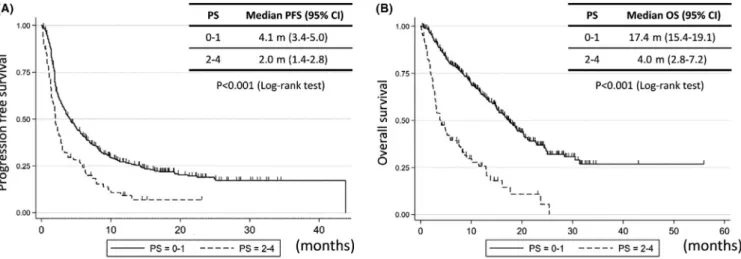
Patients with PS 0-1 had a significantly longer PFS than patients with PS 2-4 (median PFS, 4.1 vs 2.0 months, respectively, P < .001; Figure 1A). Univariate (hazard ratio [HR], 1.819; 95% confidence in-terval [CI], 1.404-2.357) and multivariate analyses (HR, 1.908; 95% CI, 1.465-2.484) indicated that a PS of 2-4 was an independent fac-tor predicting poor PFS (Table 2A).
Similarly, patients with a worse PS had a significantly shorter OS. The median OS in patients with a PS of 0-1 and 2-4 was 17.4 and 4.0 months, respectively (Figure 1B). The OS was significantly shorter in patients in the PS 2-4 group than in the PS 0-1 group (P < .001). Univariate (HR, 3.526; 95% CI, 2.641-4.709) and multivar-iate analyses (HR, 3.914; 95% CI, 2.908-5.269) revealed that a PS of 2-4 was an independent factor predicting short OS (Table 2B).
To obtain further insight into the impact of PS on ICI therapy outcome, we stratified patients into 4 groups according to their PS (PS 0, 1, 2, and 3-4) and undertook survival analysis for each patient group (Figure 2). The median PFS times in patients in the PS 0, 1, 2, and 3-4 groups were 6.9, 3.5, 2.3, and 1.1 months, respectively (Figure 2A). Furthermore, PFS was significantly shorter in patients with PS 1, 2, and 3-4 than patients with PS 0 (PS 1 vs PS 0: HR, 1.336; 95% CI, 1.031-1.732; P = .026; PS 2 vs PS 0: HR, 1.451; 95% CI, 1.214-1.734; P < .001; PS 3-4 vs PS 0: HR, 2.410; 95% CI, 1.772-3.277; P < .001). Similarly, OS was significantly shorter in patients with worse PS (Figure 2B). The median OS times in patients with PS 0, 1, 2, and 3-4 were 20.4, 15.5, 5.0, and 1.9 months, respectively (PS 1 vs PS 0: HR, 1.536; 95% CI, 1.092-2.160; P = .014; PS 2 vs PS 0: HR, 2.088; 95% CI, 1.682-2.593; P < .001; PS 3-4 vs PS 0: HR, 4.619; 95% CI, 3.034-7.032, P < .001).
3.3 | Characteristics of PS 2 patients who benefited
from ICI therapy
Although patients with PS 2 or higher had worse survival after ICI therapy than those with PS less than 2, some patients with PS 2 responded to ICI treatment, achieving disease control for more than 1 year. By contrast, all patients with PS 3-4 experienced disease progression or death in less than 10 months (Figure 2A). These observations suggest that certain patients with PS 2 could benefit from ICI therapy, despite their poor PS. Hence, we sought to assess the characteristics of patients with PS 2 who benefited from ICI therapy. Because the efficacies of pembrolizumab as a first-line treatment for NSCLC patients with PD-L1 expression of 50% or higher and that of any ICIs as second- or later-line treat-ments irrespective of PD-L1 expression in NSCLC patients are quite different, we stratified patients according to treatment strat-egy and compared the outcomes of patients with PS 2 and PS 0-1
(Figure S1). Cohort 1 included patients with NSCLC (PD-L1 expres-sion 50% or higher) treated with pembrolizumab as first-line treat-ment (Table S1), whereas cohort 2 included NSCLC patients with any PD-L1 expression who were treated with any ICI as second- or later-line therapy (Table S2).
Among patients with NSCLC with PD-L1 expression of 50% or higher who were treated with pembrolizumab as first-line therapy (cohort 1), the median PFS for patients with PS 2 was 7.3 months (95% CI, 1.5-11.4 months), whereas that of patients with PS 0-1 was 8.1 months (95% CI, 4.8 months–not reached) (Figure 3A). There was no significant difference in PFS between patients with PS 2 and PS 0-1 (P = .321). However, patients with PS 3-4 had a PFS of 1.0 month (95% CI, 0.3 months-not reached) (Figure 3A), which was significantly worse than that of PS 0-1 patients (P < .001). Similar findings were observed for the OS (Figure 3B). The 1-year OS rates in patients with PS 2 and those with PS 0-1 were 53.0% (95% CI, 20.9%–77.3%) and 69.7% (95% CI, 55.9%–79.9%), respectively. The
PS 0-1 (n = 448) PS 2-4 (n = 79)
P
value
PS (0/1/2/3/4) 103/345/0/0/0 (23/77/0/0/0) 0/0/64/13/2 (0/0/81/16/3) <.001
Median age, years
(range) 69 (28-96) 70 (37-87) Gender (male/ female) 352/96 (79/21) 64/15 (81/19) .765 Staging (recurrence/IIIB or IV) 131/317 (29/71) 18/61 (23/77) .279 Histology (Ad/Sq/ others) 286/129/33 (64/29/7) 51/20/8 (65/25/10) .563 Driver mutation (EGFR/ALK/WT or undetermined) 51/4/393 (11/1/88) 8/0/71 (10/0/90) .921 PD-L1 expression (0%-49%/50% or more/unknown) 115/113/220 (26/25/49) 15/22/42 (19/28/53) .462 Smoking status (never/ex or current/ unknown) 84/361/3 (18/81/1) 10/67/2 (13/84/3) .117 Treatment line (1st/2nd/3rd or more) 74/155/219 17/35/48) 17/30/32 (22/38/41) .325 Immune checkpoint inhibitors (Pem/ Nivo/Ate) 128/317/3 (29/70/1) 28/51/0 (35/65/0) .427 Median BMI (range) 21.6 (13.6-34.4) 20.1 (12.4-28.5) .001a
Abbreviations: Ad, adenocarcinoma; ALK, anaplastic lymphoma kinase; Ate, atezolizumab; BMI, body mass index; EGFR, epidermal growth factor receptor; Nivo, nivolumab; PD-L1, programmed cell death ligand 1; Pem, pembrolizumab; Sq, squamous cell carcinoma.
aData are shown as median (range) or n (%).
at test. TA B L E 1 Characteristics of 527
patients with non-small-cell lung cancer treated with immune checkpoint inhibitors, grouped according to ECOG performance status (PS)
log-rank test revealed that there were no significant differences in these outcomes between the 2 groups (P = .148). In contrast, patients with PS 3-4 showed significantly worse OS than those with PS 0-1 (P < .001) (Figure 3B). These data suggest that there is a potential clinical benefit of pembrolizumab in NSCLC patients with PS 2 and PD-L1 of 50% or higher when used as a first-line treatment.
Among the patients in cohort 2, patients with PS 2 had a signifi-cantly shorter PFS compared to patients with PS 0-1 (median PFS, 2.0 vs 3.5 months, respectively; 95% CI, 1.6-2.8 vs 2.9-4.3 months;
P < .001) (Figure 3C). The median OS and 1-year OS rates were
4.7 months (95% CI, 3.0-8.2 months) and 26.0% (95% CI, 14.5-39.2%), respectively, in patients with PS 2, whereas patients with PS 0-1 had median OS and 1-year OS rates of 16.7 months (95% CI, 14.9-18.8 months) and 62.9% (95% CI, 57.4-67.9%), respectively. Patients with PS 2 had a significantly shorter OS than those with PS 0-1 (P < .001). Patients with PS 3-4 had significantly shorter PFS and OS (median PFS, 1.1 months, P < .001; median OS, 1.7 months, P < .001; Figure 3C,D).
3.4 | Incidence of adverse effects is not higher in
NSCLC patients with PS 2
Table 3 shows the adverse events (AEs) experienced by the NSCLC patients treated with ICIs. Adverse events of any grade were significantly less frequent in patients with PS 2 than in those with PS 0-1 (21.9% vs 34.8%, P = .047). Grade 3/4 AEs were observed in 37 patients (8.3%) in the PS 0-1 group and 9 patients (14.1%) in the PS 2 group. This difference was not sta-tistically significant (P = .157). Any grade and grade 3/4 AEs were observed in 26.7% and 6.7% of PS 3-4 patients, respec-tively; the incidence of any grade and grade 3/4 AEs did not dif-fer significantly between PS 3-4 and PS 0-1 patients (P = .593 and P = 1.000, respectively).
4 | DISCUSSION
In the present study, we showed that, when given as a first-line treatment, pembrolizumab could provide a clinical benefit in NSCLC patients with PS 2 and PD-L1 expression of 50% or higher.
In this study, we found that PFS and OS were significantly shorter in NSCLC patients with worse PS. Previous retrospective studies investigating the efficacy of ICIs in patients with poor PS support our findings. Ahn et al reported a retrospective study of 155 patients, including 34 patients with PS 2 or 3, and showed that patients with PS 2 or 3 who were treated with ICIs had significantly shorter OS than patients with PS 0-1.11 Ichiki et al12 also found
that patients with PS 2 had significantly shorter OS than patients with PS 0-1 in a retrospective study of 44 ICI-treated patients, 6 of whom had a PS of 2. Fujimoto et al also showed that patients with PS 2 or higher had significantly shorter PFS than patients with PS 0-1 in a retrospective study of 613 nivolumab-treated patients (in-cluding 141 patients with PS 2 or higher).13 Across these studies,
patients with poor PS consistently experienced poor outcomes after ICI therapy.
Patients with PS 3-4 had a significantly lower BMI in our study (Table 1). Several studies showed that low BMI was associated with poor outcomes in patients treated with ICIs.10 Preclinical studies
have reported that adipose tissue secretes various proinflamma-tory cytokines and chemokines, including leptin, tumor necrosis factor-alpha, and Interleukin-6.14-17 Additionally, obesity has been
linked to PD-1-mediated T cell dysfunction and increased respon-siveness to anti-PD-1/PD-L1 therapy.18 Poor outcomes after ICI
therapy in patients with poor PS might be due to cachexia and lower fat content.
Despite the increasing evidence linking poor PS to worse ICI outcomes, no study has assessed the clinical benefit of first-line pembrolizumab treatment in NSCLC patients with poor PS and PD-L1 expression of 50% or higher. Therefore, it remained unclear whether patients with NSCLC with PD-L1 expression of 50% or
F I G U R E 1 A, Progression-free survival (PFS) of patients with non-small-cell lung cancer treated with immune checkpoint inhibitors with
performance status (PS) of 0-1 (solid line, n = 448) and 2-4 (dashed line, n = 79). B, Overall survival (OS) of patients with PS 0-1 (solid line, n = 448) and PS 2-4 (dashed line, n = 79). CI, confidence interval
higher and poor PS should be treated with ICIs. Our study included NSCLC patients with PD-L1 of 50% or higher who were treated with pembrolizumab as a first-line treatment. Within this cohort,
we found no significant differences in PFS or OS between patients with PS 2 and PS 0-1 (Figure 3A,B), implying that pembrolizumab has a potential clinical benefit even in patients with a PS of 2.
Univariate analysis Multivariate analysis
HR 95% CI P value HR 95% CI P value (A) Gender Female 1.350 1.071-1.701 .011 0.903 0.617-1.322 .601 Male 1.000 1.000 Staging III or IV 1.470 1.175-1.840 .001 1.502 1.198-1.883 <.001 Recurrence 1.000 1.000 EGFR mutation Positive 2.009 1.509-2.673 <.001 1.598 1.176-2.170 .003 WT or undetermined 1.000 1.000 Smoking Ex or current 0.615 0.483-0.783 <.001 0.623 0.418-0.930 .021 Never 1.000 1.000 PS 2-4 1.819 1.404-2.357 <.001 1.908 1.465-2.484 <.001 0-1 1.000 1.000 Treatment line 2nd line or later 1.685 1.262-2.250 <.001 1.690 1.258-2.270 <.001 1st line 1.000 1.000 (B) Gender Female 1.050 0.786-1.403 .741 0.638 0.384-1.063 .084 Male 1.000 1.000 Staging III or IV 1.377 1.046-1.813 .023 1.363 1.033-1.798 .029 Recurrence 1.000 1.000 EGFR mutation Positive 1.356 0.958-1.918 .086 1.203 0.821-1.764 .344 WT or undetermined 1.000 1.000 Smoking Ex or current 0.783 0.579-1.060 .113 0.554 0.324-0.949 .031 Never 1.000 1.000 PS 2-4 3.526 2.641-4.709 <.001 3.914 2.908-5.269 <.001 0-1 1.000 1.000 Treatment line 2nd line or later 1.463 0.999-2.141 .050 1.526 1.036-2.248 .033 1st line 1.000 1.000
Abbreviations: CI, confidence interval; EGFR, epidermal growth factor receptor; HR, hazard ratio; PS, performance status.
TA B L E 2 Factors associated with (A)
progression-free survival and (B) overall survival in patients with non-small-cell lung cancer treated with immune checkpoint inhibitors
F I G U R E 2 A, Progression-free survival (PFS) of patients with non-small-cell lung cancer treated with immune checkpoint inhibitors
with performance status (PS) 0 (solid line, n = 103), PS 1 (dashed line, n = 345), PS 2 (dotted line, n = 64), or PS 3-4 (dashed and dotted line, n = 15). B, Overall survival (OS) of patients with PS 0 (solid line, n = 103), PS 1 (dashed line, n = 345), PS 2 (dotted line, n = 64), or PS 3-4 (dashed and dotted line, n = 15). CI, confidence interval
F I G U R E 3 A, B, Progression-free survival (PFS) (A) and overall survival (OS) (B) of non-small cell lung cancer patients with programmed
death-ligand 1 (PD-L1) expression ≥ 50% and performance status (PS) 0-1 (solid line, n = 68), PS 2 (dashed line, n = 11), or PS 3-4 (dotted line, n = 6), after first-line pembrolizumab treatment (cohort 1). C, D, PFS (C) and OS (D) of patients with PS 0-1 (solid line, n = 374), PS 2 (dashed line, n = 53), or PS 3-4 (dotted line, n = 9) after treatment with any immune checkpoint inhibitor as second- or later-line therapy irrespective of PD-L1 expression (cohort 2). CI, confidence interval; NR, not reached
Admittedly, the survival of patients with PS 0-1 seemed to be bet-ter than that of patients with PS 2, although the difference was not statistically significant. The use of pembrolizumab as a first-line treatment for patients with PS 2 led to a markedly higher survival rate than chemotherapy, which has been reported to provide a median OS of 3-6 months and a 1-year OS rate of 10%-40%.19,20
Even though the estimated median OS survival was not reached for these patients, the 1-year OS rate was higher than 50% in PD-L1-high NSCLC patients with PS 2 who received pembrolizumab as a first-line treatment.
However, among patients treated with any ICI as a second- or later-line treatment, patients with PS 2 had significantly inferior PFS and OS compared with patients with PS 0-1. Within this co-hort, the median PFS of patients with PS 2 was only 2.0 months, whereas the median OS was 4.7 months. These findings are similar to those of a retrospective study in which nivolumab was given to 63 patients, including 20 patients with PS 2. That study reported a median PFS of 65 days and a median OS of 95 days for patients with PS 2.21 Therefore, the clinical significance of ICI therapy as a
second- or later-line treatment for NSCLC patients with PS 2 remains controversial.
Importantly, NSCLC patients with PS 2 did not show a higher incidence of AEs of any grade after treatment with ICIs (Table 3). Nevertheless, it should be noted that the duration of treatment was shorter in patients with PS 2 than in those with PS 0-1 (Figure 2A), which could partly explain the lower frequency of AEs in patients with PS2. Therefore, these results need to be interpreted cautiously.
There are some limitations to this study. First, this study was retrospective; thus, the patient data were heterogeneous, and the results should be interpreted with caution. Second, to confirm the efficacy of ICIs in patients with poor PS, comparative analyses be-tween patients with and without ICI treatment are necessary; how-ever, our study lacked data from patients who did not receive ICIs. Finally, the combination of ICIs and chemotherapy is currently the first-line treatment for NSCLC22,23; nevertheless, our analyses did
not include patients treated with combination therapy as the data used were obtained prior to the approval of the combination ther-apy. Therefore, whether the combination of ICI and chemotherapy is safe and effective for patients with PS 2 remains unclear. Given that chemotherapy outcomes are inferior in patients with PS 2 than in those with better PS, the use of ICI and chemotherapy as a combina-tion therapy should be undertaken with care.
In conclusion, we undertook a retrospective analysis of 527 NSCLC patients who were treated with ICIs. Although poor PS was significantly associated with worse outcomes in these patients, pem-brolizumab could be considered as a first-line treatment option for PD-L1-high NSCLC patients.
CONFLIC T OF INTEREST
E. Ichihara received honoraria from Boehringer Ingelheim and ad-ditional research funding from MSD. K. Hotta received honoraria from Taiho Pharmaceutical and Chugai Pharmaceutical, and ad-ditional research funding from MSD and Chugai Pharmaceutical. T. Maeda received honoraria from Chugai Pharmaceutical and Bristol-Myers Squibb. K. Kiura received honoraria from Chugai Pharmaceutical. All other authors declare no conflicts of interest regarding this study.
ETHICAL CONSIDER ATIONS
This study was approved by the ethics committee of each institution.
ORCID
Hirohisa Kano https://orcid.org/0000-0003-4327-7547
Eiki Ichihara https://orcid.org/0000-0002-2966-106X
Katsuyuki Hotta https://orcid.org/0000-0002-0112-0843
REFERENCES
1. Borghaei H, Paz-Ares L, Horn L, et al. Nivolumab versus docetaxel in advanced nonsquamous non-small-cell lung cancer. N Engl J Med. 2015;373(17):1627-1639.
PS 0-1 (n = 448) PS 2 (n = 64) PS 3-4 (n = 15)
Any grade Grade ≥3 Any grade Grade ≥3 Any grade Grade ≥3
Pneumonitis 38 (8.5) 11 (2.5) 3 (4.7) 3 (4.7) 0 (0.0) 0 (0.0) Colitis 20 (4.5) 5 (1.1) 1 (1.6) 1 (1.6) 1 (6.7) 0 (0.0) Rash 28 (6.3) 5 (1.1) 2 (3.1) 0 (0.0) 0 (0.0) 0 (0.0) Hypo/hyperthyroidism 32 (7.1) 0 (0.0) 2 (3.1) 1 (1.6) 1 (6.7) 0 (0.0) Liver dysfunction 14 (3.1) 6 (1.3) 1 (1.6) 0 (0.0) 2 (13.3) 1 (6.7) Neuropathy 4 (0.9) 0 (0.0) 1 (1.6) 1 (1.6) 0 (0.0) 0 (0.0) Adrenal insufficiency 8 (1.8) 3 (0.7) 1 (1.6) 1 (1.6) 0 (0.0) 0 (0.0) Lung infection 1 (0.2) 1 (0.2) 2 (3.1) 1 (1.6) 0 (0.0) 0 (0.0) Others 35 (7.8) 9 (2.0) 4 (6.3) 2 (3.1) 0 (0.0) 0 (0.0) Any 156 (34.8) 37 (8.3) 14 (21.9) 9 (14.1) 4 (26.7) 1 (6.7)
Note: Data are shown as n (%). Abbreviation: PS, performance status.
TA B L E 3 Adverse effects of treatment
with immune checkpoint inhibitors in patients with non-small-cell lung cancer
2. Brahmer J, Reckamp KL, Baas P, et al. Nivolumab versus docetaxel in advanced squamous-cell non-small-cell lung cancer. N Engl J Med. 2015;373(2):123-135.
3. Herbst RS, Baas P, Kim DW, et al. Pembrolizumab versus docetaxel for previously treated, PD-L1-positive, advanced non-small-cell lung cancer (KEYNOTE-010): a randomised controlled trial. Lancet. 2016;387(10027):1540-1550.
4. Scagliotti GV, Parikh P, Von Pawel J, et al. Phase III study comparing cisplatin plus gemcitabine with cisplatin plus pemetrexed in che-motherapy-naive patients with advanced-stage non-small-cell lung cancer. J Clin Oncol. 2008;26(21):3543-3551.
5. Park K, Tan EH, O’Byrne K, et al. Afatinib versus gefitinib as first-line treatment of patients with EGFR mutation-positive non-small-cell lung cancer (LUX-Lung 7): a phase 2B, open-label, randomised controlled trial. Lancet Oncol. 2016;17(5):577-589.
6. Asmis TR, Ding K, Seymour L, et al. Age and comorbidity as inde-pendent prognostic factors in the treatment of non-small-cell lung cancer: a review of National Cancer Institute of Canada Clinical Trials Group Trials. J Clin Oncol. 2008;26(1):54-59.
7. Simmons CP, Koinis F, Fallon MT, et al. Prognosis in advanced lung cancer – a prospective study examining key clinicopathological fac-tors. Lung Cancer. 2015;88(3):304-309.
8. Finkelstein DM, Ettinger DS, Ruckdeschel JC. Long-term survivors in metastatic non-small-cell lung cancer: An Eastern Cooperative Oncology Group study. J Clin Oncol. 1986;4(5):702-709.
9. Bonomi P, Gale M, Rowland K, et al. Pre-treatment prognos-tic factors in stage III non-small cell lung cancer patients receiv-ing combined modality treatment. Int J Radiat Oncol Biol Phys. 1991;20(2):247-252.
10. Ichihara E, Harada D, Inoue K, et al. The impact of body mass index on the efficacy of anti-PD-1/PD-L1 antibodies in patients with non-small cell lung cancer. Lung Cancer. 2020;139:140-145.
11. Ahn BC, Pyo KH, Xin CF, et al. Comprehensive analysis of the char-acteristics and treatment outcomes of patients with non-small cell lung cancer treated with anti-PD-1 therapy in real-world practice. J Cancer Res Clin Oncol. 2019;145(6):1613-1623.
12. Ichiki Y, Taira A, Chikaishi Y, et al. Prognostic factors of advanced or postoperative recurrent non-small cell lung cancer targeted with immune checkpoint inhibitors. J Thorac Dis. 2019;11(4):1117-1123. 13. Fujimoto D, Yoshioka H, Kataoka Y, et al. Efficacy and safety of
nivolumab in previously treated patients with non-small cell lung cancer: a multicenter retrospective cohort study. Lung Cancer. 2018;119:14-20.
14. Ouchi N, Parker JL, Lugus JJ, Walsh K. Adipokines in inflammation and metabolic disease. Nat Rev Immunol. 2011;11(2):85-97.
15. Santos-Alvarez J, Goberna R, Sánchez-Margalet V. Human leptin stimulates proliferation and activation of human circulating mono-cytes. Cell Immunol. 1999;194(1):6-11.
16. Hotamisligil GS, Shargill NS, Spiegelman BM. Adipose expression of tumor necrosis factor-alpha: direct role in obesity-linked insulin resistance. Science. 1993;259(5091):87-91.
17. Fried SK, Bunkin DA, Greenberg AS. Omental and subcutaneous adipose tissues of obese subjects release interleukin-6: depot dif-ference and regulation by glucocorticoid. J Clin Endocrinol Metab. 1998;83(3):847-850.
18. Wang Z, Aguilar EG, Luna JI, et al. Paradoxical effects of obesity on T cell function during tumor progression and PD-1 checkpoint blockade. Nat Med. 2019;25(1):141-151.
19. Langer CJ, Li S, Schiller J, Tester W, Rapoport BL, Johnson DH. Randomized phase II trial of paclitaxel plus carboplatin or gemcit-abine plus cisplatin in Eastern Cooperative Oncology Group perfor-mance status 2 non-small-cell lung cancer patients: ECOG 1599. J Clin Oncol. 2007;25(4):418-423.
20. Zukin M, Barrios CH, Pereira JR, et al. Randomized phase III trial of single-agent pemetrexed versus carboplatin and pemetrexed in patients with advanced non-small-cell lung cancer and Eastern Cooperative Oncology Group performance status of 2. J Clin Oncol. 2013;31(23):2849-2853.
21. Katsura H, Suga Y, Araya T, et al. Efficacy and safety of nivolumab in patients with advanced non-small-cell lung cancer and poor per-formance status. J Cancer. 2019;10(10):2139-2144.
22. Gandhi L, Rodríguez-Abreu D, Gadgeel S, et al. Pembrolizumab plus chemotherapy in metastatic non-small-cell lung cancer. N Engl J Med. 2018;378(22):2078-2092.
23. Socinski MA, Jotte RM, Cappuzzo F, et al. Atezolizumab for first-line treatment of metastatic nonsquamous NSCLC. N Engl J Med. 2018;378(24):2288-2301.
SUPPORTING INFORMATION
Additional supporting information may be found online in the Supporting Information section.
How to cite this article: Kano H, Ichihara E, Harada D, et al.
Utility of immune checkpoint inhibitors in non-small-cell lung cancer patients with poor performance status. Cancer Sci. 2020;00:1–8. https://doi.org/10.1111/cas.14590