第 55 卷 第 2 期
2020 年 4 月
JOURNAL OF SOUTHWEST JIAOTONG UNIVERSITY
Vol. 55 No. 2
Apr. 2020
ISSN: 0258-2724 DOI:10.35741/issn.0258-2724.55.2.22
Research articleComputer and Information Science
G
REENFLY
A
PHID
S
WARM
O
PTIMIZATION
A
LGORITHM
绿色蚜虫群体优化算法
Hanan A.R. Akkar, Sameem Abbas Salman
Electrical Engineering Department, University of Technology Baghdad, Iraq
[email protected], [email protected]
Received: September 22, 2019 ▪ Review: January 18, 2019 ▪ Accepted: February 27, 2020
This article is an open access article distributed under the terms and conditions of the Creative Commons Attribution License (http://creativecommons.org/licenses/by/4.0)
Abstract
A new metaheuristic swarm intelligence optimization technique, called general greenfly aphid swarm optimization algorithm, which is proposed by enhancing the performance of swarm optimization through cockroach swarm optimization algorithm. The performance of 23 benchmark functions is tested and compared with widely used algorithms, including particle swarm optimization algorithm, cockroach swarm optimization and grasshopper optimization algorithm. Numerical experiments show that the greenfly aphid swarm optimization algorithm outperforms its counterparts. Besides, to demonstrate the practical impact of the proposed algorithm, two classic engineering design problems, namely, pressure vessel design problem and himmelblau’s optimization problem, are also considered and the proposed greenfly aphid swarm optimization algorithm is shown to be competitive in those applications.
Keywords: Greenfly Aphid Swarm Optimization, Particle Swarm Optimization, Cockroach Swarm Optimization, Grasshopper Optimization Algorithm
摘要 通过蟑螂群优化算法提高群优化性能,提出了一种新的启发式群智能优化技术,称为通用蚜 虫群优化算法。测试了23个基准功能的性能,并与包括粒子群优化算法,蟑螂群优化和蚱料斗优 化算法在内的广泛使用的算法进行了比较。数值实验表明,蚜虫蜂群优化算法的性能优于同类方 法。此外,为了演示该算法的实际影响,还考虑了两个经典的工程设计问题,即压力容器设计问 题和himmelblau的优化问题,并且所提出的蚜虫蜂群优化算法在这些应用中具有竞争力。 关键词: 绿蝇蚜群优化,粒子群优化,蟑螂群优化,蚱草优化算法
I. I
NTRODUCTIONIn the past decade, various optimization algorithms have been proposed and applied to different research fields. Procedures may vary to
solve different optimization problems, but the following questions need to be considered in advance before selecting the optimization algorithm: (1) Parameters of the problem. The
problem can be divided into continuous or discrete depending on the parameters. (2) Constraints of variables. Optimization problems can be classified into constrained and unconstrained ones based on the type of constraints [1]. (3) The cost function of a given problem. The problem can be divided into single-objective and multi-single-objective problems [2]. Based on the above three points, we need to select the optimization algorithm according to the parameter type, constraint and target number. The development of optimization algorithms is relatively mature at present, and many excellent optimization algorithms have been applied in various fields. We can divide the optimization algorithms into two categories: gradient-based methods and meta-heuristic algorithms. For simple problems such as continuous and linear problems, some classical algorithm gradient algorithms can be utilized, such as Newton's method [3], truncated gradient method [4], gradient descent method [5], etc. For more complex problems, meta-heuristics such as genetic algorithm [6], ant colony algorithm [7] and particle swarm optimization algorithm [8] can be considered. And the meta-heuristic algorithm becomes very popular because of its stability and flexibility and its ability to better avoid local optimization [9]. People usually divide the meta-heuristic algorithm into three types, which are based on the principles of biological evolution, population and physical phenomena. The evolutionary approach is inspired by the concept of natural evolution. The population-based optimization algorithm is mainly inspired by the social behavior of animal groups, while the physical phenomenon based method mainly imitates the physical rules of the universe [10]. Table 1 summarizes the algorithms included in each category.
Table 1. Algorithm classification Meta-heuristic algorithms Evolutionary algorithms Genetic algorithm [6] Geneticprogramming [11] Biogeography-based optimizer [12] Evolution strategies [13] Probability-based incremental1 learning1 [14] Physics-based algorithms Gravitational search algorithm [15] Central force optimization [16] Charged system search [17] Simulated annealing [18] Big-bang big-crunch [19] Gravitational local search [20] Galaxy-based search algorithm [21] Small-world optimization algorithm [22] Curved space optimization [23] Black hole algorithm [24] Artificial chemical reaction optimization algorithm [25] Ray optimization algorithm [26] Swarm-based algorithms Particle swarm optimization algorithm [8] Termite algorithm [27] Cuckoo search [28] Honey bees optimization algorithm [29] Cockroach swarm optimization [30] Grasshopper optimization algorithm [31] Dolphin partner optimization [32] Fruit fly optimization algorithm [33] Bee collecting pollen algorithm [34] Bird mating optimizer [35]
Firefly algorithm [36] Artificial fish-swarm algorithm [37]
In the face of so many existing meta-optimization algorithms, a concern naturally rises. So far, there have been many different types of optimization algorithms. Why do we need more algorithms? We will mention that there is no free lunch (NFL) [38] theorem, no matter how smart or how clumsy the optimization algorithm is, their performance is logically equivalent. That is, there is no optimization algorithm that can solve all optimization problems. This theorem makes the number of algorithms increase rapidly over the past decade, which is one of the motivations of this paper.
In this paper, a new optimization, namely Greenfly Aphid Swarm Optimization (GASO) algorithm, is proposed by combining cockroach swarm mechanism with group optimization algorithm. The rest of the paper is structured as follows. Section 2 describes the Greenfly Aphid Swarm Optimization algorithm developed in this study. Section 3 tests the performance of the algorithm on the unimodal functions, multimodal functions and fixed-dimension multimodal
functions. Section 4 applies the GASO algorithm to the multi-objective problems to further test the performance of the algorithm. Section 5 draws conclusions.
II. G
REENFLYA
PHIDS
WARMO
PTIMIZATIONA
LGORITHM(GASO)
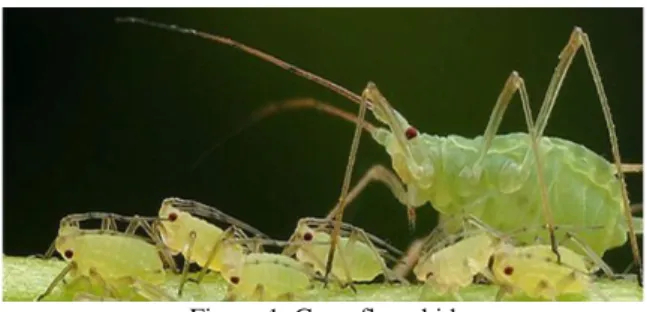
Insects have a shifting chemical sensory system that senses various environmental stimuli and guides their behavior [39], [40]. The antennae of insects are important chemical receptors. They mainly playolfactory and tactile effects, and some even have an auditory function. They can help insects communicate, find the opposite sex, find food and choose spawning sites [41]. People often use this property of insects to release substances with specific volatile odors to attract or evade insects harmful to plants [42]. The greenfly aphid shown in Figure 1 is characterized by two antennae, sometimes up to two times the length of its body. This kind of antenna has two basic functions: one is to explore the surrounding environment. For example, when encountering an obstacle, the feeler can perceive its size, shape, and hardness. The second is to capture the smell of food or find potential mates by swinging the body’s antenna. When a higher concentration of odor is detected on one side of the antenna, the insect will rotate in the same direction, otherwise, it will turn to the other side. According to this simple principle, greenfly aphid can effectively find food [43]. With the continuous deepening of the experiment, we found that the performance of the cockroach swarm optimization (CSO) algorithm in dealing with high-dimensional functions is not very satisfactory, and the iterative result is very dependent on the initial position of the cockroach. In other words, the choice of an initial position greatly affects the efficiency and effectiveness of optimization. Inspired by the swarm optimization algorithm, we have made further improvements to the CSO algorithm by expanding an individual to a group. The greenfly-aphid Algorithm can automatically realize the optimization process without knowing the specific form of the function and gradient information. The major advantage of the GASO is the lesser complexity involved in its design and in its ability to solve the optimization problem in less time and high accuracy. When using GASO to optimize nonlinear systems, a simple two-step building procedure is employed as follows: (i) model the searching behavior; (ii) formulate the behavior of detecting.
Figure 1. Greenfly aphid
In this algorithm, the position of aphid at time ( ) is denoted as , denote the concentration of odor at position to be known as a fitness function, where the maximum (or minimum) value corresponds to the point of odor source. Each aphid represents a potential solution to the optimization problem, and each aphid corresponds to a fitness value determined by the fitness function. Similar to the particle swarm algorithm, the aphids also share information, but the distance and direction of the aphids are determined by their speed and the intensity of the information to be detected by their two antennae. We borrowed the mathematical idea to GASO from two methods, particle swarm algorithm, and cockroach swarm algorithm. There is a population of aphids
represented as in an
S-dimensional search space, where the th aphid represents an S-dimensional vector , represents the position of the th aphid in the S-dimensional search space, and also represents a potential solution to the problem. According to the target function, the fitness value of each aphid position can be calculated. The speed of the th aphid is
expressed as .The
individual extremity of the aphid is represented
as , and the group
extreme value of the population is represented as . The mathematical model for simulating its behavior is as follows:
(1)
where is the
current number of iterations. is expressed as the speed of aphids, and represents the increase in aphid position movement. is a positive constants.
Then the speed formula is written as [8]: (2)
where are two positive constants, and are two random functions in the range [0,1]. is the inertia weight. In the standard particle swarm optimization (PSO) algorithm, is a fixed constant, but with the gradual improvement of the algorithm, many scholars have proposed a changing inertia factor strategy. This paper adopts the strategy of decreasing inertia weight, and the formula is as follows:
(3) where and respectively represent the minimum and maximum value of . and are the current number of iterations and the maximum number of iterations. In this paper, the maximum value of is set to 0.9, and the minimum value is set to 0.4, so that the algorithm can search a larger range at the beginning of evolution and find the optimal solution area as quickly as possible. As gradually decreases, the aphids speed decreases and then enters local search. The function, which defines the incremental function, is calculated as follows:
(4) In this step, we find a high dimension mechanism formula to detect the behavior of aphid. indicates step size. represents a sign function. The search behaviors of the right antenna and the left antenna are respectively expressed as:
(5) where represents the distance between the two antennae. In general, we set the initial step length as a constant, and the initial step length increases as the fitness function dimension increases. To simplify the parameter turning furthermore, we also construct the relationship between searching distance and step size as follows:
(6) (7) where , and are constants to be adjusted by designers, we recommend eta’s value is 0.95.
b
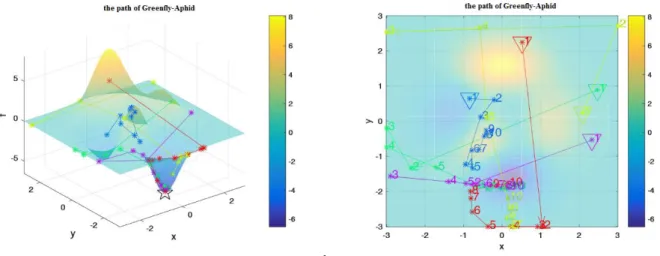
Figure 3. Greenfly-aphids search path in (a) 2D space and (b) 3D space Figure 3 shows the trajectories of the
greenfly-aphid swarm in two-dimensional and three-dimensional space, respectively. To represent the search path more visually, we used a small population size and showed the location change process of 10 iterations in 3D space. Because factors such as step length and inertial weight coefficient are decreasing in the iterative process, the algorithm will not converge to the target point too quickly, thus avoiding the group falling into the local optimum greatly. The GASO algorithm first initializes a set of random solutions. At each iteration, the search agent updates its location based on its own search mechanism and the best solution currently available. The combination of these two parts can not only accelerate the population's iteration speed, but also reduce the probability of the population falling into the local optimum, which is more stable when dealing with high-dimensional problems.
The pseudo-code of the GASO is presented.
A. Procedure
Initialize the swarm
Initialize population speed
Initialize population speed , speed boundary and , population size sizepop and maximum number of iterations
Calculate the fitness of each search agent
While ( < )
Set inertia weight using Eq. 3 Update using Eq. 7
for each search agent
Calculate and using Eq. 5 Update the incremental function by the Eq. 4
Update the speed formula by the Eq. 2 Update the position of the current search agent by the Eq. 1
end for
Calculate the fitness of each search agent Record and store the location of each search agent
for each search agent if
end if if end if end for
Update if there is a better solution Update step factor by the Eq. 7
end while
Return ,
In theory, the GASO algorithm includes exploration and exploitation ability, so it belongs to global optimization. Furthermore, the linear combination of speed and aphid search enhances the rapidity and accuracy of population optimization and makes the algorithm more stable. In the next section, we will examine the performance of the proposed algorithm through a set of mathematical functions.
III. R
ESULTS ANDD
ISCUSSIONIn the optimization field, a set of mathematical functions with optimal solutions is usually used to test the performance of different optimization algorithms quantitatively and the test functions should be diverse so that the conclusions are not too one-sided. In this paper, three groups of test functions with different characteristics are used to benchmark the performance of the proposed algorithm which are unimodal functions, multimodal functions and fixed-dimension multimodal functions [10], [44], [45], [46], [47], [48], [49], [50], [51]. The specific form of the function is given in Tables
2-4, where represents the dimension of the function, Range represents the range of independent variables, that is, the range of
population, and represents the minimum value of the function.
Table 2.
Description of unimodal benchmark functions
Function Dim Range
30 [-100,100] 0 30 [-10,10] 0 30 [-100,100] 0 30 [-100,100] 0 30 [-30,30] 0 30 [-100,100] 0 30 [-1.28,1.28] 0 Table 3.
Description of multimodal benchmark functions
Function Dim Range
30 [-500,500] 0 30 [-5.12,5.12] 0 30 [-600,600] 0 30 [-50,50] 0 30 [-50,50] 0 Table 4.
Description of fixed-dimension multimodal benchmark functions
Function Dim Range
2 [-65,65] 0.998 4 [-5,5] 0 2 [-5,5] -1.03 2 [-5,5] 0.398 2 [-2,2] 3 3 [1,3] -3.86
6 [0,1] -3.32
4 [0,10] -10.15
4 [0,10] -10.42
4 [0,10] -10.56
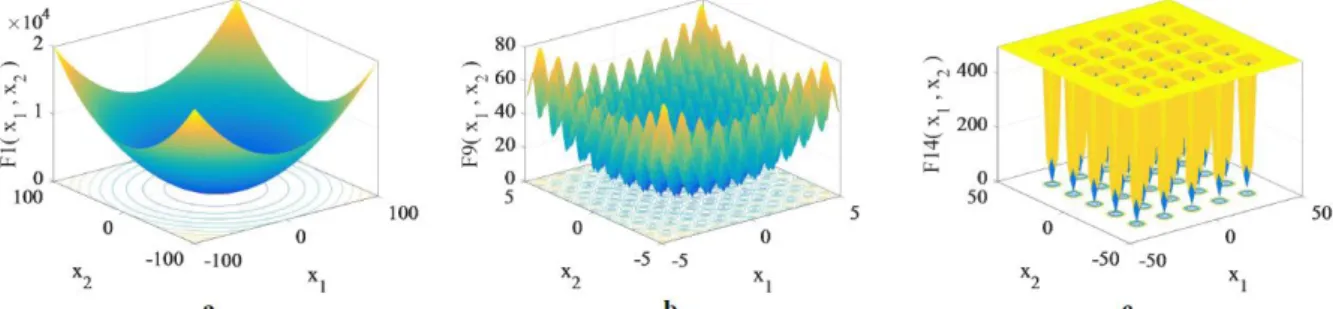
Figure 4 shows the two-dimensional versions of the unimodal function, multimodal function and fixed-dimension multimodal function respectively. The unimodal test function has only one global optimal solution, which is helpful to find the global optimal solution in the search space, and it can test the convergence speed and efficiency of the algorithm well. From Figure 5,
it can also be seen that the multimodal function, and the fixed-dimension multimodal test function have multiple locally optimal solutions, which can be used to test the algorithm to avoid the performance of the local optimal solution, and the fixed-dimension multimodal function compared with unimodal test function is more challenging.
Figure 4. 2-D version functions: (a) unimodal function, (b) multimodal function, (c) fixed-dimension multimodal function In the part of qualitative analysis, six typical
test functions are provided, including optimal trajectory map, contour map and convergence curve of the search path. In the quantitative analysis part, 50 search agents were used, the maximum number of iterations was set to 1000, and each test function was run 30 times to generate statistical results. Quantitative evaluation was performed using the mean, standard deviation, and program performance time of three performance indicators. Statistical results are reported in Table 4. GASO was compared with PSO [8], CSO [30], and grasshopper optimization algorithm (GOA) [31]. A. Qualitative Results and Discussion
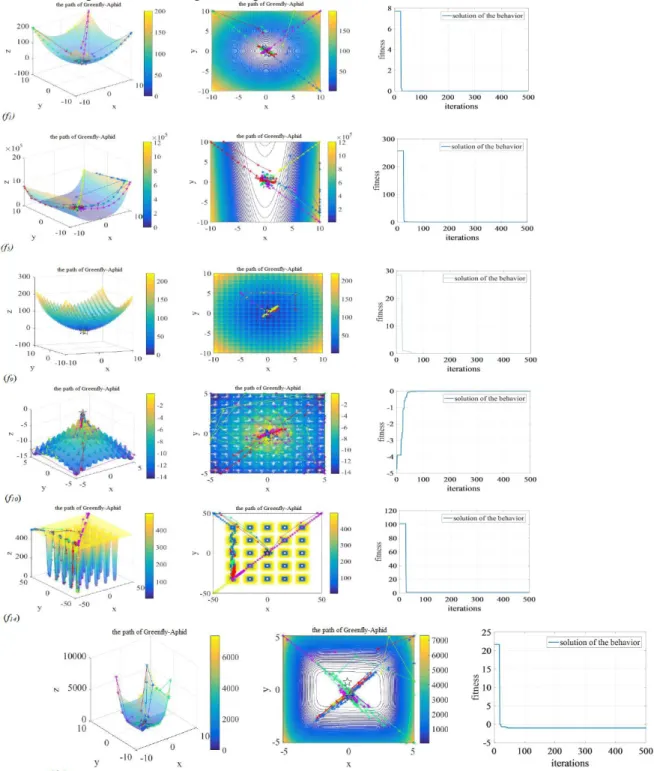
In this paper, six unimodal, multimodal and fixed-dimension multimodal functions are selected to observe the GASO algorithm’s optimization behavior. In order to express the optimization trajectory more intuitively, we use five search agents. Figure 6 shows the optimal trace of each test function, the contour map of the search path, and the convergence curves. The optimal trajectory gives the best aphid
optimization route. Since the initial position of the aphid is randomly generated, the optimal trajectory may be different when reproducing the result. The contour map of the search path can more intuitively display the aphid’s trajectory, and connecting the same -values on the plane makes it easier to observe aphid movements. The convergence curve shows the function value of the best solution obtained so far. From Figure 6 it can be seen that aphids gradually move to the best point and eventually gather around the global best point. This phenomenon can be observed in unimodal, multimodal, and fixed-dimension multimodal functions. The results show that the GASO algorithm has a good balance between exploration and exploitation capabilities to promote the aphid to move to the global optimum. In addition, in order to more clearly represent the trajectory of the aphid, some of the function images are processed. Such as , this paper selects the opposite form and can more intuitively observe the optimal trajectory.
The GASO algorithm of the aphid self-optimization mechanism has been added, which
can more intelligently avoid local optimums. During the optimization process, we found that some aphids always move quickly toward the maximum value, and then reach the maximum value and then perform normal iterations. This mechanism makes the aphid cleverly avoid the local optimum during the optimization process. For unimodal and multimodal functions, the advantage of the self-optimization mechanism is even more pronounced. Figure 5 provides a
convergence curve to further prove that this mechanism can improve the search results. The convergence curve clearly shows the descending behavior of all test functions. Observe that the GASO search agent suddenly changes during the early stage of the optimization process, and then gradually converges. According to Bergh, et al. [52], this behavior ensures that the algorithm quickly converges to the optimal point to reduce the iteration time.
Figure 5. Behavior of GASO on the 2D benchmark problems
B. Quantitative Results and Discussion
The above discussion proves that the proposed algorithm can solve the optimization problem,
but pure qualitative test can not prove the superiority of the algorithm. This section raises the dimensions of test functions other than fixed
dimensions to 30 dimensions and gives quantified results. Table 5 gives the experimental results of the test function. As shown in Table 5, when dealing with the unimodal functions, the processing speed of GASO is comparable to that of PSO, but it is obviously better than CSO and GOA algorithm. In addition, compared with the other three algorithms, GASO algorithm is more stable in performance. Adding the aphid search mechanism in the process of optimization makes the algorithm have better global optimization performance, accelerates the convergence speed of the algorithm, and effectively avoids the phenomenon of “premature”. When dealing with multimode functions, GASO algorithm shows good performance again. Because multimodal functions have multiple local optimal solutions, the results can be directed to show that GASO algorithm is effective and efficient in avoiding local optimal solutions. For the fixed-dimension multimodal functions, the proposed algorithm gives very competitive results. The GASO algorithm has the ability to balance the exploration and exploitation of the individual and can solve more challenging problems.
C. Analysis of Convergence Behavior
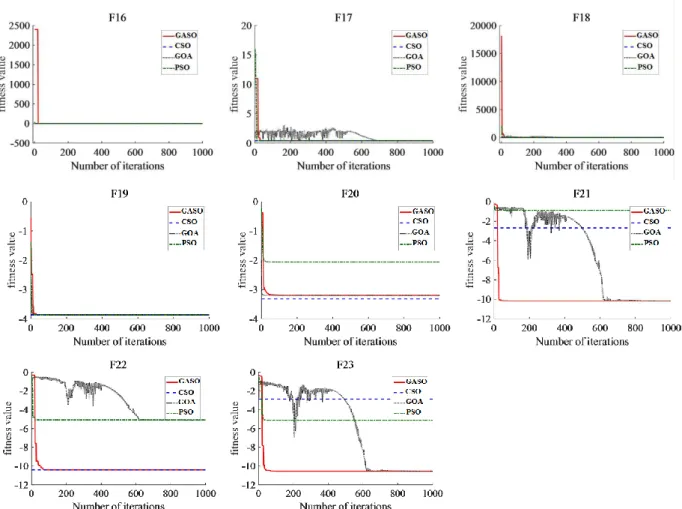
Convergence curves of GASO, CSO, GOA and PSO are compared in Figure 6 for all of the test functions. The figure shows that GASO has good processing ability for unimodal functions, multimodal functions and fixed-dimension functions, and the processing process is very stable. Especially when solving more complex fixed-dimension functions, GASO shows more obvious advantage than other algorithms. It can be seen that GASO is enough competitive with other state of the art metaheuristic algorithms. As a summary, the results of this section revealed different characteristics of the proposed GASO algorithm. Efficient and stable search capabilities benefit from aphids-specific optimization features. The increase in the exploration function of the left and right must greatly improve the stability of the search, making the exploration and exploitation capabilities more balanced, and the GASO can handle better for high-dimensional and more complex problems. Overall, the success rate of the GASO algorithm seems to be higher in solving challenging problems. In the next sections, GASO performance is validated on more challenging multi-objective issues.
Table 5.
The comparison of optimization results obtained for the unimodal, multimodal, and fixed-dimension multimodal functions
F GASO PSO CSO GOA
.0035
Figure 6. Comparison of convergence curves of GASO and other optimization algorithms
IV. GASO
FORM
ULTI-
OBJECTIVEO
PTIMIZATIONIn order to better illustrate the superiority and competitiveness of GASO algorithm in solving constrained optimization problems, two multi-objective functions in GASO algorithm are used in this paper and the results are compared with the results of other algorithms.
A. GASO for a Pressure Vessel Design Problem
As shown in Figure 7, two hemispheres cover the ends of the cylinder to form a pressure vessel. The goal is to minimize the total cost including material costs, welding costs and molding costs [53]:
Figure 7. Schematic of pressure vessel
There are four variables in pressure vessel problem where is the thickness of the shell , is the thickness of the head , is the inner radius , and is the length of the section of the cylinder of the container . and are integral times of , the available thickness of rolled steel plates, and are continuous.
The constraint function can be stated as follows:
Table 6 illustrates the best results obtained by the GASO algorithm just using 100 iterations and
other various existing algorithm to solve the pressure vessel optimization. And most of these results are taken from other articles. The results show that the best results of GASO algorithm are better than most existing algorithms and in the
case where the population number is properly selected (we suggest 50 individuals), the convergence rate is faster and has good robustness. The GASO algorithm iterative process is shown in Figure 8.
Table 6.
Comparisons results for pressure vessel function
Methods [54] [55] -[56] [57] [58] [59] [60] [61] [62] [63] [64] GASO
Figure 8. Iteration process for pressure vessel design problem
B. GASO for Himmelblau’s Optimization Problem
This problem is proposed by Himmelblau [65] and is a common function for nonlinear constrained optimization problems. It is widely used in the optimization field. It consists of five variables, three equality constraints and six inequality constraints. The specific forms are as follows:
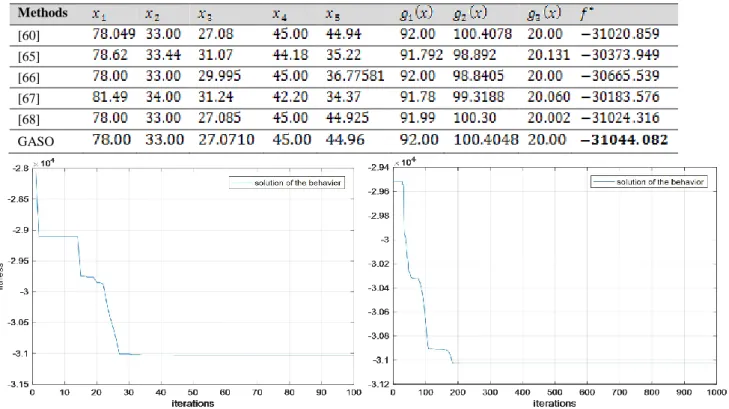
Table 7 shows the performance results of the existing algorithm and the GASO algorithm. The number of iterations is set to 100. Evidently, the best result generated from the GASO shows the most excellent performance among all the results
listed in Table. The above experiments justify that the proposed GASO algorithm is effective to handle constraint optimum problem and could achieve a good performance with high convergence rate. In the experiment process, when the population size is 50 and the number of iterations is 1000, the effect is the most stable. The GASO algorithm iterative process is shown in Figure 9.
Table 7.
Comparisons results for himmelblau function
Methods [60] [65] [66] [67] [68] GASO
Figure 9. Iteration process for himmelblau’s optimization problem
V.
C
ONCLUSIONSThis paper proposes a new metaheuristic swarm algorithm called greenfly aphids group optimization. The algorithm combines the greenfly mechanism with the group optimization algorithm, and establishes a mathematical model and applies it to unimodal functions, multimodal functions, fixed-dimension multimodal benchmark functions. The results show that compared with the current popular optimization algorithms, the GASO algorithm can still give very competitive results, and has good robustness and running speed. In addition, the GASO algorithm also exhibits higher performance when dealing with nonlinear constraints. Compared with other optimization algorithms, GASO can handle multi-objective optimization problems efficiently and stably. Finally, in the research process, we found that the change in step size and speed will affect the efficiency and effectiveness
of GASO optimization. Therefore, in the next work, we will further study the impact of different parameter settings on GASO.
![Table 1. Algorithm classification Meta-heuristic algorithms Evolutionary algorithms Genetic algorithm [6] Genetic programming [11] Biogeography-based optimizer [12] Evolution strategies [13] Probability-based incremental1 learning1 [14] Physics-](https://thumb-ap.123doks.com/thumbv2/123deta/8046306.1255050/2.892.456.788.86.722/algorithm-classification-algorithms-evolutionary-programming-biogeography-probability-incremental.webp)