1.Introduction
With the rapid development of science and technology, especially the globalization in the world, English has become an international language, and now serves as an indispensable tool of international communication. English language education draws many countries’ attention, and it is not unusual to teach English to young learners. Like other countries, China has made great efforts to improve the system of English language education and assessment in the past two decades.
In China, English used to be taught as a subject from junior high school onwards. However, in 2001 the Ministry of Education(MoE, hereafter)required it to be taught as an obligatory subject from primary school to graduate school. Since then, the reform of English language education has taken place. Moreover, English language education has flourished because of China’s accession to the World Trade Organization and also because of China’s being the host country of the 2008 Olympic Games and the 2010 World Exposition. The government, schools and families have paid much more attention to English language education than before.
English testing is an important constituent in the process of English language education. Chinese students have to take numerous tests and examinations at different levels. Besides quizzes and tests at school, they have to pass unified English examinations administered by local education committees or the National Education Examination Authority, an institution directly under the supervision of the MoE, in order to enter senior high school, university, and graduate school. Currently, each year at least60million Chinese university students are learning English and taking English examinations. Unified English examinations are also administered to pre-school children, and also to adults for the selection of government officials, for the promotion of academics and professionals, and for obtaining better paid jobs involving international communication skills.
This paper aims to present a comprehensive picture of English language education and assessment in China to deepen people’s understanding of them, to discuss their hidden problems and to give some suggestions to promote the reform of English language education and assessment.
2.Education System
Before describing the current situation of English language education in China, this paper will present a picture of school education. As Table1shows, children in China enter primary school at the age of six or seven and have primary education for six years. The new school year begins on1st of September. The
children who reach the school age of six before 31st of August will be enrolled in primary school.
Primary school education usually lasts5or6years.
Chinese secondary schools are called middle schools and divided into junior and senior levels. There OF EDUCATION
Volume262011
English Language Education and Assessment in China
ZHOU Lin
*and ITO Harumi
**(Keywords : English language education, English language assessment, China)
**
Research Fellow at Naruto University of Education(from Capital Normal University in China)in 2010
**Naruto University of Education, Language Course(English)
Table1: Education System in China under40
doctoral course,3-4years master’s course,2-3years
19−22 university,4-5years vocational college,2-3years 72.7% 16−18 senior high school,3years vocational school,3years 83.4%
13−15 junior high school,3years 99.7%
6−12 primary school,5-6years
Age Levels Promotion Rate
Table2: Current System of English Language Education in China
Levels Course types Learning hours per week
from grade three at primary school junior high school
senior high school
first two years at college and university last two years at college and university first year at graduate school
last two years at graduate school
obligatory obligatory
obligatory and elective obligatory elective obligatory elective 2-4 4-5 6-7 4-5 2 2-4 2
are three years of junior high school education for ages12to15. Education at primary school and junior high school is compulsory. Senior high school education is for ages16to18.
According to the 2008official statistics, 99.7% of primary school graduates are enrolled into junior high schools. The promotion rates of junior high school graduates and senior high school graduates are 83.4%(including those admitted into vocational schools)and 72.7%(including those admitted into
vocational colleges and continuing education institutes).
Higher education includes vocational college education for two or three years, college education for four or five years, and graduate school education usually for two or three years for master’s degrees and for three or four years for doctoral degrees.
3.English Language Education System
Millions of Chinese students are learning English as the most important foreign language. However, the importance of English language education has not been consistent in China. After the establishment of new China in1949, English as the main foreign language in the country was replaced by Russian in the 1950s. This did not last long and English language education came back to schools again. With the inauguration of the open-door policy in1976, English came to be considered as a tool to communicate with other countries and to facilitate access to modern scientific and technological advances. English remained to be taught as a subject from junior high school. With the progress of globalization in economy and society, many countries have already introduced English language education into primary schools. After having many years of discussion on whether or not to introduce English into primary schools, the MoE issued the document of English Curriculum Standards in 2001, and required primary schools to provide English as a subject.
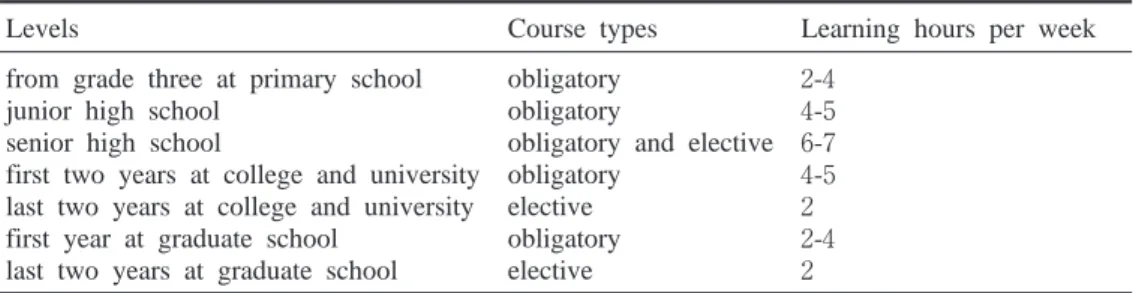
According to the MoE, foreign language education, generally English language education, is an obligatory course from grade three at primary school to graduate school. However, primary schools have the right to provide English language education from grade one. Table2shows the system of English language education in China.
From Table2, we can see that children have2-4English lessons per week at primary school. English
Table3: English Language Teaching Syllabuses in China
Levels Syllabuses by the MoE Issued
primary school junior high school senior high school college and university
for vocational college students for non−English majors for English majors
English Curriculum Standards English Curriculum Standards English Curriculum Standards
English Curriculum Basic Requirements
College English Curriculum Teaching Requirements English Teaching Syllabus
2001 2001 2003 2000 2004 2000 graduate school
for non−English majors for English majors
English Teaching Syllabus for graduate students unknown
1992 unknown
is taught in middle schools throughout the six years, and students generally have4-7English lessons per week. College English language education is obligatory for all the college students and graduate students including those who are enrolled in master’s courses or doctoral courses. College students weekly have4-5 English lessons during their first two years while vocational college students weekly have 2-3 English lessons for2-3terms. Students of graduate schools studying for their master’s degrees or doctor’s degrees have2-3English lessons weekly usually for one year. In the last two years, both undergraduate students and graduate students often have lessons of English for Special Purposes(ESP)as elective lessons.
4.English Syllabuses by the Ministry of Education
The MoE published English syllabuses and English proficiency requirements which range from primary school to graduate school, as Table3shows. English Curriculum Standards issued by the MoE in2001 serves as guidelines for English language education from primary school to senior high school. The belief of English Curriculum Standards is All for Student Development. The differences between traditional English syllabuses and English Curriculum Standards are mainly in goals, teaching methods and assessment.
According to English Curriculum Standards, the goals of English language education are described in terms of five dimensions, that is, knowledge, skills, affects, learning strategies and cultural awareness while traditional English syllabuses focused on knowledge and skills. English language assessment should be used to develop a corresponding system for analyzing test results with high reliability and validity, thus promoting the reform of English language education. Table3gives us a picture of English syllabuses published by the MoE.
During the stage of primary school, the main aims of English language education are to develop students’ interests, self confidence and positive attitudes towards English learning, to cultivate students’ language sense, to enable them to have good pronunciation and intonation, to develop students’ preliminary ability to use English in daily exchanges, and to lay a good basis for further study.
At the stage of junior high school, students’ motivation and active attitudes towards learning English are emphasized. Students are encouraged to listen to and understand familiar topics and take part in discussions. Language skills and learning strategies are required to be developed.
At the stage of senior high school, the general goals of English language education are to let students have a clear and sustained motivation to study English, to develop further effective learning strategies, and to foster the ability of autonomous learning and cooperating learning. Students are required to exchange information and express themselves about a fairly wide range of topics. Much importance is attached to acquiring language skills and learning strategies, assessing their own learning styles, making use of a wide variety of resources, and increasing their understanding and awareness of cultural differences.
At the higher education level, there are also English Curriculum Basic Requirements for vocational
college students, College English Curriculum Teaching Requirements for undergraduate students whose majors are not English, English Teaching Syllabus for undergraduate students whose majors are English and English Teaching Syllabus for graduate students whose majors are not English. These are issued by the MoE. However, colleges and universities independently design their own English syllabuses to meet their specific conditions.
According to English Curriculum Basic Requirements for vocational college published in2000, students are required to master certain English knowledge and skills, including skills for translating business documents with a dictionary, to exchange information in written and spoken English, and to lay a language basis for improving communicative competence in the future. College English Curriculum Teaching Requirements published in 2004 describes teaching goals and requirements, teaching modes, teaching contents and the forms of teaching assessment in details. The teaching goals are to cultivate students’ integrated abilities of using language skills, especially listening and speaking skills, to enable students to effectively exchange information in written and spoken English in their future work and to have the ability of autonomous learning. English Teaching Syllabus was issued in2000. English Teaching Syllabus for graduate students was issued in1992.
On the whole, the goals of English language education at the higher education level are to develop students’ ability to use English in their future work and social interactions and to raise their cultural awareness to meet the needs of China’s social development and international exchanges. On the other hand, traditional English language education focused on grammar and translation with emphasis on the training of students’ reading ability. As the belief of English language education has changed, teaching methods have somewhat changed in the past ten years.
Hughes(2000)claims that teaching and testing have a relationship of partnership, and testing is an essential part in teaching, and has effects on teaching contents or teaching methods. This is called backwash or washback. Bailey(1996)points out that backwash can be positive or negative to the extent that it either promotes or impedes the accomplishment of the educational goals. In the following sections, English language assessment will be discussed.
5.Assessment through Unified English Examinations in China
5.1 General Information about Unified English Examinations
In China, the Chinese language, mathematics and a foreign language, usually English, are three main tested subjects in entrance examinations from junior high school to graduate school.
Table 4 below gives the general information about English language assessment at school and university. The English proficiencies at different stages from primary school to graduate school are regulated by the MoE. According to English Curriculum Standards published in2001, English proficiency
Table4: General information about Unified English Examinations in China
Levels Test guideline Implementation Test time Proficiency
primary school junior high school senior high school college and university
Level B and Level A CET4and CET6 TEM4and TEM8
unknown by local government by local government or the MoE by the MoE by the MoE by the MoE some areas by local government by local government or the MoE by the MoE by the MoE by the MoE unknown 120m 120m 120m 125m 140m and185m Level2 Level5 Level7 B level CET4 TEM4 graduate school
entrance examination for master’s courses entrance examination for doctoral courses degree’s tests for non−English majors
by the MoE by university by the MoE by the MoE by university by university 180m unknown unknown ―291―
is divided into nine levels. Primary school graduates should reach the proficiency of Level2. Level5 applies to junior high school graduates, and Level7applies to senior high school graduates. Level8and Level9are for senior high school students in elective courses. There are also English proficiency requirements at the stage of higher education, which will be explained in the following paragraphs. Based on the English syllabuses, the test guidelines at different stages are issued by the MoE or local governments. Unified tests are carried out by the MoE or by local educational institutions every year, and all of them last more than two hours.
Generally, unified English tests are not held at primary school except in some cities such as Beijing, where primary school students in grade5take a unified English test by the local government. The Entrance Examination for Senior High School is held by local education committees, and is usually held in June every year. Students who expect to study further at senior high school should have very good marks on this examination. The National Higher Education Entrance Examination used to be a unified examination across the country. At present, the test is conducted by the MoE or provinces. The MoE prepares the test every year, and provinces can use it or design their own tests, and more and more provinces have prefered to conduct the examination by themselves since2005. Parents and students spend years preparing for the examination because universities do not give their own tests and the scores students get in the examination will determine which university they can enter. In2003, the MoE enacted the new Regular Senior English Curriculum Standards, which put forward the assessing criteria and principles of English language education. It aims to exert a positive impact on teaching and learning at senior high school.
Unified English tests at the higher education level are administered by the MoE. It is vital for students to pass them. At many universities, passing certain tests means that students can get their academic degrees. Practical English Level B as a basic proficiency and Level A as an advanced proficiency are designed for vocational college students. College English Test(CET, hereafter)for undergraduates whose majors are not English includes CET4and CET6. Undergraduate students are required to take the examination of CET4, and they can apply for CET4several times in order to pass it within the four years. The certificate holders of CET4can apply for CET6. Passing CET6may be a beneficial qualification for students to get a good job. Both Practical English Tests and CETs are administered by the MoE twice a year. in June and December. Tests for English Major Students(TEM, hereafter)designed by the MoE also includes two levels; TEM4and TEM8. Students are asked to take TEM4in their fourth term and TEM8in their eighth term. If they fail to pass TEM4, they cannot take it again during their following academic terms, but they can apply for taking TEM8. Those who fail to pass TEM8are allowed only one re-test during the following year after they graduate from college. A second failure results in disqualification. TEM4and TEM8are held once a year. Some colleges and universities consider Level B, CET4and TEM4as one of the qualifications for academic degrees.
The English test of Graduate School Entrance Examination for those whose majors are not English consists of written and oral tests. The written test is designed by the MoE. Those who pass the English written test and other tests of their major will sit for a listening test and an oral test administered by universities they apply for. Graduate School Entrance English Examinations for English major students and for those who apply for doctoral courses are conducted independently by universities and research institutions. The Degree’s English Test is administered to graduate students in order to ascertain if they have reached the expected English proficiency.
5.2 Contents of Unified English Examinations
Traditional English language assessment in China used to have three parts; multiple choices, reading comprehension and translation. With the English curriculum reform, teachers are advised to provide students with more opportunities to experience the language and let students do things in English. Much attention is paid to listening and speaking abilities. Nowadays, all the unified English tests include at least four parts; listening comprehension, reading comprehension, knowledge and writing. Being a part of most
Table5: Testing Components of Unified English Examinations in China
Levels Listening Knowledge Reading Writing
Translation
Speaking junior high school
senior high school college and university
Level B and Level A CET4and CET6 TEM4 TEM8 graduate school Entrance Examination 20% 20% 15% 35% 30% 20% part 23% 30% 15% 10% 25% 20% 10% 37% 27% 35% 35% 25% 20% 60% 20% 23% 35% 20% 20% 40% 30% no
for some students unknown
for some students for some students for some students for some students
English tests, oral tests are also held for those who are successful in written tests. Table5shows the testing components of the unified English Examinations.
Practical English Test for Colleges for vocational college students has five parts in the written test; listening comprehension, vocabulary and structure, reading comprehension, translating English into Chinese and writing an essay or translating Chinese into English. As the name of the test implies, practical competence is emphasized. Testing language knowledge and skills is limited in English Curriculum Basic Requirements, and 60% of the test contents are related to practical use. Practical English Test has the largest number of subjective questions(65%)among unified English examinations.
CET was started in1987, and has been reformed during the past five or six years. The new CET has been held at all the universities since 2006, and there are some changes in the new CET as follows. Reading comprehension is divided into fast reading and careful reading. Long conversation is added to listening comprehension and the percentage of listening comprehension is increased from 20% to 35%. Subjective questions are also increased. The full scores of CET are710points, and students who get550 or above in CET4and520or above in CET6can have an oral test, which is optional and is also held twice a year. Thus the CET reform has been performed with the purpose of giving a better guide for college English language education.
TEM requires a high level of language skills and knowledge. The listening comprehension part of TEM is more difficult than others, including BBC or VOA news and paragraph dictation. The subjective questions in TEM8cover60%. Among all the tests, only TEM assesses students’ knowledge about foreign countries.
English Test of Graduate School Entrance Examination attaches much importance to reading comprehension, and the percentage of reading comprehension is up to60%. Students will have a listening test and an oral test if they meet the admission requirements of the English written test and academic tests in their special field.
5.3 Other Unified English Examinations
In addition to unified English examinations at school, there are also unified English examinations such as Cambridge Young Learners’ English Test and Public English Test System(PETS, hereafter), which are partly administered by the MoE.
Cambridge Young Learners’ English Test includes three levels, that is, starters for children at the age of6-8years old with the experience of100English learning hours and about400words, movers for those of8-11years with the experience of175learning hours and600words, and flyers for those of9-12years with the experience of250learning hours and1,000words.
PETS is a series of national English proficiency tests which have five levels, covering the range from junior high school to graduate school. With the support and advice from English experts, PETS are developed and administered by the MoE. When people apply for a job position which requires certain
knowledge of the English language, the PETS’ scores of applicants may be taken into consideration by employers. Moreover, many Chinese students enroll themselves in the tests such as TOEFL(Test of English as a Foreign Language)and IELTS(International English Language Testing System), and so on.
6.Discussion
Through reforming the system of English language education, issuing English syllabuses and testing guidelines, and creating unified English examinations, the Chinese government and local educational institutes have tried to improve English language education so that students will acquire skills to communicate with people from other countries in English. However, there are still some problems to be solved.
First, we should pay more attention to teachers’ education and teachers’ standards. Chinese learners lack the English language environment, and teaching resources and facilities are inadequate. Moreover, the class sizes are too big. It is almost impossible for an English teacher to take good care of each student in the classroom. English teachers’ high language competence could make up for the lack of English language input. Qualified English teachers are vital for English language education, and teachers’ education and teachers’ standards need to be improved.
Second, the implementation of English Curriculum Standards should be effectively monitored. The MoE attaches great importance to all-round education and integrated language competence. The goals of English language education are described in terms of five dimensions; language knowledge, language skills, students’ affects, learning strategies and cultural awareness. However, schools, parents and students pay most of their attention to being successful in examinations. As we mentioned above, most unified English tests focus on language knowledge and language skills. How can we measure our students’ motivation, learning strategies, cultural awareness and communicative abilities by unified English tests?
Third, the merits and demerits of English tests should be fully realized. A test is not an end, but a means of assessing the efficiency of teaching and learning. English language assessment is an important part of English language education in China. Most students and their parents lay much emphasis on English language learning because of unified English examinations. Students spend a lot of money and time on learning English in order to get good marks in various English tests. Many families let their child learn English from kindergarten. With hard work for more than ten years, students’ English proficiency has been highly developed, and many students have obtained experiences and techniques of taking tests. To some extent, unified English examinations provide students with opportunities to study further or get a good job.
However, numerous tests also have negative backwash on teaching. Students have to face the academic challenges and take unified English examinations more than three times from junior high school to graduate school. The scores students get in unified English examinations sometimes determine their future. Parents and students do their best to prepare for each test, and students are overburdened by taking extra lessons or doing a lot of exercises after school even at the expense of their physical or mental health.
Fourth, we should reform the contents of English tests so that they may well reflect the current trend of English language education aimed at communicative competence. What should we do to improve unified English examinations, to change the current situation of teaching to test, and to develop students communicative competence? Are we still measuring how well students prepare for tests at the expense of the ability to apply English in a meaningful way? For example, we should measure students’ ability to exchange information with others in English. Meaningful speaking activities require communication between speakers to solve a problem or complete a task. English language tests still focus on knowledge and skills, which could not reflect students’ competence of using the language in communication. Including more subjective tests and making more use of scientific objective tests may be helpful for the reform.
Finally, we should give students time and space for experiencing and enjoying the English language.
Under the current circumstances of English language education and assessment, it is likely that teachers study test guidelines and explain techniques of taking tests to their students. As a result, students spend much time in doing English test books and exercise books, and have no time to read English newspapers and books or enjoy listening to English songs and real conversations. English Curriculum Standards recommends us to use formative assessment as the major method of assessing students’ achievement. Formative assessment may be useful to stimulate students’ interest in English language learning, which is one of the general goals set by the MoE.
7.Conclusion
English language education, English syllabuses and English language assessment are closely related to one another. English syllabuses serve as guidelines to English language education, and English language assessment is an indispensable part and an effective measure for evaluating English language education.
The present paper has presented a picture of the current system of English language education in China, focusing on English syllabuses and tests guidelines by the MoE, and the contents of unified English tests. Further, the merits and demerits of assessment through unified English examinations have been discussed. Curriculum writers, assessment designers and English language teachers should try to take advantage of the positive backwash effects to improve English language education. To some extent, test-oriented English teaching should be changed. Including more subjective tests and making more use of scientific objective tests are encouraged.
To sum up, the system of English language education and assessment has fully been built up, but it has a space to be perfected. A comprehensive understanding of the backwash of English language testing is essential for curriculum designers, assessment policy makers, ESL/EFL materials writers and English language teachers in China and other countries.
References
Bailey, K. M. Working for washback : A review of the washback concept in language testing. Language
Testing.13/3: 257−279,1996.
Hughes, A. Testing for language teachers. Cambridge: Cambridge University Press / Beijing: Foreign Language Teaching and Research Press,2000.
With a view to deepening people’s understanding of the current situation of English language education in China, this paper presents a comprehensive picture of the English language education system, English syllabuses and test guidelines by the Ministry of Education or local educational governments in China. Further, the contents of unified English tests from primary school to graduate school are described and the impact of English language assessment on English language education is discussed. Finally, the importance of realizing the backwash of English language assessment is pointed out.
ZHOU Lin and ITO Harumi
(Keywords : English language education, English language assessment, China)