Journal of the Operations Research Society of Japan
Vol. 43, No. 3, September 2000
A GENERALIZED OPTIMUM REQUIREMENT SPANNING TREE
PROBLEM WITH A MONGE-LIKE PROPERTY
Tsutomu Anazawa
Sapporo University
(Received May 26, 1999; Revised January 27, 2000)
Abstract We consider a generalized optimum requirement spanning tree problem (GORST problem) which is an extension of the problem studied by Hu. In the GORST problem, the degrees of vertices are restricted and the objective function is generalized. We will show that a particular tree T*, which is obtained by a sort of greedy algorithm but is explicitly definable, is a solution to the GORST problem when a condition similar to the Monge property is satisfied. Also, we will define a problem of finding a tree network which minimizes the probability that a request of communication is not realized when the network has k failures (called a "k-failure problem"), and show that T* is an explicit solution to the k-failure problem for any k when the maximum degree constraint is imposed and the Monge-like property is satisfied. 1. Introduction
We begin by introducing the optimum requirement spanning tree problem (ORST problem) studied by Hu [?l, which has motivated our studies. Let V = { O , 1,
.
.
.
,
n - l} be a set of n vertices,(v)
the set of all pairs of distinct vertices in V, andT
the whole set of undirected spanning trees on V. A tree TE
T
with an edge set E is denoted by T = (V, E), and the edge e E connecting two vertices V , U V is denoted by e = (v, U). Assume that a nonnegative value rvà is given to each pair {v, U } E(:),
where rvà = rã holds. Hu [7] defined an ORST as a treeT
E
which minimizeswhere d(v,u; 2') is the length of the path between v and U on
T.
ORSTs can be regarded as communication networks of tree type with the minimum average cost when the cost of communication between v and U is proportional to d(v, U ;T )
and rvu denotes the frequency of communication between v and U . Hu [7] showed that a tree minimizing f is obtained bythe Gomory-Hu algorithm [5] when the degrees of vertices are not restricted.
The author and his colleagues have extended the ORST problem in various manners. Anazawa, Kodera and Jimbo [2, 31 considered the problem of finding a tree
T
ET
which minimizes/
under the constraint that, for each vertex v, the degree of v inT
denoted by deg(v;T)
cannot exceed a given integer lv, that is,deg (v;
T)
<,
lv holds for all vE
V,where
T. Anaza wa
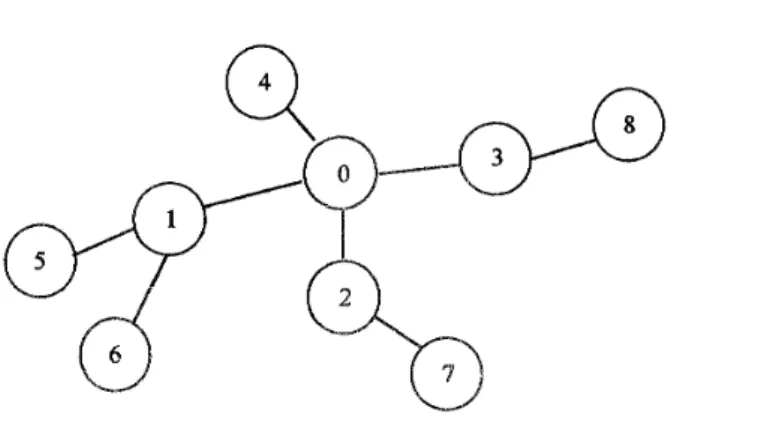
Figure 1:
T*
for n = 9 and l. = 4, ll = 3, =-
= Is = 2.are assumed. (The problem for l* = ll = a = ln-1 = n - 1 is equivalent t o Hu's one.) And they showed that if
e a positive value pp is assigned to each vertex v E V,
0 p0
>
p12
*2
pn-1>
0 is satisfied (only strictly-decreasingness is assumed in [2]),and
e rvu = cpvpu holds for all {v, U} E
(I)
(where c is a positive constant),then a particular tree T* = (V, E*) is an explicit solution to the problem. The definition of
T* is as follows: Assuming that
U- 1
l v > l h o l d s f o r a l l v ~ V a n d V l v > 2 ( u - 1 ) h o l d s f o r a l l u ~ { 1 , 2 ,
...,
n - l } (3) v=O(condition (2) implies condition (3), which is proved in Appendix l), we set S-1 = 0, S, =
ELo
1,-
U (U = 0,1,..
.
,
n-
1) and let N be the minimum integer satisfying n-
1<
SJV-I;also we define a function
v
on a set {l, 2,.. . ,
n-
l} byif ~ ~ . ~ + for u = 0 , 1 , 2 l ~ v ~
,...,
s N - 2 ~ T T ( ~ ) = { W - ~ if s ~ _ 2 + 1 < u < n - l 1and let
E*
= {el, ea,. . .
,
en_i} where e, = ( ~ ( v ) , v) (v = 1,2,.. .
,
n-
1). Then we obtainT*
= (V, E*). Appendix 1 shows that if condition (3) is satisfied then TT is definable and T*surely is a tree. Roughly speaking, the tree
T*
is constructed by the following procedure: First, to vertex 0, connect the remaining vertices by ascending order of vertex number as many as possible; secondly, to vertex 1, connect the remaining vertices by the same order as many as possible; and continue to connect the remaining vertices in the same manner until all n vertices are connected. This procedure can be regarded as a sort of "greedy algorithm". An example ofT*
(for n = 9 and l. = 4, ll = 3, Is = = ig = 2) is shown byFigure 1. Anazawa et al. [2, 31 also gave another interpretation of ORSTs as follows: They minimize the probability that a request of communication is not realized when there is one failure on a vertex or an edge (the probability for k failures will be shown in Section 5).
Anazawa [l] considered the problem of minimizing f under constraint (1) satisfying 11) = 2; =
.
= ln_! = L>
2 (where L is a commonly-given integer), and showed thatT*
is a unique explicit solution under the conditions thate rvu
>
rvu, holds for all v, U, U' ? V (U#
v , U'#
W, U<
U'), ande rvu
+
r v w>
rvu1+
rutu holds for all v, v', U, U' V (v<
v', U<
U') such that rvu, r d d ,Generalized ORST Problem with a Monge-like Property 41 9
Since the above inequalities hold if rm = cpvpu (c
>
0) and p0>
p1>
>
pn-1>
0are satisfied, the conditions of {rvu} assumed by Anazawa [l] are more general than those considered by Anazawa et al. [2].
The aim of this paper is to generalize the problems and results discussed in the literatures [l, 2, 31. Let g(x) be an arbitrary real-valued function of real variable X such that it is
monotone nondecreasing on [O, n
-
l], and consider a problem of finding a treeT
E
T
which minimizes a functionsubject to constraint (1) satisfying (2). We call this problem a generalized optimum re-
quirement spanning tree problem (GORST problem), and a solution to this problem an fg-optimum tree. Our main assertion on the GORST problem in this paper is that
T*
is an fg-optimum tree if rvu>
rvut holds for all v, u,u'E
V (U#
v, U'#
v, U<
U') andr U
+
rvtut2
rvut+
rutu holds for all v,vl, u,u'E
V (v<
v', U<
U') such that run, rvtut,rãà and rdu are all defined. Further, by introducing dummy vertices {v\v
2
n } and settingrã == 0 if v or
u
is dummy, the main assertion can be described more simply as follows:Main
TheoremI/
{rvu} satisfiesfor ail 4-tuple {v,vl,ii,ii'} (v
<
vl,u<
U') such that rvu, rvtut, rCTt and r,tu are ail defined,then
T*
defined aboveis
fg-optimum.Remark
(a) By setting v'2
n in inequality (4), we have rvu2
rvut. Also, we easily findthat inequality (4) holds if rã = cp,pu (c
>
0) and p0>.
p1>.
2
pn-12
Pn == = 0 are satisfied. Therefore, the condition of {rvu} in Main Theorem is more general than those in the literatures [l, 2, 31. (b) It is easy to see that if rVu+
rutu,>
rvut+
rutu holds for some4-tuple {v, v', U, U'} (v
<
v', U<
U') then both v and U are non-dummy. In fact, it followsfrom rvu
+
rdut>
0 and rvu2
rvut>
rdut2
0 that rm>
0 holds.It is of interest that condition (4) is closely related to the Monge property. A m X n matrix C = [cvã is called a Monge matrix if it satisfies the Monge property
cvu
+
cvtut<-
cvut+
cutu for all 0<
v<
v'<
r n-
1, 0<-
U<
U'<
n-
1. ( 5 )The property is named after the French mathematician Gaspard Monge, and is rediscovered by Hoffman [6] (compactly reviewed by Pferschy et al. [8] and Deineko et al. [4]). It is well-known that, in the classical Hitchcock transportation problem, if the cost matrix is Monge then a feasible solution obtained by the north-west-corner rule is optimum for any feasible demand and supply vectors. Also, Monge matrices make some NP-hard problems (ex. travelling salesman problem) efficiently solvable (see [8]). If C has unspecified elements and satisfies the first inequality in (5) for all 4-tuple {v, v', U, U'] (v
<
v', U<
U') such thatcvui cvtut, cvut and cutu are all specified, then C is called an incomplete Monge matrix. For
{rvu} satisfying the condition in Main Theorem, if n X n matrix C is defined so as to satisfy
cvu = arn_v_l,n-u_~
+
b (where a (< 0) and b are arbitrary constants) with diagonal elements unspecified, then C is a symmetric incomplete Monge matrix.In this paper, after giving mathematical preliminaries in Section 2, we will show some properties of the tree T* in Section 3. The proof of Main Theorem will be given in Section 4.
420 T. Anaza wa
As an example of the GORST problem, we will formulate in Section 5 a "k-failure problem" which is an extension of the "one-failure problem" discussed by Anazawa et al. [2, 31, and show that
T*
is an explicit solution to the k-failure problem for any k (0<
k<
In-
1) when constraint ( l ) with (2) is imposed and the condition in Main Theorem is satisfied..
Preliminaries
hout this paper, we use the following notation. For a graph G = (V, E) and a subset a subgraph
G
n
U
is defined by G' = (U, E'), where E' = {(v, U) E \ v , U 6 U};ubgraph G
\
U is defined by G" = (V\
U, E"), where E" = {(v, U) 6 q v , U E V\
U}.r a rooted tree
T
E T , if vertex v lies on a path (root,. . . ,
U ) of T , then v is called the d(v, U; 7')-th ancestor of it (note that any vertex is the 0-th ancestor of itself); especially the first ancestor of U is called the parent of U. As to 7" defined in Section 1, v { v ) is the parent of W for v = 1,..
.
,n-
1 if vertex 0 is the root. Also, let y(v) = {u[,v is the parent of U}.vel of v is defined by d(v, roo
P = ( u l , u 2 , Â ¥
.
, u t ) of a tree (V,E)
67,
letF
be a forest defined byand T(ui) = (V (ui), E(ui)) (2 = l,
. . . ,
k) the connected components ofF
each of which contains U,.An edge (v,u) such that v or U is a dummy vertex is called a dummy edge. For a
tree
T
= (V, E ) , we will sometimes construct another treeT
= (V,B)
satisfyingV
=V U {dummy vertices} and
,!?
= E U {dummy edges}, i.e.T
\
{dummy vertices} = T.Then it is obvious that A(T) = fg(T) holds. When constructing a dummies-added tree
T
= (V,E ) ,
we do not restrict the degrees of vertices in V.For a tree T = (V, E)
E
T
satisfying (1) with (2) and a path P = (ul,.
. . ,
ut) (fe =2 or 3) of T , we define an isomorphism ap. Let T (U;) = (V(ui),
E
(Ui)) be defined forP,
and !f(ui) = (flu,),E{ui))
(2 = 1, k) be obtained by adding dummies to T(ui) = (V(ui), E(ui)) ( i = l, k ) so that T(u1) and T(u~i.) can be isomorphic and the underlying isomorphism up : V(ui) Ñ V(uk) can satisfy the following two:( f ~ ( " l ) = "k a
(ii) For any v 6 V(ui), if d v ) has at least one dummy vertex, then x(ap(v)) has no dummy vertices, where we regard HI as the root of T(uI) and uk as that of T(uk).
We call such an isomorphism ap a forced isomorphism for P. Appendix 2 shows that a p
can be defined for any tree
T
ET
and any pathP
= (ul,..
.
,
uk)(k
= 2 or 3) ofT.
Also, = ( V , I!?) whereuV(uk) and
B
= E ( u ~ ) u2=2
we consider the following transformation of
T
which may reduce the fà value: Let VC = {U V"(ui)jv>
ap(v)}, and exchange v and op(v) for all v E VC. We call such a transformationbiasing with respect to ap. Further, let T' be a tree obtained from
T
by biasing andT'
=T'
\
{dummy vertices}. (An example of constructingT'
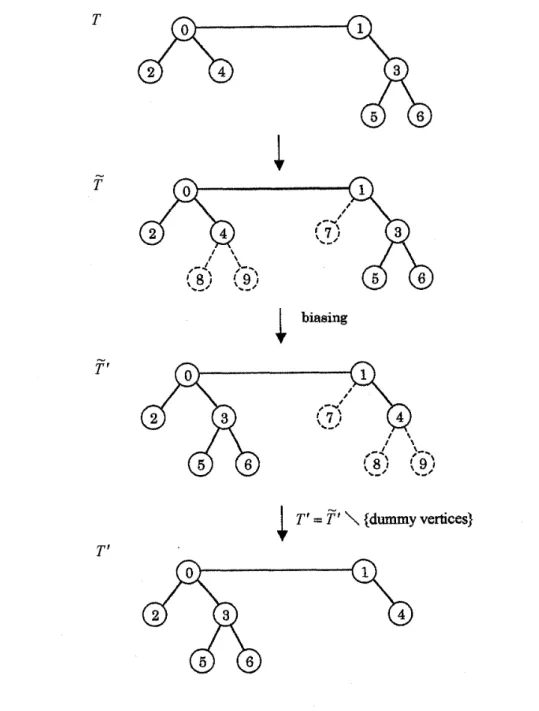
from T is illustrated by Figure 2.) The following lemma assures us that T1 is also a tree belonging to7
and satisfies constraint (1).r
T
and i ~ p defined above and for an arbitrary vertex v EV{ui),
letGeneralized ORST Problem with a Monge-like Property
l
biasingT =
f'
\ {dummy vertices}Figure 2: An example of constructing T' from T, where broken lines denote dummy vertices and edges. In T , we choose a path P = (u1,u2) with ul = 0 and u2 = 1, and define
T ( u l ) = ( V ( q ) , E(ui)) and T(ui) = ( V ( u 2 ) , E(u2)) for P where V ( u l ) = { O , 2,4} and
V ( u 2 ) = {l, 3,5,6}. T has two isomorphic dummies-added trees 'T(u1) = ( p ( u l ) , ~ ( u ~ ) )
and T ( u 2 ) = (V(u2), ~ ( 2 4 2 ) ) where V ( u 1 ) = { O , 2,4,8,9} and
V{Uf)
= {l, 3,5,6,7}. Theunderlying forced isomorphism up is defined by setting <rp(0) = 1, ~ ( 2 ) = 7 , up(4) = 3,
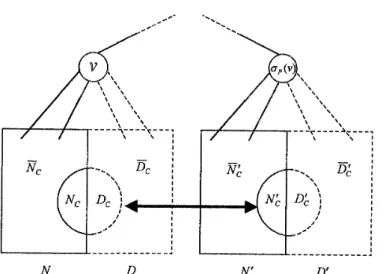
Figure 3: The inclusion relation of N , D , NI, D and their subsets. In this figure, the left-right arrow indicates that the elements of Nc U DC and those of N& U D'(- are exchanged by biasing with respect to ap.
The inclusion relation of N,
D,
NI,D'
and their subsets is illustrated by Figure 3. Note that the following five relations are always satisfied:\N\
+
\D\
=\N'\
+
1
D'\,
\
Nc\+
\Dc\
=P&\
+
\D&\, \Nc\+
\DC\
=pc\
+
\D&l,\N\
5
l , - 1 IN1\5
l,,,.)-
1.(i) Since N = Nc (i.e. Nc =
0)
and NI = N&uN& =0,
we havel7VcI+l~&l
= IN1<
(,-land
R
1
+
\Nc\
= 0.(ii) The proof is similar to that of (i).
(iii) In this case, l.
>.
holds and D =0
or D' =0
is satisfied. When D =0
holds,D&
=0
is obvious. Then we have\Nc
\
=1
N&1.
Hence, we find that\m
+
\ N c \ =V&\
+
P&\
= IN1\5
l.,(.) - 1are satisfied. When D =
0
holds, we have IN1<
m.
Since it is obvious thatDC
=0
holds, we obtain
pc\
=pi-,\-
Hence, we find thatGeneralized ORS T Problem with a Monge-like Property
(iv) The proof is similar to that of (iii)
.
Lemma
2 For a treeT
67"
and a pathP
= (ui,...,
uk)( k
= 2 or 3) ofT ,
letT
be adummies-added tree on which a forced isomorphism ap is defined. Also, let
T'
be a tree obtained fromT
by biasing with respect to up andT
=T
\
{dummy vertices}. If {rvu} satisfies the condition in Main Theorem, then fg(Tt)<:
fg ( T ) holds.Proof We have only t o show that fg(T1}
<,
f . ( ~ )
holds. LetVC
= v ( u i )\
VC andD v u = {g(dlv, U ;
p ) )
-
g(d(v, U ; ~))}r,.. First, we consider the case ofk
= 2. Thenfg(T1)
-
f g ( T ) is expressed byHowever, noting that the first six summations are all equal to zero, we have
For two vertices v ? VC and u ?
VC,
letSvu
= d(v,u;T )
and AV. = d ( v , Ã § ; f ' ) Then<
Avu is obvious. Also, noting thatand
A,,, = d(v, U ;
p)
= d(crp(v), ap(u);T')
= d(v,ffp(u);T )
= d(ap(v),u;T ) ,
we obtain
Due to the assumption of {rvu}, the second factor of the summand in (7) is always nonneg- ative, and if it is positive then we find from the remark of Main Theorem that both crp(v) and U are non-dummy, which implies Auu
<
n-
1. Hence, we find from the assumption ofg that f,(T")
-
/,(p)
<
0 holds for k = 2.In the case of
k
= 3, fg( p )
-
f g( T )
is expressed byHowever, the first three summations are all equal to zero. Hence,
fa(P)
-
f , ( ~ )<
0 is similarly obtained. The proof is just completed.3. Properties of
T*
Here, we show some properties of the tree T* = (V, E") defined in Section 1. Suppose that
T* satisfies (2). Let V, = {0,1,.
. .
, v-
l } ( 1<.
v n) and T; =T*
n
K.
Note that424 T. Anaza wa
Lemma 3 For each
T*
(v2
2), let P = (ul, ui,.
.
.
,
uk) be an arbitrary path ofTz
satisfying u~<
ut, and let r n = where [rJ is the maximum integer not exceeding x. ThenU,
<
uk-+l and deg(ui; T')2
d e g ( ~ ~ - ~ + i ; T') hold for i = 1,2,.
.
.
,
m.Proof Let vertex 0 be the root of
Tc.
For two vertices v and U onT*,
we find from theprocedure of constructing
T*
that(i) if v is the d-th (d
>
0) ancestor of U, then v<
U holds,ii) if 0
<
v<
U, then v(v)<
^(U) holds, andiii) if v
<
u, then the level of v does not exceed that of U.r the path
P,
if ul is an ancestor of uk, then we find from (i) that U,<
uk-i+l holds for,
. . .
m. Otherwise, continue to compare U, with uk-i+l by ascending order of i untilecomes an ancestor of ' K ( u ~ - ~ + ~ ) (this stopping condition is valid due to (iii)
).
Thenom (ii) that ui
<
uk-i+~ holds for z = 1,2,..
.
,m.the lemma is proved as follows. Since 7" satisfies deg(u; T*) = là (U =
2
<
deg(1V-
l ; T * ) $ ZN-1 and deg(u;T*) = l (U = N,N+
1,..
. , n-
l), S from condition (2) that (= T*) satisfiesWe also find that des{v(n
-
1);T;)>
2 and deg(u;T;) = 1 (U = v(n-
1)+
1,. .
.
, n-
l )hold. Hence, considering a tree
T',
= T'\
{n-
l}, we havedeg(u; T i )
-
l if u = ir(n-
l ) deg(u;T - l )
=deg(u; Tn') otherwise, which implies that
holds. Continuing to delete the last vertex, we finally obtain T* and find that
holds. Hence, we have deg(ui;
T;)
>
d e g ( ~ ~ _ ~ + ~ ;T;)
(i
=
l, 2 , ..
. ,
m).Lemma 4 Suppose that a tree
T
CT
satisfies (1) with (2) and contains a subtree T* (i.e.T n
V, =T;).
LetP
= (ul,..
.
,uk) (k = 2 or 3) be an arbitrary path o f T . For the treeT
and the path P, let
T
be a dummies-added tree on which a forced isomorphism ap is defined,f"
a tree obtained from by biasing with respect toQ,
and T =1"
\
{dummy vertices}. ThenT'
also containsT*.
Proof We have only to show that
7"
contains T" Since the proof varies according as where lies onT,
we should consider the following three cases:(i)
k
= 3 and V, C V(ui),(ii)
k
= 2 or 3, V v n v ( u i )# 0
and V , n v ( u k ) =0,
(iii) k = 2 or 3, V,
n
q u i )#
0
and V, f-l v ( u k )#
0.
In case (i), it is obvious for
7"
obtained by biasing to containT*.
In case (ii), since v2
v holds for all v v(uis), it follows that V, D p ( u l ) CVC.
Hence,7"
also containsT>
In case (iii), suppose that ul<
uk holds without loss of generality. Then we find from Lemma3 that V,
n
V(uk) C ap(Vvn
V ( i l ) ) holds. We also find that v<
ap(v) holds for any vE
V,n
V(ul). In fact, if (rp(v) E V, 0 V(uk), then v<
ap(v) comes from Lemma 3;otherwise v
<
v<,
op(v) holds. Hence, we have V,,n
v(u1) CVC
and V,,n
V ( U ~ ) C ap(Vc), which imply thatT'
contains T*-Generalized ORS T Problem with a Monge-like Property 425
4. Proof of
Main
TheoremLet
T*
= (V,E*)
E
T
be the tree defined in Section 1, and suppose that T* satisfies (2). For a tree T = ( V , m E7,
letWe will show that any fg-optimum tree can be transformed into T* with the fn value unchanged.
Let
T
be an fg-optimum tree with VT<
n. Note thatT
n
{0,1,.. . ,
VT-
l} =T;,
(a subtree of T*). Also, let W* = ir(vT) in
T*.
Since UT<
n, we can consider a pathP = (v*,
.
.
.
,
vT) ofT.
Among the vertices onP',
a vertex adjacent to VT is denoted by v1,
and a vertex adjacent to v* is denoted by v2 (v2 may coincide with vl). Then we find that v*
<
vl holds. In fact, if v* = wi, then we have (vl, vT) = ('"'(vT), vT) E E, which contradicts the definition of VT; else, if v*>
vi, then a certain vertex v' in {v<
vT\v(v) = ul in T*}is pushed out by UT, that is, (vl, v') = (ir(vl), v')
E
E*
and ( ~ ( v ' ) , v')6
E
hold, whichcontradicts the minimality of VT. Here, we consider the following two cases: (i) v2
<
VT and(ii) v2
>
UT.In case (i), let
P
= (ui,.. . ,
U&) be a subpath ofP'
satisfying d ( v * , u ~ ; T )-
ld(ul, v*; T) d(%,
T)
= (thenk
= 2 or 3).Let 5? be a dummies-added tree on which we can define a forced isomorphism v p such that op(v*) = v1 holds and a vertex v** adjacent to v* satisfies op(v**) = WT and v**
>
VT (it isobvious that such v** exists). Also, let
f"
be the tree obtained from T by biasing with respect to op, and T' = (V,E')
= T'\{dummy vertices}. Then we find from Lemmas 2 and 4 that l"is also fg-optimum and satisfies Tf
n
{O,
l ,. . . ,
UT-
l} = T,* and (v*, uT) = (ir(wr), vT) ?E',
that is, u p
>
VT holds.In case (ii), let P = (ul,
.
. . ,
uk) be a subpath of P' satisfyingd(ul, u2; T ) = d(uis, VT; T ) = d(v2'vT;T)
-
'1
(thenk
= 2 or 3).2
Similarly to (i), let
T
be a dummies-added tree on which we can define a forced isomorphism crp satisfying op(v2) = VT. Also, letT'
be the tree obtained from T by biasing with respectto
crp,
andT
=7"
\
{dummy vertices}. Then we obtain v p>
V* in the same way with that of (i).By continuing this process, we find that T* is fn-optimum.
5. An Example of the GORST Problem
Finally, we show an example of the GORST problem, which is to find a tree network minimizing the probability that a request of communication is not realized when the network has k failures (called a "k-failure problem"). Let vertices be regarded as network hosts, edges
as network cables, and { r m } as relative frequencies of communication. A failure can occur on a vertex or an edge; if even one failure has occurred on a path (v,.
.
.
,
U), then v and U cannotcommunicate with each other. Let us define the probability that a request of communication is not realized on a tree network T = (V, E ) with
k
failures, denoted by p(T;k}.
Consider a time interval7
in which the number of failures onT
does not change and at most one426 T. Anaza wa
request of communication occurs on
T.
Let FT denote the number of failures on T in I , Rvu the event that a request of communication between v and U occurs in I, andRT
the eventthat a request of communication between a certain pair on T occurs in I. Then the relative frequency of communication between U and U is expressed by rvu = Pr{RvuIRr}. We assume
that each vertex (host) has enough ability of processing and, hence, the frequency of failure on each vertex does not depend on the amount of traffic. Also, we observe that an edge failure results mostly from incomplete connection at the connector of a host (rarely from the snapping of a cable) and it occurs independently of a vertex failure. Hence, we assume that
(i) a failure occurs equally often on n vertices, and so does it on n
-
1 edges, where the probability of vertex failure is not necessarily equal to that of edge failure,(ii) any two failures occur mutually independently. om these assumptions, letting
aij = Pr{z vertices and j edges are broken downlFT = a
+
l } ,
we can assume that aij's do not depend on the structure of 7\ Let
v
H U be the state that the path (v,..
.
, U ) has no failure in I, and à the state that(v,.
.
.
,U) has at least one.
It is easy to see thatThen the desired probability is expressed by
The A-failure problem is to find a tree T minimizing
p(T;
k ) for each k .For afixed k (0
<
k
<,
2 n - l), letwhich is obtained by replacing d ( v , u ; T ) in Pr{=<4FT =
k}
by X. Then it is easy to find that g(x) is monotone increasing on [O, n-
l]. Hence, the k-failure problem under constraint (1) satisfying (2) is a special case of the GORST problem. Further, if {rvu} satisfies the conditionin
Main Theorem, thenT*
defined in Section 1 minimizes p(T; k } for anyk
(0<
k<.
I n - 1).Generalized ORST Problem with a Monge-like Property
Appendix 1
First, we show that condition (2) implies condition (3). Note that condition (3) also satisfies 1,
>
2(n-
1). In fact, since~~~~
l,>
2(n-
1-
1)+
1 = 2n-
3 is obtained from (3), it follows from ln-1>
1 thatholds. Assume that {l,} with (2) also satisfies
^,=1
l,<:
2(r-
1) for some v (< n). Since~~~~
1, = lÃ+
1,2
2(n-
l), we have 2 ( r-
1)+
1,2
2(n-
l), that is,~~~
l,>
2(72- v). Then it follows from the monotoneity of {l.} that lÃ>.
2 holds. However, we also find that~ f z i
lc
>
2u holds, which is contradiction.Secondly, we show that if condition (3) is satisfied then v is definable and T* surely is a tree. Since condition (3) implies that
$^E;
l,>,
2(n - 1) holds, we have sn_12
n-
1 under (3). This means that N in the definition of TT is surely determined. Also, it is easy to see that T" is a tree if v(v)<
v holds for all v 6 {l, 2,.. .
,
n - l}. For any vertex v satisfying v(v) = U (0<
U<
N-
1<
re), we have su_l+
1<:
v. On the other hand, we find fromcondition (3) that
U-1
U < y l v - ( u - l ) + l = S u - 1 + 1 v=O
holds. Hence, we obtain 7r(v) = U
<
v.Appendix 2
For any tree T
T
and any path P = (ul,.. .
,
uk)(k
= 2 or 3) ofT,
we can si- multaneously establish two dummies-added trees 'T(ui) = (V(ui), E(uil} ( i = l, k) and a forced isomorphism op stated in Section 2 by using the following algorithm, where T(ui) = (V(ui), E(ui)) (i = l,.
.
. ,
k) are defined for the path P, and V(ui, l) is defined by {W P(ut) lthe level of W is l}.Procedure ~ a k e - ~ u ~ ) - f l u ~ ) - a n d - o ~ (T: tree; P: path); begin
v(u1) := V(Ul); V(%&) := v(?&); E('U1) := E('U1); . J @ ( M ~ ) := E ( u ~ ) ; set cp(u1) = ujs;;
dv := n; { dv denotes the current number of dummy vertex
}
I
:= 0;while V(ul, 1) U V(uis, I) has a vertex v with x(v)
#
0
do begin for all vE
V(u1, l) do begind* := rnax{deg(v;
T
(ul)),
deg (op(v);T
(ui))};{ adding dummy vertices and edges so that deg(v; r(u1)) = deg(op(v);
T ( % ) )
= d*}
if deg(u; T(u1))
<
d* thenfor i := 1 to d*
-
deg(v; ~ ( u l ) ) do begin Y(u1) := Y(u1) U {dv};JS(ul) := JS(u1) U {(v, dv)}; dv := d v + l;
end
T. Anaza wa
for i := 1 to d*
-
deg(op(v); r ( u i ) ) do begin V(uk) := V(uk) U {dv};E(%) := @(ut) U { ( ~ P ( u ) , dv)}; dv
:=
d v + l ;end;
{ making one-to-one mapping from ^(v) t o 'X.{op(w))
}
for
all
W E %(v) do beginchoose W' x(op(v)) to which any vertex in ~ ( v ) is not mapped by ap\
set op(w) = W'; end; end; l := l
+
l ; end; end; AcknowledgementThe author is grateful t o Professor K. Murota of Kyoto University, Professor M. Jimbo of Keio University and the referees for their helpful comments.
References
[l]
T.
Anazawa: On a condition for obtaining an explicit solution of optimum requirement spanning tree. Networks, 34 (1999) 132-135.[2]
T.
Anazawa,T.
Kodera and M. Jimbo: An explicit solution of optimum requirement spanning tree with maximum degree conditions. Congressus Numerantium, 117 (1996) 43-52..
Optimum requirement spanning trees and reliability of tree networks. Net-PI
-.
works, 34 (1999) 122-131.
[4] V. Deineko, R. Rudolf and G. J. Woeginger: On the recognition of permuted Supnick and incomplete Monge matrices. Acta Informatica, 33 (1996) 559-569.
[5] R.
E.
Gomory and T. C. Hu: Multi-terminal network flows. SIAM Journal on Applied Mathematics, 9 (1961) 551-570.[G] A. J. Hoffman: On simple linear programming problems. In V. Klee(ed.): Convexity.
Proc. Symposia in Pure Mathematics. 7 (American Mathematical Society, Providence,
RI,
1963) 317-327.[?l
T. C. Hu: Optimum communication spanning trees. SUM Journal on Computing, 3(1974) 188-195.
[8] U. Pferschy, R. Rudolf and G . 3. Woeginger: Monge matrices make maximization
manageable. Operations Research Letters, 16 (1994) 245-254.
Tsutomu Anazawa
Department of Industry and Information Sapporo University
Sapporo, Hokkaido 062-8520, Japan E-mail: anazawaOsapporo-U