Title A Comprehensive Study of Molecular Mechanisms on Anti-obesity Effect by the Constituents of Grains of Paradise( 本文 (Fulltext) ) Author(s) 服部, 浩之 Report No.(Doctoral Degree) 博士(農学) 甲第729号 Issue Date 2020-03-13 Type 博士論文 Version ETD URL http://hdl.handle.net/20.500.12099/79371 ※この資料の著作権は、各資料の著者・学協会・出版社等に帰属します。
A Comprehensive Study of Molecular Mechenisms on
Anti-obesity Effect by the Constituents of Grains of Paradise
(香辛料 Grains of Paradise 成分の肥満抑制効果と
その分子メカニズムの網羅的解明
)
2019
The United Graduate School of Agricultural Science, Gifu University
Science of Biological Resources
(Gifu University)
A Comprehensive Study of Molecular Mechenisms on
Anti-obesity Effect by the Constituents of Grains of Paradise
(香辛料 Grains of Paradise 成分の肥満抑制効果と
その分子メカニズムの網羅的解明
)
CONTENTS
Ⅰ OVERVIEW 1
Ⅱ EXPERIMENTS 2
1 Extraction, Isolation and Elucidation of Grains of Paradise (GOP)
Constituents 2
1.1 Introduction 2
1.2 Materials and Methods 3
1.2.1 General Procedures 3
1.2.2 Plant Material 4
1.2.3 Extraction and Isolation 4
1.2.4 Elucidation of the Compound Structure of GOP 5
1.3 Results and Discussion 13
2 Synthesis of Phenolic Constituents of GOP 15
2.1 Introduction 15
2.2 Materials and Methods 16
2.2.1 General Procedures 16
2.2.2 Synthesis of Compound J 17
2.2.3 Synthesis of Compound C and the Analogue 20
2.2.4 Synthesis of Compound R 45
2.3 Results and Discussion 54
3 Evaluation of Anti-obesity Effect by GOP Extract and the Constituents 59
3.1 Introduction 59
3.2 Materials and Methods 60
3.2.1 General Procedures 60
3.2.3 Lipid Analysis of Serum and Liver 61 3.2.3.1 Measurement of Serum Total Cholesterol (TC) Concentration 61
3.2.3.2 Measurement of Serum High-Density Lipoprotein Cholestero
(HDL-C) Concentraion 61
3.2.3.3 Measurement of Serum Triglyceride (TG) Concentration
3.2.3.4 Hepatic Lipid Extraction 61
3.2.3.5 Measurement of Hepatic TC Concentration 62 3.2.3.6 Measurement of Hepatic TG Concentration 62
3.2.4 Statistical Analysis 62
3.3 Results and Discussion 62
4 Elucidation of the Anti-obesity Effect of GOP Components 65
4.1 Introduction 65
4.2 Materials and Methods 66
4.2.1 General Procedures 66
4.2.2 Animal 66
4.2.3 Neural Activity Measurement 66
4.3 Results and Discussion 67
Ⅲ CONCLUSIONS 73
Ⅳ REFERENCES 74
Ⅴ ACKNOWLEDGEMENTS 81
- 1 -
OVERVIEW
The cause of death in Japan is largely changing from infections as tuberculosis and pneumonia to lifestyle diseases as cancer, heart disease, and cerebrovascular disease. It’s associated with the way a person or group of people lives their life. Among lifestyle disease obesity has especially higher risks that causes several complications. Obesity is generally caused by excessive energy intake more than energy expenditure and the population is increasing year by year. The number of obese people is 710 million in 195 countries at 2015 and it has been two times between 1980 and 2015 (Institute for Health
Metrics and Evaluation (IHME), University of Washington, [Global Burden of Diseases Study]) Therefore, development of novel functional materials to ameliorate and/or prevent obesity is necessary. I have studied a spice named Grains of Paradise (GOP) which have long been used in West Africa.
GOP is one of the names given to the dried seeds of the tropical plant
Aframomum melegueta, which is widely distributed throughout West Africa. The seeds
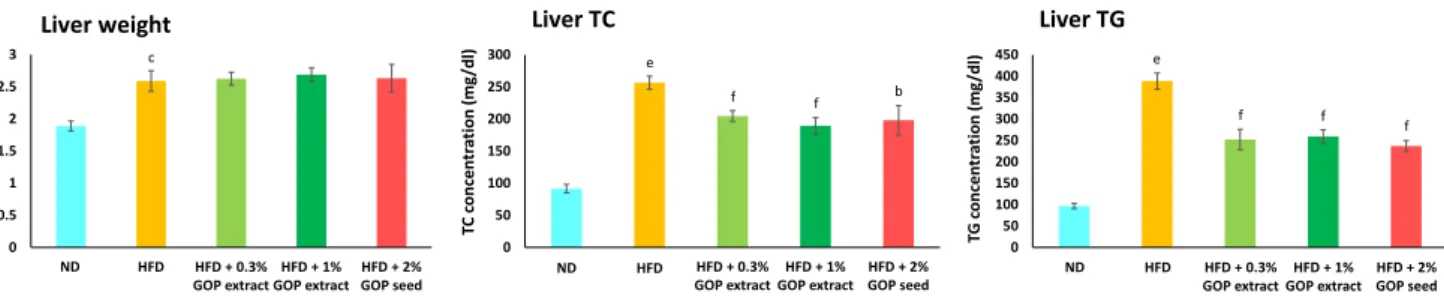
have long been used in folkloric herbal remedies and are known to have, among other properties, antioxidant, antibacterial and antinociceptive activity. However, it is more widely known as a spice and condiment for beer, bread, meats and wines than as a phytomedicine or food. Therefore, the pharmacological action of the plant has not yet been well studied. To discover the novel function of GOP, I subjected GOP extract and the ingredients to animal and measured body weight gain, total cholesterol and triglyceride concentrations in serum and liver of mice. I also tried to isolate compounds in GOP which have high effectiveness on anti-obesity and measured sympathetic nerve activity (SNA) entering brown adipose tissue (BAT) to clarify the anti-obesity mechanism by GOP.
- 2 -
EXPERIMENTS
1 Extraction, Isolation and Elucidation of Grains of Paradise (GOP) Constituents
1.1 Introduction
There are large number of anecdotal documents concerning the historical use of spices and herbs for human health benefits.1 Spices and herbs have been utilized as
phytopharmacological medicines, to mask unpleasant tastes and food flavors, and to keep food fresh. Since ancient times, human beings have understood that parts of plants, including the leaves, seeds, and roots, have a pleasant taste, agreeable odors, or medicinal potency; thus, the demand for the plants has increased and they have gradually spread widely throughout various cultures as condiments and herbal medicines.
At present, worldwide interest in the health benefits of spices and herbs is growing. Certain anecdotal information passed down by ancestors has been supported by scientific evidence from research studies of natural product chemistry, biochemistry, and food science. For example, chili pepper extract and the main ingredient capsaicin, which is responsible for the pungency of chili pepper, possess antimicrobial and anti-inflammatory activities2 and ginger and black pepper extract possess significant
antioxidant activity.3,4 Spices and herbs are rich sources of phytochemicals composed of
flavonoids and other phenolic compounds, including carotenoids and sterols.5–8
Phytochemicals have the potential to exert preventive effects against diseases. Thus, spices not only provide flavor and aroma to food and retard microbial growth, but also provide beneficial effects for human health and prevent certain diseases.9
GOP, the dried seed of Aframomum melegueta, is the only major spice used by natives of West Africa. GOP was used to flavor spicy wine with cinnamon and ginger during medieval times and as a substitute for pepper in ancient Europe. In the Middle Ages, the seeds, which were initially imported from Africa into Italy, were as popular in Europe as other hot spices, such as cinnamon, cloves, and ginger. At present, GOP is
- 3 -
rarely used as a spice except in veterinary preparations and to flavor traditional liqueurs and vinegars in America. However, it is more widely known as a spice and condiment for beer, bread, meats, and wines than as a phytomedicine or food. Therefore, the pharmacological action of the plant has not yet been well studied. A number of pharmacological studies involving the spice have reported that the pungent principles included in GOP have antifeedant, antiseptic, molluscicidal10, hepatoprotective11, and
antidiarrheal12 activities and can induce apoptosis in leukemia (HL-60) cells.13 In
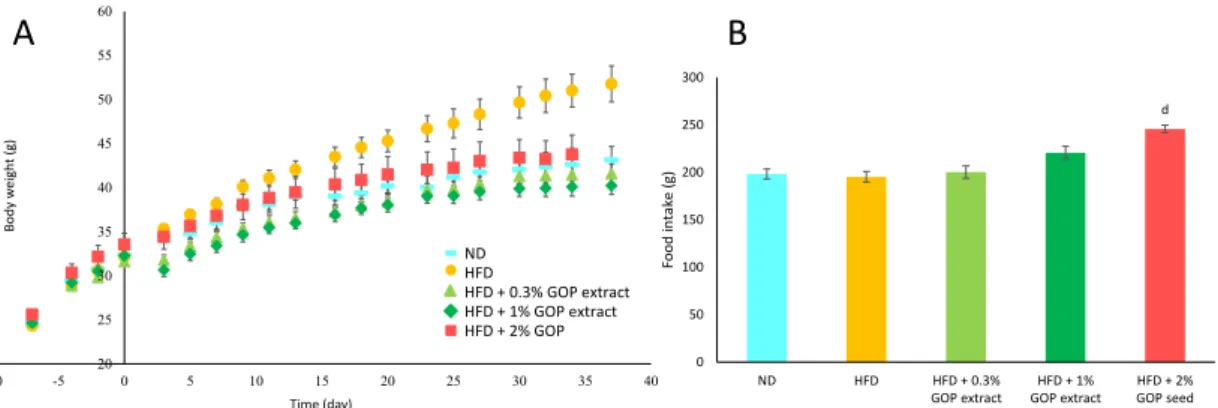
addition to these effective properties, I previously demonstrated that the daily intake of GOP daily decreased body weight gain and hepatic and serum fats in mice.14 An
increase in whole-body energy expenditure and in a decrease visceral fat after ingestion of GOP extract were also reported by Sugita et al.15 To investigate the bioactive
ingredients I attempted to isolate and identify the compounds that contributed to obesity prevention.
1.2 Materials and Methods 1.2.1 General Procedures
NMR analysis was performed using a JEOL ECA-600NMR (JEOL, Tokyo, Japan) and a Bruker Biospin AVANCEIII 600 (Bruker corporation, MA, USA) with deuterated solvent signals as internal standards. Matrix-assisted laser desorption ionization TOF-MS (MALDI-TOF-MS) spectra were measured on a Shimadzu AXIMA-Resonance spectrometer (Shimadzu Corporation, Kyoto, Japan) equipped with a nitrogen laser (λ = 337 nm). HPLC analysis was performed on a reversed-phase column [Sunniest C18, 5 µm (I.D.) × 250 mm (L)] (ChromaNik Technologies Inc., Osaka, Japan) equipped with an SPD-M20A photodiode array detector (Shimadzu Corporation) to confirm the purity of the isolated compounds. Preparative HPLC, equipped with a 880-PU pump, 875-UV detector, and an Inertsil® ODS-3 column (20
- 4 -
mmφ × 250 mm; GL Sciences, Tokyo, Japan) was conducted to obtain highly purified compounds.
Other commercially available products, including solvents, were purchased from Wako Pure Chemical Industries, Ltd. (Osaka, Japan).
1.2.2 Plant Material
The dried whole spice of GOP was provided by Share Trade Inc. (Tokyo, Japan).
1.2.3 Extraction and Isolation
Dried GOP powder (approximately 5 kg) was extracted with methanol on a rotary shaker (NR-20, TAITEC, Saitama, Japan) for a whole day at room temperature (20 ± 2 °C). This extraction was repeated three times. The extract was successively extracted with hexane, diethyl ether, ethyl acetate, and methanol, and each solution was concentrated in vacuo at 30 °C to obtain each soluble extract. I focused on the hexane soluble extract and performed a separation by silica gel column (75 mm φ × 510 (L) mm) chromatography using a mixture of ethyl acetate-benzene (1:3, v/v) as the eluent and obtained four fractions (HFr.1–4) by monitoring the TLC analysis. The ether soluble extract was also separated by silica gel column (75 mm φ × 525 (L) mm) chromatography using ethyl acetate-benzene (1:3, v/v) as eluents and five fractions were obtained (EFr.1–5) by TLC analysis. Preparative HPLC (JASCO Corporation, Tokyo, Japan) was performed using an Inertsil® ODS-3 column (20 mm φ × 250 mm) with a
gradient elution to obtain the isolated and purified compounds. UV spectra were detected with a JASCO 875-UV intelligent UV/VIS Detector (JASCO Corporation) during the preparative HPLC procedure. Compounds A–T were isolated from HFr.1–4
- 5 -
NMR and MS measurement. The isolated compounds were identified by 1H-, 13C-, and
2D-NMR and MALDI-TOF-MS.
1H- and 13C- NMR spectra were recorded in Methanol-D4 or Chloroform-D
(Wako Pure Chemical Industries, Ltd, Tokyo, Japan) using a JEOL EC600 NMR (JEOL, Tokyo, Japan) or a Bruker Biospin AVANCEIII 600 (Bruker corporation, MA, USA). Coupling constants were expressed in Hz and the chemical shifts were expressed on a δ (ppm) scale. The isolated compounds were mixed with the matrix (2,3-dihydroxybenzoic acid in methanol, 10 mg/mL) and loaded onto a 384-well MALDI sample plate. MALDI-TOF-MS spectra were measured using a Shimadzu AXIMA-Resonance spectrometer (Shimadzu Corporation, Kyoto, Japan). Optical rotations were measured using a JASCO P-2300 system (Easton, MD, USA).
1.2.4 Elucidation of the Compound Structure of GOP
Compound A; yellow oil; UV λmax 201, 223, 494, 418, 395 nm; 1H-NMR
(Chloroform-D, Bruker Biospin AVANCEIII, 600 MHz) δ 0.87 (3H, m, H-11), 1.26– 1.30 (10H, m, H-6–10), 1.57 (2H, m, H-5), 2.22 (2H, m, H-4), 2.56 (2H, t, J = 7.6 Hz, H-2), 2.87 (2H, m, H-1), 3.87 (3H, s, H-1′), 6.68 (1H, m, H-6′), 6.70 (1H, m, H-2′), 6.81 (1H, m, H-5′); 13C-NMR (Chloroform-D, Bruker Biospin AVANCEIII, 150 MHz) δ 15.8
(C-11), 24.3 and 34.4 (C-9 and C-10), 27.3 (C-5) 29.7, 31.6, and 38.4 (C-6, C-7, and C-8), 33.4 (C-1), 40.2 (C-4), 42.5 (C-2), 57.8 (C-12), 112.9 (C-2′), 122.7 (C-6′), 116.2 (C-5′), 134.6 (C-11′), 145.9 (C-4′), 148.3 (C-3′), 195.4 (C-3); MALDI-TOF-MS m/z 293.6 [M+H]+.
Compound B; yellow oil; UV λ max 203, 280, 485, 569, 593 nm; 1H-NMR
(Chloroform-D, JEOL EC, 500 MHz) δ0.87 (3H, m, H-10), 1.24–1.34 (8H, m, H-6–9), 1.56 (2H, m, H-5), 2.24 (1H, t, J = 7.5 Hz, H-2), 2.36 (2H, t, J = 7.5 Hz, H-4), 2.68 (1H, t, J = 7.45 Hz, H-2), 2.83 (2H, m, H-1), 3.85 (3H, s, H-11), 6.65 (1H, br d, J = 8.0 Hz,
- 6 -
H-6′), 6.68 (1H, br s, H-2′), 6.81 (1H, d, J = 8.0 Hz, H-5′); 13C-NMR (Chloroform-D,
JEOL EC, 125 MHz) δ 14.1 (C-10), 22.7 (C-8), 23.9 (C-5) 29.1–29.3 (C-6 and C-7), 29.6 (C-1), 31.7 (C-9), 43.2 (C-4), 44.7 (C-2), 55.9 (C-11), 111.2 (C-2′), 114.4 (C-5′), 120.8 (C-6′), 133.2 (C-1′), 144.0 (C-4′), 146.5 (C-3′), 210.8 (C-3); MALDI-TOF-MS
m/z 279.5 [M+H]+.
Compound C; yellow oil; [𝛼]𝐷20 -0.46 (c 0.29, CHCl3); UV λmax 203, 223, 280, 485,
440 nm; 1H-NMR (Chloroform-D, Bruker Biospin AVANCEIII, 600 MHz) δ 0.86 (3H, t,
J = 5.7 Hz, H-11), 1.34–1.41 (10H, m, H-6–10), 1.44 (2H, m, H-5), 1.48 (2H, m, H-4),
1.69–1.78 (2H, m, H-2), 2.60–2.73 (2H, m, H-1), 3.62 (1H, m, H-3), 3.87 (3H, s, H-12), 6.69 (1H, m, H-6′), 6.71 (1H, m, H-2′), 6.83 (1H, d, J = 7.9 Hz, H-5′); 13C-NMR
(Chloroform-D, JEOL EC, 125 MHz) δ 14.2 (C-11), 22.7, 29.4–29.7 (C-6, C-7, C-8, C-9, and C-10), 25.7 (C-5), 31.9 (C-1), 37.7 (C-4), 39.5 (C-2), 56.0 (C-12), 71.5 (C-3), 111.1 (C-2′), 114.3 (C-5′), 121.0 (C-6′), 134.2 (C-1′), 143.8 (C-4′), 146.5 (C-3′); MALDI-TOF-MS m/z 294.7 [M+H]+.
Compound D; yellow oil; [𝛼]𝐷20 +27.3 (c 1.2, CHCl3); UV λmax 201, 227, 280, 422, 443
nm; 1H-NMR (Chloroform-D, JEOL ECA, 500 MHz) δ 0.86 (3H, t, J = 6.9 Hz, H-10),
1.27–1.32 (4H, m, H-8 and H-9), 1.36 (2H, m, H-7), 1.45 (2H, m, H-6), 2.50 (2H, m, H-4), 2.70 (2H, t, J = 7.4 Hz, H-2), 2.80 (2H, t, J = 7.5 Hz, H-1), 3.82 (3H, s, H-11), 4.00 (1H, m, H-5), 6.62 (1H, dd, J = 1.8, 8.9 Hz, H-6′), 6.65 (1H, d, J = 1.7 Hz, H-2′), 6.78 (1H, d, J = 7.5 Hz, H-5′); 13C-NMR (Chloroform-D, JEOL ECA, 125 MHz) δ 14.1
(C-10), 22.7 (C-9), 25.2 (C-7), 29.3 (C-1), 31.8 (C-8), 36.5 (C-6), 45.5 (C-2), 49.4 (C-4), 55.9 (C-11), 67.8 (C-5), 111.2 (C-2′), 114.6 (C-5′), 120.8 (C-6′), 132.7 (C-1′), 144.1 (C-4′), 146.7 (C-3′), 211.6 (C-3); MALDI-TOF-MS m/z 294.7 [M+H]+.
- 7 -
Compound E; yellowish oil; UV λmax 201, 226, 280, 577 nm; 1H-NMR (Chloroform-D,
Bruker Biospin AVANCEIII, 600 MHz) δ 0.88 (3H, t, J = 7.2 Hz, H-10), 1.21–1.31 (6H, m, H-7–9), 1.53 (2H, m, H-6), 1.99 (3H, s, H-13), 2.60 (2H, m, H-4), 2.72 (2H, m, H-2), 2.83 (2H, m, H-1), 3.87 (3H, s, H-11), 5.22 (1H, m, H-5), 6.66 (1H, dd, J = 1.8 and 7.8 Hz, H-6′), 6.69 (1H, d, J = 1.8 Hz, H-2′), 6.82 (1H, d, J = 7.8 Hz, H-5′); 13C-NMR
(Chloroform-D, Bruker Biospin AVANCEIII, 150 MHz) δ 15.9 (C-10), 23.0 (C-13), 24.4 (C-9), 26.7 (C-7), 31.2 (C-1), 33.4 (C-8), 36.1 (C-6), 47.1 (C-2), 49.3 (C-4), 57.8 (C-11), 72.3 (C-5), 113.0 (C-2′), 116.2 (C-5′), 122.7 (C-6′), 134.8 (C-1′), 145.8 (C-4′), 148.3 (C-3′), 172.4 (C-12), 209.1 (C-3); MALDI-TOF-MS m/z 336.6 [M+H]+.
Compound F; yellowish oil; [𝛼]𝐷20 +0.67 (c 1.15, CHCl3); UV λmax 201, 226, 280, 413
nm; 1H-NMR (Chloroform-D, Bruker Biospin AVANCEIII, 600 MHz) δ 0.88 (3H, t, J =
7.2 Hz, H-12), 1.26–1.43 (10H, m, H-7–11), 2.41 (2H, dd, J = 4.8 and 16.2 Hz, H-4a), 2.64 (2H, dd, J = 7.8 and 16.2 Hz, H-4b), 2.75 (2H, m, H-2), 2.83 (2H, t, J = 7.8 Hz, H-1), 3.29 (3H, s, H-14), 3.66 (1H, m, H-5), 3.87 (3H, s, H-13), 6.67 (1H, dd, J = 1.8 and 7.8 Hz, H-6′), 6.70 (1H, d, J = 1.8 Hz, H-2′), 6.82 (1H, d, J = 8.4 Hz, H-5′);
13C-NMR (Chloroform-D, Bruker Biospin AVANCEIII, 150 MHz) δ 15.9 (C-12), 24.5,
26.7, 31.6, 32.2 and 33.8 (C-7, C-8, C-9, C-10, and C-11), 31.2 (C-1), 35.7 (C-6), 47.7 (C-2), 49.5 (C-4), 57.8 (C-13), 58.9 (C-14), 78.9 (C-5), 113.0 (C-2′), 116.2 (C-5′), 122.7 (C-6′), 135.0 (C-1′), 145.8 (C-4′), 148.3 (C-3′), 211.0 (C-3); MALDI-TOF-MS m/z 336.6 [M+H]+.
Compound G; yellow oil; UV λmax 201, 226, 280 nm; 1H-NMR (Chloroform-D, Bruker
Biospin AVANCEIII, 600 MHz) δ 0.81–1.64 (7H, m, H-8–10), 1.45 (2H, m, H-7), 2.20 (2H, m, H-6), 2.82–2.89 (4H, m, H-1 and H-2), 3.87 (3H, s, H-11), 6.09 (1H, dt, J = 1.8 and 17.4 Hz, H-4), 6.69 (1H, dd, J = 1.8 and 7.7 Hz, H-6′), 6.71 (1H, d, J = 2.4 Hz, H-2′), 6.79–6.84 (2H, m, H-5 and H-5′); 13C-NMR (Chloroform-D, Bruker Biospin
- 8 -
AVANCEIII, 150 MHz) δ 15.9, 24.3, and 33.3 (C-8, C-9, and C-10), 29.7 (C-7) 31.8 (C-1), 34.7 (C-6), 43.9 (C-2), 57.8 (C-11), 113.0 (C-2′), 116.2 (C-5′), 122.7 (C-6′), 132.2 (C-4), 135.2 (C-1′), 145.8 (C-4′), 148.3 (C-3′), 149.8 (C-5), 201.7 (C-3); MALDI-TOF-MS m/z 276.5 [M+H]+.
Compound H; yellow powder; UV λmax 200, 371, 253, 485, 577 nm; 1H-NMR
(Chloroform-D, Bruker Biospin AVANCEIII, 600 MHz) δ 0.91 (3H, t, J = 7.2 Hz, H-10), 1.32–1.35 (4H, m, H-8 and H-9), 1.65 (2H, quint, J = 7.2 Hz, H-7), 2.37 (2H, t, J = 7.2 Hz, H-6), 3.97 (3H, s, H-11), 5.63 (2H, s, H-4), 6.34 (1H, d, J = 15.6 Hz, H-2), 6.92 (1H, d, J = 8.4 Hz, H-5′), 7.02 (1H, d, J = 1.8 Hz, H-2′), 7.08 (1H, dd, J = 1.2 and 7.8 Hz, H-6′), 7.53 (1H, d, J = 15.6 Hz, H-1); 13C-NMR (Chloroform-D, Bruker Biospin
AVANCEIII, 150 MHz) δ 15.9 (C-10), 24.4 (C-8), 27.3 (C-9), 33.4 (C-7), 42.0 (C-6), 57.9 (C-11), 102.1 (C-4), 111.4 (C-2′), 116.7 (C-5′), 122.5 (C-2), 124.5 (C-6′), 129.6 (C-1′), 141.8 (C-1), 148.7 (C-4′), 149.6 (C-3′), 180.0 (C-3), 202.1 (C-5); MALDI-TOF-MS m/z 291.1 [M+H]+.
Compound I; yellowish oil; UV λmax 202, 222, 280, 424, 368 nm; 1H-NMR
(CHLOROFORM-D, Bruker Biospin AVANCEIII, 600 MHz) δ 0.88 (3H, t, J = 7.2 Hz, H-10), 1.23–1.34 (6H, m, H-7–9), 1.41 (1H, m, H-6a), 1.48 (1H, m, H-6b), 2.41 (1H, dd,
J = 4.2 and 16.2 Hz, H-4a), 2.64 (1H, dd, J = 7.8 and 16.2 Hz, H-4b), 2.74 (2H, m, H-2),
2.83 (2H, t, J = 7.8 Hz, H-1), 3.29 (3H, s, H-12), 3.66 (1H, m, H-5), 3.87 (3H, s, H-11), 6.67 (1H, dd, J = 1.8 and 8.4 Hz, H-6′), 6.70 (1H, d, J = 1.8 Hz, H-2′), 6.82 (1H, d, J = 8.4 Hz, H-5′); 13C-NMR (Chloroform-D, Bruker Biospin AVANCEIII, 150 MHz) δ 15.9
(C-10), 24.5 (C-9), 26.7 (C-7), 31.2 (C-1), 33.8 (C-8), 35.7 (C-6), 47.7 (C-2), 49.5 (C-4), 57.8 (C-11), 58.9 (C-12), 78.9 (C-5), 113.0 (C-2′), 116.2 (C-5′), 122.7 (C-6′), 135.0 (C-1′), 145.8 (C-4′), 148.3 (C-3′), 211.0 (C-3); MALDI-TOF-MS m/z 308.1 [M+H]+.
- 9 -
Compound J; yellow oil; UV λmax 202, 224, 280, 432 nm; 1H-NMR (Chloroform-D,
Bruker Biospin AVANCEIII, 600 MHz) δ 0.93 (3H, t, J = 7.2 Hz, H-8), 1.63 (2H, sext, J = 7.2 Hz, H-7), 2.48–2.53 (4H, m, H-2 and H-6), 2.72 (2H, t, J = 7.2 Hz, H-1), 3.88 (3H, s, H-9), 6.11 (1H, dt, J = 1.8 and 15.9 Hz, H-4), 6.67–6.68 (2H, m, H-2′ and H-6′), 6.81–6.86 (2H, m, H-3 and H-5′); 13C-NMR (Chloroform-D, Bruker Biospin
AVANCEIII, 150 MHz) δ 15.7 (C-8), 19.6 (C-7), 36.1 (C-1), 36.4 (C-2), 44.0 (C-6), 57.8 (C-9), 112.8 (C-6′), 116.2 (C-5′), 122.8 (C-2′), 132.7 (C-4), 134.6 (C-1′), 145.9 (C-4′), 147.8 (C-3), 148.3 (C-3′), 202.7 (C-5); MALDI-TOF-MS m/z 248.4 [M+H]+.
Compound K; brown oil; UV λmax 201, 223, 494, 418, 395 nm; 1H-NMR
(METHANOL-D4, Bruker Biospin AVANCEⅢ, 600 MHz) δ 2.45–2.49 (2H, m, H-6), 2.62 (2H, t, J = 7.2 Hz, H-7), 2.76–2.79 (2H, m, H-1), 2.82–2.85 (2H, m, H-2), 3.82 (3H, s, H-8), 6.08 (1H, d, J = 16.2 Hz, H-4), 6.49 (1H, dd, J = 1.8, 7.8 Hz, H-6′′), 6.59 (1H, dd, J = 1.8, 7.8 Hz, H-6′), 6.62 (1H, d, J = 1.8 Hz, H-2′′), 6.66 (1H, d, J = 7.8 Hz, H-5′′), 6.68 (1H, d, J = 7.8 Hz, H-5′), 6.75 (1H, d, J = 1.8 Hz, H-2′), 6.87 (1H, dt, J = 7.2, 16.2 Hz, H-5); 13C-NMR (CHLOROFORM-D, Bruker Biospin AVANCEⅢ, 600 MHz) δ
31.7 (C-1), 35.3 (C-7), 36.1 (C-6), 43.2 (C-2), 56.8 (C-8), 113.6 (C-2′), 116.6 (C-5′′), 116.8 (C-5′), 117.0 (C-2′′), 121.2 (C-6′′), 122.2 (C-6′), 132.1 (C-4), 134.3 (C-1′′), 134.5 (C-1′), 145.1 (C-4′′), 146.3 (C-4′), 146.7 (C-3′′), 149.4 (C-3′), 149.8 (C-5), 203.4 (C-3); MALDI-TOF-MS m/z 342.1 [M+H]+, 365.2 [M+Na]+.
Compound L; brown oil; UV λmax 203, 280 nm; 1H-NMR (METHANOL-D4, Bruker
Biospin AVANCEⅢ, 600 MHz) δ 1.50 (4H, m, H-5 and H-6), 2.41 (4H, m, H-4 and H-7), 2.69 (2H, t, J = 6.6 Hz, H-2), 2.75 (2H, t, J = 6.6 Hz, H-1), 3.80 (3H, s, H-8), 6.45 (1H, dd, J = 2.4, 8.4 Hz, H-6′′), 6.59 (2H, m, H-6′ and H-2′′), 6.65 (1H, d, J = 8.4 Hz, H-5′′), 6.68 (1H, d, J = 7.8 Hz, H-5′), 6.74 (1H, d, J = 1.8 Hz, H-2′); 13C-NMR
- 10 -
(METHANOL-D4, Bruker Biospin AVANCEⅢ, 600 MHz) δ 24.9 and 32.8 (C-5 and C-6), 31.1 (C-1), 36.5 (C-7), 44.2 (C-4), 45.9 (C-2), 56.8 (C-8), 113.6 (C-2′), 116.65 (C-5′), 116.73 (C-5′′), 117.0 (C-2′′), 121.1 (C-6′′), 122.2 (C-6′), 134.6 (C-1′), 135.7 (C-1′′), 144.7 (C-4′′), 146.2 (C-4′), 146.6 (C-3′′), 149.4 (C-3′), 214.1 (C-3); MALDI-TOF-MS m/z 344.2 [M+H]+, 367.2 [M+Na]+.
Compound M; brownish solid; UV λmax 203, 280, 325 nm; 1H-NMR (METHANOL-D4,
JEOL ECA-600, 600 MHz) δ 1.48 (4H, m, H-5 and H-6), 2.39 (4H, m, H-4 and H-7), 2.66 (4H, t, J = 4.8 Hz, H-1 and H-2), 3.76 (3H, s, H-8), 6.26 (1H, d, J = 1.4 Hz, H-6′′), 6.28 (1H, d, J = 2.1 Hz, H-2′′), 6.43 (1H, dd, J = 2.1, 7.6 Hz, H-6′′), 6.55 (1H, d, J = 2.1 Hz, H-2′′), 6.62 (1H, d, J = 8.3 Hz, H-5′′); 13C-NMR (METHANOL-D4, JEOL ECA-600, 150 MHz) δ 23.0 (C-5), 29.6 (C-1), 30.9 (C-6), 34.6 (C-7), 42.4 (C-4), 44.0 (C-2), 55.2 (C-8), 103.4 (C-2′), 108.4 (C-6′), 114.9 (C-5′′), 115.2 (C-2′′), 119.3 (C-6′′), 132.0 (C-1′ and C-4′), 133.9 (C-1′′), 142.8 (C-4′′), 144.7 (C-3′′), 145.1 (C-5′), 148.3 (C-3′), 212.4 (C-3); MALDI-TOF-MS m/z 360.9 [M+H]+.
Compound O; yellowish oil; UV λmax 202, 220, 280, 359, 485 nm; 1H-NMR
(CHLOROFORM-D, JEOL EC, 600 MHz) δ 0.86 (3H, t, J = 6.84 Hz, H-12), 1.26–1.30 (10H, m, H-7–11), 1.40 (2H, m, H-6), 2.51 (2H, m, H-4), 2.71 (2H, t, J = 7.56 Hz, H-2), 2.82 (2H, t, J = 7.56 Hz, H-1), 3.85 (3H, s, H-13), 4.00 (1H, m, H-5), 6.64 (1H, dd, J = 2.04, 8.22 Hz, H-6′), 6.66 (1H, d, J = 2.04 Hz, H-2′), 6.80 (1H, d, J = 8.22 Hz, H-5′);
13C-NMR (CHLOROFORM-D, JEOL EC, 600 MHz) δ 14.2 (C-12), 22.7 (C-10 or
C-11), 25.5 (C-7 or C-8), 29.31 (C-7 or C-8), 29.36 (C-9), 29.6 (C-1), 31.9 (C-10 or C-11), 36.6 (C-6), 45.5 (C-2), 49.4 (C-4), 56.0 (C-13), 67.8 (C-5), 111.1 (C-2′), 114.5
- 11 -
(C-5′), 120.8 (C-6′), 132.7 (C-1′), 144.1 (C-4′), 146.5 (C-3′), 211.5 (C-3); MALDI-TOF-MS m/z 322.7 [M+H]+, 345.7 [M+Na]+.
Compound P; brown oil; UV λmax (202, 222, 278 nm; 1H-NMR (CHLOROFORM-D,
JEOL ECA-600, 600 MHz) δ 1.49–1.60 (4H, m, H-5 and H-6), 2.38 (2H, t, J = 6.9 Hz, H-4), 2.51 (2H, t, J = 7.6 Hz, H-7), 2.67 (2H, t, J = 7.6 Hz, H-2), 2.80 (2H, t, J = 7.6 Hz, H-1), 3.83 (3H, s, H-8), 6.64 (1H, dd, J = 1.3, 8.3 Hz, H-6′), 6.66 (1H, d, J = 2.0 Hz, H-2′), 6.73 (2H, d, J = 8.2 Hz, H-3′′ and H-5′′), 6.81 (1H, d, J = 8.3 Hz, H-5′), 6.99 (2H, d, J = 8.2 Hz, H-2′′ and H-6′′); 13C-NMR (CHLOROFORM-D, JEOL ECA-600, 150
MHz) δ 23.4 (C-5),29.6 (C-1), 31.3 (C-6), 34.9 (C-7), 43.0 (C-4), 44.7 (C-2), 55.9 (C-8), 111.2 (C-2′), 114.4 (C-5′), 115.2 (C-3′′ or C-5′′), 120.8 (C-6′), 129.5 (C-2′′ or C-6′′), 133.1 (C-1′), 134.3 (C-1′′), 143.9 (C-4′), 146.5 (C-3′), 153.8 (C-4′′), 210.0 (C-3); MALDI-TOF-MS m/z 328.6 [M+H]+, 351.7 [M+Na]+.
Compound Q; yellowish oil; UV λmax 202, 220, 280, 359, 485 nm; 1H-NMR
(CHLOROFORM-D, JEOL EC, 600 MHz) δ 0.87 (3H, t, J = 6.9 Hz, H-10), 1.40 (2H, m, H-6), 1.21–1.30 (6H, m, H-7–9), 2.51 (1H, m, H-4), 2.73 (2H, t, J = 7.6 Hz, H-2), 2.84 (2H, t, J = 7.6 Hz, H-1), 3.83 (3H, s, H-11), 3.85 (3H, s, H-12), 4.00 (1H, m, H-5), 6.68 (1H, s, H-2′), 6.71 (1H, bd, J = 10.3 Hz, H-6′), 6.77 (1H, d, J = 8.9 Hz, H-5′);
13C-NMR (CHLOROFORM-D, JEOL EC, 600 MHz): δ 14.1 (C-10), 22.7 (C-9), 25.2
(C-7), 29.3 (C-1), 31.8 (C-8), 36.5 (C-6), 45.4 (C-2), 49.4 (C-4), 55.9 (C-12), 56.0 (C-11), 67.7 (C-5), 111.4 (C-5′), 111.7 (C-2′), 120.1 (C-6′), 133.4 (C-1′), 147.5 (C-4′), 149.0 (C-3′), 211.5 (C-3); MALDI-TOF-MS m/z 322.7 [M+H]+, 345.7 [M+Na]+.
- 12 -
Compound R; brown oil; UV λmax 219, 278, 370, 348, 321nm; 1H-NMR
(CHLOROFOLM-D, JEOL ECA-600, 600 MHz) δ 1.26 (2H, m, H-5), 1.47 (2H, m, H-6), 1.52 (2H, t, J = 7.6 Hz, H-4), 1.76 (2H, m, H-2), 1.96 (3H, s, H-9), 2.40 (2H, t, J = 7.6 Hz, H-7), 2.46 (2H, m, H-1), 3.76 (3H, s, H-10), 4.83 (1H, m, H-3), 6.26 (2H, s, H-2′ and H-6′), 6.43 (1H, dd, J = 2.0, 8.2 Hz, H-6′′), 6.57 (1H, d, J = 2.0 Hz, H-2′′), 6.63 (1H, d, J = 8.2 Hz, H-5′′); 13C-NMR (CHLOROFOLM-D, JEOL ECA-600, 150
MHz) δ 19.8 (C-9), 24.3 (C-5), 31.1 (C-6), 31.3 (C-1), 33.6 (C-4), 34.7 (C-7), 35.7 (C-2), 53.3 (C-10), 73.9 (C-3), 103.5 (C-2′ or C-6′), 108.5 (C-2′ or C-6′), 114.9 (C-5′′), 115.2 (C-2′′), 119.4 (C-6′′), 131.9 (C-3′ or C-5′), 132.5 (C-1′), 134.1 (C-1′′), 142.8 (C-4′′), 144.7 (C-3′′), 145.1 (C-3′ or C-5′), 148.2 (C-4′), 171.7 (C-8); MALDI-TOF-MS
m/z 404.9 [M+H]+, 427.9 [M+Na]+.
Compound S; white solid; UV λmax (205, 220, 279, 322, 391 nm; 1H-NMR
(METHANOL-D4, JEOL EC, 600 MHz) δ 6.77 (1H, d, J = 2.0 Hz, C2-H), 7.40 (1H, dd,
J = 2.1, 8.2 Hz, C6-H), 7.41 (1H, d, J = 7.6 Hz, C5-H); 13C-NMR (METHANOL-D4,
JEOL EC, 150 MHz) δ 114.4 (C-5), 116.4 (C-2), 121.9 (C-1), 122.5 (C-6), 144.7 (C-3), 150.2 (C-4), 169.0 (C-7); MALDI-TOF-MS m/z 154.5 [M+H]+, 177.5 [M+Na]+.
Compound T; yellow oil; UV λmax (205, 220, 279, 322, 391 nm; 1H-NMR (METHANOL-D4,
JEOL EC, 600 MHz) δ 0.88 (3H, t, J = 6.9 Hz, H-10), 1.22–1.33 (6H, m, H-7–9), 1.41 (2H, m, H-6), 1.49 (2H, quin, J = 4.1 Hz, H-4), 1.69 (2H, m, H-2), 2.60 (2H, m, H-1), 3.76–3.83 (2H, m, H-3 and H-5), 3.79 (3H, s, H-11), 6.60 (1H, dd, J = 2.0, 8.3 Hz, H-6′), 6.67 (1H, d, J = 8.2 Hz, H-5′), 6.74 (1H, d, J = 1.3 Hz, H-2′); 13C-NMR
(METHANOL-D4, JEOL EC, 150 MHz) δ 13.2 (C-10), 22.4 (C-9), 25.2 (C-7), 31.3 (C-1), 31.8 (C-8), 37.8 (C-6), 40.1 (C-2), 44.3 (C-4), 55.1 (C-11), 67.4 (C-3), 68.1 (C-5),
- 13 -
111.9 (C-2′), 114.8 (C-5′), 120.5 (C-6′), 140.0 (C-1′), 144.1 (C-4′), 147.5 (C-3′); MALDI-TOF-MS m/z 319.8 [M+Na]+.
1.3 Results and Discussion
Compounds C, J, and R were identified as novel compounds. According to the
NMR data of Compound C, the signals at 6.69, 6.71, and 6.83 ppm corresponded to
aromatic ring protons related to the ortho, meta, and ortho-meta positions because of their chemical shift, coupling constant, and 1H-1H correlation spectroscopy (COSY).
The two protons detected at 3.62 ppm as a multiplet and at 3.87 ppm as a singlet indicated the methine and methyl proton, respectively, which were exceedingly shifted to a low magnetic field and the correlations were observed from the hetero-nuclear multiple-bond correlation (HMBC). Moreover, after the consideration of the hetero nuclear multiple quantum coherence (HMQC), COSY, and MS spectra, Compound C
was determined as a novel vanilloid, 1-(4′-hydroxy-3′-methoxyphenyl)-decan-3-ol. According to the NMR data of Compound J, the signals at 6.11, 6.67–6.68, and
6.81–6.86 ppm corresponded to aromatic ring protons related to the ortho, meta, ortho-meta, and trans-alkene protons owing to their chemical shift, coupling constant, and COSY correlations. The proton detected at 3.88 ppm as a singlet and the carbon detected at 202.7 ppm indicated the methine proton significantly shifted to a lower magnetic field and the carbonyl carbon, respectively. The correlations observed in HMBC are shown in Figure. Moreover, in considering the HMQC, COSY, and MS spectra, Compound J was determined as a novel vanilloid, 1-(4′-hydroxy-3′-methoxyphenyl)-3-octen-5-one.
Compound R was isolated as a brown oil and exhibited an adduct ion at m/z
427.9 [M+Na]+ by MALDI-TOF-MS, corresponding to C22H28O7Na. The 1H NMR
- 14 -
(H-7), 2.46 (H-1), and 4.83 (H-3), two methyl signals; acetate methyl at δH 1.96 (H-9)
and methoxyl methyl at δH 3.76 (H-10), and 5 aromatic signals at δH 6.26 (s, H-2′ and
H-6′), 6.43 (H-6′′), 6.57 (H-2′′), and 6.63 (H-5′′). The 13C NMR spectrum desplayed one
ester carbon above 170 ppm, 12 aromatic carbons between 110–150 ppm, and other 9 carbons. There were HMBC correlations (Shown in below) from H-1 to the signals δC
73.9 (C-3) and aromatic carbons at δC 103.5 (C-2′ or C-6′), 108.5 (C-2′ or C-6′), and
132.5 (C-1′), as well as the correlations from H-9 and H-3 to acetate carbonyl at δC
171.7 (C-8). Moreover, in considering the HMQC, COSY, and MS spectra, Compound
R was determined as a novel diarylheptanoid, 7-(3′′, 4′′-dihydroxylphenyl)-1-(4′,
5′-dihydroxy-3′-methoxyphenyl)-3-acetyl-heptan. However, the compound has not been determined its absolute configuration.
The others were identified as known compounds by the comparison of the NMR data obtained in this study with that of previous reports.16–19 The other ompounds
were identified as 7-paradol (A), 6-paradol (B), 6-gingerol (D), acetyl-6-gingerol (E),
1-(4′-hydroxy-3′-methoxyphenyl)-5-methoxy-dodecan-3-one (F), 6-shogaol (G),
1-dehydrogingerdione (H), and 1-(4′-hydroxy-3′-methoxyphenyl)-5-methoxydecan-3-
one (I), 7-(3′′, 4′′-dihydrophenyl)-1-(4′-hydroxy-3′-methoxyphenyl)-hept-4-en-3-one
(K), 7-(3′′, 4′′-dihydroxylphenyl)-1-(4′-hydroxy-3′-methoxyphenyl)-heptan-3-one (L),
7-(3′′, 4′′-dihydroxylphenyl)-1-(4′,5′-dihydroxy-3′-methoxyphenyl)-heptan-3-one (M),
8-gingerol (O), 7-(4′′-hydroxylphenyl)-1-(4′-hydroxy-3′-methoxyphenyl)-heptan-3-one
- 15 -
2 Synthesis of Phenolic Constituents of GOP
2.1 Introduction
GOP is one of the names given20 to the dried seeds of the tropical plant
Aframomum melegueta, which is widely distributed throughout West Africa. The seeds
have long been used in folkloric herbal remedies21 and are known to have, among other
properties, antioxidant,22 antibacterial23 and antinociceptive20 activity. In preliminary
studies14 it was found that intake of a methanol extract of GOP has an anti-obesity effect
in mice and lowers hepatic and serum fats. A reduction in visceral fat has also been observed in humans, using an ethanol extract.15 Some of the phenolic compounds
present in the seeds24 were also isolated25 and found to share structural features with
vanilloids that were already known26 to have anti-obesity properties. Consequently, it
was of interest to establish if the vanilloids from Aframomum melegueta were responsible for the anti-obesity effect. Most of the compounds could be isolated in adequate quantities and several were found to possess anti-obesity properties,27 but the
isolated amounts of the vanilloids 125 and 225,28 were insufficient for biological
evaluation in mice. For this reason I have synthesized both 1 and 2, as well as the
homolog 3, and the synthetic work is described below. Independently of the initial
report of 125 the same compound was isolated from a different plant.29 Compound 2 has
been isolated as a racemate by hexane extraction from Aframomum melegueta;30 and by
supercritical CO2 extraction from the rhizomes of ginger (Zingiber officinale Roscoe),31
and has been prepared32 in racemic form by NaBH4 reduction of 6-shogaol. Racemic 2
has been found to promote cholesterol efflux from THP-1-derived macrophages.33 Our
sample of natural 2,25,28 as isolated, contained a small impurity25 and had [α]
D –0.46 (c =
0.29 g/100 mL). After I had prepared the S-enantiomer I established that the natural material was not racemic but was a 1:1.7 mixture of the R and S enantiomers.34
- 16 - 2.2 Materials and Methods
2.2.1 General Procedures
Solvents used for chromatography were distilled before use. Commercial thin layer chromatography plates (silica gel, Merck 60F-254) were used. Silica gel for flash chromatography was Merck type 60 (230−400 mesh). Dry solvents were prepared under an inert atmosphere (N2) and transferred by syringe or cannula. Unless otherwise
indicated, all reactions were done under an inert atmosphere (N2). The symbols s, d, t,
and q used for 13C NMR spectra indicate zero, one, two, or three attached hydrogens,
respectively, the assignments being made from APT spectra. Optical rotations were measured at 20 °C. Solutions were evaporated under water pump vacuum, and the residue was then kept under oil pump vacuum. High resolution electrospray mass spectrometric analyses were done with an orthogonal time-of-flight analyzer, and electron ionization mass spectra were measured with a double-focusing sector mass spectrometer. Gradient flash chromatography was done by stepwise small increases in the proportion of the more polar solvent, as described for the individual experiments.
- 17 - 2.2.2 Synthesis of Compound J
Synthesis of (1) (Compound J)
2.2.2.1 Ethyl (2E)-3-(4-hydroxy-3-methoxyphenyl)prop-2-enoate and Ethyl (2Z)-3-(4-hydroxy-3-methoxyphenyl)prop-2-enoate (1.3)35,36
1.1 1.3
Dry PhH (150 mL) was added to a flask containing vanillin (8.0 g, 52.6 mmol) and the Wittig reagent 1.237 (19.0 g, 54.6 mmol). The solution was stirred and heated at
80 °C for 4.5 h (oil bath) by which time the reaction was complete (tlc, silica, 1:1 EtOAc-hexane). Evaporation of the solvent and flash chromatography of the residue over silica gel (23 5 cm), using 1:1 EtOAc-hexane, gave 1.3 (11.6 g, 99%) as an oil
which was a mixture of Z and E isomers (ca 3:1 E:Z).
In an earlier run we separated the Z and E isomers. The Z isomer had: FTIR (CDCl3, cast) 3419, 2925, 1515, 1174 cm–1; 1H NMR (CDCl3, 500 MHz) δ 1.31 (t, J =
7.0 Hz, 3 H), 3.95 (s, 3 H), 4.21 (q, J = 7.0 Hz, 2 H), 5.83 (d, J = 13.0 Hz, 1 H), 5.83 (d,
J = 13.0 Hz, 1 H), 6.81 (d, J = 13.0 Hz, 1 H), 6.90 (d, J = 8.0 Hz, 1 H), 7.13 (dd, J = 1.5,
8.5 Hz, 1 H), 7.79 (d, J = 2.0 Hz, 1 H); exact mass (electrospray) m/z calcd for C12H13O4
(M–H)– 221.0819, found 221.0816.
The E isomer had: FTIR (CDCl3, cast) 3392, 2927, 1514, 1176 cm–1; 1H NMR
(CDCl3, 500 MHz) δ 1.35 (t, J = 7.0 Hz, 3 H), 3.94 (s, 3 H), 4.27 (q, J = 7.0 Hz, 2 H),
5.92 (s, OH), 6.31 (d, J = 15.9 Hz, 1 H), 6.93 (d, J = 8.0 Hz, 1 H), 7.05 (br s, 1 H), 7.09 (br d, J = 8.0 Hz, 1 H), 7.63 (d, J = 15.9 Hz, 1 H); exact mass (electrospray) m/z calcd for C12H13O4 (M–H)– 221.0819, found 221.0817.
- 18 -
2.2.2.2 Ethyl 3-(4-hydroxy-3-methoxyphenyl)propanoate (1.4)35,36
1.3 1.4
10% Pd/C (1.2 g) was added to a solution of 1.335,36 (Z,E isomer mixture, 11.8
g, 56.0 mmol) in EtOH (120 mL). The flask was flushed with hydrogen (balloon) several times, then kept under a slight pressure of H2 (balloon), and the mixture was
stirred overnight by which time the reaction was over (tlc, silica, 1:4 EtOAc-hexane). The mixture was diluted with EtOH and passed through a short pad of Celite. Evaporation of the filtrate gave 1.4 (10.2 g, 86%) as an oil which was pure enough for
the next step. The material had: 1H NMR (CDCl3, 400 MHz) δ 1.24 (t, J = 7.2 Hz, 3 H),
2.59 (t, J = 7.2 Hz, 2 H), 2.88 (t, J = 7.6 Hz, 2 H), 3.87 (s, 3 H), 4.13 (q, J = 7.2 Hz, 2 H), 5.48 (s, OH), 6.69 (dd, J = 2.0, 8.0 Hz, 1 H), 6.71 (d, J = 2.0 Hz, 1 H), 6.83 (d, J = 8.0 Hz, 1 H).
2.2.2.3 3-(4-Hydroxy-3-methoxyphenyl)propanal (1.5)35
1.4 1.5
DIBAL-H (1.1 M in cyclohexane, 30 mL, 33 mmol) was added dropwise by syringe to a stirred and cooled (–78 °C) solution of 1.4 (4.23 g, 18.9 mmol) in dry
CH2Cl2 (200 mL). After the addition, stirring at –78 °C was continued for 3.5 h, and
- 19 -
Rochelle salt (400 mL) was added, the cold bath was left in place but not recharged, and stirring was continued overnight. The layers were separated and the aqueous layer was extracted with CH2Cl2 (3 200 mL). The combined organic extracts were washed with
brine, dried (MgSO4) and evaporated. Flash chromatography of the residue over silica
gel (5 23 cm), using first 20% EtOAc-hexane, and then 50% EtOAc-hexane, gave 1.5
(2.5 g, 73%) as an oil: 1H NMR (CDCl3, 400 MHz) δ 2.75 (t, J = 7.2 Hz, 2 H), 2.90 (t, J
= 7.2 Hz, 2 H), 3.88 (s, 3 H), 5.48 (s, OH), 6.67–6.70 (m, 2 H), 6.84 (d, J = 8.0 Hz, 1 H), 9.82 (s, 1 H); exact mass (EI) m/z calcd for C10H14O3 (M)+182.0943; found: 182.0943.
2.2.2.4 (5E)-8-(4-Hydroxy-3-methoxyphenyl)oct-5-en-4-one (1)
1.5 1
A solution of ylide 1.630,39 (1.3 g, 3.68 mmol) in dry CH2Cl2 (24 mL) was
added dropwise by syringe to a cooled (ice bath) flask containing 1.5 (552.3 mg, 3.07
mmol) and a magnetic stirring bar. The mixture was stirred and the ice bath was left in place but not recharged. Stirring was continued for 18 h by which time the reaction was over (tlc control, silica, 1:4 EtOAc-hexane). Evaporation of the solvent and flash chromatography of the residue over silica gel (20 2 cm), using 1:3 EtOAc-hexane, gave 1 (1.3 g, 77%) as a pale yellow solid which was a single E isomer, corresponding
spectroscopically (1H and 13C NMR) to the natural product: mp 35–38 °C; FTIR (CDCl3,
cast) 3418, 2962, 1516, 1272 cm–1; 1H NMR (CDCl
3, 700 MHz) δ 0.92 (t, J = 7.7 Hz, 3
H), 1.62 (sextet, J = 7.7 Hz, 2 H), 2.48–2.52 (m, 4 H), 2.71 (t, J = 7.0 Hz, 2 H), 3.87 (s, 3 H), 5.54 (s, OH), 6.10 (dt, J = 1.4, 15.4 Hz, 1 H), 6.66–6.68 (m, 2 H), 6.81–6.85 (m, 2
- 20 - H); 13C NMR (CDCl
3, 175 MHz) δ 13.8 (q), 17.7 (t), 34.2 (t), 34.4 (t), 42.1 (t), 55.9 (q),
110.9 (d), 114.3 (d), 120.9 (d), 130.8 (d), 132.7 (s), 144.0 (s), 145.9 (d), 146.4 (s), 200.7 (s); exact mass (electrospray) m/z calcd for C15H19O3 (M–H)– 247.134, found 247.1339.
2.2.3 Synthesis of Compound C and the Analogue
Synthesis of (3)
2.2.3.1 (3S)-3-Hydroxy-4-methoxy-4-oxobutanoic acid (4.2)40,41
4.1 4.2
The l-(−)-malic acid used in this experiment (99%) had [α]D –3.22 (c = 30.036,
MeOH); Lit.42 [α]D –2.92 (c = 30, MeOH).
(CF3CO)2O (29.3 mL, 207.6 mmol) was added to a stirred sample of
l-(–)-malic acid (4.1) (11.1 g, 83.0 mmol) and stirring was continued for 90 min (N2
atmosphere). Residual (CF3CO)2O was evaporated under water pump vacuum
(protection from moisture). Dry MeOH (35 mL) was added and stirring was continued for 2 h. The MeOH was evaporated and the residue was crystalized from Et2O to afford
4.2 (12.1 g, 98%): [α]D –5.57 (c = 9.5 g/100 mL); FTIR (MeOH, cast) 3440, 3116, 1732,
1223 cm–1; 1H NMR (CDCl3, 500 MHz) δ 2.84 (dd, J = 6.5, 16.9 Hz, 1 H), 2.92 (dd, J =
4.5, 16.9 Hz, 1 H), 3.81 (s, 3 H), 4.52 (dd, J = 4.0, 6.5 Hz, 1 H); 13C NMR (CD3OD,
175 MHz) δ 39.8 (t), 52.7 (q), 68.6 (d), 173.9 (s), 175.2 (s); exact mass (electrospray)
- 21 -
2.2.3.2 Methyl (2S)-2,4-dihydroxybutanoate (4.3)40
4.2 4.3
BH3.SMe2 (9.0 mL, 94.9 mmol) was added dropwise by syringe over ca 15 min
to a stirred and cooled (0 °C) solution of 4.2 (3.5 g, 23.7 mmol) in THF (20 mL). The
ice bath was left in place but not recharged, and stirring was continued overnight. The mixture was quenched by slow addition of MeOH and the solvents were evaporated at
room temperature under water pump vacuum. The residual oil was diluted with MeOH
and the solution was evaporated at room temperature. This procedure was repeated four more times to remove B(OMe)3. The resulting crude diol (4.3) was used directly for the
next step without purification. The material had: 1H NMR (CDCl
3, 500 MHz) δ 1.88–
1.95 (m, 1 H), 2.05–2.11 (m, 2 H), 3.80 (s, 3 H), 4.40 (dd, J = 3.5, 7.5 Hz, 1 H).
2.2.3.3 Methyl (2S)-4-[(tert-butyldimethylsilyl)oxy]-2-hydroxybutanoate (4.4)43
4.3 4.4
Crude 4.3 (5.5 g, 41.2 mmol), was dissolved in dry CH2Cl2 (25 mL), and Et3N
(6.9 mL, 49.4 mmol) and DMAP (503.2 mg, 4.12 mmol) were then added (N2
atmosphere). The stirred solution was cooled in an ice bath and solid t-BuMe2SiCl (6.8
g, 45.3 mmol) was added in several small portions by momentarily removing the septum used to close the reaction flask. The ice bath was left in place but not recharged,
- 22 -
and stirring was continued for 30 h. Water (50 mL) was added and the mixture was extracted with EtOAc (3 50 mL). The combined organic extracts were dried (Na2SO4)
and evaporated. Flash chromatography of the residue over silica gel (25 4.5 cm), using 15:85 EtOAc-hexane, gave 4.4 (5.6 g, 60% over two steps) as an oil: which
contained a small impurity (1H NMR signals at δ 0.13 and 0.16 ppm); [α]D –5.29 (c =
1.369, CHCl3); Lit33 –37.5 (c = 0.5, CHCl3); FTIR (CHCl3, cast) 3494, 2955, 1739,
1101 cm–1; 1H NMR (CDCl
3, 500 MHz) δ 0.05 (s, 6 H), 0.90 (s, 9 H), 1.83–1.90 (m, 1
H), 2.00–2.06 (m, 1 H), 3.77 (s, 3 H), 3.78–3.82 (m, 2 H), 4.35 (dd, J = 3.5, 7.0 Hz, 1 H); 13C NMR (CD3OD, 175 MHz) δ –5.59 (q), 18.2 (s), 25.8 (q), 36.2 (t), 52.3 (q), 59.8
(t), 68.9 (d), 175.3 (s); exact mass (electrospray) m/z calcd for C11H24NaO4Si (M+Na)+
271.1336, found 271.1333.
2.2.3.4 Methyl (2S)-2-(benzyloxy)-4-[(tert-butyldimethylsilyl)oxy]butanoate (4.5)44
4.4 4.5
(a) Use of Ag2O45
Freshly-prepared Ag2O46 (7.4 g, 32.0 mmol) was tipped into a stirred solution
of 4.4 (5.3 g, 21.3 mmol) and BnBr (3.8 mL, 32.0 mmol) in CH2Cl2 (60 mL). Stirring
was then continued at 35 °C for 15 h with protection from light. The mixture was filtered through a pad of Celite, using CH2Cl2 as a rinse. Evaporation of the filtrate and
flash chromatography of the residue over silica gel (20 6 cm), using 7:93 EtOAc-hexane, gave 4.5 (2.2 g, 30%) as an oil.
- 23 -
(b)Use of NaH47
Bu4NI (939.5 mg, 2.54 mmol) was tipped into a stirred mixture of NaH (57–
63% dispersion in oil, 1.29 g, 30.5 mmol) in dry DMF (30 mL). Dry DMF (15 mL) was injected into another flask containing 4.4 (6.3 g, 25.4 mmol), followed by BnBr (3.65
mL, 30.5 mmol). The resulting solution was taken up into a syringe and added at a fast dropwise rate to the stirred mixture in the first flask. Stirring was continued for 6 h. The mixture was quenched with ice-cold water and extracted with CH2Cl2 (3 60 mL).
The combined organic extracts were washed with water and brine, dried (Na2SO4) and
evaporated. Flash chromatography of the residue over silica gel (26 5.5 cm), using 5:95 EtOAc-hexane, gave 4.5 (6.9 g, 79%) as an oil: [α]D –48.28 (c = 1.110, CHCl3);
FTIR (CHCl3, cast) 2954, 1753, 1255, 1099 cm–1; 1H NMR (CDCl3, 400 MHz) δ 0.04 (s,
6 H), 0.90 (s, 9 H), 1.90–2.04 (m, 2 H), 3.69–3.81 (m, 2 H), 3.75 (s, 3 H), 4.17 (dd, J = 4.4, 8.4 Hz, 1 H), 4.43 (d, J = 11.2 Hz, 1 H) , 4.71 (d, J = 11.2 Hz, 1 H), 7.27–7.37 (m, 5 H); 13C NMR (CD3OD, 125 MHz) δ –5.4 (q), 18.3 (s), 25.9 (q), 36.1 (t), 51.8 (q), 58.6
(t), 72.6 (t), 75.0 (d), 127.8 (d), 128.0 (d), 128.4 (d), 137.6 (s), 173.5 (s); exact mass (electrospray) m/z calcd for C18H30NaO4Si (M+Na)+ 361.1806, found 361.1802.
2.2.3.5 (2S)-2-(Benzyloxy)-4-[(tert-butyldimethylsilyl)oxy]butanal (4.6)
4.5 4.6
DIBAL-H (1 M in hexane, 8.12 mL, 8.12 mmol) was added by syringe at a slow dropwise rate to a stirred and cooled (–78 °C) solution of 4.5 (2.3 g, 6.76 mmol) in
dry hexane (10 mL). Stirring at –78 °C was continued for 6 h and the mixture was quenched by dropwise addition of MeOH (5 mL), followed by saturated aqueous
- 24 -
Rochelle salt (40 mL). The cold bath was left in place but not recharged, and stirring was continued overnight. The mixture was extracted with EtOAc (3 50 mL) and the combined organic extracts were dried (Na2SO4) and evaporated. Flash chromatography
of the residue over silica gel (22.5 4 cm), using 7:93 EtOAc-hexane, gave 4.6 (1.90 g,
91%) as an oil: [α]D –20.64 (c = 1.149, CHCl3); FTIR (CDCl3, cast) 2929, 1732, 1255,
1099 cm–1; 1H NMR (CDCl3, 500 MHz) δ 0.05 (s, 6 H), 0.90 (s, 9 H), 1.88–1.98 (m, 2
H), 3.71–3.81 (m, 2 H), 3.97–3.99 (m, 1 H), 4.57 (d, J = 12.0 Hz, 1 H), 4.69 (d, J = 11.5 Hz, 1 H), 7.30–7.36 (m, 5 H), 9.69 (br s, 1 H); 13C NMR (CD3OD, 125 MHz) δ –5.47
(q), 18.2 (s), 25.9 (q), 33.9 (t), 58.1 (t), 72.6 (t), 80.8 (d), 127.9 (d), 128.0 (d), 128.5 (d), 137.5 (s), 203.4 (d); exact mass (electrospray) m/z calcd for C17H28NaO3Si (M+Na)+
331.17, found 331.1709.
2.2.3.6 Diethyl {[4-(benzyloxy)-3-methoxyphenyl]methyl}phosphonate (3.4)48a
- 3.4
4-(Benzyloxy)-3-methoxybenzaldehyde49 was reduced (NaBH4)50 and the
resulting alcohol was converted into the corresponding bromide (PBr3)50 to afford
1-(benzyloxy)-4-(bromomethyl)-2-methoxybenzene.
(EtO)3P (24.4 mL, 142.5 mmol) was added dropwise by syringe to a stirred
solution of the bromide (8.8 g, 28.5 mmol) in PhH (50 mL) and the mixture was refluxed (oil bath at 100 °C) for 20 h. The mixture was cooled and evaporated. Flash chromatography of the residue over silica gel (11.5 5.5 cm), using 1:4 EtOAc-hexane, gave 3.4 (9.9 g, 95%) as an oil: 1H NMR (CDCl3, 500 MHz) δ 1.24 (t, J = 7.0 Hz, 3 H),
- 25 -
3.08 (d, J = 21.4 Hz, 2 H), 3.88 (s, 3 H), 3.96–4.04 (m, 4 H), 5.13 (s, 2 H), 6.73–6.76 (m, 1 H), 6.82 (d, J = 8.0 Hz, 1 H), 6.88 (t, J = 2.0 Hz, 1 H), 7.27–7.43 (m, 5 H).
2.2.3.7
{[(3S,4E)-3-Benzyloxy)-5-[4-benzyloxy)-3-methoxyphenyl]pent-4-en-1-yl]oxy}(tert-buty
l)dimethylsilane (E-5.1) and
{[(3S,4Z)-3-Benzyloxy)-5-[4-benzyloxy)-3-methoxyphenyl]-pent-4-en-1-yl]oxy}(tert-but yl)dimethylsilane (Z-5.1)
3.4 4.6 5.1
(Me3Si)2NLi (1 M in THF, 5.37 mL, 5.37 mmol) was added dropwise by
syringe to a stirred and cooled (–78 °C) solution of the phosphonate 3.4 (1.95 g, 5.37
mmol) in THF (12 mL) and HMPA (3 mL). Stirring at –78 °C was continued for 1 h and a solution of aldehyde 4.6 (1.4 g, 4.41 mmol) in THF (5 mL) was added dropwise.
The cold bath was left in pace but not recharged, and stirring was continued for 23 h. The mixture was quenched with saturated aqueous NaHCO3 and extracted with Et2O (3
40 mL). The combined organic extracts were dried (Na2SO4) and evaporated. Flash
chromatography of the residue over silica gel (21.5 4.5 cm), using 1:19 EtOAc-hexane, gave E-5.1 (1.6 g, 70%) and Z-5.1 (140.5 mg, 6%) as colorless oils: Z-5.1 had: [α]D –
30.42 (c = 1.208, CHCl3); FTIR (CDCl3, cast) 2928, 1513, 1255, 1089 cm–1; 1H NMR
(CDCl3, 400 MHz) δ 0.05 (d, J = 1.6 Hz, 6 H), 0.90 (s, 9 H), 1.83–2.00 (m, 2 H), 3.72–
3.77 (m, 1 H), 3.83–3.89 (m, 1 H), 3.88 (s, 3 H), 4.26 (d, J = 11.6 Hz, 1 H), 4.55 (d, J = 11.6 Hz, 1 H), 4.71 (dt, J = 4.0, 12.8 Hz, 1 H), 5.19 (s, 2 H), 5.61 (dd, J = 9.6, 12.0 Hz,
- 26 -
1 H), 6.61 (d, J = 11.6 Hz, 1 H), 6.82–6.84 (m, 3 H), 7.22–7.49 (m, 10 H); 13C NMR
(CDCl3, 175 MHz) δ –5.4 (q), 18.3 (s), 25.9 (q), 38.6 (t), 56.0 (q), 59.4 (t), 70.2 (t), 71.1
(t), 112.9 (d), 113.8 (d), 121.5 (d), 127.2 (d), 127.3 (d), 127.81 (d), 127.83 (d), 128.2 (d), 128.6 (d), 130.2 (s), 131.6 (d), 132.6 (d), 137.2 (s), 138.7 (s) 147.4 (s), 149.3 (s); exact mass (electrospray) m/z calcd for C32H42NaO4Si (M+Na)+ 541.2745, found 541.2745.
E-5.1 had: [α]D –33.95 (c = 1.121, CHCl3); FTIR (CDCl3, cast) 2928, 1512,
1258, 1091 cm–1; 1H NMR (CDCl3, 400 MHz) δ 0.04 (s, 6 H), 0.89 (s, 9 H), 1.79 (sextet, J = 6.0 Hz, 1 H), 1.97 (sextet, J = 6.0 Hz, 1 H), 3.68–3.78 (m, 2 H), 3.92 (s, 3 H), 4.11 (dd, J = 8.0, 13.6 Hz, 1 H), 4.40 (d, J = 12.0 Hz, 1 H), 4.62 (d, J = 12.0 Hz, 1 H), 5.17 (s, 2 H), 5.99 (dd, J = 8.0, 16.0 Hz, 1 H), 6.48 (d, J = 16.0 Hz, 1 H), 6.83 (d, J = 8.0 Hz, 1 H), 6.87 (dd, J = 2.0, 8.0 Hz, 1 H), 6.98 (d, J = 1.6 Hz, 1 H), 7.28–7.45 (m, 10 H); 13C NMR (CDCl3, 175 MHz) δ –5.3 (q), 18.3 (s), 26.0 (q), 39.2 (t), 56.0 (q), 59.4 (t), 70.2 (t), 71.1 (t), 109.4 (d), 114.0 (d), 119.6 (d), 127.2 (d), 127.4 (d), 127.7 (d), 127.8 (d), 128.3 (d), 128.5 (d), 128.6 (s), 130.3 (d), 132.0 (d), 137.1 (s), 138.8 (s) 148.1 (s), 149.8 (s); exact mass (electrospray) m/z calcd for C32H42NaO4Si (M+Na)+ 541.2745, found
541.274.
2.2.3.8 Preparation of Z,E-5.1 without separation
(Me3Si)2NLi (1 M in THF, 7.26 mL, 7.26 mmol) was added dropwise by
syringe to a stirred and cooled (–78 °C) solution of the phosphonate 3.4 (2.65 g, 7.26
mmol) in THF (15 mL) and HMPA (5 mL). Stirring at –78 °C was continued for 1 h and a solution of aldehyde 4.6 (1.9 g, 6.1 mmol) in THF (5 mL) was added dropwise. The
cold bath was left in pace but not recharged, and stirring was continued for 18 h. The mixture was quenched with saturated aqueous NaHCO3 and extracted with Et2O (3 50
mL). The combined organic extracts were dried (Na2SO4) and evaporated. Flash
chromatography of the residue over silica gel (20 4.5 cm), using 7:93 EtOAc-hexane, gave E,Z-5.1 (2.3 g, 72%) as a colorless oil.
- 27 -
2.2.3.9 (3S,4E)-3-(Benzyloxy)-5-[[4-(benzyloxy)-3-methoxyphenyl)pent-4-en-1-ol (5.2)
5.1 5.2
Bu4NF (1 M in THF, 10.6 mL, 10.6 mmol) was added by syringe at a fast
dropwise rate to a stirred solution of E-5.1 (1.567 g, 3.02 mmol, containing ca 3% of the
Z isomer as judged by 1H NMR) in THF (10 mL). Stirring was continued for 44 h, and
the mixture was diluted with water and extracted with CH2Cl2 (3 40 mL). The
combined organic extracts were dried (Na2SO4) and evaporated. Flash chromatography
of the residue over silica gel (23 4 cm), using 1:1 EtOAc-hexane, gave E-5.2 (1.142 g,
93%) and Z-5.2 (78 mg, 6%) as oils. Z-5.2 had: [α]D –65.10 (c = 2.139, CHCl3); FTIR
(CDCl3, cast) 3457, 2926, 1513, 1256, 1139 cm–1; 1H NMR (CDCl3, 500 MHz) δ 1.85– 1.91 (m, 1 H), 1.97–2.04 (m, 1 H), 3.74–3.78 (m, 1 H), 3.82–3.86 (m, 1 H), 3.83 (s, 3 H), 4.23 (d, J = 12.0 Hz, 1 H), 4.52 (d, J = 11.5 Hz, 1 H), 4.69 (dt, J = 4.0, 13.4 Hz, 1 H), 5.18 (s, 2 H), 5.63 (dd, J = 9.5, 12.0 Hz, 1 H), 6.65 (d, J = 12.0 Hz, 1 H), 6.72 (dd, J = 2.0, 8.5 Hz, 1 H), 6.79 (d, J = 2.0 Hz, 1 H), 6.85 (d, J = 8.5 Hz, 1 H), 7.15–7.45 (m, 10 H); 13C NMR (CDCl3, 125 MHz) δ 37.5 (t), 56.0 (q), 60.6 (t), 70.2 (t), 71.0 (t), 73.3 (d), 112.6 (d), 113.7 (d), 121.4 (d), 127.2 (d), 127.7 (d), 127.9 (d), 128.0 (d), 128.3 (d), 128.6 (d), 130.0 (s), 131.5 (d), 132.2 (d), 137.1 (s), 138.1 (s) 147.5 (s), 149.4 (s); exact mass (electrospray) m/z calcd for C26H28NaO4 (M+Na)+ 427.188, found 427.188.
E-5.2 had: [α]D –54.53 (c = 1.136, CHCl3); FTIR (CDCl3, cast) 3443, 2935,
1512, 1265, 1138 cm–1; 1H NMR (CDCl3, 500 MHz) δ 1.85–1.91 (m, 1 H), 1.97–2.04
- 28 - 11.5 Hz, 1 H), 4.68 (d, J = 12.0 Hz, 1 H), 5.18 (s, 2 H), 6.04 (dd, J = 8.5, 15.9 Hz, 1 H), 6.52 (d, J = 15.9 Hz, 1 H), 6.86 (d, J = 8.5 Hz, 1 H), 6.90 (dd, J = 1.5, 8.5 Hz, 1 H), 7.00 (d, J = 1.5 Hz, 1 H), 7.29–7.46 (m, 10 H); 13C NMR (CDCl3, 125 MHz) δ 38.3 (t), 56.1 (q), 60.6 (t), 70.3 (t), 71.1 (t), 79.7 (d), 109.5 (d), 114.0 (d), 119.8 (d), 127.3 (d), 127.6 (d), 127.7 (d), 127.8 (d), 127.9 (d), 128.5 (d), 128.6 (d), 129.9 (s), 132.5 (d), 137.0 (s), 138.3 (s), 148.3 (s), 149.8 (s); exact mass (electrospray) m/z calcd for C26H28NaO4 (M+Na)+ 427.188, found 427.1878.
2.2.3.10 (3S,4E)-3-(Benzyloxy)-5-[[4-(benzyloxy)-3-methoxyphenyl)pent-4-enal (E-5.3)
5.2 5.3
Dess-Martin reagent (1.30 g, 3.07 mmol) was added in portions to a stirred and cooled (0 °C) mixture of E-5.2 (992.7 mg, 2.45 mmol), NaHCO3 (1.44 g, 17.2 mmol)51
and CH2Cl2 (10 mL). The ice bath was left in place and stirring was continued for 3 h,
during which time all the ice melted. The mixture was cooled to 0 °C, quenched with saturated aqueous Na2S2O3 and extracted with EtOAc (3 40 mL). The combined
organic extracts were dried (Na2SO4) and evaporated. Flash chromatography of the
residue over silica gel (23.5 4 cm), using 1:2 EtOAc-hexane, gave E-5.3 (943 mg,
95%) as a yellowish oil: [α]D –51.26 (c = 2.233, CHCl3); FTIR (CDCl3, cast) 3031,
2863, 1724, 1512, 1265 cm–1; 1H NMR (CDCl3, 400 MHz) δ 2.64 (qd, J = 1.6, 4.8, 16.0
Hz, 1 H), 2.85 (qd, J = 2.4, 8.0, 16.4 Hz, 1 H), 3.94 (s, 3 H), 4.46 (d, J = 12.0 Hz, 1 H), 4.48–4.52 (m, 1 H), 4.67 (d, J = 12.0 Hz, 1 H), 5.18 (s, 2 H), 6.03 (dd, J = 8.0, 15.6 Hz,
- 29 - 1 H), 6.58 (d, J = 16.0 Hz, 1 H), 6.87 (d, J = 8.4 Hz, 1 H), 6.90 (dd, J = 1.6, 8.4 Hz, 1 H), 6.99 (d, J = 1.6 Hz, 1 H), 7.29–7.47 (m, 10 H), 9.81 (t, J = 2.0 Hz, 1 H); 13C NMR (CDCl3, 125 MHz) δ 49.6 (t), 56.0 (q), 70.3 (t), 71.0 (t), 75.2 (d), 109.5 (d), 114.0 (d), 119.9 (d), 126.2 (d), 127.2 (d), 127.7 (d), 127.8 (d), 127.9 (d), 128.4 (d), 128.6 (d), 129.5 (s), 133.2 (d), 137.0 (s), 138.0 (s), 148.4 (s), 149.8 (s), 200.7 (d); exact mass (electrospray) m/z calcd for C26H26NaO4 (M+Na)+ 425.1723, found 425.1725.
2.2.3.11 (3S,4E)-3-(Benzyloxy)-5-[[4-(benzyloxy)-3-methoxyphenyl)pent-4-enal and (3S,4Z)-3-(Benzyloxy)-5-[[4-(benzyloxy)-3-methoxyphenyl)pent-4-enal (E,Z-5.3)
E,Z-5.2 E,Z-5.3
Dess-Martin reagent (1.95 g, 4.59 mmol) was added in portions to a stirred and cooled (0 °C) mixture of E,Z-5.2 (1.55 g, 3.82 mmol), NaHCO3 (2.25 g, 26.8 mmol)51
and CH2Cl2 (10 mL). The ice bath was left in place and stirring was continued for 4 h,
during which time all the ice melted. The mixture was cooled to 0 °C, quenched with saturated aqueous Na2S2O3 and extracted with EtOAc (3 40 mL). The combined
organic extracts were dried (Na2SO4) and evaporated. Flash chromatography of the
residue over silica gel (22 5 cm), using 1:2 EtOAc-hexane, gave E,Z-5.3 (1.46 g,
- 30 -
2.2.3.12
1-(Benzyloxy)-4-[(1E,3S)-3-(benzyloxy)undeca-1,5-dien-1-yl]-2-methoxybenzene (1E-5.4) from E-5.3
E-5.3 (1E)-5.4
(Me3Si)2NLi (1 M in THF, 4.69 mL, 4.69 mmol) was added dropwise by
syringe to a stirred and cooled (–78 °C) solution of hexyltriphenylphosphonium bromide52 (2.00 g, 4.69 mmol) in a mixture of THF (40 mL) and HMPA (5 mL).
Stirring at –78 °C was continued for 1 h and then a solution of E-5.3 (926.0 mg, 2.30
mmol) in THF (5 mL) was added dropwise by syringe over ca 5 min. The cold bath was left in place but not recharged, and stirring was continued for 22 h. The mixture was quenched by addition of aqueous phosphate buffer [pH 7.2, prepared53 by mixing
aqueous 1 M Na2HPO4 (3.42 volumes) and 1 M NaH2PO4 (1.58 volumes)] and
extracted with Et2O (3 60 mL). The combined organic extracts were dried (Na2SO4)
and evaporated. Flash chromatography of the residue over silica gel (21.5 4.5 cm), using 7:93 EtOAc-hexane, gave 5.4 (827.1 mg, 76%) as a yellowish oil, which appeared
to be a single isomer (1H NMR, 13C NMR) of unestablished C5–C6 geometry: [α]D –
57.70 (c = 1.003, CHCl3); FTIR (CDCl3, cast) 2926, 1265, 1160 cm–1; 1H NMR (CDCl3, 500 MHz) δ 0.88 (t, J = 7.0 Hz, 3 H), 1.26–1.38 (m, 6 H), 2.05 (dd, J = 6.5, 13.9 Hz, 2 H), 2.38–2.44 (m, 1 H), 2.51–2.56 (m, 1 H), 3.92–3.96 (m, 1 H), 3.93 (s, 3 H), 4.45 (d, J = 12.0 Hz, 1 H), 4.66 (d, J = 12.0 Hz, 1 H), 5.18 (s, 2 H), 5.43–5.52 (m, 2 H), 6.02 (dd, J = 8.0, 15.9 Hz, 1 H), 6.48 (d, J = 15.4 Hz, 1 H), 6.85 (d, J = 8.5 Hz, 1 H), 6.89 (dd, J = 2.0, 8.5 Hz, 1 H), 6.99 (d, J = 2.0 Hz, 1 H), 7.27–7.46 (m, 10 H); 13C NMR (CDCl 3,
- 31 -
175 MHz) δ 14.1 (q), 22.6 (t), 27.5 (t), 29.3 (t), 31.6 (t), 33.9 (t), 56.0 (q), 70.1 (t), 71.1 (t), 80.2 (d), 109.6 (d), 114.1 (d), 119.6 (d), 124.8 (d), 127.2 (d), 127.4 (d), 127.7 (d), 127.9 (d), 128.3 (d), 128.4 (d), 128.6 (d), 130.3 (s), 132.2 (d), 137.1 (s), 138.8 (s), 148.1 (s), 149.8 (s); exact mass (electrospray) m/z calcd for C32H38NaO3 (M+Na)+ 493.2713,
found 493.2716.
2.2.3.13 1-(Benzyloxy)-4-[(3S)-3-(benzyloxy)undeca-1,5-dien-1-yl]-2-methoxybenzene (1E,1Z-5.4) from E,Z-5.3
(Me3Si)2NLi (1 M in THF, 7.25 mL, 7.25 mmol) was added dropwise by
syringe to a stirred and cooled (–78 °C) solution of hexyltriphenylphosphonium bromide52 (3.1 g, 7.25 mmol) in a mixture of THF (55 mL) and HMPA (7.5 mL).
Stirring at –78 °C was continued for 1.5 h and then a solution of E,Z-5.3 (1.43 g, 3.55
mmol) in THF (5 mL) was added dropwise by syringe over ca 10 min. The cold bath was left in place but not recharged, and stirring was continued for 15 h. The mixture was quenched by addition of aqueous phosphate buffer [pH 7.2, prepared53 by mixing
aqueous 1 M Na2HPO4 (3.42 volumes) and 1 M NaH2PO4 (1.58 volumes)] and
extracted with Et2O (3 50 mL). The combined organic extracts were dried (Na2SO4)
and evaporated. Flash chromatography of the residue over silica gel (22 4.5 cm), using 5:95 EtOAc-hexane, gave 1E-5.4 as a single isomer and 1E,1Z-5.4 (1.5 g in total,
88%) as yellowish oils.
2.2.3.14 1-(Benzyloxy)-4-[(3S)-3-(benzyloxy)undecyl]-2-methoxybenzene (5.5)
- 32 -
5% Rh/Al2O3 (28.4 mg) was added to a solution of 1E-5.4 (single compound of
unestablished C5–C6 geometry, 567.8 mg, 1.21 mmol) in EtOH (4 mL) and the diene was hydrogenated at room temperature (H2-filled balloon) for 3 h. The mixture was
filtered through a pad of Celite, using CH2Cl2 as a rinse. Evaporation of the filtrate and
flash chromatography of the residue over silica gel (22.5 2 cm), using 1:19 EtOAc-hexane, gave 5.5 (551.3 mg, 96%) as an oil: [α]D 9.14 (c = 1.996, CHCl3); FTIR
(CDCl3, cast) 2927, 1513, 1263, 1027 cm–1; 1H NMR (CDCl3, 500 MHz) δ 0.90 (t, J = 7.0 Hz, 3 H), 1.28–1.42 (m, 12 H), 1.51–1.66 (m, 2 H), 1.77–1.90 (m, 2 H), 2.56–2.62 (m, 1 H), 2.68–2.74 (m, 1 H), 3.42 (quint, J = 6.0 Hz, 1 H), 3.87 (s, 3 H), 4.49 (d, J = 11.5 Hz, 1 H), 4.55 (d, J = 12.0 Hz, 1 H), 5.13 (s, 2 H), 6.65 (dd, J = 2.0, 8.0 Hz, 1 H), 6.73 (d, J = 2.0 Hz, 1 H), 6.81 (d, J = 8.0 Hz, 1 H), 7.27–7.46 (m, 10 H); 13C NMR (CDCl3, 175 MHz) δ 14.1 (q), 22.7 (t), 25.3 (t), 29.3 (t), 29.6 (t), 29.8 (t), 31.4 (t), 31.9 (t), 33.8 (t), 35.9 (t), 56.0 (q), 70.8 (t), 71.3 (t), 78.4 (d), 112.4 (d), 114.3 (d), 120.2 (d), 127.3 (d), 127.4 (d), 127.7 (d), 127.8 (d), 128.3 (d), 128.5 (d), 135.9 (s), 137.5 (s), 139.1 (s), 146.3 (s), 149.6 (s); exact mass (electrospray) m/z calcd for C32H42NaO3 (M+Na)+
497.3026, found 497.3026.
2.2.3.15 4-[(3S)-3-Hydroxyundecyl]-2-methoxyphenol [(S)-3]
5.5 (S)-3
10% Pd/C (7.2 mg) was added to a solution of 5.5 (144.1 mg, 0.30 mmol) in
EtOH (3 mL) and the compound was hydrogenated at room temperature (H2-filled
balloon) for 2.5 h. The mixture was filtered through a pad of Celite, using CH2Cl2 as a
- 33 -
(17 2 cm), using EtOAc, gave (S)-3 (86.2 mg, 96%) as a white solid: mp 53–55 °C;
[α]D 8.35 (c = 1.233, CHCl3); FTIR (CDCl3, cast) 3338, 3245, 1516, 1153 cm–1; 1H NMR (CDCl3, 400 MHz) δ 0.89 (t, J = 6.8 Hz, 3 H), 1.28–1.51 (m, 14 H), 1.66–1.81 (m, 2 H), 2.57–2.64 (m, 1 H), 2.69–2.76 (m, 1 H), 3.60–3.66 (m, 1 H), 3.86 (s, 3 H), 6.68– 6.71 (m, 2 H), 6.83 (d, J = 8.0 Hz, 1 H); 13C NMR (CDCl 3, 175 MHz) δ 14.1 (q), 22.6 (t), 25.6 (t), 29.2 (t), 29.6 (t), 29.7 (t), 31.8 (t), 31.9 (t), 37.6 (t), 39.4 (t), 55.9 (q), 71.4 (d), 111.0 (d), 114.2 (d), 120.9 (d), 134.1 (s), 143.7 (s), 146.4 (s); exact mass (EI) m/z calcd for C18H30O3 (M)+ 294.2195, found 294.2191.
Chiral HPLC (CHIRALCEL OD column, 250 4.6 mm, 15:85 i-PrOH:hexane, 0.5 mL/min, wavelength 230 and 280 nm, 20 °C) showed the compound to have an ee of 90%.
Preparation of (±)-3 for establishing enantiomeric purity of [(S)-3] 2.2.3.16 ()-1-[4-(Benzyloxy)-3-methoxyphenyl]undecan-3-ol [(±)-3]
(a) (3S)-1-[4-(Benzyloxy)-3-methoxyphenyl]undecan-3-ol
(S)-3 -
K2CO3 (218.8 mg, 1.59 mmol) was added to a stirred solution of (S)-3 (155.4
mg, 0.53 mmol) in dry acetone (6 mL) and then BnBr (0.13 mL, 1.06 mmol) was added. The stirred mixture was heated at 60 °C for 10 h. The solvent was evaporated and water (20 mL) was added to the residue. The mixture was extracted with EtOAc (3 20 mL) and the combined organic extracts were washed with brine, dried (Na2SO4) and
- 34 -
EtOAc-hexane, gave (3S)-1-[4-(benzyloxy)-3-methoxyphenyl]undecan-3-ol (194.4 mg, 95%) as a white solid: mp 53–54 °C; [α]D 6.78 (c = 1.15, CHCl3); FTIR (CDCl3, cast)
3328, 2924, 1514, 1223 cm–1; 1H NMR (CDCl3, 500 MHz) δ 0.88 (t, J = 7.0 Hz, 3 H), 1.25–1.49 (m, 14 H), 1.67–1.81 (m, 2 H), 2.58–2.64 (m, 1 H), 2.70–2.76 (m, 1 H), 3.60– 3.65 (m, 1 H), 3.88 (s, 3 H), 5.12 (s, 2 H), 6.67 (dd, J = 2.0, 8.0 Hz, 1 H), 6.76 (d, J = 2.0 Hz, 1 H), 6.81 (d, J = 8.5 Hz, 1 H), 7.28–7.45 (m, 5 H); 13C NMR (CDCl 3, 175 MHz) δ 14.1 (q), 22.6 (t), 25.6 (t), 29.2 (t), 29.6 (t), 29.7 (t), 31.7 (t), 31.9 (t), 37.6 (t), 39.2 (t), 56.0 (q), 71.2 (t), 71.4 (d), 112.4 (d), 114.4 (d), 120.2 (d), 127.3 (d), 127.7 (d), 128.5 (d), 135.6 (s), 137.4 (s), 146.4 (s), 149.6 (s); exact mass (electrospray) m/z calcd for C25H36NaO3 (M+Na)+ 407.2557, found 407.2552.
(b) 1-[4-(Benzyloxy)-3-methoxyphenyl]undecan-3-one
- -
NaHCO3 (105.9 mg, 1.26 mmol) and Dess-Martin periodinane (213.9 mg, 0.50
mmol) were added sequentially to a stirred and cooled (0 °C) solution of (3S)-1-[4-(benzyloxy)-3-methoxyphenyl]undecan-3-ol (161.5 mg, 0.42 mmol) in dry CH2Cl2 (3 mL). Stirring at 0 °C was continued for 3.5 h. The reaction mixture was
quenched by addition of saturated aqueous Na2S2O3 (4 mL) and the mixture was
extracted with CH2Cl2 (3 20 mL). The combined organic extracts were washed with
brine, dried (Na2SO4) and evaporated. Flash chromatography of the residue over silica
gel (24 2 cm), using 1:4 EtOAc-hexane, gave
1-[4-(benzyloxy)-3-methoxyphenyl]undecan-3-one (125.6 mg 78%) as a white solid: mp 70–72 °C; FTIR (CDCl3, cast) 2920, 1701, 1512, 1136 cm–1; 1H NMR (CDCl3, 700
- 35 - MHz) δ 0.88 (t, J = 7.0 Hz, 3 H), 1.24–1.30 (m, 10 H), 1.55 (quint, J = 7.0 Hz, 2 H), 2.37 (t, J = 7.0 Hz, 2 H), 2.69 (t, J = 7.0 Hz, 2 H), 2.83 (t, J = 7.0 Hz, 2 H), 3.87 (s, 3 H), 5.12 (s, 2 H), 6.64 (dd, J = 2.1, 7.7 Hz, 1 H), 6.73 (d, J = 2.1 Hz, 1 H), 6.79 (d, J = 7.7 Hz, 1 H), 7.28–7.43 (m, 5 H); 13C NMR (CDCl3, 175 MHz) δ 14.1 (q), 22.6 (t), 23.8 (t), 29.1 (t), 29.2 (t), 29.3 (t), 29.4 (t), 31.8 (t), 43.1 (t), 44.4 (t), 56.0 (q), 71.2 (t), 112.3 (d), 114.3 (d), 120.1 (d), 127.2 (d), 127.7 (d), 128.5 (d), 134.5 (s), 137.4 (s), 146.5 (s), 149.6 (s), 210.5 (s); exact mass (electrospray) m/z calcd for C25H34NaO3 (M+Na)+ 405.24,
found 405.2401.
(c) ()-1-[4-(Benzyloxy)-3-methoxyphenyl]undecan-3-ol
- -
NaBH4 (10.4 mg, 0.27 mmol) was added in portions to a stirred solution of
1-[4-(benzyloxy)-3-methoxyphenyl]undecan-3-one (105 mg, 0.27 mmol) in dry MeOH (4 mL). Stirring was continued for 2 h, ice water (10 mL) was added and the mixture was extracted with EtOAc (3 20 mL). The combined organic extracts were washed with brine, dried (Na2SO4) and evaporated. Flash chromatography of the residue over
silica gel (20 2 cm), using 7:93 EtOAc-hexane, gave ()-1-[4-(benzyloxy)-3-methoxyphenyl]undecan-3-ol (101.3 mg 96%) as a white solid: mp 59–62 °C; FTIR (CDCl3, cast) 3226, 2918, 1515, 1255 cm–1; 1H NMR (CDCl3, 500
MHz) δ 0.90 (t, J = 7.0 Hz, 3 H), 1.25–1.58 (m, 14 H), 1.67–1.81 (m, 2 H), 2.58–2.64 (m, 1 H), 2.71–2.77 (m, 1 H), 3.60–3.65 (m, 1 H), 3.88 (s, 3 H), 5.13 (s, 2 H), 6.68 (dd,