TUMSAT-OACIS Repository - Tokyo University of Marine Science and Technology (東京海洋大学)
サバ科雑種宿主によるクロマグロ精子の生産
著者
川村 亘
学位名
博士(海洋科学)
学位授与機関
東京海洋大学
学位授与年度
2020
学位授与番号
12614博甲第559号
URL
http://id.nii.ac.jp/1342/00001991/
博士学位論文
サバ科雑種宿主によるクロマグロ精子の生産
2020 年度
(2020 年 9 月)
東京海洋大学大学院
海洋科学技術研究科
応用生命科学専攻
川村 亘
博士学位論文
サバ科雑種宿主によるクロマグロ精子の生産
2020 年度
(2020 年 9 月)
東京海洋大学大学院
海洋科学技術研究科
応用生命科学専攻
川村 亘
サバ科雑種宿主によるクロマグロ精子の生産
目次
緒言 引用文献
第1章 ゴマサバ×マサバ雑種の作出とその特性解析
Suitability of hybrid mackerel (Scomber australasicus × S. japonicus) with germ cell-less sterile gonads as a recipient for transplantation of bluefin tuna germ cells
Abstract Introduction
Materials and methods Results Discussion References Figure legends Figures Tables 第2 章 サバ科魚類における野外での簡便な精子凍結法の開発
Development of a simple method for sperm cryopreservation of Scombridae fishes in outdoor environments 1 9 20 21 24 31 35 40 49 52 58
Abstract Introduction
Materials and methods Results Discussion References Figure legends Figures Table 第3 章 スマ雑種の作出とその特性解析 緒言 材料および方法 結果 考察 参考文献 図説明 図 表 総括 参考文献 謝辞 62 63 66 74 76 80 84 86 91 94 96 101 103 106 110 112 117 118 120 121
緒言
我が国はクロマグロ(Thunnus orientaris および Thunnus thynnus)の世界最大
の消費国であり、2017 年における我が国のクロマグロ供給量は総計 4.88 万トンと 世界全体の生産量の6 割以上を占めている(水産庁, 2019)。本マグロとも呼ばれる 本種は、その肉質の良さからマグロ属の中でも最も高値で取引されており、世界中 で日本への輸出に向けたクロマグロの漁獲や養殖が盛んにおこなわれている。また、 最近では健康食ブームや寿司人気の高まりによって、欧米やアジア諸国でのマグロ の消費が拡大しており、今後もこの需要拡大は続いていくと予測されている。 このような需要増加に伴い、クロマグロ資源の減少が大きな問題となってい る。現在、クロマグロは太平洋クロマグロ、大西洋クロマグロともに国際自然保護 連合(International Union for Conservation of Nature and Natural Resources: IUCN)に よって絶滅危惧種に指定されている(IUCN, 2019)。特に、太平洋クロマグロは日 本の周辺海域内に産卵場が存在するため(Shimose, 2019)、我が国が率先して本種 の資源量増加に向けた策を講じる必要がある。北太平洋マグロ類国際科学委員会 (International Scientific Committee for Tuna and Tuna-like Species in the North Pacific Ocean: ISC)が 2018 年に更新した太平洋クロマグロの資源評価によると、最近年 (2016 年)の親魚資源量は約 2.1 万トンであると推定され、歴史的最低値を記録し た2010 年の約 1.2 万トンから緩やかな回復傾向にあることが示された(ISC, 2018)。 したがって、近年の国際的な取り決めに基づく資源管理の強化によって、太平洋ク ロマグロの資源は増加傾向にあると考えられるが、親魚資源量の歴史的中間値が約 4.3 万トンであることからも、依然として太平洋クロマグロの資源水準は低位にあ るとされている(水産庁, 2019)。 現在、クロマグロ類を含むカツオ・マグロ類は 5 つの地域漁業管理機関 (Regional Fisheries Management Organization: RFMO)によって世界中の全ての海域
で資源管理が行われている。我が国は5 つすべての RFMO に加盟しているが、中 でも特に重要なのが日本の排他的経済水域を管理する中部太平洋マグロ類委員会 (Western and Central Pacific Fisheries Commission: WCPFC)である。2014 年に開催 されたWCPFC の年次会合では、太平洋クロマグロの親魚資源量を 2024 年までに 歴史的中間値である約 4.3 万トンまで回復させることを当面の目標とし、30 kg 未 満の小型魚の漁獲量を 2002 年-2004 年の平均水準から半減させる等の管理措置が 採択された(WCPFC, 2014)。我が国ではこの採択を受けて、2015 年の 1 月より 30 kg 未満の小型魚の漁獲上限を 2002 年-2004 年の平均漁獲実績 8,015 トンから半減 し、4,007 トンとすることを発表した。このような小型魚の漁獲規制が施行された 要因の1 つとして、0 歳から 3 歳までの未成魚の高い漁獲圧があげられる。ISC に よると太平洋クロマグロの全漁獲尾数に対する3 歳以下の未成魚の割合は 97.9%で あると推定され、中でもヨコワと呼ばれる 0 歳魚の割合は 73.2%を占める(ISC, 2018)。これらの未成魚は食用として利用されるほか、養殖原魚としての利用も多 い。我が国ではクロマグロ養殖産業の急速な拡大に伴って、曳き縄による養殖用ヨ コワの漁獲が増加し、2000 年代以降では 0 歳魚の総漁獲尾数の 1/4 程度が養殖用 として利用されている(升間, 2015)。生簀へ活け込まれた全長 20-30cm、体重 100-500 g のヨコワは 2-3 年間(2 年で約 25-30 kg、3 年で約 50-60 kg)養成された後、 市場へ出荷される。また、メキシコで漁獲された未成魚(主に2 歳魚)はほとんど が養殖原魚として利用されている(水産庁, 2019)。 他方、大西洋クロマグロでは、資源量の減少を引き起こした要因の1つが産 卵回遊にきた成魚を旋網によって漁獲し、養殖原魚として利用する蓄養産業の拡大 であると考えられている(Metian et al., 2014; Die, 2016)。1990 年代から、主に地中 海諸国、オーストラリア、メキシコにおいて大西洋クロマグロの“畜養(fattening)” が盛んにおこなわれてきた。畜養とは、旋網などで漁獲した20-60 kg の天然種苗を 6-7 カ月間生簀で飼育し、給餌によって可食部への“脂の乗り”を良くした後に出
荷する養殖様式のことである(Ottolenghi et al., 2004)。この畜養によって日本人が 好むトロが多くとれるようになったため、日本が高値で大西洋クロマグロを輸入す るようになった。これにより、養殖場の建設が相次ぎ、産卵回遊にきた成魚が過剰 漁獲されたことが、大西洋クロマグロ資源量の減少に拍車をかけたといわれている (Metian et al., 2014; Die, 2016; Porch et al., 2019)。現在では、大西洋マグロ類保存国 際委員会(ICCAT)による資源管理の強化によって大西洋クロマグロの資源量は回 復傾向にあるが(ICCAT, 2017)、我が国でもこの前例にならい、天然種苗の過度な 利用を避ける様な対策が取られ始めている。
このような漁業規制が強化されていく中で、天然種苗に依存しない完全養殖 技術への期待が高まっている。クロマグロの完全養殖技術は近畿大学によって 2002 年に構築され(Sawada et al., 2005; Masuma et al., 2011)、人工種苗を用いたク ロマグロ養殖がすでに展開されている(熊井, 2010)。しかし、飼育下で産卵可能な クロマグロ親魚は一般的に3 歳から 5 歳で初産を迎え、大型個体では全長 3 m、体 重 500 kg にも達するため、親魚の養成には大型の海面生簀が必要なうえ、親魚の 維持には大量の餌料や多大な労力を要する(Seoka et al., 2007; Masuma et al., 2008)。 また、海面生簀で飼育したクロマグロの性成熟の進行や産卵回数、産卵頻度、産卵 寄与率、受精卵数および卵質は、年や地域により大きな変動があることが報告され ており(升間, 2011)、受精卵の安定供給が課題となっている。 最近では、水産研究・教育機構によってクロマグロの安定採卵技術の開発を 目的として、直径20 m×深さ 6 m、容量 1,880 m3の循環ろ過式大型陸上水槽が西海 区水産研究所のまぐろ増養殖研究センターへ設置され、2014 年に調光および調温 による環境制御によってクロマグロを産卵させることに成功している(樋口ら, 2015; Higuchi et al., 2019)。このような陸上水槽を用いた環境制御による産卵誘発は 安定的に採卵できる可能性がある反面、初期設備投資およびランニングコストが莫 大である。このように完全養殖技術の確立以来、クロマグロの人工種苗生産技術は
急速に発展しているが、クロマグロという巨大な生物を飼育する以上、上述のよう に親魚の管理に莫大なコストや労力、スペースが必要となることは避けられない。
そこで、本研究室ではサケ科魚類において開発された代理親魚技法をクロマ グロへ応用することを考えた。代理親魚技法とは、ドナーとなる個体の生殖腺から 得た生殖幹細胞を、宿主魚の仔魚の腹腔内へ移植し、成熟した宿主魚にドナー由来 の配偶子を生産させる技術である(Yoshizaki and Yazawa, 2019)。実際に本技法を用 いて、ニジマス Oncorhynchus mykiss の生殖幹細胞を、ニジマスの近縁種であるヤ
マメ Oncorhynchus masou の仔魚へ移植することで、成熟したヤマメ代理親にドナ
ー由来のニジマス配偶子を生産させることに成功している(Okutsu et al., 2007)。ま た、現在では様々な海産魚種へ代理親魚技法が応用され、アジ科(Morita et al., 2012, 2015)、フグ科(Hamasaki et al., 2017, Yoshikawa et al., 2018b)、ニベ科(Yoshikawa et al. 2017, 2018a)でドナー由来の配偶子を生産する宿主魚の作出に成功している。 そこで、この代理親魚技術をクロマグロへ応用できれば、クロマグロの生 殖腺から得た生殖幹細胞をサバなどの小型近縁種へ移植することにより、成熟した サバ代理親からクロマグロ種苗を生産することが可能になると期待される。クロマ グロの代理親候補であるサバ科マサバScomber japonicus は、雌雄ともに全長約 30 cm 体重約 300 g、満1歳で成熟することが明らかにされている(石橋ら, 2007)。代 理親魚技法により、マサバからクロマグロの配偶子を得ることができれば、親魚を 陸上の小型水槽で飼育することが可能であるため、海面生簀で行われるクロマグロ の親魚養成に必要な広大なスペースや給餌にかかる莫大なコストを大幅に削減す ることが可能となる。また小型でハンドリングが容易なマサバは、ホルモン投与に よる産卵誘発技術が確立されているため(Shiraishi et al., 2005)、計画的かつ安定的 なクロマグロ受精卵の採卵が可能となるのみならず、陸上水槽での水温や日長の制 御とホルモン投与を組み合わせることで、早期採卵等の非産卵期における種苗生産 が可能になると期待される。さらに、次世代のクロマグロ養殖産業には有用系統の
作出が必須であるが、クロマグロの成熟には最低でも3 年を要し、世代時間の長さ がクロマグロの家魚化•育種において問題となる。そこで、1 年で成熟するマサバ を代理親とすれば、世代時間の短縮によってクロマグロ育種の高速化が可能になる。 以上の背景から、当研究室ではクロマグロ代理親魚技法の構築を目指し、すでにマ サバを宿主に用いた移植技術を開発している(Yazawa et al., 2010, 2013)。 代理親魚技法において正常に成熟する宿主を用いると、移植細胞由来の配偶 子に加えて宿主自身の配偶子が大量に生産されるため、次世代のほとんどが宿主由 来となることが問題となる。そのため、ドナー由来のクロマグロ配偶子のみを生産 するサバを作出するためには宿主の不妊化が必須となる。しかし、現在までにサバ 科魚類において安定的かつ大量に不妊魚を作出可能な技術の開発には至っていな い。これまでの先行研究では、受精卵への温度•圧力処理による三倍体化(Okutsu et al., 2007; Yoshizaki et al., 2010; Lee et al., 2013; Yoshikawa et al., 2017; Hamasaki et al., 2017; Seki et al., 2017)や生殖細胞の生存に必須な遺伝子である dead end 遺伝子 (Weidinger et al., 2003)の機能阻害が不妊化法として利用されてきた(Saito et al., 2008; Yoshizaki et al., 2016; Li et al., 2017; Octavera and Yoshizaki, 2019;Marinović et al., 2019)。しかし、クロマグロの宿主候補となるサバ科魚類は初期減耗が著しく、こ れら受精卵への処理が必要な不妊化方法は、宿主の生残に多大な影響を与えること から、不妊宿主の大量生産には不向きである。したがって、クロマグロ代理親魚技 法を実現するために、宿主魚の生残に影響を与えない方法による不妊宿主の安定生 産が必須である。そこで本研究では受精卵への処理が不要な宿主魚の不妊化方法と して種間交雑に着目した。 古くから農業や畜産業の分野では雑種強勢効果を期待して多くの雑種が作 出されてきた。その中で、メスのウマとオスのロバの雑種であるラバが不妊である 例など、両親種の組み合わせによっては雑種が不妊性を示すことは、様々な生物種 で知られている(Coyne and Orr, 2004; Maheshwari and Barbash, 2011)。水産分野にお
いても育種技術の一つとして種間交雑は様々な魚種で実施され、現在までに多くの 不妊雑種が作出されている(Bartley et al., 2001; Rahman et al., 2013)。特にサケ科で は様々な組み合わせの種間交雑が試みられており、例えばカワマス Salvelinus fontinalis♀×サクラマス Oncorhynchus masou♂雑種やスポーツフィッシングの対象
魚として有名なタイガートラウト(ブラウントラウト Salmo trutta♀×カワマス♂
雑種)も不妊の雑種となる(Arai, 1984; Chevassus, 1979; Gray et al., 1993)。そのほ かにも淡水魚の不妊雑種はメダカ科(Hamaguchi and Sakaizumi, 1992)、コイ科 (Yamaha et al., 2003)、チョウザメ科(Linhartová et al., 2018)、トゲウオ科(Takahashi et al., 2005)、ナマズ科(Ponjarat et al. 2019)など様々な魚種で知られている。
また、雑種作出の報告は淡水魚に比べ少ないが、海産魚においても不妊雑種 となる両親種の組み合わせとして、タイ科のマダイ Pagrus major♀×クロダイ Acanthopagrus schlegelii♂雑種およびマダイ♀×チダイ Sparus sarda♂雑種(Murata
et al., 1997)やニベ科のニベ Nibea mitsukurii♀×シログチ Pennahia argentata♂雑種 (Yoshikawa et al., 2018)、ヒラメ科の Yellowtail flounder Pleuronectes ferrugineus♀× Winter flounder Pleuronectes americanus♂雑種(Park et al., 2003)などが知られてい る。
多くの場合、雑種では両親種の異なる染色体構成が引き起こす減数分裂の異 常によって不妊となることが知られている。雑種生殖細胞の減数分裂時における染 色体の挙動を詳しく調べた例として、哺乳類では実験用近交系マウス C57BL/6
Mus musculus domesticus♀×ヨーロッパハツカネズミ Mus spretus 雑種(Matsuda et
al., 1992)や、ジャンガリアンハムスター Phodopus sungorus♀×キャンベルハム スターPhodopus campbelli♂雑種(Ishishita et al., 2015)、鳥類ではアヒル Anas platyrhynchos♀×バリケン Cairina moschata♂雑種(Islam et al., 2013)、また魚類に
おいてもニホンメダカ Oryzias latipes♂×ジャワメダカ Oryzias cuvinotus♀雑種
の主たる原因は、第一減数分裂中期までに生じる減数分裂の停止としている。また、 両親種間の染色体構造の違いによるザイゴテン期やパキテン期での相同染色体の 対合異常およびそれに伴う染色体組換えと染色体分離の異常によって減数分裂の 停止が引き起こされると報告している。 したがって、3 セットの染色体を保持することに起因する減数分裂異常によ って不妊となる三倍体と同様に、不妊雑種においても生殖腺体細胞は正常であるこ とが予想され、代理親魚技法の宿主として利用可能であると考えられる。実際に、 Yamaha ら(2003)はキンギョ Carassius auratus♀×コイ Cyprinus capio♂不妊雑種 を宿主として、正常なキンギョ胚から採取した pre-PGC を含む細胞集塊を移植す ることで、ドナーに由来するキンギョ精子のみを生産させている。また、Wong et al. 2011 ではゼブラフィッシュ Danio rerio♀×パールダニオ Danio albolineatus♂不 妊雑種を宿主として、wTg(vasa:DsRed2-vasa;bactin:EGFP)ゼブラフィッシュの卵 原細胞移植によって、ドナーに由来する精子のみを生産させている。さらに、最近 ではニベ♂×シログチ♀雑種が生殖細胞欠損型の不妊雑種となることが明らかに され、本雑種を宿主としてドナー由来のニベ配偶子を生産可能であることが示され ている(Yoshikawa et al., 2018a)。以上のように種間交雑による不妊化は、魚類での 知見も多いうえ、代理親魚としての利用例も報告されている。しかし、不妊となる 両親種の組み合わせの明確な規則性は不明なうえ、サバ科魚類において不妊雑種の 作出例は皆無である。そこで、本研究ではクロマグロの代理親として利用可能なサ バ科の不妊雑種を作出することを目的とした。 第1 章ではゴマサバ Scomber australasicus とマサバに着目し、ゴマサバ×マ サバ雑種の生残性と妊性について調べた。さらに、本研究ではクロマグロの有力な 宿主候補であると期待されているスマEuthynnus affinis の種間交雑にも着手した。 代理親魚技法によって宿主にドナー由来の配偶子を高効率で生産させるためには、 ドナー種に合わせて適切な宿主種を選択することが重要である。一般に、宿主種と
ドナー種が遺伝的に近縁であるほど宿主のドナー由来配偶子の生産効率が高い (Bar et al., 2016; Yoshizaki and Yazawa, 2019; Goto and Saito, 2019)。また、産卵適水 温等の繁殖に関わる生理学的特性が宿主種とドナー種で類似しているかどうかも、 宿主によるドナー由来配偶子の生産効率に関わる重要な要素であると考えられる。 スマの属するサバ科スマ属は、クロマグロが属するサバ科マグロ属と遺伝的に最も 近縁な関係にある分類群であり(Miya et al., 2013)、インド太平洋の熱帯から亜熱 帯に生息するスマは産卵適水温等の生理学的特性がクロマグロと類似している (Yesaki, 1994)。したがって、スマの不妊雑種を作出することができれば、クロマ グロ配偶子を高効率で生産する宿主になることが期待される。スマ雑種の作出には 近縁種の凍結精子が必要となるが、スマの近縁種であるカツオ・マグロ類は大型の 回遊魚であり、精子の採取は船上や漁港といった凍結精子の作製に不向きな野外環 境で実施することになる。そこで、まず第2 章では野外でも簡便にカツオ・マグロ 類の凍結精子を作製可能な手法を開発した。そして第 3 章では、スマ Euthynnus
affinis♀から得た卵に対して、3 属 4 種(カツオ属カツオ Katsuwonus pelamis、ソウ
ダガツオ属マルソウダAuxis rochei、マグロ属コシナガ Thunnus tonggol、マグロ属
クロマグロT. orientalis)の凍結精子を用いた人工授精を行い、生残性のスマ雑種を
引用文献
Arai K. Development genetic studies on salmonid: morphogenesis, isozyme phenotypes and chromosome in hybrid embryos. Mem. Fac. Fish. Hokkaido Univ. 1984; 31:1-91.
Bar I, Smith A, Bubner E, Yoshizaki G, Takeuchi Y, Yazawa R, Chen BN, Cummins S, Elizur A. Assessment of yellowtail kingfish (Seriola lalandi) as a surrogate host for the production of southern bluefin tuna (Thunnus maccoyii) seed via spermatogonial germ cell transplantation. Reprod., Fertil. Dev. 2016; 28: 2051-2064.
Bartley DM, Rana K, Immink AJ. The use of interspecific hybrids in aquaculture and fisheries. Rev. Fish Biol. Fisher. 2001; 10: 325-337.
Chevassus B. Hybridization in salmonids: results and perspectives. Aquaculture 1979; 17: 113-128.
Coyne JA, Orr A. The genetics of postzygotic isolation. In: Speciation. Sinauer Associates, Sunderland, MA. 2004; 283-320.
Die DJ. Challenges faced by management of the Atlantic bluefin tuna stock related to the development of Mediterranean bluefin tuna farming. In: Benetti DD, Partridge GJ, Buentello A (eds). Advances in Tuna Aquaculture. Oxford, UK, 2016; 43-58.
Goto R, Saito T. A state-of-the-art review of surrogate propagation in fish. Theriogenology 2019; 133: 216-227.
Grey AK, Evans MA, Thorgaard GH. Viability and development of diploid and triploid salmon hybrids. Aquaculture 1993; 112: 125-142.
Hamaguchi S, Sakaizumi M. Sexually differentiated mechanisms of sterility in interspecific hybrid between Oryzias latipes and O.cuvinotus. J. Exp. Zool. 1992; 263: 323-329.
Hamasaki M, Takeuchi Y, Yazawa R, Yoshikawa S, Kadomura K, Yamada T, Miyaki K, Kikuchi K, Yoshizaki G. Production of tiger puffer Takifugu rubripes offspring from triploid grass puffer Takifugu niphobles parents. Mar. Biotechnol. 2017; 19: 579-591.
樋口健太郎, 小西淳平, 高志利宣, 田中庸介, 鈴木絢子, 辻田明子, 澤口小有美, 玄 浩一郎, 岡 雅一, 虫明敬一. 電解海水がクロマグロ Thunnus orientalis 受精卵のふ 化に及ぼす影響. 水産増殖. 2015; 63: 333-341.
Higuchi K, Goto R, Konishi J, Ina Y, Kazeto Y, Gen K. Early development of primordial germ cells in Pacific bluefin tuna Thunnus orientalis. Theriogenology. 2019; 131: 106-122.
ICCAT. Report of the 2017 ICCAT bluefin stock assessment meeting. ICCAT, Madrid, Spain. 2017.
ISC. Stock assessment of Pacific bluefin tuna (Thunnus orientalis) in the Pacific Ocean in 2018. Report of the 18th Meeting of the International Scientific Committee for Tuna and Tuna-Like Species in the North Pacific Ocean plenary session annex 14. ISC, Yeosu, Republic of Korea. 2018.
IUCN. The IUCN Red List of Threatened Species. Version 2019-3. http://www.iucnredlist.org. 2019; Downloaded on 25 February 2020.
Ishishita S, Tsuboi K, Ohishi N, Tsuchiya K, Matsuda Y. Abnormal pairing of X and Y sex chromosomes during meiosis I in interspecific hybrids of Phodopus campbelli and P.
sungorus. Sci. Rep.2015; 24: 9435.
石橋亮, 山本眞司, 小林徹, 和泉健一, 宮下盛, 村田修. HCG 投与による養成マサバ 1 歳魚からの採卵の試み. 水産増殖 2007; 55: 17-22.
Islam FB. Ishishita S, Uno Y, Mollah MBR, Srikulnath K, Matsuda Y. Male Hybrid Sterility in the Mule Duck is Associated with Meiotic Arrest in Primary Spermatocytes. J. Poult. Sci. 2013; 50: 311-320.
熊井英水. クロマグロ増養殖の来歴と現状そして将来.「クロマグロ完全養殖」(熊 井英水・宮下 盛・小野征一郎編)成山堂書店. 東京, 2010; 1-21.
Lee S, Iwasaki Y, Shikina S, Yoshizaki G. Generation of functional eggs and sperm from cryopreserved whole testes. Proc. Natl. Acad. Sci. U. S. A. 2013; 110: 1640-1645.
Li Q, Fujii W, Naito K, Yoshizaki G. Application of dead end-knockout zebrafish as recipients of germ cell transplantation. Mol. Reprod. Dev. 2017; 84: 1100-1111.
species affects differently their gonadal development. Czech J. Anim. Sci. 2018; 63: 1-10.
Maheshwari S, Barbash DA. The Genetics of Hybrid Incompatibilities. Annu. Rev. Genet. 2011; 45: 331-355.
Marinović Z, Li Q, Lujić J, Iwasaki Y, Csenki Z, Urbányi B, Yoshizaki G, Horváth Á. Preservation of zebrafish genetic resources through testis cryopreservation and spermatogonia transplantation. Sci. Rep. 2019; 9: 13861.
Masuma S, Miyashita S, Yamamoto H, Kumai H. Status of Bluefin Tuna Farming, Broodstock Management, Breeding and Fingerling Production in Japan. Rev. Fish. Sci. 2008; 16: 385-390.
Masuma S, Takebe T, Sakakura Y. A review of the broodstock management and larviculture of the Pacific northern bluefin tuna in Japan. Aquaculture 2011; 315: 2-8.
升間主計. 成熟と産卵.「クロマグロ養殖-技術開発と事業展開-」(熊井英水編) 恒星社厚生閣. 東京, 2011; 42-52.
升間主計. 将来のクロマグロ養殖産業を支える完全養殖技術. 精密工学会誌 2015;
81: 828-831.
Matsuda Y, Moens PB, Chapman VM. Deficiency of X and Y chromosomal pairing at meiotic prophase in spermatocytes of sterile interspecific hybrids between laboratory mice
Metian M, Pouil S, Boustany A, Troell M.Farming of Bluefin Tuna–Reconsidering Global Estimates and Sustainability Concerns. Rev. Fish. Sci. Aquac. 2014; 22: 184-192.
Miya M, Friedman M, Satoh TP, Takeshima H, Sado T, Iwasaki W, Yamanoue Y, Nakatani M, Mabuchi K, Inoue JG, Poulsen JY, Fukunaga T, Sato Y, Nishida M. Evolutionary origin of the Scombridae (tunas and mackerels): Members of a paleogene adaptive radiation with 14 other plagic fish families. PLoS One 2013; 8: e73535.
Morita T, Kumakura N, Morishima K, Mitsuboshi T, Ishida M, Hara T, Kudo S, Miwa M, Ihara S, Higuchi K, Takeuchi Y, Yoshizaki G. Production of donor-derived offspring by allogeneic transplantation of spermatogonia in the yellowtail (Seriola quinqueradiata). Biol.
Reprod. 2012; 86: 1-11.
Morita T, Morishima K, Miwa M, Kumakura N, Kudo S, Ichida K, Mitsuboshi T, Takeuchi Y, Yoshizaki G. Functional sperm of the yellowtail (Seriola quinqueradiata) were produced in the small-bodied surrogate, jack mackerel (Trachurus japonicus). Mar. Biotechnol. 2015;
17: 644-654.
Murata O, Ishitani Y, Nasu S, Miyashita S, Yamamoto S, Kumai H. Gonadal Maturation of
Pagrus major X Acanthopagrus schlegeli and Pagrus major X Sparus sarda Sea bream
Hybrids. Aquacult. Sci. 1997; 45: 75-80.
Octavera A, Yoshizaki G. Production of donor-derived offspring by allogeneic transplantation of spermatogonia in Chinese rosy bitterling. Biol. Reprod. 2019; 100:
1108-1117.
Okutsu T, Shikina S, Kanno M, Takeuchi Y, Yoshizaki G. Production of trout offspring from triploid salmon parents. Science 2007; 317: 1517.
Ottolenghi F, Silvestri C, Giordano P, Lovatelli A, New MB (eds). Tunas. In: Capture-Based Aquaculture. The Fattening of Eels, Groupers, Tunas and Yellowtails. FAO, Rome; 2004.
Park IS, Nam YK, Douglas SE, Johnson SC, Kim DS. Genetic characterization, morphometrics and gonad development of induced interspecific hybrids between Yellowtail flounder, Pleuronectes ferrugineus (Storer) and winter flounder, Pleuronectes americanus (Walbaum). Aquacult. Res. 2003; 34: 389-396.
Ponjarat J, Singchat W, Monkheang P, Suntronpong A, Tawichasri P, Sillapaprayoon S, Ogawa S, Muangmai N, Baicharoen S, Peyachoknagul S, Parhar I, Na-Nakorn U, Srikulnath K. Evidence of dramatic sterility in F1 male hybrid catfish [male Clarias gariepinus (Burchell, 1822) × female C. macrocephalus (Günther, 1864)] resulting from the failure of homologous chromosomepairing in meiosis I. Aquaculture 2019; 505: 84-91.
Porch CE, Bonhommeau S, Diaz GA, Arrizabalaga H, Melvin G. The journey from overfishing to sustainability for Atlantic bluefin tuna, thunnus thynnus. In: Barbara AB (eds).
The future of bluefin tunas ecology, fisheries management, and conservation. Johns Hopkins
University Press, Maryland. 2019; 131-146.
its potential for aquaculture of fin fishes. Asian J. Anim. Vet. Adv. 2013; 8: 139-153.
Saito T, Goto-Kazeto R, Arai K, Yamaha E. Xenogenesis in teleost fish through generation of germ-line chimeras by single primordial germ cell transplantation. Biol. Reprod. 2008;
78: 159-166.
Sawada Y, Okada T, Miyashita S, Murata O, Kumai H. Completion of the Pacific bluefin tuna Thunnus orientalis (Temminck et Schlegel) life cycle. Aquaclt. Res. 2005; 36: 413-421.
Seki S, Kusano K, Lee S, Iwasaki Y, Yagisawa M, Ishida M, Hiratsuka T, Sasado T, Naruse K, Yoshizaki G. Production of the medaka derived from vitrified whole testes by germ cell transplantation. Sci. Rep. 2017; 7: 43185.
Seoka M, Kato K, Kubo T, Mukai Y, Sakamoto W, Kumai H, Murata O. Gonadal maturation of Pacific bluefin tuna Thunnus orientalis in captivity. Aquacult. Sci. 2007; 55: 289-292.
Shimose T. Life history of pacific bluefin tuna, Thunnus orientalis. In: Barbara AB (eds).
The future of bluefin tunas ecology, fisheries management, and conservation. Johns Hopkins
University Press, Maryland. 2019; 131-146.
Shiraishi T, Ohta K, Yamaguchi A, Yoda M, Chuda H, Matsuyama M. Reproductive parameters of the chub mackerel Scomber japonicus estimated from human chorionic gonadotropin-induced final oocyte maturation and ovulation in captivity. Fish. Sci. 2005; 71: 531-542.
水 産 庁. か つ お ・ ま ぐ ろ 類 に 関 す る 国 際 情 勢 に つ い て 平 成 31 年 3 月 . https://www.jfa.maff.go.jp/j/tuna/attach/pdf/index-53.pdf. 2019; Downloaded on 25 February 2020.
Takahashi H, Nagai T, Goto A. Hybrid Male Sterility between the Fresh- and Brackish-water Types of Ninespine Stickleback Pungitius pungitius (Pisces, Gasterosteidae). Zool. Sci. 2005; 22: 35-40.
WCPFC. Commission for the Conservation and Management of Highly Migratory Fish Stocks in the Western and Central Pacific Ocean Eleventh Regular Session summary report. WCPFC, Apia, Samoa. 2014.
Weidinger G, Stebler J, Slanchev K, Dumstrei K, Wise C, Lovell-Badge R, Thisse B, Raz E.
dead end, a novel vertebrate germ plasm component, is required for zebrafish primordial
germ cell migration and survival. Curr. Biol. 2003; 13: 1429-1434.
Wong TT, Saito T, Crodian J, Collodi P. Zebrafish germline chimeras produced by transplantation of ovarian germ cells into sterile host larvae. Biol. Reprod. 2011; 84: 1190-7.
Yamaha E, Murakami M, Hada K, Otani S, Fujimoto T, Tanaka M, Sakao S, Kimura S, Sato S, Arai K. Recovery of fertility in male hybrids of a cross between goldfish and common carp by transplantation of PGC (primordial germ cell)-containing graft. Genetica 2003; 119: 121-131.
support colonization, survival, and proliferation of intraperitoneally transplanted xenogenic germ cells. Biol. Reprod. 2010; 82: 896-904.
Yazawa R, Takeuchi Y, Morita T, Ishida M, Yoshizaki G. The Pacific bluefin tuna (Thunnus
orientalis) dead end gene is suitable as a specific molecular marker of type A spermatogonia. Mol. Reprod. Dev. 2013; 80: 871-880.
Yesaki M. A review of the biology and fisheries of kawakawa (Euthynnus affinis) in the Indo-Pacific region. In: Shomura RS, Majkowski J, Langi S (eds). Interactions of Indo-Pacific Tuna
Fisheries, Vol. 2: Papers on Biology and Fisheries, Processing of the First FAO Expert
Consultation on Interactions of Pacific Tuna Fisheries, 3–11 December 1991, Noumea, New Caledonia. FAO, Rome. 1994; 388–408.
Yoshikawa H, Ino Y, Shigenega K, Katayama T, Kuroyanagi M, Yoshiura Y. Production of tiger puffer Takifugu rubripes from cryopreserved testicular germ cells using surrogate broodstock technology. Aquaculture 2018; 493: 302-313.
Yoshikawa H, Takeuchi Y, Ino Y, Wang J, Iwata G, Kabeya N, Yazawa R, Yoshizaki G. Efficient production of donor-derived gametes from triploid recipients following intra-peritoneal germ cell transplantation into a marine teleost, Nibe croaker (Nibea mitsukurii).
Aquaculture 2017; 478: 35-47.
Yoshikawa H, Xu D, Ino Y, Yoshino T, Hayashida T, Wang J, Yazawa R, Yoshizaki G, Takeuchi Y. Hybrid sterility in fish caused by mitotic arrest of primordial germ cells.
Yoshizaki G, Ichikawa M, Hayashi M, Iwasaki Y, Miwa M, Shikina S, Okutsu T. Sexual plasticity of ovarian germ cells in rainbow trout. Development 2010; 137: 1227-1230.
Yoshizaki G, Takashiba K, Shimamori S, Fujinuma K, Shikina S, Okutsu T, Kume S, Hayashi M. Production of germ cell-deficient salmonids by dead end gene knockdown, and their use as recipients for germ cell transplantation. Mol. Reprod. Dev. 2016; 83: 298-311.
Yoshizaki G, Yazawa R. Application of surrogate broodstock technology in aquaculture. Fish.
第
1 章
ゴマサバ×マサバ雑種の作出とその特性解析
Suitability of hybrid mackerel (Scomber australasicus × S.
japonicus) with germ cell-less sterile gonads as a recipient for
Abstract
We aim to establish a small-bodied surrogate broodstock, such as mackerel, which produces functional bluefin tuna gametes by spermatogonial transplantation. When reproductively fertile e fish are used as recipients, endogenous gametogenesis outcompetes donor-derived gametogenesis, and recipient fish predominantly produce their gametes. In this study, we assessed fertility of hybrid mackerel, Scomber australasicus × S. japonicus, and its suitability as a recipient for transplantation of bluefin tuna germ cells. Hybrid mackerel were produced by artificially inseminating S. australasicus eggs with S. japonicus spermatozoa. Cellular DNA content and PCR analyses revealed that F1 offspring were diploid carrying both paternal and maternal genomes. Surprisingly, histological observations found no germ cells in hybrid mackerel gonads at 120 days post-hatch (dph), although they were present in the gonad of 30- and 60-dph hybrid mackerel. The frequency of germ cell-less fish was 100% at 120-dph, 63.1% at 1-year-old, and 81.8% at 2-year-old. We also confirmed a lack of expression of germ cell marker (DEAD-box helicase 4, ddx4) in the germ cell-less gonads of hybrid mackerel. By contrast, expression of Sertoli cell marker (gonadal soma-derived growth factor, gsdf) and of Leydig cell marker (steroid 11-beta-hydroxlase, cyp11b1) were clearly detected in hybrid mackerel gonads. Together these results showed that most of the hybrid gonads were germ cell-less sterile, but still possessed supporting cells and steroidogenic cells, both of which are indispensable for nursing donor-derived germ cells. To determine whether hybrid gonads could attract and incorporate donor bluefin tuna germ cells, testicular cells labeled with PKH26 fluorescent dye were intraperitoneally transplanted. Fluorescence observation of hybrid recipients at 14 days post-transplantation revealed that donor cells had been incorporated into the recipient’s gonads. This suggests that hybrid mackerel show significant promise for use as a recipient to produce bluefin tuna gametes.
Introduction
Surrogate broodstock technology consists of producing donor-derived gametes in a surrogate fish by transplanting germline stem cells of a donor to a recipient of a different strain or species (Yoshizaki and Yazawa, 2019). Intraperitoneally transplanted donor germline stem cells migrate towards recipient genital ridges by chemotaxis and are eventually incorporated. The donor-derived germline stem cells start either spermatogenesis or oogenesis depending on the sex of the recipient fish (Yoshizaki and Lee, 2018). Using this technique, we successfully generated masu salmon (Oncorhynchus masou) that produce gametes of rainbow trout (O. mykiss) (Takeuchi et al., 2004; Okutsu et al., 2007; Lee et al., 2015; Yoshizaki et al., 2016). As an application of the surrogate broodstock technology in aquaculture, seed production of large-bodied and commercially important fish species would be possible in small land-based fish tanks using surrogate small-bodied parents with short generation times. Thus, we have attempted to establish a small-bodied surrogate recipient, such as mackerel, that produces functional bluefin tuna gametes. If realized, the strategy will save space, labor and cost for the seedling production of bluefin tuna. To date, surrogate recipients that produce allogeneic and xenogeneic gametes is established in various marine teleosts, including Carangidae (Morita et al., 2012, 2015), Tetraodontidae (Hamasaki et al., 2017, Yoshikawa et al., 2018b) and Sciaenidae (Yoshikawa et al., 2017, 2018a). We also developed a spermatogonial transplantation technique using chub mackerel as recipients (Yazawa et al., 2010, 2013).
To establish a surrogate broodstock for bluefin tuna, sterile mackerel recipients are desirable. When reproductively fertile fish are used as recipients, endogenous gametogenesis outcompetes donor-derived gametogenesis, resulting in dominant production of recipient gametes. We previously demonstrated that triploid recipients can produce only donor-derived gametes (Okutsu et al., 2007; Yoshizaki et al., 2010; Lee et al., 2013; Yoshikawa et
al., 2017; Hamasaki et al., 2017; Seki et al., 2017). As an option to triploidization, sterile recipients lacking endogenous germ cells caused by gene knockdown or knockout of the
dead end (dnd) gene, which is required for the maintenance of primordial germ cells
(Weidinger et al., 2003), has been used as recipients in several previous reports (Saito et al., 2008; Yoshizaki et al., 2016; Li et al., 2017; Octavera and Yoshizaki, 2019; Marinović et al., 2019).
However, application of these sterilization methods to marine fish is difficult due to their generally high mortality during larval development. Since the above-mentioned methods directly treat fertilized eggs, production of large numbers of sterile fish with is unrealistic with feeble marine fish larvae. Although triploidy in eastern little tuna (Euthynnus affinis) is successfully induced, triploid fish showed high mortality than the diploids during two to four weeks post-hatching because of selective cannibalism by diploid siblings (Yazawa et al., 2019). Thus, an alternative method suitable for marine fish is required for the mass-production of sterile recipient fish.
In this study, we focused on interspecific hybridization as an alternative approach. Hybrid sterility is a common phenomenon observed in many eukaryotic inter-species hybrids, including examples in yeast, plants, insects, birds, and mammals (Coyne and Orr, 2004; Maheshwari and Barbash, 2011). Interspecific hybridization is commonly used in the field of aquaculture to improve economic value. Typically, combinations of superior traits of parent species and positive heterosis are sought, and numerous examples of sterile hybrids are known for various fish species (Bartley et al., 2001; Rahman et al., 2013). Further, several reports that used sterile hybrids as recipients for germ cell transplantation (Yamaha et al., 2003; Shimada and Takeda, 2008; Wong et al., 2011; Xu et al., 2019). Recently, we found that hybrids of female blue dram (Nibea mitsukurii) × male white croaker (Pennahia
hybrid recipients receiving blue dram spermatogonia, produced only donor-derived gametes (Yoshikawa et al., 2018a). These examples of use of hybrid recipients indicate that sterile hybrids can fully support gametogenesis of transplanted germ cells. Thus, interspecific hybridization can be an effective method to produce sterile recipients. Moreover, interspecific hybridization enables mass-production of recipient fish simply by in vitro insemination and requires no additional treatment of fertilized eggs.
We focused on blue mackerel (Scomber australasicus) and chub mackerel, belonging to Scombridae to produce sterile hybrids for the creation of broodstock for bluefin tuna. Since both mackerel species are distributed in the coastal waters of Japan, and their spawning areas and timing show a large overlap (Yukami et al., 2009), we expected that hybrid sterility may be the reason for reproductive isolation of these closely related species. In the present study, we produced hybrid mackerel using a combination of female blue and male chub mackerel and assessed gonadal development. Further, its suitability as surrogate broodstock to produce bluefin tuna gametes was evaluated.
Materials and methods
Spawning induction of broodstock
Blue mackerel and chub mackerel were caught in purse seines and held for a month in an offshore aquaculture net pen (144 m2 × 5-m depth) located in Higashi-Matsuura, Saga prefecture, Japan. On December 2013, approximately 40 blue mackerel and 160 chub mackerel (400-600 g in body weight; 30-40 cm in fork length) were transferred to Tateyama Station (Banda), Field Science Center of the Tokyo University of Marine Science and Technology (34°97′N, 139°76′E). These broodstock fish were reared in a land-based 70-m3 fiber reinforced plastic (FRP) circular tank with flow-through seawater (100 l/min) under a natural photoperiod until use. The broodstock were fed extruded pellets (White Ikusei no.4; Hayashikane Sangyo, Yamaguchi, Japan), defrosted sand eel, and krill to apparent satiety twice daily. On May 2014, 10 blue and chub mackerel were transferred from the 70-m3 rearing tank to 5-m3 FRP-tanks for spawning induction with flow-through seawater (25 l/min) at 20.5°C–21.2°C under a natural photoperiod. To induce final maturation of parental fish, gonadotrophin-releasing hormone agonist (GnRHa) for the spawning induction was administered by implantation of sustained-release cholesterol pellets (Amezawa et al., 2018). Cholesterol pellets containing GnRHa were prepared by a custom peptide synthesis service (Anygen, Jeollanam-do, Korea) and implanted into the abdominal cavity. Pellets contained GnRHa at a dose of 100 μg/kg BW.
Interspecific hybridization
Approximately 32 h after GnRHa treatment, the fish were anesthetized with 100 ppm. 2-phenoxyethanol (Fujifilm Wako Pure Chemical Co., Osaka, Japan). Ovulated eggs were obtained from female blue mackerel by gently squeezing its abdomen, and the eggs were collected into a 2,000 ml beaker. Approximately 1 ml of milt was collected from each chub
mackerel male (for hybrid) and each blue mackerel male (for control blue mackerel) by pressing its abdomen. Milt was kept on ice until use. To compare the early development of hybrid mackerel and control blue mackerel, blue mackerel eggs were fertilized with chub mackerel or blue mackerel sperm. Blue mackerel eggs were divided into two fractions each containing approximately 40,000 eggs. One fraction was mixed with 1 ml of chub mackerel sperm, and the other with 1ml blue mackerel sperm. Mixed eggs and sperm were subsequently activated by adding 1,000 ml natural seawater and rinsed twice with natural seawater. Eggs that rose to the water surface within 5 min after fertilization were defined as floating eggs and triplicate lots of 20 floating eggs were collected into 8 ml Petri dishes filled with sterile seawater and incubated at 20°C. The number of eggs that reached the two- to four-cell stages within 1–2 h of fertilization was recorded as fertilized egg count, and the number of larvae that hatched within 48 h of fertilization was recorded as hatched egg count. The fertilization rate was calculated as [fertilized egg count / 20 floating eggs × 100], and hatching rate calculated as [hatched larva count / 20 floating eggs × 100]. This cross experiment was repeated three times, using different batches of fertilized eggs.
Larval culture
Approximately 20,000 fertilized eggs of hybrid mackerel were transferred to a 100-l polycarbonate tank (440 mm diameter × 700 mm deep) with flow through seawater and maintained at 20°C–21°C with gentle aeration. Larval rearing was described previously (Yazawa et al. 2010). Briefly, feeding of larvae began 2 days post-hatch (dph). The rotifer
Brachionus rotundiformis, fed with freshwater type of Chlorella (Super fresh Chlorella V12;
Cholera Industry Co., LTD, Tokyo, Japan), was added to the tank twice a day. Densities of rotifers and Nannochloropsis sp. (Marine fresh; Marine-bio Inc., Kumamoto, Japan) in the tank were maintained at 10 individuals/ml and 5 × 10⁵ cells/ml, respectively. Artemia nauplii
and an artificial diet (Otohime, Pacific Trading Co., Ltd., Fukuoka, Japan) were provided from 12- and from 14-dph, respectively. To increase the n-3 fatty acid concentration in live food, the rotifers and Artemia nauplii were incubated with Hyper Gloss (Nissin Marine Tech Co. Ltd., Kanagawa, Japan) for 6 to 12 h before feeding. Fish were reared in 100-l tanks for approximately 25 days, followed by transfer into 5-m3 tanks. The photoperiod and water temperature were not modified from ambient conditions.
Polymerase chain reaction (PCR) and ploidy analysis.
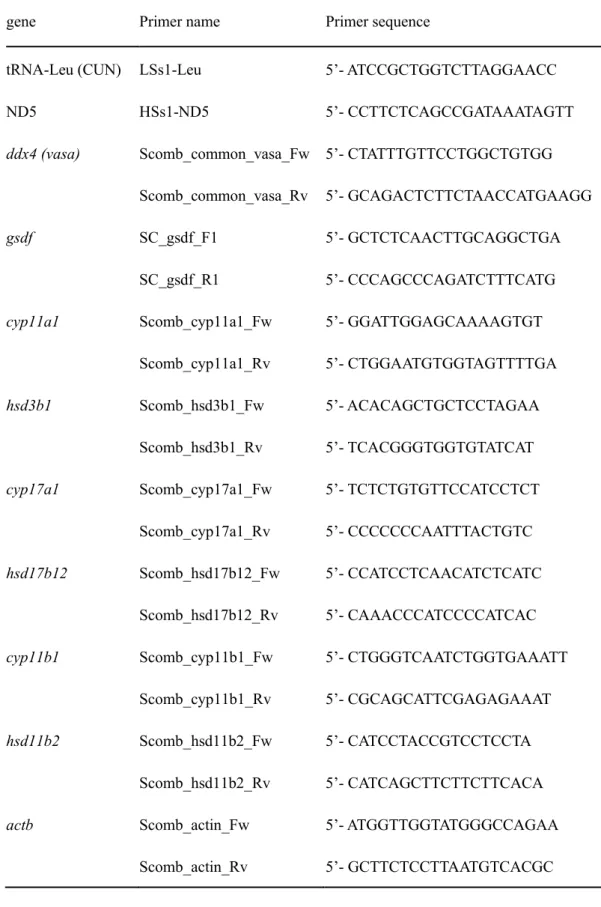
Aneuploid, gynogenic, or androgenic offspring were previously produced by interspecific hybridization (Liu, 2010). Therefore, to confirm successful production of diploid hybrids, 10 hybrid larvae at 1-dph were subjected to DNA analyses against nuclear DNA (nDNA) or mitochondrial DNA (mtDNA). Detection of parental nDNA was performed using a multiplex PCR kit “ Saba checker-I” (SCOTS, Saga, Japan) according to manufacturer's instructions. This method amplified both blue and chub mackerel specific regions in the nuclear ribosomal DNA (rDNA) internal transcribed spacer (ITS1) region. Identification of maternal origin was performed by PCR-restriction fragment length polymorphism (RFLP) analysis of mtDNA following a previously reported protocol (Food and Agricultural Materials Inspection Center and Fisheries Research Agency, 2007). Briefly, the PCR was performed with primer sets LSs1-Leu and HSs1-ND5 (Table. 1), designated for the conserved region located from tRNA-Leu (CUN) to NADH dehydrogenase subunit 5 (ND5) gene between chub and blue mackerel. PCR amplification was conducted in a 50-μl reaction volume containing 1× PCR Buffer II, 200 μM of dNTPs, 1.5mM MgCl2, 1.25 U of AmpliTaq Gold DNA polymerase (Thermo Fisher Scientific, MA, USA), 50 ng of template DNA, and 1 µM of each primer. Thermal cycling conditions were: 1 cycle of 95°C for 8 min, then 35 cycles of 94°C for 30 s, 55°C for 15 s, 72°C for 1 min, followed by a final
elongation step at 72°C for 7 min. Amplified PCR fragments were digested for an hour at 37°C with Hae III, which recognizes a sequence unique to the target region of chub mackerel. PCR-RFLP products were electrophoresed on a 2.0% agarose gel. To estimate average cellular DNA contents of parental species and hybrid larvae at 1-dph, flow cytometric analysis was performed as described previously by Yazawa et al. (2019). Relative DNA content of each larva was measured using a Guava PCA‐96 (Millipore, Billerica, MA). CyStain PI Absolute T kits (Partec, Munster, Germany) were used according to the manufacturer's instructions and a blue mackerel larva was used to represent the standard DNA content value of respective sample types. Flow cytometry was performed using ten 1-dph hybrid mackerel, control chub mackerel, and blue mackerel.
Histological analysis of hybrid mackerel gonads
Fish used in histological analyses were 30-, 60-, 120-dph, 1 and 2-year-old hybrid mackerel. Gonadosomatic indices (GSI; [gonad weight in grams/body weight in grams] × 100) were measured to monitor gonadal development of hybrid mackerel. Gonads were fixed with Bouin’s fixative overnight at 4°C, cut into 4-m thick sections using standard paraffin-embedding methods, and stained with hematoxylin and eosin. Images of sections were obtained using a light microscope (BX-51; Olympus, Tokyo, Japan) and a digital camera (DP-70; Olympus). This histological analysis was performed using at least 10 gonads of hybrid mackerel at each age.
Gene expression analyses of hybrid mackerel gonads
The localization of germ cell marker, DEAD-box polypeptide 4 (ddx4) mRNA, and Sertoli cell marker, gonadal soma derived growth factor (gsdf) mRNA, were analyzed by in situ hybridization (ISH) on tissue sections of 120-dph hybrid and blue mackerel. Antisense
RNA probes were synthesized from 379-bp chub mackerel ddx4 (nucleotide 2,008-2,387 bp; GQ404693), and 488-bp chub mackerel gsdf (nucleotide 1-488 bp; GQ404694) cDNA fragments, as previously described (Yazawa et al., 2010). The ISH was performed as described previously (Sawatari et al., 2007). Since homologies of ddx4 and gsdf probes between the two mackerel are 95.2% and 98.7%, respectively, these probes are expected to be hybridized to transcripts from alleles of both species. Total RNA extraction and cDNA synthesis were performed as previously described (Yazawa et al., 2010). To validate the histological observations, the reverse-transcription PCR (RT-PCR) for germ cell marker,
ddx4; Sertoli cell marker, gsdf; Leydig cell marker, steroid 11-beta-hydroxylase (cyp11b1);
and internal control, beta-actin (actb) was performed using cDNA obtained from the gonads of hybrid mackerel at 120-dph and 1-year-old. Moreover, to clarify whether hybrid mackerel have the potential to produce the 11-ketotestosterone (11-KT) that plays a pivotal role in spermatogenesis, RT-PCR for six steroidogenic enzyme genes required for conversion of cholesterol to 11-KT (cholesterol side-chain-cleavage enzyme, cyp11a1; 3 beta-hydroxysteroid dehydrogenase / delta 5-delta 4 isomerase type I, hsd3b1; steroid 17 alpha-hydroxylase / C17,20 lyase, cyp17a1; hydroxysteroid 17-beta dehydrogenase 12, hsd17b12;
cyp11b1 and hydroxysteroid 11-beta dehydrogenase 2, hsd11b2) were performed using
cDNA obtained from the testis of hybrid mackerel at 1-year-old. The PCR amplification was conducted with AmpliTaq Gold DNA polymerase; primer sets for each gene are listed in Table 1. To detect transcripts from alleles of both species, all primers were designed against regions that are completely conserved between chub and blue mackerel. The GenBank accession number of each gene of both chub and blue mackerel is listed in Table 2. Thermal cycling conditions were: 1 cycle of 95°C for 10 min, then 35 cycles of 95°C for 30 s, 58°C for 30 s, and 72°C for 1 min, followed by a final elongation step at 72°C for 3 min. PCR products were electrophoresed on a 2.0% agarose gel.
Germ cell transplantation
Donor testicular cells were prepared from 3-year-old male Pacific bluefin tuna (body weight, approximately 40 kg) which were reared in net pens at Kushimoto, Wakayama Prefecture, Japan. Freshly isolated testes were minced with Weckel scissors and dissociated as previously described (Yazawa et al., 2013). To isolate spermatozoa and blood cells from whole testicular cell suspensions, density gradient centrifugation using a Percoll gradient (Percoll Plus; GE Healthcare, Princeton, NJ) was performed as previously described (Ichida et al., 2019). To label donor testicular cells, PKH26 (Sigma-Aldrich, Inc., St. Louis, MO) staining was performed as described by Takeuchi et al. (2009). We previously revealed that chub mackerel larvae with a total length of 5.3-mm showed higher incorporation efficiency of transplanted germ cells relative to those with a total length of 4.2-mm or 6.9-mm (Yazawa et al., 2010). In this study, therefore, PKH26-labeled cells were transplanted into the peritoneal cavity of hybrid mackerel larvae at 10-dph with a total length of 5.8-mm. At least 10,000 cells were injected into each of the 170 recipients. Transplantation was performed as previously described (Yazawa et al., 2010). Genital ridges excised from five recipients were imaged under a fluorescent microscope (BX51N-34FL, Olympus) at 14 days post-transplantation to confirm the incorporation of PKH26-labeled donor germ cells. Incorporation rate of donor-derived germ cells in recipient genital ridges was calculated as [ number of fish incorporating fluorescent cells in genital ridges at 14 days post-transplantation/number of fish observed x 100].
Statistical analysis
All data are represented as the mean ± standard error of the mean (SEM). A value of p < 0.01 was considered significant for all tests. A two-tailed Student's t-test was used to
determine statistical differences in means of fertilization rates and hatching rates between hybrid mackerel and chub mackerel (F-test was performed to show that the variance of populations were equal). Further, one-way analysis of variance (ANOVA), followed by Tukey’s multiple comparison test was used to determine statistical significance in the mean GSI of 1- and 2-year-old hybrid mackerels and 1-year-old chub mackerels. Before conducting the ANOVA, the homogeneity of variances was determined with Bartlett’s test. All analyses were carried out using GraphPad Prism version 5.0 (GraphPad).
Results
Production of hybrid mackerel
Early survival of hybrid mackerel is illustrated in Fig. 1A. Mean ± SEM values for fertilization and hatching rates of hybrid mackerel were 93.5% ± 2.3% and 87.4% ± 4.4% (n = 3), respectively. By comparison, mean fertilization and hatching rates of control blue mackerel were 96.7% ± 0.6% and 84.7% ± 3.6% (n = 3), respectively. No significant differences between these fertilization and hatching rates were found. Genomic DNA of hybrid mackerel larvae at 1-dph was subjected to multiplex PCR analysis that targeted a species-specific sequence of the ITS region in nDNA (Fig. 1B). As a result, both blue mackerel and chub mackerel specific fragments (200 bp and 125 bp, respectively) were amplified in all tested hybrid mackerel larvae (n = 10). Moreover, the PCR-RFLP targeted region of mtDNA indicated that hybrid mackerel larvae possessed mtDNA derived from blue mackerel; restriction patterns were identical to those of blue mackerel (Fig. 1C, n=10). Analyses of cellular DNA content revealed that hybrid mackerel showed the same peaks for DNA contents observed in diploid parental species and none exhibited signs of aneuploidy (Fig. 1D). Moreover, the external appearance of hybrid mackerel at 120dph was similar to parental species at the same age and showed no deformation. Hybrid fish grew normally (Fig. 1E).
Gonadal development of hybrid mackerel at 30-, 60- and 120-dph
To clarify the fertility of hybrid fish, gonadal development was compared with that of control chub mackerel (Fig. 2). At 30-dph, hybrid mackerel possessed sexually undifferentiated gonads with primordial germ cells (PGCs) that were enclosed by gonadal somatic cells (Fig. 2B), as also observed in controls (Fig. 2A). Control chub mackerel gonads at 60-dph differentiated into testis or ovary (Fig. 2C, D) and sperm duct and spermatogonia
were observed in testis (Fig. 2C). The ovarian cavity and ovarian lamella were formed in control fish, and oogonia were observed (Fig. 2D). By contrast, all hybrid mackerel at 60-dph showed only testis-like gonads possessing sperm duct and spermatogonia (n = 10, Fig. 2E). In control at 120-dph, numbers of germ cells were drastically increased in both testis (Fig. 2F) and ovary (Fig. 2G). In ovaries, primary oocytes were observed during the perinucleolus stage (Fig. 2G). Hybrid mackerel at 120-dph showed only testis-like gonads as at 60-dph, and germ cells were not observed in these testis-like gonads (n = 10, Fig. 2H).
Gene expression analyses of germ cell-less gonads of hybrid mackerel at 120-dph
To further confirm depletion of germ cells, we investigated expression of the germ cell marker, ddx4 mRNA, in hybrid mackerel gonads at 120-dph by ISH (Fig. 3A-F, A’-F’). ddx4-positive germ cells were detected in control blue mackerel testis (Fig. 3B, B’), whereas no
ddx4-positive germ cells were detected in hybrid mackerel gonads (Fig. 3E, E’). Further,
transcripts for ddx4 were not detectable using RT-PCR (Fig. 3G). gsdf-positive Sertoli cells were detected in both control blue mackerel and hybrid mackerel at nearly equal levels (Fig. 3C, C’, F, F’). Thus, hybrid mackerel are devoid of germ cells, but not Sertoli cells. Expression of gsdf in the hybrid gonads was further confirmed by RT-PCR (Fig. 3G), as was the of Leydig cell marker, cyp11b1 (Fig. 3G). These results are promising for germ cell transplantation because the presence of supporting cells and steroidogenic cells that can nurse donor-derived germ cells is a prerequisite for the successful colonization and development of these cells.
Histological analysis of hybrid mackerel gonads at 1- and 2-year-old
Male and female chub mackerel are reported to reach sexual maturity at one year in captivity (Ishibashi et al., 2007; Nyuji et al., 2014). We investigated 1- and 2-year-old hybrid
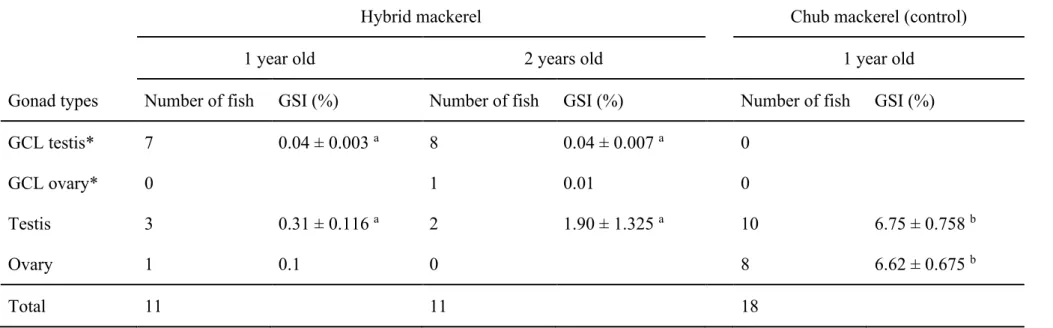
mackerel for germ cell-less testis during spawning seasons. At one and two years after hatching, seven out of 11 (63.6 %) and eight out of 11 (72.7 %) hybrid mackerel possessed germ cell-less testes, respectively (Fig. 4A, G, M) and GSI of these germ cell-less testes was 0.04 ± 0.003% and 0.04 ± 0.007%, respectively both of which are significantly lower than testes of control chub mackerel at 1 year old (GSI; 6.75 ± 0.758% , Fig. 4E, K, Q) (p > 0.01). Three out of 11 (27.3%) 1-year-old and 2 out of 11 (18.2%) 2-year-old hybrid mackerel possessed spermiated testes and all stages of spermatogenic cells, i.e. spermatogonia to sperm, was observed with HE staining (Fig. 4C, I, O), yet the GSI of these spermiated testes was 0.31 ± 0.12% and 1.9 ± 1.3%, respectively, were also significantly lower than testes of 1 year-old control chub mackerel (p > 0.01). Also, one out of 11 (9.1%) 1-year-old hybrid mackerel showed displayed an ovary with numerous oocytes (Fig. 4D, J, P). Moreover, one out of 11 (9.1%) 2-year-old hybrid mackerel possessed germ cell-less ovary-like gonad with an ovarian cavity and ovarian lamella (Fig. 4B, H, N). As mentioned above, although a 50:50 sex ratio is observed in wild chub mackerel, the sex ratio of male to female hybrid mackerel was 10:1 at both 1- and 2-years after hatching (Table 3). Thus, hybrid mackerel exhibit a strong male-biased sex ratio.
Gene expression analyses of testis of hybrid mackerel at 1-year-old
The expression of ddx4, gsdf and six steroidogenic enzyme genes required for conversion of cholesterol to 11-KT (cyp11a1, hsd3b1, cyp17a1, hsd17b12, cyp11b1, hsd11b2) in the testis of 1-year-old hybrid mackerel were investigated using RT-PCR (Fig. 5). The germ cell-less testis of 1-year-old hybrid mackerel were found to be ddx4-negative, gsdf-positive, and
cyp11b1-positive. Thus, the expression pattern of each cell-type maker genes in the germ
cell-less testis of 1-year-old fish was the same as those at 120-dph. Moreover, all tested steroidogenic enzyme genes were detected in both germ cell-less testis (ddx4-negative) and
spermiated testis (ddx4-positive) of hybrid mackerel, as well as in the spermiated testis of control blue and chub mackerel. These results suggested that the germ cell-less testis of hybrid mackerel have the ability to produce the 11-KT.
Transplantation of bluefin tuna testicular cells into the hybrid mackerel.
Bluefin tuna testicular cells labeled with PKH26 (Fig. 6A, B) were transplanted into the peritoneal cavity of hybrid larvae at 10-dph. At 24-dph, no fluorescence was observed in the gonads of non-transplanted fish (Fig. 6C-E), whereas numerous PKH26-labeled cells were incorporated in the gonad of transplanted recipient larvae (Fig. 6F-H). The frequency of occurrence of recipient larvae incorporating donor-derived bluefin tuna germ cells was 100% (n = 5). The mean number of donor-derived germ cells found in the hybrid mackerel recipients was 36.9 ± 8.4. Hybrid mackerel gonads thus possessed a capability to attract and incorporate donor germ cells of bluefin tuna at high efficiency.
Discussion
In this study, we succeeded in producing a hybrid mackerel (female blue mackerel × male chub mackerel) that lost germ cells in gonads after 120-dph. This loss was confirmed by lack of expression of a germ cell marker, ddx4. In contrast, gene expression of a Sertoli cell marker, gsdf, and a Leydig cell marker, cyp11b1, were clearly detected in the hybrid mackerel gonads. The hybrid mackerel thus shows germ cell-less sterility but retains supporting cells and steroidogenic cells both of which are essential for nursing transplanted exogenous germ cells. More importantly, bluefin tuna germ cells transplanted into the peritoneal cavity migrated to and were incorporated into hybrid mackerel gonads with high efficiency. The genital ridge of hybrid mackerel thus retains the capability to attract and incorporate xenogeneic bluefin tuna germ cells.
As a key regulator for guiding the migration of PGCs, the chemokine SDF-1 (stromal cell-derived factor 1, also called as CXCL12) secreted by the region where the gonad develops and its receptor CXCR4 (C-X-C chemokine receptor type 4) expressed in the PGCs have been identified in zebrafish (Doitsidou et al., 2002), medaka (Sasado et al., 2008), and kingfish (Fernández et al., 2015). We previously confirmed CXCR4 is also expressed in testicular germ cells (Hayashi et al., unpublished data). Therefore, hybrid mackerel SDF-1 may activate bluefin tuna CXCR4 signaling and guide the migration of transplanted bluefin tuna germ cells to the region where the gonad develops, even though they were isolated from a different genus. In a previous study, migration of donor cells into recipient gonads was usually possible even if donor and recipient were genetically distant species (Yoshizaki and Yazawa, 2019; Goto and Saito, 2019). Notably, Saito et al. (2014) showed that transplanted sturgeon PGC was incorporated into the genital ridge of goldfish. These species are from different orders. These reports suggest that mechanisms of germ cell migration are conserved across fish species, and the present results are consistent with this hypothesis.
Incorporation rate (100.0%) found in the present inter-generic transplantation was higher than colonization rates (70.0%) observed in our previous inter-family transplantation using donor nibe croaker and recipient chub mackerel (Yazawa et al., 2010). Colonization frequency may be affected by the phylogenic distance between the donor and recipient species.
Overall, hybrid mackerel show significant promise as a recipient for production of bluefin tuna gametes by surrogate broodstock technology. Most hybrid mackerel are germ cell-less and hold advantages over sterile triploid fish. First, germ cell-less recipients produce only donor-derived gametes. Triploids produce small numbers of abnormal, aneuploid gametes in some species (Felip et al., 2001; Piferrer et al., 2009), leading to risks of producing both donor-derived gametes and dysfunctional endogenous gametes. Consequently, the efficiency of producing donor-derived offspring might be compromised undesirable fertilization with dysfunctional endogenous gametes. Since germ cell-less recipients are completely devoid of endogenous germ cells, they will produce only donor-derived offspring. Second, since triploid gonads maintain a normal number of mitotic germ cells, endogenous cells are presumed to compete with the transplanted germ cells for germ cell niches. No such competitive endogenous germ cells exist in germ cell-less sterile fish. In rainbow trout, the donor-derived germ cells showed significantly higher colonization and proliferation efficiency in the gonads of germ cell-less recipients, produced by knockdown of dnd expression using antisense morpholino oligonucleotides (AMO), than those in the gonads of the control recipients (Yoshizaki et al., 2016). In contrast to dnd-AMO-treated recipients that show no germ cells during the transplantation period, hybrid mackerel possess endogenous germ cells until 60-dph. Therefore, the colonization efficiency of donor-derived germ cells might not be enhanced in the gonads of hybrid mackerel. On the other hand, since endogenous germ cells of most hybrid mackerels disappeared by 120-dph, the transplanted
germ cells can occupy the germ cell niches effectively, meaning that their proliferation would be enhanced in the gonads of hybrid mackerel. Further, when testicular cells of sockeye salmon (Oncorhynchus nerka) are transplanted into triploid and dnd-knockdown rainbow trout, triploid trout produces donor-derived salmon sperm but not eggs, but the dnd-knockdown trout recipient successfully produces both donor-derived salmon sperms and eggs (Yoshizaki et al., unpublished data). In the present study, most hybrid mackerel possess germ cell-less gonads, making them promising recipients for production of xenogeneic bluefin tuna gametes.
In various animal species, including fish, a cytological mechanism of hybrid sterility is meiotic arrest caused by failure to achieve synapsis between homologous chromosomes (Chandley et al., 1975; Shimizu et al., 1997; Sawamura et al., 2004; Bhattacharyya et al., 2013; Islam et al., 2013). Therefore, germ cell-less sterility in the hybrid mackerel is a rare case of hybrid sterility. Recently, Yoshikawa et al. (2018a) reported that a hybrid of female blue dram × male white croaker showed germ cell-less sterility, and this report is apparently to only one in the existing literature. The PGCs of hybrid larvae from this cross migrate and are incorporated into genital ridges normally but are unable to proliferate. Eventually, hybrid gonads become germ cell-less and sterile. In contrast, proliferation of PGCs in mackerel hybrid gonads was observed histologically at 60-dph, indicating that germ cell-less sterility of hybrid mackerel is caused by mechanisms different from mechanisms underlying sterility in blue dram × white croaker hybrids. Further study is required to investigate proliferation, differentiation, and apoptosis in germ cells found in the gonads of hybrid mackerel juveniles. We revealed that hybrid mackerel show a strong male-biased sex ratio and individuals possessing ovary-like germ cell-less gonads rarely appeared. In zebrafish and medaka (Oryzias latipes), numbers of germ cells affect sex differentiation; that is, absence of germ cells leads to exclusive male development even in genetic females (Weidinger et al., 2003;
Slanchev et al., 2005; Kurokawa et al., 2007; Li et al., 2017). This phenomenon also occurred in hybrid mackerel possessing germ cell-less gonads. This male-biased sex ratio may become a potential disadvantage for production of donor-derived eggs. However, we have succeeded in producing feminized chub mackerel by oral administration of estradiol-17beta (Tani et al., unpublished data), the promising potential for production of female hybrid mackerel using this technique will be assessed in future work.
In order to nurse the spermatogenesis of transplanted exogenous germ cells, it is essential that the recipient has the ability to produce the androgens (11-KT) that play a pivotal role in spermatogenesis (Miura et al., 1991, Schulz and Miura, 2002). The RT-PCR analysis revealed that the steroidogenic enzyme genes, required for conversion of cholesterol to 11-KT, are expressed in the germ cell-less testis of 1-year-old hybrid mackerel. Since the germ cells depletion markedly affects the anatomical structure and frequency of occurrence of each cell type in testes, quantitative analyses of reproductive hormones in the germ cell-less testis were not performed. Certainly, however, the germ cell-less testis of hybrid mackerel do have the potential for androgen production. Future studies will be required to reveal whether transplanted hybrid mackerel recipients can nurse spermatogenesis of donor-derived germ cells.
The sterility of hybrid mackerel was not displayed in all individuals. The frequency of non-sterile fish was as low as 36.4% after 1 year, and 18.2% after 2 years, and 0% after the first four months (120-dph group). Since we produced these fish groups using different broodstock, we could not rule out the possibility that the frequency of the sterile fish is affected by their genetic background. To produce a 100% sterile population, the precise mechanism of sterility caused by hybridization in mackerel will require better understanding. In the present study, we showed biological characteristics of hybrid mackerel, with special emphasis on germ cell-less sterility. We also showed applicability of this hybrid for
mass-production and its ability to harbor tuna germ cells. Thus, hybrid mackerel are promising recipient candidates as surrogate broodstock for bluefin tuna gamete production.