ScienceDirect
Available online at www.sciencedirect.com
Procedia Computer Science 159 (2019) 1670–1679
1877-0509 © 2019 The Authors. Published by Elsevier B.V.
This is an open access article under the CC BY-NC-ND license (https://creativecommons.org/licenses/by-nc-nd/4.0/) Peer-review under responsibility of KES International.
10.1016/j.procs.2019.09.337
10.1016/j.procs.2019.09.337 1877-0509
© 2019 The Authors. Published by Elsevier B.V.
This is an open access article under the CC BY-NC-ND license (https://creativecommons.org/licenses/by-nc-nd/4.0/) Peer-review under responsibility of KES International.
Available online at www.sciencedirect.com
ScienceDirect
Procedia Computer Science 00 (2019) 000–000
www.elsevier.com/locate/procedia
1877-0509 © 2019 The Author(s). Published by Elsevier B.V.
This is an open access article under the CC BY-NC-ND license (https://creativecommons.org/licenses/by-nc-nd/4.0/) Peer-review under responsibility of KES International.
23rd International Conference on Knowledge-Based and Intelligent Information & Engineering
Systems
Failure-enhanced evacuation training using a VR-based disaster
simulator: A comparative experiment with simulated evacuees
Hiroyuki Mitsuhara
a*, Chie Tanimura
b, Junko Nemoto
c, Masami Shishibori
aaTokushima University, 2-1 Minami-josanjima, Tokushima 770-8506, Japan bNaruto University of Education, 748 Takashima-nakajima, Naruto 772-8502, Japan
cMeiji Gakuin University, 1-2-37 Shirokanedai Minato-ku, Tokyo 108-8636, Japan
Abstract
Evacuation training is an important component of disaster education and survival. Evacuation training using a virtual reality (VR)-based disaster simulator that provides a highly immersive simulated evacuation experience (SEE) has attracted significant attention. To improve the training effect, we propose a failure-enhanced evacuation training model based on Kolb’s experiential learning theory. Our model aims to purposefully induce participants to succumb to conformity bias and fail to evacuate during the first SEE because inactive evacuees (i.e., people who are not evacuating speedily or not starting their evacuation) are simulated in a VR-based disaster simulator. The participants are expected to overcome failure in the second SEE via reflection and conceptualization. A preliminary comparative experiment focused on how simulated evacuees influence the SEE of participants in a VR-based disaster simulator. Results indicated that failure-enhanced evacuation training can successfully improve the training effect.
© 2019 The Author(s). Published by Elsevier B.V.
This is an open access article under the CC BY-NC-ND license (https://creativecommons.org/licenses/by-nc-nd/4.0/) Peer-review under responsibility of KES International.
Keywords: Evacuation training; failure; conformity bias; inactive evacuees; disaster simulator; virtual reality
* Corresponding author. Tel.: +81-88-656-7497.
E-mail address: [email protected]
Available online at www.sciencedirect.com
ScienceDirect
Procedia Computer Science 00 (2019) 000–000
www.elsevier.com/locate/procedia
1877-0509 © 2019 The Author(s). Published by Elsevier B.V.
This is an open access article under the CC BY-NC-ND license (https://creativecommons.org/licenses/by-nc-nd/4.0/) Peer-review under responsibility of KES International.
23rd International Conference on Knowledge-Based and Intelligent Information & Engineering
Systems
Failure-enhanced evacuation training using a VR-based disaster
simulator: A comparative experiment with simulated evacuees
Hiroyuki Mitsuhara
a*, Chie Tanimura
b, Junko Nemoto
c, Masami Shishibori
aaTokushima University, 2-1 Minami-josanjima, Tokushima 770-8506, Japan bNaruto University of Education, 748 Takashima-nakajima, Naruto 772-8502, Japan
cMeiji Gakuin University, 1-2-37 Shirokanedai Minato-ku, Tokyo 108-8636, Japan
Abstract
Evacuation training is an important component of disaster education and survival. Evacuation training using a virtual reality (VR)-based disaster simulator that provides a highly immersive simulated evacuation experience (SEE) has attracted significant attention. To improve the training effect, we propose a failure-enhanced evacuation training model based on Kolb’s experiential learning theory. Our model aims to purposefully induce participants to succumb to conformity bias and fail to evacuate during the first SEE because inactive evacuees (i.e., people who are not evacuating speedily or not starting their evacuation) are simulated in a VR-based disaster simulator. The participants are expected to overcome failure in the second SEE via reflection and conceptualization. A preliminary comparative experiment focused on how simulated evacuees influence the SEE of participants in a VR-based disaster simulator. Results indicated that failure-enhanced evacuation training can successfully improve the training effect.
© 2019 The Author(s). Published by Elsevier B.V.
This is an open access article under the CC BY-NC-ND license (https://creativecommons.org/licenses/by-nc-nd/4.0/) Peer-review under responsibility of KES International.
Keywords: Evacuation training; failure; conformity bias; inactive evacuees; disaster simulator; virtual reality
* Corresponding author. Tel.: +81-88-656-7497.
E-mail address: [email protected]
2 Author name / Procedia Computer Science 00 (2019) 000–000
1. Introduction
The increasing number of natural [1] and manmade [2] disasters around the world indicates that anyone can encounter disasters. People should learn how to survive disasters and recognize that disasters are not someone else’s problem. Disaster education is globally important as a disaster management measure, but widespread disaster education has not yet been established [3] because this type of education covers various disaster situations that are occasionally related to human factors (e.g., emotion, morality, and physical capacity) and influences decision making. For example, it is difficult to find solid answers about how to manage fear that may prompt survival but prevent proper decision making. Therefore, disaster education has been diversified but not established. A major approach to diversification is the use of information technology. Panoramic disaster simulators help create practical evacuation plans by visualizing spreading damage and evacuees’ trajectories in possible disasters [4]. By focusing on simulated disaster experiences, virtual reality (VR) technologies are often used to heighten immersion (i.e., reality) in the experience. In a search for popularization, serious VR-based games that combine VR and digital game technologies have been actively developed. For example, Taylor-Nelms and Hill [5] developed a VR-based role-playing game in which players can collaboratively learn emergency responses by tackling tornado-caused rescue missions as different characters (e.g., firefighters and medical responders). Chittaro and Buttussi [6] developed an immersive VR-based game that adopts a head-mounted display (HMD) and lets players learn how to escape from a ditched aircraft while receiving audiovisual feedback depending on their safety actions (proper or improper). Serious VR-based games for disaster education are expected to become more popular because of the ubiquitousness of low-cost, high-performance devices (e.g., smartphone-based HMD).
For the public, a simulated disaster experience should teach evacuation methods and procedures. In other words, evacuation training via a simulated evacuation experience (SEE) is required because everyone must successfully evacuate once a disaster occurs. In traditional evacuation training, participants simply follow a fixed route in a normal situation (the real world). However, this type of evacuation training involves little immersion and results in a minimal effect because participants hardly feel that they are in a disaster situation. It is indisputable that VR technologies can be used to realistically present disaster situations and heighten the level of immersion in SEE. For example, Smith and Ericson [7] focused on fire safety for children and developed a game based on a cave automatic virtual environment that encourages players to take proper physical actions (e.g., crawl to avoid smoke) during evacuation. Chittaro and Sioni [8] developed a VR-based desktop game in which players can learn how to evacuate from terrorist attacks while receiving instructions about proper decisions and to heighten their self-efficacy for survival. Lovreglio et al. [9] studied an HMD-enabled game that requires players to evacuate from an earthquake-damaged hospital while interacting with a changing environment and various agents (nonplayer characters). VR-based disaster simulators that do not focus on gaming elements can also effectively train people to be survivors. For example, Sharma et al. [10] developed a VR-based fire simulator that visualizes fire and crowds in a subway station and creates a multiparticipant SEE. Gong et al. [11] created a VR-based earthquake simulator that uses motion– tracking devices (e.g., Kinect) and creates an intuitively operable SEE.
This study aims to improve the effect of evacuation training by using a VR-based disaster simulator. At the early stage, we proposed an ideal training model and clarify the type of SEE that should be provided, i.e., the type of disaster situations that should be presented in the simulator.
2. Failure-Enhanced Evacuation Training
It is interesting to investigate how participants evacuate (i.e., behave) in VR-based disaster simulators [12]. For example, Gamberini et al. [13] examined how the victim’s ethnicity and emergency conditions in a VR-based disaster simulator influence participants’ helping behaviors and found that helping behaviors can depend on psychological bias (e.g., racial discrimination) and time pressure.
In evacuation training using a VR-based disaster simulator, simulated evacuees (i.e., agents other than a participant) can influence a participant’s evacuation behavior. In this study, we identify the type of simulated evacuee that has the most influence and the manner in which evacuees should be used to improve the training effect.
Hiroyuki Mitsuhara et al. / Procedia Computer Science 159 (2019) 1670–1679 1671 Available online at www.sciencedirect.com
ScienceDirect
Procedia Computer Science 00 (2019) 000–000www.elsevier.com/locate/procedia
1877-0509 © 2019 The Author(s). Published by Elsevier B.V.
This is an open access article under the CC BY-NC-ND license (https://creativecommons.org/licenses/by-nc-nd/4.0/) Peer-review under responsibility of KES International.
23rd International Conference on Knowledge-Based and Intelligent Information & Engineering
Systems
Failure-enhanced evacuation training using a VR-based disaster
simulator: A comparative experiment with simulated evacuees
Hiroyuki Mitsuhara
a*, Chie Tanimura
b, Junko Nemoto
c, Masami Shishibori
aaTokushima University, 2-1 Minami-josanjima, Tokushima 770-8506, Japan bNaruto University of Education, 748 Takashima-nakajima, Naruto 772-8502, Japan
cMeiji Gakuin University, 1-2-37 Shirokanedai Minato-ku, Tokyo 108-8636, Japan
Abstract
Evacuation training is an important component of disaster education and survival. Evacuation training using a virtual reality (VR)-based disaster simulator that provides a highly immersive simulated evacuation experience (SEE) has attracted significant attention. To improve the training effect, we propose a failure-enhanced evacuation training model based on Kolb’s experiential learning theory. Our model aims to purposefully induce participants to succumb to conformity bias and fail to evacuate during the first SEE because inactive evacuees (i.e., people who are not evacuating speedily or not starting their evacuation) are simulated in a VR-based disaster simulator. The participants are expected to overcome failure in the second SEE via reflection and conceptualization. A preliminary comparative experiment focused on how simulated evacuees influence the SEE of participants in a VR-based disaster simulator. Results indicated that failure-enhanced evacuation training can successfully improve the training effect.
© 2019 The Author(s). Published by Elsevier B.V.
This is an open access article under the CC BY-NC-ND license (https://creativecommons.org/licenses/by-nc-nd/4.0/) Peer-review under responsibility of KES International.
Keywords: Evacuation training; failure; conformity bias; inactive evacuees; disaster simulator; virtual reality
* Corresponding author. Tel.: +81-88-656-7497.
E-mail address: [email protected]
Available online at www.sciencedirect.com
ScienceDirect
Procedia Computer Science 00 (2019) 000–000
www.elsevier.com/locate/procedia
1877-0509 © 2019 The Author(s). Published by Elsevier B.V.
This is an open access article under the CC BY-NC-ND license (https://creativecommons.org/licenses/by-nc-nd/4.0/) Peer-review under responsibility of KES International.
23rd International Conference on Knowledge-Based and Intelligent Information & Engineering
Systems
Failure-enhanced evacuation training using a VR-based disaster
simulator: A comparative experiment with simulated evacuees
Hiroyuki Mitsuhara
a*, Chie Tanimura
b, Junko Nemoto
c, Masami Shishibori
aaTokushima University, 2-1 Minami-josanjima, Tokushima 770-8506, Japan bNaruto University of Education, 748 Takashima-nakajima, Naruto 772-8502, Japan
cMeiji Gakuin University, 1-2-37 Shirokanedai Minato-ku, Tokyo 108-8636, Japan
Abstract
Evacuation training is an important component of disaster education and survival. Evacuation training using a virtual reality (VR)-based disaster simulator that provides a highly immersive simulated evacuation experience (SEE) has attracted significant attention. To improve the training effect, we propose a failure-enhanced evacuation training model based on Kolb’s experiential learning theory. Our model aims to purposefully induce participants to succumb to conformity bias and fail to evacuate during the first SEE because inactive evacuees (i.e., people who are not evacuating speedily or not starting their evacuation) are simulated in a VR-based disaster simulator. The participants are expected to overcome failure in the second SEE via reflection and conceptualization. A preliminary comparative experiment focused on how simulated evacuees influence the SEE of participants in a VR-based disaster simulator. Results indicated that failure-enhanced evacuation training can successfully improve the training effect.
© 2019 The Author(s). Published by Elsevier B.V.
This is an open access article under the CC BY-NC-ND license (https://creativecommons.org/licenses/by-nc-nd/4.0/) Peer-review under responsibility of KES International.
Keywords: Evacuation training; failure; conformity bias; inactive evacuees; disaster simulator; virtual reality
* Corresponding author. Tel.: +81-88-656-7497.
E-mail address: [email protected]
2 Author name / Procedia Computer Science 00 (2019) 000–000
1. Introduction
The increasing number of natural [1] and manmade [2] disasters around the world indicates that anyone can encounter disasters. People should learn how to survive disasters and recognize that disasters are not someone else’s problem. Disaster education is globally important as a disaster management measure, but widespread disaster education has not yet been established [3] because this type of education covers various disaster situations that are occasionally related to human factors (e.g., emotion, morality, and physical capacity) and influences decision making. For example, it is difficult to find solid answers about how to manage fear that may prompt survival but prevent proper decision making. Therefore, disaster education has been diversified but not established. A major approach to diversification is the use of information technology. Panoramic disaster simulators help create practical evacuation plans by visualizing spreading damage and evacuees’ trajectories in possible disasters [4]. By focusing on simulated disaster experiences, virtual reality (VR) technologies are often used to heighten immersion (i.e., reality) in the experience. In a search for popularization, serious VR-based games that combine VR and digital game technologies have been actively developed. For example, Taylor-Nelms and Hill [5] developed a VR-based role-playing game in which players can collaboratively learn emergency responses by tackling tornado-caused rescue missions as different characters (e.g., firefighters and medical responders). Chittaro and Buttussi [6] developed an immersive VR-based game that adopts a head-mounted display (HMD) and lets players learn how to escape from a ditched aircraft while receiving audiovisual feedback depending on their safety actions (proper or improper). Serious VR-based games for disaster education are expected to become more popular because of the ubiquitousness of low-cost, high-performance devices (e.g., smartphone-based HMD).
For the public, a simulated disaster experience should teach evacuation methods and procedures. In other words, evacuation training via a simulated evacuation experience (SEE) is required because everyone must successfully evacuate once a disaster occurs. In traditional evacuation training, participants simply follow a fixed route in a normal situation (the real world). However, this type of evacuation training involves little immersion and results in a minimal effect because participants hardly feel that they are in a disaster situation. It is indisputable that VR technologies can be used to realistically present disaster situations and heighten the level of immersion in SEE. For example, Smith and Ericson [7] focused on fire safety for children and developed a game based on a cave automatic virtual environment that encourages players to take proper physical actions (e.g., crawl to avoid smoke) during evacuation. Chittaro and Sioni [8] developed a VR-based desktop game in which players can learn how to evacuate from terrorist attacks while receiving instructions about proper decisions and to heighten their self-efficacy for survival. Lovreglio et al. [9] studied an HMD-enabled game that requires players to evacuate from an earthquake-damaged hospital while interacting with a changing environment and various agents (nonplayer characters). VR-based disaster simulators that do not focus on gaming elements can also effectively train people to be survivors. For example, Sharma et al. [10] developed a VR-based fire simulator that visualizes fire and crowds in a subway station and creates a multiparticipant SEE. Gong et al. [11] created a VR-based earthquake simulator that uses motion– tracking devices (e.g., Kinect) and creates an intuitively operable SEE.
This study aims to improve the effect of evacuation training by using a VR-based disaster simulator. At the early stage, we proposed an ideal training model and clarify the type of SEE that should be provided, i.e., the type of disaster situations that should be presented in the simulator.
2. Failure-Enhanced Evacuation Training
It is interesting to investigate how participants evacuate (i.e., behave) in VR-based disaster simulators [12]. For example, Gamberini et al. [13] examined how the victim’s ethnicity and emergency conditions in a VR-based disaster simulator influence participants’ helping behaviors and found that helping behaviors can depend on psychological bias (e.g., racial discrimination) and time pressure.
In evacuation training using a VR-based disaster simulator, simulated evacuees (i.e., agents other than a participant) can influence a participant’s evacuation behavior. In this study, we identify the type of simulated evacuee that has the most influence and the manner in which evacuees should be used to improve the training effect.
1672 Hiroyuki Mitsuhara et al. / Procedia Computer Science 159 (2019) 1670–1679Author name / Procedia Computer Science 00 (2019) 000–000 3
2.1. Cognitive Bias and Evacuees
Even if they are inexperienced in disasters, most people attempt to act calm and occasionally underestimate the necessity of speedy evacuation. This behavior may result from cognitive biases that are psychological defensive functions for abnormal (particularly dangerous) situations. However, this type of behavior can prevent people from evacuating quickly [14]. In actual disasters, people often adopt one of the following cognitive biases. Normalcy bias alters people’s view of abnormal situations so that they appear normal and reduces their psychological stress [15]. Conformity bias lets people mimic the surrounding majority’s behavior to free themselves from personal judgment [16]. If the majority succumbs to normalcy bias in a disaster, the remaining people will conform to the majority and believe that evacuation is unnecessary.
In this study, we refer to people who are evacuating speedily (i.e., sprinting to safer places) as active evacuees and people who are not evacuating speedily (or not starting their evacuation) as inactive evacuees. Both types of evacuees exist in actual disasters, and active evacuees can make inactive evacuees transcend cognitive biases and become active evacuees.
Rios et al. [17] prepared a VR-based crowd simulator and examined whether participants follow agents sprinting to a hidden exit after an alarm goes off. The results indicated that as more agents sprinted, more participants tended to follow them without looking for an alternative exit. Furthermore, the participants who followed the agents felt higher levels of anxiety and nervousness, whereas participants who did not follow the agents (i.e., searched for an exit) felt lower levels of nervousness.
2.2. Ideal Model of Evacuation Training
The ideal design for evacuation training has not been clarified. In other words, well-established evacuation training models do not exist. Traditional evacuation training, in which participants follow and remember a fixed route, may not need a model because of its simplicity. If the training design requires participants to evacuate while making decisions, evacuation exercises using a VR-based disaster simulator will become complex and will require a model to improve the effects of training.
A VR-based disaster simulator allows participants to move around a virtual world. By assuming that a real-world experiential learning model is applicable to the immersive SEE provided by the simulator, we focus on Kolb’s experiential learning theory, which is depicted as a cyclic model that consists of four stages: concrete experience (CE), reflective observation (RO), abstract conceptualization (AC), and active experimentation (AE) [18]. Traditional evacuation training seems to cover only the CE. An ideal model for evacuation training using a VR-based disaster simulator should cover all four stages.
In the training exercises, participants who failed to evacuate because they made improper decisions would experience a stronger effect (e.g., disappointment and self-doubt) than if they succeeded because the failure is associated with injury or death. The failure can enhance reflection on their evacuation rather than future success. By emphasizing the importance of failed evacuation in the simulator, we propose a model of failure-enhanced evacuation training based on Kolb’s experiential learning theory. Our model aims to purposefully induce participants to fail to evacuate during the CE (Fig. 1). Our model regards the RO and AC as short learning activities in a participant’s head and prepares the same or similar disaster situations for the AE. Following our model, the participants can effectively learn how to evacuate swiftly, i.e., they can be trained to be active evacuees. After the AE, the participants move to the next CE that presents different disaster situations as a new SEE. Participants go through the following stages in our model:
CE: evacuate while making decisions (e.g., which route they should follow) RO: reflect on their evacuation experience (e.g., why they failed to evacuate) AC: conceptualize better evacuation experiences from their reflection outcomes
AE: evacuate again based on their concepts to overcome the failure and obtain their self-efficacy
4 Author name / Procedia Computer Science 00 (2019) 000–000
Fig. 1. Model of failure-enhanced evacuation training.
Purposeful failure is induced by inactive evacuees who are simulated (i.e., presented) in the simulator, and participants are made to descend into conformity bias by recognizing the simulated inactive evacuees.
3. Experiment
We conducted a preliminary comparative experiment that focuses on how simulated evacuees influence participants’ evacuation experiences in a VR-based disaster simulator. In this experiment, we prepared three conditions for the comparison: active, inactive, and no evacuees. We expected that the participants will adopt conformity bias by recognizing the inactive evacuees and failing to evacuate, i.e., the inactive evacuees would play an important role in the failure-enhanced evacuation training.
We also focused on the CE and AE (i.e., the SEEs) by assuming that all participants instinctively move to the AE from the CE via the RO and AC. Thus, we tentatively regarded the RO and AC as difficult-to-analyze stages and did not examine how these stages worked in our model.
3.1. VR-Based Disaster Simulator
We implemented a simple VR-based disaster simulator in which participants could move around small 3D worlds (virtual disaster worlds) from a first-person viewpoint with a gamepad. This simulator provided a high level of immersion by adopting a binocular opaque HMD (Oculus Rift) with a head motion–tracking sensor and headphones.
3.2. Settings
Thirty university students (20 to 30 years old), who accepted an invitation to play a VR-based game, participated in this experiment. The participants were not informed beforehand about the occurrence of disasters in the VR-based game (i.e., the VR-based disaster simulator) and divided evenly into three groups on the basis of their profiles (e.g., disaster experience and awareness): A (N = 10), B (N = 10), and C (N = 10) corresponding to active, inactive, and no evacuees, respectively.
The experiment consisted of four consecutive phases (Fig. 2). In the two SEEs, a time limit for evacuation was set for three minutes, but elapsed time was not superimposed on the 3D worlds to exclude its influence. Every participant’s evacuation time was recorded. The phases are outlined as follows:
(0) Operation exercise
This phase prepares the participants to adjust and move their avatar in the 3D worlds. Participants are required to move the avatar toward the goal of a 3D maze without a time limit. Reaching the goal shows mastery of the required operations and indicates that they can move to the next phase.
(1) First SEE (earthquake in a school)
This phase conditions the participants by comparing their evacuation experiences under different conditions. The 3D world experiences an earthquake (and a resulting fire) in a classroom during a schedule break. The participant operates a student avatar, and each group only differs with regard to simulated students (i.e.,
Hiroyuki Mitsuhara et al. / Procedia Computer Science 159 (2019) 1670–1679 1673
Author name / Procedia Computer Science 00 (2019) 000–000 3
2.1. Cognitive Bias and Evacuees
Even if they are inexperienced in disasters, most people attempt to act calm and occasionally underestimate the necessity of speedy evacuation. This behavior may result from cognitive biases that are psychological defensive functions for abnormal (particularly dangerous) situations. However, this type of behavior can prevent people from evacuating quickly [14]. In actual disasters, people often adopt one of the following cognitive biases. Normalcy bias alters people’s view of abnormal situations so that they appear normal and reduces their psychological stress [15]. Conformity bias lets people mimic the surrounding majority’s behavior to free themselves from personal judgment [16]. If the majority succumbs to normalcy bias in a disaster, the remaining people will conform to the majority and believe that evacuation is unnecessary.
In this study, we refer to people who are evacuating speedily (i.e., sprinting to safer places) as active evacuees and people who are not evacuating speedily (or not starting their evacuation) as inactive evacuees. Both types of evacuees exist in actual disasters, and active evacuees can make inactive evacuees transcend cognitive biases and become active evacuees.
Rios et al. [17] prepared a VR-based crowd simulator and examined whether participants follow agents sprinting to a hidden exit after an alarm goes off. The results indicated that as more agents sprinted, more participants tended to follow them without looking for an alternative exit. Furthermore, the participants who followed the agents felt higher levels of anxiety and nervousness, whereas participants who did not follow the agents (i.e., searched for an exit) felt lower levels of nervousness.
2.2. Ideal Model of Evacuation Training
The ideal design for evacuation training has not been clarified. In other words, well-established evacuation training models do not exist. Traditional evacuation training, in which participants follow and remember a fixed route, may not need a model because of its simplicity. If the training design requires participants to evacuate while making decisions, evacuation exercises using a VR-based disaster simulator will become complex and will require a model to improve the effects of training.
A VR-based disaster simulator allows participants to move around a virtual world. By assuming that a real-world experiential learning model is applicable to the immersive SEE provided by the simulator, we focus on Kolb’s experiential learning theory, which is depicted as a cyclic model that consists of four stages: concrete experience (CE), reflective observation (RO), abstract conceptualization (AC), and active experimentation (AE) [18]. Traditional evacuation training seems to cover only the CE. An ideal model for evacuation training using a VR-based disaster simulator should cover all four stages.
In the training exercises, participants who failed to evacuate because they made improper decisions would experience a stronger effect (e.g., disappointment and self-doubt) than if they succeeded because the failure is associated with injury or death. The failure can enhance reflection on their evacuation rather than future success. By emphasizing the importance of failed evacuation in the simulator, we propose a model of failure-enhanced evacuation training based on Kolb’s experiential learning theory. Our model aims to purposefully induce participants to fail to evacuate during the CE (Fig. 1). Our model regards the RO and AC as short learning activities in a participant’s head and prepares the same or similar disaster situations for the AE. Following our model, the participants can effectively learn how to evacuate swiftly, i.e., they can be trained to be active evacuees. After the AE, the participants move to the next CE that presents different disaster situations as a new SEE. Participants go through the following stages in our model:
CE: evacuate while making decisions (e.g., which route they should follow) RO: reflect on their evacuation experience (e.g., why they failed to evacuate) AC: conceptualize better evacuation experiences from their reflection outcomes
AE: evacuate again based on their concepts to overcome the failure and obtain their self-efficacy
4 Author name / Procedia Computer Science 00 (2019) 000–000
Fig. 1. Model of failure-enhanced evacuation training.
Purposeful failure is induced by inactive evacuees who are simulated (i.e., presented) in the simulator, and participants are made to descend into conformity bias by recognizing the simulated inactive evacuees.
3. Experiment
We conducted a preliminary comparative experiment that focuses on how simulated evacuees influence participants’ evacuation experiences in a VR-based disaster simulator. In this experiment, we prepared three conditions for the comparison: active, inactive, and no evacuees. We expected that the participants will adopt conformity bias by recognizing the inactive evacuees and failing to evacuate, i.e., the inactive evacuees would play an important role in the failure-enhanced evacuation training.
We also focused on the CE and AE (i.e., the SEEs) by assuming that all participants instinctively move to the AE from the CE via the RO and AC. Thus, we tentatively regarded the RO and AC as difficult-to-analyze stages and did not examine how these stages worked in our model.
3.1. VR-Based Disaster Simulator
We implemented a simple VR-based disaster simulator in which participants could move around small 3D worlds (virtual disaster worlds) from a first-person viewpoint with a gamepad. This simulator provided a high level of immersion by adopting a binocular opaque HMD (Oculus Rift) with a head motion–tracking sensor and headphones.
3.2. Settings
Thirty university students (20 to 30 years old), who accepted an invitation to play a VR-based game, participated in this experiment. The participants were not informed beforehand about the occurrence of disasters in the VR-based game (i.e., the VR-based disaster simulator) and divided evenly into three groups on the basis of their profiles (e.g., disaster experience and awareness): A (N = 10), B (N = 10), and C (N = 10) corresponding to active, inactive, and no evacuees, respectively.
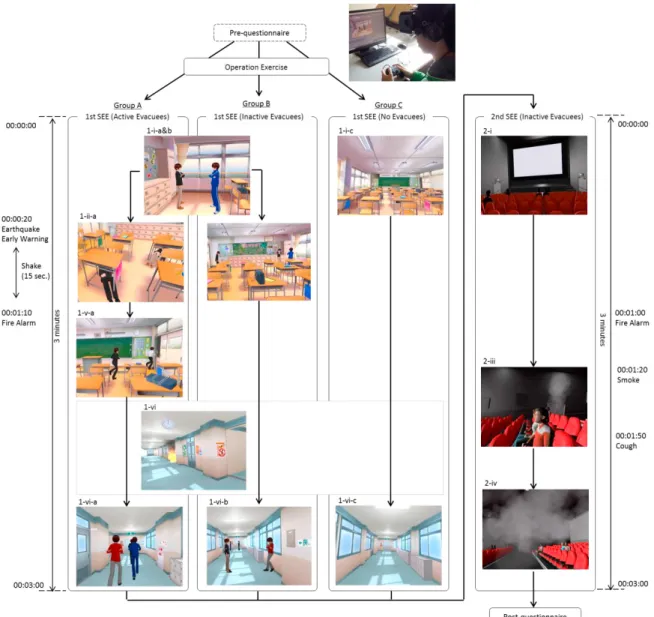
The experiment consisted of four consecutive phases (Fig. 2). In the two SEEs, a time limit for evacuation was set for three minutes, but elapsed time was not superimposed on the 3D worlds to exclude its influence. Every participant’s evacuation time was recorded. The phases are outlined as follows:
(0) Operation exercise
This phase prepares the participants to adjust and move their avatar in the 3D worlds. Participants are required to move the avatar toward the goal of a 3D maze without a time limit. Reaching the goal shows mastery of the required operations and indicates that they can move to the next phase.
(1) First SEE (earthquake in a school)
This phase conditions the participants by comparing their evacuation experiences under different conditions. The 3D world experiences an earthquake (and a resulting fire) in a classroom during a schedule break. The participant operates a student avatar, and each group only differs with regard to simulated students (i.e.,
1674 Hiroyuki Mitsuhara et al. / Procedia Computer Science 159 (2019) 1670–1679Author name / Procedia Computer Science 00 (2019) 000–000 5
evacuees). Disaster situations (represented by audiovisual effects) are presented in the following order: (i) [0:00:00] The 3D world (the classroom before the earthquake) is presented via the HMD. Groups A
and B have simulated students (Fig. 2 i-a&b]), and group C has no simulated students (Fig. 2 [1-i-c]). The participant can move the avatar within the classroom.
(ii) [00:00:20] Earthquake early-warning sounds are delivered for 10 seconds; in Japan, warning sounds are issued using information delivery devices (e.g., mobile phone, radio, and television) several seconds before a big earthquake. For group A, the simulated students hide under desks immediately after the warning (Fig. 2 [1-ii-a]). For group B, the simulated students maintain their standing position, and the participants are tasked to move the avatar under a desk.
(iii) [00:00:30] The participant’s view (i.e., the 3D world) is shaken for 15 seconds.
(iv) [00:00:45] For group A, the simulated students calmly stay under the desks. For group B, the simulated students stand and talk to one another. The participant can move the avatar toward a front door to exit the classroom.
(v) [00:1:10] A fire alarm goes off regardless of the participant’s location (the classroom or a corridor). For group A, the simulated students (active evacuees) start evacuation while saying, “Let’s evacuate outside!” (Fig. 2 [1-v-a]). For group B, the simulated students (inactive evacuees) keep talking and do not evacuate.
(vi) [Time independent] In the corridor, the participant sees a fire emerging from another classroom and an emergency door on the opposite side of the hallway from the fire (Fig. 2 [1-vi]). For group A, the simulated students move toward the door while alerting others to evacuate (Fig. 2 [1-vi-a]). For group B, the simulated students stand and continue talking in the corridor (Fig. 2 [1-vi-b]). For group C, there are no simulated students in the corridor (Fig. 2 [1-vi-c]). For successful evacuation, the participant must move the avatar toward the door to exit the building.
(vii) [00:03:00] If the participant does not reach the door within the time limit (i.e., failed evacuation), a menu screen is presented. If evacuation is successful, outside scenery is presented.
(2) Second SEE (fire in a theater)
This phase observes how the participants’ evacuation experiences differ in the same disaster situation. From the menu screen, the participant moves into this phase. The 3D world shows a fire that occurred during a movie in a theater (with 16 people in the audience). The participant operates an avatar representing an audience member. The disaster situations are presented in the following order:
(i) [00:00:00] The 3D world (the theater before the fire) is presented via the HMD. A latest movie trailer plays on the front screen (Fig. 2 [2-i]). The participant can move the avatar initially in a centrally positioned seat in the theater.
(ii) [00:01:00] A fire alarm goes off. The entire simulated audience (inactive evacuees) keeps watching the trailer and does not start to evacuate. No disaster happens for 1 minute so that the participant can be encouraged to continue gazing at the screen.
(iii) [00:1:20] Smoke begins to flow into the theater from the right rear door (Fig. 2 [2-iii]). If gazing at the screen, the participant may not recognize the smoke.
(iv) [00:01:50] The simulated audience members begin to cough. Thereafter, they cough every 20 seconds but do not evacuate. The participant may recognize the smoke depending on the avatar’s line of sight (Fig. 2 [2-iv]). For successful evacuation, he or she must move the avatar toward an available emergency door (the left front door) to exit the theater; the right front door is also an emergency door but does not open to prevent the smoke from increasing.
(v) [00:03:00] If the participant does not reach the door within the time limit, a menu screen is presented. If evacuation is successful, outside scenery is presented.
(3) Postdisaster questionnaire
Hiroyuki Mitsuhara et al. / Procedia Computer Science 159 (2019) 1670–1679 1675 6 Author name / Procedia Computer Science 00 (2019) 000–000
Fig. 2. Phases and disaster situations in the experiment.
3.3. Results
We analyzed the results with nonparametric statistics by assuming an unpredictable population distribution and heteroscedasticity. Table 1 shows the medians and mean ranks of the participants’ evacuation times. For the first SEE, the medians were similar among the groups; variance analysis (Kruskal–Wallis test) revealed no significant differences. Their evacuation times ranged from 102 to 131, 105 to 180, and 97 to 161 seconds for groups A, B, and C, respectively; one participant in group B failed to evacuate. For the second SEE, the medians of groups A and B were the highest (Med. = 153) and the lowest (Med. = 96), respectively; on the basis of multiple comparisons (Steel-Dwass test), a significant difference was found between group A and group B (p < 0.05). Their evacuation times ranged from 92 to 180, 58 to 128, and 85 to 180 seconds for groups A, B, and C, respectively; four participants in group A and one participant in group C failed to evacuate.
1676 Hiroyuki Mitsuhara et al. / Procedia Computer Science 159 (2019) 1670–1679
Author name / Procedia Computer Science 00 (2019) 000–000 7
Table 1. Medians and mean ranks of evacuation times (Med., median (in seconds); M., mean.) First SEE Second SEE Med., s (M. rank) Med., s (M. rank) Group A 108.5 (11.65) 153 (20.25) Group B 122 (19.80) 96 (10.00) Group C 118.5 (15.05) 114 (16.25)
Table 2 shows the medians and mean ranks of the participants’ five-degree replies to single-choice questions on the questionnaire. The questionnaire mainly asked about the participants’ immersion in the SEEs from the viewpoints of reality and tension. If tension is felt, participants can be regarded as being immersed in the SEE. For the first SEE, the medians for question 1 about reality were identical (Med. = 4). On the basis of multiple comparisons, a significant difference was found between group B and group C (p < 0.05). The medians for question 2 about tension were similar (Med. = 3–3.5). On the basis of multiple comparisons, a significant difference was found between group B and group C (p < 0.05). Participants in group A were asked the following about the active evacuees: “What did you think about the students who evacuated?” The participants mainly replied the following: “I have to evacuate too,” “I just have to follow them,” and “They are well trained.” Participants in group B were asked the following about the inactive evacuees: “What did you think about the students who did not evacuate?” They mainly replied as follows: “We do not have to evacuate,” “We are not in danger,” and “Why did they not evacuate?” Participants in group C were asked the following: “What did you think about no students in the classroom?” They mainly replied as follows: “I could not understand the situation” and “Why is nobody here?” For the second SEE, the medians for question about reality were identical (Med. = 4) and not significantly different in variance analysis. The medians for question 4 about tension were similar (Med. = 3–3.5) and were not significantly different in variance analysis. For the combined SEEs, the medians for question 5 about the participants’ motivation for disaster management were identical (Med. = 4) and not significantly different.
Table 2. Medians and mean ranks of five-degree single-choice questions (Med., median; M., mean; Q, question.) Question: “Do you agree that …?”
Options: 1 = definitely no, 2 = no, 3 = neutral, 4 = yes, 5 = definitely yes Group A Group B Group C Med. (M. rank) Med. (M. rank) Med. (M. rank) Q1. You felt the first simulation (the earthquake in a school) was realistic. 4 (15.65) 4 (10.75) 4 (20.10)
Q2. You felt tension in the first simulation. 3 (15.60) 3 (11.15) 3.5 (19.75)
Q3. You felt the second simulation (the fire in a theater) was realistic. 4 (13.80) 4 (16.50) 4 (16.20) Q4. You felt tension in the second simulation. 3.5 (15.40) 3 (15.10) 3 (16.00) Q5. You had higher motivation in disaster management through the two
simulations. 4 (15.95) 4 (13.30) 4 (17.25)
The participants replied to a question about their activity level during evacuation in the SEEs. Table 3 shows the number of responses to the question for each group and SEE. The replies from group B tended to be different from those in groups A and C. Most participants (N = 6) in group B evacuated actively during the second SEE and mainly described the reasons as follows: “I could think of what to do” and “I saw incoming smoke.” However, most participants (N = 7) of groups A and C evacuated more actively in the first SEE and mainly described the reasons as follows: “The students evacuated,” “I immediately recognized a disaster (earthquake),” “I did not feel danger because the audience did not evacuate,” and “I kept gazing at the screen and did not perceive danger (smoke).” The first two reasons affirm the first SEE, and the latter reasons disallow the second SEE. All participants (N = 5) who failed to evacuate in the second SEE evacuated more actively in the first SEE.
8 Author name / Procedia Computer Science 00 (2019) 000–000
Table 3. Number of responses about activeness during evacuation in SEEs.
Question: “In which SEE did you evacuate more actively?” First SEE Second SEE Both SEEs
Group A 7 3 0
Group B 3 6 1
Group C 7 1 2
It is important to know whether the SEEs were effective in the evacuation training, i.e., whether the participants obtained the training effect through the SEEs. In the postdisaster questionnaire phase, participants were required to describe the lessons they learned through the SEEs. Table 4 shows their typical lessons and the number of participants in each group who responded that they had learned the lesson. Lesson 1 was predominant and was learned by most participants across all groups. Lesson 2 was learned by more participants in groups A and B than in group C, and lesson 3 was learned most effectively by participants in group B. Lesson 4 was not learned by those in the group C.
Table 4. Typical lessons learned through SEEs (L, lesson.)
Categorized lessons Group A Group B Group C
L1. We should not necessarily follow others in disasters. 3 3 4 L2. We should evacuate immediately in unusual situations (e.g., following a
fire alarm). 4 3 1
L3. We should recognize emergency exits and evacuation routes in advance. 1 4 1
L4. We should quickly check on disaster situations. 3 1 0
Other (e.g., We should think and evacuate without hurrying.) 1 1 6
3.4. Considerations
For the first SEE, the participants’ evacuation time did not significantly differ among the groups. However, the participants in group A completed their evacuation more rapidly than those in groups B and C; there was a difference of 14 seconds between the medians of groups A and B. This result may indicate that the participants in group A were encouraged to evacuate by recognizing the active evacuees and that conformity bias worked positively for speedy evacuation. By contrast, the participants in group B spent the most time completing the evacuation. This result may indicate that they descended into conformity bias and did not evacuate speedily by recognizing the inactive evacuees. Furthermore, this result indicated that conformity bias worked negatively. The median of group C was similar to that of group B. This result may indicate that the participants in group C could not guess what to do because of the drab disaster environment (no evacuees). For question 1 (reality) and question 2 (tension), the participants in group C gave higher scores than those in group B with significant differences. This result may indicate that for the participants in group B, the inactive evacuees decreased reality and tension via unnaturalness (i.e., they did not start to evacuate) and conformity bias, respectively; for the participants in group C, their solo evacuation heightened tension. Their experience of low reality and tension might indicate that they refused to face the presented disaster situations, i.e., they descended into normalcy bias. From these results, we assume that simulating active and inactive evacuees can provide conformity bias and influence evacuation experiences in SEE. In particular, simulating inactive evacuees is indispensable for bringing people purposefully to a failed evacuation.
For the second SEE, the participants in group B completed the evacuation more rapidly than those in group A with a significant difference. This result indicates that the first SEE (i.e., recognizing the active or inactive evacuees) influenced the evacuation experience of the participants in the second SEE that presented the same disaster situation. The medians of question 3 (reality) and question 4 (tension) did not significantly differ among the groups. The
Hiroyuki Mitsuhara et al. / Procedia Computer Science 159 (2019) 1670–1679 1677
Author name / Procedia Computer Science 00 (2019) 000–000 7
Table 1. Medians and mean ranks of evacuation times (Med., median (in seconds); M., mean.) First SEE Second SEE Med., s (M. rank) Med., s (M. rank) Group A 108.5 (11.65) 153 (20.25) Group B 122 (19.80) 96 (10.00) Group C 118.5 (15.05) 114 (16.25)
Table 2 shows the medians and mean ranks of the participants’ five-degree replies to single-choice questions on the questionnaire. The questionnaire mainly asked about the participants’ immersion in the SEEs from the viewpoints of reality and tension. If tension is felt, participants can be regarded as being immersed in the SEE. For the first SEE, the medians for question 1 about reality were identical (Med. = 4). On the basis of multiple comparisons, a significant difference was found between group B and group C (p < 0.05). The medians for question 2 about tension were similar (Med. = 3–3.5). On the basis of multiple comparisons, a significant difference was found between group B and group C (p < 0.05). Participants in group A were asked the following about the active evacuees: “What did you think about the students who evacuated?” The participants mainly replied the following: “I have to evacuate too,” “I just have to follow them,” and “They are well trained.” Participants in group B were asked the following about the inactive evacuees: “What did you think about the students who did not evacuate?” They mainly replied as follows: “We do not have to evacuate,” “We are not in danger,” and “Why did they not evacuate?” Participants in group C were asked the following: “What did you think about no students in the classroom?” They mainly replied as follows: “I could not understand the situation” and “Why is nobody here?” For the second SEE, the medians for question about reality were identical (Med. = 4) and not significantly different in variance analysis. The medians for question 4 about tension were similar (Med. = 3–3.5) and were not significantly different in variance analysis. For the combined SEEs, the medians for question 5 about the participants’ motivation for disaster management were identical (Med. = 4) and not significantly different.
Table 2. Medians and mean ranks of five-degree single-choice questions (Med., median; M., mean; Q, question.) Question: “Do you agree that …?”
Options: 1 = definitely no, 2 = no, 3 = neutral, 4 = yes, 5 = definitely yes Group A Group B Group C Med. (M. rank) Med. (M. rank) Med. (M. rank) Q1. You felt the first simulation (the earthquake in a school) was realistic. 4 (15.65) 4 (10.75) 4 (20.10)
Q2. You felt tension in the first simulation. 3 (15.60) 3 (11.15) 3.5 (19.75)
Q3. You felt the second simulation (the fire in a theater) was realistic. 4 (13.80) 4 (16.50) 4 (16.20) Q4. You felt tension in the second simulation. 3.5 (15.40) 3 (15.10) 3 (16.00) Q5. You had higher motivation in disaster management through the two
simulations. 4 (15.95) 4 (13.30) 4 (17.25)
The participants replied to a question about their activity level during evacuation in the SEEs. Table 3 shows the number of responses to the question for each group and SEE. The replies from group B tended to be different from those in groups A and C. Most participants (N = 6) in group B evacuated actively during the second SEE and mainly described the reasons as follows: “I could think of what to do” and “I saw incoming smoke.” However, most participants (N = 7) of groups A and C evacuated more actively in the first SEE and mainly described the reasons as follows: “The students evacuated,” “I immediately recognized a disaster (earthquake),” “I did not feel danger because the audience did not evacuate,” and “I kept gazing at the screen and did not perceive danger (smoke).” The first two reasons affirm the first SEE, and the latter reasons disallow the second SEE. All participants (N = 5) who failed to evacuate in the second SEE evacuated more actively in the first SEE.
8 Author name / Procedia Computer Science 00 (2019) 000–000
Table 3. Number of responses about activeness during evacuation in SEEs.
Question: “In which SEE did you evacuate more actively?” First SEE Second SEE Both SEEs
Group A 7 3 0
Group B 3 6 1
Group C 7 1 2
It is important to know whether the SEEs were effective in the evacuation training, i.e., whether the participants obtained the training effect through the SEEs. In the postdisaster questionnaire phase, participants were required to describe the lessons they learned through the SEEs. Table 4 shows their typical lessons and the number of participants in each group who responded that they had learned the lesson. Lesson 1 was predominant and was learned by most participants across all groups. Lesson 2 was learned by more participants in groups A and B than in group C, and lesson 3 was learned most effectively by participants in group B. Lesson 4 was not learned by those in the group C.
Table 4. Typical lessons learned through SEEs (L, lesson.)
Categorized lessons Group A Group B Group C
L1. We should not necessarily follow others in disasters. 3 3 4 L2. We should evacuate immediately in unusual situations (e.g., following a
fire alarm). 4 3 1
L3. We should recognize emergency exits and evacuation routes in advance. 1 4 1
L4. We should quickly check on disaster situations. 3 1 0
Other (e.g., We should think and evacuate without hurrying.) 1 1 6
3.4. Considerations
For the first SEE, the participants’ evacuation time did not significantly differ among the groups. However, the participants in group A completed their evacuation more rapidly than those in groups B and C; there was a difference of 14 seconds between the medians of groups A and B. This result may indicate that the participants in group A were encouraged to evacuate by recognizing the active evacuees and that conformity bias worked positively for speedy evacuation. By contrast, the participants in group B spent the most time completing the evacuation. This result may indicate that they descended into conformity bias and did not evacuate speedily by recognizing the inactive evacuees. Furthermore, this result indicated that conformity bias worked negatively. The median of group C was similar to that of group B. This result may indicate that the participants in group C could not guess what to do because of the drab disaster environment (no evacuees). For question 1 (reality) and question 2 (tension), the participants in group C gave higher scores than those in group B with significant differences. This result may indicate that for the participants in group B, the inactive evacuees decreased reality and tension via unnaturalness (i.e., they did not start to evacuate) and conformity bias, respectively; for the participants in group C, their solo evacuation heightened tension. Their experience of low reality and tension might indicate that they refused to face the presented disaster situations, i.e., they descended into normalcy bias. From these results, we assume that simulating active and inactive evacuees can provide conformity bias and influence evacuation experiences in SEE. In particular, simulating inactive evacuees is indispensable for bringing people purposefully to a failed evacuation.
For the second SEE, the participants in group B completed the evacuation more rapidly than those in group A with a significant difference. This result indicates that the first SEE (i.e., recognizing the active or inactive evacuees) influenced the evacuation experience of the participants in the second SEE that presented the same disaster situation. The medians of question 3 (reality) and question 4 (tension) did not significantly differ among the groups. The
1678 Hiroyuki Mitsuhara et al. / Procedia Computer Science 159 (2019) 1670–1679Author name / Procedia Computer Science 00 (2019) 000–000 9
participants in group A tended to be more active in the first SEE. From their reasoning responses, this result may indicate that they were motivated to evacuate because they could see active evacuees. However, the participants in group B tended to be more active in the second SEE, and all of them succeeded in evacuating. From their reasoning responses, this result may indicate that they became sensitive to disaster situations (danger) and evacuated quickly even if they were surrounded by inactive evacuees. Therefore, they reflected on their intuitively time-consuming evacuation (the first SEE) and realized the necessity of a speedy evacuation without being influenced by the inactive evacuees. The participants in group C tended to be more active in the first SEE because they may have lost motivation to evacuate when they saw inactive evacuees in the second SEE. From these results, we assume that simulating inactive evacuees in the consecutive SEEs can eventually prevent people from adopting conformity bias and promote speedy evacuation. This SEE composition can fit well to the failure-enhanced evacuation training.
For question 5 (motivation), the participants in all groups replied positively. This result may indicate that the SEE in a VR-based disaster simulator leads to evacuation training. The participants in each group described the same number of lessons learned via the SEEs and equally described lesson 1 regardless of the different conditions (active, inactive, and no evacuees) in the first SEE. This result may indicate that lesson 1 was derived mainly from the inactive evacuees in the second SEE. The participants in groups A and B described lesson 2 more frequently than those in group C. This result may indicate that lesson 2 was derived mainly from the active and inactive evacuees in the first SEE for groups A and B, respectively. The participants in group B described lesson 3 more frequently than those in groups A and C. This result may indicate that the intuitively time-consuming evacuation experiences of group B participants in the two SEEs encouraged the recognition of exits and routes. The participants in group A described lesson 4 more frequently than the other groups. This result may indicate that group A participants reflected on their experience of simply following the active evacuees without checking the disaster situation carefully in the first SEE.
Overall, from the preceding results and considerations, we conclude that evacuation training using a VR-based disaster simulator should (1) introduce simulated inactive evacuees, (2) provide at least two SEEs in which participants can recognize the simulated inactive evacuees, (3) lead the participants to a failed evacuation resulting from conformity bias in the first SEE, (4) enhance their ability to reflect on and conceptualize the failure, and (5) make them overcome the failure in the second SEE. Furthermore, we believe that our proposed model is likely to train people to be active evacuees (i.e., survivors).
4. Conclusion
In this paper, we proposed failure-enhanced evacuation training that purposefully induces conformity bias and failed evacuation by inactive evacuees simulated (i.e., presented) in a VR-based disaster simulator. We then reported on the preliminary comparative experiment conducted in different conditions (active, inactive, and no evacuees). The experimental results indicated that participants could descend into conformity bias and fail to evacuate by recognizing inactive evacuees in the first SEE. However, participants could overcome failure and succeed in evacuating even when they recognized inactive evacuees in the second SEE. This failure-enhanced evacuation training is expected to improve the training effect.
This study is still in the early stages. To use our findings for practical evacuation training, we must address the following issues:
For what types of people is failure-enhanced evacuation training most suitable? This issue is derived from a small-scale experiment (i.e., a small number and a limited range of participants). Furthermore, the collected evacuation time and questionnaire results seem insufficient to clarify the participants’ perceptions (e.g., the existence or degree of failed evacuation and conformity bias) or the training effect. We must conduct large-scale experiments that collect various data (e.g., participant’s vital signs and line of sight).
How should the VR-based disaster simulator cover the RO and AC? The experiment attempted to verify the partial model and has not clarified the validity of the whole model. We regard these stages as a black box; therefore, we must conduct experiments that examine how these stages work in our proposed model. To ensure the training effect based on the model, the simulator will need to support these stages.
10 Author name / Procedia Computer Science 00 (2019) 000–000
How should the simulator be extended? The simulator presents evacuees and disaster situations and does not introduce interactivity into the simulated situations; the simulator also enables participants to move around the 3D worlds. In an actual evacuation, people may encounter difficult disaster situations and make difficult decisions (e.g., whether to rescue an injured person). As an extension, the simulator should present difficult disaster situations beyond participants’ prediction and provide high interactivity, including gaming elements. How should the training ensure ecological validity? The discussions about this issue are common in any VR and
cannot be avoided in this study. We must clarify how much the training (the SEE in virtual disasters) contributes to surviving actual disasters. However, such a clarification may be difficult because we cannot plan experiments by predicting when and where a disaster will occur.
Acknowledgments
This work was supported by the Japan Society for the Promotion of Science Grants-in-Aid for Scientific Research (Grant No. 18H01054). We thank H. Naka for his effort in this study.
References
[1] Munich RE. (2018) “Topics geo: Natural catastrophes 2017.” München, Germany
[2] Institute for Economics & Peace. (2018) “Global terrorism index 2018: Measuring the impact of terrorism.” Sydney, Australia
[3] Johnson, Victoria, Kevin R. Ronan, David M. Johnston, and Robin Peace. (2014) “Evaluations of disaster education programs for children: A methodological review.” International Journal of Disaster Risk Reduction 9: 107–123.
[4] Takabatake, Tomoyuki, Tomoya Shibayama, Miguel Esteban, Hidenori Ishii, and Go Hamano. (2017) “Simulated tsunami evacuation behavior of local residents and visitors in Kamakura, Japan.” International Journal of Disaster Risk Reduction 23: 1–14.
[5] Taylor-Nelms, Lee, and Valerie Hill. (2014) “Assessing 3D virtual world disaster training through adult learning theory.” International
Journal of Serious Games 1 (4): 3–16.
[6] Chittaro, Luca, and Fabio Buttussi. (2015) “Assessing knowledge retention of an immersive serious game vs. a traditional education method in aviation safety.” IEEE Transactions on Visualization and Computer Graphics 21 (4): 529–538.
[7] Smith, Shana, and Emily Ericson. (2009) “Using immersive game-based virtual reality to teach fire-safety skills to children.” Virtual Reality
13 (2): 87–99
[8] Chittaro, Luca, and Riccardo Sioni. (2015) “Serious games for emergency preparedness: Evaluation of an interactive vs. a non-interactive simulation of a terror attack.” Computers in Human Behavior 50: 508–519.
[9] Lovreglio, Ruggiero, Vicente Gonzalez, Zhenan Feng, Robert Amor, Michael Spearpoint, Jared Thomas, Margaret Trotter, and Rafael Sacks. (2018) “Prototyping virtual reality serious games for building earthquake preparedness: The Auckland City Hospital case study.” Advanced
Engineering Informatics 38: 670–682.
[10] Sharma, Sharad, Shanmukha Jerripothula, Stephon Mackey, and Oumar Soumare. (2014) “Immersive virtual reality environment of a subway evacuation on a cloud for disaster preparedness and response training.” Proc. of 2014 IEEE Symposium on Computational
Intelligence for Human-like Intelligence (CIHLI2014): 1–6.
[11] Gong, Xiaoli, Yanjun Liu, Yang Jiao, and Baoji Wang, Jianchao Zhou, and Haiyang Yu. (2015) “A novel earthquake education system based on virtual reality.” IEICE Transactions on Information and Systems E98.D (12): 2242–2249.
[12] Ronchi, Enrico, Max Kinateder, Mathias Müller, Michael Jost, Markus Nehfischer, Paul Pauli, and Andreas Mühlberger (2015) “Evacuation travel paths in virtual reality experiments for tunnel safety analysis,” Fire Safety Journal 71: 257–267.
[13] Gamberini, Luciano, Luca Chittaro, Anna Spagnolli, and Claudio Carlesso. (2015) “Psychological response to an emergency in virtual reality: Effects of victim ethnicity and emergency type on helping behavior and navigation.” Computers in Human Behavior 48: 104–113 [14] Murata, Atsuo, Tomoko Nakamura, and Waldemar Karwowski. (2015) “Influence of cognitive biases in distorting decision making and
leading to critical unfavorable incidents.” Safety l (1): 44–58.
[15] Omer, Haim, and Nahman Alon. (1994) “The continuity principle: A unified approach to disaster and trauma.” American Journal of
Community Psychology 22 (2): 273–287.
[16] Asch, Solomon. (1956) “Studies of independence and conformity: I. A minority of one against a unanimous majority,” Psychological
Monographs: General and Applied 70 (9): 1–70.
[17] Rios, Àlejandro, Daniel Mateu, and Nuria Pelechano. (2018) “Follower behavior in a virtual environment.” Proc. of 3rd Virtual Humans and
Crowds in Immersive Environments (VHCIE2018): 1–6.
[18] Kolb, David. (1984) “Experiential learning: Experience as the source of learning and development.” Prentice Hall, Inc., Englewood Cliffs, NJ.