A teacher-training workshop
Anthony C
RIPPS, Richard M
ILESand Sean O’C
ONNELLAbstract
This paper documents a teacher-training workshop designed to address the problem of motivating instructors and learners of English in Japan. It first provides a brief overview of the relevant research to date on motivation and the Japanese English education context. It then explores a series of interviews (n=6) with in-service Japanese high school teachers of English, which ultimately proved to be the impetus behind this study. Findings from an analysis of these interviews revealed a lack of learner motivation was the primary concern for in-service teachers. It also revealed that in-service teachers felt ill-equipped to deal with this problem. A workshop was then created to provide pedagogical support for Japanese teachers of English. This workshop first involved examining the different factors that influence motivation, before moving on to showcase how the use of authentic materials by instructors can greatly enhance learner motivation. It concluded with a discussion of the specific problems that instructors typically face. Feedback from a post-workshop questionnaire suggests the workshop was highly successful. Finally, implications and future workshops are discussed.
1 Introduction
Motivation in any walk of life is difficult to maintain. Arguably, this is especially true in an educational setting. A series of one-on-one interviews with in-service teachers revealed that they find it challenging to motivate their students (and themselves) on an ongoing basis. This paper gives an overview of the need to provide support for English teachers in Japan before outlining the creation of
a workshop specifically designed to address the issue of ‘motivation’. Feedback on the workshop provided by the participants (n=13) and the design of future teacher-training workshops is discussed.
2 Background
Teacher training should be the cornerstone of any effective language program. It is therefore imperative to examine some of the main issues connected with teacher training for English teachers in Japan and to take a critical look at the current state of in-service teacher training. The Japanese Ministry of Education, Sports, Science, Culture and Technology (MEXT) revised its Course of Study (COS) guidelines in 2011 and advised teachers that the purpose of studying English is to develop the ability to communicate in English rather than to simply build grammatical knowledge. Yet this sentiment appears to run at a tangent to how many Japanese teachers of English (JTEs) actually teach. Teachers are fully aware of the directive to ‘teach English in English’ but many do not do so (see Cripps 2016 for detailed information). Blaming teachers for disregarding the guidelines fails to take into account the reasons why they cannot and do not follow this policy ― van Amelsvoort summarises the situation and highlights the need for effective teacher training:
...it is tempting to just blame teachers, but for policy to be adopted effectively there need to be clear, acceptable goals and clear, actional pathways toward those goals. From a teacher training and development perspective, however, it is self-evident that policy cannot be enacted if teachers do not understand the goals, do not know how to implement them, are incapable of implementing them, or choose to ignore them. (van Amelsvoort, 2014, p. 32)
Inescapably, JTEs are a product of the Japanese education system. They have successfully completed compulsory education in Japan and have been trained within the system to become teachers. The education system at junior high school and senior high school level, is geared towards teaching to help students pass
entrance examinations. When MEXT asks teachers to develop L2 communicative skills, this directive seems to create a harmful dichotomy. There is a gap between teachers’ attitudes to communicative based language teaching (CBT), which is largely positive, and their actual use of CBT. Teachers are seemingly ‘handcuffed’ by a system that encourages them to develop students’ L2 use but whose students are being pressured to pass examinations that require reading and grammar skills rather than communicative proficiency. This preoccupation with learning English in order to pass examinations instead of focusing on more communicative aspects, such as listening and speaking, is a major contributing factor to Japanese students underperforming when compared with students who are studying English as a foreign language in other countries (Martin, 2004; McConnell, 2000). The inadequate pre-service teacher training which would-be teachers undergo further exacerbates this problematic situation. Current teachers have a great deal of knowledge about grammar, vocabulary building, and translation; however, their spoken English is relatively poor. Yet these are the very teachers who are expected to help new teachers to teach under the umbrella of MEXT’s new COS guidelines. To make matters worse, each prefecture seems to have different standards concerning teacher training and candidate selection as Oda explains:
...it seems that there is no consistency among the boards of education as to what kind of teachers they want. Do they give priority to the candidate’s communicative competence in English, knowledge about grammar, ability to teach, overseas experience, and/or potentials? Unless this is clear to all of those involved in teacher education including trainers, trainees, schools, boards of education and government, we would never be able to produce good English teachers. (Oda, 2008, p. 72)
Japan’s pre-service teacher training is poor when compared with its Asian neighbours (Wang et al, 2003). In Japan it is relatively easy for teachers to qualify as an English teacher: “English literature majors who take only a couple of supplementary courses at university ― with only a few hours on second language acquisition theory, and very little (if any) TESOL training―and complete a three-week practical placement training session can and do become licensed teachers” (van Amelsvoort, 2014, p. 34). In addition to the above, new teachers’ English
language ability is low compared to their Asian counterparts. It is hardly surprising that teachers with this background are less inclined to ‘teach English in English’. Brown (2016) notes that English-Medium Instruction (EMI) in Japan is still in its infancy. It is certainly not the norm at Japanese universities and has yet to trickle down to all but a few (mostly private) high schools (see Sutherland, 2012).
In addition to a lack of applicable training, teachers are often faced with non-language related issues such as demotivation, which can hinder their ability to teach effectively. Weak learner motivation is perhaps the biggest obstacle facing JTEs, but factors such as authentic materials (Pinner, 2016) and increased learner autonomy (Miles, 2012) have been shown to mitigate against this. Teacher motivation is a widely under-researched, but extremely important area. Dörnyei (2001) states that while teachers tend to be more intrinsically motivated than professionals in other areas, a host of factors can detract from this: stress, restricted autonomy, insufficient self-efficacy, lack of intellectual challenge, inadequate career structure, and mandated curricula and tests.
2.1 Workshop rationale
The proposal for setting up a series of intensive teacher-training workshops arose from a tangible need to help both pre-service and in-service JTEs. Each year Nanzan University holds teacher-training seminars as part of the teacher licence renewal program and also their community-service support program. Attendees of these programs often express a desire to attend more practical workshops, which would help them with the problems that they face in the classroom.
In addition to the needs of the in-service teachers, pre-service teachers often express fears that they are going into the teaching field with inadequate knowledge of practical teaching skills. This concern was echoed by newly qualified teachers who were interviewed as part of another study (Cripps, 2015). Many of the newly qualified teachers stated candidly that they felt out of their depth in the classroom, received little or no in-house support, and dissatisfaction with the pre-service training they received ― especially in terms of the lack of practical guidance they were given.
With the above concerns in mind, the research team drew up a grant proposal to provide practical pedagogical support to Japanese English teachers in Japan. The proposal was accepted (JSPS KAKENHI Number 15H03481) and
preparations for the workshops began. In order to create a workshop that would specifically meet the needs of in-service English teachers in Japan, a series of one-on-one interviews were conducted by the authors. In essence, this represented a needs analysis. Discovering what type of pedagogical support teachers wanted and what problems they were typically dealing with, would serve to guide the content and design of the workshops.
3 Pre-workshop interviews with teachers
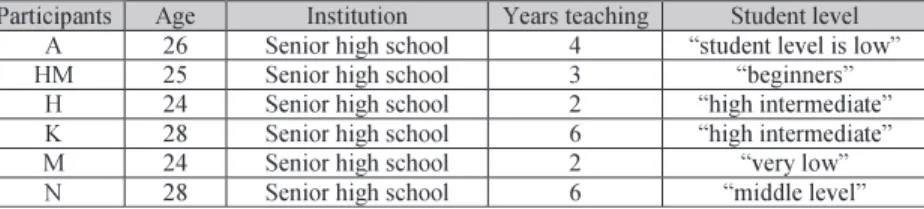
The participants (n=6) were all Japanese nationals, female, recent graduates (within the last six years) and currently employed as English teachers. The interviews took place in various locations (after consulting with the participants) and lasted approximately 30 minutes. To protect their privacy, the participants have each been given a pseudonym. The participants’ respective information is listed in Table 1.
Table 1:In-service teachers’ biodata
Appendix 1 provides a complete list of all the core questions that were posed to the participants during the interview, and in the order that they were asked. For this paper, the focus will be limited to responses to the following question: “What are the typical problems that you face on a day-to-day basis as an English teacher?” Through thematic coding (as defined by Saldaña, 2013) and grounded theorization (as defined by Charmaz, 2014), the participants’ responses were analysed and several salient themes emerged. The most prominent theme was the notion that a lack of learner motivation was the biggest day-to-day problem that teachers faced. Many teachers stated that their students actually disliked or hated English and saw little need for it in their future careers. According to Participant A:
“They hate it the most in all the subjects they have. They say they don't need it. They don't want to study abroad. They are so happy to be in Japan. So it's hard to motivate them to learn English.” Participant HM concurred, and added: “They are not completely motivated. They hate English because in junior high school it was just a time to sit down and listen to complicated difficult talking. They have an English allergy.” Participant N also expressed
the same view: “My school's level isn't that high, so they are not very eager to study. No
motivation sometimes.” Along with feeling little need to learn English, another
potential demotivating factor was the difficulty for learners to follow English classes taught in English, as prescribed by MEXT (2011). Participant K points out what many teachers are feeling: “As an English teacher, I have problems trying to follow
what Monkasho tells me. Like in high school we are supposed to teach in English, like grammar and communication in English. But it's very difficult to teach students grammar in English. And they can't even understand what I am saying in Japanese.”
The other salient theme to emerge from the interviews was that the teachers felt their training had left them unprepared to deal with such low motivation amongst their students. Participant A said that she was: “...not sure what kind of
English skills they need. I have difficulty in making my classes because I don't know what kind of things I should set for my students.” Part of the problem ― according to the
teachers ― seemed to be an emphasis on theory and the history of language education, instead of more practical activities, in teacher training courses. As Participant K surmised: “Well we never really had English exercises. We were only told
about the history of the teaching system and the Monkasho and all these rules that we have to follow. Rules and old theories that were used then. They were used then but they are not really useful now. All these things we can't really use when we become teachers. Very impractical.”
Participant M responded similarly: “I think it is not effective because the teacher course is
just law and there are no activities.” Participant N noted that: “I mostly learned everything at my school in the two-week training practicum.”
4 Workshop design
After analysing the interview data, the research team decided to make ‘Motivation’ the theme of the first teacher-training workshop. Professor Richard Pinner from Sophia University was contacted and interviewed by the research team and asked to run the first workshop. Professor Pinner agreed and the details of
the workshop framework were discussed through face-to-face meetings and e-mail discussions. After consulting teachers and Professor Pinner, it was decided that the motivation workshop would be held on September 3, 2016. Since teachers are particularly busy after the summer break, it was agreed that a one-day workshop would be the best logistical choice. The workshop was advertised through e-mail and social media. Thirteen people signed up for the workshop (six pre-service teachers and seven in-service teachers.)
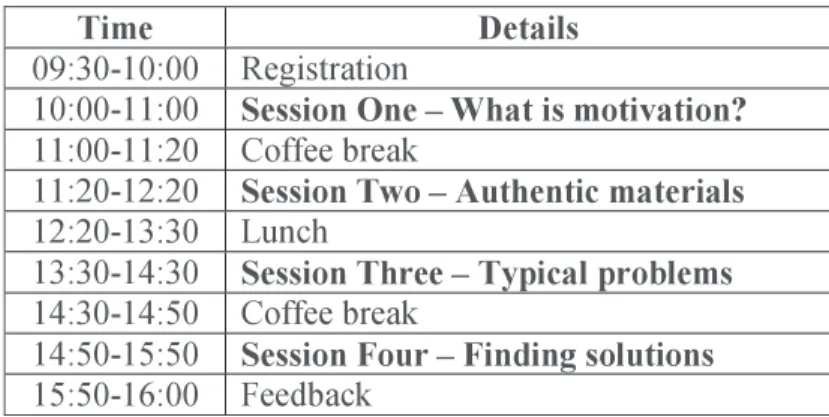
The workshop was divided into four distinct sessions: Session One ― What is motivation?; Session Two ― Authentic materials; Session Three ― Typical problems; Session Four ― Finding solutions.
Below, a brief summary of each session is offered.
Table 2:Teacher-training workshop schedule
4.1.Workshop sessions
Session 1 ― What is motivation?
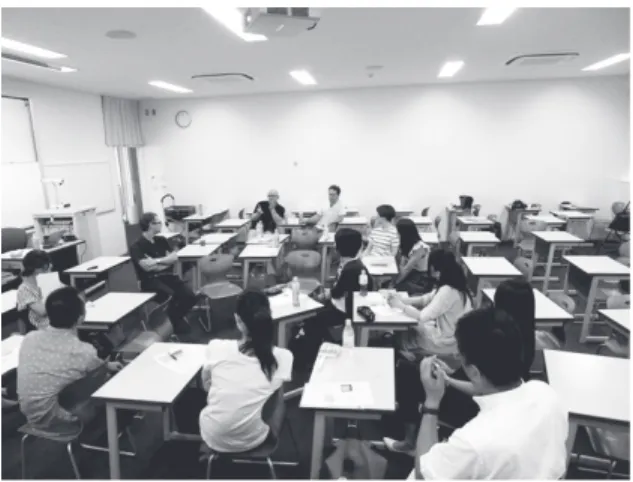
In this session, Professor Pinner gave a formal lecture on motivation. He provided a brief overview of the theory of motivation, highlighting the importance of teacher motivation and how this affects student motivation. In his lecture, Professor Pinner stated that: “In other words, we have to motivate ourselves
to motivate others.” This statement resonated with many of the participants. The
ideas behind the theories. This segued into session two which examined authenticity ― focusing on issues of personalization and relevance.
Figure 1:Session One ― What is motivation? Session 2 ― Authentic materials
In the authentic materials session, Professor Pinner concentrated on what authentic materials are (and are not), why they are motivating, and strategies for creating motivating content. This session involved teachers discussing the nature of authenticity and how to make it relevant to themselves and their students.
Session 3 ― Typical problems
In this interactive session, participants wrote a question or asked for help on post-it notes. The participants collated them, worked in groups to write responses, and presented their solutions through discussion. The participants were very active during this session and it was clear that both sets of participants ― in-service teachers and pre-in-service teachers, were actively engaged.
Figure 3:Session Three ― Typical problems Session 4 ― Finding solutions
In the final session, the focus was on finding solutions to typical problems which Japanese teachers of English face. Participants were asked to backwards-engineer highly motivating teaching/learning experiences into strategies for motivating classes. The practical nature of this session resulted in lively discussion involving all parties including the workshop organisers.
Figure 4:Session Four ― Finding solutions
5 Feedback
At the end of the workshop, a feedback form (Appendix 2) was distributed to the attendees. The feedback session took longer than expected because the participants were meticulous and thorough with their comments. Their feedback provided a wealth of rich information regarding motivation and the effectiveness of the workshop. Due to space constraints, only their comments directly related to motivation will be discussed below. A separate paper focusing on their general workshop comments will be published later this year.
5.1 Reasons for choosing to attend the motivation workshop
All pre-service students answered that the reason why they chose to attend the workshop was because they thought it would help them with their future teaching careers. Many in-service teachers decided to participate in the workshop because they had attended previous teaching seminars at Nanzan University. One teacher said that she chose to attend because she wanted: “To motivate myself” and “To learn
about motivation”. Another teacher explained that they were too busy to study after
study after being a teacher. I thought this workshop would be helpful for me to teach English.”
As well as deepening their understanding of motivation, one teacher stated that another reason for joining the workshop was to improve their English.
5.2 Thoughts on the topic of motivation
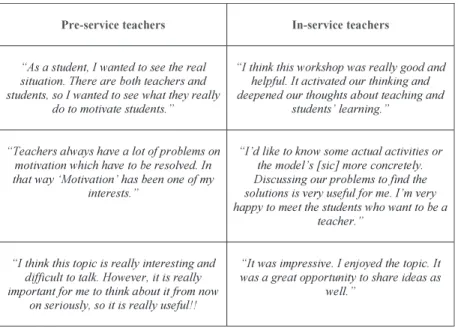
The comments from the pre-service teachers and in-service teachers on the topic of motivation were informative and disparate (Table 3). Understandably, the pre-service teachers were interested in the reality of teaching English to students. They were aware that motivation is a major problem for all teachers and they were interested in trying to find ways to solve the ‘problem’ of motivation. The in-service teachers appeared to benefit from the opportunity to address and discuss the issue of motivation. Having a forum, which provided a crucible for airing their problems, seemed to be extremely cathartic.
6 Reflective comments
The workshop was more successful than we had expected. This was largely due to the meticulous planning of the research team and the inspired work of Professor Pinner. It was extremely gratifying to see the practical manifestation of our research proposal come to fruition. The exchanges between pre-service and in-service teachers were lively, honest, and invigorating. A dynamic atmosphere was created which seemed to benefit all the parties. The post-workshop feedback was overwhelmingly positive and all participants expressed their hope that similar workshops would be held in the future.
7 Future plans
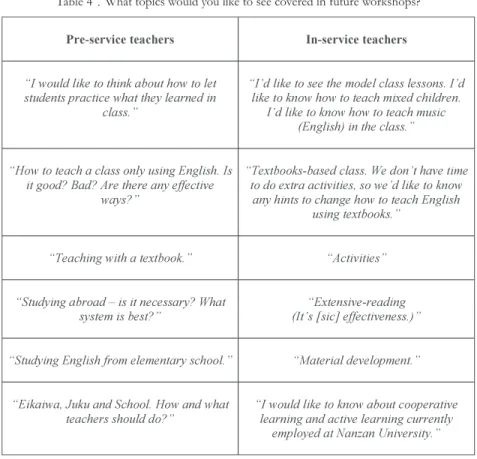
The motivation workshop was extremely successful. All participants (and the organisers) found the experience enriching and rewarding. Future workshops are being planned and the content will be shaped according to the feedback provided by the workshop participants. As part of the workshop feedback, participants were asked what topics they would like to see covered in future workshops. Their comments are summarized in Table 4 below.
Table 4:What topics would you like to see covered in future workshops?
8 Conclusion
Motivation is an issue with which teachers and students continually struggle. The workshop described in this paper set out to address one of the major problems which teachers of English face at Japanese junior high and senior high schools. After canvassing the opinions of English teachers in Japan the workshop was designed to meet their immediate needs. Professor Pinner’s workshop on motivation and using authentic materials proved to be very successful. Feedback suggested that the combination of theory intertwined with practice was both
accessible and practical.
The interaction between in-service teachers and pre-service teachers created an incredible dynamic of mutual sharing and growth. The workshop participants and designers benefitted a great deal. As the post-workshop comments demonstrate, the participants appreciated the opportunity to learn about motivation and to discuss the issue at length and in depth. Their call for further workshops is proof that there is a real need to support teachers’ professional development.
Two key Japanese educators, Masaki Oda and Toshinobu Nagamine, were asked about the future of teacher education in Japan. Both agreed that: “...providing quality teacher education is the key to effective English language teaching in Japan” (Floris, 2013, p. 6). One objective of the teacher-training workshops outlined in this paper is to help raise the level of English teacher education in Japan by providing an effective forum where teachers can learn about, and discuss, tangible issues which they face on a day-to-day basis. The research team will continue to create effective workshops in the future.
Note
This work was generously supported by a research grant from the Japanese Ministry of Education, Sports, Science, Culture and Technology (MEXT) - JSPS KAKENHI Number 15H03481. The authors would like to thank Professor Pinner for his invaluable contribution to this workshop.
Bibliography
Brown, H. (2016). English-medium instruction in Japan: Discussing implications for language teaching. In P. Clements, A Krause, & H. Brown (Eds.), Focus on the learner. Tokyo: JALT. (433―438).
Cripps, A. C. (2015). Exploring the need for creativity. 13th International Education Conference.
Online proceedings. Retrieved January 15, 2017, from: http://hiceducation.org/wp-content/
uploads/proceedings-library/EDU2015.pdf
Cripps, A. C. (2016). English Language Education in Japan: Problems and Solutions. In A. C. Cripps (Ed.) Perspectives on English Language Education in Japan. Charleston, US: CreateSpace. Charmaz, K. (2014). Constructing Grounded Theory (2nd ed.). Los Angeles, CA: Sage.
Floris, F. D. (2013). English language teaching in Japan issues and challenges: An interview with Toshinobu Nagamine and Masaki Oda. ELT World Online, http://blog.nus.edu.sg/ eltwo/?p=3576
Martin, A. (2004). The ‘katakana’ effect and teaching English in Japan. English Today 20(1): 50― 55.
McConnell, D. (2000). Importing diversity: Inside Japan's JET program. Berkeley, CA: University of California Press.
MEXT. (2011). Kokusai kyotsugo toshite no eigoryoku koujou no tameno itsutsu no teigen to gutaiteki
shisaku (Five Proposals to Improve the Proficiency of English as Liungua Franca).
Retrieved from: www.mext.go.jp/b_menu/houdou/23/07/130888.htm
Miles, R. (2012). Motivation through autonomy. English Language Teaching World Online, 4, www.eltworldonline.com
Oda, M. (2008). Teacher education in Japan: Clearing the ground. In Y. H. Choi and B. Spolsky (Eds.), Asia TEFL Book 2008 3rd Volume, pp. 71―87.
Pinner, R. S. (2016). Reconceptualising Authenticity for English as a Global Language. Bristol, UK: Multilingual Matters.
Saldaña, J. (2013). The Coding Manual for Qualitative Researchers. Los Angeles, CA: Sage.
Sutherland, S. (2012). ‘Real English’ in Japan: Teach teachers’ views on nativeness in language teaching. Journal of English Studies, Vol. 10, pp. 175―191.
van Amelsvoort, M. (2014). Language teacher training approaches in Japan: What are the issues? 神奈川県立国際言語文化アカデミア紀要. 平成25年度(3), pp. 31―44.
Wang, A., Ashaki, C., Coley, R., & Phelps, R. (2003). Preparing teachers around the world.
ETS Research and Policy Information Center. Retrieved January 17, 2017 from: http://www.ets.
Appendix 1.Interview Schedule
Interview Schedule Descriptive Statistics Age M/F Education Books used English levelLiving/Study abroad experience Technology options available Teaching Background
How long have you been teaching English? Where do you teach?
What level(s) do you teach?
How long have you been teaching there? Why did you become an English teacher? Pre-service and in-service support
What do you think about the pre-service instruction/support you received
before you became a teacher? How could it have been improved?
What do you think about the in-service instruction/support after you became a teacher? How could it have been improved? What are the typical problems that you face on a day-to-day basis as an English teacher?
What do you know about MEXT’s Course of Study plan? Workshop information
We are making some teacher-training workshops. What kind of content would you like to see as part of the workshops?
What specific support would you like to help you? E. g. How to improve students’ listening skills, speaking activities etc.
Online Support Center Information
We are making on online teacher support center. What kind of content would you like us to put on the website?
Would you be interested in the following?
- contributing to or just accessing the OTSC - contributing to a resource book
- demonstrating some of your successful activities - allowing us to observe your teaching
Workshop 1 Dates ― Sat. August 27 or Sat. Sept 3 Workshop 2 Dates ― late March/early April 2017
Appendix 2.End of workshop feedback form
End of Workshop FeedbackThank you for participating in our first workshop. We would welcome any feedback you could give us as it will help us improve future workshops.
A.Details about you Profession
Please circle one Teacher Student
If you are a teacher, please circle the grade of students that you teach:
Junior High School Grade 1 2 3
Senior High School Grade 1 2 3
Other ― please specify
B.Workshop Feedback
1.Why did you choose to attend this workshop?
3.Please give some feedback on the four sessions of today’s workshop
Session Session Level
Session One ― What is Motivation? Very Easy
Easy Just right
Difficult Very Difficult
Session Two ― Authentic Materials Very Easy
Easy Just right
Difficult Very Difficult
Session Three ― Typical Problems Very Easy
Easy Just right
Difficult Very Difficult
Session Four ― Finding Solutions Very Easy
Easy Just right
Difficult Very Difficult
4.Please give us your opinion of this workshop Was there anything that you liked? How could we improve the workshops?
6.We would like to contact you at a later date to help improve future workshops. If you are willing to help us, please write your name and e-mail address below:
Name: E-mail: