Performance Evaluation of Anaerobic Membrane
Bioreactor in Treating Dairy Food Industrial
Wastewater
著者
シティ ヌア ファティハン ビンティ モイディーン
number
64
学位授与機関
Tohoku University
学位授与番号
環博第139号
URL
http://hdl.handle.net/10097/00129719
してい ぬーる ふあていはー びんてい もいでいん
氏
名
SITI NUR FATIHAH BINTI MOIDEEN
授
与
学
位
博士(環境科学)
学 位 記 番 号
学 位 授 与 年 月 日
令和 2 年 3 月 25 日
学位授与の根拠法規 学位規則第 4 条第 1 項
研究科,専攻の名称 東北大学大学院環境科学研究科(博士課程)環境科学専攻
学 位 論 文 題 目
PERFORMANCE EVALUATION OF ANAEROBIC MEMBRANE BIOREACTOR IN
TREATING DAIRY FOOD INDUSTRIAL WASTEWATER (
乳製品系食品廃棄物を処理する嫌気性
MBR の性能評価
)指
導
教
員 東北大学教授 PROF. YU-YOU LI
論 文 審 査 委 員
主査 東北大学教授 PROF. YU-YOU LI
東北大学教授 PROF. CHIHIRO INOUE
東北大学
准教授 ASSOC. PROF. DAISUKE SANO
論 文 内 容 要 旨
This study focused on the performance of anaerobic membrane bioreactor (AnMBR) in treating dairy industrial
wastewater. AnMBR is a treatment where the advantages of anaerobic treatment were combined with membrane
separation. AnMBR system having high operation stability, therefore, it is suitable for treating wastewater under
extreme condition including water or wastewater with high salinity, high suspended solids content or wastewater with
poor biomass granulation.
Membrane fouling is the major drawbacks in AnMBR which is affected by a range of factors such as operational
conditions, influent characteristics, membrane and biomass properties and their mutual combination. Membrane fouling
results in the decrement of hydraulic performance. However, membrane fouling can be treated by cleaning the
membrane physically and chemically. Ex-situ membrane cleaning need to be done after long-term continuous
experiment and the specific methods are following (Chen et al., 2017) Moreover, in each step of membrane cleaning, a
clear water filtration test was applied in order to measure the remaining resistance of each filtration (Chen et al., 2017).
On the other hands, the physical cleaning was expected to remove cake layer, the sodium hypochlorite and citric acid
steps were to remove organic and inorganic foulants on the gel layer or in the pores.
The analysis of COD and pH were measured based on the American Public Health Association (APHA).
Carbohydrate measurement was following phenol-sulphuric acid method and protein measurement was according to
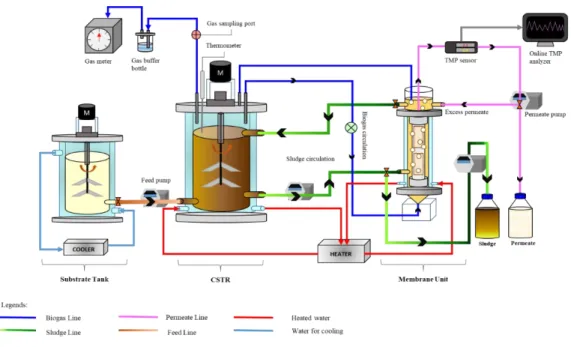
Lowry’s method. The daily biogas production was measured by a wet gas meter and the composition of biogas were measured by Shimadzu GC-8A gas chromatograph. The AnMBR system is consisted of substrate tank and continuous
stirred tank reactor (CSTR) with side-stream membrane filtration. Generally, the system having 15 L working volume
(13 L of CSTR with additional 2 L of membrane tank). The membrane installed in the membrane tank was supplied by
Sumitomo Electric Industries Ltd and it was made of polytetrafluoroethylene (PTFE) with a mean pore size of 0.2 µm
and an effective filtration area of 0.1 m2.
Figure A: The schematic diagram of the HF-AnMBR system
Based on the results of the AnMBR performance with stimulated milk wastewater, the methane composition was
in a range of 52.42 ± 0.89 to 58.38 ± 0.21% with the highest value of methane composition was 58.38 ± 0.21% and the
methane yield was 0.33 ± 0.01 L- CH4/g-COD at HRT 30 days. As the time passed, the biogas production rate and pH
and MLVSS content in the reactor. The COD removal efficiencies obtained from this experimental study was at
maximum rate at OLR of 5.01 g-COD/L/d with the value of 99.544 ± 0.001%. While the other three major organic
matters; carbohydrates, proteins and lipids showing a promising value of removal efficiency at corresponding OLR with
the value of 98.944 ± 0.01%, 99.306 ± 0.001% and 79.003 ± 0.049% respectively.
Figure B: Time course of pH, biogas production rate and biogas composition in HF-AnMBR system
OLR. The total COD entering the system was assumed to be 100%. Whereas the COD output was consisting of COD
in permeate, COD converted into methane (including gas and dissolved state) and the COD used for biomass growth.
From the analysis, it indicated that methane gas was discovered as the principle recoverable component where
accounting 90.31%, 86.26%, 85.85% and 85.28% of total COD input at OLR of 1.61, 3.28, 5.01 and 8.38 g-COD/L/d.
Meanwhile, the COD for sludge multiplication and discharge were 9.57%, 13.67%, 14.13% and 14.63% respectively.
Furthermore, it also is shown that only a small portion of COD remaining in the permeate which is less than 0.15% for
all OLRs. This has suggested that for all OLRs in HF-AnMBR the carbon source in milk wastewater was almost totally
hydrolyzed and metabolized and contributing to energy production. Moreover, it also indicates higher bioenergy from
milk wastewater can be harvested. The energy production (E0) produced by the system was in the range of 3.397– 4.286
kJ/gCOD and the highest peak at HRT 10d with the value of energy production at 4.286 kJ/gCOD. Net energy potential
(NEP) indicated in this study used to specify whether the AnMBR has the potential to produce energy in excess by
looking at the positive value obtained from the calculation made. Apart from that, the situation also can be viewed based
on energy ratio which could depict the bioenergy recovery that defined the ratio of the energy production to energy
consumption. Based on ratio calculated, the results showed that the ratio was in the range of 2.790 – 4.237 and the
maximum value of energy ratio were obtained from HRT 5 days, which means the AnMBR was energy-positive at all
HRTs and was most energy efficient at HRT 5.
In the second phase of research study, dairy wastewater with sewage sludge co-digestion was implemented. The
substrate utilized in this study was consist of crusher liquid, yogurt, concentrated permeate and concentrated triple
sewage sludge with the ratio of 3:4:2:1 in terms of COD concentration. The raw materials were provided by Tokyo Gas
Co Ltd. Experiment conducted by implementing dairy wastewater and sewage sludge co-treatment into AnMBR system,
showing that the biogas generated from the system was kept increasing proportionally towards the increasing of OLRs.
The biogas production was the maximum peak when the OLR increased to 9.00 g-COD/L/d. However, the methane
composition was decreased as the OLR increased. It getting more serious when the HRT get shorten to 3.5 days with
the OLR was 9.00 g-COD/L/d. The decrement of methane gas in the system was followed by the reduction of pH in the
reactor. This was an indication that inhibition of fermentation process has occurred in HF-AnMBR (Cheng et al., 2018;
the value of 0.339 ± 0.001 L- CH4/g-CODrem. The MLSS and MLVSS were increased gradually as the OLR increased
with shortening HRT. Furthermore, it was also shown that the value of biomass increased sharply when the OLR hit
9.00 g-COD/L/d. The performance in terms of organic removal showed that the COD removal resulted from
HF-AnMBR treatment system showing that HF-HF-AnMBR able to remove more than 90% removal efficiency under all OLRs
implemented. Based on these results, it indicates that the membrane completely retained the microorganism in the mixed
liquor in order to produce high-quality effluent. The variations of MLSS and MLVSS and its relationship with the
trans-membrane pressure (TMP) trends at different OLRs were analyzed. Based on the analysis, at OLR of 1.00 g-COD/L/d
the MLSS and MLVSS trends in the reactor were low and have affected to lower TMP. However, as the OLR increased,
there was a gradual increase in MLSS, MLVSS, TMP and membrane resistance. As the OLR increased to 3.00
g-COD/L/d, the slope became steep. Apart from that, the membrane fouling mechanism was also analyzed via membrane
cleaning and filtering test. The analysis was based on Ruigómez et al., (2017), where, the value of hydraulic resistance
of fouling fractions obtained at the end of cleaning step was considered. Based on the test conducted, the results revealed
that cake layer fouling was the main contribution to the total fouling with a value of 70.4%. While other parameters
such as organic pore blocking, cake layer blocking and inorganic foulant blocking having values of 6.3%, 2.3% and
0.32% of the total hydrolysis resistance respectively.
Figure C:Membrane resistance percentage (%)
100 M em b ra n e re si st anc e p er ce n t (% ) 80 60 40 20 0
In the study of dairy wastewater with sewage sludge co-digestion showing that the COD in permeate was lower
than 2000 mg/L at all times and the COD removal efficiencies achieved at all OLRs surpassed 95%. On the other hands,
the removal efficiencies obtained from other major organic substances such as protein and carbohydrate were 99.63 ±
0.13% and 99.14 ± 0.12% respectively. As can be seen, the removal efficiencies showed by carbohydrate and protein
was not significant, and indicated that both of organic matter were contributed to the biogas production and have
achieved nearly fully degradation in the reactor (Chen et al., 2017; X. Xiao et al., 2015). Based on this justification, it
is proven that the co-digestion performance was benefited from completely retaining microorganisms in the biomass by
membrane for efficient biodegradation. As for indication of reactor stability, VFA concentration and alkalinity in the
reactor was analyzed (Du et al., 2018). The alkalinity concentration was varied in the range of 470-3600 mgCaCO3/L
and it has shown that the value was sufficient to provide buffer capacity in the reactor in order to curb sudden decreased
of pH that caused by VFA accumulation. The maximum VFA accumulated was at 1306.3 mg/L at HRT of 3.5 days with
an OLR of 9.00 g-COD/L. This result has proved that as OLR increased, the VFA accumulation also increased, hence
affected methane composition in biogas production. In energy balance analysis, the experiment indicated that the value
of energy production obtained from this study was decreased as the OLR decreased. The NEP value of 2.927 kJ/gCOD
indicated that AnMBR having potential to generate energy in excess from the demand in order to run AnMBR system.
The maximum value of energy ratio, 4.255, obtained from HRT 10 days, revealed the AnMBR was energy-positive at
all HRTs and was most energy efficient at HRT 10. As a conclusion, the result obtained from the digestion of stimulated
milk wastewater by HF- AnMBR which been presented in Chapter 3, it was found that 90.31% of TCOD was converted
to CH4 and the methane yield achieved was 0.33 ± 0.01 L-CH4/g-CODremoved. Based on methane production rate, the
optimal OLR was 8.38 g-COD/L/d. Moreover, the highest NEP captured from the study was 3.268 kJ/gCOD at HRT
10 days. Based on the study of co-digestion of yogurt wastewater and sewage sludge in HF-AnMBR which been
discussed in Chapter 4 and Chapter 5, it was found that the optimal OLR was 9.0 g-COD/L/d and the methane yield
obtained from the study was 0.339 ± 0.001 L-CH4/g-CODremoved and the NEP captured was 2.927 kJ/gCOD at HRT 10
days. In a nutshell, anaerobic co-digestion is proven could improve the nutrient imbalance in dairy wastewater and also
could synergized micro-organisms effects in digestion process that lead to better biogas yield. Moreover, it is also
process of dairy wastewater. Hence, this work gives support that the approach of introducing either sewage sludge or
(別紙)
論文審査結果の要旨及びその担当者
論文提出者氏名 SITI NUR FATIHAH BINTI MOIDEEN(B7GD4001 )
論 文 題 目
Performance Evaluation of Anaerobic Membrane Bioreactor in Treating Dairy Food Industrial Wastewater (乳製品系食品廃棄物を処理する嫌気性 MBR の性能評価) 論文審査担当者 主査 教 授 李 玉友 教 授 井上 千弘 准教授 佐野 大輔