JAIST Repository
https://dspace.jaist.ac.jp/Title Research on Mechanism of Knowledge diffuseness in Technology Innovation
Author(s) WANG, Jiabin; SUO, Baimin; PANG, Xiaozhong Citation
Issue Date 2007-11
Type Conference Paper
Text version publisher
URL http://hdl.handle.net/10119/4089 Rights
Description
The original publication is available at JAIST Press http://www.jaist.ac.jp/library/jaist-press/index.html, KICSS 2007 : The Second International Conference on Knowledge, Information and Creativity Support Systems : PROCEEDINGS OF THE CONFERENCE, November 5-7, 2007, [Ishikawa High-Tech Conference Center, Nomi, Ishikawa, JAPAN]
Research on Mechanism of Knowledge diffuseness in Technology
Innovation
WANG Jiabin* SUO Baimin* PANG Xiaozhong*
*Management School
Shenyang Normal University, 110034, Shenyang, China
{sywangjiabin, suobaimin}@163.comAbstract
Technology innovation means the complete activity that begins with new idea from technology, passes through research and development or technologies combination, goes up to obtaining practical application and gives birth to the economic or social benefits. Its essence is the course of knowledge diffuseness. By the analysis on the phases in the course of technology innovation, we can design the mechanism of knowledge diffuseness in technology innovation from the following four parts: socialization, externalization, combination and internalization. It is helpful for people to understand in profound the course of technology innovation from the point of view of knowledge process.
Keywords: technology innovation, knowledge
diffuseness, imitative innovation, knowledge overflow
1 Introduction
Competition between Modern enterprises more and more depends on the science and technology. It has been the developing trend of enterprise management for enterprises from all kinds of countries to strengthen technology innovation. According to the developing course of technology innovation, as the inner variable of economic increase, innovation gradually begins to arose the people’s recognition since the
conception of innovation was firstly put forward by Schumpeter(1939) in the early 20 centuries. Especially after the 1960s, the economists of new Schumpeterism have done a lot of research work for technology innovation from the view of point of positive and empirical analysis to make research eyeshot transfer from special individual innovation to the more abroad technology development. Innovation is considered as relative, namely people should comprehend it in the continuously increasing environment and on the basis of the continuously developing technology structure. With the coming of the era of knowledge economy and research on technology innovation embedding continuously, people more and more realize that the course of technology innovation is actually the course which the innovative activity is achieved in knowledge diffuseness. And in the course, knowledge mostly undergoes the following taches: generation, research, development, reservation and diffuseness.
Differing from the traditional resource, knowledge in technology innovation not only cannot disappear or depreciate, but also can obtain accumulation and renewal after knowledge diffuseness and use. But at the same time, it can be not ignored that aging speed of knowledge will be faster. So, the most important work in technology innovation is to replace the old knowledge in time, expedite the speed of knowledge renewal and reduce the cost of knowledge production. This paper analyzes the
essence of technology innovation profoundly proceeding with the meaning of technology innovation and points out that the course of technology innovation is just the course of knowledge diffuseness. Knowledge diffuseness in the course of technology innovation differs from the common knowledge diffuseness and has the special feature. On the side, this paper constructs the system of knowledge diffuseness in technology innovation based on the Nonaka’s model of knowledge conversion on the basis of divided phases for the course of technology innovation and point out the negative effect of knowledge diffuseness in the course of technology innovation at the same time.
2 The meaning and essence of technology
innovation activity
2.1 The meaning of technology innovation
Technology innovation means the activity of commercialization that the new idea of technology gains practical application and bring economic and social benefit by R&D and technology combination.[1]
Differing from system innovation and organizational innovation, category of innovative technology in technology innovation is determinative. By all appearances, innovative activities of non-technology can be arranged in the range of technology innovation. Just as the point of Mansfield, the new product which gains the market realization is the centralizing representation of technology innovation. So, technology change which is relative to new products is just the technology innovation. National Science Foundation of U.S.A. puts forward the extensive explanation for technology innovation. It considers that the some successful change of production technics and operational fashion which doesn’t need new
technology knowledge belongs to the category of technology innovation, although the arrangement is quite low.[2]
From the definition of technology innovation, it is not hard for us to see that successful technology innovation doesn’t leave the application and contribution of knowledge. The essence of technology mentioned here is the inventory of knowledge. They bring on the improvement of product, technics process and service by creating the reproductive methods. So, it is to say that the course of technology innovation is also the course of realizing the value of knowledge.
2.2 The essence of technology innovation
The activity of technology innovation is a kind of the special practical course. R.M. Kanter thought that no matter what kind of innovation includes technology innovation, all put up four kinds of different characteristics:
(1) The course of innovation is dubious. It includes origin of innovation, obtainment of innovation chance and innovation results. And all these are uncertain.
(2) The innovation is the course of knowledge intensive. It not only depends on the creativity and wisdom from innovationist, but also depends on the learning capability of members from innovative group.
(3) The course of innovation is disputed. The disputation is mostly embodied the contrast and competition for different blueprints.
(4) The course of innovation is cross-border. This mostly means that fountain of innovation results from cross-subject and cross-department.[3]
The four characteristics fully indicate the objective existence of knowledge fluid in innovative activities. Uncertainty in the course of innovation requires blazing the sparkle of thought and forming fountain of innovation,
increases the innovation chance in knowledge fluid and achieves the goal of innovation in knowledge fluid. Knowledge intensiveness of the course of innovation requires improving the learning capability and obtaining knowledge by knowledge communication. Competition of the course of innovation requires communication and competition of the potential blueprint in knowledge fluid. Synthesis of the course of innovation requires cooperation and knowledge communication cross departments and absorbs all kinds of information in favor of innovation.[4]
Some research indicates that innovative activities is more blossoming in some organizations which have the high synthesis degree of information communication.[5] the course of technology innovation involves the following three factors: data, information and knowledge. People cannot achieve the common ground in differentiation of information and knowledge. Commonly, data means the fact which is not structured and significant, information is the data that is endowed with association and meaning and knowledge is the valuable information. [6] In some conditions, on the one hand, knowledge and information can be inter-translation; on the other hand, sometimes they get across the same or alike process and depend on the same or alike artifice in fluid. So, technology innovation is the special practice course which utilizes knowledge to create value. This course contains the knowledge fluid course. And the point just is associative with the point of knowledge management, namely, knowledge creates value in fluid. This course of creating value is the activity of technology innovation in practice.
3 Knowledge diffuseness in technology
innovation
Knowledge course commonly can include three phases: knowledge production (discovery and creation), knowledge diffuseness and knowledge application. Thereinto, sometimes knowledge diffuseness coexists with technology innovation activities. Knowledge diffuseness enhances value and meaning on creation and discovery of knowledge and satisfies the continuously extending knowledge requirement from society. Fruits of knowledge innovation can be applied abroad and transformed the productivity only by diffuseness. Knowledge diffuseness means to transfer the enterprise’s knowledge processed to the relative staff by some forms or artifices in order to achieve knowledge sharing. [7] Only by knowledge diffuseness, can people learn and grasp knowledge on science and technology and make knowledge effective diffuseness, accelerate application abroad of science and technology in society, realize the functions of its production and economy and advance the society development consequently.
3.1 Relationship between technology innovation and knowledge management
As well known, enterprise technology innovation is a course which transforms the knowledge, skill embodied potential knowledge and matter into the product and service which makes customer satisfaction, which products, shares, creates and applies knowledge and which chooses, communicates and processes information. In era of knowledge economy, knowledge quantity which enterprise can obtain and dominate rapidly increases, speed of knowledge diffuseness and renewal cycle quicken continuously, fashion of knowledge innovation trends to diversification. As the idea of innovative management, knowledge management make enterprise’s a large quantity and disorder information and knowledge order and easy to diffuse by tidying, classifying,
digital and coding in order to provide strong pledge for smooth operation of the course of technology innovation.
Uniformity, course of technology innovation contains the content of knowledge management, namely, activity of knowledge diffuseness. Course of technology innovation mainly includes the following seven phases:
(1) Producing the innovative design. Innovative design is likely to come from presumption or discovery of scientist which grasps the relative knowledge, information, experience and skill or engineer which engages in some technology activity, and also come from experience of environment, market needs or opportunity from marketing personnel or users.
(2) Evaluating the innovative design according to the likely condition from technology, business, organization and other sides, extending the innovative design by synthesizing scientific knowledge and technical experience and putting forward the design archetype for realizing the innovative design.
(3) Developing the examination model, namely, transforming the design archetype into experiment archetype in order to validate the possible realization of design archetype.
(4) Developing the industrial archetype, drawing the whole technical criterion, and carrying through the locale technics examination and test
production of new product, and putting up the market testing and research on marketing according to scale requirement of commercialization.
(5) Accidence and practical application of innovative technology or original commercialization production of innovative product.
(6) Abroad adoption of innovative technology or mass production of innovative product, innovation produces the distinct the commercial or social effect.
(7) Diffuseness of innovative technology, namely, innovative technology which contains archetype knowledge, information, experience and skill is endowed with the new purpose and enters into the new market.
3.2 System of knowledge diffuseness based on SECI in technology innovation
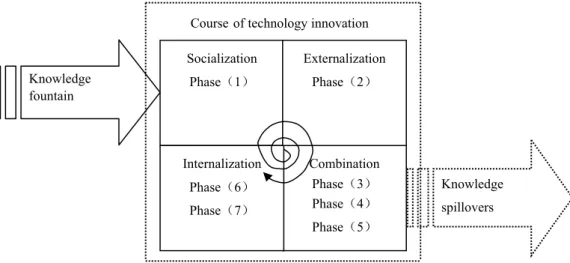
Knowledge diffuseness activity of each phase in the course of technology innovation can be embodied by the SECI knowledge transforming model based on Socialization, Externalization, Combination and Internalization which is designed by Nonoka I. et al(1991). shown by Figure 1.
From figure 1, technology innovation is the systematic activity and the dynamic knowledge
Socialization Phase(1) Combination Phase(3) Phase(4) Phase(5) Internalization Phase(6) Phase(7) Externalization Phase(2)
Figure 1 system of knowledge diffuseness in technology innovation based on SECI
Knowledge fountain
Knowledge spillovers Courseof technology innovation
diffuseness. Innovation thought in realism can have multi-origins and present to any phase of research, development, market and diffuseness. Innovation can have many forms, which includes takes on products and improves the process continuously. New knowledge is produced continually in every course and phase, and the knowledge which is combined in enterprise products and outer environment influences and promotes the every course of technology innovation. So, management for knowledge in every phase in technology innovation and feedback for innovative condition in time are the strong artifice which reduces the risk of innovation failure. During the whole course of technology innovation based on SECI, enterprise can forms a system on management of knowledge diffuseness, tidy and process the knowledge inhere in the phase of design and research in technology innovation and form a dynamic system of feedback (shown by Figure ). This is not only helpful to grasp innovative speed for innovative personnel in every phase of course of technology innovation in time, but also is helpful to knowledge diffuseness and communication between innovative groups.
3.3 Negative effect of knowledge diffuseness in technology innovation
If effective diffuseness and communication for the relative knowledge in enterprise is the artifice of activation technology innovation, imitative innovation and knowledge spillovers can bring the block and influence for technology innovation.
Imitative innovation means enterprise absorbs the successful experience and failure, buy and translate the core technology and technology secret, and develop further more. Imitative innovation is a common innovative activity in the activities of technology innovation.
Knowledge diffuseness can be one of the factors which is not neglect. In addition, knowledge diffuseness also can product the problem of knowledge spillovers in technology innovation. This is mainly because the new technical knowledge has the nature of non-competition; leader of innovation sometimes avoids providing the convenience for other enterprise and organization by implementing some influence. Problem of knowledge spillovers still often happen with knowledge diffuseness. On the one hands, leader of innovation usually disseminate information which contains the relative technology information in order to realize the innovative market and form the knowledge spillovers. On the other hand, when enterprise constructs the innovative group with other enterprises to realize its goal of development, knowledge diffuseness also leads to the knowledge spillovers by the means of technology transfer or technology diffuseness.
4 Conclusions
To sum up, activity of knowledge diffuseness plays the important role in the course of technology innovation. As the effective diffuseness of technology which agglomerates knowledge, experience, skill and information, enterprise’s technology innovation continually develops and promotes the progress of society. At the same time, we should know clearly that the neglect influence from knowledge diffuseness and adopt some relative measures to ensure the security for the course of knowledge diffuseness and guarantee the benefit of leader of innovation and enthusiasm for standing innovation.
[1]WU Guisheng. Management on technology innovation. Qinhua University Press, 2000, 10. [2] [8]FU Jiaji. technology innovation. Qinhua University Press, 1998,8,51
[3]R.M. Kanter. Supporting innovation and venture development in established corporations. Journal of Business Venturing, 1 (Winter)
(1985), 47 - 60.
[4]LIN Huiyue. Research on the knowledge space of technology innovation. Communication of nature dialectic, 2002(4): 38-44, 25
[5]Paul.S.Myers. Knowledge management and organization designing. Zhuhai Press.1998,166. [6]Rolf Blumentritt & Ron Johnston. Towards a Strategy for Knowledge management,
Technology Analysis & Strategic management, Vol.11, No.3, 1999,291
[7]CAI Weimin, WU Dekun. Research on disciplinarian of enterprise knowledge
diffuseness. Progress and Policy and Science and Technology, 2006(6):33-36.
[9]Dierkes.M.Organizational learning and knowledge creation. Shanghai Renmin Press, 2001,387