Studies on Direct-seeding Adaptability of Cambodian Rice Cultivars and Development of Cultivars with Good Eating Quality
2008.3
Science of Plant and Animal Production United Graduate School of Agricultural Science Tokyo University of Agriculture and Technology
This research was conducted from April 2005 to October 2007 at Utsunomiya University, Japan. The work carried out during the course of this research has resulted in the following publications:
1. Ly Tong, Tomohiko Yoshida, Tadanobu Maeda and Haruki Kimijima (2007)
Effects of temperature, sowing depth and soil hardness on seedling establishment and yield of Cambodian rice direct-seeded in flood paddy fields
Plant Production Science
10 (1):129-135.2. Ly Tong and Tomohiko Yoshida (2008)
Can hot-water emasculation be applied to artificial hybridization of indica-type Cambodian rice?
Plant Production Science
11(1):132-133.3. Ly Tong and Tomohiko Yoshida
Genetic Diversity of Cambodian Rice Cultivars
Plant Production Science
11(in press).Contents
General Summary..………..1
Summary………2
Ⅰ Introduction………...5
Ⅱ Genetic Diversity of Cambodian Rice Cultivars………13
Ⅲ Effects of Temperature, Sowing Depth and Soil Hardness on Seedling Establishment and Yield of Cambodian Rice Direct-seeded in Flood Paddy Fields………..………28
Ⅳ Application of Hot-water Emasculation to Artificial Hybridization of
Indica
-type Cambodian Rice……….44Ⅴ Evaluation of Progenies Derived from Crossings between Four Cambodian Cultivars with Koshihikari on Agronomic Traits and Eating Quality………..58
Ⅵ General Conclusions……….82
References……….88
Acknowledgments……….. 92
1
General Summary
This literature is about to study on genetic diversity of Cambodian rice cultivars, their adaptability to direct-sowing under paddy conditions, the method for crossing using Cambodian cultivars and evaluation of agronomic characteristics for selecting lines derived from the crossing.
Cluster analysis of SSRs data showed that Cambodian cultivars were classified into 3 groups. One of those groups included traditional cultivars, which showed farther genetic distance from Koshihikari. Crossing of this group with Koshihikari could expect to gain wide variation.
Cambodian cultivars had low adaptability to direct-sowing by showing lower seedling establishment at both low temperature and deep sowing than
Koshihikari. It is recommended to cross those cultivars with Koshihikari to improve not only seedling establishment but as well as eating quality.
Hot-water emasculation could be adopted to cross indica type Cambodian cultivars with japonica cultivars by emasculation with hot water at 43℃ or 44℃ for 7 minutes.
Crossing of Cambodian cultivars and Koshihikari was achieved. Generations were advanced and selections of progeny lines were conducted. Through the process of selection, two lines were recommended as promised lines. Both of them had long panicle length, short plant length, good seedling establishment, strong lodging tolerance and low amylose content. These lines could contribute to the breeding materials adapted in Cambodia for direct-sowing.
2
Summary
Rice is the most important crop for supporting Cambodian economy; however the cultivated area is limited due to the rice production system. Rice is usually transplanted by hand and yet the direct-seeding technology and proper cultivars for direct-seeding have not been established. The aim of this study is to find the adaptability of Cambodian cultivars for direct-seeding.
Another purpose of this study was to develop cultivars adapted in Cambodia with high adaptability to direct-sowing and good eating quality by crossing some of Cambodian rice cultivars with Koshihikari.
1. The genetic diversity of Cambodian rice cultivars was studied. Koshihikari and Nipponbare as a control cultivar and 16 Cambodian cultivars were employed. The genetic distance was determined by SSRs markers using 22 primers. Cluster analysis showed that they were divided into three groups. Group A included traditional cultivars. Group B included cultivars of newly released and having genetic relationalship to IR lines and some traditional cultivars. Group C included Koshihikari, Nipponbare and one IR line.
2. Seedling establishment of rice direct-seeded in a flooded paddy field was determined, and their growth and yield were examined. The seedling establishment of Japanese cultivars, Koshihikari and W42, was significantly higher than those of Cambodian cultivars, Rumpe and Sen Pidao, at both medium and low temperatures, but not significantly different among cultivars at high temperature. Koshihikari and W42 showed significantly higher seedling establishment than Sen Pidao at 0 cm deep sowing. Koshihikari also showed significantly higher seedling establishment than both Rumpe and Sen Pidao at 1
3
cm and 2 cm deep sowing. The percentage of seedling establishment from the seeds sown after 4, 1 and 0 day of drainage was higher in Rohat than in the other cultivars. The percentage of seedling establishment in 0 day drainage (drained just before seeding) was 51 % in Rohat, but only 28 % in Sen Pidao, which was the lowest among the cultivars. Cambodian rice cultivars had a short plant length and short basal low internodes, which contributed to strong lodging resistance. Crossing of Cambodian cultivars with Koshihikari to obtain cultivars adapted to direct-seeding in Cambodia was proposed.
3. Hot water emasculation was applied to indica-type Cambodian cultivars. The panicles of Cambodian rice at the flowering stage were submerged in hot water (40 – 46℃) for 7 minutes after removing the opened (flowered) spikelets. The panicles after the treatment were grown in the natural condition for 7 days, and the number of spikelets fertilized by self-pollination was counted. The numbers of fertilized spikelets per panicle were 7.1, 0.1 and 0 in the panicles treated with hot water at 40, 43 and 46℃, respectively, as the average of 11 Cambodian cultivars in the experiment in 2005, and 3.6, 0.1, 0, 0.06 and 0 at 40. 43, 44, 45 and 46℃ , respectively, as the average of 5 Cambodian cultivars in the experiment in 2006. In the other experiment, the panicles were treated as above, but the spikelets after the hot-water treatment were artificially pollinated with healthy pollens of Koshihikari, W42 or Srau Sar. The percentages of fertilized spikelets in the panicles treated at 43, 44, 45 and 46℃ were 36.0, 23.6, 13.0 and 0.3%, respectively, as the average of 11 Cambodian cultivars in 2005, and those treated at 44,45 and 46℃ were 21.9, 11.7 and 10.6%, respectively, as the average of 5 Cambodian cultivars in 2006. These results showed that female
4
organ in more than 20% of the spikelets were tolerant to hot-water treatment at 43 or 44℃ for 7 min, although most of the pollens were inactivated by these treatments. Thus, the hot-water treatment at 43 or 44℃ for 7 minutes is useful for emasculation of indica-type Cambodian rice.
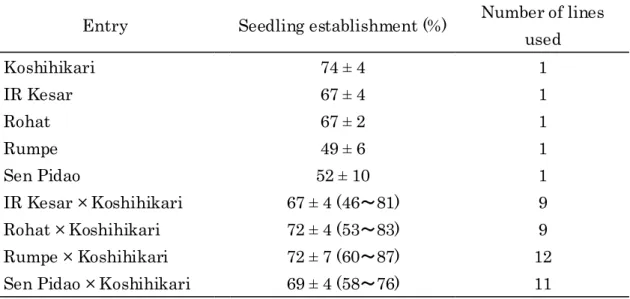
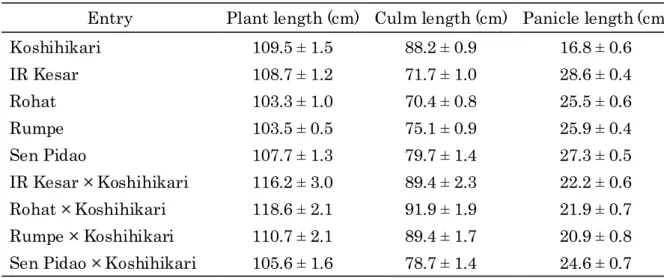
4. Four Cambodian rice cultivars, IR Kesar, Rohat, Rumpe and Sen Pidao, as female parents were used to cross with japonica Koshihikari as a male parent. Generations were accelerated and from F3 generation, selection has been conducted for direct-seeding. Some of agronomic traits were evaluated. Plant length and panicle length of F3 plants, F4 and F5 lines were measured. Lodging of F4 and F5 lines and seedling establishment of F5 lines was checked. Yield and amylose content of F4 and F5 lines were also evaluated. The average of seedling establishment of lines in each combination was slightly lower than Koshihikari, whereas, higher than their parents of Cambodian cultivar. Some lines showed higher seedling establishment than Koshihikari. The average of lodging of lines in each combination was lower than Koshihikari. F5 lines showed higher number of spikelets per panicle than Koshikari, however, they showed lower brown rice yield than Koshihikari. There were promising lines with good agronomic characters and low amylose content, which might be used for further crossings to develop good eating quality cultivars adapted in Cambodia for direct-sowing.
5
Chapter 1
6
In 1966, IRRI released IR8, the first high-yielding modern rice cultivar for the tropical irrigated lowlands. Since then, IRRI has also developed many high-yielding indica inbred cultivars such as IR36, IR64 and IR72 (Peng and Khush, 2003). Those cultivars performed a high yield as high as 10 t h-1 (in paddy) recorded
in the tropical irrigated lowland (Peng et al., 2000).
In Cambodian, farmers have been growing rainfed rice for at least 2000 years, possibly longer in the case of upland rice. Historians believe that rice-growing technologies may have been imported into Cambodia along trade routed from India. Irrigated rice production technologies were introduced 1500 years ago. Farmers integrated rice production into their existing systems of land use which had developed since prehistoric times (Nesbitt, 1997).
The Angkorian period, from the 9th to the 14th centuries AD, witnessed
the rise of the greatest kingdom in Southeast Asia in Cambodia. The center of Khmer population shifted from the northwest to the Tonle Sap Lake region, with the economic power of Angkor being based on rice agriculture. Some historians contend that Angkor gained its power through dramatic and widespread innovations in rice irrigation technology. However, between the 15th and 17th
centuries, Angkor was abandoned and population gains were forfeited.
In the 18th and 19th centuries, rural life and rice production were
dominated by wars, rebellions, and violence as neighborhood, and Khmer forces fought across Cambodian territory, destroying villages, killing and displacing villages, and laying farming regions to waste.
Since 1987, the Cambodian-IRRI-Australia Project has been established in Cambodia and fulfilled the rice research service that could determine appropriate
7
improved technologies for Cambodia (Nesbitt, 1997).
There are approximately 1270 local cultivars unique to Cambodia (Edwin et al., 1999). During more than three decades of civil wars, some of them were lost and studies to improve the cultivars have been started recently. Some new cultivars have been released for Cambodian farmers and most of them were introduced from IRRI. However, there is not any report studying on the genetic diversity of Cambodian rice cultivars. In order to utilize those local cultivars and also the newly released cultivars, studying on genetic diversity of Cambodian rice cultivars is necessary as basic information for developing new cultivars. Thus, the author studied, at first, on the genetic diversity of 16 Cambodian cultivars included 5 traditional cultivars, 11 newly released cultivars, and 2 japonica cultivars as a control.
Microsatellites, also known as simples sequence repeats (SSRs), are tandem arrays of short nucleotide repeats from 1 to 5 bases per unit, randomly spread in genomes. SSRs are very polymorphic due to the high mutation rate affecting the number of repeat units and can be easily detected on high resolution gels. Microsatellites have been extensively exploited for genome mapping and for wide range of population and evolutionary studies. SSR loci are particularly useful for the study of population structure and demographic history of domesticated species because their high level of allelic diversity facilitates the detection of the fine structure of diversity more efficiently than an equal number of RFLP, AFLP or SNP loci (Amanda et al., 2005).
In this study, the author aimed to characterize population structure and demographic history of 18 Cambodian cultivars as a fundamental information for
8
crossing among Cambodian rice cultivars (indica type) and Japanese cultivars including Koshihikari and Nipponbare (japonica type). This study of the genetic characteristics and the analysis of genetic relationships among those Cambodian cultivars could enhance the genetic diversity.
Secondly, adaptability of Cambodian cultivars was studied for direct-sowing. Direct-seeding is needed to reduce the cost and labor of rice production in Japan, where the age of the farmers is advancing and the number of farmers is decreasing. Not only in Japan, but also in countries of South East Asia such as Malaysia, Thai and the Philippines, the number of farmers having a large irrigated rice production area is low, and direct-seeding is increasing to replace the traditional transplant system (De Datta and Saaran, 1990), including Cambodia. Cambodia was the third largest rice-exporting country in the world in 1940. However, the civil wars in the past four decades have damaged the industries, which supported the domestic economy. Agriculture was the most important sector at that time. However, agricultural machinery is no longer made domestically. Ninety percent of the population lives in poverty, and only a small number of farmers have access to machinery, all of which is imported. Due to the lack of machinery, labor in agriculture relies on human and animal power. Especially, in the rice production system, transplanting is mostly done by hand. Sixty to 70 people are required per hectare. By direct-seeding, this number can be reduced to 30 to 40 people (Yada, 1975). Generally, the average area cultivated per household is approximately 2 to 5 hectares, which is limited by lack of irrigation facility and low water use efficiency. However, the most important limitation is the labor required for growing rice.
9
Thus in order to enlarge the area of rice production per household in Cambodia, the establishment of a proper direct-seedling method is the extremely important. There are approximately 2000 local cultivars in Cambodia. However, the data about their agronomic characteristics and productivity are scarce especially under the condition of direct-seeding in flooded paddy fields.
Cambodia has a tropical monsoon climate with mean temperature ranges from 21 to 35 ℃. According to the climate, it is possible to grow rice three times per year. But as the lowest temperature is in January (21 - 25 ℃), cultivars which perform high seedling establishment in low temperature are needed. As approximately 86 % are cultivated with rainfed lowland in Cambodia, cultivars which perform high seedling establishment under flooded condition are also required. In this study, the author paid special attention to the genetic resources and attempted to find the cultivars highly adapted to direct-seeding under puddled condition and different temperatures.
In order to select lines from crossing those Cambodian cultivars, with some Japanese promising cultivars, the author had to focus on seedling establishment under various conditions and some agronomic characters of Cambodian cultivars. Yielding and heading time must be examined to check the response of Cambodian cultivars in different environments, especially in Japan, where good lines adapted in Cambodia will first be selected. Thus, it is important to collect the data of agronomic traits of a cultivar under various environments.
Therefore, using several Cambodian cultivars, the author examined the seedling establishment, growth and yield under direct-seeding in flooded paddy fields. Although some new cultivars have enhanced the rice production in the
10
country, they still lack adaptability to the Cambodian ecosystem and rice productive system, and its eating quality is lower than traditional cultivars. As a result, these cultivars are not fully accepted by Cambodian consumers. Thus, introducing local cultivars into the rice breeding program may be necessary to improve yield potential, eating quality, pest resistance, response to high fertilizer input, and so on. Thirdly, the establishment of crossing method for Cambodian cultivars was attempted. In rice breeding, clipping (Coffman and Herrera, 1980) and vacuuming (Coffman and Herrera, 1980) are commonly used to remove pollens in IRRI and the U.S.A; while deactivating pollen by hot water is popularly used in japonica rice breeding programs (Kondo, 1939; Matsubayashi et al., 1965). Both of clipping and vacuum methods require more labor than hot-water emasculation; and need a highly skillful operation, otherwise the stigma is easily injured or contaminated with self-pollinated spikelets due to remaining anthers. Hot-water emasculation is a method that is easy to handle for both the skillful person and the unskillful person and requires less labor.
It is not known why breeders other than Japanese are not willing to accept this hot-water emasculation method, but one reason might be the absence of reports about this method applied to indica cultivars. Therefore, in the study this method was applied to Cambodian cultivars of indica type.
Finally, selection of lines with good adaptability and eating quality was attempted. Enlargement of genetic variance of rice by japonica-indica crossing is one strategy to improve agronomic traits including yield, grain quality, early heading, lodging tolerance, as well as pest, disease and environmental tress tolerance by screening useful traits from both sides. Depend on the combination, some show
11 heterosis performing high yield in hybrid plants. Yun et al. (1997) studied on growth and yield of cultivars of japonica-indica crossing under direct seeding in paddy field and upland cultivation, comparing with japonica cultivars, and concluded that these cultivars showed higher yield than japonica cultivars. Wada et al. (2001) investigated the growth and dry-matter production of japonica, indica and japonica-indica hybrid cultivars during vegetative growth under upland cultivation with water stress condition, and pointed out that those japonica-indica hybrid cultivars showed better recovery after watering than other japonica and indica cultivars. Yokoo et al. (1978) developed blast resistant lines from indica and japonic crossing. Kang et al. (2002) studied on branching habit of root system development of japonica-indica hybrid cultivars, and indicated that lateral roots development of japonica-indica hybrid cultivars were more vigorous than that of japonica type.
Although, there are obstacles in the japonica-indica crossing, such as hybrid sterility (Oka, 1974; Ikehashi and Araki, 1986), hybrid weakness (Oka, 1957; Sato and Morishima, 1987), Ikehashi and Araki (1986) found out that there are some cultivars designated as wide compatible varieties (WCVs), which showed normal fertility in F1 crosses with indica and japonica.
More than increasing yield which is the main theme in rice production, grain quality is another major issue in rice breeding program. While, many components contribute to rice quality, the most important factor is cooking and eating quality. These factors primarily involve with the physical and chemical properties of starch. Those factors which play important roles in cooking and eating quality are amylose content, gelatinization temperature and gelling consistency. Singh et al. (2000) indicated that eating quality of rice grain is second compared to yield as major rice breeding program.
12 However, in the future, eating quality of rice grain will be even more important as very poor consumers, who depend largely on rice for their daily food and claim higher quality rice (Juliano and Villarreal, 1993).
Therefore, the author tried to develop lines which have a high adaptability in direct-seeding and have a good eating quality by crossing 4 Cambodian rice cultivars with Koshihikari.
13
Chapter 2
14
Microsatellites, also known as simples sequence repeats (SSRs), are tandem arrays of short nucleotide repeats from 1 to 5 bases per unit, randomly spread in genomes of bacteria (Gur-Arie et al., 2000), animals (Elgar et al., 1999), and plants (Morgante et al., 2002). SSRs are very polymorphic due to the high mutation rate affecting the number of repeat units. Such length-polymorphisms can be easily detected on high resolution gels; by running PCR amplified fragments obtained using a unique pair of primers and flanking the repeat. SSRs have several advantages over other molecular markers. For example, (i) microsatellites allow the identification of many alleles at a single locus, (ii) they are evenly distributed all over the genome, (iii) they are co-dominant, (iv) a little DNA is required and (v) the analysis can be semi-automated and performed without the need of radioactivity. Microsatellites have been extensively exploited for genome mapping and for wide range of population and evolutionary studies in human (Bowcock et al., 1994), rice (Yang et al., 1994), mouse (Dietrich et al., 1996), and other animal and plant species (Jarne and Lagoda, 1996; Powell et al., 1996). In rice, intraspecific classification of it has been important to rice geneticists and breeders, but with the advent of population genetics, it is now feasible to examine the genetic basis of domestication, adaptation, plant development, and agricultural performance. SSR loci are particularly useful for the study of population structure and demographic history of domesticated species because their high level of allelic diversity facilitates the detection of the fine structure of diversity more efficiently than an equal number of RFLP, AFLP or SNP loci (Amanda et al., 2005).
In this study, the author aimed to characterize population structure and demographic history within 18 Cambodian and Japanese cultivars as fundamental
15
information for crossing among Cambodian rice cultivars (indica type) and Japanese cultivars including Koshihikari (japonica type). This study of the genetic characteristics and the analysis of genetic relationships among those Cambodian cultivars can be an opportunity of enhancing the genetic diversity from crossing between parents, of which relationship is far distant, each other.
Materials and Methods
Sixteen Cambodian rice cultivars (Oryza sativa L.) listed in Table 1, and Japanese cultivars, Koshihikari and Nipponbare, were used. Seeds of Cambodian rice cultivars were obtained from Cambodian Agricultural Research and Development Institute (CARDI). IR Kesar, Sen Pidao, Rohat and Rumpe are photoperiod-insensitive rice, newly released in Cambodia. All four cultivars are cultivated under rain-fed lowland conditions, and classified into early maturity cultivars (less than 120 days). Rohat and Rumpe were released in 1999. Sen Pidao is premium aromatic rice, released in 2002. Average yield (t ha-1) of Sen Pidao,
Rohat and Rume are 3.5-5.5, 4.0-6.0, 4.0-6.0, respectively, in Cambodia (Cambodian Agricultural Research and Development Institute, 2001). Sentepheap 3, Popoul and Sarika are medium maturity cultivars insensitive to photoperiod. Phka Rumdoul and Phka Rumchang are also medium cultivars, but they are sensitive to photoperiod, and classified into aromatic rice cultivars. CAR 13, Chhma Prum, Neang Minh, Phka Khgnei, Phka Mlis and Srau Sar are late maturity cultivars, which are traditional cultivars of rice production areas in Cambodia. Torng Lahong is waxy rice, and the others are nonwaxy rice. The grain type of all cultivars is
16
Table 1. List of cultivars used for the genetic diversity experiment. Entry
No. Name Type Details
1 CAR 13 indica Traditional cultivar, late maturity
2 Chhma Prum indica Traditional cultivar, late maturity
3 IR Kesar indica New released cultivar, early maturity
4 Koshihikari japonica Popular cultivar in Japan
5 Neang Minh indica Traditional cultivar, late maturity 6 Nipponbare japonica Popular cultivar in Japan
7 Phka Khgnei indica Traditional cultivar, late maturity 8 Phka Mlis indica Traditional cultivar, late maturity 9 Phka Rumdoul indica New released cultivar, medium maturity 10 Phka Rumchang indica New released cultivar, medium maturity
11 Popoul indica New released cultivar, medium maturity
12 Rohat indica New released cultivar, early maturity
13 Rumpe indica New released cultivar, early maturity
14 Santepheap 3 indica New released cultivar, medium maturity
15 Sarika indica New released cultivar, medium maturity
16 Sen Pidao indica New released cultivar, early maturity
17 Srau Sar indica Traditional cultivar, late maturing
17
slender.
Seeds of all cultivars were sown in a nursery box and were grown in a growth chamber at 32 ℃ at day-time and 27 ℃ at night-time in 2004. Leaves of young plants (one sample for one plant) at the stage of 7 or 8 leaves were collected, washed by 70 % of ethanol and were scaled to 0.1 g. DNA extraction was done by using a DNA extraction Kit Nucleon Phytopure for Plant DNA Extraction (Amersham Biosciences). The protocol was followed by the manual included in the product. After DNA extraction, concentration of each solution was diluted to 100 times using 5 μl, and was detected by Gene Spec Ⅲ (Model 7A0-0030, Naka Instruments Co., Ltd.). Amount of DNA of each sample was obtained from 140 ng/μl to 735ng/μl and was adjusted to 10 ng/μl to a new micro-tube. The DNA solution after adjustment was stored at -20 ℃ or was kept at -80 ℃ refrigerator.
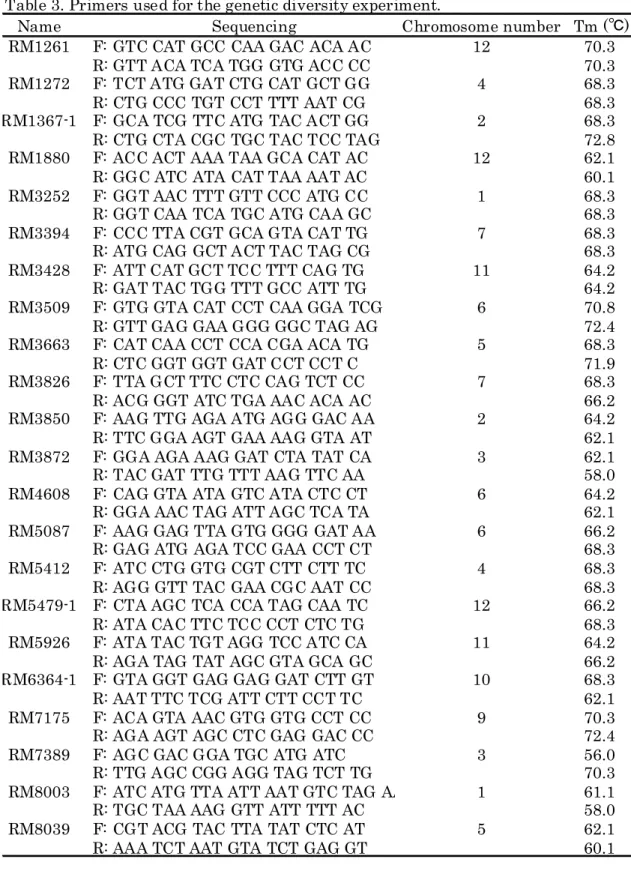
KOD Dash Kit containing 100 μl of KOD Dash, 1200 μl of 10× Buffer and 1000 μl of 2 mM dNTPs (LDP-101, TOYOBO CO., LTD.) was used for Polymerase Chain Reaction (PCR) amplification. KOD Dash Kit was stored at -20 ℃ as the instruction of the product. The PCR reactive solution was in a volume of 20 μl and the component contained 10 ng of template DNA, 14.4 μl of MilliQ water, 2 μl of 10× Buffer, 2 μl of 2 mM dNTPs, 0.2 μl of Forward primer, 0.2 μl of Reverse primer and 0.2 μl of KOD Dash (Table 2). Figure 1 shows the preparation of PCR reaction solution. Primers were listed in the Table 3, which were designed on all rice chromosomes except chromosome number 8. PCR reactions were run by a PCR system 9700 (Gene Amp), in which the program was followed by 30 cycles of 94 ℃ for 30 seconds, and annealing temperature was depended on the Tm of primers for 5 seconds and extension was at 72 ℃ for 30 seconds. PCR products were stored at 4 ℃
18
Table 2. Composition of reagents to PCR reaction.
Reagent Amount (μl) MilliQ water 14.4 10× Buffer 2 2mM dNTPs 2 Forward Primer 0.2 Reverse Primer 0.2 KOD Dash 0.2 Total 19
Fig 1. The illustration showing the preparation of PCR reaction solution. Each PCR tube contains 19 μl (PCR reaction solution) + 1 μl (template DNA)
KOD Dash : 0.2 μl × ( Number of samples + 1) Reverse Primer : 0.2 μl × ( Number of samples + 1) Forward Primer : 0.2 μl × ( Number of samples + 1) 2mM dNTPs : 2 μl × ( Number of samples + 1) 10× Buffer : 2 μl × ( Number of samples + 1) MilliQ water : 14.4 μl × ( Number of samples + 1)
19
Personal communication from Dr. Ideta for chromosome number.
Table 3. Primers used for the genetic diversity experiment.
Name Sequencing Chromosome number Tm (℃)
RM1261 F: GTC CAT GCC CAA GAC ACA AC 12 70.3
R: GTT ACA TCA TGG GTG ACC CC 70.3
RM1272 F: TCT ATG GAT CTG CAT GCT GG 4 68.3
R: CTG CCC TGT CCT TTT AAT CG 68.3
RM1367-1 F: GCA TCG TTC ATG TAC ACT GG 2 68.3
R: CTG CTA CGC TGC TAC TCC TAG 72.8
RM1880 F: ACC ACT AAA TAA GCA CAT AC 12 62.1
R: GGC ATC ATA CAT TAA AAT AC 60.1
RM3252 F: GGT AAC TTT GTT CCC ATG CC 1 68.3
R: GGT CAA TCA TGC ATG CAA GC 68.3
RM3394 F: CCC TTA CGT GCA GTA CAT TG 7 68.3
R: ATG CAG GCT ACT TAC TAG CG 68.3
RM3428 F: ATT CAT GCT TCC TTT CAG TG 11 64.2
R: GAT TAC TGG TTT GCC ATT TG 64.2
RM3509 F: GTG GTA CAT CCT CAA GGA TCG 6 70.8
R: GTT GAG GAA GGG GGC TAG AG 72.4
RM3663 F: CAT CAA CCT CCA CGA ACA TG 5 68.3
R: CTC GGT GGT GAT CCT CCT C 71.9
RM3826 F: TTA GCT TTC CTC CAG TCT CC 7 68.3
R: ACG GGT ATC TGA AAC ACA AC 66.2
RM3850 F: AAG TTG AGA ATG AGG GAC AA 2 64.2
R: TTC GGA AGT GAA AAG GTA AT 62.1
RM3872 F: GGA AGA AAG GAT CTA TAT CA 3 62.1
R: TAC GAT TTG TTT AAG TTC AA 58.0
RM4608 F: CAG GTA ATA GTC ATA CTC CT 6 64.2
R: GGA AAC TAG ATT AGC TCA TA 62.1
RM5087 F: AAG GAG TTA GTG GGG GAT AA 6 66.2
R: GAG ATG AGA TCC GAA CCT CT 68.3
RM5412 F: ATC CTG GTG CGT CTT CTT TC 4 68.3
R: AGG GTT TAC GAA CGC AAT CC 68.3
RM5479-1 F: CTA AGC TCA CCA TAG CAA TC 12 66.2
R: ATA CAC TTC TCC CCT CTC TG 68.3
RM5926 F: ATA TAC TGT AGG TCC ATC CA 11 64.2
R: AGA TAG TAT AGC GTA GCA GC 66.2
RM6364-1 F: GTA GGT GAG GAG GAT CTT GT 10 68.3
R: AAT TTC TCG ATT CTT CCT TC 62.1
RM7175 F: ACA GTA AAC GTG GTG CCT CC 9 70.3
R: AGA AGT AGC CTC GAG GAC CC 72.4
RM7389 F: AGC GAC GGA TGC ATG ATC 3 56.0
R: TTG AGC CGG AGG TAG TCT TG 70.3
RM8003 F: ATC ATG TTA ATT AAT GTC TAG AA 1 61.1
R: TGC TAA AAG GTT ATT TTT AC 58.0
RM8039 F: CGT ACG TAC TTA TAT CTC AT 5 62.1
20
or lower before electrophoresis.
Polymorphic PCR products were pooled by 10 % of polyacrylamide gels (W90 mm × H80 mm, Cat. No.: AE-6440, ATTO Co.), polymerized as the composition listed in the Table 4 for 1 hour. 5 μl of PCR products were mixed with 1 μl of 6× Loading Buffer Triple Dye ( Wako, Nippon Gene) and were pipetted into individual well of the gel gently, which was cleaned sufficiently by removing debris. For checking the band size of each sample, 50 bp DNA Ladder (Cat. No.:10416-014, Invitrogen) was used. Electrophoresis was run at 100 V and 20 mA. After electrophoresis, gel cassettes were stained in ethidium bormide (1 μg / ml) for 10 or 15 min and washed in distilled water for 5 min. Amplified fragments were scanned using “LAS-1000UV Mini” (Fuji Photo Film Co., LTD) connected with Image Reader Software Version 1.01 (Fuji Photo Film Co., LTD). Data were taken by simply giving the number 1 as for existed band, whereas 0 as for non-existed band. Nei’s genetic distance (Nei, 1972) was calculated among 18 cultivars. The resulting matrix was employed for a cluster analysis. The clustering dendogram by UPGMA method was drawn using the program in “http://aoki2.si.gunma-u.ac.jp/Mokuji/index2.html”.
21
Table 4. Composition of chemicals for composing 10 ml of polyacrylamide gel.
Chemicals Amount
Distilled water 6.33 ml
30 % Acrylamide solution 2.66 ml
10 × TBE 1 ml
10 % APS (Ammonium Peroxide Sulfate) 100 μl
TEMED (N,N,N’,N-Tetra-methylethylenediamine) 6 μl
22
Results
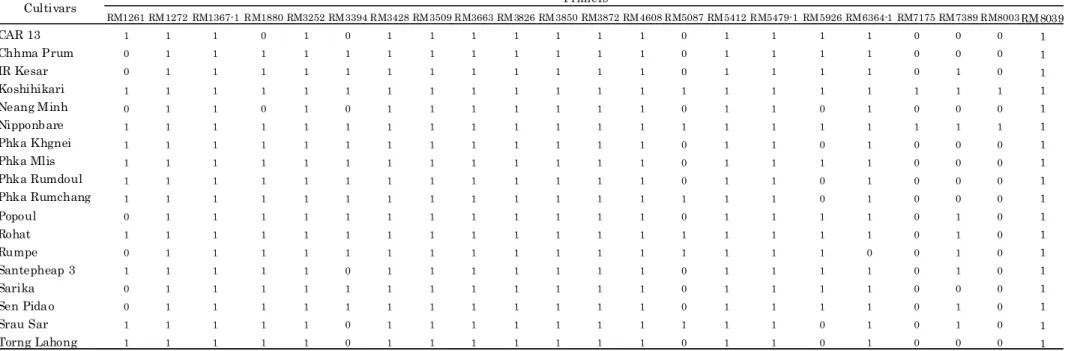
In 22 primers used in the experiment, only 9 primers showed polymorphism. They are RM1261, RM1880 on chromosome number 12, RM3394, RM5087, RM5926, RM6364-1, RM7175, RM7389 and RM8003 on chromosome number 7, 6, 11, 10, 9, 3, 1, respectively (Table 5). RM7175 and RM8003 could distinguish between Cambodian cultivars and Japanese cultivars, Koshihikari and Nipponbare, by showing a band existed both in Koshihikari and Nipponbare; however, none was observed in Cambodian cultivars (Table 5).
Figure 2 shows the bands of the PCR products, which were amplified by primers RM 3349, showing polymorphism and RM 3663 on the polyacrylamide gel. Values of Nei’s genetic distance are shown in Table 6. The result of cluster analysis is shown in Fig. 3. The author roughly divided all the genotypes used in the experiment into three groups. Group A included CAR 13, Torng Lahong, Neang Minh, Phka Khgnei, Phka Rumdoul, Phka Rumchang, Rohat, Santepheap 3 and Srau Sar. Group B included Chhma Prum, Sarika, Phka Mlis, IR Kesar, Popoul and Sen Pidao. Group C included Koshihikari, Nipponbare and Rumpe. The genetic distance of Cambodian cultivars to Koshihikari ranged from 0.1 to 0.45 and it ranged from 0.05 to 032 among Cambodian cultivars (Table 6). Rohat showed the closest genetic relationship with Koshihikari, of which the genetic distance was 0.1; while, Neang Minh showed the fartherest genetic distance with Koshihikari and the value was 0.45.
Discussion
23
Table 5. Scores read from 22 primers.
RM1261 RM1272 RM1367-1 RM1880 RM3252 RM3394 RM3428 RM3509 RM3663 RM3826 RM3850 RM3872 RM4608 RM5087 RM5412 RM5479-1 RM5926 RM6364-1 RM7175 RM7389 RM8003RM8039 CAR 13 1 1 1 0 1 0 1 1 1 1 1 1 1 0 1 1 1 1 0 0 0 1 Chhma Prum 0 1 1 1 1 1 1 1 1 1 1 1 1 0 1 1 1 1 0 0 0 1 IR Kesar 0 1 1 1 1 1 1 1 1 1 1 1 1 0 1 1 1 1 0 1 0 1 Koshihikari 1 1 1 1 1 1 1 1 1 1 1 1 1 1 1 1 1 1 1 1 1 1 Neang Minh 0 1 1 0 1 0 1 1 1 1 1 1 1 0 1 1 0 1 0 0 0 1 Nipponbare 1 1 1 1 1 1 1 1 1 1 1 1 1 1 1 1 1 1 1 1 1 1 Phka Khgnei 1 1 1 1 1 1 1 1 1 1 1 1 1 0 1 1 0 1 0 0 0 1 Phka Mlis 1 1 1 1 1 1 1 1 1 1 1 1 1 0 1 1 1 1 0 0 0 1 Phka Rumdoul 1 1 1 1 1 1 1 1 1 1 1 1 1 0 1 1 0 1 0 0 0 1 Phka Rumchang 1 1 1 1 1 1 1 1 1 1 1 1 1 1 1 1 0 1 0 0 0 1 Popoul 0 1 1 1 1 1 1 1 1 1 1 1 1 0 1 1 1 1 0 1 0 1 Rohat 1 1 1 1 1 1 1 1 1 1 1 1 1 1 1 1 1 1 0 1 0 1 Rumpe 0 1 1 1 1 1 1 1 1 1 1 1 1 1 1 1 1 0 0 1 0 1 Santepheap 3 1 1 1 1 1 0 1 1 1 1 1 1 1 0 1 1 1 1 0 1 0 1 Sarika 0 1 1 1 1 1 1 1 1 1 1 1 1 0 1 1 1 1 0 0 0 1 Sen Pidao 0 1 1 1 1 1 1 1 1 1 1 1 1 0 1 1 1 1 0 1 0 1 Srau Sar 1 1 1 1 1 0 1 1 1 1 1 1 1 1 1 1 0 1 0 1 0 1 Torng Lahong 1 1 1 1 1 0 1 1 1 1 1 1 1 0 1 1 0 1 0 0 0 1
Score 1 shows the band existed, score 0 shows the band not existed.
Primers Cultivars
24 Fig. 2. PCR products of 18 genotypes. The left side of the photograph was amplified by primers RM 3349, and the right one was amplified by primer RM 3663.
200bp 50bp Marker 10 1 3 18 17 9 7 6 4 5 2 11 8 13 15 16 14 12 Marker 10 1 3 18 17 9 7 6 4 5 2 11 8 13 15 16 14 12
25 Table 6. Nei's genetic distance of 16 Cambodian cultivars and 2 Japanese cultivars, Koshihikari and Nipponbare.
No. Name of cultivars 1 2 3 4 5 6 7 8 9 10 11 12 13 14 15 16 17 18 Average
1 CAR 13 0.15 0.20 0.32 0.10 0.32 0.15 0.10 0.15 0.20 0.20 0.20 0.32 0.10 0.15 0.20 0.20 0.10 0.18 2 Chhma Prum 0.15 0.05 0.26 0.15 0.26 0.10 0.05 0.10 0.15 0.05 0.15 0.15 0.15 0.00 0.05 0.26 0.15 0.13 3 IR Kesar 0.20 0.05 0.20 0.20 0.20 0.15 0.10 0.15 0.20 0.00 0.10 0.10 0.10 0.05 0.00 0.20 0.20 0.13 4 Koshihikari 0.32 0.26 0.20 0.45 0.00 0.26 0.20 0.26 0.20 0.20 0.10 0.20 0.20 0.26 0.20 0.20 0.32 0.22 5 Neang Minh 0.10 0.15 0.20 0.45 0.45 0.15 0.20 0.15 0.20 0.20 0.32 0.32 0.20 0.15 0.20 0.20 0.10 0.22 6 Nipponbare 0.32 0.26 0.20 0.00 0.45 0.26 0.20 0.26 0.20 0.20 0.10 0.20 0.20 0.26 0.20 0.20 0.32 0.22 7 Phka Khgnei 0.15 0.10 0.15 0.26 0.15 0.26 0.05 0.00 0.05 0.15 0.15 0.26 0.15 0.10 0.15 0.15 0.05 0.13 8 Phka Mlis 0.10 0.05 0.10 0.20 0.20 0.20 0.05 0.05 0.10 0.10 0.10 0.20 0.10 0.05 0.10 0.20 0.10 0.11 9 Phka Rumdoul 0.15 0.10 0.15 0.26 0.15 0.26 0.00 0.05 0.05 0.15 0.15 0.26 0.15 0.10 0.15 0.15 0.05 0.13 10 Phka Rumchang 0.20 0.15 0.20 0.20 0.20 0.20 0.05 0.10 0.05 0.20 0.10 0.20 0.20 0.15 0.20 0.10 0.10 0.15 11 Popoul 0.20 0.05 0.00 0.20 0.20 0.20 0.15 0.10 0.15 0.20 0.10 0.10 0.10 0.05 0.00 0.20 0.20 0.13 12 Rohat 0.20 0.15 0.10 0.10 0.32 0.10 0.15 0.10 0.15 0.10 0.10 0.10 0.10 0.15 0.10 0.10 0.20 0.13 13 Rumpe 0.32 0.15 0.10 0.20 0.32 0.20 0.26 0.20 0.26 0.20 0.10 0.10 0.20 0.15 0.10 0.20 0.32 0.20 14 Santepheap 3 0.10 0.15 0.10 0.20 0.20 0.20 0.15 0.10 0.15 0.20 0.10 0.10 0.20 0.15 0.10 0.10 0.10 0.14 15 Sarika 0.15 0.00 0.05 0.26 0.15 0.26 0.10 0.05 0.10 0.15 0.05 0.15 0.15 0.15 0.05 0.26 0.15 0.13 16 Sen Pidao 0.20 0.05 0.00 0.20 0.20 0.20 0.15 0.10 0.15 0.20 0.00 0.10 0.10 0.10 0.05 0.20 0.20 0.13 17 Srau Sar 0.20 0.26 0.20 0.20 0.20 0.20 0.15 0.20 0.15 0.10 0.20 0.10 0.20 0.10 0.26 0.20 0.10 0.18 18 Torng Lahong 0.10 0.15 0.20 0.32 0.10 0.32 0.05 0.10 0.05 0.10 0.20 0.20 0.32 0.10 0.15 0.20 0.10 0.16
26
Fig. 3. Dendogram showing genetic relationship among Cambodian cultivars and Japanese cultivars, Koshihikari and Nipponber.
Group C Group B Group A CAR 13 Torng Lahong Neang Minh Phka Kgnei Phka Rumdoul Phka Rumchung Rohat Sentepheap 3 Srau Sar Chhma Prum Sarika Phka Mlis IR Kesar Popoul Sen Pidao Koshihikari Nipponbare Rumpe
27
band on only Koshihikari and Nipponbare. These primers may be specific primers for distinguishing between japonica and Cambodian cultivars.
All cultivars (except Rohat) in “group A” are traditional cultivars generally having farther genetic distance from Koshihikari, and “group B” (except Phka Mlis) include cultivars, which have the genetic relationship to IR bred lines (Men et al. 2001), relatively having closer genetic distance to Koshihikari than the genetic relationship between Cambodian traditional cultivars and Koshihikari. Rumpe was placed in group C, even though, it is indica and has genetic relationship to IR lines, and it might have close genetic relationship to japonica type.
Some Cambodian cultivars, especially Cambodian traditional cultivars, showed farther genetic distance from Koshihikari. It is expected that, crossing between those cultivars with Koshihikari may be able to get wide genetic variation, by which genetic diversity is able to be enhanced. Though, there might be problem of sterility barrier, which will reduce the width of segregation in F2 generation.
Summary
The genetic diversity of Cambodian rice cultivars was studied. Koshihikari and Nipponbare as a control cultivar and Sixteen Cambodian cultivars were
employed. Nei’s genetic distance was determined by SSRs markers using 22
primers. Cluster analysis showed that they were divided into three groups. Group A included traditional cultivars. Group B included cultivars of newly released and having genetic relationalship to IR lines and some traditional cultivars. Group C included Koshihikari, Nipponbare and one IR line.
28
Chapter 3
Effects of Temperature, Sowing Depth and Soil Hardness on Seedling Establishment and Yield of Cambodian Rice Direct-seeded in Flood Paddy Fields
29
In order to enlarge the area of rice production per household in Cambodia, the establishment of a proper direct-seedling method is extremely important. There are approximately 2000 local cultivars in Cambodia. However, the data about their agronomic characteristics and productivity are scarce especially under the condition of direct-seeding in flooded paddy fields.
Westcott and Mikkelsen (1983) investigated the effects of sowing depth and CaO2 coating rate on the emergence of rice seedlings in a flooded soil by changing
sowing depth. Ohta et al., (2003) studied the genetic variation of seedling emergence using non-CaO2-coated seeds by changing the sowing depth in a growth
chamber. However, no Cambodian cultivars were used in those studies.
In Cambodia, it is possible to grow rice three times per year. But as the lowest temperature is in January (21 - 25 ℃), cultivars which perform high seedling establishment in low temperature are needed.
In order to select lines from crossing those Cambodian cultivars, yield and heading time must be examined to check the response of Cambodian cultivars in different environments, especially in Japan, where we will first select good lines adapted in Cambodia. Therefore, using several Cambodian cultivars, the author examined the seedling establishment, growth and yield under direct-seeding in flooded paddy fields. Since seeding by machinery using CaO2-covered seeds for
enhanced germination is not practical in Cambodia, in this experiment, soaked seeds were direct-sown on a puddled soil surface.
30
Materials and Methods
1. Materials
Three Cambodian rice cultivars Sen Pidao, Rohat and Rumpe, which were able to be harvested by growing at Utsunomiya location while the other cultivars could not, were used. Koshihikari and W42 of Japanese cultivars were used as control cultivars. The characteristic and the some agronomic character of these Cambodian rice cultivars are described at Table 1 of Chapter 2. The aim of using of Koshihikari as a control is that Koshihikari has good eating quality and the author intends to select lines deriving from crossing between Cambodian cultivars and Koshihikari, which will be described in a later chapter. W42 is a cultivar selected from the cross between Hinohikari and Koshihikari for direct-seeding in flooded paddy fields (Won et al., 1998, 1999).
2. Effect of temperatures
In Cambodia, rice can be grown all year long and the average of temperature ranges from 20 ℃ to 30 ℃. The author wanted to find out how those Cambodia cultivars adapt to such various temperature changing. The experiments were conducted in growth chambers at Utsunomiya University (Utsunomiya, Tochigi, Japan) in 2005, adjusted to 32 ℃ / 27 ℃ (high temperature); 27 ℃ / 22 ℃ (medium temperature) and 22 ℃ / 17 ℃ (low temperature) in 12-hour daytime and 12-hour nighttime. Non coated-seeds were soaked in water for 5 days. Twenty soaked seeds of each cultivar were sown on the surface in a pot (15 cm diameter) filled with Andosol soil of the depth of 3 cm with 5 replications. Soil was puddled and leveled. Water in the pot was kept at a depth of approximately 1 cm.
31
The established plant number was counted one month after the sowing date. 3. Effect of sowing depth
Fifty soaked seeds of each cultivar were sown in a greenhouse of Utsunomiya University in 2005, with 3 replications, in a pot 27 cm in diameter filled with puddled and leveled Andosol soil. Seeds were sown either on the surface, or at a depth of 1 or 2 cm. Plants were grown for 4 weeks after sowing, and the number of plants established was counted.
4. Effect of soil hardness
The experiment was conducted in a paddy field at Utsunomiya University. To change the degree of soil hardness, the puddled field was drained for 0, 1, 2 and 4 days before seeding. For 0 day draining, the field was drained just before seeding, and immediately flooded again. One hundred seeds of each cultivar were sown on the top of the soil. Seeds were sown two times: May 20 and June 2 in 2005 with 3 replications each. Soil penetration resistance was examined by dropping a golf ball (45.93 g) from 1 meter height and the depth of penetration of the ball was measured (Sawamura et al., 1986).
5. Growth and yield trial
The experiment was conducted at the University farm in Moka, Tochigi from 2003 to 2005, where the soil type is Haplic Andosols (Food and Agriculture Organization, 1988). Sowing date was 8 May in 2003, 14 May in 2004 and 12 June in 2005. The field was puddled, leveled and drained just before sowing. Seeds were soaked in water for 5 days and 300 seeds of each cultivar were sown by broadcasting in a 3 m square in 2003 and 2004. In 2005, 300 seeds were drilled in a 1 m square. The row distance was approximately 33 cm. Four weeks after sowing, the number of
32
plants established was counted and plants were reduced to approximately 60 plants per 1 m square. Chemical fertilizer was supplied as a basal dressing at a rate of 4, 7.2 and 6.4 kg per 10 ares for N, P2O and K2O, respectively. Herbicide and pesticide
for rice water weevil (Lissorhoptrus oryzophilus) were appropriately applied. An area of 50×100 cm (in 2003), 30×100 cm (in 2004), 66×100 cm (in 2005) in each plot was harvested for 1000-grain weight and brown rice weight. After harvesting, the number of stems per plant was counted, and ten plants with the same number of stems per plant were examined for internode length, the number of spikelets per panicle, and the percentage of ripened grains. There is no reference on a method to determine the percentage of ripened grains of Cambodia cultivars. Therefore, the percentage of ripened grains of Cambodian cultivars was decided by submerging in water, while, the percentage of ripened grains of Koshihikari was examined by submerging in a salt solution with a specific gravity of 1.06. Throughout the growing stage, leaf stage, plant length and number of stems per plant for 10 representative plants of each cultivar were determined every two weeks in 2004. Plant length from the ground to the top of the stretched leaf was measured.
6. Statistical analysis
The data were analyzed by analysis of variance (ANOVA) for the number of spikelets per panicle, the percentage of ripened grains, 1000-grain weight and brown-rice weight. Years were treated as replications.
Results
33
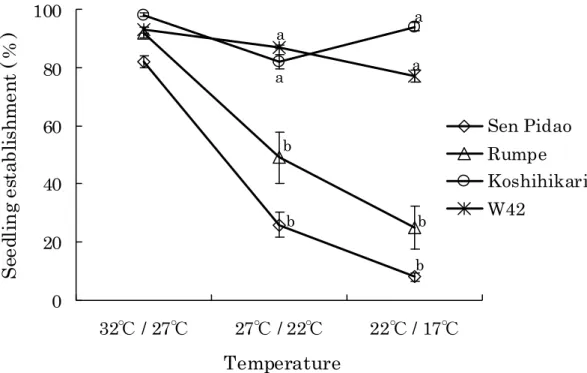
The percentage of seedlings established was scarcely influenced by temperature in Koshihikari and W42 (Fig. 4). However, it was extremely decreased by low temperature in Cambodian rice, especially in Sen Pidao. In Sen Pidao, the percentage of seedling establishment was 82, 26 and 8 % at high, medium and low temperatures, respectively, and in Rumpe it was 92, 49 and 25 %, respectively. The seedling establishment of Koshihikari and W42 were significantly higher than those of Rumpe and Sen Pidao at both medium and low temperatures, but not significantly different among cultivars at high temperature.
2. Effect of sowing depth
Both Cambodian rice cultivars sown deep in the soil showed an extremely low seedling establishment compared with Koshihikari (Fig. 5). The percentage of seedling establishment from the seeds sown at a depth of 0, 1 and 2 cm was 82, 33 and 0 %, respectively, in Rumpe, and 67, 3 and 0 %, respectively in Sen Pidao. Koshihikari and W42 showed significantly higher seedling establishment than Sen Pidao at 0 cm deep sowing. And Koshihikari also showed significantly higher seedling establishment than both Rumpe and Sen Pidao at 1 cm and 2 cm deep sowing.
3. Effect of soil hardness
Fig. 6 shows the soil penetration resistance after drainage for various periods. The longer the drainage period, the harder the soil surface. The percentage of seedling establishment from the seeds sown after 4, 1 and 0 day of drainage was higher in Rohat than in the other cultivars (Fig. 7). The percentage of seedling establishment in 0 day drainage was 51 % in Rohat, but only 28 % in Sen Pidao, which was the lowest among the cultivars. The value in Sen Pidao was
34 0 20 40 60 80 100 0 1 2
Sowing depth ( cm )
S
ee
dli
n
g
e
st
ab
li
sh
m
en
t
(
%
)
Sen Pidao Rumpe Koshihikari W42Fig. 4. Effect of temperature on seedling establishment. Bars represent SE among replications. Values followed by the same letter are not significantly different at 5 % level according to Duncan's multiple range test.
Fig. 5. Effect of sowing depth on seedling establishment. Bars represent SE among replications. Values followed by the same letter are not significantly different at 5 % level according to Duncan's multiple range test.
0 20 40 60 80 100 32℃ / 27℃ 27℃ / 22℃ 22℃ / 17℃
Temperature
S
ee
dl
in
g
es
ta
bli
sh
m
en
t
( %
)
Sen Pidao Rumpe Koshihikari W42 a a a a b b b b a b a ab a ab bc c a b c c35
Fig.6. Change of soil penetration resistance by drainage for 0 ~ 4 days. The value of soil penetration resistance is reciprocal of the distance (mm) from soil surface to the bottom of golf ball which was dropped from 1 m above the soil surface. Bars represent SE among replications.
Fig.7. Effect of soil hardness on seedling establishment. Bars represent SE among replications. 0 0.1 0.2 0.3 0.4 4 2 1 0
Days drained before sowing
So il p en et ra ti on r es is ta nc e (m m -1 ) 0 10 20 30 40 50 60 4 2 1 0
Days drained before sowing
See dl in g es tab lis h m en t ( % ) Sen Pidao Rohat Rumpe Koshihikari W42
36
29, 33, 37 and 28 % at 4, 2, 1 and 0 day-drainage, respectively. 4. Growth and yield
No lodging was observed in any of the cultivars. Fig. 8 shows the change in the number of leaves on the main stem through the growing stage. All Cambodian cultivars had a larger number of leaves than Koshihikari. The number of leaves in Koshihikari and Cambodian cultivars at the ripened stage was 14 and 16, respectively.
Fig. 9 shows the change in plant length during the growing stage. The plant length of Cambodian cultivars was shorter than that of Koshihikari. The plant length of Koshihikari was 106±1 cm, and that of Cambodian cultivars was 100±1 cm on the average at the ripened stage.
Fig. 10 shows the change in the number of stems per plant. At the maximum tiller number stage (10 weeks after sowing), Rumpe, Sen Pidao, Rohat and Koshihikari had 22±1, 18±1, 14±1 and 11±1 stems per plant, respectively. However, tillers of Cambodian cultivars decreased rapidly thereafter, and the average number of productive tillers at the maturation stage was 8±1 per plant in Cambodian cultivars, and 6±1 in Koshihikari at the maturation stage.
Fig. 11 shows the panicle and internode lengths of Cambodian cultivars and Koshihikari. The average panicle length of Cambodian cultivars was 24.1±0.8 cm, which was longer than that of Koshihikari of 18.6±0.3 cm. The lengths of third and fourth internodes of Cambodian cultivars were 8.1± 1.3 cm and 4.6± 0.2 cm, respectively, which were shorter than those of Koshihikari, 15.1±0.3 cm and 8.9± 0.6 cm, respectively.
37
Fig.8. Change of leaf stage in the field during the growing period. Bars represent SE among plants.
Fig.9. Change in plant length in the field during the growing period. Bars represent SE among plants.
0 2 4 6 8 10 12 14 16 18 5 7 9 11 13 15 17 19
Weeks after sowing day
L
ea
f s
ta
ge
Sen Pidao Rohat Rumpe Koshihikari0
20
40
60
80
100
120
6
8
10
12
14
16
18
20
Weeks after sowing day
P
la
nt
le
ng
th
(c
m
)
Sen Pidao
Rohat
Rumpe
Koshihikari
38 0 10 20 30 40 50 60 70 80 90 100 110
Sen Pidao Rohat Rumpe Koshihikari
Cultivar L en gt h ( c m ) panicle Ⅰ internode Ⅱ internode Ⅲ internode Ⅳ internode Ⅴ internode Ⅵ internode Ⅶ internode Fig.10. Change in number of stems per plant in the field during the growing period.
Bars represent SE among plants.
Fig. 11. Length of internodes and panicle of Cambodian cultivars and Koshihikari. Bars represent SE among plants.
0
5
10
15
20
25
6
8
10 12 14 16 18 20
Weeks after sowing day
N
um
be
r
of
s
te
m
s
pe
r
pl
an
t
Sen Pidao
Rohat
Rumpe
Koshihikari
39
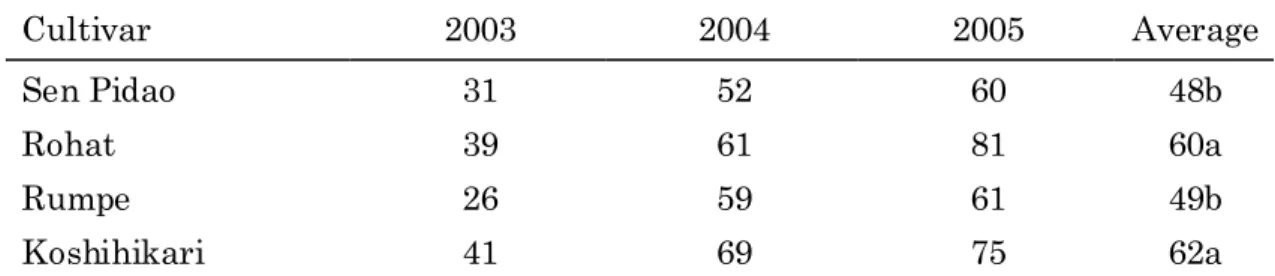
Table 7 shows the percentage of seedling establishment in the field in 2003, 2004 and 2005. Sen Pidao showed the lowest percentage of seedling establishment except in 2003. Rohat showed the highest percentage of seedling establishment among the Cambodian cultivars in all the years. On the average, Sen Pidao and Rumpe showed nearly the same percentage of seedling establishment. Sen Pidao and Rumpe showed a significantly lower percentage of seedling establishments than Rohat and Koshihikari. Rohat and Koshihikari showed a similar percentage of seedling establishments.
Table 8 shows the heading date in the field. The heading date of Sen Pidao and Rumpe were almost the same, and were approximately 2 weeks to 3 weeks later than that of Koshihikari. Rohat headed earlier than Sen Pidao and Rumpe except in 2004, and later than Koshihikari in all the years.
Table 9 shows the average yield and yield components. Sen Pidao and Rumpe had a significantly larger number of spikelets per panicle than either Rohat or Koshihikari. Rohat had a significantly larger number of spikelets per panicle than Koshihikari. The percentage of ripened grains in Sen Pidao was significantly lower than that in Rohat and Koshihikari, but not significantly different from that in Rumpe. The percentage of ripened grains in Rohat and Rumpe was not significantly different from that in Koshihikari. Sen Pidao and Rumpe had a significantly lower 1000-grain weight than Rohat and Koshihikari. Between Rohat and Koshihikari, there was no significant difference in the 1000-grain weight. Because of the high variation of brown rice weight among the cultivars, there was no significant difference in the 1000-grain weight between the Cambodian cultivars and Koshihikari.
40
Table 7. Seedling establishment (%) in a field of 2003 to 2005.
Cultivar 2003 2004 2005 Average
Sen Pidao 31 52 60 48b
Rohat 39 61 81 60a
Rumpe 26 59 61 49b
Koshihikari 41 69 75 62a
Average values followed by the same letter are not significantly different at 5 % level according to Duncan's multiple range test.
Table 8. The heading date in a field.
Cultivar 2003 2004 2005
Sen Pidao 3rd Sep. 30th Aug. 18th Sep.
Rohat 28th Aug. 30th Aug. 12th Sep.
Rumpe 3rd Sep. 30th Aug. 20th Sep.
Koshihikari 19th Aug. 13th Aug. 27th Aug.
Table 9. Yield and yield components in the field.
Number of spikelets Percentage of ripened 1000-grain Brown rice per panicle grains ( % ) weight ( g ) weight ( g m-2 )
Sen Pidao 132 a 53 b 19 b 421
Rohat 99 b 72 a 21 a 508
Rumpe 134 a 65 ab 18 c 491
Koshihikari 88 c 78 a 21 a 506
Values are average of 2003, 2004 and 2005. Values followed by the same letter are not significantly different at 5 % level according to Duncan's multiple range test.
41
Discussion
Cambodian cultivars showed a low seedling establishment rate at a low temperature (Fig. 4). Akita et al. (1998) reported that most of the indica cultivars did not reach the 25 % emergence rate in submerged soil at 18 ℃. Uchimura et al. (2001) showed that the emergence rate of IR lines was low (1 % ~ 2 %) when direct-seeded without the coating of oxygen-generator on the soil surface of flooded paddy fields. The seedling establishment rate of Sen Pidao was low (26 % and 8 % at medium and low temperatures, respectively). This cultivar is considered to have low adaptability to direct-seeding in flooded paddy fields in some parts of Cambodia, where the maximum and minimum temperatures from October to December are lower than 30 ℃ and 22 ℃, respectively, (Nesbitt, 1997). Cambodian cultivars also showed a low seedling establishment rate at deep sowing (Fig. 5). Yamauchi and Chuong (1995) reported that the seedling establishment rate was decreased by increasing the sowing depth in flooded soil. In the present experiment, the Cambodian cultivars sown at the depth of 1 cm and 2 cm showed less than 50 % and 0 % seedling establishment rate, respectively. This means that Cambodian cultivars have low adaptability to deep sowing or thick soil covering in direct sowing in flooded paddy fields. Due to the result, the percentage of seedling establishment of W42 and Koshihikari showed almost the same tendency, the author decided to discuss the seedling establishment of Cambodian cultivars comparing with Koshihikari. Koshihikari has high adaptability to direct-seeding in flooded paddy fields showing a high seedling establishment rate even at a low temperature or deep-sowing condition (Fig. 4, 5). Won and Yoshida (2000a, b) reported varietals differences of establishment rate in rice direct-seeded in flooded paddy fields at a
42
low dissolved oxygen level. In order to improve the seedling establishment of Cambodian cultivars, it is necessary to cross them with Koshihikari and to select progenies which have a high ability to germinate in both low temperature and deep-sowing conditions.
Rice seeds sown on puddled soil may penetrate into the soft and reduced zone of soil, which is lacking in oxygen necessary for seed germination. Rice seeds can germinate even in anoxia, but O2 is required for seedling establishment. The
elongation of coleoptile is promoted, but that of leaf and roots are reduced at a low O2 (Alpi and Beevers, 1983; Ishizawa and Esashi, 1984). Rice seedlings can be
established in flooded paddy fields because O2 is dissolved in water (Chapman and
Peterson, 1962). When seeds are sown deep in the soil lacking in O2,seedling
establishment becomes erratic (Jones, 1933). In the present experiment, water was drained before sowing to avoid seed penetration into soil. However, all of the cultivars except Sen Pidao showed a high seedling establishment rate even after 0-day drainage, and Sen Pidao showed a high establishment rate after 1-day drainage (Fig. 7). Sen Pidao also showed low establishment rate in other experiment (data not shown). It could be concluded that seedling establishment of Sen Pidao was unstable in water direct-seeding and the cultivar might be less adapted to the condition of low oxygen in water because it showed low seedling establishment rate at after 0-day drainage plot. The depth of seed penetration might be less than 1 cm even without drainage and drainage before sowing might not be necessary. Long drainage caused soil surface harder and the plant roots were hard to anchor to the soil surface. The author observed that there were many floated seedlings at the 2-day and 4-day drainage plots. That might have caused low
43
seedling establishment (data not shown).
Plant length of Cambodian cultivars was shorter than that of Koshihikari (Fig. 9). In particular, the lengths of the lower internodes (third and fourth internodes) of Cambodian cultivars were shorter than those of Koshihikari, which may contribute to the high resistance to lodging of Cambodian cultivars. Cambodian cultivars had a high number of stems per plant at the maximum tiller number stage, but the number of tillers decreased almost to half of the maximum at the maturation stage (Fig. 10). The growing period between Koshihikari and Cambodian cultivars were not quite different, suggesting that Cambodian cultivars are ear-number type. In order to improve yield of Cambodian cultivars by increasing the number of productive tillers, it is necessary to decrease the planting density and to apply topdressing. Although Sen Pidao and Rumpe showed a low percentage of ripened grains, they had a higher number of spikelets per panicle than either Rohat or Koshihikari and exhibited a high yield (Table 9). Topdressing is needed to increase the percentage of ripened grains, which contributes to the increase in filled grains per panicle.
Summary
Seedling establishment of rice direct-seeded in a flooded paddy field was determined, and their growth and yield were examined. The seedling establishment of Japanese cultivars was significantly higher than Cambodian cultivars at low temperatures and deep sowing. Cambodian rice cultivars had a short plant length and short basal low internodes, which contributed to strong lodging resistance. Crossing of Cambodian cultivars with Koshihikari to obtain cultivars adapted to direct-seeding in Cambodia was proposed.
44
Chapter 4
Application of Hot-water Emasculation
45
In rice breeding, clipping and vacuuming (Coffman and Herrera, 1980) are commonly used to remove pollens in IRRI and the U.S.A., requiring labor and a highly skillful operation. Hot-water emasculation is popularly used in japonica rice breeding programs (Kondo, 1939; Matsubayashi et al., 1965) and it is easy to handle and requires less labor.
Kondo (1939), who was the first to report this method for japonica rice cultivars, submerged the panicles in hot water at 42, 43, 44 and 45℃ for 3, 5, 7, 10 and 13 minutes. He reported that self-pollination occurred even after the treatment at 42℃ for 10 minutes and at 43 and 44℃ for 3 minutes submerging. He also suggested that higher temperature and longer duration of submergence was able to emasculate the pollens. Matsubayashi (1965) reported that panicle of female parents was submerged in hot water of 43℃ for 5 minutes. Commonly used method in Japan nowadays is the treatment by 43℃ for 7 minutes ( Yamamoto et al., 1996). Optimal temperature was also examined in this study.
Materials and Methods
1. Materials
Eleven Cambodian rice cultivars shown in Table 10, and Koshihikari and W42 of Japanese cultivars were used as male parents. Pollens parents were grown in a field to get large amount of pollens. The author also intended to select lines deriving from the crossings between Cambodian cultivars and Koshihikari. W42 is a cultivar selected from the cross between Hinohikari and Koshihikari for direct-seeding in a flooded paddy field (Won et al., 1998, 1999).
46
Table 10. Pollen tolerance at 40℃ for 7 min in 2005.
Fertilized spikelets Total spikelets Number of panicles Cultivars
per panicle per panicle used
Chheam An'-tung 5 18 7 IR Kesar 1 16 7 Neang Minh 1 15 7 Phka Khgnei 11 23 5 Phka Mlis 8 18 5 Phka Rumdoul 8 18 5 Phka Rumchang 19 26 5 Rohat 4 14 6 Rumpe 4 23 6 Santepheap 3 12 22 5 Sen Pidao 5 17 9 ( Koshihikari 5 11 5 ) Average 7.1 ± 1.6 19.1 ± 1.2 6
Plants treated with hot water at 40℃ were self-pollinated. Each value at the bottom shows the mean of the numbers in 11 Cambodian cultivars and standard errors (Koshihikari was excluded).
47
2. Pollen tolerance to hot water
The experiment was conducted in 2005 and 2006. Female plants were sown in pots and were grown under natural condition until 5 July in 2005 and until 20 July in 2006, and were transferred to a dark room for exposing 8-hr photoperiod (from 9 a.m. to 5 p.m.). During flowering time, the plants with about two third of panicles emerged out from the leaf sheath were selected as a female parent, and 5 panicles were used for each treatment. Spikelets that had already flowered before treatment and spikelets which didn’t open after treatment were removed.
The panicles were submerged in hot water adjusted to 40, 43, 44, 45 and 46℃ in a double stainless thermos bottle (Seven Seven Co.) in 2005, and in an incubator (ADVANTEC Toyo Co.) in 2006, for 7 minutes. Then, the panicles having more than 10 spikelets were chosen and grown in the natural condition. Panicles were covered with 26 × 18 cm paper bags to avoid cross pollination. Seven days after the hot-water treatment, the number of fertilized and unfertilized spikelets was counted for each treatment. Koshihikari was included as a check cultivar.
3. Stigma tolerance to hot water
The panicles were submerged in hot water at 43, 44, 45 and 46℃ for 7 min in 2005 and 44, 45, 46℃ for 7 min in 2006. After the hot-water treatment, un-opened spikelets were removed and 3-7 panicles each having more than 10 spikelets were artificially pollinated with healthy pollens of Koshihikari, W42 and Srau Sar. Plants of Koshihikari and W42 were grown in a field. After crossing, panicles were covered by 26 × 18cm paper bags. One week after pollination, the number of fertilized and non-fertilized spikelets was counted for each treatment.
48
Results 1. Pollen tolerance to hot water
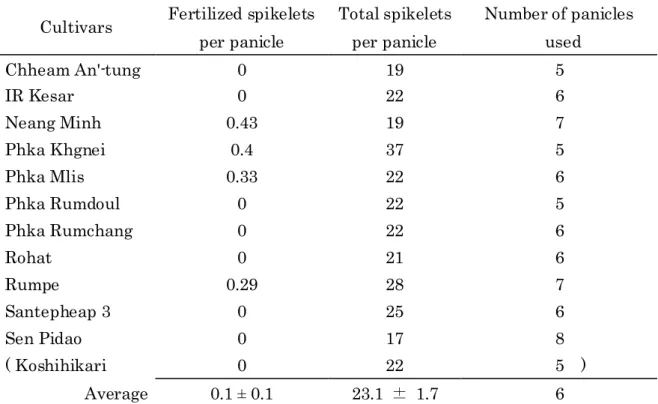
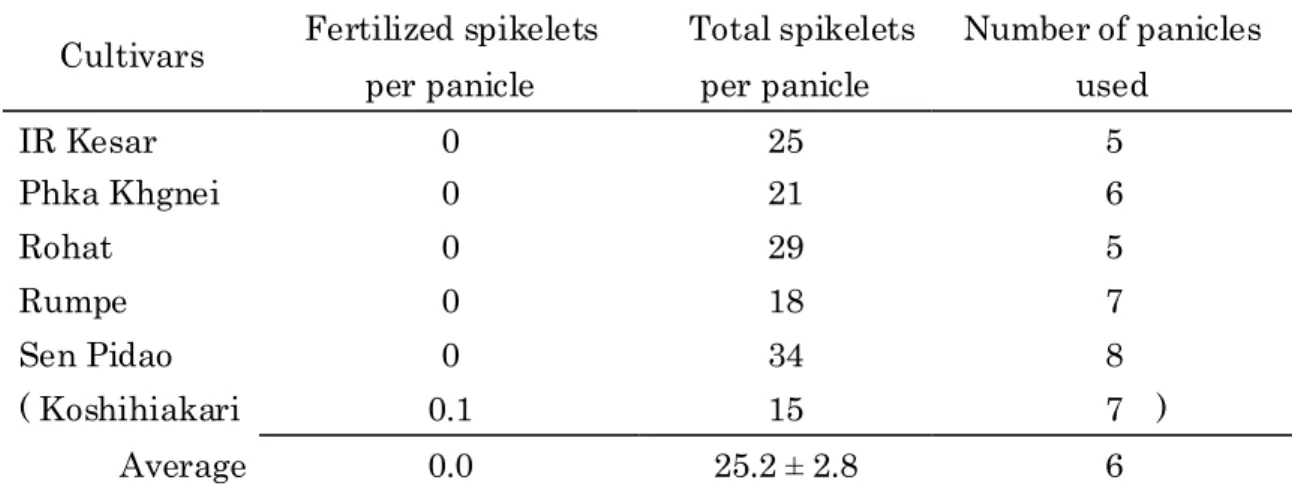
The number of fertilized spikelets per panicle by self-pollination in the panicles of each culture treated with hot water at 40℃ for 7 min ranged from 1 to 19 in 2005 (Table 10) and from 1 to 14.5 in 2006 (Table 11). The average of the value in all cultivars was 7.1 and 3.6 in 2005 and 2006, respectively. The number of fertilized spikelets per panicle treated at 43℃ ranged from 0 to 0.43 in 2005 (Table 12) and from 0 to 0.4 in 2006 (Table 13). The average was 0.1 in both years. The number of fertilized spikelets per panicle treated at 44℃ was 0 in 2006 (Table 14). The number of fertilized spikelets per panicle treated at 45℃ ranged from 0 to 0.2 and the average was 0.06 in 2006 (Table 15). The number of fertilized spikelets per panicle treated at 46℃ was 0 in 2005 (Table 16) and 0 in 2006 (Table 17).
2. Stigma tolerance to hot water
The percentage of fertilized spikelets to total spikelets per panicle treated with hot water at 43, 44, 45 and 46℃ for 7 min and pollinated with healthy pollens was 36.0, 23.6, 13.0 and 0.3%, respectively, as the average of all Cambodian cultivars pollinated with the pollens of designated cultivars, in 2005 (Table 18). The percentage of fertilized spikelets treated at 44, 45 and 46℃ were 1.0, 3.4 and 9.6% , respectively, in Rohat, and 6.9, 7.4 and 0%, respectively, in Rumpe, and 12.4, 1.8 and 15.4%, respetively, in Sen Pidao, and 23.6, 4.6 and 10.8%, respectively, in IR Kesar, and 65.6, 41.5 and 17.3%, respectively, in Phka Khgnei in 2006 (Fig. 12). The percentage of fertilized spikelets in the panicles treated with hot water at 44, 45, 46℃ for 7 min were 21.9, 11.7 and 10.6%, respectively, as the average of all 5 cultivars.
49
Table 11. Pollen tolerance at 40℃ for 7 min in 2006.
Fertilized spikelets Total spikelets Number of panicles Cultivars
per panicle per panicle used
IR Kesar 1 24.5 6 Phka Khgnei 10.2 27.7 6 Rohat 1 20.2 5 Rumpe 4.6 20.6 8 Sen Pidao 1 26.4 5 ( Koshihiakari 14.5 22.7 6 ) Average 3.6 ± 1.8 23.8 ± 1.5 6
Plants treated with hot water at 40℃ were self-pollinated. Each value at the bottom shows the mean of the numbers in 5 Cambodian cultivars and standard errors (Koshihikari was excluded).
50
Table 12. Pollen tolerance at 43℃ in 2005.
Fertilized spikelets Total spikelets Number of panicles Cultivars
per panicle per panicle used
Chheam An'-tung 0 19 5 IR Kesar 0 22 6 Neang Minh 0.43 19 7 Phka Khgnei 0.4 37 5 Phka Mlis 0.33 22 6 Phka Rumdoul 0 22 5 Phka Rumchang 0 22 6 Rohat 0 21 6 Rumpe 0.29 28 7 Santepheap 3 0 25 6 Sen Pidao 0 17 8 ( Koshihikari 0 22 5 ) Average 0.1 ± 0.1 23.1 ± 1.7 6
Plants treated with hot water at 43℃ were self-pollinated. Each value at the bottom shows the mean of the numbers in 11 Cambodian cultivars and standard errors (Koshihikari was excluded).
Table 13. Pollen tolerance at 43℃ for 7 min in 2006.
Fertilized spikelets Total spikelets Number of panicles Cultivars
per panicle per panicle used
IR Kesar 0.4 19 5 Phka Khgnei 0 20 5 Rohat 0 27 5 Rumpe 0 26 7 Sen Pidao 0 24 6 ( Koshihiakari 0 19 6 ) Average 0.1 ± 0.1 23.2 ± 1.6 6
Plants treated with hot water at 43℃ were self-pollinated. Each value at the bottom shows the mean of the numbers in 5 Cambodian cultivars and standard errors (Koshihikari was excluded).
51
Table 14. Pollen tolerance at 44℃ for 7 min in 2006.
Fertilized spikelets Total spikelets Number of panicles Cultivars
per panicle per panicle used
IR Kesar 0 25 5 Phka Khgnei 0 21 6 Rohat 0 29 5 Rumpe 0 18 7 Sen Pidao 0 34 8 ( Koshihiakari 0.1 15 7 ) Average 0.0 25.2 ± 2.8 6
Plants treated with hot water at 44℃ were self-pollinated. Each value at the bottom shows the mean of the numbers in 5 Cambodian cultivars and standard errors (Koshihikari was excluded).
Table 15. Pollen tolerance at 45℃ for 7 min in 2006.
Fertilized spikelets Total spikelets Number of panicles Cultivars
per panicle per panicle used
IR Kesar 0.2 21 6 Phka Khgnei 0 14 5 Rohat 0.1 14 6 Rumpe 0 28 8 Sen Pidao 0 32 6 ( Koshihiakari 0.2 14 8 ) Average 0.06 ± 0.04 22.0 ± 3.6 6
Plants treated with hot water at 45℃ were self-pollinated. Each value at the bottom shows the mean of the numbers in 5 Cambodian cultivars and standard errors (Koshihikari was excluded).