© 2019 Journal of International and Advanced Japanese Studies Vol. 11, March 2019, pp. 99-120 (ONLINE)
Master’s and Doctoral Programs in International and Advanced Japanese Studies
Graduate School of Humanities and Social Sciences, University of Tsukuba
Research Note
A Critical Analysis of UNDP-Supported “Social Innovation” Projects in Local Governance in Armenia, Ukraine and Uzbekistan
Bakhrom RADJABOV
University of Tsukuba, Faculty of Humanities and Social Sciences, Ph.D. Student The publication researches and evaluates 68 projects labeled as ‘social innovations’ in/for local governments and communities, that have been undertaken by Kolba Lab (Armenia), Social Boost and other organizations (Ukraine) and UNDP/UNV ‘Social Innovation and Volunteerism in Uzbekistan’ Project (Uzbekistan) with development assistance from the United Nations Development Program (UNDP). It contributes to knowledge on the concept of social innovation through the yet missing critical analysis of social innovations in local governments and communities of post-Soviet republics. Theoretical and empirical analysis is achieved by applying ‘connected difference’ approach, social innovation cycle, and social practice theory to theoretically formulate, and empirically apply the concept of social innovation. To contribute to scientific research on social innovations, this study critically evaluates projects in local governments and communities, as perspective social innovations on micro (local) level, namely combination of new social practices.
Key words: Social Innovations, Armenia, Ukraine, Uzbekistan, Local Governance, Local Communities
Introduction
There is a significant amount of literature on social innovations where one can find demonstratively opposite definitions of this concept or even a strong belief that social innovation is an empty concept. Attempts to conceptualize social innovations are challenged by the lack of clarity and overwhelming number of various definitions of the concept. For instance, based on four dimensions proposed by Eduardo Pol and Simone Ville one defines ‘social innovation’ based on the following correlation: (1) social innovation and institutional change, (2) social innovation and social purpose, (3) social innovation and ‘public good’, (4) social innovation and needs not considered by the market. Furthermore, definitions of ‘social innovation’ can be drawn from Murray et al. who provides the following definition of social innovations:
“…innovations that are social both in their ends and in their means. Specifically, one defines social innovations as new ideas (products, services and models) that simultaneously meet social needs and create new social relationships or collaborations. In other words, they are innovations that are both good for society and enhance society’s capacity to act”.1
1 Murray et al. The open book of Social Innovation. London, United Kingdom: The Young Foundation, 2010, p. 5.
Leadbeater complements Murray’s definition of social innovation and describes ‘social innovation’ even broader, using institutional and personalized dimensions. He writes: “Social innovation – like many other forms of innovation – is a process of collective innovation involving many players: social enterprises, companies, service users, regulators, funders, politicians”.2
In fact, there is a significant number of attempts to theoretically and empirically define social innovation.
One of them is to distinguish social innovations from business or technological innovations, or to compare it (social innovation) to institutional change in the society. From a developmental perspective, social innovation is approached through its ability to produce social impact. But social impact is not the single element of social innovation envisioned by development organizations. Since, in this article, the researcher discusses projects supported by United Nations Development Program (UNDP) through different organizations, it primarily refers to UNDP’s definition of social innovation discussed below.
For the sake of the clarity and complementarity of definitions relevant to the research purpose of this study UNDP’s definition of social innovations is going to be primarily discussed. According to UNDP Social Innovation for Public Service Excellence Report:
“Social innovation refers to new ideas that work in meeting social goals. A social innovation approach puts capacity to harness innovation at the core of public service (…). A feature of social innovation is that it combines multiple disciplines, types of actors and sectors. Social innovation is also more than just invention; it describes a process from initial prompt through to scale and systemic change”.3
In the theoretical part of the study this definition will be used as the point of departure in extensive discussion of criteria of social innovations. Scrutinizing projects supported by the UNDP and relevant organizations in Armenia, Ukraine and Uzbekistan provides empirical findings of theoretical approach to social innovation.
The study compiles and critically analyzes up to 68 projects supported by the UNDP through Social Innovation Kolba Lab in Armenia, SocialBoost and other organizations in Ukraine, and UNDP/UNV ‘Social Innovation and Volunteerism in Uzbekistan’ Project. A separate part of this article is dedicated to the description of above mentioned organizations. These case study countries and organizations were selected for further analysis after careful examination of social innovation related initiatives in post-Soviet republics. Only in Armenia, Ukraine and Uzbekistan, by the time of the current research, are there UNDP supported projects which were aimed to be social innovations in local governments and communities.
1. Theoretical contribution/Significance of the research
Scholars and practitioners have been using the term ‘social innovation’ extensively for the last two decades.
Though different theories (e.g. structuration theory, structural function theory, actor-network theory, development theories, etc.) discuss the conceptual and theoretical underpinnings of social innovation as an independent theoretical and practical unit, they remain silent about clear-cut criteria of social innovation. Furthermore, a variety of uses and interpretations of social innovation makes this concept loosely used by scholars, politicians, international and governmental organizations, etc. In this regard these problems in the theory and empirics of social innovations are being addressed by the research project. To tackle them the research critically evaluates projects supported and labeled by UNDP as ‘social innovations’ against criteria of ‘connected difference’ approach, social innovation cycle, and social practice theory.
Selection of the case studies: Kolba Lab in Armenia, Social Boost (other organizations) in Ukraine and UNDP/UNV ‘Social Innovation and Volunteerism in Uzbekistan’ Project are organizations/projects selected for the analysis of social innovations in/for local governments and communities. These organizations/projects are the best choice to fit in the study, and correspond with the goals of the current research. Besides being the only projects/organizations in Armenia, Ukraine and Uzbekistan, as well as on the post-Soviet Eurasia space, dealing with social innovations. They possess a multispectral approach in the introduction of ‘social innovations’. This approach allowed specific selection of projects labeled as ‘social innovations’ in local governments and
2 Leadbeater, Social enterprise and social innovation: Strategies for the next ten years. London: Office of Third Sector, 2007, p. 14.
3 Tucker, Social Innovation for Public Service Excellence. UNDP Global Centre for Public Service Excellence. Singapore: United Nations Development Programme, 2014, p. 4.
communities. The study does not expect that projects labeled as ‘social innovations’ would reach a systemic change stage that would promote debate about newly introduced and widely accepted new practices. However, the study is going to consider projects moving towards this stage after completion of the previous stages.
Gap in the literature and Contribution to theory: While many studies have been conducted on the theory and practice of ‘social innovations’ in different countries, hardly any scholarly research has thus far been done on the experience with ‘social innovations’ in post-communist countries. It is argued that in the UNDP’s approach, ‘social innovation’ is seen as something that can be volitional and developmental. Most scholars analyze ‘social innovations’
post factum. UNDP views ‘social innovation’ as something that can be aspired and worked towards. Based on conducted research and critical analysis, the study checks the projects against the criteria of ‘connected difference’
approach, social innovation cycle, and social practice theory to provide scholarly assessment of local projects advancing towards being local social innovations. By this, the study will generate, yet still missing, scholarly analysis (and literature) on the social innovations in post-Soviet republics.
(1) Research Questions
The purpose of the study is to critically analyze whether projects supported by the UNDP and Kolba Lab (Armenia), SocialBoost (and other projects) (Ukraine) and UNDP/UNV ‘Social Innovation and Volunteerism in Uzbekistan’ Project (Uzbekistan) in/for local governments and communities can become social innovations.
Therefore, the study formulates research questions designed to critically approach the projects:
1. What have been the gains and shortcomings of these UNDP-supported projects in terms of ‘social innovation’?
2. How have projects maintained by Kolba Lab (Armenia), SocialBoost (and other projects) (Ukraine) and the UNDP/UNV ‘Social Innovation and Volunteerism in Uzbekistan’ Project (Uzbekistan) and supported by UNDP advanced towards bringing social innovations in local governments and communities?
(2) Argument
Social innovation is a multidimensional concept that is inversely used in various contexts. UNDP in Armenia, Ukraine and Uzbekistan has introduced projects labeled as ‘social innovations’ to address issues in local governments and communities. ‘Social innovation’ projects in Uzbekistan have failed to become true social innovations as the projects suffered from weak civic activism, accountability, ICT infrastructural problems, and the lack of the true commitment from policymakers. While projects in Armenia and Ukraine have likewise experienced intermittent support from the government, they have benefited from active local community participation, a stronger ICT component, and easy access to open data.
While they have a long way to go before achieving institutionalization, some of the Armenia and Ukraine projects show hopeful signs of developing into real ‘social innovation.’ These projects can potentially advance towards being new social practices in social contexts and, subsequently, social innovations on micro (local) level.
2. Theoretical foundations of the research
Theoretical debate concerning social innovations is ongoing since the concept is still undertheorized but is beginning to catch up to the practice. Scholarly debate is happening as Domanski points out: “around definition of it (social innovation) either through social relations, or ‘social’ in terms of societal impact”.4 One could have a quite different perspective on social innovations if asked a question whether any innovation has a societal impact or compels social relationships that, by default, makes any innovation ‘social innovation’.
Subsequently, numerous social science theories have contributed to the theoretical discourse on social innovation. Practically speaking, the scope of discussion covers development theories, theories of entrepreneurship, theories of sociology etc. that try to conceptualize social innovation and provide definition of this term. In this article, given the task of the current research, the researcher applies a ‘connected difference’ approach and social practice theory to evaluate UNDP supported projects in local governments and communities. The rationale to opt for this combination of theoretical approaches is explained below.
4 Domanski., Exploring the Research Landscape of Social Innovation. Dortmund, Germany: A deliverable of the project Social Innovation Community (SIC), 2017, p. 20.
(1) ‘Connected difference’ approach and social innovations
Social innovation is often regarded as a separate unit of analysis sometimes overlapping with business and/or technological innovations. Numerous recent studies (Evers 2012, Bhatt 2013, Barraket 2015, Howaldt 2015, Ionescu 2015, Oosterlynck 2015, Domanski 2017, Howaldt et al. 2018) emphasize the growing role of social innovations for development. Based on theoretical methodology, development, sociological, entrepreneurial approaches the researcher tried to analyze social innovations. To set scholarly criteria for the analysis of social innovations, critical analysis of those theories has led to the selection of ‘connected difference’ approach and social practice theory for the further analysis. Those theories have been applied for the first time to analyze projects on micro (local) level in post-Soviet republics, labeled as ‘social innovations’.
Mulgan et al. (2007) in his study points out that:
“Social innovation plays a decisive role in development. Past advances in healthcare and the spread of new technologies like the car, electricity or the internet, depended as much on social innovation as they did on innovation in technology or business. Today there are signs that social innovation is becoming even more important for development. This is partly because some of the barriers to lasting growth (such as climate change, or ageing populations) can only be overcome with the help of social innovation, and partly because of rising demands for types of economic growth that enhance rather than damage human relationships and well-being”.5
Clearly, development agencies and donors are also introducing innovations in design of the new development programs in various countries and sectors where change is required. For instance, United Nations Development Program Global Center for Public Service Excellence (UNDP GCPSE) is concerned about Public Service Innovations and the introduction of social innovations in the public sector.
It should be noted that UNDP in its work uses methodology developed by the organizations with expertise in social innovation, such as NESTA Global Innovation Foundation or/and Young Foundations. UNDP uses Mulgan et al. ‘connected difference’ approach with emphasis on three key dimensions of social innovation:
1. They are usually new combinations or hybrids of existing elements, rather than being wholly new in themselves;
2. Putting them into practice involves cutting across organizational, sectoral or disciplinary boundaries;
3. They leave behind new relationships between previously separate individuals and groups. These new relationships which matter greatly to the people involved contribute to the diffusion and embedding of the innovation. Also, they fuel a cumulative dynamic whereby each innovation opens up the possibility of further innovations.
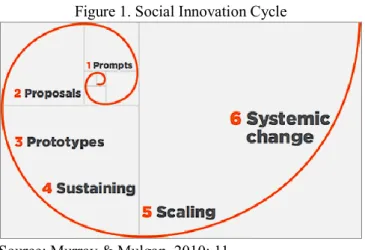
This approach highlights the critical role of ‘connectors’ in any innovation system – the brokers, entrepreneurs and institutions that link together people, ideas, money and power – who contribute as much to lasting change as thinkers, creators, designers, activists and community groups.6 The ‘connected difference’ approach functions in the frame of practice-led methodology that explains generation of social innovation. The essence of the approach is in connecting different elements, individuals, organizations and groups not otherwise connected. By doing so, it creates new social relationships which matter in enabling social innovation. In addition, the generation of social innovation is also addressed by Murray and Mulgan’s ‘stages of social innovation’, also known as social innovation cycle (see Figure. 1). According to the social innovation cycle the ultimate goal of any social innovation is systemic change that includes many elements and happens over long period of time.7
5 Mulgan et al. Social Innovation: what it is, why it matters and how it can be accelerated? The Young Foundation. Oxford:
Basingstoke Press, 2007, p. 5.
6 Mulgan et al. Social Innovation: what it is, why it matters and how it can be accelerated? The Young Foundation. Oxford:
Basingstoke Press, 2007, p. 5.
7 ibid
Figure 1. Social Innovation Cycle
Source: Murray & Mulgan, 2010: 11 Guide for social innovation (2013) describes this process as follows:
They [social innovations] start as ideas, which may then be piloted or prototyped. If successful there is a process of sustaining the new model in the implementation stage – perhaps as a new venture or as a new policy within an existing institution. The final stage is to scale up so that the new approach makes a real impact and becomes part of the norm.8
Yet the combination of the ‘connected difference’ approach and Mulgan’s explanation of the process of the creation of social innovations alone are not sufficient for understanding and explaining how projects supported by UNDP advance towards being social innovations in local governments and communities. Although the ways by which a new idea becomes an everyday practice, sustainability (meaning availability of budget), legislation etc. is addressed by Mulgan, he does not touch upon the mechanism that “transforms innovations into social structures and practice” - imitation/repetition.9 Moreover, nothing is said about interruptions that lead to social innovation as new social practices, once they are transferred and imitated from person to person.10 In other words, theoretical instruments explaining creation of social innovations on the local level is missing and should be supplemented.
Social practice theory is very helpful in tackling this gap.
(2) Social practice theory and social innovation
Social practice theory emphasizes that social innovation is not just an invention but “a new combination and/or configuration of social practices prompted by certain actors or the constellation of actors in an intentional targeted manner with the goal of better satisfying, or answering needs and problems, than is possible on the basis of established practices”.11 For social practice theory invention is a central element for social development12 but imitation/repetition is the central mechanism of social reproduction and social change (see Figure 2).13
The process of social innovation, according to social practice theory, goes through the stages of implementation through planned, or unplanned, intervention, prototyping/piloting of a new idea in an existing social context. Institutionalization follows the implementation stage to assure that a new social practice becomes an everyday routine. The diffusion stage advances imitation to the level of new social practice that potentially changes existing social structure enabling social change. These key stages of generation of social innovation are helpful in understanding how a new social practice is able to make social change and create a new social reality. To embody anticipated social innovation, the following key elements of social practice described in Table 1 should be present:
8 European Commission, Guide to Social Innovation. Brussels: European Commission, 2013, p. 9.
9 Tarde cit. in Howaldt, Theoretical Approaches to Social Innovation - A critical Literature Review. Dortmund, Germany: A deliverable of the project: ‘Social Innovation: Driving Force of Social Change’ (SI-DRIVE), 2014, p. 19.
10 ibid
11 ibid, p.16.
12 ibid, p. 19.
13 ibid
Table 1. Key elements of Social Practice
Source: Howaldt et al. 2014: 13
According to Tarde, “Novelty can go out of each of these elements. New practices thus arise from the combination of new and existing elements”.14 As mentioned above, social change may occur through the mechanism by translating invention through imitation into a reproduced new social fact able to change the existing structure.
Figure 2. Mechanism of Social Reproduction and Social Change
Source: Howaldt et al. 2014: 19
Tarde’s theoretical contribution might be used to study social innovation as a mechanism of social change on the micro and meso levels. Thus, social practice theory has been applied for analytical purposes of the study to scrutinize projects aimed to be social innovations on the micro (local) level. Mulgan’s ‘connected difference’
approach to social innovation, has been primarily applied to analyze projects labeled by UNDP as ‘social innovations’ as the point of departure of theoretical analysis in this study. Since UNDP used this approach for nurturing social innovations in local governments and communities, the primary task of the research was to evaluate the projects supported by UNDP against criteria applied by this development organization. Additionally, social practice theory addressed the projects supported by UNDP and checked them against its criteria and stages of a generation of social innovation. The application of two approaches allowed using an analytical mechanism of double control and check of projects against their potential social innovation characteristics throughout the social innovation generation process.
(3) Methodological guidelines
The study applied qualitative methods of data collection, including analysis of documents, projects related documents, and other available sources of information. On the level of primary data collection, the research uses in-depth interviews for the collection of qualitative data. Interviews have been carried out in person and via skype/messengers during 2017-2018, with 23 respondents from Armenia, Ukraine and Uzbekistan who supported and/or introduced projects in local governments and communities labeled as ‘social innovations’. With the permission of respondents, interviews were recorded. Permission to directly quote respondents in the research has been obtained. The data gained from the interviews was combined with the data consisting of project documents available for analysis from 68 projects. The following categories of respondents have been covered:
1. UNDP staff members in charge of ‘social innovation’ projects,
2. Individuals/team members of Kolba Lab, Social Boost (and other organizations), and UNDP/UNV ‘Social Innovation and Volunteerism in Uzbekistan’ Project in charge of ‘social innovations’ in local governments and communities,
3. Local civil society leaders, members of interest groups, activists and advocates implemented ‘social innovation’
projects in local governments and communities.
While conducting Skype/Messenger interviews with respondents in Armenia and Ukraine, limitations related to the usage of English or Russian languages have occurred. Respondents without good command of either English or Russian have not been interviewed. The researcher does not possess adequate knowledge of Armenian
14 ibid, p. 14.
Invention Imitation/repetition Social Reproduction/Social Change
Physicality Materiality Competencies
Sociality and physicality carried out practices
Things, technologies in and for social practice
Know-how, practical knowledge, background knowledge,
understanding
and Ukrainian languages to collect primary data from interviews, or secondary information from other sources.
Respondents from UNDP and Kolba Lab, SocialBoost (and other organizations) and UNDP/UNV ‘Social Innovation and Volunteerism in Uzbekistan’ organizations/projects have been chosen based on: a) engagement in
‘social innovation’ activities in/for local governments and communities in Armenia, Ukraine and Uzbekistan confirmed by official programs and/or project documents; b) confirmed and documented cooperation with UNDP in the creation and delivery of ‘social innovation’ solutions in local governments and communities.
Local civil society leaders, members of local interest groups, activists and advocates have been chosen based on: a) leadership in ‘social innovation’ initiatives and ‘social innovation’ projects; b) Implementation by them of
‘social innovation’ solutions in local governments and communities.
To obtain primary data through interviews a networking strategy has been applied to contact respondents, who introduced ‘social innovations’.
Questions of the interviews have been related to the background information and the argument derived from theories. The questionnaire for the interview has been prepared in Russian and English.
(4) Evaluation criteria of social innovation applied in the study
The criteria and the basis for interpretation of the results of the study have been drawn from the theoretical framework, encompassing a ‘connected difference’ approach, to the social innovation cycle and social practice theory. The 68 projects in Armenia, Ukraine, Uzbekistan mentioned earlier have been evaluated based on criteria formulated and explained below.
The criteria applied in the analysis encompasses the following explanation:
(1) Project ideas should be new to the social contexts of local governments and communities in Armenia, Ukraine and Uzbekistan;
(2) Social impact is a change occurring in local governances or communities, as the result of intervention of the project;
(3) The criterion of interaction of different actors/sectors/disciplines involved in idea generation and implementation implies that the projects should be cross-cutting several sectors (market-state-civil society), involve different actors interacting in the network, and across disciplines;
(4) The involvement of technology criterion considers technology, basic or advanced electronic, engineer or ICT tools introduced by the project;
(5) The process of generation of social innovation being a final criterion in the study should track whether the project followed the accepted order from prompting to ideation/proposition, prototyping, sustaining, scaling, and finally, to systemic change. Social innovation cycle has been applied for this purpose.
Projects have been additionally evaluated against key elements of social practice such as physicality, materiality and competences, as well as being checked against social practice generation stages of social practice theory chosen as one of the theories framing the study. The stages of the social innovation cycle and social practice theory are explained in Tables 2 and 3 below. A social innovation cycle starts with the diagnosis of the problem and identification of the need to innovate. This stage is dedicated to prompts, inspirations and diagnoses. The next stage is dedicated to proposals and ideas, ideas generation.
Social practice theory marks this stage as invention. In the table below, the example of social innovation cycle and social practice theory. Those primary stages have been eliminated because the projects supported by UNDP have advanced to prototyping or implementation stage. Some of them, however, have not moved forward and remain at those stages. Thus, being a critical point for analysis, evaluation of the projects starts from the prototyping/implementation stages of generation of social innovations.
Table 2. Social Innovation Cycle
Stages Prototyping Sustaining Scaling Systemic change
Explanation Testing ideas in practice
Idea becomes everyday practice
Growing and spreading innovation
New frameworks and/or architectures
made up of innovations Source: Murray & Mulgan, 2010: 12
Table 3. Social Practice Theory
Stages Implementation Institutionalization Diffusion Social change
Explanation Introduction of idea into context
of use
Idea becomes a regular practice or made routine
Fast and sustained spread of innovation
Change in the social structure of a
society, its underlying institutions, cultural
patterns, Source: Howaldt et al. 2014: 19
The philosophy of UNDP supporting social innovations was to change its approach to development work.
By introducing social innovations UNDP withdraws itself from complex political economy analysis and needs assessment, and regards individuals facing certain development problems as experts able to find solutions of these problems. Thus, individuals (not UNDP) should identify the challenges which required efforts for change. This approach is called a human-centered approach. Hence, any initiative or project introduced and led by individuals experiencing those challenges, and not initiated by UNDP or any organization, are considered in this research as a potential ‘social innovation’.
3. Evaluation of solutions supported by UNDP in Armenia, Ukraine and Uzbekistan against their social innovation characteristics
Armenia is the first country in the World where United Nations has based a Social Innovation Laboratory. – Kolba Lab in 2013, was funded by the European Union to design and implement ‘social innovations’ for development.15 While the idea behind Kolba Lab was to embrace new technologies and methodologies in development work, it incubated social startups and selected ideas through local government Challenge, mylocgov, to tackle problems in local governments and communities. Kolba Lab has had two approaches to the generation of
‘social innovations’ in Armenia: 1) Innovation Challenges - Ideas competing for social startups in local communities, and 2) Local government Challenges for ‘social innovations’ in local governments.
In Ukraine UNDP supported ‘social innovation’ projects through National Hackathons and Municipal Innovation Labs. Differently from Armenia and Uzbekistan, ‘social innovation’ projects in Ukraine were supported by diverse organizations. Many of these organizations engaged with UNDP as a partner and as a donor. A lot of emphasis was made on open data and technology involved in innovation. The major organization supported ‘social innovation’ projects with UNDP was SocialBoost16 which did a massive amount of socially significant projects involving ICT solutions in partnership with international donors, global corporations and partners. In addition to SocialBoost, E-Governance for Accountability and Participation (EGAP) Program, Transparency and Accountability in Public Administration Services (TAPAS), Eidos Centre for Political Studies and Analysis, as well as other programs have also nurtured local and national projects. Some of these organizations, for instance EGAP, explicitly promoted social innovations, intending to promote higher quality governance, and cooperation between citizens and governments. Others, like TAPAS and Eidos, promoted cooperation between governments and citizens, and governments’ accountability based on open data.
In Uzbekistan, The UNDP/UNV ‘Social Innovation and Volunteerism in Uzbekistan’ Project led by UNDP was the first and, as yet, only social innovation initiative. The Project was directly implemented by UNDP Good
15 What is Kolba Lab? Retrieved February 13, 2017, from Kolba Lab: http://kolba.am/en/FAQ
16 SocialBoost. Retrieved February 13, 2017, from SocialBoost: http://socialboost.com.ua/
Governance Unit, allowing cooperation with national partner organizations based on Memorandums of Understanding.17 Two national organizations in Uzbekistan worked with UNDP/UNV. ‘Social Innovation and Volunteerism in Uzbekistan’ Project in Uzbekistan, the National Library of Uzbekistan named after Alisher Navoi, and the Centre for Youth Initiatives “Kelajak Ovozi” were selected. The choice of these organizations as the partners of the Project has been made based on several factors.
The first reason was the Project objectives related to involvement of young people into social innovation and volunteerism activities – two overlapping areas in understanding of UNDP in Uzbekistan. Since the major share of the population of Uzbekistan is young people under thirty, UNDP saw the biggest potential for innovation from extensive involvement of youth in social innovation projects. Moreover, volunteerism was another area that might be of interest for young individuals. The second reason UNDP was chosen is that organization was seeking ways for the institutionalization of its social innovation and volunteerism related initiatives. Since, the Project was directly implemented by UNDP, commitments from local organizations to maintain performance of the initiatives after the completion of the Project was crucial. Hence, the National Library of Uzbekistan and the Center for Youth Initiatives agreed to cooperate with the Project and commit their resources and institutional capabilities. Additionally, the Project collaborated with private companies in Uzbekistan to institutionalize its ‘social innovation’ initiatives. Two companies, namely, the biggest retail chain Korzinka.uz and the taxi company ‘Perekrestok’ have been contacted for cooperation. Further in the analysis we refer to these and other initiatives inspired by UNDP as UNDP-led ideas.
(1) Generation of ‘social innovations’: how it worked
All three-country projects/organizations followed the process of creation of ‘social innovation’ projects in local government and communities:
Proposition. Identify and set priority development challenges. After identifying development problems, propose the list of problems which call for innovative solutions from individuals. Individuals/users then come up with their shortlist of priorities.
Prioritization. Do preparatory work on identifying and setting development challenges. It, allows users experiencing certain problems to agree or disagree with proposed challenges. Users can actually disagree with all propositions and prioritize different development challenges which they intend to tackle. End-users challenges are always chosen to announce an open call for ideas and projects able to solve these challenges. At this stage UNDP supported organizations assist potential trouble-solvers in learning, pitching, and idea/project presentation techniques. Those skills are required for presenting/pitching their ideas/projects in front of an experienced selection board of experts from different sectors. For this purpose, Kolba Lab, SocialBoost (and other organizations) and UNDP/UNV ‘Social Innovation and Volunteerism in Uzbekistan’ Project organize Hackathons, Municipal Innovations Lab, Social Innovation Camps, Trainings, etc. At these events ideas are usually being revised and selected for the next stage – incubation.
Incubation. Selected ideas are taken to the incubation process supported by Kolba Lab, SocialBoost (and other organizations) and UNDP/UNV ‘Social Innovation and Volunteerism in Uzbekistan’ Project. Ideas receive mentorship support, and assistance in connecting them to the existing eco-system in Armenia, Ukraine and Uzbekistan. Moreover, Kolba Lab, SocialBoost (and other organizations), and UNDP/UNV ‘Social Innovation and Volunteerism in Uzbekistan’ Project provide seed funding to the best ideas and help in turning ideas into minimum viable products (MVPs) or workable business models. Incubation stage is/was usually followed by the Demo Day or Implementation stage.
Implementation. Once the ideas/projects are incubated Kolba Lab, SocialBoost (and other organizations) and UNDP/UNV ‘Social Innovation and Volunteerism in Uzbekistan’ Project as well as authors of the ideas/projects work on implementation of these ideas/projects together with local partner organizations and government authorities.
In the case of local governments and communities, Kolba Lab, SocialBoost (and other organizations) and UNDP/UNV ‘Social Innovation and Volunteerism in Uzbekistan’ Project were able to support ideas coming from
17 UNDP/UNV Social Innovation and Volunteerism in Uzbekistan Project. Retrieved February 13, 2017, from Social Innovation and Volunteerism in Uzbekistan Project Goal:
http://www.uz.undp.org/content/uzbekistan/en/home/operations/projects1/democratic_governance/social-innovation-and- volunteerism-in-uzbekistan.html
individuals within the organizations. Those individuals were aware of the problems, and possessed sufficient knowledge to offer solutions to the existing problems. Moreover, projects would not succeed without social capital integrated into them as a substantial element. The role of those social relationships (or social capital of individuals) has not been researched. Their input was not comprehensively assessed nor explained, to better understand how social innovations can be created. Also, in the case of governance institutions in Armenia, public sector employees actually understood the problem of, say, violation of consumers’ rights, better than end-users, and/or citizens in local communities. For instance, an accessibility map was created by users, for consumers’ rights protections. The application was proposed by mid-level government employee to inform citizens about their rights and allow them to report violations which they experienced. Policy level innovation and free legal tools for analyzing court decisions and cases allowed analysis of statistics and visualization tools that permitted citizens to stay informed about court decision. To make these projects work, two components were required: 1) involvement and commitment of individuals in governments and communities; 2) ICT tools and access to open data.
Obviously, though all projects pass through very careful selection process, not all of the proposed solutions turn out to be sustainable. This research covers and analyzes all projects and discusses them in accordance with theoretical framework. Besides explaining why certain projects fail to be social innovations in the future, it determines those potentially able to be social innovations in local governments and communities.
(2) Towards being a “social innovation”
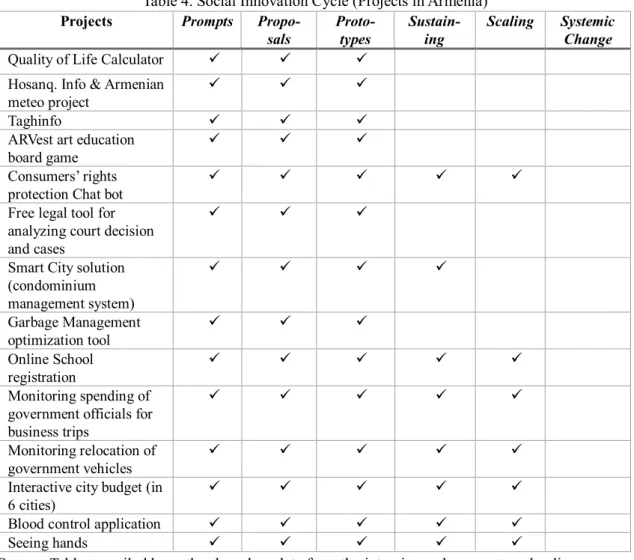
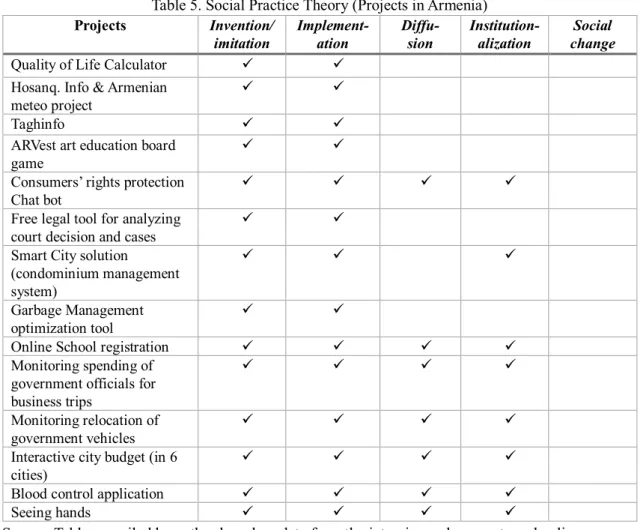
Armenia. Due to the Kolba Lab assistance every project has been connected to organizations and partners from different sectors. Projects in/for local governments have been designed in a way to involve ICT sector representatives, public and private organizations. 13 out of 14 projects involved technology usually in form of IT tools (apps, websites etc.). All 14 projects were designed in accordance with criteria applied by UNDP. Since criteria that UNDP applied on the projects were met, all projects also went through the stages of creation of social innovations both by social innovation cycle and social practice theory. Tables 4 and 5 covered all projects and demonstrate how each of them advanced towards being social innovation. Key elements of social practice such as physicality, materiality and competences were addressed by the projects in local communities and governments.
They consisted of aspects required for new social practices, technology and knowledge of the project team. Also, Kolba Lab invested in building missing capacity of the projects’ members and assisted in making necessary connections between the projects and interested organizations.
Table 4. Social Innovation Cycle (Projects in Armenia)
Projects Prompts Propo-
sals
Proto- types
Sustain- ing
Scaling Systemic Change
Quality of Life Calculator ✓ ✓ ✓
Hosanq. Info & Armenian meteo project
✓ ✓ ✓
Taghinfo ✓ ✓ ✓
ARVest art education board game
✓ ✓ ✓
Consumers’ rights protection Chat bot
✓ ✓ ✓ ✓ ✓
Free legal tool for analyzing court decision and cases
✓ ✓ ✓
Smart City solution (condominium management system)
✓ ✓ ✓ ✓
Garbage Management optimization tool
✓ ✓ ✓
Online School registration
✓ ✓ ✓ ✓ ✓
Monitoring spending of government officials for business trips
✓ ✓ ✓ ✓ ✓
Monitoring relocation of government vehicles
✓ ✓ ✓ ✓ ✓
Interactive city budget (in 6 cities)
✓ ✓ ✓ ✓ ✓
Blood control application ✓ ✓ ✓ ✓ ✓
Seeing hands ✓ ✓ ✓ ✓ ✓
Source: Table compiled by author based on data from the interviews, documents and online sources related to the projects.
It is important to mention that Kolba Lab and UNDP were primarily considering two aspects in any project to be qualified as ‘social innovation’: 1) social impact and 2) human-centered principal. In this regards, Marina Mkhitaryan says:
“Impact is the key word. Kolba Lab sees what is the impact and what is the likelihood of impact for those ideas, and how effective they are in terms of what has been spent in terms of resources, time, human resources on implementing this idea. If the ratio is optimal then this is a social innovation. If it is responding to the human-centered principal, this is social innovation”.18
Also, Kolba Lab and UNDP have not tried to replicate and scale up all solutions offered by the projects.
Provoking innovative thinking inside the system and/or organization, that could be used after the completion of the project has been regarded as the very good accomplishment. Mkhitaryan argues:
“Not all solutions, according to the philosophy of Kolba Lab, have to be replicated, accelerated or expanded, but they can provoke innovative thinking inside the existing system, which can be also a great achievement”.19
18 Mkhitaryan, UNDP Armenia, Kolba Innovations Lab lead. (B. Radjabov, Interviewer, 2017, December 22).
19 Mkhitaryan, UNDP Armenia, Kolba Innovations Lab lead. (B. Radjabov, Interviewer, 2017, December 22).
In other words, UNDP and Kolba Lab in Armenia were predominantly concerned about the social impact from the projects designed by the individuals experiencing the problem, and less about the replication of the solution that helped to solve the problem. This, in accordance with the approach of Kolba Lab, was sufficient for the project to progress towards being a ‘social innovation’.
Table 5. Social Practice Theory (Projects in Armenia)
Projects Invention/
imitation
Implement- ation
Diffu- sion
Institution- alization
Social change
Quality of Life Calculator ✓ ✓
Hosanq. Info & Armenian meteo project
✓ ✓
Taghinfo ✓ ✓
ARVest art education board game
✓ ✓
Consumers’ rights protection Chat bot
✓ ✓ ✓ ✓
Free legal tool for analyzing court decision and cases
✓ ✓
Smart City solution
(condominium management system)
✓ ✓ ✓
Garbage Management optimization tool
✓ ✓
Online School registration ✓ ✓ ✓ ✓
Monitoring spending of government officials for business trips
✓ ✓ ✓ ✓
Monitoring relocation of government vehicles
✓ ✓ ✓ ✓
Interactive city budget (in 6 cities)
✓ ✓ ✓ ✓
Blood control application ✓ ✓ ✓ ✓
Seeing hands ✓ ✓ ✓ ✓
Source: Table compiled by author based on data from the interviews, documents and online sources related to the projects
A human-centered approach was applied to every project. Though not all projects could become social innovations, as any innovation possesses failures as a part of the process, Kolba Lab could establish a systemic innovations generation mechanism that could advance the number of projects to the stage of social/systemic change in the existing social structure. Thus, by the introduction of new social practices on the local level, projects supported by Kolba Lab and UNDP might advance towards being social innovations. Projects have been evaluated against the stages of generation of social innovations in accordance with the social innovation cycle and social practice theory.
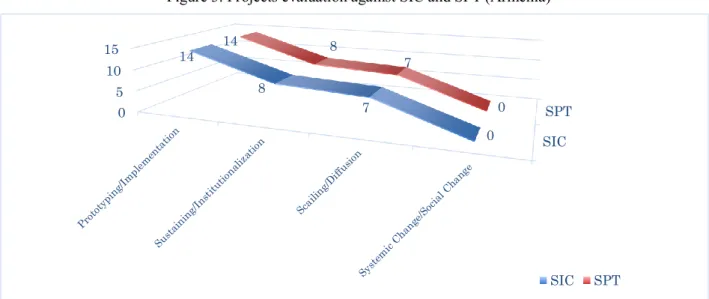
Both approaches showed that out of 14 projects only 7 advanced towards the scaling/diffusion stage (Figure 3). The major reason for this was political dynamism and change of decision-makers that committed to introduce projects.
Political change being in general a positive trend, nevertheless, turned out to be a challenge for institutionalization and diffusion of the projects.
Figure 3. Projects evaluation against SIC and SPT (Armenia)
Source: Figure compiled by author based on data from the interviews, documents and online sources related to the projects
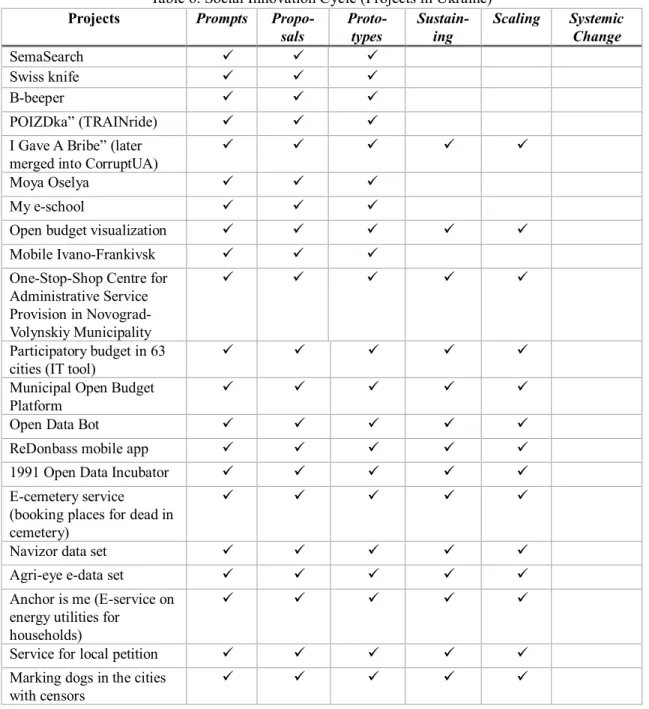
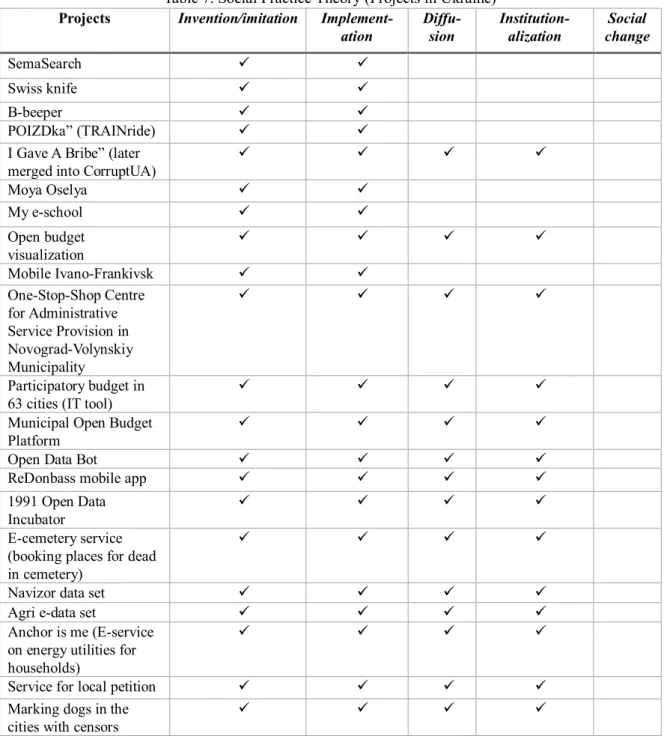
Ukraine. Almost all projects supported by UNDP, SocialBoost and other organizations were hi-tech initiatives, in which advanced technologies were used. The criteria of involvement of technology, mostly in form of ICT solutions, were introduced by the projects. All projects accomplished the criteria of interaction of different actors/sectors/disciplines and engaged with numerous actors locally, which allowed project ideas cross-cutting several sectors. All project ideas proved to be new in the social context of local communities in Ukraine, albeit proving their social impact was problematic due to the absence of indicators, proper pre and post-analysis of the problem, and the lack of access to open data. Since criteria that UNDP applied on the projects were met, all projects also went through the stages of generation of social innovations both by social innovation cycle and social practice theory. Tables 6 and 7 covered all projects and demonstrated how each of them advanced towards being social innovation. Key elements of social practice such as physicality, materiality and competences were addressed by the projects in local communities and governments. They consisted of aspects required for new social practice, technology and knowledge of the project team. Also, SocialBoost and other organizations invested in building missing capacity and mentorship of the projects’ members and assisted in making necessary connections between the projects and interested organizations.
UNDP and partner organizations in Ukraine have also emphasized two aspects, namely 1) human-centered approach and 2) social impact, that could make the project a ‘social innovation’. Former UNDP Ukraine staff member in charge of social innovations, Maksym Klyuchar emphasizes the human-centered aspect that should prevail in any project that is supposed to be called a ‘social innovation’. He argues:
“Social innovation is tried and tested approach. And by tried and tested I mean tried and tested by people, not by the designers of an idea, but rather than by actual future users of this approach. So, tried and tested approach of making a public service, or making a polity closer to the citizens, more user friendly and accessible for the citizens, and trying to reduce the costs to deliver this service, or making this service faster”.20
The co-founder and the lead of SocialBoost Denis Gurskiy adds the aspect of social impact through the extensive use of technology, that is required for the project to become a ‘social innovation’. He says:
“Social Innovation in 2018 is definitely the reinvention or redesign of social, economic or political processes which directly impacts peoples’ lives. And this definitely happens with extensive use of technology”.21
As in the case of UNDP and Kolba Lab in Armenia, in Ukraine human-centered approach and social impact, have been highlighted as the core aspects of ‘social innovation’. Additionally, technology was mentioned as the
20 Klyuchar, Knowledge Management Expert at United Nations Development Program at Ukraine under the Democratization and Human Rights Program 2013 – 2016. (B. Radjabov, Interviewer, 2018, March 5).
21 Gursky, Lead of Social Boost, Co-founder of 1991 Open Data Incubator . (B. Radjabov, Interviewer, 2018, March 5).
SIC 0 SPT
5 10
15 14
8
7
0
14 8
7
0
SIC SPT
mean of introduction of ‘social innovation’.
Table 6. Social Innovation Cycle (Projects in Ukraine)
Projects Prompts Propo-
sals
Proto- types
Sustain- ing
Scaling Systemic Change
SemaSearch ✓ ✓ ✓
Swiss knife ✓ ✓ ✓
B-beeper ✓ ✓ ✓
POIZDka” (TRAINride) ✓ ✓ ✓
I Gave A Bribe” (later merged into CorruptUA)
✓ ✓ ✓ ✓ ✓
Moya Oselya ✓ ✓ ✓
My e-school ✓ ✓ ✓
Open budget visualization ✓ ✓ ✓ ✓ ✓
Mobile Ivano-Frankivsk ✓ ✓ ✓
One-Stop-Shop Centre for Administrative Service Provision in Novograd- Volynskiy Municipality
✓ ✓ ✓ ✓ ✓
Participatory budget in 63 cities (IT tool)
✓ ✓ ✓ ✓ ✓
Municipal Open Budget Platform
✓ ✓ ✓ ✓ ✓
Open Data Bot ✓ ✓ ✓ ✓ ✓
ReDonbass mobile app ✓ ✓ ✓ ✓ ✓
1991 Open Data Incubator ✓ ✓ ✓ ✓ ✓
E-cemetery service (booking places for dead in cemetery)
✓ ✓ ✓ ✓ ✓
Navizor data set ✓ ✓ ✓ ✓ ✓
Agri-eye e-data set ✓ ✓ ✓ ✓ ✓
Anchor is me (E-service on energy utilities for
households)
✓ ✓ ✓ ✓ ✓
Service for local petition ✓ ✓ ✓ ✓ ✓
Marking dogs in the cities with censors
✓ ✓ ✓ ✓ ✓
Source: Table compiled by author based on data from the interviews, documents and online sources related to the projects
Table 7. Social Practice Theory (Projects in Ukraine) Projects Invention/imitation Implement-
ation
Diffu- sion
Institution- alization
Social change
SemaSearch ✓ ✓
Swiss knife ✓ ✓
B-beeper ✓ ✓
POIZDka” (TRAINride) ✓ ✓
I Gave A Bribe” (later merged into CorruptUA)
✓ ✓ ✓ ✓
Moya Oselya ✓ ✓
My e-school ✓ ✓
Open budget visualization
✓ ✓ ✓ ✓
Mobile Ivano-Frankivsk ✓ ✓
One-Stop-Shop Centre for Administrative Service Provision in Novograd-Volynskiy Municipality
✓ ✓ ✓ ✓
Participatory budget in 63 cities (IT tool)
✓ ✓ ✓ ✓
Municipal Open Budget Platform
✓ ✓ ✓ ✓
Open Data Bot ✓ ✓ ✓ ✓
ReDonbass mobile app ✓ ✓ ✓ ✓
1991 Open Data Incubator
✓ ✓ ✓ ✓
E-cemetery service (booking places for dead in cemetery)
✓ ✓ ✓ ✓
Navizor data set ✓ ✓ ✓ ✓
Agri e-data set ✓ ✓ ✓ ✓
Anchor is me (E-service on energy utilities for households)
✓ ✓ ✓ ✓
Service for local petition ✓ ✓ ✓ ✓
Marking dogs in the cities with censors
✓ ✓ ✓ ✓
Source: Table compiled by author based on data from the interviews, documents and online sources related to the projects
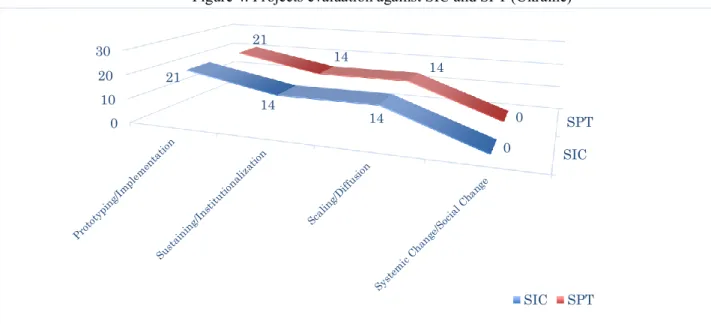
Projects have been evaluated against the stages of generation of social innovations in accordance with social innovation cycle and social practice theory. Both approaches showed that out of 21 projects, 14 advanced towards scaling/diffusion stage (Figure 4). The major reason for this was political dynamism and change of decision-makers that committed to introduce projects.
Figure 4. Projects evaluation against SIC and SPT (Ukraine)
Source: Figure compiled by author based on data from the interviews, documents and online sources related to the projects
In Uzbekistan almost all projects and UNDP proposed ideas were low-tech initiatives, meaning that advanced technologies were rarely used. Special attention was given to criteria of interaction of different actors/sectors/disciplines involved in idea generation and implementation. Almost all projects accomplished this goal and could engage with numerous actors locally, in order to propose project ideas cross-cutting several sectors.
All project ideas proved to be new in the social context of local communities in Uzbekistan, albeit proving their social impact was problematic. Having UNDP-led initiatives for the analysis, together with small scaled projects, showed that development projects driven by donor can go through the similar stages of social innovation cycle.
However, it does not make them social innovations. Tables 8 and 9 summarize projects and UNDP-led initiatives and demonstrates that several UNDP-led initiatives could advance to the stage of scaling. None of the projects or UNDP-led initiatives could make a systemic change that requires more time and efforts.
UNDP in Uzbekistan highlighted two characteristics of ‘social innovation’ such as: 1) being new for the social context, and 2) delivering the public good. In this context, UNDP Good Governance Unit Program Associate Ms. Emiliya Asadova says:
“Social innovations are solutions that work for resolution of social problem/issue. They do not have to be scientifically new. Sometimes they can be new for the certain area/context. For example, something used in farming can be used in medicine”.22
Manager of the UNDP/UNV ‘Social Innovation and Volunteerism in Uzbekistan’ Project Mr. Bokhodir Ayupov argues that:
“Social Innovation is an innovation that is social, that is beneficial for the society, especially for vulnerable groups of the society, not as a priority, but as an additional aspect. I have never considered financial component excluded from social innovation. In other words, social innovation can be profitable, though the practice shows that such examples are quite rare. Many people see social innovation as a charity. But the essence of social innovation is delivering public good. As for innovation itself, it is about unconventional approaches and using existing systems and opportunities by integrating them for public good. It can be an invention in the core of social innovation”.23
22 Asadova, Program Associate at UNDP, Good Governance Unit. (B. Radjabov, Interviewer, 2017, August 27).
23 Ayupov, Project Manager at UNDP/UNV Project ‘Social Innovation and Volunteerism in Uzbekistan’. (B. Radjabov, Interviewer, 2017, August 7).
SIC 0 SPT
10 20 30
21
14 14
0 21
14 14
0
SIC SPT
In Uzbekistan, UNDP has viewed ‘social innovation’ as something that might have the invention in its core, and be relatively (not necessarily absolutely) new for the certain social context. Also, ‘social innovation’, according to UNDP, should deliver a public good desirable for the society.
Table 8. Social Innovation Cycle (Projects in Uzbekistan)
Projects Prompts Propo-
sals
Proto- types
Sustain- ing
Scaling Systemic Change
“Fantasy-Club” Initiatives ✓ ✓ ✓
“Crafty Master” ✓ ✓ ✓
“IT masters” ✓ ✓ ✓
“The week of football” ✓ ✓ ✓
“Mobile electro station” ✓ ✓ ✓
‘Afishka’ Festival of auteur theory and social films
✓ ✓ ✓
Film on TB prevention ✓ ✓ ✓
Summer Camp and DIY Labs in Muynak Web site of Muynak
Debates Tournament in Andijan ✓ ✓ ✓
Voice of Volunteerism ✓ ✓ ✓
Training on reproductive health among Roma population
Translations of audio and video for the Deaf and Hard of Hearing
✓ ✓
Theatre by children ✓ ✓ ✓
Module “All the money under control” ✓ ✓ ✓
Raising awareness campaigns on Breast Cancer prevention among women in Jizzakh.
✓ ✓ ✓
“Enjoying old age” ✓ ✓ ✓
“Inspired Teachers” ✓ ✓ ✓
“English guides” ✓ ✓ ✓
Video project about people living with HIV ✓ ✓ ✓
‘Social Entrepreneurship skills’ ✓ ✓ ✓
Constructor ✓ ✓ ✓
E-dairy ✓ ✓ ✓
Infobox.uz ✓ ✓
Peers club ✓ ✓ ✓
Eco bags with Korzinka.uz (UNDP-led) ✓ ✓ ✓ ✓ ✓
Taxi for people with disabilities with
‘Perekrestok’ Taxi company (UNDP-led)
✓ ✓ ✓ Promotion of local tourism in social
networks (with LGSP project) (UNDP-led)
✓ ✓ ✓
Café Scientifique (UNDP-led) ✓ ✓ ✓
Iact. Volunteers platform (UNDP-led) ✓ ✓ ✓
Volunteers engagement (in the NatLib (UNDP-led)
✓ ✓ ✓ ✓ ✓
Do It Yorself (DIY) Lab (UNDP-led) ✓ ✓ ✓
“Shower and water supply” in the fields in rural areas plus foil to warm up water
✓ ✓ ✓
Source: Table compiled by author based on data from the interviews, documents and online sources related to the projects
Table 9. Social Practice Theory (Projects in Uzbekistan)
Projects Invention/
imitation
Implement- ation
Diffu- sion
Institution- alization
Social change
“Fantasy-Club” Initiatives ✓ ✓
“Crafty Master” ✓ ✓
“IT masters” ✓ ✓
“The week of football” ✓ ✓
“Mobile electro station” ✓ ✓
‘Afishka’ Festival of auteur theory and social films
✓ ✓
Film on TB prevention ✓ ✓
Summer Camp and DIY Labs in Muynak Web site of Muynak
Debates Tournament in Andijan ✓ ✓
Voice of Volunteerism ✓ ✓
Training on reproductive health among Roma population
Translations of audio and video for the Deaf and Hard of Hearing
✓
Theatre by children ✓ ✓
Module “All the money under control” ✓ ✓
Raising awareness campaigns on Breast Cancer prevention among women in Jizzakh.
✓ ✓
“Enjoying old age” ✓ ✓
“Inspired Teachers” ✓ ✓
“English guides” ✓ ✓
Video project about people living with HIV ✓ ✓
‘Social Entrepreneurship skills’ ✓ ✓
Constructor ✓ ✓
E-dairy ✓ ✓
Infobox.uz ✓
Peers club ✓ ✓
Eco bags with Korzinka.uz (UNDP-led) ✓ ✓ ✓ ✓
Taxi for people with disabilities with
‘Perekrestok’ Taxi company (UNDP-led)
✓ ✓
Promotion of local tourism in social networks (with LGSP project) (UNDP-led)
✓ ✓
Café Scientifique (UNDP-led) ✓ ✓
Iact. Volunteers platform (UNDP-led) ✓ ✓
Volunteers engagement (in the NatLib (UNDP-led)
✓ ✓ ✓ ✓
Do It Yourself (DIY) Lab (UNDP-led) ✓ ✓
“Shower and water supply” in the fields in rural areas plus foil to warm up water
✓ ✓
Source: Table compiled by author based on data from the interviews, documents and online sources related to the projects
To carry out new social practices, key elements have been covered. Projects have possessed physicality, new things (and sometimes new technologies), as well as practical knowledge and understanding of new social practices.
They were intended to be introduced into the existing social structure in local governments and communities in Uzbekistan. These key elements of social practice were achieved due to the mixture of existing expertise and knowledge of leaders of the projects and specialized training conducted for them by UNDP/UNV ‘Social Innovation and Volunteerism in Uzbekistan’ Project. This capacity helped to reach prototyping or implementation stage by the
majority of projects. However, only 2 could advance towards the next stage of sustaining/institutionalization and scaling/diffusion (see Figure 5), due to the lack of civic activism, and commitment to introduce innovation and new social practices. Out of 33 submitted projects supported by UNDP/UNV ‘Social Innovation and Volunteerism in Uzbekistan’ Project, 28 advanced to prototyping stage, and 11 projects involved new technology. Only 2 could proceed to the stage of diffusion and have later been institutionalized. These two projects have not corresponded with criteria of social innovation and were full UNDP-led initiatives. Moreover, to make a social change that would require turning social invention into social innovation that consequently creates new social facts widely accepted by the society, would certainly require more time. Since, at the moment, UNDP/UNV ‘Social Innovation and Volunteerism in Uzbekistan’ Project has been completed in 2014, one concludes that it has not generated social innovations.
Figure 5. Projects evaluation against SIC and SPT (Uzbekistan)
Source: Figure compiled by author based on data from the interviews, documents and online sources related to the projects
4. Conclusion
Analysis of projects supported by UNDP has been conducted in accordance with the theoretical framework of the current study. Based on this, the study has the following findings: UNDP in all countries implied (but not always applied) a human-centered approach in the projects to generate ‘social innovations’. Not all of solutions offered by UNDP in Armenia, Ukraine and Uzbekistan were sustainable social practices. Not all of these solutions were institutionalized/sustaining, diffused/scaled. Hence, not all of them are likely to be social innovations.
In Armenia 7 projects are likely to be seen as social innovations; The major reasons for projects not to advance towards being social innovations are: (a) political dynamism and (b) lack of personal commitment of policy makers to introduce innovation; In Ukraine 14 projects are likely to be seen as social innovations; The major reasons for projects not to advance towards being social innovations are: (a) political dynamism and (b) lack of personal commitment of policy makers to introduce innovation; In Uzbekistan 0 projects are likely to be seen as social innovations; The major reasons for projects not to advance towards being social innovations are: (a) 2 projects at scaling stage were UNDP-led development projects, not social innovations and (b) lack of personal commitment of policy makers to introduce innovation.
The study found that in Armenia and Ukraine, where civil society was relatively strong, communities could advocate for more accountability and transparency of government institutions on local and national levels. Raising public awareness and public control, through citizens’ participation, and their access to the open data, enabled the introduction and implementation of projects that might advance towards being social innovations which make systemic/social change. Projects which failed to advance towards making social/systemic change, and possibility of becoming social innovations, were projects where private sector (market), public sector (state) and civic sector (community) failed to cooperate. Across the countries, this study found the following problems challenging
SIC 0 SPT
10 20
30 28
2 2
0 28
2 2
0
SIC SPT
advancement of the projects towards social innovations: (a) Lack of data (open data) (b) Lack of civic activism; (c) Lack of institutionalization possibilities of social innovations due to the missing personal commitment of policy makers. Theories discussed in this study have not covered social capital and the role of ‘intrapreneurs’ or ‘insiders’, who contribute to generation of ‘social innovation’ projects in local governments and communities. Although not underestimating the role of other elements of social innovation, this study highlights the role of social capital as an element that was overlooked in the analysis of generation of social innovations on local level. Strictly speaking, theories and evidence from the case studies embody a massive amount of social interactions happening among various actors. The human-centered approach and the support of the projects led by individuals (mid-career employees in Armenia or project leaders in Ukraine and Uzbekistan) have been highlighted in the study. However, social relationships making resources of interacting individuals, or in other words a social capital, available for solution of a problem was not researched. It is required to further study this area to understand the significant role of social capital and add it as an element helping to generate the social innovation.