Colonizations of Culex (Lophoceraomyia) infantulus Edwards and Tripteraides (Tripteroides) bambusa (Yamada)
in Laboratory
Ichiro MIYAGI
Department of Medical Zoology, Institute for Tropical Medicine, Nagasaki University
(Received for Publication, November 22, 1973)
Abstract
Two Japanese mosquitoes of Culex infantulus and Tripteroides bambusa have been colonized and sustained for 15 and 10 generations respectively. The adults are
maintained in screened cages (60•~60•~30 cm for C. infantulus and 30•~30•~20 cm for T. bambusa) placed in the laboratory with daily photoperiod of 16 hours normal white light and 30 minutes each of dawn and dusk lighting conditions. Temperatures range from 24 to 26 C and relative humidity is 70 to 80 percent. Blood meals are provided by placing a restrained turtle for infantulus and an anesthetized mouse for T.
bambusa.
Introduction Culex (Lophoceraomyicf) infantulus
Edwards is one of the most commonand widely distributed mosquioes in Southeast Asia, having been recorded from Japan, China, Philippines, Malaya, Ceylon, Indo- china, Java, India, Nepal and Maldrive Islands, and Tripteroides (Tripteroides^) bambusa (Yamada) is also common and
recorded from Japan, Formosa and China.
However, little has been reported concer- ning the biology of these mosquitoes. The purpose of this paper is to report the successful colonization of the species from the material collected in Nagasaki Prefec- ture, and details of bionomics of the species in the laboratory.
* This study was supported in part by the Grant for the Scientific Research 1973 from the
Ministry of Education, Japan. Contribution No.682 from the Institute for Tropical Medicine,
Nagasaki University.
Materials and Methods Aquatic stages of C. infantulus and T,
bambusa were obtained for colonization from breeding areas near Nagasaki City.
Collections were made, totalling over 5,000 larvae and pupae of C. infantulus and about 2,000 larvae of T. bambusa,
from Apirl to May 1972. All materials were processed and maintained in the insectary of the Institute for Tropical Medicine , Nagasaki University.
The larvae were grown in a white enameled pan measuring 38x33x8 cm, filled with 2,000 to 3,000 ml of tap water. Usually about 700 larvae (6~8 egg-rafts) of C. infantulus were reared per rearing pan. As to T. bambusa approximately 500 larvae were reared with dead fallen leaves. Constant mecha- nical aeration was provided by means of an airstone attached by plastic tube to an air pump. Pulverized food for larvae consisting of equal weights of Ebios (Bre-
wer's yeast) and mouse pellets was sprinkled on the water surface daily.
The feeding schedule of the larvae was shown in Table 1. Pupae were removed daily from the rearing pans by pipet and transferred to plastic dishes with tap water. Adults emerged in a screened cage (60x60x30cm for C. infantulus and 30x30x20cm for T. bawibusa) which were furnished with cotton pads saturated with 2 percent suger solution. The females of C. infantulus were allowed to feed on blood by exposing to a turtle, Geoclemys reevesii (Gray) and those of T. bambusa by exposing to an anesthetized mouse. A brown-colored Jar (10 cm diameter, 5 cm height) was used for oviposition of these mosquitoes.
The rearing room was maintained at 24 to 26 C and 70 to 80 percent relative humidity. A photoperiod of 16 hours of daylight was provided by two 15-watt
Table \. Feeding schedule for larvae of C. infantulus^ and T. bambusa^
Day
C . infantulus
P ulverized food (mg)3>
1.5 2.0 2.0 3.0 3.0
4.0 per day
1 st 2nd
3 rd 4th 5 th 6th 7th 8 th 20 th
N otes
plus 500 ml water
T . bambusa Pulverized
food (mg) Notes
1 .5 with dead fallen leaves
1.5 :
2.0 | plus 300 ml water
1
2.0 3.0 3.0 3.0
3.0~4.0per day
plus 500 ml water
1) About 700 larvae were reared per rearing pan (38x33x8 cm) containing 3,000 ml of tap water
2) About 500 larvae were reared per rearing pan (38x33x8cm) containing 2,000 ml of tap water
3) The larval food consisted of a 1:1 mixture of Ebios and mouse pellet powder
fluorescent tubes and a crepuscular period was simulated by gradually dimming two 100-watt incandescent bulbs to full dark-
Results Mating
C. infantulus : Copulation began to take place 3 to 4 days after emergence of the adults. The peak of mating activi- ty was reached in approximately one
ness in a 30-minute period. The dimming process was reversed in the morning.
week after emergence. As shown in Table 2, dissections for spermateca indi- cated that low percentage of females (0
% in the small and W% in the large sized cage) in the FI generation was fertilized.
T able 2. Fertility rate in females of C. infantutus and 1. bambusa No. of
Generation days after emergence
M osquito species
Fertility rate of 10 $ 9 in
plastic tube1) small cage2' large cage3)
(2.5 diameterx5 cm) (30x30x20cm) (60x60x30cm)
No. fertile 0/ No. fertile 0/ No. fertile 0/
$$ /° $$ /0 $$
F i
7
15 7 15
i nfant.
b ambusa
F i5
7
15
Fio
7 15
i nfant
b ambusa
0 0
0 0
0068 00
60 80
12
20
038
10
1) One male and female housed in the plastic tube 2) 50 males and females housed in the small cage 3) About 500 males and females housed in the large cage
This reduced ability to mate in the cage was improved appreciably in the FIB generation (30% in the small and 80% in the large sized cage) in the laboratory culture. The act of mating appeared to occur mainly during the short twilight period ,
T. bambusa: The peak of mating activity was reached in approximately 8 days after emergence. Mating took place readily both at day and night in the cage
0
30 80 100
10 20
60 80
as small as 30x20x20cm. When dissec- ted 15 days after emergence, 8 out of 10 females of the FI generation were found to have sperm at least in one spermatheca.
As shown in Table 3, this mosquito is a stenogamic species, capable of mating in a small plastic tube (2.5 cm diameter, 5 cmheight).
Blood feeding
C. infantulus : Only a turtle restrained
in a wide-mesh screen cage was used as a source of blood meal. The host was left in the cage for 1 day. Females began taking blood meals from 3 days after emergence. They fed readily on the host not only at the night-time but also day-time.
T. bambusa: The females are a day- time biter. When a mouse was exposed to the females during day-time for 2 to 3 hours, they were very fastidious at feed- ing site, concentrated on the mouth part and eyelid of the anesthetized mouse.
They fed on it leisurely taking 5 to 10 minutes.
Lo ngevity
C. infantulus : Observations on longev- ity of the adults are still in progress, but the adults have been maintained alive for over 3 months in the laboratory.
T. bambusa : The maximus longevity of the adults was approximately 2 months,
although the majority of the individuals lived an average of 15 to 18 days.
Oviposition and egg stage
C. infantulus : Since the adults were found of resting and laying eggs in a dark colored container, the two brown-colored jars containing wet sponges were placed in the cage. Oviposition usually occurred
2 to 3 days after feeding. Eggs were deposited mainly early in the morning on the wet sponge above the waterline in the jar (Fig. 3) and hatched without flooding, if they were kept moist. The egg stage lasted 1.5 to 2 days. The egg-raft was contained approximately 150 eggs.
T. bambusa: Oviposition occurred on the 5th to 7th day after feeding. The female ready to oviposit hoverd over the oviposition container. Some females drop- ped the eggs while hovering on the water (Fig. 1) and the other females rested on the wall of the container and dropped the eggs directly on the surface of the water.
Very few females rested on the surface of the water and laid the eggs as does Culex. The females preferred a brown- colored jar as oviposition site to wet filter paper. An average of 150 mature eggs was found in a female. The egg stage lasted 4 to 5 days.
Larval and pupal stages
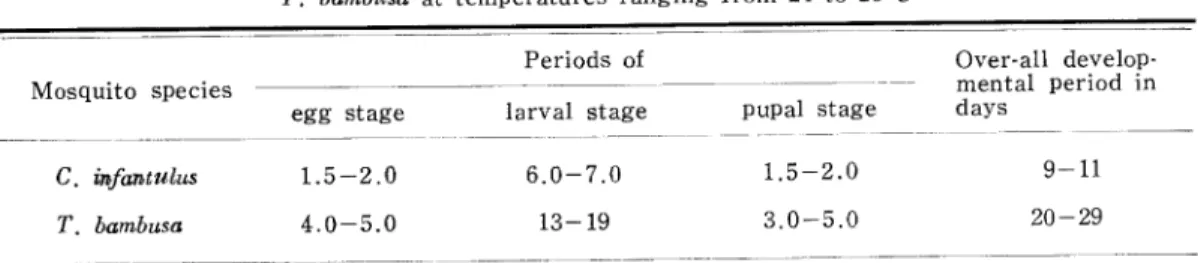
C. infantulus : Duration of the larval and pupal stages was rather short, as indicated in Table 3.
T. bambusa: Duration of the larval and pupal stages was long, as indicated in Table 3.
Table 3. Durations of egg, larval and pupal stages of C. infantulus and T. bambusa at temperatures ranging from 24 to 26 C
M osquito species
Periods of
egg stage larval stage pupal stage
C . infantulus 1.5-2.0 6.0-7.0 1.5-2.0
T. bambusa 4.0-5.0 13-19 3.0-5.0
Over-all develop- mental period in days
9-ll
20-29
Discussion So far as the literature is concerned,
no mosquito species belonging to the subgenus Lophoceraomyia of Culex and Tripteroides have been reported to colonize successfully in the laboratory.
Although Culex infantulus are commonly found in Southern Japan, the bionomics of the species in the field are poorly known. The female of C. infantulus is not known to feed on man and no obser- vations have been reported concerning a source of blood in the field. Recently Miyagi (1972) gave an account of the feeding habit of this species in the breeding cage under semi-natural condition. He observed that the adult females fed readily
on frogs, snakes, lizards and turtles as well as chicks and mice, The females in the cage were attracted to the turtle and
fed on it leisurely. The average time for each feeding period was 10 to 20 minutes. The colony of the species have been sustained for 15 generations using only turtles as the source of blood meal.
A knowledge of the mosquitoes that com- monly feed on cold-blooded animals such as reptiles and amphibia is necessary for better understanding of enzootic virus cycles in nature. The females of C.
infantulus seem to feed on both cold- and warm-blooded animals in the field. Ovi- position behavior of C. infantulus sug- gested that the egg-rafts were deposited normally above the waterline and may
sometimes be deposited on the water
surface. Although the eggs can hatch even-when they are above the waterline, it seems that in usual cases in the field the egg-rafts are washed down to the water surface prior to hatching.
The sabethine mosquitoes have been called attention as a possible vector of Sylvan yellow fever in Middle and South America (Shaman et al., 1938, Galindo, 1958, Trapido and Galindo 1957). Their biology is very peculiar and interesting.
The Japanese sabethine mosquito, T.
bambusa is prevallent throughout the wooded areas particularly in bamboo forests but the biology of this mosquito is poorly known. The oviposition behavior of T. bambusa is very different from that of other Japanese mosquitoes, being basically similar to that of Sabethes Moropterus (Humboldt) in Panama (Ga- lindo, 1958). As soon as the oviposition container is offered to the gravid females in the cage, they hover about the con- tainer. Most of the eggs are projected while hovering over the container and some eggs are also projected while rest- ing on the wall of the container. The eggs float to the water's edge and stick to the sides of the container (Fig. 2).
Observation on the ability of the egg to withstand desiccation is still in progress, but the eggs exposed to the lower temper- ature showed that they are capable of withstanding some degree of drying.
A cknowledgements On this occasion I wish to express my
sincere gratitude to Prof. Yoshito WADA
of Nagasaki University for his direction
and reading manuscript.
References
1) Aitken, T. H., Hingwan, J. O., Manuel,
R. & Hosein, H. : Laboratory colonization of
Trlchoprosopon digitatum (Rondani) (Diptera :
Culicidae). Mosq. News, 28 (3) : 445-454, 1968.
2) Barr,A.R. & Barr,S. : Theeggof
Wyeomyia smithi (Coquillett) and a review of
knowledge of the eggs of the Sabethini. Mosq.
News, 29 (2) : 193-198, 1969.
3) Chapman, H. C. &Barr, A. R. : Tech-
niques of successful colonization of many mos- quito species. Mosq. News, 29 (4) : 532-535, 1969.
4) Colless, D. H. : Anote on Culex (Lo-
phoceraomyia) infantulus Edwards and its occur- rence in Malaya (Diptera: Culicidae). J. Med.
Ent., 4 (4) : 519-520, 1967.
5) Galindo, P. : Bionomics of Sabethes
chloropterus Humboldt, a vector of Sylvan
yellow fever in Middle America. Amer. J.
Trop. Med. and Hyg. 7 (4) : 429-440, 1958.
6) Gerberg, E. J. : Manual for mosquito
rearing and experimental techniques. Amer.
Mosq. Cont. Assoc. Bull., 5 : 1-107, 1970.
7) LaCasse, W.Y. & Yamaguti, S. : Mos-
quito fauna of Japan and Korea, Office Surgeon 8th U. S. Army Kyoto, pp. 268, 1950.
8) Mattingly, P. F. : Mosquito eggs IV.
Tribe Sabethini. Mosq. Syst. Newsletter, 1(4):
74-77, 1969.
9)Miyagi, I. : Feeding habits of some
Japanese mosquitoes on cold-blooded animals
in laboratory. Trop. Med. Nagasaki, 14 (4) :
203-217, 1972 (in Japanese with English sum- mary).
10) Price, R.D. : Notes onthebiology and
laboratory colonization of Wyeomyia smithii
(Coquillett) (Diptera: Culicidae). Canad. Ent. , 110 : 473-478, 1958.
ll) Shannon, R. C., Whitman, L. & France.
M, : Yellow fever virus in jungle mosquitoes.
Science, 88 : 110-111, 1938.
12) Stone, A., Knight, K. L. &Starcke, H. :
A synoptic catalog of the mosquitoes of the
world (Diptera, Culicidae). Ent. Soc. Amer.
(The Thomas Say Foundation), 6 : 1-358,
1959.
13) Trapido, H. & Galindo, P. : Mosquitoes associated with sylvan yellow fever near Almi-
rante, Panama. Amer. Jour. Trop. med. and
Hyg., 6 : 114-144, 1957.
14) Wallis, R. C. & Frempong-Boadu, J. :
Colonization Wyeomyia smithii from Connecticut.
Mosq. New, 27 (1) : 9-ll, 1967-
15) Weathersby, A. B. : Colonization of
six species of mosquitoes in Japan. Mosq. News, 22 (1) 31-34, 1962.
16) Yamada, S. : On two new species of
Japanese Culicidae. Dobutsugaku Zasshi, Tokyo,
29 : 61-72, 1917 (in Japanese).
本邦産フトシマフサカ及びキンパラナガハシカのコロニゼーション
宮城一郎 長崎大学熱帯医学研究所衛生動物学研究室
摘 要
フトシマフサカCulex (Lophoceraomyia)infantulusとキンパラナガハシカTripteroides (Tripteroides)
bambusaの生態を明らかにするために長崎近郊で採集した多数の両種幼虫を研究室内に持帰り,累代飼育を試 みた.羽化させたフトシマフサカは60×60×30cmのナイロンケージで吸血源にカメを与え,キンパラナガハ
シカは30×30×20cmのナイロンケージで,吸血源に麻酔したマウスを与えて飼育した.飼育は24±1C,
湿度70〜80%,16時間照明に30分間の薄明薄暮を加えた恒温室でおこなわれ,フトシマフサカはすでに15世
代,キンパラナガハシカは11世代(1973年11月現在)を経過した.特記すべき習性が両種とも産卵習性に見ら
れた.即ちフトシマフサカの卵塊は水面に直接産卵されなく,常に産卵容器の中に入れた湿った苔が付着した
石又は湿ったスポンジに水面より少し上方に産卵された.その位置が湿っている限り卵塊はそのままの位置で
も孵化出来幼虫は水面まで辿り着くことが出来るが,多くの場合,水面が少し揺れると卵塊は波にさらわれ水
面に浮き孵化することが多かった.抱卵したキンパラナガハエシカはケージ内に産卵容器を置くと直ちに容器上
をヘリコプターが旋回する様に飛び交い,水面上3〜5cmの空中より卵を落した.時には容器の壁に静止し,
後肢を跳上げゆっくり動かしながら卵を水面に発射させたが,水面上に静止して産卵する雌は稀であった.
$
/
»8
ii
Jiv^N --
,*8§f"
& ,kNw, * ^
I
"**:"%,?' à"<<*',:-à"à"'* à"
.;*,-...
.y- \ >;$K:
^f
I
s