REFINING CHRONOLOGY FOR THE
BRUNHES-MATUYAMA GEOMAGNETIC BOUNDARY
Yusuke SUGANUMA*
,**
Abstract The geomagnetic polarity reversals, including the Matuyama–Brunhes boundary (MBB), provides an invariant datum plane for sediments and lavas. However, geomagnetic synchronization has complications despite its potential. Its popular age of 780 ka for the MBB is based on astrochronologically-tuned marine sedimentary records, and is supported by
40Ar/
39Ar ages of 781–784 ka from Hawaiian lavas using a recent age calibration. Challenging this age, however, younger astrochronological ages using oxygen isotope stratigraphy of high- sedimentation-rate marine records, and records of cosmogenic nuclides in marine sediments and an Antarctic ice core have been reported. Moreover, a high-precision U-Pb zircon age of 772.7 ± 7.2 ka is reported from a marine-deposited tephra near the MBB in the Chiba composite section in the Kokumoto Formation, Kazusa Group. U-Pb dating has a distinct advantage over
40Ar/
39Ar dating in that it is relatively free from assumptions regarding standardization and decay constants.
In addition, a high-resolution oxygen isotope chronology is also obtained in this section through the MBB. Therefore, the Chiba composite section will provide a basis for the first direct comparison between astrochronology, U-Pb dating, and magnetostratigraphy for the MBB, fulfilling a key requirement for calibrating the geological timescale. In this paper, I report these recent achievements according to the MBB.
Key words: Brunhes–Matuyama boundary, post-depositional remanent magnetization (PDRM),
10
Be, Chiba composite section, U-Pb zircon dating
1. Introduction
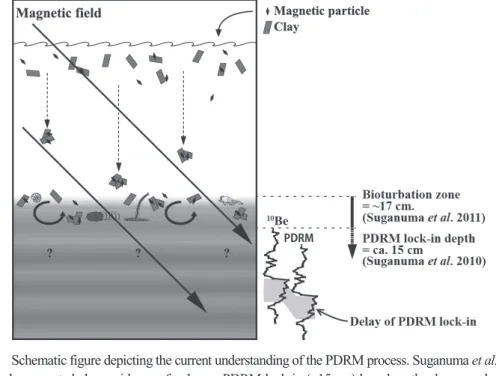
The Matuyama–Brunhes boundary (MBB), and preceding the other geomagnetic polarity reversals constitute critical markers for calibrating the age of sedimentary sequences and volcanic rocks. Therefore, knowing the age of this polaritychron (reversal) boundary is very important to a wide range of geological studies. Most age determinations for the MBB are based on marine astronomically-tuned benthic and planktonic foraminiferal oxygen isotope records to date the mid-point of the transition of virtual geomagnetic pole (VGP). However, an understanding of post-depositional remanent magnetization (PDRM) processes shows that lock-in of the geomagnetic signal occurs below the sediment–water interface in marine sediments, which adds uncertainty to geomagnetic synchronization of marine sedimentary records (Fig. 1). Because this ______________________________________________________________________________
* National Institute of Polar Research.
** Department of Polar Science, SOKENDAI (The Graduate University for Advanced Studies).
uncertainty (age offset) is thought to be a function of sedimentation rate (e.g. Suganuma et al.
2010; Suganuma 2014), those records with higher sedimentation rates should minimize the PDRM lock-in problem. On the other hand, fluxes of cosmogenic radionuclides such as
10Be provide an alternative tool to decipher the astrochronological MBB age. The Earth’s magnetic field intensity dropped significantly during the MBB and other reversals, resulting in increased production of cosmogenic radionuclides, including
10Be, in the upper atmosphere (Beer et al.
2002). Hence, the MBB has also been recognized as a positive spike in the
10Be flux recorded in an Antarctic ice core (Raisbeck et al. 2006) and in marine sediments (e.g. Suganuma et al. 2010).
The MBB has a popular age of 780 ka, which derives from astronomically-tuned benthic and planktonic oxygen isotope records from the eastern equatorial Pacific Ocean (Shackleton et al.
1990). This marine astronomically-dated MBB age is supported by
40Ar/
39Ar ages of Maui lavas at 775.6 ± 1.9 (Coe et al. 2004; Singer et al. 2005), revised to 781–783 ka by recent revisions to the reference age of Fish Canyon Tuff sanidine (FCTs) standards for
40Ar/
39Ar geochronology (Kuiper et al. 2008; Renne et al. 2010). However, younger astrochronological MBB ages of 772–773 ka are given for high sedimentation rate records (Channell et al. 2010; Valet et al. 2014). These MBB ages are consistent with records of cosmogenic nuclides in marine sediments (e.g. Suganuma et al.
2010) and an Antarctic ice core (Dreyfus et al. 2008), although they are not supported so far by radiometric timescales.
Fig. 1 Schematic figure depicting the current understanding of the PDRM process. Suganuma et al. (2010)
has reported clear evidence of a deeper PDRM lock-in (~15 cm) based on the downward offset of
the paleointensity minimum relative to the
10Be flux anomaly at the MBB. However, the lock-in
process (function) of PDRM remains unclear and topic of debate. The benthos illustrations were
made by Dr. Nomaki. This figure is modified from Suganuma (2011).
2. PDRM Lock-in Problem
It is widely considered that sediments become permanently magnetized through a PDRM mechanism (Irving and Major 1964; Kent 1973). Immobilization of magnetic particles is thought to occur during sediment dewatering and compaction, which causes vertical offsets between the sediment/water interface and the zone where the paleomagnetic record is fixed (Verosub 1977).
This offset is called the PDRM lock-in depth, and the magnitude of this depth has long been debated (e.g. deMenocal et al. 1990; Tauxe et al. 1996; Sagnotti et al. 2005; Tauxe and Yamazaki 2007; Liu et al. 2008). Suganuma et al. (2010) estimated the PDRM lock-in depth for marine sediments based on an offset between high-resolution
10Be flux and paleomagnetic records through the MBB, and then they demonstrated that acquisition of the paleomagnetic record is delayed relative to the
10Be record (Fig. 1). The delayed PDRM acquisition has been modeled by a so-called lock-in function (e.g. Suganuma et al. 2011; Egli and Zhao 2015). These studies suggest that the PDRM is not simply locked as a result of progressive consolidation and dewatering of marine sediments, and that mechanisms such as microbial activity, changes in sediment composition, and particle (flocculation) sizes, changes in chemical conditions, etc., are likely to be relevant.
3. Chiba Composite Section and Single Zircon U-Pb Dating of Byk-E Tephra
The Chiba composite section in the Kokumoto Formation, in the Kazusa Group, central Japan (Fig. 2a and 2b), is a well-exposed deep-sea sedimentary sequence across the Lower–Middle Pleistocene boundary deposited in a forearc basin open to the Pacific Ocean (e.g. Kazaoka et al.
2015). The Chiba composite section comprises the adjacent and contiguous Tabuchi (35˚17.66’N;
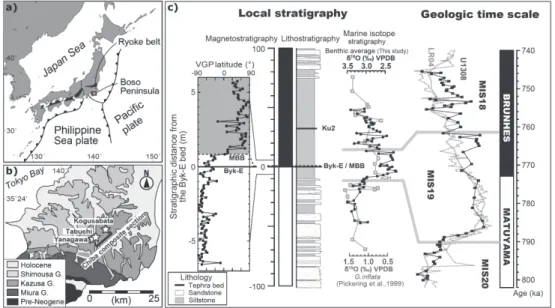
140˚08.79’E), Yanagawa (35˚17.15’N; 140˚07.88’E), and Kogusabata (35˚18.52’N; 140˚11.89’E) sections (Fig. 2b). Detailed magnetostratigraphy and oxygen isotope stratigraphy for this formation are newly established at 10 cm and 100 cm sample spacing, respectively (Suganuma et al. 2015) (Fig. 2c). A transition in the VGP records across the MBB is clearly identified in the section. The high-resolution oxygen isotope stratigraphy shows the midpoint of the VGP transition located between Marine Isotope Stage (MIS) 19 and 18, postdating the peak of MIS 19. A widespread rhyolitic tephra bed named Byk-E occurs ca. 80 cm below the midpoint of the VGP transition. This geological setting offers a unique opportunity to apply SHRIMP-II (sensitive high-resolution ion microprobe) U-Pb dating to zircon crystals from the Byk-E tephra, in order to provide the first accurate U-Pb radioisotope age constraint on the MBB in a sedimentary sequence with a high-resolution oxygen isotope record.
The U–Th–Pb analyses of separated zircons from the Byk-E tephra were made using
SHRIMP-II at the National Institute of Polar Research, Japan. Correction of
206Pb/
238U dates based
on the Th/U of zircon (Th/U [zircon]), and the magma (Th/U [magma]) from which the zircon
crystallized, are carried out by Th/U values from the volcanic glass of the tephra, determined as
5.82 ± 0.03 (1σ). From the 24 youngest zircons, we obtain a weighted mean of 772.7 ± 7.2 ka for
the eruption/deposition age of the Byk-E tephra (Suganuma et al. 2015).
4. Discussion and Conclusion
The U-Pb zircon age for the Byk-E tephra gives an age of 770.2 ± 7.3 ka for the MBB based on the depositional time from the tephra to the MBB (the uncertainity of the MBB age is estimated by integration of errors in these data). This MBB age is younger than the popular astrochronological age of 780–781 ka based on marine records with low sedimentation rate (e.g.
Shackleton et al. 1990; Lisiecki and Raymo 2005). In contrast, the U-Pb age is consistent with astrochronological ages obtained from high sedimentation rate records from the North Atlantic Ocean (773.1 ka: Channell et al. 2010), and a record from the equatorial Indian Ocean (772 ka:
Valet et al. 2014). Dating of the
10Be flux anomaly from marine sediments in the equatorial Indian (772 ka: Valet et al. 2014) and Pacific (770 ka: Suganuma et al. 2010) oceans is also consistent with our U-Pb age. VGP records from high sedimentation rate sections should be less affected by PDRM lock-in (Suganuma et al. 2010; 2011), which suggests that the younger MBB ages are the most reliable. In addition, the U-Pb age implies that the MBB corresponds to mid-MIS 19 and not its peak at 780 ka (Lisiecki and Raymo 2005).
Fig. 2 Location and stratigraphy of the Chiba composite section. (a) Tectonic setting. (b) Distribution of Kazusa Group (Kanto Basin) and position of Chiba composite section, shown by stars. (c) MBB and Byk-E tephra along with newly obtained high-resolution oxygen isotope stratigraphy in addition to that of Pickering et al. (1999) visually tuned to that of Integrated Ocean Drilling Program (IODP) Site U1308 (Channell et al. 2010) with LR04 benthic stack (Lisiecki and Raymo 2005) shown for comparison. VPDB—Vienna Peedee belemnite; G. inflata—Globorotalia inflata; MIS—Marine Isotope Stage. Assigments of MIS 20 ~ 18 are the benthic δ
18O average based on this study (local stratigraphy). This figure is modified from Suganuma et al. (2015).
The
10Be flux record in the EPICA Dome C ice core from Antarctica contains two broad peaks
at about 770 and 795 ka. The younger peak represents a weakening of the geomagnetic field
intensity associated with the MBB, and the preceding smaller peak is thought to be a “precursor”.
A recently revised ice core chronology (AICC2012: Bazin et al. 2013)places the point of highest
10
Be flux for the MBB peak at 767.7 ± 6.0 ka, and the midpoint of this peak at 771.7 ± 6.0 ka. The AICC2012 chronology for this age range is constructed with physics-based models (ice flow and accumulation models) owing to weak orbital (atmospheric δ
18O) constraints (Bazin et al. 2013).
Nonetheless, the ice core record supports a “young” MBB as inferred from the zircon U-Pb age of the Byk-E tephra (Fig. 3).
Fig. 3 U-Pb age of the MBB in comparison with
40Ar/
39Ar ages,
10Be flux, and paleoclimatic proxies.
40
Ar/
39Ar ages for Maui lavas (Coe et al. 2004) are recalculated with different FCTs ages. The oxygen isotope stratigraphy is from IODP U1308 (Channell et al. 2010) and LR04 (Lisiecki and Raymo 2005), and the temperature change is inferred from the deuterium content of the EPICA Dome C ice core (Jouzel et al. 2007).
10Be flux and paleointensity (inverted) data are from the EPICA Dome C ice core (Raisbeck et al. 2006; Dreyfus et al. 2008) and IODP U1308 (Channell et al. 2010), respectively. The EPICA Dome C data are corrected to the AICC2012 ice-core chronology (Bazin et al. 2013). Asterisk numbers:
*1Coe et al. (2004),
*2Mochizuki et al. (2011),
*3Channell et al. (2010),
*4Kuiper et al. (2008),
*5Renne et al. (2010),
*6Valet et al. (2014),
*7Channell et al. (2010),
*8Raisbeck et al. (2006),Dreyfus et al. (2008). This figure is
modified fromSuganuma et al. (2015).
VGP records from lavas have the advantage that
40Ar/
39Ar geochronology can be used to date
the MBB directly, and the thermal remanent magnetization of lavas is also free from PDRM
lock-in delays. Four lava piles that record transitional VGPs across the MBB have been dated by
40
Ar/
39Ar geochronology, with two age peaks statistically recognized (Singer et al. 2005). Only one of these piles, represented by six lavas on Maui at 775.6 ± 1.9 ka (2σ analytical), records the MBB (Coe et al. 2004) judging by consistency with the astrochronological age from sedimentary records. A peak that is 18 kyr older must then correspond to the “precursor” (Singer et al. 2005).
However, recent revisions to the reference age of the FCTs standard for
40Ar/
39Ar geochronology require a systematic shift of the
40Ar/
39Ar ages to 781–783 ka for the MBB (Kuiper et al. 2008;
Renne et al. 2010). These ages, if real, place the MBB at the peak of MIS 19, in contrast to the mid-MIS 19 position indicated by high-resolution records and
10Be peaks (Fig. 3). Uncertainty in ice volume models for the astronomical tuning of oxygen isotope records gives an error for the age of Termination IX (MIS 20/19 boundary) within 4 kyr (Channell et al. 2010). Similarly, the
10Be peak in the EPICA Dome C ice core cannot shift to the peak of MIS 19 because uncertainty for the AICC2012 age model is thought to be ± 6 kyr (Bazin et al. 2013; Fig. 3). Thus, the discrepancy between
40Ar/
39Ar geochronology and astrochronology is unlikely to stem from uncertainty in the astronomical tuning.
The standardizations of
40Ar/
39Ar geochronology with the recently proposed FCTs ages (28.201 Ma: Kuiper et al. 2008; 28.294 Ma: Renne et al. 2010) may explain the discrepancy. It has been shown that the recalibrated
40Ar/
39Ar ages relative to the new FCTs are systematically older not only for the astrochronological MBB age, but also for other astronomically-tuned reversal and excursion ages back to 1.2 Ma (Channell et al. 2010). Based on the best fits to these geomagnetic reversals and excursions during 700–1250 ka, a new FCTs standard age of 27.93 Ma has been proposed (Channell et al. 2010). If our U-Pb age of MBB of 770.2 ± 7.3 ka is reliable, this suggests recalibration of the FCTs age to 27.824 ± 0.265 Ma, based on the same reasoning made for the ages of the Maui lavas. Considering the error, this age is consistent with the suggested age of 27.93 Ma (Channell et al. 2010). Singer (2014) recently reported that the reanalysis of Maui lavas using the FCTs age of Kuiper et al. (2008) but introducing exceptionally low, stable blanks yielded an age consistent with the astrochronologic age of Channell et al. (2010), suggesting that the recent
40Ar/
39Ar geochronology is also consistent with the younger MBB age. On the other hand, Sagnotti et al. (2014) recently reported a MBB age of 786.1 ± 1.5 ka with a remarkably brief directional transition (<100 yr) based on
40Ar/
39Ar dates from tephras within a lacustrine succession in Central Italy. However, an apparently longer transition recorded from a core drilled through the same lacustrine sediments but at a higher stratigraphic position (Giaccio et al. 2013) suggests that the magnetic stability and/or sediment magnetization processes may require reexamination. Overall, further investigations of suitable stratigraphic sequences are still needed to understand the exact timing and nature of the geomagnetic field reversal.
In summary, the SHRIMP U-Pb dating of zircon grains from a marine-deposited tephra close to the MBB are provided alongside new paleomagnetic and δ
18O measurements of the host section.
Results yield the first highly-accurate radiometric age constraint for this important boundary, given that the U-series timescale is relatively free from arguments of standardization and decay constant.
Dating of the Byk-E tephra in the Chiba composite section at 772.7 ± 7.2 ka yields an age of 770.2
± 7.3 ka for the MBB which is consistent with astrochronological MBB ages from high-resolution
oxygen isotope records and
10Be spikes in marine sediments and an Antarctic ice core, affirming
correlations between astrochronology and the U-series radiometric timescale with respect to
magnetic reversal stratigraphy.
Acknowledgements
This study received funding from the National Institute of Polar Research, Japan, and JSPS Kakenhi (15K13581). I thank Makoto Okada, Osamu Kazaoka and all members of a working group of the Chiba compsite section. I am also grateful to Toshitsugu Yamazaki, Andew P. Roberts, and Martin J. Head about their productive comments on this study. I would like to dedicate this paper to Prof. Haruo Yamazaki, who inspired me to study the Geomorphology and Quaternary Geology.
References
Bazin, L., Landais, A., Lemieux-Dudon, B., Toyé Mahamadou Kele, H., Veres, D., Parrenin, F., Martinerie, P., Ritz, C., Capron, E., Lipenkov, V., Loutre, M.-F., Raynaud, D., Vinther, B., Svensson, A., Rasmussen, S.O., Severi, M., Blunier, T., Leuenberger, M., Fischer, H., Masson-Delmotte, V., Chappellaz, J. and Wolff, E. 2013. An optimized multi-proxy, multi-site Antarctic ice and gas orbital chronology (AICC2012): 120-800 ka. Climate of the Past 9:
1715–1731.
Beer, J., Muscheler, R., Wagner, G., Laj, C., Kissel, C., Kubik, P.W. and Synal, H.A. 2002.
Cosmogenic nuclides during Isotope Stages 2 and 3. Quaternary Science Reviews 21:
1129–1139.
Channell, J.E.T., Hodell, D.A., Singer, B.S. and Xuan, C. 2010. Reconciling astrochronological and
40Ar/
39Ar ages for the Matuyama–Brunhes boundary and late Matuyama Chron.
Geochemistry, Geophysics, Geosystems 11: Q0AA12.
Coe, R.S., Singer, B.S., Pringle, M.S. and Zhao, X.X. 2004. Matuyama–Brunhes reversal and Kamikatsura event on Maui: paleomagnetic directions,
40Ar/
39Ar ages and implications. Earth and Planetary Science Letters 222: 667–684.
deMenocal, P.B., Ruddiman, W.F., and Kent, D.V. 1990. Depth of post-depositional remanence acquisition in deep-sea sediments – a case-study of the Brunhes–Matuyama reversal and oxygen isotopic stage-19.1. Earth and Planetary Science Letter 99: 1–13.
Dreyfus, G.B., Raisbeck, G.M., Parrenin, F., Jouzel, J., Guyodo, Y., Nomade, S. and Mazaud, A.
2008. An ice core perspective on the age of the Matuyama–Brunhes boundary. Earth and Planetary Science Letter 274: 151–156.
Egli, R. and Zhao, X. 2015. Natural remanent magnetization acquisition in bioturbated sediment:
General theory and implications for relative paleointensity reconstructions. Geochemistry, Geophysics, Geosystems 16: 995–1016.
Giaccio, B., Castorina, F., Nomade, S., Scardia, G., Voltaggio, M. and Sagnotti, L. 2013. Revised chronology of the Sulmona lacustrine succession, central Italy. Journal of Quaternary Science 28: 545–551.
Irving, E. and Major, A. 1964. Post-depositional detrital remanent magnetization in a synthetic sediment. Sedimentology 3:135–143.
Jouzel, J., Masson-Delmotte, V., Cattani, O., Dreyfus, G., Falourd, S., Hoffmann, G., Minster, B.,
Nou, J., Barnola, J.M., Chappellaz, J., Fischer, H., Gallet, J.C., Johnsen, S., Leuenberger, M.,
Loulergue, L., Luethi, D., Oerter, H., Parrenin, F., Raisbeck, G., Raynaud, D., Schilt, A.,
Schwander, J., Selmo, E., Souchez, R., Spahni, R., Stauffer, B., Steffensen, J.P., Stenni, B.,
Stocker, T.F., Tison, J.L., Werner, M. and Wolff, E.W. 2007. Orbital and millennial antarctic climate variability over the past 800,000 years. Science 317: 793–796.
Kazaoka, O., Suganuma, Y., Okada, M., Kameo, K., Head, M.J., Yoshida, T., Kameyama, S., Nirei, H., Aida, N. and Kumai, H. 2015. Stratigraphy of the Kazusa Group, Chiba Peninsula, Central Japan: an expanded and highly-resolved marine sedimentary record from the Lower and Middle Pleistocene. Quaternary International 383: 116–135.
Kent, D.V. 1973. Post-depositional remanent magnetisation in deep sea sediment. Nature 246:
32–34.
Kuiper, K.F., Deino, A., Hilgen, F.J., Krijgsman, W., Renne, P.R. and Wijbrans, J.R. 2008.
Synchronizing rock clocks of earth history. Science 320: 500–504.
Lisiecki, L.E., and Raymo, M.E. 2005. A Pliocene-Pleistocene stack of 57 globally distributed benthic δ
18O records. Paleoceanography 20: PA1003
. doi:10.1029/2004PA001071.Liu, Q.S., Roberts, A.P., Rohling, E.J., Zhu, R.X. and Sun, Y.B. 2008. Post-depositional remanent magnetization lock-in and the location of the Matuyama–Brunhes geomagnetic reversal boundary in marine and Chinese loess sequences. Earth and Planetary Science Letters 275:
102–110.
Mochizuki, N., Oda, H., Ishizuka, O., Yamazaki, T. and Tsunakawa, H. 2011. Paleointensity variation across the Matuyama–Brunhes polarity transition: observations from lavas at Punaruu Valley, Tahiti. Journal of Geophysical Research 116: B06103.
Pickering, K.T., Souter, C., Oba, T., Taira, A., Schaaf, M. and Platzman, E. 1999. Glacio-eustatic control on deep-marine clastic forearc sedimentation, Pliocene-mid-Pleistocene (c. 1180-600 ka) Kazusa Group, SE Japan. Journal of the Geological Society 156: 125–136.
Raisbeck, G.M., Yiou, F., Cattani, O., and Jouzel, J. 2006. Be-10 evidence for the Matuyama–Brunhes geomagnetic reversal in the EPICA Dome C ice core. Nature 444: 82–84.
Renne, P.R., Mundil, R., Balco, G., Min, K. and Ludwig, K.R. 2010. Joint determination of
40K decay constants and
40Ar*/
40K for the Fish Canyon sanidine standard, and improved accuracy for
40Ar/
39Ar geochronology. Geochimica et Cosmochimica Acta 74: 5349–5367.
Sagnotti, L., Budillon, F., Dinarès-Turell, J., Iorio, M. and Macri, P. 2005. Evidence for a variable paleomagnetic lock-in depth in the Holocene sequence from the Salerno Gulf (Italy):
implications for “high-resolution” paleomagnetic dating. Geochemistry, Geophysics, Geosystems 6: Q11013.
Sagnotti, L., Scardia, G., Giaccio, B., Liddicoat, J.C., Nomade, S., Renne, P.R. and Sprain, C.J.
2014. Extremely rapid directional change during Matuyama-Brunhes geomagnetic polarity reversal. Geophysical Journal International 199: 1110–1124. doi:10.1093/gji/ggu287.
Shackleton, N.J., Berger, A. and Peltier, W.R. 1990. An alternative astronomical calibration of the Lower Pleistocene timescale based on ODP Site 677. Transactions - Royal Society of Edinburgh: Earth Sciences 81: 251–261.
Singer, B.S., Hoffman, K.A., Coe, R.S., Brown, L.L., Jicha, B.R., Pringle, M.S. and Chauvin, A.
2005. Structural and temporal requirements for geomagnetic field reversal deduced from lava flows. Nature 434: 633–636.
Singer, B.S. 2014. A Quaternary geomagnetic instability time scale. Quaternary Geochronology 21: 29–52.
Suganuma, Y., Yokoyama, Y., Yamazaki, T., Kawamura, K., Horng, C.S. and Matsuzaki, H. 2010.
10